The snow fell in thick, wet flakes that December evening, the kind that clung to coats, eyelashes, bus windows, and the tired shoulders of people who had already worked too long. Thomas Bennett pulled his black coat tighter as he walked through the downtown bus station with his nine-year-old daughter Maya holding his left hand. At forty-two, Thomas had learned that life rarely followed the plan you made for it, especially after his wife left three years earlier and the word “temporary” became the shape of everything. Temporary apartment, temporary overtime, temporary meals made from whatever was still in the fridge, temporary hope that somehow kept lasting.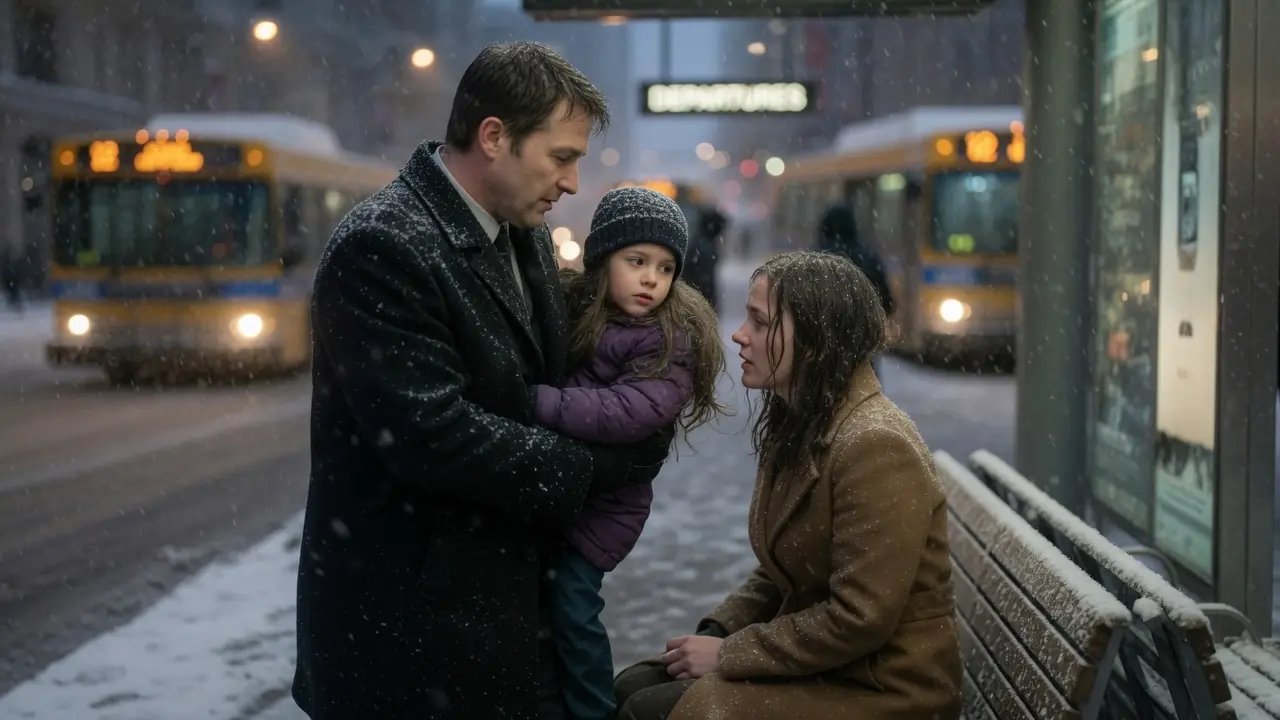
Maya walked beside him with her purple backpack bouncing against her coat and her knit hat slipping over one eyebrow. She had spent the afternoon at his sister’s apartment while Thomas finished a late shift repairing heating systems in an office tower across town. They were supposed to catch Route 22 home at 6:28, eat leftover soup, finish spelling homework, and get to bed before the snow turned the sidewalks into ice. Thomas wanted nothing more than a quiet ride home and one hour where nobody needed him to fix anything.
The downtown bus station was crowded, loud, and miserable. Buses hissed at the curb, brakes squealing as drivers opened doors into gusts of cold air. People stood beneath flickering route signs, hunched into scarves, checking phones, complaining about delays, and pretending not to notice anyone worse off than themselves. Thomas was good at noticing because life had taught him that the people in trouble rarely shouted first.
That was why he saw her.
She sat at the far end of a metal bench beneath the sign for Route 12, her arms wrapped tightly around herself, her hair wet from melted snow, her coat soaked at the shoulders. She looked to be in her mid-thirties, maybe younger if fear had aged her for the evening. Her gray wool coat was expensive, but one sleeve was torn near the cuff, and one shoe was missing its heel. She stared at the route board as if the words had stopped making sense.
Maya tugged his hand. “Dad, our bus is that way.”
“I know,” Thomas said, but he did not move.
The woman lifted her face when a bus pulled in, then lowered it again when the number was wrong. Her lips trembled, not from crying exactly, but from trying very hard not to. Several people walked past her without slowing. One man glanced at her, decided she was someone else’s problem, and disappeared into the crowd.
Thomas knew that look too.
“Stay close,” he told Maya.
They crossed the platform together. Thomas stopped a few feet from the bench, not wanting to scare the woman by standing over her too suddenly. Maya stayed behind his arm, peeking around him with wide worried eyes. The woman looked up, and Thomas saw panic flash across her face before she controlled it.
“Ma’am,” he said gently, “why are you sitting out here alone?”
The woman blinked as if the question itself surprised her. “I don’t know where I am,” she whispered. “And someone took my phone.”
Thomas glanced around the station. “Do you have a purse? Wallet? Anything with an address?”
She shook her head. “Gone.”
“Do you know your name?”
Her expression tightened, offended and frightened at once. “Of course I know my name.”
“I’m sorry,” Thomas said quickly. “I had to ask.”
She looked down at her hands. They were shaking badly. “Claire,” she said. “Claire Donovan.”
Thomas did not react because the name meant nothing to him yet. He spent more time fixing furnaces than reading business headlines. He knew the names of Maya’s teachers, his landlord, the bus drivers on their route, and the clerk at the discount grocery who sometimes saved dented cans for him. CEOs, investors, and downtown power players lived in a different weather system.
“All right, Claire,” he said. “Where are you trying to go?”
She looked toward the street. “Home. I think. No, not home.” Her breathing grew shallow. “They may be waiting there.”
Maya stepped closer to Thomas. He felt her hand tighten around his.
“Who may be waiting?” Thomas asked.
Claire swallowed hard. “I don’t know who I can trust.”
That sentence changed everything. Thomas looked more carefully at her coat, her torn sleeve, the raw red marks around one wrist, the way she kept scanning the crowd whenever someone in a dark coat passed near them. This was not a woman who missed a bus or lost her phone after a bad day. This was someone who had been placed here, abandoned in the cold by people who wanted her confused.
Thomas removed his coat and held it out. “Put this on.”
Claire shook her head. “No, you’ll be cold.”
“I work outside half the winter. You’re soaked.”
Maya immediately unzipped her backpack and pulled out a small fleece blanket with stars on it. “You can use this too,” she said.
Claire looked at the child, and something broke softly in her face. “You carry a blanket?”
Maya nodded. “Dad says buses get cold when they take forever.”
Thomas wrapped his coat over Claire’s shoulders while Maya handed her the blanket. Claire clutched it like a person who had forgotten warmth could be given freely. Around them, the station continued moving, people rushing for buses, the loudspeaker announcing delays, tires splashing through slush at the curb. But for one moment, the three of them stood inside a small circle of human attention.
“Do you have anyone I can call?” Thomas asked.
Claire opened her mouth, then stopped. “My assistant. Rachel Kim. But I don’t know her number without my phone.”
“Company name?”
She hesitated.
Thomas saw the hesitation and softened his voice. “I’m not asking because I want anything. I’m asking because you’re freezing, and somebody took your phone.”
Claire looked at him carefully. “Donovan Enterprises.”
The name hit a man standing nearby before it hit Thomas. The man turned sharply from the vending machine, stared at Claire, then looked down at his phone. Thomas noticed the recognition and did not like it.
“Donovan Enterprises?” Thomas repeated.
Claire nodded.
The man near the vending machine whispered to his companion, “Isn’t that the missing CEO?”
Thomas felt the words pass through the air like a cold wire.
Maya looked up. “Dad?”
Thomas held up one hand for quiet. “Claire, are people looking for you?”
Her eyes filled. “They should be.”
“What happened?”
She pressed Maya’s blanket against her chest. “I was at the investor dinner at the Whitmore Hotel. My board chair said I needed air before the vote. He said there was too much pressure, that I looked tired. I remember stepping into a side hallway. Then someone put a coat around my shoulders and told me the car was ready.”
Thomas went still. “Whose car?”
“I thought it was mine.”
“But it wasn’t?”
Claire shook her head. “The driver took my phone, said it was for security, then everything got blurry. I don’t think they hurt me, but I remember waking up near the station with no purse, no phone, no ID.” Her voice dropped. “They wanted me gone before the vote.”
Thomas did not understand corporate votes, but he understood when someone was being erased.
A bus pulled up behind them, spraying slush along the curb. Route 22. Their bus. Maya looked at it, then at Claire, then at her father. Thomas checked the time and felt the painful tug of ordinary responsibility. Lily, spelling homework, leftover soup, bedtime, rent, tomorrow’s shift. But there was a woman in front of him who had been left in the snow on purpose.
Maya answered the question before he asked it. “We can miss this one.”
Thomas looked down at her. “You sure?”
She nodded. “She’s lost.”
The bus doors closed and Route 22 pulled away without them.
Thomas took out his old phone and searched Donovan Enterprises. The first result showed Claire’s face, polished, confident, standing at a podium in a navy suit. The headline underneath made his stomach tighten. “CEO Claire Donovan Missing Before Emergency Board Vote.” He looked from the photo to the soaked woman on the bench, and the difference between those two versions of her was painful.
“You’re famous,” Maya whispered.
Claire gave a small broken laugh. “Not in any way that helps tonight.”
Thomas dialed the company’s main number, but an automated system answered. He tried the emergency press contact listed online, then the security desk, then the hotel. Each call led to transfers, holds, and voices trained to avoid responsibility. Meanwhile, the man near the vending machine had lifted his phone and was pretending not to record.
Thomas turned toward him. “Put it away.”
The man blinked. “What?”
“She’s not entertainment.”
The man lowered the phone slowly.
Claire looked at Thomas with startled gratitude. “You don’t know what you’re stepping into.”
“No,” Thomas said. “But I know what I’m standing in front of.”
A uniformed station officer walked by, and Thomas waved him over. The officer approached with the bored caution of someone used to arguments over schedules and lost bags. Thomas quickly explained that Claire was a missing person, possibly abandoned there after a corporate event, with no phone or ID. The officer looked skeptical until Thomas showed him the news article.
The officer’s posture changed. “Ma’am, can you come with me to the station office?”
Claire stiffened. “Who will be there?”
“Transit supervisor. Security cameras. A phone.”
Thomas saw her fear. “I’ll walk with you,” he said.
The officer looked at him. “Are you family?”
“No.”
“Then you may not be able to stay.”
Claire spoke before Thomas could. “He stays.”
There was no CEO power in her voice, not the polished kind from business interviews. There was only the sharp certainty of a person clinging to the first safe thing she had found. The officer nodded.
In the station office, fluorescent lights hummed overhead while a dispatcher called city police and attempted to reach Donovan Enterprises directly. Maya sat in a plastic chair eating crackers from her backpack. Thomas stood near the door, still without his coat, rubbing his hands together against the cold.
Claire sat at a small desk wrapped in his coat and Maya’s star blanket, answering questions slowly. Yes, she knew her name. Yes, she remembered the hotel. No, she had not left voluntarily. Yes, the board vote was scheduled for 8:00 p.m. No, she did not know if Rachel Kim had been warned. Every answer seemed to pull her closer to herself.
At 7:31, the dispatcher reached someone named Rachel.
The voice on the speaker nearly broke. “Claire? Claire, is that you?”
Claire leaned toward the phone. “Rachel.”
“Oh my God. Where are you?”
“Downtown bus station. Someone left me here.”
Rachel swore softly, then caught herself. “The board is claiming you had a breakdown and disappeared before the vote. Martin Vale is pushing an emergency leadership transfer.”
Claire closed her eyes. “Of course he is.”
“We have thirty minutes before they formalize it.”
Thomas looked at Maya, then at the phone. He still did not understand all of it, but he understood thirty minutes.
Claire sat straighter. The broken woman from the bench was still there, but something else began returning beneath the fear. Authority. Focus. The woman from the news photo was not gone. She had just been buried under snow, shock, and betrayal.
“Rachel,” Claire said, “can you get me on a secure video call?”
“I can, but Claire, you have no ID, no device, no safe transport.”
Thomas looked at the station officer. “How far is the Whitmore Hotel?”
“Eight blocks.”
“In this snow?”
“Ten minutes by car. Thirty walking.”
Thomas turned to Claire. “Your meeting is there?”
She nodded.
The officer said, “Police can transport once they arrive.”
“When?” Thomas asked.
The officer hesitated. “Could be fifteen, maybe twenty. Roads are bad.”
Claire looked at the clock. 7:36.
Thomas picked up his phone. “My sister has a car two blocks from here. She watches Maya after school. If she can get us, we can make it.”
Claire stared at him. “Thomas, you do not have to do this.”
He looked at Maya.
Maya zipped her backpack. “We already missed the bus.”
Thomas called his sister, Angela, who answered with the weary suspicion of someone used to his emergencies. He explained quickly. There was a pause, then Angela said, “You picked up a missing CEO at a bus station?”
“I didn’t pick her up. I helped her.”
“That sounds like you picked her up.”
“Angela.”
“I’m coming.”
Twelve minutes later, Angela Bennett’s old gray minivan skidded to the curb outside the station. She was forty-five, sharp-eyed, and not impressed by wealth, panic, or snow. She took one look at Claire wrapped in Thomas’s coat and Maya’s blanket and opened the side door.
“Get in before the whole city figures out where you are,” Angela said.
Claire climbed in with Thomas’s help. Maya buckled beside her. Thomas sat in front, and Angela drove like a woman who had raised three sons and feared neither weather nor men in expensive cars. The van rattled through downtown streets while Rachel stayed on speaker, feeding updates from the investor dinner.
“They’re saying you voluntarily left after admitting exhaustion,” Rachel said.
Claire’s jaw tightened. “Who is saying it?”
“Martin. Eleanor. Two board members are backing him.”
“And security footage?”
“Hotel claims the hallway cameras were down for maintenance.”
Angela snorted. “That’s convenient.”
Claire looked at her. “Very.”
Thomas glanced back. “Can you stop the vote?”
Claire’s eyes met his in the rearview mirror. “If I walk in before they finish lying about me.”
The Whitmore Hotel rose ahead, bright and elegant against the storm. Black cars lined the entrance. Men in suits and women in evening coats hurried beneath umbrellas while valets jogged through slush. Angela pulled to the curb behind a delivery truck.
Before Claire got out, she turned to Maya and carefully removed the star blanket from her shoulders. “Thank you.”
Maya took it back. “Are you still lost?”
Claire’s eyes softened. “Less than I was.”
Thomas handed her his coat, but she pushed it back. “You need it.”
“You’re walking into a room full of people who left you in the cold,” he said. “Take the coat.”
She held his gaze, then nodded and put it on.
Inside the hotel, everything was gold light, polished floors, and controlled panic. Rachel Kim met them near the side entrance, small, fast, and furious. She hugged Claire hard, then pulled back with tears in her eyes. “I thought they had you.”
“They almost did,” Claire said.
Rachel looked at Thomas and Angela. “Who are they?”
Claire turned. “The reason they didn’t.”
Security tried to stop Thomas and Maya at the ballroom doors, but Claire did not slow down. “They’re with me,” she said, and something in her tone made the guards step aside.
The ballroom was full of investors, board members, senior executives, and reporters who had clearly been told to expect a controlled statement. Martin Vale stood near the stage, one hand on the podium, speaking in a solemn voice about leadership continuity and concern for Claire’s well-being. He was handsome, silver-haired, and calm in the way dishonest men become when they believe the room is already theirs.
Then Claire walked in wearing Thomas’s black coat over her soaked clothes.
The room froze.
Martin’s voice died mid-sentence.
Claire walked down the center aisle with Rachel on one side and Thomas, Maya, and Angela several steps behind. People turned, whispered, raised phones, lowered them, then raised them again. Claire’s hair was still damp, her face pale, her shoes ruined by slush, but she walked like every step was returning ownership to her body.
Martin recovered first. “Claire, thank God. We were so worried.”
She stopped ten feet from him. “Were you?”
His smile flickered. “Of course.”
“Then you must be relieved I made it before you stole my company.”
A gasp moved through the room.
Martin’s expression hardened beneath the smile. “You’re upset. Understandably. This is not the time for accusations.”
Claire reached the stage and took the microphone from his hand. He resisted for half a second, then let go because cameras were watching. Claire faced the room.
“I was taken from this hotel under false pretenses,” she said. “My phone, purse, and identification were removed. I was left at the downtown bus station in the snow while members of this board attempted to declare me unstable and transfer emergency control.”
The room erupted.
Martin stepped forward. “That is outrageous.”
Claire turned to him. “Yes. It was.”
Rachel lifted a tablet. “We have a live call with transit security, police, and counsel. Station footage confirms Ms. Donovan was found disoriented without her belongings. The driver who dropped her off has already been identified from traffic cameras.”
Martin’s face lost color.
Claire looked out over the room. “The only reason I am standing here is because a single father and his daughter noticed what everyone else was willing to ignore.”
Every head turned toward Thomas and Maya. Thomas shifted uncomfortably, wishing he could disappear into the wall. Maya stood straighter, still holding her star blanket.
Claire continued, “Martin Vale told you I walked away from leadership. The truth is, he needed me gone long enough to make a lie look official.”
Martin tried again. “Claire, listen to yourself.”
“No,” she said. “Tonight, you listen.”
The old power in her voice returned fully then, and the room obeyed.
She laid out the facts quickly. Martin had pushed for an emergency vote after months of disagreement over a merger that would enrich a small group of investors while stripping Donovan Enterprises of its founding protections. Claire had refused. That evening, she had been guided away from the investor dinner by people she trusted. Within an hour, Martin had begun telling the board she was emotionally unfit to continue.
One board member stood. “I was told she left voluntarily.”
Claire looked at him. “And you believed it because it made your vote easier.”
He sat down.
Police arrived before the speech ended. Martin tried to leave through a side door, but hotel security blocked him after Rachel showed them the transit call record. The driver who had abandoned Claire at the station was detained later that night. The story would take days to fully unwind, but the room already understood enough.
The vote was canceled.
Martin was suspended pending investigation.
The investors withdrew their merger pressure before midnight.
When it was over, Claire stepped down from the stage and walked straight to Thomas. The crowd parted for her now. That bothered him more than the earlier confusion. People always seemed to make space once they knew someone mattered.
Claire stopped in front of him. “I don’t know how to thank you.”
Thomas glanced at Maya. “You already thanked her blanket.”
Maya smiled shyly.
Claire laughed, and it was the first sound she had made all night that did not carry fear beneath it. Then her face grew serious. “You could have kept walking.”
“So could everyone else,” Thomas said.
“I know.”
“That’s why we didn’t.”
Angela cleared her throat. “Not to ruin this touching moment, but my van is in a loading zone, and I am not paying a hotel ticket because billionaires can’t behave.”
Claire looked at Rachel. “Take care of it.”
Angela blinked. “I was joking.”
Rachel was already on the phone. “Too late.”
Thomas tried to return Claire’s coat, then remembered it was his coat she was wearing. She slipped it off and handed it back carefully. “I owe you more than this.”
“No,” Thomas said. “You owe the city a better board.”
She smiled faintly. “I can work on that.”
Two weeks later, Thomas received a letter at his apartment. Inside was a handwritten note from Claire and a check large enough to make him sit down at the kitchen table without speaking. Maya leaned over his shoulder, eyes wide.
“Dad?”
Thomas read the note first.
Thomas and Maya, you gave me warmth, time, and courage when I had none left. This is not payment for kindness, because kindness like yours cannot be bought. This is an investment in the life of a father who stopped when everyone else walked past.
Thomas stared at the check.
Maya whispered, “Are we rich?”
“No,” Thomas said softly. “But we might be okay for a while.”
He did not cash it immediately. Pride argued with need for three days. Then his sister Angela came over, read the note, looked him in the eye, and said, “If you refuse help from a woman you helped, you are not being noble. You are being annoying.”
So Thomas cashed it.
He paid overdue bills, fixed the heater in their apartment, bought Maya a proper winter coat, and put the rest into a college fund with Claire’s financial advisor explaining every step patiently. He did not quit work. He did not buy a fancy car. He simply stopped waking up every morning with fear already sitting on his chest.
Claire kept in touch, first through letters, then through occasional coffee with Thomas and Maya at a small cafe near the bus station. She never arrived with cameras. She never turned them into a charity story. She asked Maya about school, asked Thomas about work, and listened like someone practicing the art of being human again.
Months later, Donovan Enterprises announced a new foundation supporting transit safety, emergency assistance for stranded passengers, and training programs for station staff to identify people in distress. At the launch, Claire stood at a podium and told the story carefully, without using Thomas or Maya as props. She said a city reveals its character not by how it treats the powerful when they are recognized, but by how it treats the vulnerable before anyone knows their name.
Thomas watched from the back of the room with Maya on his shoulders.
“Dad,” she whispered, “is this because of the blanket?”
He smiled. “A little.”
She leaned down. “We should carry two next winter.”
Thomas looked toward Claire, who caught his eye from the stage and smiled.
“Yeah,” he said. “We probably should.”
Years later, Thomas would still remember that night whenever snow began falling thick over the city. He remembered the route board flickering, the missed bus, Claire’s shaking hands, and Maya deciding without hesitation that they could wait. He remembered how close a person could come to being erased in a crowd. He remembered learning that someone could be famous, powerful, and still need a stranger to ask if they were all right.
Claire remembered it too.
Not as the night she nearly lost her company, though that was true. Not as the night she exposed Martin Vale, though that was true too. She remembered it as the night a single father with tired eyes and an empty wallet gave her his coat without asking what she was worth.
That was the part that saved her first.
The rest came after.