The morning always came too early for Marcus Hale.
4:38 a.m.
The alarm on his cracked phone vibrated against a nightstand made from stacked wooden crates.
He didn’t need it anymore—his body had already learned the rhythm of survival—but he kept it anyway because routine was the only thing keeping his life from falling apart completely.
He sat up slowly.
The apartment was cold.
Not the “winter cold.”
The kind of cold that meant the heater had given up trying.
Marcus exhaled, watching his breath linger in the air for a moment before disappearing.
From the small bedroom down the hall, he could hear soft movement.
Two girls.
His daughters.
Lily, ten years old. Quiet. Observant. Too grown in the eyes already.
Maya, six. Still hopeful in a way the world hadn’t broken yet.
Marcus rubbed his face with both hands.
“Another day,” he whispered to himself.
Not encouragement.
Just fact.
In the kitchen, there was almost nothing.
A nearly empty carton of milk. Half a loaf of bread. One apple that had started to wrinkle at the edges.
He split everything carefully.
Half milk for each child.
Two thin slices of bread each.
The apple he cut into uneven pieces so no one would feel like they got less.
For himself, he poured black coffee so weak it barely deserved the name.
He didn’t eat.
He rarely did in the mornings.
Food was a math problem now.
And Marcus had become very good at math.
From the doorway, Lily watched him quietly.
“You didn’t eat again,” she said.
Marcus didn’t look up.
“I ate already,” he lied easily.
Lily frowned. She didn’t believe him. She never did.
But she also didn’t argue.
Kids learn early when arguments don’t change outcomes.
Maya ran into the kitchen in mismatched socks, holding a broken plastic hairbrush like it was something important.
“Daddy, it’s snowing outside!”
Marcus glanced toward the small window.
She was right.
Soft flakes drifted down over the city like ash from a slow-burning fire.
Snow meant trouble.
Snow meant delays.
Snow meant the janitorial building might shut early.
No hours. No overtime. No extra pay.
He exhaled slowly.
“Girls,” he said gently, “today you stay with Mrs. Carter after school. I might be late.”
Lily nodded.
Maya asked, “Is late like yesterday late?”
Marcus hesitated.
“Yes,” he said softly.
That wasn’t entirely true.
Yesterday he had come home at midnight.
But “yes” was easier than explaining why.
At 5:20 a.m., Marcus left the apartment.
The hallway light flickered as he locked the door behind him.
The building was old. The kind of old that didn’t get renovated—it just got tolerated.
Downstairs, Mrs. Carter from apartment 1B peeked out.
“You working double shifts again?” she asked.
Marcus forced a small smile.
“Just one job today.”
She gave him a look that said she knew better but didn’t have the energy to argue with another tired man.
“Bring the girls over if school closes early,” she said.
“I will,” Marcus replied.
He appreciated her.
More than he ever said.
Outside, the city was gray.
Snow was already sticking to the sidewalks.
Marcus pulled his jacket tighter and walked toward the bus stop.
His workday started at the Meridian Tower—forty-two floors of glass and steel where people wore clothes that cost more than his monthly rent.
He cleaned their floors.
Their bathrooms.
Their forgotten corners.
He was invisible there.
Which suited him fine.
Invisible men didn’t get fired for mistakes.
They just got forgotten.
By 9:00 a.m., he was on the 31st floor, mopping near a row of executive offices.
Music leaked faintly from someone’s phone.
Coffee machines hummed.
Life above his pay grade continued as if the world outside didn’t exist.
Then the announcement came over the radio.
“Non-essential staff prepare for early dismissal. Severe winter storm approaching.”
Marcus paused.
Early dismissal meant fewer hours.
Fewer hours meant choosing between electricity and groceries next week.
He tightened his grip on the mop handle.
“Of course,” he muttered under his breath.
By noon, snow had become a wall.
The supervisor started clearing floors early.
“Wrap it up,” the man said. “We’re shutting down in an hour.”
Marcus nodded.
He didn’t argue.
He never did.
Arguing didn’t change weather.
At 12:47 p.m., he headed toward the parking garage.
That’s when he heard it.
“Please—someone help us!”
A woman’s voice.
Sharp. Panicked.
Not the kind of sound people made lightly.
Marcus stopped.
Another voice followed.
A child.
Coughing.
Struggling.
He turned the corner.
And saw them.
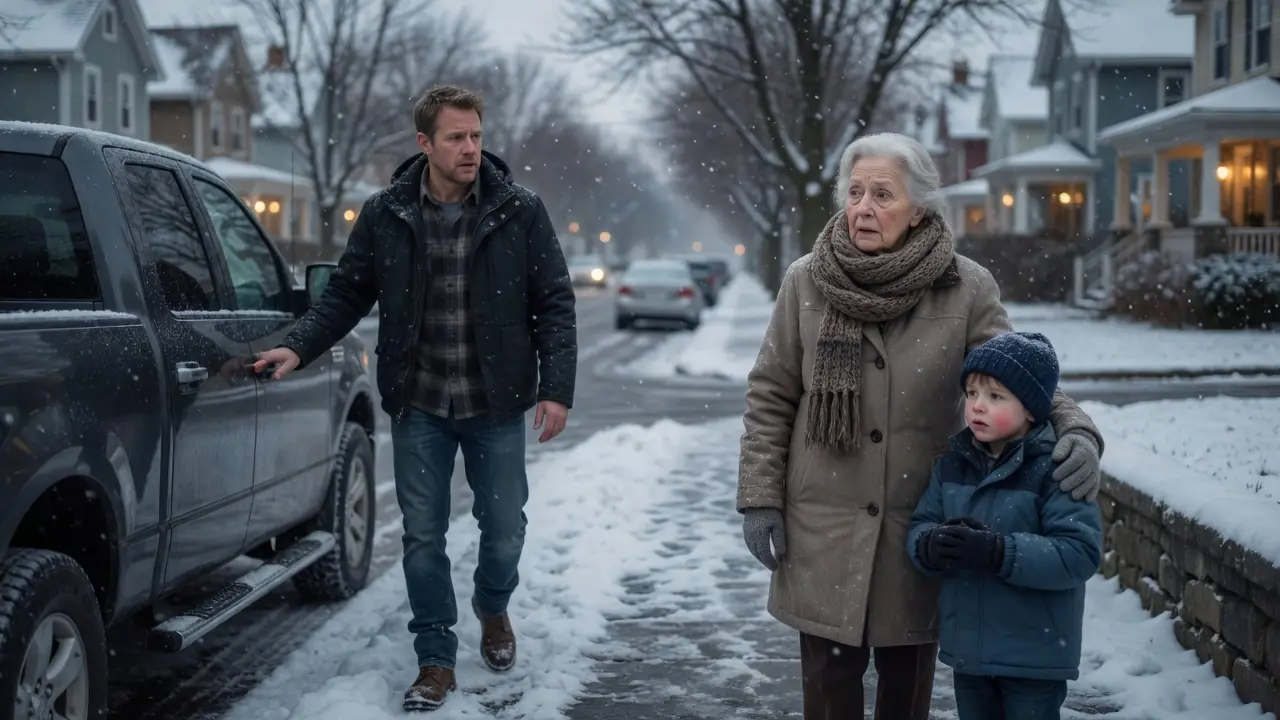
An elderly woman in an elegant coat, soaked at the hem, standing beside a black luxury car that looked too expensive to belong in a place like this.
And a small boy.
Maybe seven.
Curled into himself, shaking violently.
His breath came in short, broken gasps.
Asthma.
Triggered by cold.
Marcus knew that sound.
Too well.
Because Maya had it too.
“Help him,” the woman said immediately when she saw Marcus. “Please—he can’t breathe properly.”
Marcus didn’t ask questions.
He stepped forward.
“Do you have his inhaler?”
She shook her head quickly.
“It’s in the car—it’s not working—battery is dead, I don’t—”
“Okay,” Marcus cut in.
Calm.
Controlled.
“What’s his name?”
“Ethan,” she said.
Marcus crouched.
“Ethan, look at me.”
The boy tried.
Failed.
Marcus took off his own scarf.
Wrapped it gently around the boy’s face to block wind.
Then he looked at the woman.
“We need to get inside. Now.”
“The car—”
“Car won’t matter in ten minutes,” Marcus said.
Something in his voice made her stop arguing.
He turned slightly, scanning the distance.
The nearest shelter.
A community center.
Six blocks away.
Through snow that was getting worse by the minute.
He made a decision.
“Can you walk?”
“I… I think so,” the woman said.
Marcus nodded once.
“Then we move.”
He bent down.
Without hesitation, he lifted Ethan into his arms.
The boy was light.
Too light.
Then Marcus looked at the woman.
She looked shocked for half a second.
Then he said, “Stay close.”
And they stepped into the storm.
Snow hit like punishment.
The world disappeared within minutes.
Buildings became shadows.
Roads became guesses.
Sound became muffled chaos.
Marcus kept moving.
One step.
Then another.
Ethan clung weakly to his jacket.
The woman struggled behind him.
By the second block, she was slowing down.
“I can’t—” she gasped.
Marcus stopped.
Looked back once.
Then, without a word, shifted Ethan carefully and bent slightly.
“Hold onto my shoulder,” he told her.
“I can carry him,” she said weakly.
“No,” Marcus said. “You conserve strength. I’ll handle weight.”
And then he adjusted.
Now he was carrying both.
A child in his arms.
A woman leaning on his back.
Each step heavier than the last.
Wind screamed around them.
Snow burned his face like needles.
But Marcus didn’t stop.
Because stopping meant deciding who gets cold first.
And he never allowed himself that kind of decision.
At the fourth block, Ethan’s breathing worsened.
Marcus stopped immediately.
Checked him.
“Stay with me,” he said firmly.
He pressed the boy closer to his chest to share warmth.
Then he looked at the woman.
“Almost there,” he lied.
It was still at least two blocks.
But “almost there” was sometimes all people had left.
The woman was crying now.
Not loudly.
Just silently.
Marcus didn’t acknowledge it.
There was no time for emotional processing.
Only survival.
They reached the community center at 1:31 p.m.
Marcus kicked the door open.
A volunteer rushed forward.
“Oh my God—bring him here!”
Marcus didn’t hand Ethan over immediately.
He checked the boy’s breathing first.
Steady now.
Better.
Only then did he release him.
His arms were shaking.
He didn’t notice at first.
Only when he tried to straighten his back.
The woman collapsed onto a bench.
Marcus stepped back slowly.
Only then did exhaustion hit him.
Like a delayed wave.
But he didn’t sit.
Not yet.
He waited.
Because that’s what fathers do when they don’t trust the world to finish the job.
Later that afternoon, after Ethan was stabilized, the woman approached him.
She looked different now.
Less fragile.
More composed.
“You saved my grandson’s life,” she said.
Marcus shook his head.
“I just walked.”
“That’s not what happened,” she said.
He didn’t respond.
She studied him for a moment.
Then asked, “What’s your name?”
“Marcus.”
She nodded slowly.
“You work nearby?”
“Yes.”
“What do you do?”
“Janitor,” he said simply.
She didn’t react.
Not negatively.
Not positively.
Just observed.
Then she said, “You carried us through a storm most people wouldn’t survive alone.”
Marcus shrugged slightly.
“I had a coat.”
That made her pause.
Because it wasn’t modesty.
It was truth.
And that difference mattered.
She left that evening without saying much more.
Marcus assumed that was the end of it.
He was wrong.
Three days later, the snow was gone.
The city felt like it had survived something it didn’t fully understand.
Marcus came home late.
The girls were asleep.
There was a paper on the table.
Eviction notice.
Two weeks overdue.
He sat down slowly.
Didn’t speak.
Just stared at it.
Then a knock came at the door.
Three sharp knocks.
He opened it.
A black town car outside.
And the same woman.
But now dressed differently.
Cleaner.
Stronger.
Accompanied by a man in a suit holding documents.
“Mr. Marcus Hale,” she said.
“Yes.”
“I owe you the truth.”
Marcus said nothing.
And that was when she told him.
Who she really was.
And what his act of carrying them through a storm had just triggered in motion.
Marcus listened quietly.
Not because he wasn’t shocked.
But because his daughters were sleeping inside.
And fathers learn how to absorb entire worlds without letting them shake the house.
When she finished, there was silence.
Then she said something that changed everything.
“I’d like to offer you a position.”
Marcus blinked once.
“I don’t have qualifications.”
“You have judgment,” she said.
A pause.
“In my world, that’s rarer.”
And this was only the beginning.
Because what Marcus didn’t know yet was that the storm he walked through wasn’t the biggest one coming.
It was just the one that started everything else.
And somewhere in a city that didn’t yet know his name, his quiet act of carrying people through snow was already rewriting his entire future.
Marcus didn’t sleep that night.
The eviction notice stayed on the kitchen table like a silent threat he couldn’t ignore anymore. He kept staring at it until the letters blurred together, as if looking long enough might somehow change the numbers printed on it.
It didn’t.
Two weeks.
That was all he had left.
In the next room, Lily coughed softly in her sleep. Maya turned over and mumbled something unclear, clutching her worn stuffed rabbit tighter.
Marcus stood up and walked to their doorway.
He didn’t enter.
He just watched them.
There was something almost unbearable about seeing them like that—safe, for now, unaware of how thin the ground beneath them really was.
“I’ve got you,” he whispered. “I always will.”
But even as he said it, he wasn’t sure he believed it anymore.
The next morning came too fast.
Cold light slipped through the thin curtains of their apartment, revealing every crack in the walls Marcus had been ignoring for months.
He moved through the routine like muscle memory.
Breakfast first.
Except there wasn’t enough.
One egg left.
Half a loaf of bread.
A nearly empty carton of milk.
Marcus stood still in front of the fridge longer than he should have.
Then he quietly divided everything into three portions.
One for Lily.
One for Maya.
And one for “later,” which really meant nothing.
He skipped breakfast again.
He had gotten good at that.
Too good.
At 5:00 a.m., Marcus left for work.
The city was still half-asleep, streets slick from last night’s frost.
Meridian Tower rose above everything like a glass monument to people who never worried about rent or empty refrigerators.
Marcus clocked in at the service entrance, nodded to security, and took the elevator to the upper floors.
He cleaned quietly.
That was his job.
Be invisible.
Move through other people’s success without disturbing it.
Polish their glass.
Empty their trash.
Erase their fingerprints from the spaces they forgot they even had.
But that morning felt different.
People were talking.
Whispers in hallways.
Phones being lowered too quickly when he walked by.
Something had shifted in the building’s atmosphere, like pressure before a storm.
Marcus ignored it.
He always did.
At 9:42 a.m., everything changed.
“Marcus Hale,” his supervisor called over the radio. “Come to the lobby. Now.”
He frowned.
That wasn’t normal.
He rode the elevator down, wiping his hands on his uniform as he went.
When the doors opened, he saw them immediately.
Black SUV.
Tinted windows.
Two men in suits standing near the entrance.
And her.
Eleanor Manchester.
But this time she wasn’t alone.
She was waiting beside someone Marcus didn’t recognize.
A tall man holding a tablet, scanning something with clinical focus.
Marcus stepped forward slowly.
“What’s going on?” he asked.
Eleanor turned to him.
And for the first time since the storm, she looked… uncertain.
“Mr. Hale,” she said softly. “We need to leave.”
Marcus frowned.
“Leave where?”
“To your neighborhood.”
That stopped him.
“My neighborhood? Why?”
The man with the tablet spoke instead.
“There’s been an emergency city council vote scheduled for this afternoon. It concerns Riverside East redevelopment.”
Marcus felt something tighten in his chest.
He knew that name.
Everyone in his district did.
He’d seen the flyers.
The promises.
The vague corporate language that always meant the same thing:
People like you will be moved.
“Why are you telling me this?” Marcus asked.
Eleanor held his gaze.
“Because you’re on the list of affected residents.”
A pause.
“And because no one is going to represent them at that meeting except you.”
Marcus almost laughed.
It came out sharp and bitter.
“I’m a janitor.”
Eleanor didn’t flinch.
“And you’re also the only person I’ve met in years who didn’t walk past a dying child in a snowstorm.”
Silence hit harder than words.
Marcus looked away.
“I have kids.”
“I know.”
“I can’t just—”
“Then don’t,” she interrupted gently. “Don’t just do anything. Decide.”
That word lingered.
Decide.
Like it was heavier than everything else.
That afternoon, Marcus stood outside the city council building.
He didn’t feel ready.
He didn’t feel powerful.
He didn’t feel anything except the weight of every bill unpaid on his kitchen table.
But he walked in anyway.
The room was full.
Suits.
Lawyers.
Developers.
People speaking in calm, confident tones about “urban renewal” and “economic optimization.”
Marcus sat in the back at first.
Then he heard it.
His neighborhood described like a statistic.
“Low-income displacement is statistically unavoidable…”
“Relocation assistance will be provided…”
“Long-term improvement outweighs short-term disruption…”
He stood up before he realized it.
The room turned slightly.
A few heads shifted.
Marcus didn’t have notes.
Didn’t have training.
He just spoke.
“You’re talking about homes,” he said.
His voice wasn’t loud.
But it carried.
“You’re talking about places where kids sleep, where people cook dinner, where fathers like me try to figure out how to keep their families together.”
A pause.
No one interrupted.
Maybe because he didn’t sound like someone who came to argue.
He sounded like someone who came because he had no other choice.
“My daughters don’t care about redevelopment plans,” he continued. “They care about whether the roof leaks when it rains.”
A few people looked down.
Not many.
But some.
“That’s what you’re deciding on today,” Marcus said. “Not numbers. Not projections. Lives.”
The vote was postponed.
Not canceled.
But delayed.
It was enough.
For now.
Outside the building, Eleanor waited.
“You did better than I expected,” she said.
Marcus exhaled slowly.
“I didn’t do anything.”
“You stood up,” she corrected.
“That counts more than you think.”
Weeks passed.
Then months.
Marcus didn’t become rich.
He didn’t become powerful overnight.
But something shifted.
Eleanor’s foundation formally brought him in—not as a symbol, not as a story—but as someone who understood what spreadsheets never could.
He worked on housing stabilization projects.
Tenant protection systems.
Community support networks.
Not from theory.
From lived experience.
Every decision still felt heavy.
But no longer meaningless.
One evening, Marcus came home late.
Lily was doing homework at the kitchen table.
Maya was drawing on a cracked notebook.
The eviction notice was gone now.
Paid off.
Quietly.
Without celebration.
Lily looked up.
“Dad?”
“Yeah?”
“Are we still poor?”
Marcus paused.
Then smiled faintly.
“We’re still us,” he said.
“That’s what matters.”
Later that night, after they were asleep, Marcus stood by the window.
The city looked the same.
But he didn’t.
For the first time in a long time, he wasn’t just surviving inside it.
He was pushing back against it.
Not alone.
Not powerless.
And somewhere in that realization, something finally eased inside him.
Not hope.
Not yet.
But something close enough to carry him forward.
The first sign that things were escalating came quietly.
Too quietly.
A week after Marcus spoke at the council hearing, trucks started appearing at the edge of Riverside East.
White vans.
Survey crews.
Men in reflective vests marking sidewalks with neon paint.
At first, people thought it was routine maintenance.
Then the notices arrived.
Official. Clean. Cold.
“Preliminary relocation assessment zone.”
That phrase spread through the neighborhood faster than fear ever could.
Marcus saw it taped to his own apartment door.
He didn’t take it down immediately.
He just stood there reading it again and again, as if repetition might turn it into something else.
Behind him, Maya asked softly, “Does that mean we have to leave again?”
Marcus turned around too fast.
“No,” he said.
But the word didn’t feel as solid as it should have.
That night, he went back to Eleanor.
She was waiting in a small office downtown.
No SUV this time.
No entourage.
Just her.
She looked older than she had before.
Tired in a way money couldn’t hide.
“They pushed it forward,” Marcus said.
“I know,” she replied.
“Can you stop it?”
Eleanor didn’t answer immediately.
That silence said more than anything else.
Finally, she spoke.
“I can slow it down. Not stop it.”
Marcus laughed, but there was no humor in it.
“So what was all this? The council meeting. The speeches. Me standing there like an idiot thinking I could change something?”
Eleanor’s voice stayed calm.
“You did change something.”
Marcus shook his head.
“No. They’re still coming.”
“Yes,” she said. “But now they’re paying attention to you.”
That didn’t feel like enough.
It didn’t feel like anything.
Two nights later, Marcus got a call.
A reporter.
Then another.
Then three more.
Someone had leaked footage of the council meeting.
His speech.
His words.
His refusal to stay silent.
By morning, clips of him were online.
Not polished.
Not edited.
Just real.
A janitor speaking in front of developers.
Talking about leaking roofs and empty fridges while men in suits looked down at their papers.
It spread faster than anyone expected.
By the end of the week, Riverside East was no longer a “quiet redevelopment zone.”
It was a public controversy.
And Marcus Hale was at the center of it.
He didn’t like it.
He didn’t trust it.
He especially didn’t trust how quickly people who never cared before suddenly cared now.
But something else was happening too.
People were showing up.
Neighbors.
Tenants.
Families.
Standing together outside council meetings.
Speaking when they never had before.
Because if Marcus could speak, so could they.
One evening, Marcus found a letter slipped under his door.
Not eviction this time.
A petition.
Hundreds of signatures.
Demanding revised redevelopment terms.
Stronger protections.
Fair relocation guarantees.
He stared at it for a long time.
Then Maya walked up beside him.
“What is it?”
He crouched down slightly.
“It’s people trying to help each other,” he said.
She nodded like that made perfect sense.
Because to her, it did.
The final council vote was scheduled for late spring.
The room was even more crowded than before.
But this time, something had shifted.
Marcus wasn’t sitting in the back.
He was at the table.
Not as a council member.
But as a community representative.
Eleanor had made sure of that.
When his turn came to speak, Marcus stood slowly.
He looked different now.
Not richer.
Not changed in appearance.
But steadier.
“I’m not here to argue economics,” he said.
“I’m here to tell you what happens after your models are approved.”
He looked around the room.
“You don’t see the kids who stop asking questions because they know no one is listening.”
“You don’t see the parents choosing between rent and medicine.”
“You don’t see the empty rooms after families leave quietly because they can’t fight anymore.”
A pause.
“This isn’t development,” he said.
“It’s displacement with better branding.”
Silence.
Even the lawyers weren’t typing anymore.
The vote was not what Marcus expected.
It wasn’t a full cancellation.
But it was a revision.
A legally binding community protection framework was added.
Relocation limits.
Rental caps.
Mandatory rebuilding guarantees within the same district.
It wasn’t perfect.
But it meant something stayed.
Something didn’t get erased.
Outside the building, Eleanor met Marcus again.
“This is the best outcome I could push through,” she said.
Marcus nodded slowly.
“I know.”
A pause.
Then he asked, “Why me?”
Eleanor studied him for a long moment.
“Because most people only react when something happens to them,” she said.
“You react when it happens to someone else.”
That stayed with him longer than he expected.
Months passed again.
The neighborhood didn’t disappear.
It changed, slowly, unevenly, with compromises and tensions and ongoing fights.
But families weren’t erased overnight anymore.
And Marcus stayed in it.
Not as a symbol.
Not as a hero.
Just as someone who refused to leave the place that shaped him.
One evening, after work, he sat on the porch with his daughters.
The air was warmer now.
Different season.
Maya leaned against him.
Lily talked about school.
For the first time in a long time, Marcus wasn’t thinking about survival.
He was just there.
Present.
Whole in a way he hadn’t been before everything started.
“Dad,” Lily asked suddenly.
“Yeah?”
“Was it worth it? All of it?”
Marcus looked at her.
At both of them.
At the life still fragile but no longer collapsing.
He thought about the storm years ago.
The woman.
The child.
The choice he didn’t overthink.
He smiled slightly.
“Yeah,” he said.
“It was.”
And this time, he didn’t need to add anything after that.
Because the answer was already living beside him.