The beautiful thirty-six-year-old American Woman stared at the business card beside the pink cake box, unsure whether she had heard the handsome stranger correctly. She had never told him that her money had been frozen, only that she needed to cancel the cake, yet his calm blue eyes held the certainty of someone who recognized the shape of a financial trap. Behind the bakery counter, the young American Baker remained silent, pretending to rearrange receipts while listening to every word. Outside the wide storefront windows, traffic moved through downtown Wilmington as though nothing in the Woman’s life had just fallen apart.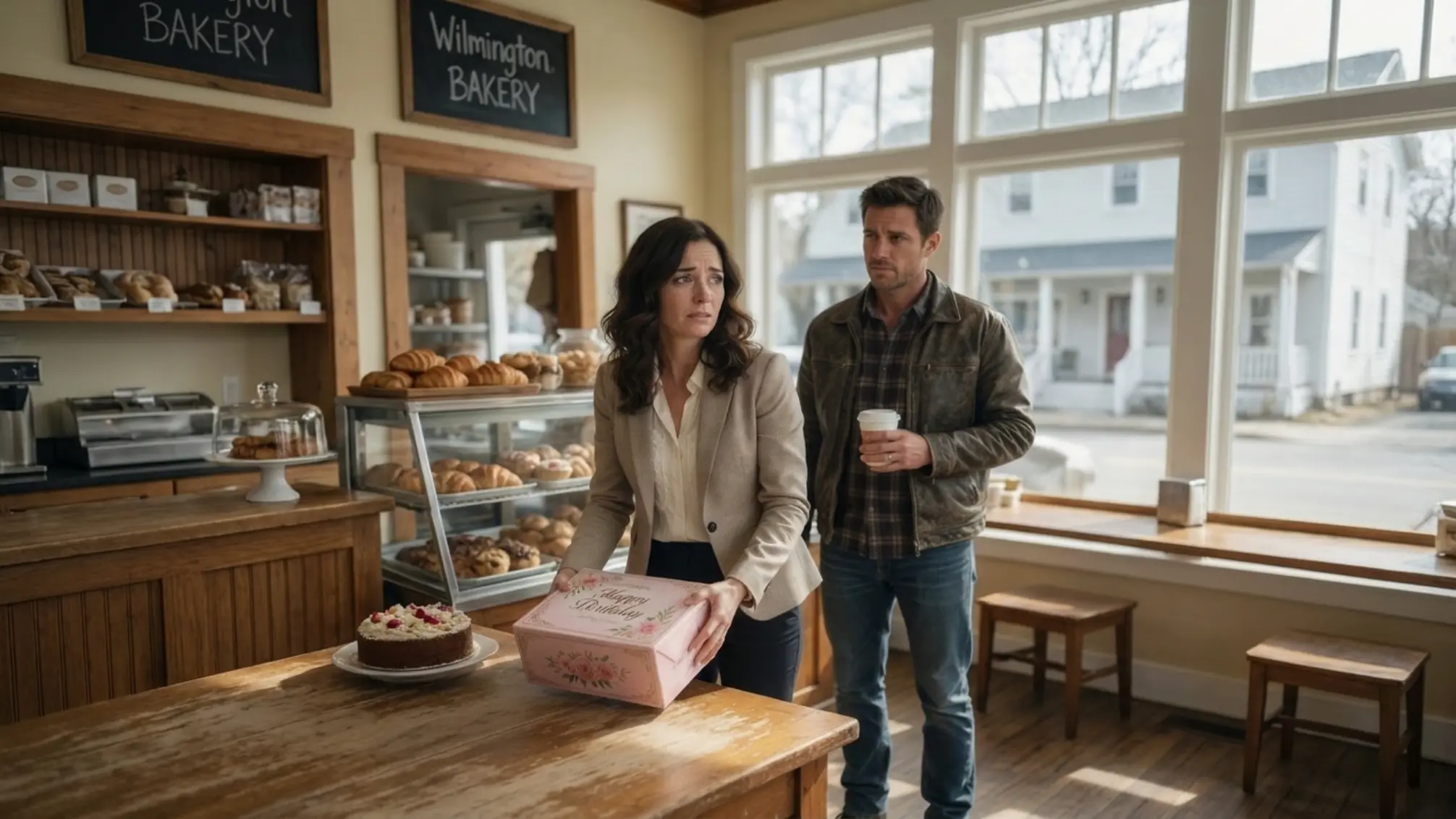
The Woman looked down at the card. It carried the name of a construction company in modest lettering, along with a local phone number and no hint that its owner knew anything about frozen accounts. The Single Dad wore a weathered brown leather jacket over a dark plaid shirt, his tall athletic frame dusted lightly with sawdust from a nearby renovation project. He held a paper coffee cup in one hand, but the directness in his expression belonged to someone accustomed to walking into rooms where people lied professionally. She pushed the card back toward him.
“I appreciate what you’re trying to do,” she said. “But I don’t accept money from strangers.”
“I’m not offering you money.”
“You just offered to buy my son’s cake.”
“I offered to make sure an eight-year-old boy doesn’t pay for an adult’s cruelty.”
The words struck harder than she expected. Her son had spent three weeks choosing the cake—chocolate layers, vanilla frosting, and a small sailboat across the top because he wanted to work at the harbor one day like his grandfather. The Woman had already reduced the guest list, canceled the rented games, and planned a simple dinner at home, but she had promised him the cake. That morning, someone inside her own company had made even that promise uncertain.
Her personal account had been frozen without warning. The bank representative claimed a review had been requested under the terms of a family trust connected to her ownership of a major American shipping company. The Woman was chief executive, controlled hundreds of employees, and could approve contracts worth millions, yet she could not access enough of her own money to purchase a birthday cake. Every call ended with the same careful phrase: temporary hold pending internal authorization.
She had spent the afternoon pretending the problem was administrative. Then the bakery called to confirm final payment, forcing her to face the humiliation of choosing between the cake and the groceries already charged to her remaining credit card. She had come in person because canceling over the phone felt cowardly. She had not expected a stranger to notice her trembling hand.
The Single Dad pulled the card back and wrote something on the reverse.
“That’s my address,” he said. “Bring whatever documents the bank gave you. I’ll look at them tonight.”
“You’re a contractor.”
“Now.”
“What were you before?”
His expression closed slightly. “Someone who knows what a manufactured financial emergency looks like.”
The Woman studied him. He did not flirt, boast, or try to turn her weakness into intimacy. He simply looked angry on behalf of a child he had never met. She took the card, but she still left without the cake.
Twenty minutes later, the Single Dad paid the bakery in full and asked the Baker to deliver the pink box to the address on the canceled order. He refused to attach his name. When his handsome eight-year-old American Son entered after soccer practice, he found his father staring through the window at the street where the Woman had disappeared.
“Who was she?” the Boy asked.
“Someone having a bad day.”
“Did you help?”
“I bought a cake.”
The Boy nodded as if that explained everything. Since losing his mother two years earlier, he had watched his father repair broken houses and quietly help people who could not afford full payment. The Single Dad claimed he preferred work that ended with visible results: a straight wall, a sealed roof, a staircase that no longer shifted beneath frightened feet. The Boy understood there had once been another life before sawdust, but his father rarely discussed it.
That evening, the cake arrived at the Woman’s elegant but unusually quiet home. Her handsome eight-year-old American Son ran toward the porch when he recognized the bakery van. He had no idea she had canceled the order, and she protected him from the truth by accepting the box with a smile. Only after he returned upstairs did she open the lid and find a small receipt marked paid in full.
There was no note.
The Woman sat on the porch steps with the pink box balanced beside her and finally allowed herself to cry. She cried for the frozen account, the secret meetings at her company, and the growing suspicion that the man she trusted to manage the board had planned the entire crisis. Mostly, she cried because a stranger had protected her son from seeing the fear she could no longer hide.
She visited the Single Dad’s renovation site three days later.
He was replacing rotten window framing on an old American coastal home, standing halfway up a ladder while clean daylight caught the sawdust drifting around him. The Woman waited until he climbed down, then held out an envelope containing the cost of the cake.
He did not take it.
“My account is working again?” he asked.
“No.”
“Then keep it.”
“I came to repay you.”
“You came because you want to know how I knew.”
She lowered the envelope. “How did you know?”
The Single Dad removed his gloves and leaned against the tailgate of his truck. “People cancel luxuries when they’re struggling. You canceled something for your child while carrying a handbag worth more than the cake, wearing a company access badge, and answering calls from a private bank. That wasn’t poverty. It was sudden control.”
The Woman’s eyes narrowed. “You studied me.”
“I noticed you.”
“That still doesn’t explain your confidence.”
Before he could answer, a cream-colored business card slid from an open toolbox and landed near her shoe. The Woman picked it up. The faded card identified him as the former founder of an investment firm in Charlotte.
She looked from the card to his work clothes.
“You ran this company?”
“I used to.”
“What happened?”
“My wife died. I sold my share, took my son, and left before the life I built took the rest of me.”
The Woman returned the card without asking for more. Grief had changed his face in a way she recognized from photographs taken after her own father’s death. She understood the boundary and respected it.
“I brought the bank notice,” she said.
The Single Dad read it inside his truck. The language referenced a trust amendment granting the board’s acting governance officer authority to suspend personal distributions during a leadership review. The document sounded precise, but one phrase bothered him. It referred to an “equity stabilization protocol,” language more common in aggressive investment agreements than family trust documents created decades earlier.
“Who controls the review?” he asked.
“The Board Vice Chair.”
“Does he want your job?”
“He says he wants stability.”
“That means yes.”
The Woman explained that the shipping company had belonged to her family for three generations. Her grandfather began with one leased tugboat, her father expanded into port logistics, and she became chief executive after his death. The Board Vice Chair had initially presented himself as a loyal adviser, but over the previous year he had begun questioning her decisions, contacting investors privately, and describing ordinary delays as evidence of weak leadership.
The frozen money was only the latest move.
A formal board vote had been scheduled in three weeks. If the Vice Chair convinced five of nine directors to suspend her operational authority, he would become interim chief executive. The trust hold ensured she entered the fight distracted, humiliated, and personally vulnerable.
The Single Dad handed the notice back. “Do you have the original trust agreement?”
“In my office safe.”
“Not a company copy. Your father’s copy.”
She remembered a folder locked inside her car. Her father had told her never to surrender the original partnership and trust papers, though she had never understood why. They drove to her office garage and compared the documents inside her vehicle.
The original contained no equity stabilization protocol.
It also required the approval of two independent trustees before any personal distribution could be frozen. Both trustees had died years earlier, and no formal replacements had been appointed. The version used by the Vice Chair included a new paragraph granting emergency authority to the board’s governance officer.
The Woman stared at the pages.
“He changed it.”
“Maybe.”
“Maybe?”
“You have two different documents. That proves inconsistency, not yet forgery.”
The answer frustrated her, but it also earned her trust. The Single Dad did not tell her what she wanted to hear. He demanded proof strong enough to survive the boardroom.
They needed metadata, archived files, and signature analysis. The Single Dad contacted a former colleague who had handled forensic reviews during his investment career. He asked for discretion and provided only the documents necessary for comparison.
The former colleague called back the next day.
The signature attributed to the Woman’s late father had been inserted digitally. Pressure and stroke patterns were identical to a signature on another public filing, down to a tiny break in the final letter that no person could reproduce perfectly twice. The modified file had also been created eighteen months after the date printed on the document.
The forgery was clear.
The question was who created it.
The Woman wanted to confront the Vice Chair immediately. The Single Dad stopped her.
“If he knows what you found, he’ll erase the trail.”
“He has access to company systems now.”
“Then act like you still believe his review is legitimate.”
She hated the idea of sitting politely across from the man who had used her father’s name to control her. Yet she understood the advantage of appearing frightened and unprepared. The Vice Chair had built his plan around her emotional reaction. Calm would make him careless.
Over the following week, the Woman attended meetings, answered questions, and allowed directors to believe the trust freeze had weakened her. She stopped using the company car, delayed personal appointments, and let rumors spread that she might sell part of her ownership to cover expenses. The Vice Chair became more confident.
He hosted a public event at the harbor and spoke repeatedly about “stabilizing leadership.” Reporters photographed him shaking hands with investors while the Woman stood nearby, forced to praise employees without revealing that the man beside her had frozen her money using a forged document.
The Single Dad was working two hundred yards away, repairing a damaged section of dock.
He watched the Vice Chair move through the crowd and recognized him.
Nine years earlier, the man had represented an American logistics company seeking investment from the Single Dad’s former firm. The financial records contained unexplained receivables, altered customer signatures, and contracts that did not match bank deposits. The Single Dad’s team declined the deal, but no charges followed because the evidence suggested manipulation without proving who directed it.
The pattern had returned.
He called his former colleague. “Check the Vice Chair’s previous companies, especially the logistics deal from Savannah.”
The investigation uncovered a series of failed companies followed by settlements, confidential resignations, and missing accounting records. In each case, the Vice Chair entered during a period of normal stress, exaggerated the weakness, isolated the original leader, and positioned himself as the only person capable of stabilizing operations.
He did not build companies.
He captured them.
Inside the shipping company, the beautiful forty-five-year-old American Compliance Director had been watching the same pattern. She had remained silent because the Vice Chair drafted her contract personally, including a confidentiality clause tied to her severance and retirement funds. She had two children, a mortgage, and enough fear to spend months telling herself that quiet survival was responsibility.
Then she saw the Woman cancel a planned employee scholarship event because personal funds were inaccessible. She watched the Vice Chair describe the cancellation as proof that the chief executive was emotionally unstable. Silence began feeling less like protection and more like participation.
The Compliance Director contacted the Woman privately.
They met in a diner parking lot outside the city. She brought copies of internal emails, archived trust records, and payment instructions showing that the Vice Chair had hired an outside document consultant using a false project name. The consultant’s invoice referenced “signature harmonization” and “legacy document modernization.”
The Woman read the phrase twice.
“He paid someone to forge my father’s signature.”
“Yes.”
“Why didn’t you bring this earlier?”
The Compliance Director’s eyes filled with shame. “Because I was afraid he would destroy my family before I could protect yours.”
The Woman closed the folder. “Then we protect both.”
The Single Dad reviewed the new evidence with his former colleague and the Woman’s attorney. Together they built a timeline showing when the false amendment was created, how it entered company archives, when the bank received it, and which executive approved the freeze.
They also discovered a second scheme.
The Vice Chair had been moving selected shipping contracts toward a private logistics firm owned through hidden trusts. Once he became interim chief executive, he planned to sell the company’s profitable port division to that firm at a reduced valuation. He would then claim the sale was necessary to rescue the business.
The forged trust amendment was not merely about humiliating the Woman.
It was the key to stealing the company.
The Single Dad could have delivered the evidence privately and returned to repairing houses. Instead, the Woman asked him to attend the board vote.
“You understand these people,” she said.
“I understand men like him.”
“I need someone in that room who won’t be impressed by titles.”
He looked toward his Son playing with her Boy near the renovation site. Returning to corporate conflict meant allowing his former life near the child he had tried to protect from it. He had left investment work because grief and ambition had turned every relationship into an asset or liability. The Woman was asking him to use the same skills without becoming the same man.
“I’ll present the evidence,” he said. “Then I leave.”
She accepted the condition, though neither believed the matter would end so cleanly.
Nine directors gathered around the conference table on the morning of the vote. The Vice Chair stood instead of sitting, dressed in a perfect navy suit and wearing the concerned expression he used whenever planning something cruel. He described falling cash reserves, delayed shipments, and damaged investor confidence. Each problem contained enough truth to make the larger lie sound responsible.
He recommended suspending the Woman’s authority for six months.
Three directors appeared ready to support him. A fourth had already drafted questions about appointing him interim chief executive. The Woman sat at the head of the table with her hands folded, giving no sign that the evidence existed.
The Vice Chair smiled. “This is not personal. It is about protecting the company.”
The conference-room door opened.
The Single Dad entered wearing clean work boots, dark jeans, and the brown leather jacket he had worn in the bakery. He carried a slim folder rather than a briefcase. The Vice Chair looked at him and laughed.
“Who allowed the contractor into a closed board session?”
The Woman answered. “I did.”
The Single Dad placed the original and altered trust documents on the table. “Before I repaired houses, I founded an American investment firm that reviewed corporate fraud, acquisitions, and distressed businesses. Nine years ago, my team rejected a logistics company represented by the man standing beside you because its records contained manipulated signatures and unexplained receivables.”
The Vice Chair’s smile disappeared.
“That allegation was never proven.”
“This one is.”
The Single Dad displayed the forensic report. It showed the duplicated signature, creation date, software history, and payment trail to the document consultant. The Compliance Director entered next and authenticated the internal emails.
Directors began turning pages.
The Vice Chair claimed the consultant modernized old records without changing their legal meaning. The Woman’s attorney then presented the original trust agreement, county filings, and statements from the bank confirming that the freeze relied entirely on the inserted paragraph.
One director looked up. “Without that paragraph, the bank had no authority to block her distributions.”
“Correct,” the attorney said.
The Vice Chair pointed toward the Woman. “This is theater designed to distract from her failed leadership.”
The Single Dad opened a second folder.
“Then let’s discuss the contracts transferred toward a private logistics firm linked to your brother and controlled through two Delaware trusts.”
The room changed.
The Vice Chair objected loudly, but the more he spoke, the more directors examined the documents instead of him. Bank transfers, draft sale agreements, private messages, and property records formed a pattern too specific to dismiss.
The Woman finally stood.
“You froze my money to make me appear desperate. You forged my father’s signature to control my vote. Then you prepared to sell the company division my grandfather built to a firm your family owned.”
The Vice Chair looked around the table, searching for support that no longer existed.
“You cannot prove intent.”
The Compliance Director placed a printed email before him.
Its subject line read: Pressure before transition.
In the message, the Vice Chair instructed an assistant to ensure the Woman experienced “personal liquidity discomfort” before the board review. He believed fear would make her accept suspension quietly.
The directors voted.
Eight supported his immediate removal and an independent investigation. He cast the only opposing vote.
Company security collected his access badge before he left the room. Federal investigators were informed that afternoon, and the bank froze accounts linked to the private logistics firm. The forged amendment, false invoices, and attempted asset transfer became evidence in a broader criminal inquiry.
The Woman’s authority was restored immediately.
Her personal accounts reopened before sunset.
Yet when directors congratulated her in the hallway, she felt no triumph. She thought about the bakery counter, the pink box, and how close she had come to hiding the entire crisis because she was ashamed of canceling one cake.
The Single Dad stood near the elevator, prepared to leave.
“You could have told me who you were,” she said.
“I wasn’t sure I still wanted to be that person.”
“You walked into the room like you never left.”
“That’s what frightened me.”
She understood. “You weren’t the man you were before. You used the skill without letting it use you.”
He looked toward the floor. “I bought a cake. This became larger than planned.”
“The cake was already larger than you understood.”
The Woman told him that her son never learned it had been canceled. He remembered only opening the pink box and seeing the sailboat he had chosen. One quiet act had protected his birthday while his mother fought for their future.
The Single Dad smiled. “That was the point.”
The company investigation continued for months. The Vice Chair had manipulated reports, hidden conflicts of interest, and pressured employees into silence. Several directors admitted they had accepted his warnings too quickly because he sounded confident while the Woman appeared exhausted.
The Compliance Director became head of an independent ethics office with authority to report directly to the board. Employees received protection for raising concerns, and major governance documents could no longer be altered without dual verification and outside review.
The Woman also changed how the family trust operated.
No single executive could freeze personal distributions again. Emergency decisions required independent trustees, documented evidence, and a rapid appeal process. She refused to let future generations experience the same manufactured helplessness.
The Single Dad returned to his renovation work, but the Woman began appearing near the job site with coffee. Sometimes she had real questions about company property. Other times she watched him repair boards while their sons played together on the grass.
He never asked why she kept coming.
She never pretended the visits were accidental.
Their relationship developed through ordinary things rather than dramatic declarations. They attended school events, shared dinners, and spent Saturday mornings watching the boys play soccer. The Woman learned that the Single Dad still stood outside his Son’s bedroom some nights, listening to him breathe. He learned that she kept the empty pink cake box on a shelf because throwing it away felt like discarding the moment someone helped without demanding anything.
One evening, they sat beside the harbor while their sons threw a football across the grass. The Woman asked whether he missed investment work.
“I miss being useful,” he said. “I don’t miss confusing usefulness with worth.”
“You were useful in that boardroom.”
“I was also useful fixing your broken dock.”
She smiled. “Which mattered more?”
“The dock didn’t lie to me.”
She laughed, and the sound stayed between them as the sun lowered over the water.
Weeks later, the company hosted a delayed birthday celebration for her Son at the marina pavilion. The Baker delivered another pink cake, larger than the first, with two sailboats on top because the Single Dad’s Son had become part of the celebration.
The boys insisted on blowing out the candles together.
The Single Dad stood beside the Woman while employees, families, and children gathered around the table. Their shoulders touched, and neither moved away.
“Good cake,” he said quietly.
“You would know.”
The Woman turned toward him. “I never repaid you.”
“You saved your company.”
“That wasn’t repayment.”
“What do you think you owe me?”
She looked toward their sons, then back at the man who had recognized her fear before knowing her name.
“An honest answer.”
“To what question?”
“Why did you really buy the cake?”
The Single Dad watched the candles flicker across the boys’ faces.
“Because after my wife died, I learned children remember the day adults stop showing up. I didn’t want your son remembering his birthday as the day the world made his mother break a promise.”
The Woman’s eyes filled with tears, but this time she did not look away.
“He remembers a stranger being kind.”
“Not a stranger anymore.”
The words were quiet, but they changed the space between them.
She reached for his hand beneath the edge of the table. He held hers carefully, as though accepting something more valuable than gratitude.
The first cake had arrived anonymously on a porch during the worst week of her life. The second stood beneath open daylight, surrounded by people who knew exactly who had carried it to the table.
The Woman once believed canceling her son’s birthday cake proved she had failed him.
Instead, that moment exposed the man trying to steal her company, brought an honest Single Dad into her life, and reminded her that strength did not always mean surviving alone.
Sometimes it meant allowing the right person to stand beside you before the candles went out.