“I haven’t eaten all day, but they said I don’t belong here.”
Caleb Mercer followed the woman’s tired blue eyes toward the manager standing beside the counter. Grant Maddox wore a pressed navy shirt, polished shoes, and the pleased expression of a man who believed authority made every cruel decision respectable. Around him, the crowded roadside diner in Cedar Falls, Ohio, had gone strangely quiet, though customers continued pretending to study menus and stir coffee.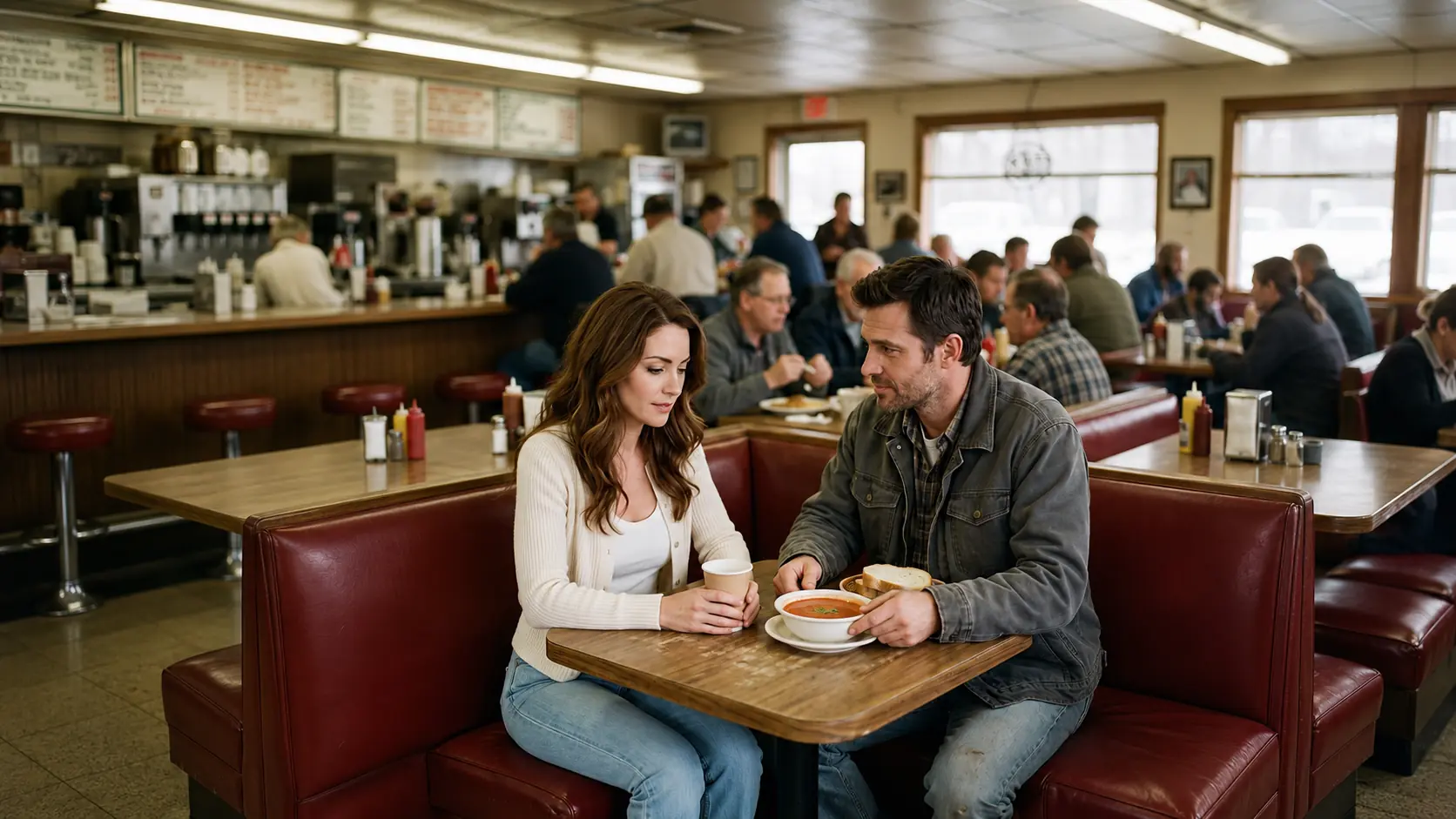
Caleb looked down at the tray in his hands. The bowl of tomato soup, two slices of bread, and a small pat of butter had cost nearly everything left in his pocket. His eight-year-old daughter, Nora, was waiting in their apartment above an abandoned hardware store, expecting him to bring dinner home after his warehouse shift.
“Tonight, you belong at this table,” Caleb said.
He placed the tray in front of the woman before he could calculate what the decision would cost him. She stared at the rising steam as if it carried a memory she had almost forgotten. Rainwater dripped from the hem of her faded gray coat, forming a small dark circle beneath the booth.
“Wasn’t this meal meant for you?” she asked.
Caleb slid the spoon toward her. “Someone is waiting for me—but no one should wait alone while hungry.”
The woman’s fingers tightened around the empty paper cup she had been holding for warmth. Her long chestnut-brown hair clung damply to her cheeks, and beneath the exhaustion, Caleb noticed an elegance that did not match the worn trousers and scuffed shoes. She held herself too carefully, as though she had spent years being watched.
Grant crossed the diner and stopped beside the booth. “I already told her to leave.”
Caleb removed one slice of bread, folded it inside a napkin, and slipped it into his jacket pocket for Nora. “She’ll leave after she eats.”
“This is a business, not a shelter.”
“It can be both for ten minutes.”
Several customers glanced at one another. Grant’s face tightened, not because Caleb had threatened him, but because he had contradicted him without raising his voice. Men like Grant understood anger because anger gave them an excuse to punish someone; calm resistance left them with nowhere to hide.
“You work at the Hartwell distribution warehouse, don’t you?” Grant asked.
Caleb recognized the danger in his tone. “Night loading crew.”
“I remember your name now. Caleb Mercer—the employee who filed complaints about our disposal policies.”
“I reported edible food being thrown away.”
“You questioned management decisions you weren’t qualified to understand.”
Caleb looked at the woman in the gray coat. “Eat before it gets cold.”
She lifted the spoon, but her hand trembled. The first taste seemed to require more courage than hunger should ever demand. Caleb looked away to spare her the humiliation of being watched while she ate.
Grant leaned closer. “You enjoy pretending to be noble, don’t you?”
“No.”
“Then what is this performance?”
Caleb’s gaze shifted toward the rain striking the windows. “A warm bowl of soup.”
Grant laughed, and two employees near the counter joined him, though their amusement sounded forced. “You can barely support your own child, yet you’re giving dinner to strangers.”
The woman stopped eating.
Caleb’s expression changed almost imperceptibly. “Leave my daughter out of this.”
“Why? Everyone knows about your emergency scheduling requests. Everyone knows family services has been asking questions.”
A few customers lowered their eyes. Caleb had learned to survive humiliation by refusing to react quickly, but Grant had chosen the one fear he could not separate from his heart. The county had given him thirty days to prove consistent income, stable housing, and reliable meals for Nora.
“I said leave her out of this.”
Grant reached toward the tray. “Both of you are leaving.”
His hand struck the edge of the bowl. Tomato soup spilled across the table, over the seat, and onto the floor near Caleb’s worn brown boots. The spoon spun once against the tile before becoming still.
No one laughed.
The woman stood abruptly. Anger had replaced the exhaustion in her eyes, but Caleb bent before she could speak. He gathered napkins from the dispenser and began wiping up the mess.
“You don’t have to clean that,” she whispered.
“Someone does.”
Grant stared down at him. “You should have known better than to challenge me.”
Caleb placed the stained napkins in the empty bowl and rose slowly. “You should have known better than to waste food in front of someone hungry.”
For one second, the diner seemed to wait for violence. Caleb was tall, broad-shouldered, and strong from years of lifting warehouse pallets and repairing heating units. Grant took half a step back despite himself.
But Caleb did not touch him. He reached into his pocket, checked that Nora’s slice of bread remained dry, and turned toward the woman.
“Come on,” he said. “I’ll walk you to the bus stop.”
Outside, the rain swept sideways across the parking lot. Caleb removed his jacket and placed it around the woman’s shoulders, leaving himself in a faded gray work shirt. The bus shelter stood three blocks away beneath a flickering streetlamp.
“You shouldn’t have done that,” she said as they walked.
“Given you the soup?”
“Given away your daughter’s dinner.”
Caleb’s jaw tightened. “Nora has bread. I’ll find something else.”
“Do you always believe you can fix everything?”
“No. I just don’t like walking past things I might be able to fix.”
She studied his profile as rain ran through his short dark-brown hair. “What if helping someone costs you more than you can afford?”
“Then I hope it was worth the cost.”
They reached the shelter, where a cracked plastic roof offered little protection. Caleb stood outside it so the woman could remain dry. The napkin in his pocket showed the corner of a purple crayon heart Nora had drawn that morning.
The woman noticed it. “Your daughter made that?”
“She puts hearts on things she wants me to remember.”
“What did she want you to remember?”
“To come home.”
The bus appeared at the end of the road. Before boarding, the woman returned Caleb’s jacket and held it against his chest for a moment longer than necessary.
“What is your name?” she asked.
“Caleb Mercer.”
She hesitated. “Ellie.”
He nodded as though that simple answer was enough. “Take care of yourself, Ellie.”
Caleb watched until the bus disappeared, never realizing that Ellie Warren did not exist.
The woman’s real name was Evelyn Hartwell, and she owned the diner, the distribution warehouse where Caleb worked, and more than two hundred grocery stores and restaurants across the Midwest.
That morning, Evelyn had occupied the forty-second floor of Hartwell Foods headquarters in Columbus. She had sat at the head of a walnut conference table while executives praised rising profits, reduced waste costs, and a public campaign promising that every Hartwell location treated customers like family.
The reports had been perfect.
That was the problem.
An anonymous envelope had reached Evelyn’s private office two days earlier. Inside were photographs of sealed trays of edible food dumped behind restaurants, copies of rejected community-meal requests, and a handwritten note.
They are using your family’s name to turn hungry people away.
At the bottom, someone had written two more words.
Ask Cedar Falls.
Evelyn had questioned Grant Maddox, the regional operations director responsible for Cedar Falls. He had smiled and explained that charitable programs attracted “the wrong kind of customer.” According to him, compassion created loitering, reduced efficiency, and weakened the brand.
Her late father had built Hartwell Foods around a different belief. Food, he often said, was the first language of welcome. After his death, Evelyn had expanded the company so quickly that she no longer knew what happened beneath its signs.
She decided to find out.
Evelyn left her phone, driver, jewelry, and tailored suit behind. She bought a faded coat and worn shoes from a thrift shop, carried less than one dollar, and spent the day visiting businesses bearing her name.
At the first location, an employee refused to let her use the restroom. At another, security followed her between aisles. A restaurant manager told her to leave before the lunch crowd arrived because her appearance made paying customers uncomfortable.
By the time she entered the Cedar Falls diner, she was genuinely cold and hungry. Grant had happened to be inspecting the location when she asked for a small meal. He did not recognize the woman whose photograph appeared in every executive report.
He only saw someone powerless.
And then Caleb had walked in.
The following morning, Caleb awoke at the kitchen table to the sound of his phone ringing. Nora slept beneath a faded quilt on the couch because wind pushed through the bedroom window. Her crayon drawings covered the wall above her, each one showing houses with bright yellow windows.
His warehouse supervisor spoke carefully. A video from the diner had been posted online, edited to show Caleb standing beside the spilled soup while Grant accused him of causing a disturbance. Hartwell Foods had suspended him pending an internal investigation.
“How long?” Caleb asked.
“I don’t know.”
“I need those shifts.”
“I know.”
After the call ended, Caleb looked at the family-services notice beside the unpaid electric bill. Without his income, he could not prove stability. Without proof, the county might place Nora temporarily with another family.
She appeared in the doorway wearing oversized pajamas. “Daddy?”
Caleb folded the notice beneath his hand.
“Are we in trouble?”
“No.”
Children knew when adults lied gently.
Nora approached the table and touched the corner of the envelope. “Is this about me?”
Caleb pulled her onto his lap. He wanted to promise that no one would ever separate them, but promises did not impress courts, employers, or landlords.
“It’s about grown-ups asking too many questions,” he said.
“Are they taking me away?”
The fear in her voice broke through every defense he had built since his wife, Hannah, died four years earlier. Caleb held Nora tightly enough to feel her heartbeat against his chest.
“Not if I can help it.”
At Hartwell headquarters, Evelyn watched the public video three times. Something felt wrong about the way it began after the soup had already spilled. She ordered her chief of staff, Mara Jennings, to retrieve every camera recording from the diner.
Grant attempted to block the request, claiming an equipment failure. Evelyn contacted the security contractor directly.
By noon, she had four camera angles and complete audio.
The footage showed Caleb counting coins before buying the meal. It showed Grant humiliating her, mentioning Nora, and knocking the bowl from the table. It showed Caleb cleaning the floor and leaving two quarters as a tip.
The parking-lot camera captured him walking Evelyn to the bus shelter. She paused the recording when he checked the bread wrapped inside Nora’s napkin. The purple heart filled the screen.
“Find everything we have on Caleb Mercer,” Evelyn told Mara.
His personnel file revealed seven years of reliable work, no disciplinary history, and repeated requests to rescue edible food scheduled for disposal. Grant had denied every proposal.
There was also an emergency request for daytime hours. Caleb explained that Nora suffered from asthma and that overnight work made it difficult to supervise her medical care. Grant had marked the request low priority.
Evelyn read those words twice.
She also found a report from warehouse security. Caleb had photographed pallets of fresh food being destroyed after Grant secretly canceled a community donation agreement. The anonymous envelope had come from another employee, but Caleb’s complaints had documented the same misconduct.
That afternoon, Grant entered the regional boardroom expecting to discuss reputation management. Attorneys had prepared a statement describing Caleb as an unstable employee who had confronted management in a public setting.
Evelyn arrived wearing the faded gray coat.
Grant’s face lost its color.
“You,” he whispered.
“Sit down.”
The first video played on the wall. Executives watched Grant refuse service to a hungry woman and order her removed. Then they watched Caleb place his dinner before her.
When the soup spilled, one attorney closed his prepared statement.
Grant stood. “Evelyn, I can explain.”
“You believed I was poor.”
“I believed you were disrupting the business.”
“I was sitting quietly with an empty cup.”
“You don’t understand what those locations deal with.”
“I understand exactly what you did when you thought the person in front of you could not harm your career.”
Evelyn displayed Caleb’s ignored reports, the destroyed food, and Grant’s internal messages describing hungry families as “brand contamination.” The evidence also showed that he had reduced donation programs and redirected the savings into performance bonuses.
Grant’s authority was revoked immediately. Hartwell Foods opened an independent investigation into every location he supervised. Evelyn ordered the company to preserve all records and notify law enforcement if the financial review confirmed fraud.
Then she addressed the board.
“Caleb Mercer gave away the meal he bought with his last few dollars. This company responded by suspending him and threatening his ability to keep his daughter. We will correct that before anyone leaves this room.”
At five that evening, someone knocked on Caleb’s apartment door.
He expected a county worker. Instead, the woman from the diner stood in the hallway wearing an elegant cream coat, tailored trousers, and black heels. Her chestnut hair fell in soft waves over her shoulders, and without the rain and exhaustion, she looked entirely different.
Only her eyes remained familiar.
“Ellie?”
“My name is Evelyn Hartwell.”
Caleb stared at her.
She held a covered box of food in one hand and a folder in the other. “My family owns the diner and the warehouse.”
Understanding came slowly, followed by hurt. “You lied to me.”
“Yes.”
“Was I part of some test?”
“No. The company was the test. You were the only person who passed without knowing one existed.”
Caleb did not open the door farther. “I don’t need a reward for giving someone soup.”
“I know.”
“Then why are you here?”
“Because my company punished you for telling the truth, and because I cannot stop thinking about the meal you carried for your daughter.”
Nora peeked around the corner. Evelyn’s expression softened immediately.
“You’re the hungry lady,” Nora said.
“I was.”
“Did Daddy give you my bread?”
“Part of it.”
Nora frowned at Caleb. “You said you dropped it.”
Caleb rubbed his forehead. “I simplified the story.”
Evelyn knelt and held out the covered box. “I brought tomato soup, bread, chicken, fruit, and chocolate cake.”
Nora considered the offering. “You can come in.”
Caleb gave his daughter a helpless look. “Apparently, she makes the decisions.”
Inside, Evelyn placed the food on the small kitchen table. She handed Caleb the folder containing written confirmation of his reinstatement, back pay, benefits, and the removal of all false disciplinary claims.
The final page offered him a new position directing Hartwell’s regional food-recovery program. It included stable daytime hours and a salary nearly twice what he had earned at the warehouse.
Caleb closed the folder. “You don’t know whether I can do this job.”
“I read seven years of reports proving you already understand the problem better than the executives who created it.”
“You’re offering it because you feel guilty.”
“I am offering it because you were right.”
He studied her face, searching for pity. Evelyn did not look away.
“I won’t be your charity project,” Caleb said.
“I don’t want a project.”
“What do you want?”
Evelyn glanced at Nora, who was arranging three bowls on the table. “The chance to become someone who would have shared the soup before meeting you.”
Caleb’s expression softened, though only slightly. “That sounds harder than writing a check.”
“I’m beginning to understand that.”
Over the next six months, Caleb built the Hartwell Community Table program. Every company restaurant reserved meals for people unable to pay, while grocery locations redirected safe surplus food to shelters, schools, and neighborhood kitchens.
He refused publicity photographs unless the company focused on the communities rather than him. Evelyn attended planning meetings personally, surprising executives accustomed to seeing her only during major negotiations.
Their disagreements became frequent.
Caleb accused corporate teams of creating forms too complicated for hungry families. Evelyn argued that systems required oversight. He reminded her that dignity disappeared when people had to prove suffering to strangers.
She changed the forms.
Evelyn also began visiting the apartment, sometimes to discuss the program and sometimes without a convincing business reason. Nora taught her card games, corrected her method of making grilled cheese, and asked questions no board member would dare ask.
“Are you married?”
“No.”
“Do you like Daddy?”
Evelyn nearly dropped her coffee.
Caleb looked up from the broken window latch he was repairing. “Nora.”
“What? She looks at you when you’re not looking.”
Evelyn’s cheeks turned pink. “Your daughter is observant.”
“She considers privacy an outdated concept.”
Their relationship grew in quiet spaces. Evelyn helped Nora prepare for a school science fair, while Caleb repaired the heater in Evelyn’s childhood home without accepting payment. He learned that her controlled manner came from years of being valued only for flawless decisions.
She learned that his strength was not endless. Some nights he still woke believing he had failed Hannah by allowing illness and debt to consume their life. Evelyn never told him to move on, and Caleb never treated her loneliness as something money should have prevented.
One evening, they returned to the Cedar Falls diner after closing. The corner booth had been replaced, and beside it hung a small framed napkin bearing Nora’s purple heart.
“No explanation required,” read the sign above the table. “Anyone hungry may sit here.”
Evelyn touched the glass frame. “Your daughter’s heart is now company policy.”
“She’ll demand royalties.”
They sat across from each other while rain tapped gently against the windows, echoing the night they met. Evelyn looked toward the place where Grant had stood.
“I came here disguised because I thought I needed to see whether my company still had a conscience,” she said. “I never expected to find someone who made me question whether I had one.”
“You came back.”
“I almost didn’t.”
“Why?”
“Because I knew you would see everything I had failed to notice.”
Caleb reached across the table and placed his hand over hers. “I saw a hungry woman.”
Evelyn’s eyes filled. “And now?”
He smiled faintly. “Now I see a woman who keeps finding reasons to visit my apartment even though she owns several nicer buildings.”
“I like the company.”
“Nora?”
“She isn’t the only one.”
Caleb held her gaze as the empty diner seemed to become smaller and quieter around them. Their first meeting had begun with hunger, humiliation, and a meal neither could afford to forget.
This time, there were two bowls of tomato soup between them.
Evelyn turned her hand beneath his and intertwined their fingers. “Was this dinner meant for me?”
Caleb’s smile deepened.
“Tonight,” he said softly, “you belong at this table.”