The knock came just as the winter wind began shaking the old cedar cabin hard enough to rattle the dishes in the kitchen cupboard. Marcus Hale looked up from the unpaid electric bill spread across the table, listening as three more desperate blows struck the front door. Outside, snow swept across the northern Montana valley in thick white sheets, burying the narrow road that connected his isolated rental home to the nearest town. No sensible person would have been walking through that storm.
His nine-year-old son, Noah, appeared in the hallway holding a worn storybook against his chest. Since Marcus’s wife died three years earlier, the boy had learned to read danger in his father’s face before a single word was spoken. Marcus told him to remain beside the fireplace, then took the heavy flashlight from the counter and approached the door. Another knock came, weaker this time.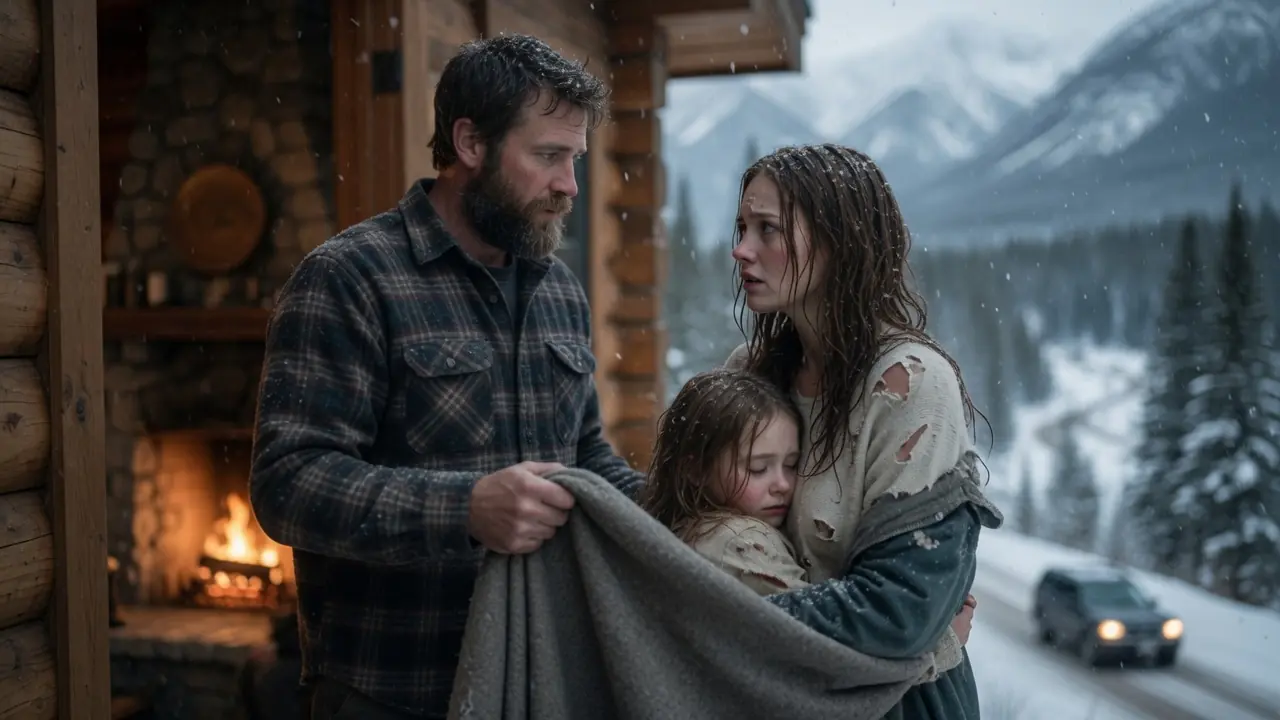
Marcus opened it only a few inches at first.
A young woman stood on the porch beneath the yellow light, her long chestnut hair soaked with melting snow and her pale face trembling from the cold. She clutched a little girl against her chest, but the child’s arms hung without strength and her breathing came in shallow, frightening gasps. The woman wore a faded blue coat over a torn cream sweater, and neither garment was thick enough for a Montana winter. Behind her, the storm had already begun erasing their footprints.
“Please,” she whispered. “My daughter can’t breathe.”
Marcus pulled the door open immediately.
The woman stumbled across the threshold, nearly collapsing before he caught her. Noah ran to bring blankets without being asked, and Marcus wrapped the thickest one around the little girl while guiding them toward the couch. The child’s cheeks were flushed with fever, but her lips carried a faint blue tint that made Marcus’s stomach tighten. He had seen illness before, but he had never seen a child look so close to disappearing.
“What’s her name?” he asked.
“Hannah.”
“And yours?”
“Grace.”
Marcus placed the back of his hand against Hannah’s forehead. “She needs a doctor.”
Grace looked toward the window with sudden terror. “We can’t go into town.”
“She can barely breathe.”
“The people looking for us will find her.”
Marcus turned sharply. “Who is looking for you?”
Grace did not answer. Her eyes moved toward Noah, then back to Marcus as though measuring how much danger she had brought inside. She held Hannah tighter and whispered that they would leave as soon as the child became warmer. Marcus looked at the snow outside and knew they would not survive ten minutes beyond the porch.
“No one is leaving tonight,” he said.
Grace shook her head. “You don’t understand.”
“I understand that your daughter needs help.”
“They’ll punish anyone who hides us.”
Marcus thought of Noah standing near the fireplace in his flannel pajamas. Every instinct told him to protect his son by closing the door on whatever trouble Grace carried. Yet when he looked at Hannah’s feverish face, he imagined Noah lying helpless in a stranger’s arms while someone considered whether saving him was worth the risk. The answer came before fear could argue.
“Stay with me,” Marcus said gently. “I already lost one family, and I won’t let the storm take you and your little girl too.”
Grace stared at him.
For one fragile second, the fear in her eyes gave way to something warmer and more painful. It looked like the memory of being protected, something she had nearly forgotten. Then Hannah began coughing violently, and the moment disappeared. Marcus lifted the child into his arms and carried her toward the truck.
His old Ford started on the fourth attempt.
Grace sat beside Hannah in the back seat while Noah remained at the cabin with Mrs. Donnelly, their nearest neighbor, who lived half a mile down the road. The truck slid twice as Marcus drove through the snow, its headlights cutting a narrow tunnel through the darkness. Grace kept whispering to Hannah that she was safe, though her own voice shook too badly to sound convincing.
The nearest emergency clinic was eighteen miles away.
By the time they arrived, Hannah’s breathing had grown worse. Nurses rushed her into an examination room while Grace stood frozen near the entrance, staring at the swinging doors as though someone had removed the center of her body. Marcus filled out the admission papers because Grace’s hands would not stop trembling. When the receptionist asked about insurance, he placed his own information on the form.
“You can’t afford this,” Grace said.
“That can wait.”
“You don’t even know us.”
“I know she needs treatment.”
The doctor diagnosed severe pneumonia complicated by exhaustion and prolonged exposure to cold. Hannah needed antibiotics, oxygen, and at least one night of observation. Grace sat beside the hospital bed holding her daughter’s small hand, while Marcus called Mrs. Donnelly to check on Noah. His neighbor assured him the boy was asleep, but Marcus could hear concern beneath her calm voice.
When he returned to Hannah’s room, Grace was crying silently.
She apologized for bringing danger into his life. Marcus told her to stop speaking as though needing help were a crime. She looked at his worn boots, his faded work shirt, and the hospital papers bearing his name, then asked why a struggling stranger would accept a debt for someone else’s child. He answered with the only truth he had.
“Because my wife died in a hospital while I stood there wishing someone could save her.”
Grace lowered her eyes.
Marcus told her about Claire, the woman he had married when they were both twenty-three. She had been kind, stubborn, and able to make their tiny apartment feel rich even when dinner came from a box. Three years earlier, an undiagnosed heart condition took her in less than an hour. Marcus had been raising Noah alone ever since.
“I spent months being angry at everyone who still had a family,” he admitted. “Then I realized Noah needed a father more than I needed somewhere to put my anger.”
Grace looked toward Hannah. “You make it sound simple.”
“It wasn’t.”
Hannah stabilized before morning.
The clinic gave Grace medication and instructions, but the storm had closed the road toward town. Marcus brought them back to the cabin, where Noah had already placed his favorite pillow on the couch for Hannah. Grace tried to refuse the bedroom Marcus offered, insisting she and her daughter could sleep near the fireplace. He reminded her that sick children needed real beds, not pride.
Grace and Hannah stayed three days.
Then three days became a week because the snow continued falling and Hannah remained weak. Grace cooked to repay Marcus, transforming his ordinary pantry supplies into meals that tasted better than anything the cabin had known since Claire died. She repaired a tear in Noah’s winter coat, organized the medicine cupboard, and somehow convinced Hannah to laugh despite her cough. The house began to feel less like a place where three people were hiding from grief.
Marcus continued working at the construction yard whenever roads allowed.
His hours had recently been cut, and every missed shift pushed him closer to losing the cabin. At night, he repaired farm equipment in a shed beside the house while Noah completed homework at a small desk nearby. Grace often joined them, sitting quietly with Hannah or bringing hot coffee without being asked.
She revealed little about herself.
Marcus learned that Hannah was six, that Grace had lost her husband two years earlier, and that she had been traveling for nearly a month. She spoke with the careful precision of someone accustomed to formal rooms, though she pretended not to notice when Marcus recognized it. Her hands were soft despite the bruises along her wrist, and she knew too much about private hospitals, corporate travel, and security systems for someone who claimed to have no money.
Marcus did not question her.
Trust, he believed, could not be dragged out of frightened people. It had to be given somewhere safe to land. Yet he became increasingly aware that Grace was not simply a homeless widow caught in a storm. She was hiding from a life powerful enough to reach them even in northern Montana.
The first black SUV appeared near the end of the road on the eighth afternoon.
Marcus spotted it while chopping firewood. Its glossy paint and expensive tires looked absurd against the rural landscape. The vehicle remained beneath the pine trees for several minutes, then reversed without approaching the cabin.
Grace went pale when he mentioned it.
“We have to leave,” she said.
“Hannah still has a fever.”
“They found us.”
“Who?”
Grace packed their few belongings without answering. Hannah began crying because she did not want to leave Noah, and Noah stood in the doorway pretending he was not frightened. Marcus blocked the front entrance.
“You’re not taking a sick child into the snow because someone parked on the road.”
Grace faced him. “You offered shelter, Marcus. You did not offer to lose your home or your son.”
“I decide what I’m willing to risk.”
“You don’t know what they can do.”
“Then tell me.”
Grace looked at the floor.
Before she could answer, the sound of engines rose beyond the cabin. Three black SUVs climbed the road, followed by a dark sedan. Marcus told Noah to take Hannah into the back bedroom and lock the door. Then he moved to the porch with an old hunting rifle kept lowered beside his leg.
Grace followed him outside.
Men in tailored winter coats stepped from the first two vehicles. None drew weapons, but they spread across the snow with the disciplined movements of trained security officers. From the sedan emerged an older silver-haired man carrying a leather case. He looked at Grace with unmistakable relief.
“Mrs. Whitmore,” he said. “Thank God.”
Marcus turned toward her.
Grace closed her eyes.
The man introduced himself as Arthur Bennett, chief legal counsel for Whitmore Global Holdings. He explained that Grace Evelyn Whitmore was the controlling owner of one of the largest private logistics and technology companies in North America. Her late husband had founded the company with her, and his death had triggered a brutal dispute over control of their estate.
Marcus stared at the woman beside him.
Grace was not poor.
She was a billionaire.
The men were not hunters sent to harm her. They were security specialists hired by her own attorneys after she vanished from a private medical retreat in Wyoming. For weeks, her family and company had searched across three states while news organizations speculated about her disappearance.
Marcus felt foolish.
He thought of the hospital papers signed in his name, the groceries he had stretched, and the shifts he had missed. Grace could have paid for every clinic in the county, bought the cabin, and replaced his truck without noticing the expense. Yet she had watched him worry over bills while hiding the truth.
“You lied to me,” he said.
Grace’s eyes filled. “I was afraid.”
“Of what? Your own employees?”
“Of everyone.”
Arthur interrupted, explaining that after Grace’s husband died in a helicopter accident, several Whitmore executives attempted to have her declared psychologically unfit. They controlled her schedule, restricted communication, and surrounded her with people who reported every decision to the company’s board. Her brother-in-law, Richard Whitmore, claimed she was unstable and sought temporary control of both the corporation and Hannah’s trust.
Grace had entered the Wyoming retreat voluntarily.
Then she learned Richard planned to use her stay as evidence in court that she could not raise her daughter or manage the company. She took Hannah and escaped before her phone, accounts, and identification were frozen. The security team searching for her included loyal employees, but Grace had no way to know which men reported to Richard.
“I could trust no one with money,” she told Marcus. “Everyone had a reason to control me.”
Marcus looked toward the cabin where Noah and Hannah waited together.
“You could have trusted me with the truth.”
“I wanted to.”
“But you didn’t.”
Grace began crying. “You looked at me like I was human before you knew my name. I was terrified that would change.”
Marcus lowered the rifle.
It had changed, but not in the way she feared. He did not see her as more valuable because she was wealthy. He saw the risks he had taken without understanding them, and he felt used by someone who could have protected all of them sooner.
Arthur opened the leather case and produced legal documents.
Grace had been declared missing, but no court order gave Richard control over her or Hannah. Arthur had secured emergency protection and arranged a safe residence. He asked Grace to return with them immediately.
Hannah refused.
She ran from the cabin wearing Noah’s oversized coat and wrapped both arms around Marcus. “Please don’t make us go.”
Grace knelt beside her daughter. “We have to.”
“He kept us safe.”
“I know.”
Hannah began coughing.
Marcus looked at Grace’s exhausted face and realized wealth had not prevented her from becoming trapped. It had only made the cage more expensive. She had lied, but fear had taught her that every truth could become a weapon.
He told Arthur that Grace and Hannah would leave only after the doctor cleared Hannah to travel.
Arthur protested.
Marcus stepped closer. “You searched for them for weeks and failed. She knocked on my door because her child was dying. You don’t get to arrive with expensive cars and start giving orders.”
The security men glanced toward Arthur.
Grace looked at Marcus with quiet gratitude.
Arthur finally agreed.
Over the next two days, federal investigators arrived to question Grace. Evidence from her hidden email account revealed that Richard had bribed two doctors to exaggerate her condition, intercepted communications from her attorneys, and transferred millions from a family account. He also planned to place Hannah under the supervision of a guardian loyal to him.
Richard was arrested before Grace left Montana.
The news spread quickly.
Reporters gathered along the county road, and Marcus’s quiet life disappeared overnight. Cameras photographed the cabin, the truck, and Noah walking to school. Headlines called Marcus a hero, a mysterious companion, and in one article, a poor widower who had sheltered America’s missing billionaire.
Marcus hated all of them.
Grace used her legal team to protect his privacy, but the attention damaged his work. The construction company suspended him after clients complained about reporters. His landlord announced that the cabin would be sold, claiming the property had become a security risk.
Marcus had saved Grace’s daughter.
Now he might lose his home.
When Grace learned what happened, she returned to the cabin alone.
She wore a dark wool coat and arrived without the large security convoy. Hannah was staying safely with Arthur’s wife while Grace handled the legal case. Marcus found her on the porch holding an envelope.
“If that is money, take it back,” he said.
“It is not a payment.”
“It looks like one.”
Grace handed him the envelope. Inside was the deed to the cabin and the surrounding twenty acres. She had purchased the property from his landlord that morning and transferred ownership into a trust benefiting Noah.
Marcus pushed it back.
“I can’t accept this.”
“You are being evicted because you protected us.”
“That doesn’t mean you owe me a house.”
“No,” Grace said. “It means I refuse to let my presence destroy the safety you gave my child.”
Marcus looked at her.
She was no longer the trembling woman on his porch, but neither was she the untouchable billionaire from the headlines. She stood between both versions, still grieving and still learning how to make decisions without fear.
“I’m angry with you,” he said.
“I know.”
“You watched me sign that clinic bill.”
“I intended to repay it.”
“That isn’t the point.”
Grace lowered her eyes. “I forgot that people without money cannot treat debt like a temporary inconvenience.”
Marcus did not answer.
She continued, “I also forgot that accepting help means trusting the person giving it. I let you risk everything while I protected my secret.”
“That hurt.”
“I know.”
For several moments, only the wind moved through the pine trees.
Grace asked him to accept the property for Noah, not as a reward but as restitution for damage caused by her family’s public scandal. Marcus eventually agreed on one condition: the unused land would support emergency cabins for parents traveling with sick children who had nowhere safe to stay.
Grace smiled through tears. “You really cannot accept anything without helping someone else.”
“I’m difficult.”
“I noticed.”
Months passed.
Richard Whitmore was convicted of fraud, unlawful surveillance, and conspiracy. Grace regained complete control of her company and replaced the board members who helped isolate her. She also created strict protections for employees reporting abuse and established a medical travel fund for rural families.
Marcus returned to work, but not at the construction yard.
Grace’s foundation hired him to supervise the building of six small cabins across the property. Each provided free temporary housing for families whose children received treatment at the regional clinic. Marcus insisted on durable materials, proper insulation, and porches wide enough for children to sit outside when spring returned.
Hannah and Noah spent nearly every weekend together.
Hannah recovered fully, though she remained small for her age and carried an inhaler during winter. Noah became more confident, proud that the cabin where he once worried about losing electricity had become the center of something important. Grace visited without reporters, often bringing groceries and staying to help with ordinary tasks.
She was terrible at splitting firewood.
Marcus was worse at accepting instructions.
Their arguments gradually became laughter.
One evening, almost a year after the storm, snow began falling over the completed cabins. Marcus stood on the porch watching lights glow from the windows while families settled inside. Grace joined him carrying two cups of coffee.
“You opened the door for us when you had almost nothing,” she said.
“I had enough.”
“You had one bedroom, overdue bills, and a truck that sounded like it was dying.”
“It still sounds like that.”
“I offered to replace it.”
“And I said no.”
Grace smiled. “Repeatedly.”
Inside the original cabin, Hannah and Noah decorated a small pine tree. Their laughter drifted through the open doorway, blending with the crackle of the fireplace. Marcus looked at Grace and realized the house no longer felt haunted by the family he had lost.
Claire would always be part of him.
But grief had stopped demanding that he remain alone to prove his love.
Grace seemed to understand what he was thinking.
“I was afraid to ask you something,” she said.
“That is unusual.”
“I am serious.”
“So am I.”
She looked toward the children. “When the storm came, I thought Hannah and I needed a place to survive one night. I didn’t understand that we were walking into the first home that had felt safe since my husband died.”
Marcus’s expression softened.
Grace continued, “I know money complicates everything between us.”
“Only when you use it to avoid saying what you mean.”
She took a breath. “Then I’ll say it.”
Marcus waited.
“I don’t want to visit anymore. I want to stay.”
He looked into her green eyes and saw no fear, no command, and no hidden bargain. Just a woman asking whether she and her daughter could belong somewhere without buying the right.
Marcus took her hand.
“I already told you once,” he said. “Stay with me.”
Grace’s eyes filled.
He drew her closer as snow settled quietly across the porch. Inside, Noah noticed them through the window and elbowed Hannah, who immediately began smiling. Neither child interrupted.
Grace rested her forehead against Marcus’s.
“I came here believing the storm had taken everything from me,” she whispered.
Marcus looked toward the glowing cabins, the children, and the valley beyond them.
“Maybe it only brought you to the right door.”
Years later, people still told the story of the poor single father who sheltered a missing billionaire and her sick daughter. They spoke about the black SUVs, the criminal conspiracy, and the fortune Grace tried to give him. They often made it sound as though Marcus’s kindness had been rewarded with wealth.
That was not how Marcus remembered it.
He remembered a desperate knock.
He remembered a feverish child in his arms and a frightened mother who believed no one could help without wanting something in return. He remembered opening the door before he knew her name, her past, or the power waiting beyond the storm.
The cabins eventually sheltered hundreds of families.
Noah and Hannah grew up together beneath the Montana pines. Grace transformed her company, Marcus rebuilt his life, and the old cabin became a home filled with noise, warmth, and photographs from two families that had slowly become one.
On the coldest nights, Grace sometimes stood beside the front door and remembered how close she had come to walking past the light.
Marcus would place an arm around her and remind her that she had knocked.
“And you answered,” she would say.
He always gave the same reply.
“A child was freezing outside. There was never another choice.”
Marcus once believed life had taken his family and left only enough strength to protect his son. But compassion asked him to risk that strength for two strangers, and in doing so, he discovered that love had not finished with him.
The storm had brought Grace and Hannah to his porch with nothing but fear.
He opened the door with almost nothing to offer.
Yet beneath that tired roof, they found warmth, protection, and the courage to begin again.
And Marcus found the family he had never expected the world to return.