The rain pounded against the empty streets of Cincinnati that night, turning the dim streetlights into trembling circles of yellow mist.
Water rushed along the curbs in dark ribbons.
Gutters overflowed.
Bare maple branches scraped against one another above the sidewalks like tired bones.
Every house on Birchwood Lane seemed sealed tight against the storm, curtains drawn, porch lights glowing softly, families tucked safely behind locked doors and warm windows.
But one child was still outside.
He walked quickly along the sidewalk, clutching a soaked backpack against his chest with both arms.
His hoodie was too thin for the weather, and rain had turned it heavy against his small shoulders.
His shoes made wet sounds with every step.
His lips trembled, not only from the cold, but from the kind of fear that made him keep looking behind him.
Again and again.
Not casually.
Not because he was curious.
Because he expected someone to come after him.
His name was Caleb Brooks.
He was eleven years old, though the night had made him look younger.
Under the weak glow of the streetlights, his face looked pale and hollow. His brown hair was plastered flat to his forehead. One cheek had a faint red mark that the rain could not wash away.
He carried no suitcase.
No umbrella.
No phone.
Only the backpack, half-zipped and sagging open, stuffed with a folded sweatshirt, a small notebook, a toothbrush, and a plastic bag holding two peanut butter crackers.
Everything he had been able to take before running.
Caleb had been walking for nearly two miles.
At first, panic gave him strength.
He had run from the bus stop, turned down random streets, crossed through alleys, and kept moving until his lungs burned. But fear could not keep a body warm forever.
Now his knees shook.
His stomach twisted from hunger.
His fingers had gone numb around the straps of his backpack.
He did not know this neighborhood.
That was why he had chosen it.
He had learned, in the hard way children should never have to learn, that unfamiliar streets were safer than familiar ones when someone angry was looking for you.
The houses here were small but cared for.
Front lawns trimmed low.
Children’s bicycles leaned against garages.
Wind chimes rattled beneath porch roofs.
In one window, a nightlight glowed in the shape of a moon.
Ordinary homes.
Safe homes.
Homes that belonged to people who probably had dinner at a table and beds with clean sheets and someone who noticed when a child was missing.
Caleb slowed near a small white house at the end of the block.
It had blue shutters, a narrow porch, and a detached garage set a little behind the driveway.
A single bulb glowed inside the garage, spilling warm light across the wet concrete.
The garage door was open halfway.
Inside, a man stood at a workbench putting tools away.
A bicycle leaned against the wall beside him.
A little girl’s bicycle.
Pink frame.
White basket.
Purple streamers hanging from the handlebars.
Caleb stopped.
His chest tightened at the sight of it.
A child lived here.
That meant this was not just a house.
It was someone’s home.
Someone’s safe place.
He had no right to walk up carrying his storm into it.
He should keep going.
But where?
The bus station was too far.
The public library was closed.
He had tried the police once before, months ago, and all they had done was take him back to the same house and tell him he needed to be patient with adults.
He did not know which door was safe.
He did not know which adult would listen.
But the man in the garage moved gently with the bicycle, carefully adjusting the chain, wiping grease from the small pink frame like it mattered.
That detail held Caleb in place.
The man was tired.
Caleb could see that.
But he was still fixing a child’s bicycle at night.
Still making sure the chain worked.
Still making sure someone small would be safe when she rode it.
Caleb took one step forward.
Then stopped.
Rain ran down his face and into his collar.
His voice came out so quietly the storm nearly swallowed it.
“I have nowhere else to go.”
The words disappeared into the rain.
For another moment, he stood trembling in the driveway.
Then he walked up and knocked lightly on the side of the garage door.
Inside, Michael Turner adjusted the wrench on his workbench and reached for an old rag.
It had been another exhausting day at the auto repair shop.
A transmission job had run two hours over schedule.
Mrs. Alvarez’s minivan needed a part that would not arrive until Monday.
His boss had mentioned, not unkindly but clearly, that overtime was becoming a problem.
Then Michael had come home, made boxed macaroni and cheese for dinner, helped his eight-year-old daughter Grace with multiplication homework, washed dishes, packed her lunch, and spent forty minutes trying to fix the chain on her bicycle.
Now, at almost nine-thirty, all he wanted was to finish putting away his tools, check the locks, and sit for ten quiet minutes before bed.
Ten minutes.
That was all he asked from the universe most nights.
Since his wife Rebecca had passed away three years earlier, Michael had learned to ask for small things.
A full night’s sleep.
A morning when Grace did not cry because she could not remember her mother’s voice clearly.
A day when he did not feel like he was failing at every role he had been left to carry alone.
He was thirty-five years old, but some mornings he looked at himself in the bathroom mirror and saw a man ten years older.
There were lines near his eyes that had not been there before Rebecca died.
His shoulders had grown strong from work and tense from worry.
He had learned how to braid Grace’s hair by watching videos online.
He had learned which cough required medicine and which required a humidifier.
He had learned how to smile when his daughter asked questions that had no answer.
“Is Mommy lonely in heaven?”
“Can she see my spelling test?”
“If I forget her laugh, does that mean I don’t love her anymore?”
Michael had learned that grief did not end.
It changed rooms.
Some days, it sat beside him in the truck.
Some days, it waited in the grocery aisle when he saw Rebecca’s favorite tea.
Some days, it slept lightly and let him laugh.
But it was always somewhere in the house.
That night, he thought the hard part of the day was over.
Then came the knock.
At first, he thought it was the storm.
A loose branch, maybe.
Then it came again.
Soft.
Human.
Michael froze.
He looked toward the half-open garage door.
No one visited at this hour.
Not in weather like this.
He reached instinctively for the heavy flashlight on the bench.
Not a weapon exactly.
But something solid in his hand.
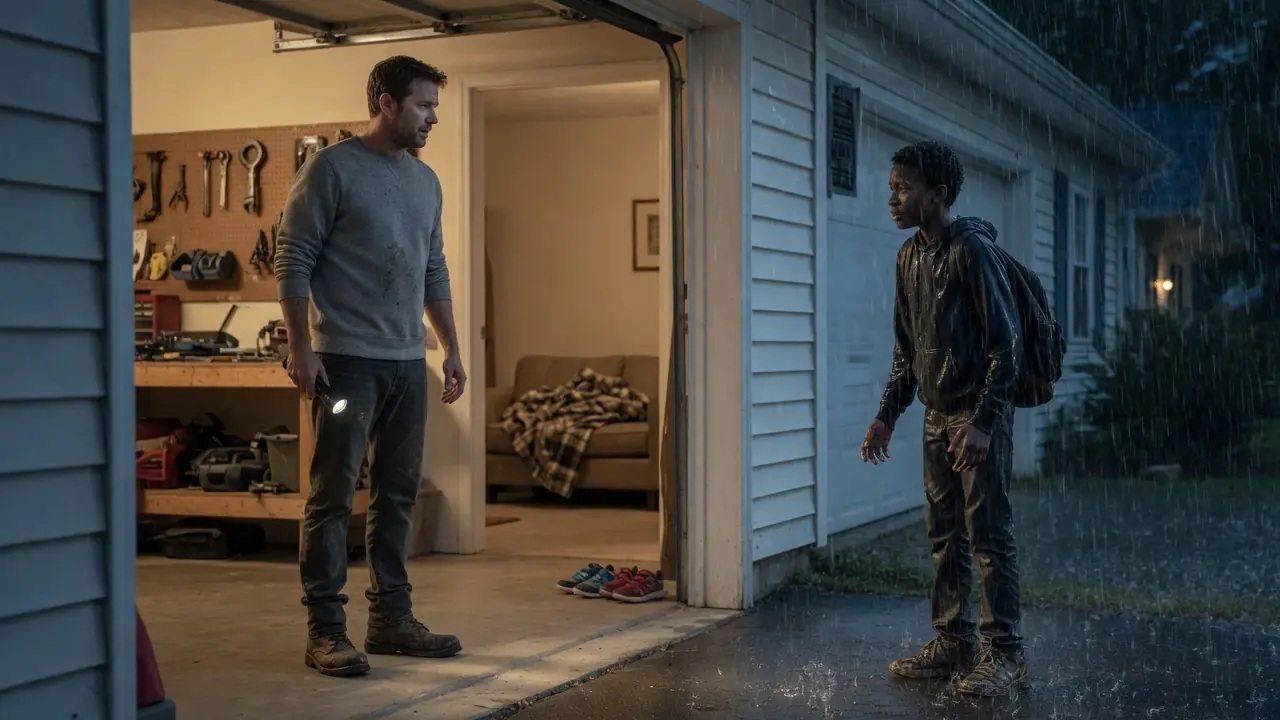
Then he walked toward the garage opening and lifted the door the rest of the way.
When he saw the boy, he stopped.
A child stood in the driveway, soaked from head to toe.
He could not have been more than eleven or twelve.
His hoodie clung to his thin frame.
Rain dripped from his hair onto his cheeks.
His arms were wrapped tightly around a backpack, and one foot was angled as if he might run at the first wrong word.
Michael’s grip tightened around the flashlight.
Every instinct he had as a father told him to be cautious.
There was a child in the house.
His child.
He could not afford to be reckless.
But the boy’s eyes stopped him.
Michael had seen fear before.
He had seen it in Grace the night Rebecca did not come home from the hospital.
He had seen it in customers who could not afford repairs but needed their cars to keep their jobs.
He had seen it in his own reflection during the first year of single fatherhood.
This boy’s fear was not loud.
It was exhausted.
The kind that had been running too long.
“Please,” the boy whispered. “I don’t know where else to go.”
Michael glanced past him into the rain.
No car.
No adult.
No one standing at the corner.
No obvious danger.
But danger did not always announce itself clearly.
“What’s your name?” Michael asked.
The boy hesitated.
“Caleb.”
“How old are you, Caleb?”
“Eleven.”
Michael’s chest tightened.
Eleven.
Still a child.
Too young to be standing alone in a stranger’s driveway in the rain.
“What happened?”
Caleb looked down quickly.
“I can’t go back.”
“Back where?”
The boy’s mouth trembled.
“The house.”
Michael chose his next words carefully.
“Did someone hurt you?”
Caleb did not answer.
But his silence answered enough.
Before Michael could speak again, Grace’s voice came from behind him.
“Daddy?”
Michael turned sharply.
Grace stood in the doorway between the garage and the house, wearing blue pajamas with stars on them, her brown hair loose around her face. One hand rubbed sleep from her eye.
“Grace,” he said quietly, “go back inside.”
But she had already seen Caleb.
Her eyes widened.
The boy looked away immediately, ashamed to be seen.
Grace stepped closer to Michael’s side.
“He’s wet,” she whispered.
“I know.”
“He looks scared.”
Michael looked at his daughter.
Then back at the boy in the rain.
There are moments in life when caution and compassion stand on opposite sides of a door.
Michael knew caution was sensible.
He also knew that sensibility, if worshiped too long, could become cowardice.
He drew a slow breath.
“Caleb,” he said carefully, “you can come inside the garage and get out of the rain. We’ll keep the door open for now. Okay?”
Caleb looked up.
Like he had expected refusal so completely that acceptance confused him.
“I don’t want trouble.”
“You’re a child standing in a storm,” Michael said. “Come in.”
The boy stepped into the garage slowly, leaving wet footprints on the concrete.
Grace disappeared into the house before Michael could stop her.
“Grace.”
“I’m getting a towel,” she called back.
Michael sighed.
Caleb stood near the wall, still clutching the backpack.
He did not sit.
Did not set anything down.
He watched everything.
The exits.
Michael’s hands.
The door to the house.
The tools.
A child trained to measure danger.
Michael lowered the flashlight and set it on the workbench where Caleb could see it was not being held anymore.
“I’m Michael,” he said. “That’s my daughter, Grace.”
Caleb nodded faintly.
Grace returned with a towel almost as large as she was.
“Here,” she said, holding it out.
Caleb stared at it for a second before taking it.
“Thank you.”
Grace watched him seriously.
“You can sit on the stool. It spins, but only if you push with your foot.”
“Grace,” Michael said.
“What? It does.”
Caleb looked at the stool, then slowly sat on the edge.
Not fully.
Like he might need to leave quickly.
Michael went to the kitchen and made hot cocoa because it was the only thing he could think to do that did not require too many questions.
When he returned, Caleb had the towel around his shoulders and the backpack still locked against his chest.
Grace had climbed onto the bottom step near the doorway, watching him with quiet concern.
Michael handed Caleb a mug.
“Careful. It’s hot.”
Caleb held it with both hands.
The warmth made his fingers shake.
Michael noticed and said nothing.
“Are you hungry?” he asked.
Caleb shook his head.
His stomach betrayed him with a small, sharp sound.
Grace looked at him.
“You are.”
Caleb’s face flushed.
Michael did not smile.
“Nothing wrong with being hungry.”
He brought out leftover macaroni and cheese, a banana, and a piece of toast. It wasn’t much, but it was what they had.
Caleb stared at the plate.
“I don’t have money.”
“Nobody asked you for money.”
“I can work. I can sweep or carry things.”
Michael’s chest tightened again.
“You don’t have to earn food in this house.”
Caleb’s eyes flicked up to his face.
Suspicious.
Hopeful.
Afraid of both.
“Eat,” Michael said gently.
Caleb ate like someone trying not to look hungry.
Small bites at first.
Careful.
Polite.
Then faster.
His hands shook around the fork.
Grace watched in silence for a while, then slipped away again.
When she came back, she held a stuffed bear with one button eye and a ribbon worn soft from years of being touched.
Michael froze slightly.
That bear was special.
Grace usually kept it for nights when she missed Rebecca.
“You can borrow him,” Grace said solemnly, placing the bear on the workbench near Caleb. “His name is Mr. Waffles. He helps when you feel scared.”
Caleb stared at the bear.
His face changed.
Not dramatically.
But enough.
Like something inside him had forgotten children could be kind.
“Thanks,” he whispered.
Grace nodded.
“He knows secrets, but he doesn’t tell.”
Caleb touched one of the bear’s worn paws with two fingers.
Michael looked away.
Some moments deserved privacy, even when they happened in front of you.
After Caleb finished eating, Michael pulled a chair near the workbench but kept distance between them.
“All right,” he said quietly. “I need to ask some questions.”
Caleb’s body stiffened.
“I won’t send you back without understanding what happened,” Michael said. “But I also can’t just hide you and pretend no one is looking for you. You’re eleven.”
Caleb’s eyes filled immediately.
“Please don’t call them.”
“Who?”
“My foster dad.”
Michael went still.
Grace looked at her father.
Caleb gripped the backpack tighter.
“I’m not supposed to say bad things,” he said. “They say if I make trouble, no one else will take me. They say I’m difficult. But I didn’t do anything. I just didn’t finish the dishes fast enough, and he got mad.”
Michael’s jaw tightened.
“Did he hit you?”
Caleb’s silence came again.
This time, he nodded.
Once.
Small.
Ashamed.
Michael felt anger rise so sharply he had to set his mug down before his hand shook.
But anger would not help Caleb if it came out wrong.
So he breathed.
Slowly.
“Is there anyone safe I can call?” Michael asked. “A social worker? Teacher? Relative?”
Caleb shook his head.
“My caseworker changes all the time. I don’t know the new one’s number.”
“What’s your last name?”
“Brooks.”
Michael wrote it down.
“Do you know the foster address?”
Caleb told him.
Michael recognized the neighborhood vaguely.
Not close.
Too far for the boy to have walked the whole way.
“How did you get here?”
“Bus. Then walking.”
“Did anyone see you leave?”
“I don’t think so.”
Grace’s voice was small.
“Daddy, can he stay?”
Michael looked at his daughter.
This was exactly the question he feared.
Because his father’s heart already had an answer.
But his responsibility had another.
“For tonight,” Michael said.
Caleb looked up sharply.
“Really?”
“For tonight,” Michael repeated. “You’ll sleep on the couch. I’ll call the emergency child services number and report that you’re safe. I won’t give you back to someone who hurt you, but we have to do this properly.”
Caleb’s face crumpled.
“They won’t believe me.”
“I will tell them what you told me.”
“They still won’t.”
Michael leaned forward slightly.
“Then I will keep telling them until someone listens.”
Caleb stared at him.
Like he had never heard an adult promise persistence.
Grace slid off the step and stood beside Michael.
“And I’ll tell them too,” she said.
Michael almost smiled despite everything.
“You will be asleep.”
“But after asleep, I can tell them.”
Caleb looked between father and daughter.
Then, for the first time, he almost smiled.
Almost.
That night, Michael called the child protective services emergency hotline.
He spoke calmly at first.
Then less calmly when the person on the other end suggested Caleb might have “run away due to behavioral adjustment issues.”
Michael looked toward the couch, where Caleb sat wrapped in a blanket, Mr. Waffles tucked awkwardly beside him.
“There is a red mark on his face,” Michael said.
Grace stood in the hallway, listening.
“He is soaked, hungry, terrified, and eleven years old. I am reporting that he says he was hit in a foster placement. I am not returning him to that house tonight.”
The voice on the line shifted.
A supervisor was contacted.
A police welfare officer was dispatched.
A temporary hold was arranged.
Michael stayed on the phone for nearly an hour.
Caleb did not move.
When the call ended, Michael approached him slowly.
“Someone is coming to speak with us. Not to take you back there tonight. To make a report.”
Caleb’s eyes filled.
“Promise?”
“I promise I will not let them take you back there tonight.”
Not everything.
Not forever.
But enough truth to stand on.
The officer arrived after midnight.
A woman in her forties named Officer Daniels, rain dripping from the brim of her hat, her face tired but kind.
She spoke with Michael first.
Then with Caleb.
She did not rush him.
Did not accuse him.
Did not ask why he hadn’t reported sooner in a tone that blamed him for surviving.
When she asked about the mark on his face, Caleb’s hands shook.
Grace appeared in the doorway holding Mr. Waffles.
“He can hold him,” she said.
Officer Daniels looked at the bear, then at Grace.
“That sounds like a good idea.”
Caleb held the bear while he spoke.
Not everything.
But enough.
By two in the morning, it was decided.
Caleb would remain in Michael’s home under emergency safety supervision until a placement coordinator could find a temporary bed.
Michael signed papers he barely understood.
Officer Daniels took photos of the mark on Caleb’s face.
Grace fell asleep on the hallway rug waiting for news.
Michael carried her to bed after the officer left.
When he returned, Caleb was still awake on the couch.
“I’m sorry,” the boy whispered.
“For what?”
“Making everything hard.”
Michael sat in the chair across from him.
“Caleb, you didn’t make anything hard. Someone else did.”
The boy swallowed.
“They always say I’m too much trouble.”
Michael thought of Grace as a newborn after Rebecca died.
The bills.
The grief.
The crying.
The endless nights.
The people who told him he looked tired like it was news.
“Sometimes,” Michael said quietly, “people call children trouble when what they really mean is that they don’t want to do the work of loving them properly.”
Caleb turned his face toward the back of the couch.
Michael let him hide.
But he stayed in the chair until the boy fell asleep.
The next morning, the house smelled of pancakes.
Michael made too many because he did not know what else to do.
Grace sat at the table in her pajamas, giving Caleb serious instructions about syrup.
“You pour around the edges first,” she said. “Not the middle. The middle gets soggy too fast.”
Caleb looked overwhelmed by the specificity.
Michael set a plate in front of him.
“Eat however you want.”
Grace gasped.
“Daddy.”
“Grace.”
“There are rules.”
“Not today.”
Caleb took one bite.
Then another.
He ate more slowly than the night before, but still like he expected food could disappear if he waited too long.
Michael pretended not to notice.
Around nine, a woman from child services arrived.
Her name was Dana Reeves.
She wore a navy coat, carried a tablet, and had the exhausted look of someone responsible for too many children in too many emergencies.
She spoke with Caleb in the living room.
Then Michael.
Then Grace, who insisted she was a witness because “I saw him being wet.”
Dana listened seriously.
When she finished, she rubbed her forehead.
“We are opening an investigation into the foster placement,” she said. “Caleb will not return there during the investigation.”
Caleb’s shoulders lowered for the first time since he arrived.
“Where will he go?” Michael asked.
Dana’s face tightened.
“That’s the challenge. Emergency beds are full. Group homes are over capacity. I may have a temporary option by tomorrow, but not guaranteed.”
Caleb’s eyes dropped.
Michael heard himself speak before he fully decided.
“He can stay here tonight.”
Dana looked at him.
“Mr. Turner, emergency overnight care is one thing. Extended placement is more complicated.”
“I know.”
“You’re not licensed.”
“I know.”
“You have your own child.”
“I know that too.”
Grace raised her hand.
“I approve.”
Michael closed his eyes briefly.
Dana almost smiled, then grew serious again.
“We can consider an emergency kinship-style safety placement only under specific conditions, even though you’re not related. Background check, home visit, temporary approval, daily check-ins.”
“Do it,” Michael said.
Caleb looked up.
Michael met his eyes.
“For now,” he said gently. “Until something safe is arranged.”
Caleb nodded, but his eyes shone.
“For now” was more safety than he had expected to receive.
That was how one rainy night became two.
Then three.
Then a week.
Michael’s house changed.
Not all at once.
At first, Caleb moved like a guest in a museum where touching the wrong thing might get him thrown out. He asked before drinking water. Folded the blanket every morning into a tight square. Kept his backpack packed beside the couch. Ate only what was placed directly in front of him.
Grace did not understand this.
She kept offering him things.
Crayons.
Cereal.
Half of her blanket.
Her least favorite stuffed animal, then her second favorite, then Mr. Waffles again when she decided he needed “the strongest one.”
Caleb accepted nothing easily.
But slowly, he stopped flinching every time Michael entered the room.
He learned that Michael’s tired sighs were not anger.
He learned that Grace talked constantly and expected answers.
He learned that the hallway light stayed on at night because Grace still liked it that way, not because anyone was watching for him to make a mistake.
He learned the refrigerator was not locked.
That one took longest.
Michael noticed the first time.
Caleb stood in the kitchen at midnight, staring at the refrigerator handle.
“Hungry?” Michael asked softly from the doorway.
The boy jumped back so fast he hit the counter.
“I wasn’t stealing.”
“I didn’t say you were.”
“I just looked.”
Michael opened the refrigerator.
“House rule. If you’re hungry, you can eat. If something is saved for a specific meal, I’ll label it.”
Caleb stared.
“You don’t have to ask?”
“Not for basics.”
“What are basics?”
Michael swallowed.
“Food. Water. Bathroom. Warmth. Sleep.”
The boy blinked hard.
Like he was memorizing the list.
Michael took out a slice of bread, peanut butter, and a banana.
“Want a sandwich?”
Caleb nodded.
They sat at the kitchen table together in the quiet.
Caleb ate slowly.
Michael drank water.
Neither spoke for a while.
Then Caleb said, “Your house feels weird.”
Michael raised an eyebrow.
“Good weird or bad weird?”
Caleb thought.
“Nobody’s waiting to yell.”
Michael looked down at his glass.
“That should not feel weird.”
Caleb shrugged.
“It does.”
Michael had no answer.
So he stayed.
That became the answer more often than he expected.
Staying.
Not fixing everything.
Not making speeches.
Just staying long enough for the boy’s fear to learn the rhythm of the house.
Dana Reeves visited often.
At first, daily.
Then every other day.
She checked the bedrooms, the fridge, the bathroom, the locks, the fire alarms, the paperwork. She asked Michael questions about work schedules, childcare, discipline, emergency contacts.
Michael answered everything.
He was honest about being overwhelmed.
Honest about money being tight.
Honest about not knowing how long he could manage.
That seemed to surprise Dana.
“Most people try to sound perfect,” she said one afternoon.
Michael was repairing the kitchen chair while Caleb and Grace colored at the table.
“I’m a single dad who works full-time and still burns pancakes,” he said. “Perfect is not available here.”
Dana looked at Caleb, who was quietly helping Grace draw a dragon.
“Sometimes safe matters more than perfect.”
Michael looked at her.
“Is he safe here?”
Dana’s expression softened.
“He sleeps more here than he has in any placement I’ve seen.”
That answer stayed with Michael.
At night, after Grace and Caleb were asleep, he sat alone in the garage with the door half-open, listening to the house above him.
Two children breathing under his roof.
One his by blood.
One by circumstance.
Both fragile in different ways.
He was scared.
Not of Caleb.
Of failing him.
Of letting him get attached and then watching the system move him somewhere else.
Of Grace getting attached and then grieving another loss.
Of discovering that compassion could become responsibility faster than a person could prepare for it.
But every time he imagined telling Dana that Caleb had to leave, he saw the boy standing in the rain, backpack clutched to his chest, eyes already prepared for rejection.
And Michael couldn’t do it.
Grace, of course, made everything both harder and easier.
She decided Caleb needed a proper place to sleep.
“The couch is not a bed,” she announced one Saturday morning.
“It folds out,” Michael said.
“It makes squeaks.”
“It’s old.”
“It hurts his back. He doesn’t say, but he makes the face.”
Caleb looked horrified.
“I don’t make a face.”
Grace pointed at him.
“You do. It’s this one.”
She made an exaggerated expression of polite suffering.
Michael coughed to hide a laugh.
Caleb’s ears turned red.
So Michael spent that weekend cleaning out the small storage room off the hall. It had held boxes of Rebecca’s things, old tools, Christmas decorations, and a broken lamp he kept meaning to repair.
He moved the boxes carefully.
Rebecca’s things were hardest.
Not because he didn’t want to move them.
Because moving them felt like another goodbye.
Grace sat on the floor beside him, holding one of her mother’s scarves.
“Mommy won’t be mad,” she said suddenly.
Michael looked at her.
“How do you know?”
“Because Caleb needs a room.”
Her certainty undid him.
He pulled her close and kissed her hair.
“You’re a good kid, Gracie.”
“I know.”
By Sunday night, the storage room had become Caleb’s room.
Small.
Plain.
A twin mattress Michael found secondhand and cleaned carefully.
A lamp.
A plastic drawer unit.
A shelf Grace insisted on calling “important boy stuff storage.”
Caleb stood in the doorway, frozen.
“This is mine?”
“For now,” Michael said.
Caleb walked in slowly.
Touched the blanket.
The pillow.
The lamp switch.
He turned it on and off twice.
Then he looked at Michael.
“I don’t have to sleep on the couch?”
“No.”
Caleb nodded.
Then looked away quickly.
But Michael saw the tears before he turned.
That night, for the first time, Caleb slept with the door partly open and the light off.
Weeks became months.
The investigation into the foster home confirmed enough that Caleb would never be returned there. Other children were removed too. Dana told Michael only what she was allowed to say, but the relief in her voice carried the rest.
Caleb’s case became complicated.
His mother had died when he was six.
His father was unknown.
An aunt in Kentucky could not be located.
A distant cousin declined placement.
The system searched for family while Caleb slowly became part of Michael’s.
Not officially.
Not yet.
But in all the ways that shape a life.
He walked Grace to the bus stop with Michael.
Helped carry groceries.
Learned to fix bicycle chains.
Started school in the district under temporary placement paperwork.
At first, he kept his head down.
Did not speak unless called on.
Did not join games at recess.
Then one afternoon, Michael came to pick him up and found him showing another boy how to fold a paper airplane.
Grace ran over.
“Caleb made the best plane.”
“It went over the fence,” Caleb said, trying not to smile.
Michael nodded seriously.
“That’s advanced engineering.”
Caleb smiled fully then.
It changed his whole face.
Michael felt something sharp and warm in his chest.
Pride.
He had not expected that.
One evening in early spring, Dana came to the house with a different expression than usual.
Michael knew before she said anything that something had changed.
Caleb sat at the kitchen table doing homework.
Grace was building a tower from cereal boxes.
Dana asked to speak privately.
Michael stepped onto the porch with her.
“What happened?” he asked.
Dana folded her hands around her folder.
“We’ve exhausted family placement options.”
Michael looked through the window at Caleb.
The boy’s head was bent over a math worksheet.
Grace said something, and Caleb rolled his eyes in the exact way older brothers have done since the beginning of time.
Dana continued.
“The department would like to discuss long-term placement.”
Michael’s throat tightened.
“What does that mean?”
“It means Caleb can remain here if you’re willing to pursue foster certification. Later, if circumstances allow, adoption could become an option.”
The porch seemed to tilt beneath him.
Adoption.
The word was enormous.
Too big to hold casually.
Michael looked inside again.
At Grace.
At Caleb.
At the table that had somehow expanded around need.
“I’m a single father,” he said.
“I know.”
“I work long hours.”
“I know.”
“I don’t have a big house.”
“No.”
“I don’t know if I’m enough.”
Dana’s face softened.
“Most good parents ask that.”
Michael looked at her.
“And the bad ones?”
“They usually insist they are.”
He let out a shaky breath.
“I need to talk to Grace. And Caleb.”
“Of course.”
That night, Michael made spaghetti because it was the meal he made when he didn’t know what else to do.
Grace noticed immediately.
“Something is happening,” she said.
Caleb looked up.
Michael sat down slowly.
“Dana came by today.”
Caleb’s fork froze.
“Am I leaving?”
“No.”
The word came quickly.
Firmly.
Caleb stared at him.
“No?”
“No.”
Michael folded his hands on the table.
“They asked if we would consider making this a longer-term placement. Officially. That would mean classes, inspections, paperwork. It would mean we’re not just waiting for another place.”
Grace’s eyes widened.
“Like family?”
Michael looked at Caleb.
“Only if Caleb wants that.”
Caleb went pale.
“I get to want?”
Michael’s chest hurt.
“Yes. You get to want.”
The boy looked down at his plate.
“I don’t want to leave.”
Grace whispered, “Good.”
Caleb wiped his sleeve across his eyes angrily.
“I know I’m trouble.”
Michael leaned forward.
“Caleb, listen to me. You are not trouble.”
“I mess up.”
“So does Grace.”
“Hey,” Grace said.
“So do I,” Michael continued. “Everyone messes up. That’s not the same thing as being trouble.”
Caleb’s voice shook.
“What if you get tired of me?”
Michael looked at the boy and saw the rain again.
The driveway.
The backpack.
The expectation of rejection.
“I might get tired,” Michael said honestly. “Parents get tired. That doesn’t mean they stop being parents.”
Caleb covered his face.
Grace climbed off her chair and walked around the table. She wrapped both arms around his shoulders.
“You can be my brother,” she said.
Caleb cried then.
Not loudly.
Not like a child throwing a fit.
Like someone who had held too much for too long and finally believed, for one second, that he did not have to hold it alone.
Michael sat beside them.
He put one arm around Grace.
Then, carefully, the other around Caleb.
The boy leaned in.
That was the yes.
The process took nearly a year.
Classes.
Home studies.
Background checks.
Interviews.
Budget reviews.
Reference letters.
More forms than Michael believed could possibly exist.
There were setbacks.
A misplaced document delayed certification by six weeks.
A judge requested additional review.
Caleb had nightmares before every hearing.
Grace became fiercely protective and once told a social worker, “If you make him leave, I will write a very serious letter.”
The social worker promised to avoid that if possible.
Michael worked extra shifts.
Frank at the auto shop adjusted his schedule when he could.
Mrs. Alvarez helped with school pickups.
Dana stayed involved, not because she had to after a certain point, but because she cared.
And Caleb changed.
Slowly.
He started leaving his backpack in his room instead of carrying it everywhere.
He asked before taking food less often.
Then stopped asking about snacks entirely after Michael labeled a kitchen drawer “Caleb and Grace emergency snacks.”
He joined the school robotics club after Michael found a used kit online.
He laughed more.
Argued with Grace like a brother.
Learned how to change a bike tire.
Started calling Michael “Mike” at first.
Then, one night after a nightmare, half-asleep and shaking, he whispered, “Dad?”
Michael froze beside the bed.
Caleb woke fully and looked horrified.
“I didn’t mean—”
Michael sat on the edge of the mattress.
“You can call me whatever feels right.”
Caleb swallowed.
“What if it changes?”
“Then it changes.”
“What if I say it and you don’t want me to?”
Michael’s eyes burned.
“I want you to.”
Caleb looked at him for a long time.
Then whispered again, smaller.
“Dad.”
Michael put a hand over his own mouth for a second.
“Yeah,” he managed. “I’m here.”
The adoption finalized on a bright morning in late October, almost one year after the storm.
The courthouse was plain.
The judge was kind.
Grace wore her best yellow dress.
Caleb wore a blue button-down shirt that Michael had ironed badly and Mrs. Alvarez had secretly fixed.
When the judge asked if Michael understood the responsibility he was accepting, he looked at both children.
“Yes,” he said.
When she asked Caleb if he wanted Michael Turner to become his legal father, Caleb’s voice shook but did not break.
“Yes, ma’am.”
Grace raised her hand.
“I also want it.”
The judge smiled.
“I believe that is already clear.”
Afterward, outside the courthouse, Caleb stood between Michael and Grace while Dana took their picture.
Michael’s hand rested on Caleb’s shoulder.
Grace held the adoption certificate like it was treasure.
Caleb looked at the paper.
Then at Michael.
“So this means I stay?”
Michael knelt in front of him.
“This means you’re my son.”
Caleb’s face crumpled.
Grace threw her arms around both of them.
People walking past smiled without knowing the story.
Without knowing the rain.
The garage.
The towel.
The bear.
The year of paperwork and fear.
They only saw a father holding two children.
That was enough.
The way Caleb repaid Michael did not happen all at once.
It happened over years.
Not with money.
Not with some shocking secret inheritance.
Not with a dramatic twist that made the struggle disappear.
It happened in the quiet, steady way love gives back when it is allowed to grow.
Caleb became the kind of son who noticed everything.
At thirteen, he learned bookkeeping from YouTube and helped Michael organize garage invoices because “your filing system is a crime.”
At fourteen, he built a simple website for Michael’s side repair work, adding photos, prices, and a contact form.
At fifteen, he convinced Michael to offer weekend bicycle repair classes for neighborhood kids, remembering the pink bike in the garage the night they met.
The classes became popular.
Then bigger.
Then connected to the community center.
Kids learned to fix chains, patch tires, adjust brakes, and care for something they owned.
Michael watched Caleb teach younger children with patient seriousness and saw the boy he had found in the rain becoming someone who opened doors for others.
At seventeen, Caleb won a scholarship for engineering.
His essay was titled The Garage Door That Stayed Open.
In it, he wrote:
I used to think safety was a place other kids went after school. A house with food in the refrigerator, a bed that stayed yours, a door that did not lock you out. Then one night, I knocked on a garage door in the rain, and a single father with tired eyes let me in. He did not know me. He did not know if helping me would complicate his life. It did. He helped anyway. That is what I want to build with my life: doors that open, systems that protect children before they have to run, and machines that make hard lives easier.
Michael read it in the garage after Caleb had gone to bed.
He cried so hard he had to sit down on Grace’s old bicycle stool.
Caleb found him there.
“Dad?”
Michael held up the essay.
“You wrote this?”
Caleb looked embarrassed.
“It was for school.”
“You said I saved you.”
Caleb leaned against the workbench.
“You did.”
Michael shook his head.
“No. You did the hardest part. You knocked.”
Caleb’s eyes softened.
“You opened.”
That was the truth they shared.
Years later, Caleb became an engineer.
Not the kind who only designed machines for companies with money, but the kind who cared about practical things that changed ordinary lives.
He designed low-cost safety locks for foster housing.
Affordable child GPS alert buttons that could contact trusted adults.
Easy-to-repair bicycles for community programs.
And eventually, with Grace’s help, because she became a social worker, he started a nonprofit called Open Garage.
It helped single parents, foster families, and children in emergency transition.
They provided safe temporary rooms, repair services, transportation help, school supplies, and advocates for children who were afraid no one would listen.
The first office was not an office.
It was Michael’s old garage.
The same light above the workbench.
The same concrete floor.
The same wall where Grace’s pink bicycle had once leaned.
The grand opening was small.
Neighbors came.
Dana came.
Mrs. Alvarez came.
Grace stood beside Caleb with a clipboard and bossed everyone around.
Michael stood near the garage door, older now, hair touched with gray, hands still rough from work.
Caleb stepped up to speak.
He was tall now, confident in a quiet way. But when he looked at Michael, the eleven-year-old boy in the rain was still there somewhere.
“This place began before we named it,” Caleb said. “It began the night someone decided caution mattered, but compassion mattered too. It began with a towel, a plate of food, a stuffed bear, and a father who said, ‘For tonight,’ then kept showing up until tonight became family.”
Michael looked down.
Grace wiped her eyes.
Caleb continued.
“My dad taught me that shelter is not just a roof. Shelter is being believed. Shelter is food without shame. Shelter is a door that opens and rules that protect instead of punish. Shelter is someone saying, ‘You are not trouble,’ until you finally believe it.”
He turned toward Michael.
“You gave me a home when I had nowhere else to go. This is how I spend the rest of my life giving that back.”
Michael could not speak.
So he hugged his son instead.
No cameras captured the first night.
No headlines told the story of a soaked boy knocking on a garage door while rain swallowed the street.
But years later, many people knew the result.
Children who would have slept in police stations slept in safe rooms.
Single parents received emergency support instead of judgment.
Foster kids got advocates who believed them the first time.
Neighborhood children learned to repair bicycles and, without realizing it, learned that broken things could be fixed with patience and the right hands.
And every winter, when the first hard rain came to Cincinnati, Michael still thought about that night.
The storm.
The knock.
The boy’s eyes.
The decision that had changed his family forever.
People often said Michael saved Caleb.
Michael always shook his head.
“I opened the door,” he would say. “That’s all.”
But Caleb knew better.
Grace knew too.
Sometimes opening the door is the miracle.
Sometimes shelter is not a building, but a choice made by someone who has every reason to be afraid and helps anyway.
Sometimes a single father lets a lost boy step out of the rain, and that boy grows up to become the answer for hundreds of children still searching for a safe porch light.
And sometimes, the child you shelter for one night becomes the son who teaches you that family is not only who you are given.
Family is also who you choose to keep.
The rain that night had made every street look empty.
But one garage light stayed on.
One father listened.
One child knocked.
And from that small moment, a whole new home began.