Jack Turner pulled open the front door of Turner Woodworking with one hand braced against the frame, fighting the wind as snow swept sideways across the dark street. The storm had turned the small coastal town of Briarport, Maine, into a white blur, burying the sidewalks, frosting the parked cars, and rattling the old wooden sign above his shop. Just beyond the curb, a white SUV sat half-angled in the snow, its headlights trembling against the workshop windows. A woman stood beside it with a young boy clinging to her coat, both of them shaking so badly that Jack forgot the cold on his own face.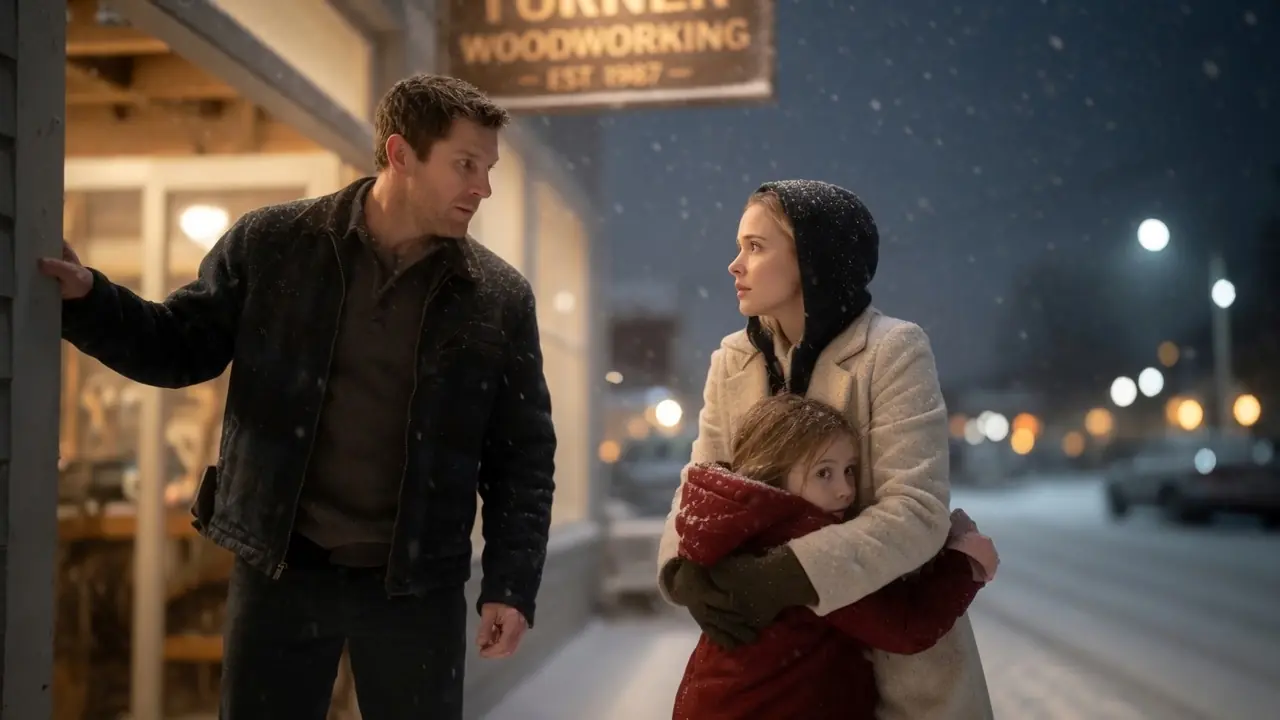
“Please,” the woman said, her voice nearly breaking beneath the wind. “My car died, and my child can’t stay out here another minute.”
Jack stepped into the snow without even reaching for his gloves. He was thirty-seven, broad-shouldered from years of carrying lumber, with sawdust still caught in his dark hair and a black work jacket zipped halfway over his flannel shirt. Behind him, warm yellow light poured from the workshop, spilling across the snow like an invitation. The woman looked at that light with the desperate hope of someone who had been trying not to panic.
“Come inside,” Jack said, opening the door wider. “Both of you. The storm can have the road, but it won’t have you.”
The woman hesitated, pulling the little boy closer. “I don’t have cash on me. I can’t pay you for this.”
Jack looked at the child’s red cheeks, the wet snow melting into his hair, and the tiny hands gripping his mother’s coat. Something in his chest tightened because he saw his own son, Ethan, at that age, frightened and cold and waiting for someone kind to make a decision. “I’m a single dad, ma’am,” Jack said softly. “When I see a child freezing in a storm, I don’t see money — I see my own son needing help.”
That was enough.
The woman stepped inside with her boy, and Jack pushed the door shut against the wind. The workshop wrapped around them with the smell of cedar, varnish, coffee, old tools, and the little electric heater struggling in the corner. Workbenches lined the walls, half-finished chairs hung from clamps, and a row of handmade cabinets waited beneath canvas sheets. The boy stared at the tools with wide, frightened eyes while his mother stood near the door like she was afraid to drip snow on the floor.
“You’re safe in here,” Jack said. “What’s your name?”
“Grace,” she answered, still trembling. “Grace Whitman. This is my child, Miles.”
Miles buried his face against her side and did not speak. He looked about six, with dark curls damp from the storm and a knitted scarf wrapped unevenly around his neck. Jack grabbed two old wool blankets from the shelf near the office, the ones he kept for customers whose cars broke down near the shop in winter. He handed one to Grace and crouched to wrap the other around Miles’s shoulders.
“There you go, buddy,” Jack said. “You like hot chocolate?”
Miles peeked up. “With marshmallows?”
Jack smiled. “If my son didn’t eat them all.”
Grace’s expression softened at the mention of another child. “Your son is here?”
“In the back office,” Jack said. “School closed early, sitter got snowed in, so he’s been building castles out of scrap wood all afternoon.” He glanced toward the office window, where eight-year-old Ethan slept curled on the old couch under a plaid blanket. “He lasted until about nine before he gave up.”
Grace followed his gaze, and for the first time since she entered, her shoulders lowered slightly. The fear on her face did not disappear, but it loosened. Jack filled the kettle from the small sink, set it on the hot plate, and moved around the shop with the quiet efficiency of a man used to handling trouble without making it louder. Outside, the storm slapped snow against the glass like handfuls of salt.
He tried her SUV first, but the engine only gave a weak cough before dying again. The battery was struggling, and the cold had made everything worse. Jack told Grace the truth without dressing it up. “I can probably get it inside the garage bay, check the battery, and see if the alternator is causing trouble, but you’re not driving anywhere tonight in this storm.”
Grace looked toward the door. “I was trying to reach Harbor View Inn before the roads closed.”
Jack frowned. “The old hotel on Cliff Road?”
She nodded. “Yes.”
“That place has been empty for years.”
“I know,” she said quickly, then looked away. “I had business there tomorrow morning.”
Jack noticed the careful way she said it, as if she was used to keeping her reasons folded away. He did not ask more. People who came in from storms were allowed to keep secrets until they warmed up.
He brought out hot chocolate in mismatched mugs, one with a crack near the handle and one painted by Ethan years ago with crooked blue stars. Miles took the star mug and held it with both hands, letting the steam warm his face. Grace sat on a stool near the heater, wrapped in the blanket, trying not to look as scared as she still felt. Her coat looked expensive, her boots even more so, but fear made everyone equal when the weather turned violent enough.
“Do you need to call someone?” Jack asked.
Grace lifted her phone. “No signal. I tried three times outside.”
“Landline works when it feels like it.” Jack pointed toward the office. “You can try from there.”
She stood, then paused. “Thank you.”
He nodded. “No need.”
While Grace made the call, Jack helped Miles choose a small block of cedar from the scrap bin. “You can sand the edges if you want,” he said, handing him a safe piece of sandpaper. “No sharp tools. Shop rule.”
Miles looked at the wood. “What do I make?”
“Whatever the wood lets you see.”
The boy studied it seriously. “A boat.”
“Good choice for a storm.”
A small smile appeared on Miles’s face, and Jack felt a quiet ache of relief. Children could be frightened one minute and building something the next if an adult made the room feel safe enough. Ethan had been that way after his mother died, clinging to Jack through nights that felt too large for either of them, then suddenly asking for pancakes or a pencil or a story about pirate ships. Grief and childhood had taught Jack that safety was sometimes just a warm room and someone calm nearby.
Grace came back from the office looking pale. “The inn’s caretaker answered. Roads are closed. He said nobody should attempt Cliff Road until morning.”
“Then you’re staying here,” Jack said.
Her eyes widened. “No, I can’t ask that.”
“You didn’t. I offered.”
“Mr. Turner—”
“Jack.”
“Jack, you’ve already done enough.”
He looked toward the storm-dark windows. “Not enough if I send you back out there.”
Grace swallowed. Pride and exhaustion fought across her face. Jack knew that look well. He had worn it in grocery stores, at school meetings, and in the bank office when he asked for more time on the shop loan. Accepting help could feel like handing someone a weapon if life had already taught you to expect judgment.
“There’s a cot in the finishing room,” Jack said. “Ethan and I have slept here plenty of times during big jobs. You and Miles can take the office couch and cot. I’ll stay out front.”
Grace’s eyes filled, but she blinked quickly. “You don’t know us.”
“No,” Jack said. “But I know the storm.”
They settled in slowly. Miles fell asleep first, curled on the office couch with the little cedar boat still in his hand. Ethan woke briefly when Jack checked on him, squinted at the strangers, then whispered, “Are they storm people?”
Jack smiled. “Something like that.”
“Did we help?”
“Yeah, buddy. We helped.”
Ethan nodded like that made perfect sense and went back to sleep. Grace stood in the office doorway, watching the exchange with a softness that looked almost painful. “He trusts you completely,” she said.
“He has to,” Jack replied. “It’s just us.”
“His mother?”
“Passed away five years ago.”
Grace’s face changed. “I’m sorry.”
“Me too.” Jack looked at Ethan’s sleeping face. “We figured out how to keep going.”
Grace nodded slowly, as if those words meant something to her beyond politeness. “Miles’s father left when he was two. He sends birthday cards sometimes, but not much else.”
Jack looked at the boy. “Then he’s lucky he has you.”
Grace gave a small, sad laugh. “Some days I’m not sure I’m enough.”
“No parent is enough every day,” Jack said. “We just try again the next morning.”
The storm carried the night forward. Snow piled against the garage door, the old roof groaned, and twice Jack had to step outside to clear drifting snow from the heater vent. Grace tried to help, but he told her to stay warm. When he came back in the second time, his hair crusted with snow, she had found a broom and was sweeping melted slush away from the front door.
“You don’t have to clean my shop,” he said.
“I can’t just sit here while you do everything.”
Jack looked around at the benches, the tools, the unfinished cabinets. “Most people don’t notice the mess unless they’re about to complain.”
Grace leaned the broom against the wall. “This isn’t mess. It’s work.”
That sentence stayed with him.
At around two in the morning, the power flickered. Jack lit two lanterns from the emergency shelf, and the workshop changed under the softer light. The wood glowed warmer, the tools cast long shapes, and Grace stood near a covered table where a nearly finished dining table waited beneath a sheet. She touched the edge of the canvas gently.
“May I?”
Jack nodded.
She lifted the sheet and uncovered a walnut table with a live edge, smooth as water, its grain running in dark waves from one end to the other. Grace stared at it for a long time. Her hand hovered above the surface but did not touch, as if the table deserved permission.
“You made this?” she asked.
“Yes.”
“It’s beautiful.”
Jack almost dismissed the compliment out of habit, but something in her face stopped him. She was not flattering him. She was seeing the work.
“It’s for a client who may not pay,” he said.
Grace looked at him. “Why not?”
“People love handmade until the invoice arrives.” He pulled the canvas back over it. “Shop’s been struggling. Big furniture chains, cheap imports, rising rent. I keep telling myself quality still matters, but quality has a hard time paying the electric bill on time.”
Grace was quiet.
Jack regretted saying that much. He did not usually share his worries with strangers, especially ones wrapped in his shop blanket at two in the morning. “Sorry,” he said. “Storm makes people too honest.”
“No,” Grace replied. “It makes people easier to hear.”
By morning, the storm had softened into pale snow drifting under a gray sky. The town plows had begun clearing the main road, though side streets were still buried. Jack made coffee, oatmeal, and toast from the emergency food he kept in the shop. It was not much, but Grace accepted it with real gratitude, and Miles ate like he had been rescued from a mountain.
Jack got the SUV into the garage bay once the snow near the door was cleared. The battery needed replacement, and the alternator belt was worn. He did what he could to make it road-safe, then called his parts supplier as soon as the phone lines stabilized. Grace watched him work with a look that was harder to read now.
When the battery was replaced and the engine finally started cleanly, Grace reached into her bag. “Please let me pay you.”
Jack shook his head. “Parts only.”
“That’s not fair.”
“It’s my shop. I decide fair.”
She frowned, almost annoyed. “You sheltered us all night, fed my son, fixed my car, and now you want to charge only for the battery?”
“That’s right.”
“Why?”
Jack tightened the last clamp, then looked at her. “Because I’m a single dad, Grace. When your SUV stopped outside my shop and I saw Miles in that snow, I saw my own kid needing help. I don’t charge extra for being human.”
Grace’s eyes shone again. “You make it very hard to thank you properly.”
“Parts receipt will do.”
She laughed softly, the first real laugh he had heard from her. She paid for the battery and belt, then helped Miles into the SUV. Before leaving, she stood under the Turner Woodworking sign and looked back at the shop.
“Jack,” she said, “if someone wanted to reach you about custom work, is the number on the sign current?”
He shrugged. “Barely. But yes.”
“Good.”
He did not know what that meant.
Three days passed. The storm melted into dirty piles along the road, and life returned to its usual difficult rhythm. Jack worked on overdue projects, took Ethan to school, argued with the landlord over the rent increase, and tried not to think too much about Grace Whitman. She felt like the kind of person who entered a hard night and disappeared with the weather.
Then, on Thursday afternoon, a black sedan pulled up outside Turner Woodworking.
Jack looked through the window and saw Grace step out, this time wearing a tailored navy coat instead of the pale storm coat. Behind her came an older man in a wool overcoat carrying a leather portfolio, and a younger woman with a tablet. Jack wiped his hands on a rag and opened the door before they knocked.
Grace smiled. “Hello, Jack.”
“Grace.” He glanced at the others. “Car trouble again?”
“No.” Her smile deepened slightly. “Business.”
Jack let them inside, confused. Ethan was at school, the shop was half-clean at best, and sawdust covered one sleeve of Jack’s shirt. Grace looked around like she had returned to a place she had been thinking about. The man with the portfolio introduced himself as Martin Cole, general counsel for Whitman Heritage Properties.
Jack stared. “Whitman as in Whitman Harbor Group?”
Grace nodded. “My family owns it. I run the restoration division.”
For a moment, Jack said nothing. Whitman Harbor Group owned historic inns, coastal hotels, and restored waterfront buildings from Maine to Rhode Island. Their projects appeared in magazines. Their budgets were the kind of numbers small craftsmen talked about like weather systems: large, distant, and capable of changing everything.
“You were going to Harbor View Inn,” Jack said slowly.
“Yes,” Grace replied. “We bought it last month.”
“That old hotel?”
“We’re restoring it.”
Jack looked around his shop, then back at her. “And you didn’t mention that because…”
“Because that night I wasn’t a developer. I was a mother with a dead car and a cold child.” She paused. “And you treated me better before you knew my name than many people treat me after learning it.”
Martin opened the portfolio and placed several pages on Jack’s workbench. “Ms. Whitman has reviewed your portfolio, local reputation, and craftsmanship. She requested we speak with you regarding a contract.”
Jack blinked. “A contract for what?”
Grace stepped toward the covered walnut table. “For the Harbor View Inn. We need custom lobby furniture, dining tables, reception desks, guest room headboards, built-in shelving, and restoration woodwork that respects the original building.” She looked at him directly. “I want Turner Woodworking to submit the primary bid.”
Jack’s throat tightened. “Grace, I’m a small shop.”
“I know.”
“I don’t have a big crew.”
“I know.”
“I can’t compete with factories.”
“I’m not asking for factory work. I’m asking for the kind of work I saw under that canvas at two in the morning.”
He looked at the papers. The preliminary scope was larger than anything he had ever touched. It would mean months of work, enough money to pay the rent, hire help, replace failing equipment, and maybe stop living one bad invoice from disaster. It was the kind of offer that sounded too good because life had trained him to distrust sudden rescue.
“I can’t accept charity,” Jack said.
Grace’s face softened. “Good. I’m not offering it.”
Martin slid another page forward. “This is a paid design consultation agreement. If you choose to proceed, you will be compensated for drawings, samples, and site planning before any full contract is awarded.”
Jack looked at Grace. “You came prepared.”
“I told you,” she said. “Business.”
His eyes moved to the office, where Ethan’s drawings were taped to the wall. One showed Jack standing beside the shop with a hammer in one hand and a cape on his back. Ethan had written “Dad fixes things” in crooked letters above it. Jack felt something inside him crack open, not with weakness, but with the terrifying possibility of relief.
“Why me?” he asked again, quieter this time.
Grace glanced toward the office where Miles had slept through the storm. “Because when the world was at its worst outside your door, you opened it. Because your work is honest. Because my son still carries that little cedar boat in his backpack.” Her voice trembled slightly. “And because I know what it means to be a single parent trying to keep a life from falling apart while pretending you’re not tired.”
Jack looked away.
For years, he had believed no one really saw the exhaustion. Customers saw the finished chair. The bank saw the numbers. Ethan saw the smile Jack forced at breakfast. But Grace had seen him in the middle of the storm, soaked, worried, late for his own son, still choosing kindness.
That mattered.
He picked up the consultation agreement. “I’ll review it.”
Grace smiled. “That’s all I’m asking.”
The weeks that followed changed Turner Woodworking slowly, then all at once. Jack visited Harbor View Inn with Grace and her team, walking through dusty rooms where ocean light fell across peeling wallpaper and old beams waited to be restored. The building had history in every scar: worn banisters, cracked mantels, carved trim hidden beneath layers of paint. Jack touched the wood the way some men read letters.
He submitted designs for the lobby table, reception desk, and guest room headboards. Grace approved the first round with only minor changes. Then the full contract came through.
Jack sat alone in the shop office after reading the final number.
For a long time, he could not move.
When Ethan arrived after school, he found his father sitting with both hands pressed over his face. “Dad?” he asked, scared.
Jack looked up quickly and smiled through tears he had not meant to show. “We got the job, buddy.”
“The big one?”
“The big one.”
Ethan ran into his arms, and Jack held him tightly, laughing and crying at the same time. He had not realized how much fear he had been carrying until hope finally made it too heavy to hide. That night, they ate pizza on the workshop floor and called it a celebration.
By spring, Turner Woodworking had hired two more craftsmen and an apprentice from the local vocational school. The shop lights stayed on late, but not with the desperation they once had. Wood arrived in steady shipments. Tools were repaired. Invoices were paid on time. Jack still worked harder than almost anyone, but the work no longer felt like a man bailing water from a sinking boat with his bare hands.
Grace came by often, sometimes with Miles, who always asked to see the scrap bin. Ethan and Miles became friends in the easy way children do when adults stop making things complicated. They built wooden boats, raced them in rain puddles behind the shop, and argued over whose design was more seaworthy.
One evening, Grace arrived after closing with two coffees and found Jack sanding the edge of the first completed lobby table. The shop smelled of walnut and fresh finish. Snow was gone now, replaced by rain tapping softly against the windows.
“It’s better than I imagined,” she said.
Jack looked at the table. “It fought me for three weeks.”
“Good things often do.”
He smiled. “You sound like someone who owns old buildings.”
She set one coffee near him. “And raises a stubborn child.”
They stood together beside the table. For a moment, neither spoke. Their lives were still complicated, full of grief, responsibility, schedules, and old fears. Jack was careful not to mistake gratitude for something more, and Grace was careful not to make promises out of relief. But there was warmth between them now, quiet and real.
“Do you ever think about that night?” she asked.
“Storm night?”
She nodded.
“Every time I lock the door.”
Grace looked toward the front windows and the old sign above them. “I almost kept driving. I thought if I stopped, I’d be admitting I couldn’t handle everything alone.”
Jack understood that too well. “Stopping saved you.”
“No,” she said softly. “Your opening the door did.”
Months later, Harbor View Inn reopened with handmade furniture from Turner Woodworking in nearly every public room. Guests ran their hands over Jack’s tables and asked where they came from. Magazine photographers took pictures of the lobby, the reception desk, the guest room headboards, and the carved sign Jack made for the front entrance. Grace made sure every press release mentioned Turner Woodworking by name.
The shop became known beyond Briarport. Orders came from restaurants, inns, and homeowners who wanted real craftsmanship. Jack did not become rich overnight, and he would have hated anyone saying he did. But he became stable. His son had new boots before winter came. The rent was paid six months ahead. The old heater was replaced before it failed.
One year after the storm, Jack hung a small cedar boat above the office door.
Miles had made it that first night, sanded unevenly, its sides lopsided, its bow too blunt. Grace had asked if they could keep it, but Miles insisted the shop should have it because “this is where boats get rescued.” Jack mounted it on a little shelf, and Ethan wrote the date beneath it.
On the anniversary of that storm, Grace and Miles came to the shop with dinner. Ethan opened the door before Jack could, shouting their names like family. Outside, light snow fell gently over the street, nothing like the storm that had brought them there. Grace stood beneath the Turner Woodworking sign, smiling at Jack with quiet emotion.
“You still letting storm people in?” she asked.
Jack stepped aside and opened the door wider. “Always.”
They ate inside the workshop at a long table Jack had built from leftover walnut. The children laughed over hot chocolate, Grace told stories about the inn’s first guests, and Jack listened with a peace he had not known for years. At one point, he looked around the shop and remembered how close he had come to losing it.
All because of a storm.
All because a car died outside his door.
All because a single mother had been brave enough to ask for help, and a single father had been tired but decent enough to give it.
Later, after Grace and Miles left, Ethan helped Jack sweep the floor. The boy looked up at the cedar boat above the office door. “Dad,” he said, “do you think helping them saved the shop?”
Jack leaned on the broom. “In a way.”
“So we should always help people?”
Jack smiled. “We should help because it’s right. Not because we know what comes back.”
Ethan thought about that seriously. “But sometimes good comes back?”
“Sometimes,” Jack said. “Sometimes it comes back through the front door wearing a snow-covered coat.”
That night, after Ethan fell asleep, Jack stood alone in the workshop. The lights glowed against the wood, the tools were clean, and the storm outside was only a soft whisper now. He ran his hand over the edge of the walnut table and thought about Grace’s first words, Miles’s frozen hands, the old blanket, and the way the shop had become shelter before it became saved.
Jack Turner had opened his door because he was a single dad who saw a child in danger.
He did not know Grace Whitman’s name mattered. He did not know she owned buildings, signed contracts, or had the power to change the future of his failing shop. He only knew that no mother and child should stand outside in a winter storm while warm light waited on the other side of a door.
And sometimes, that is the moment that changes everything.