The rain pounded against the empty streets of Cincinnati that night, making the dim streetlights blur into trembling halos of yellow mist.
Water rushed along the curbs in dark ribbons. Gutters overflowed.
The bare branches of maple trees scraped against one another like tired bones.
Every house on Birchwood Lane seemed sealed tight against the storm, curtains drawn, porch lights glowing softly, families tucked safely behind locked doors and warm windows.
But one young woman was still outside.
She walked quickly along the sidewalk, clutching her thin jacket to her chest with both hands. Her hair was drenched, plastered against her face and neck.
Her shoes squelched with every step, soaked through from the rain that had been falling for nearly an hour. Her lips quivered, not only from the cold, but from the weight of something heavier.
Fear.
Her name was Olivia Bennett.
She was twenty-four years old, though the night had aged her. In the cold glow of the streetlights, her face looked pale and hollow, her mascara streaked down her cheeks in dark, uneven trails.
She carried no suitcase. No purse. No umbrella.
Only a small backpack, half-zipped and hanging from one shoulder, as if she had packed in such a hurry that survival had mattered more than order.
Every few steps, she glanced behind her.
Not casually.
Not once or twice.
Again and again.
Like she expected someone to appear from the darkness and call her name.
She had been walking for nearly two miles.
At first, she had moved fast because panic gave her strength. But panic did not last forever. Fear burned hot, then left a body shaking and weak. Now her knees ached. Her stomach twisted. Her hands had gone numb around the broken strap of her backpack.
She did not know this neighborhood.
That was why she had chosen it.
She had turned down streets at random after getting off the bus, crossing blocks she had never seen before, hoping unfamiliar roads might make her harder to find. The houses here were small but cared for. Front lawns trimmed low. Children’s bicycles leaned against garages. Wind chimes clattered under porch roofs. In one window, a Christmas cactus bloomed early in a ceramic pot.
Ordinary homes.
Safe homes.
Homes that belonged to people who had not spent the past hour wondering if they would have to sleep under a bridge.
Olivia slowed near a small white house at the end of the block.
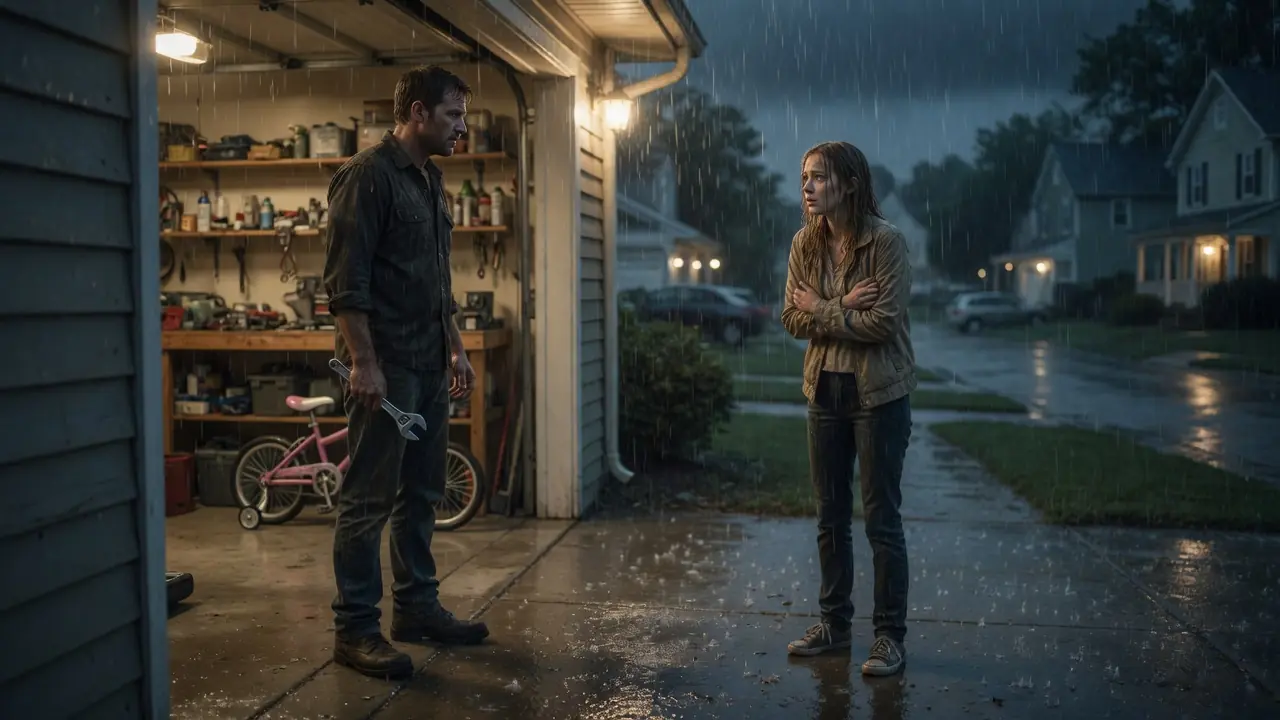
It was modest, with blue shutters, a narrow porch, and a detached garage set slightly behind the driveway. A single bulb glowed inside the garage, throwing light onto the wet concrete. The garage door was open halfway, and inside, a man stood at a workbench putting tools away.
A bicycle leaned against the wall beside him.
A little girl’s bicycle.
Pink frame. White basket. Purple streamers hanging from the handlebars.
Olivia stopped.
Her chest tightened.
The sight of that small bicycle did something to her.
It reminded her that children lived here. That this was not just a stranger’s house, but someone’s home. Someone’s safe place. She had no right to step into it carrying her storm.
She should keep walking.
But where?
Her shoes were soaked. Her phone was dead. Her money was gone. The bus station was too far now, and even if she reached it, she had nowhere to go after that. She had already called the one friend she thought might take her in, but the call had gone unanswered before her phone died.
She stared at the garage light.
The man inside wore dark jeans, work boots, and a gray sweatshirt with the sleeves pushed up. His hands were rough, blackened slightly with grease. He moved with the tired precision of someone ending a long day, wiping each tool before setting it in its proper place.
Olivia took one step forward.
Then stopped.
Her voice came out barely above the rain.
“I have nowhere else to go.”
The words disappeared into the storm.
She stood there for another moment, trembling.
Then she walked up the driveway and knocked lightly on the side of the garage door.
Inside, Michael Turner adjusted the wrench on his workbench and reached for an old rag.
It had been another exhausting day at the auto repair shop. A transmission job had run two hours over schedule. Mrs. Alvarez’s minivan needed a part that would not arrive until Monday. His boss had mentioned, not unkindly but clearly, that overtime was becoming a problem. Then Michael had come home, made boxed macaroni and cheese for dinner, helped his eight-year-old daughter Grace with multiplication homework, washed dishes, packed her lunch, and spent forty minutes trying to fix the chain on her bicycle.
Now, at almost nine-thirty, all he wanted was to finish putting away his tools, check the locks, and sit for ten quiet minutes before bed.
Ten minutes.
That was all he asked from the universe most nights.
Since his wife had passed away three years earlier, Michael had learned to ask for small things.
A full night’s sleep.
A bill that could wait another week.
A morning when Grace did not cry because she could not remember her mother’s voice clearly.
A day when he did not feel like he was failing at every role he had been left to carry alone.
He was thirty-five years old, but some mornings he looked at himself in the bathroom mirror and saw a man ten years older. There were lines near his eyes that had not been there before Rebecca died. His shoulders had grown strong from work and tense from worry. He had learned how to braid Grace’s hair by watching videos online. He had learned which cough required medicine and which required a humidifier. He had learned how to smile when his daughter looked at him across the dinner table and asked questions that had no answer.
“Is Mommy lonely in heaven?”
“Can she see my spelling test?”
“If I forget her laugh, does that mean I don’t love her anymore?”
Michael had learned that grief did not end.
It changed rooms.
Some days it sat beside him in the truck.
Some days it waited in the grocery aisle when he saw Rebecca’s favorite tea.
Some days it slept lightly and let him laugh.
But it was always somewhere in the house.
That night, he thought the hard part of the day was over.
Then came the knock.
At first, he thought it was the storm.
A loose branch, maybe.
Then it came again.
Soft.
Human.
Michael froze.
He looked toward the half-open garage door.
No one visited at this hour.
Not in weather like this.
He reached instinctively for the heavy flashlight on the bench. Not a weapon exactly, but something solid in his hand. Then he walked toward the garage opening and lifted the door the rest of the way.
When he saw her, he stopped.
A young woman stood in the driveway, soaked from head to toe.
She was maybe in her early twenties, though fear made her look younger. Her thin jacket clung to her shoulders. Rain dripped from her hair onto her cheeks, mixing with black mascara trails. Her arms were folded tightly over her chest, and she kept one foot angled as if ready to run.
Her eyes were what stopped him.
Michael had seen fear before.
He had seen it in customers who could not afford repairs but needed their cars to keep their jobs. He had seen it in Grace the night Rebecca did not come home from the hospital. He had seen it in his own reflection during the first year of single fatherhood.
The woman’s fear was not dramatic.
It was exhausted.
The kind that had been running too long.
“Please,” she whispered. “I just… I don’t know where else to go.”
Michael’s grip tightened around the flashlight.
Every instinct he had as a father told him to be cautious.
There was a child in the house.
His child.
He could not afford to be reckless.
“What happened?” he asked.
The woman flinched at the question.
Not because it was harsh.
Because answering seemed impossible.
“I had to leave,” she said. “I’m not in trouble. I didn’t do anything wrong. I just couldn’t stay there.”
Her voice broke on the last word.
Michael opened his mouth, unsure what to say.
Then Grace’s small voice came from behind him.
“Daddy? Who’s that?”
He turned sharply.
Grace stood in the doorway between the garage and the house, wearing blue pajamas with stars on them, her brown hair loose around her face, one hand rubbing sleep from her eye.
“Grace,” he said quietly, “go back inside.”
But she had already seen Olivia.
Her eyes widened.
The young woman looked down quickly, ashamed, as if even being seen by a child was too much.
Grace stepped closer to Michael’s side.
“She’s wet,” Grace whispered.
“I know.”
“She looks scared.”
Michael looked at his daughter.
Then back at the stranger in the rain.
There are moments in life when caution and compassion stand on opposite sides of a door.
Michael knew caution was sensible.
But he also knew that sensibility, if worshiped too long, could become cowardice.
He drew a slow breath.
“You can come inside for a few minutes,” he said carefully. “Just to get dry.”
Olivia blinked.
Like she had expected refusal so completely that acceptance confused her.
“I don’t want to cause trouble.”
“You’re standing in a storm,” Michael said. “Come in.”
He stepped back.
She entered the garage slowly, then the house, leaving small wet footprints on the mat.
Grace ran ahead.
“I’ll get a towel.”
“Grace—”
But she was already gone.
Inside, the warmth of the living room wrapped around Olivia like a fragile blanket.
The house smelled faintly of motor oil from Michael’s clothes, lavender laundry detergent, and the chicken noodle soup he had heated for Grace after dinner because she had complained her throat felt scratchy.
It was not a fancy home.
Two bedrooms. One bathroom. A narrow kitchen with old cabinets. A living room with a sagging couch, a recliner, a bookshelf, and framed photographs on the wall. Grace’s school drawings covered the refrigerator. A basket of clean laundry sat unfolded near the hallway. One lamp had a crooked shade.
But to Olivia, it felt unreal.
A child’s drawing of a rainbow.
A pair of small sneakers by the door.
A folded blanket on the couch.
The sound of a heater humming steadily.
Warmth.
Ordinary warmth.
She stood just inside the living room, unsure where to put herself.
Grace returned with a towel nearly as large as she was.
“Here,” she said, holding it out.
Olivia took it with trembling hands.
“Thank you.”
Grace watched her seriously.
“You can sit on the couch. It’s okay if you’re wet. Daddy spills coffee sometimes.”
“I spilled coffee one time,” Michael said.
Grace gave him a look.
“Twice.”
Michael sighed.
“Twice.”
Olivia almost smiled.
Almost.
Michael noticed.
It changed her face for half a second, revealing someone much younger beneath the fear.
“Sit,” he said gently.
She sat on the very edge of the couch, as if afraid to leave too much of herself on it. Grace disappeared again and returned with a blanket, then a stuffed bear with one button eye and a worn ribbon around its neck.
Michael watched and felt an ache in his chest.
That bear was special.
Grace usually kept it for nights when she missed Rebecca.
“You can borrow him,” Grace said solemnly, placing the bear beside Olivia. “His name is Mr. Waffles. He helps when you feel scared.”
Olivia stared at the bear.
Something in her face collapsed.
Not all the way.
Just enough.
“Thank you,” she whispered, touching one soft paw.
Michael went to the kitchen and made hot cocoa because it was the only thing he could think to do that did not require too many questions.
When he returned, Olivia sat wrapped in the blanket with the towel around her shoulders, Mr. Waffles resting awkwardly in her lap. Grace had curled into the armchair, watching her with open concern.
Michael handed Olivia a mug.
“Careful. It’s hot.”
She held it in both hands like it was something precious.
He sat in the recliner across from her, not too close.
“All right,” he said quietly. “I don’t need every detail tonight. But I need to ask one thing. You’re not in trouble with the law, right?”
Her eyes widened.
She shook her head quickly.
“No. Nothing like that. I didn’t steal anything. I didn’t hurt anyone. I just…” She swallowed hard. “I couldn’t stay where I was anymore.”
The words carried weight.
Michael nodded slowly.
“Okay.”
He did not push.
He wanted to.
Part of him needed information to feel safe.
But another part of him recognized the look in her eyes. Too much pressure, and she might break or run. So he stayed quiet.
Grace yawned.
Michael looked at the clock.
“Bed, kiddo.”
“But—”
“Grace.”
She looked at Olivia.
“Are you staying?”
Olivia’s fingers tightened around the mug.
“I don’t know.”
Grace turned to Michael.
“Daddy?”
Michael exhaled slowly.
“She can stay tonight.”
Grace nodded, satisfied, as if the matter had been legally settled.
“Good. It’s too rainy outside.”
Michael stood.
“Come on.”
Grace hugged Olivia before leaving the room.
Olivia stiffened at first, then gently hugged her back.
It was brief.
Awkward.
But real.
Michael tucked Grace into bed a few minutes later.
She lay beneath her quilt, staring up at him.
“Daddy?”
“Yeah?”
“Is she like us?”
Michael paused.
“What do you mean?”
“Sad.”
His throat tightened.
“Maybe.”
“Then we should help her.”
He brushed hair from her forehead.
“We’ll help for tonight. Tomorrow we’ll figure out what’s safe.”
Grace nodded.
“Mommy would help her.”
Michael closed his eyes briefly.
“Yes,” he whispered. “She would.”
When he returned to the living room, Olivia was still awake, sitting upright and staring at the rain tapping against the window.
She looked ready to apologize for existing.
“Thank you for letting me stay,” she said. “Even just tonight.”
Michael stood in the doorway.
“You don’t have to go back out there tonight.”
She turned toward him.
“Are you sure?”
“No,” he said honestly.
The answer surprised her.
He stepped into the room.
“I’m not sure about anything. I have a daughter asleep down the hall, and I don’t know you. But I know you were scared enough to knock on a stranger’s garage door in the rain. I know you’re cold. I know you said you couldn’t stay where you were.”
He paused.
“That’s enough for tonight.”
Olivia looked at him like she had forgotten people could say such things without wanting something in return.
“I can leave in the morning.”
“We’ll talk in the morning.”
She nodded.
Michael brought clean sheets, another blanket, and one of his old sweatshirts.
“The bathroom’s down the hall. You can change if you want. I’ll be in my room. Door stays closed. Grace’s room is across from mine.”
He hesitated.
“If you need anything, knock.”
Olivia looked at the sweatshirt.
Then at him.
“I don’t know how to thank you.”
“Sleep,” he said. “That’s enough.”
Later, long after the house had gone quiet, Michael lay awake staring at the ceiling.
Rain tapped steadily against the windows.
Grace slept down the hall.
A stranger slept on his couch.
A frightened young woman with mascara on her cheeks and a story he did not know.
Every sensible thought in him said this was too much, too sudden, too risky.
But beneath the worry was something else.
A memory of Rebecca.
Not sick in bed.
Not pale in the hospital.
Rebecca in the kitchen years ago, handing a casserole to a neighbor who had lost his job.
Michael had told her once that she could not save everyone.
She had smiled and said, “No. But I can keep from becoming the kind of person who stops seeing them.”
Michael turned onto his side.
He did not sleep for a long time.
The next morning smelled of pancakes and coffee.
Olivia woke to the sound of sizzling batter and Grace talking nonstop about fractions.
For one disoriented second, she forgot where she was.
Then she remembered.
The garage.
The rain.
The couch.
Mr. Waffles still tucked near her elbow.
She sat up quickly, panic rising.
She had slept too late.
She had taken up space.
She had let herself rest.
In the kitchen, Michael stood at the stove flipping pancakes with uneven confidence. Grace sat at the table in her school uniform, swinging her feet.
When Olivia appeared in the doorway, Michael looked over.
“Morning.”
“I’m sorry,” she said immediately.
“For what?”
“Sleeping late.”
“It’s seven.”
“That’s late.”
“Not in this house on a Saturday.”
Grace grinned.
“Daddy burns pancakes if he makes them too early.”
“I do not burn pancakes. I create texture.”
“You burned them last week.”
“They were deeply browned.”
Olivia stood uncertainly.
“I should go.”
Michael placed a pancake on a plate.
“Sit first.”
“I don’t want to impose.”
“You’re not.”
“I am.”
Grace pointed to a chair.
“Birthday pancakes.”
Olivia blinked.
“It’s not my birthday.”
“I know. But pancakes are like birthdays if you put syrup.”
Michael looked at Olivia.
“You don’t have to stay, but there’s food.”
Hunger answered before pride could.
She sat.
Her hands trembled slightly around the fork.
Michael noticed but said nothing.
Grace did most of the talking.
She explained that she was in third grade, that math was “rude,” that her best friend Ava had a hamster, and that her bicycle was almost fixed except Daddy kept “saying bad words at the chain under his breath.”
“I do not say bad words.”
Grace looked at Olivia.
“He says garage words.”
Olivia laughed.
It startled everyone, including herself.
The laugh was small and rusty from disuse, but it was real.
Michael looked at her for half a second longer than he meant to.
After breakfast, Grace went to her room to get dressed for a friend’s birthday party later that afternoon. Michael poured more coffee and sat across from Olivia at the kitchen table.
The morning light made her look even younger.
Her hair was dry now, falling in loose waves around her face. Without the rain and mascara, he could see the faint freckles across her nose, the exhaustion beneath her eyes, and the guardedness in the way she held herself.
“You said your name is Olivia,” he said.
She nodded.
“Olivia Bennett.”
“Do you have someone I can call for you?”
“No.”
“Family?”
Her jaw tightened.
“No one who would help.”
“Friend?”
“My phone died before I could reach her. I don’t remember her number by heart.”
“Do you want to charge it?”
She reached into her backpack and pulled out the dead phone.
“I don’t have the charger.”
Michael took it gently.
“What kind?”
She told him.
He nodded.
“I have one in the garage.”
He brought it, plugged in the phone, and set it on the counter.
While they waited, Olivia stared at her hands.
“I know this looks bad.”
Michael leaned back.
“It looks like you had a hard night.”
“It was more than one night.”
He waited.
Her throat moved.
“I left my stepfather’s house.”
The word stepfather came out flat and cold.
Michael said nothing.
“My mom remarried when I was sixteen. At first, he was charming. Everyone loved him. Church people, neighbors, my teachers. He knew how to look kind in public.”
She rubbed her thumb over a small scar near her wrist.
“At home, he was different.”
Michael felt something hard settle in his chest.
Olivia glanced at him quickly.
“He didn’t… I mean, I don’t want to talk about everything.”
“You don’t have to.”
“He controlled things. Money. Food. Where I went. Who I talked to. If I disagreed, he said I was ungrateful. If I cried, he said I was dramatic. My mom believed him because believing me would have meant admitting she brought danger into the house.”
Her voice shook, but she continued.
“I moved out once, but after losing my job, I had nowhere else to go. So I went back. I told myself it would only be temporary.”
She looked toward the living room window.
“Last night, he got angry because I talked back. I saw his face and realized if I stayed, I might never leave.”
Michael’s hands curled around his coffee mug.
He was careful not to let his anger frighten her.
“So you left.”
“I ran.”
“That’s not the same as leaving.”
“It felt like failing.”
“No.”
His voice came out firmer than he intended.
Olivia looked at him.
Michael took a breath.
“No,” he repeated, softer. “That sounds like surviving.”
Her eyes filled.
She looked away.
“I don’t want to bring trouble to your house.”
“You said he doesn’t know where you are.”
“He might guess I went to my friend, but not here. I don’t even know where here is exactly.”
“Good.”
The phone screen lit up.
Olivia grabbed it, entered her code, and waited.
No messages from her mother.
Three missed calls from her stepfather.
One voicemail.
She did not play it.
Her face went pale.
Michael noticed.
“You don’t have to listen to that.”
She powered the phone off.
“I can’t.”
“Then don’t.”
That morning, Michael helped her call a domestic violence hotline from his phone, not because he knew what to do, but because he knew he needed people who did. They spoke to a counselor who helped Olivia make a safety plan, gave her shelter options, and explained steps she could take without pressure.
There was no immediate bed available.
The nearest shelter had a waitlist.
Another could possibly take her in two days.
Michael wrote everything down.
Olivia sat beside him, silent, eyes lowered.
When the call ended, she stood.
“I’ll go to the bus station until then.”
“No,” Grace said from the hallway.
Both adults turned.
Grace stood holding her party dress, face serious.
“You said no one should sleep at the bus station.”
Michael closed his eyes.
“Grace, this is grown-up talk.”
“She can stay here.”
Olivia shook her head.
“No, sweetheart. I can’t.”
“Why?”
“Because it’s too much.”
Grace frowned.
“If someone is drowning, do you only help them for one minute?”
The kitchen went quiet.
Michael looked at his daughter.
Then at Olivia.
Rebecca again.
Everywhere, Rebecca.
Michael rubbed a hand over his face.
“Two nights,” he said.
Olivia looked at him.
“Michael—”
“Two nights while we figure out a safe place. We keep boundaries. We keep checking resources. We don’t pretend this is simple. But you don’t sleep in a bus station.”
Olivia’s eyes filled again.
“I can help. I can clean. Cook. Watch Grace. Anything.”
“You don’t have to earn safety.”
The words landed hard.
Olivia sat back down as if her knees had given way.
Grace walked over and put the party dress on the chair.
“Also,” she said, “you can come to Ava’s party if you want. They have cupcakes.”
Michael almost laughed from pure emotional exhaustion.
Olivia did not go to the party.
She stayed at the house, showered again, washed her clothes, and slept for four hours in the quiet afternoon while Michael took Grace.
When they returned, Olivia had folded the couch blankets into a neat square and cleaned the kitchen so thoroughly that Michael stood in the doorway confused.
“You cleaned.”
“I needed something to do.”
“You scrubbed the microwave.”
“It needed attention.”
“I’m afraid to ask what else needed attention.”
“The spice shelf is now logical.”
“It wasn’t before?”
“No.”
He looked at her.
She looked back.
Then both smiled.
That was the first easy moment.
It did not change everything.
But it mattered.
Days became a week.
The shelter bed fell through when an emergency case took priority. Then a winter storm swept through Cincinnati, shutting down buses and closing half the city. Michael told himself each extension was temporary.
One more night.
Then two.
Then until Monday.
Then until the appointment with the caseworker.
Olivia moved through the house like a guest afraid of being accused of taking too much air.
She washed every dish she used.
Folded blankets.
Asked before touching anything.
Kept her backpack packed near the couch.
Michael noticed and hated it.
But slowly, the house began to change.
Not because Olivia tried to take it over.
Because she paid attention.
She learned that Grace liked her cereal dry in a bowl with milk on the side because soggy cereal was “a crime.”
She learned Michael took his coffee black when tired, with sugar when sad, though he did not seem aware of this himself.
She learned the hallway floorboard near the bathroom creaked unless stepped on at the edge.
She learned that the living room lamp flickered if the cord was not tucked under the table leg just right.
She learned that Grace liked bedtime stories with voices, and Michael tried but always made every character sound like a mechanic explaining a carburetor.
On the fourth night, Grace brought Olivia a book and asked her to read.
Olivia looked at Michael first.
He nodded.
She sat on the edge of Grace’s bed and began.
Her voice changed with each character.
Soft for the rabbit.
Deep and silly for the bear.
Tiny and squeaky for the mouse.
Grace giggled so hard she kicked the blanket off.
Michael stood in the hallway, unseen, listening.
For the first time in three years, bedtime did not feel like a duty he was performing alone.
It felt like a room with warmth in it.
That frightened him.
Not because Olivia had done anything wrong.
Because he knew how quickly warmth could become need.
And need could become loss.
He kept reminding himself that she was healing.
That he was grieving.
That Grace was attached too easily.
That gratitude and tenderness could be mistaken for something else.
So he stayed careful.
Polite.
Kind, but measured.
Olivia noticed.
Of course she did.
She had spent years reading moods for survival. Michael was easier to read because he did not hide his kindness well.
He never stood too close.
Never asked too much.
Never made her feel watched in the wrong way.
He gave her space, and somehow that space made her feel more seen than attention ever had.
Two weeks in, Olivia found part-time work at a small bakery near Grace’s school.
It was not glamorous.
Morning prep, counter help, cleaning trays, packaging orders.
But the owner, Mrs. Patel, had kind eyes and a practical manner Olivia trusted.
“You can start with three shifts,” Mrs. Patel said. “If you show up on time, we talk about more.”
Olivia showed up twenty minutes early.
Every shift.
Her first paycheck was small, but she held it in both hands in Michael’s kitchen and cried.
Grace panicked.
“Are you sad?”
“No,” Olivia said, laughing through tears. “No, I’m happy.”
“Happy crying is confusing.”
“It is.”
Michael leaned against the counter, smiling softly.
“You earned that.”
Olivia looked at him.
The words mattered more than he knew.
Earned.
Not given.
Not rescued.
Earned.
She paid Michael twenty dollars that evening.
He refused.
She put it in the coffee can on top of the refrigerator anyway.
“What’s that?” he asked.
“Rent.”
“No.”
“Yes.”
“Olivia.”
“I need to contribute.”
He saw her face and stopped arguing.
“All right,” he said. “House fund.”
“Rent.”
“House fund.”
She narrowed her eyes.
“Fine. House fund.”
Grace raised her hand.
“I vote some house fund goes to pizza.”
“Motion denied,” Michael said.
“Democracy is broken.”
Olivia laughed.
Weeks became months.
Not because anyone planned it.
Because life kept happening.
The shelter waitlist remained uncertain.
Olivia’s bakery hours increased.
Michael helped her look for rooms to rent, but prices were too high and listings too suspicious.
Then Mrs. Alvarez down the street mentioned her cousin had a small studio above a garage that might open in spring.
Spring was three months away.
Michael and Olivia had the conversation at the kitchen table.
A serious one.
Grace was asleep.
Rain tapped softly against the window, gentler than the storm that had brought Olivia there.
“I can’t stay on your couch forever,” Olivia said.
“I know.”
“I don’t want people talking.”
“People already talk.”
“That doesn’t bother you?”
“It bothers me less than you sleeping somewhere unsafe.”
“It could affect Grace.”
“That matters.”
They sat with that truth.
Michael rubbed his thumb along the edge of his mug.
“Here’s what I think. You stay until the studio opens or until we find something safe. We keep things clear. You’re not a maid. You’re not a nanny. You’re not here because you owe me. You work. You save. You heal.”
Olivia’s voice was soft.
“And what am I to Grace?”
Michael looked toward the hallway.
The question was harder.
“Someone she loves,” he said.
Olivia closed her eyes.
“That scares me.”
“Me too.”
“What if I leave and hurt her?”
“Then we handle it honestly.”
“What if I stay and hurt her?”
He looked at her then.
“Do you plan to?”
“No.”
“Then we stop punishing ourselves for damage other people did.”
Olivia stared at him.
“That sounds like something your wife would have said.”
Michael’s face shifted.
Pain crossed it, but not anger.
“Maybe.”
“I’m sorry.”
“No. It’s okay.”
“Do you still love her?”
“Yes.”
Olivia nodded.
The answer hurt in a clean way.
It also made her trust him more.
Michael continued.
“I always will. But love doesn’t always stay the same shape.”
The room went quiet.
Olivia looked down at her hands.
“What shape is it now?”
Michael thought for a long time.
“Some days it’s grief. Some days gratitude. Some days it’s Grace laughing and looking exactly like her mother. Some days it’s me not knowing what to do with the fact that the house feels less empty lately.”
Olivia’s breath caught.
Michael looked away.
“I shouldn’t have said that.”
“I’m glad you did.”
Neither moved.
The rain continued.
Something between them shifted, not into romance yet, but into recognition.
They were two people standing on separate edges of loss, looking across and realizing the distance was not as wide as it had been.
Grace became the bridge before either adult admitted there was a river.
She wanted Olivia at school events.
At first, Michael hesitated.
Then Grace’s teacher asked, “Is Miss Olivia family?”
Grace answered, “Yes.”
No one corrected her.
Olivia began attending Grace’s soccer games, though she knew nothing about soccer and cheered at the wrong moments. Grace thought this was hilarious. Michael pretended to be embarrassed and secretly loved it.
Friday nights became movie nights.
Olivia made popcorn with too much butter.
Grace chose the movie.
Michael pretended to complain about cartoons but always stayed until the end.
Sometimes Grace fell asleep between them on the couch.
At first, there was distance.
Grace in the middle.
Then, over time, a sleeping child became less of a barrier and more of a shared tenderness.
One Friday in March, Grace fell asleep with her head on Olivia’s lap and her feet on Michael’s leg.
Olivia looked down at the little girl, brushing hair gently from her forehead.
“What is it?” Michael asked softly.
Olivia smiled through tears.
“I used to think family was something you had to be born into.”
Michael waited.
“Now I think maybe family is whoever stays.”
He looked at Grace.
Then at Olivia.
“Yeah,” he said quietly. “I think you’re right.”
Their first almost-kiss happened in April.
It was entirely Grace’s fault, though she would later deny responsibility.
Grace had a fever, not dangerous, but high enough to scare Michael because any illness still brought back memories of hospital rooms and helplessness. Olivia stayed up with him through the night, taking turns checking Grace’s temperature, changing cool cloths, and convincing her to sip water.
Around four in the morning, Grace finally slept deeply.
Michael and Olivia stood in the hallway outside her door, exhausted.
“Thank you,” he whispered.
“You don’t have to thank me.”
“Yes, I do.”
His eyes were tired and open in a way Olivia had never seen.
“For staying,” he said.
The word carried too much.
Olivia looked at him.
He looked at her.
For one suspended second, grief, gratitude, fear, and something warmer all stood in the hallway with them.
Michael’s hand lifted slightly.
Then Grace coughed in her sleep.
They both stepped back.
Olivia looked down, cheeks flushed.
“I should make tea.”
“I should check the thermometer.”
They went in opposite directions.
For two weeks afterward, they were painfully polite.
Grace noticed.
At dinner one night, she looked between them and said, “Are you mad?”
“No,” Michael said too quickly.
“You’re acting churchy.”
Olivia nearly choked on her water.
Michael coughed into his napkin.
Grace narrowed her eyes.
“Something is weird.”
“Eat your peas,” Michael said.
“That’s what grown-ups say when they’re hiding things.”
Olivia laughed then.
Michael looked at her.
The tension broke.
Later, after Grace slept, Olivia found Michael in the garage repairing a neighbor’s lawnmower.
The garage door was open. Spring rain misted the driveway. The light above the bench glowed the same way it had the night she arrived.
She stood in the doorway.
“I don’t want us to become strange with each other.”
Michael set down the wrench.
“Neither do I.”
“I’m not ready for anything complicated.”
“I know.”
“You and Grace matter too much.”
“I know.”
“I’m scared that if this goes wrong, I lose the only place I’ve felt safe in years.”
Michael’s face softened.
He wiped his hands on a rag and leaned against the workbench.
“Then we go slow.”
“How slow?”
“As slow as trust needs.”
Olivia swallowed.
“That could be very slow.”
“I’m a mechanic,” he said. “I understand slow repairs.”
She smiled.
He smiled back.
That was the night the air between them stopped pretending.
They did go slow.
Painfully slow, according to Grace, who had opinions.
Michael asked Olivia to dinner properly in May.
Not at the house.
Not with Grace.
A real dinner.
Olivia wore a green dress Mrs. Patel had given her from a church donation box after insisting it “looked like spring and second chances.” Michael wore a button-down shirt Grace selected because it made him look “less garage.”
They went to a small Italian restaurant with candles on the tables and bread that arrived warm.
At first, they were awkward.
They had eaten hundreds of meals together by then, but this was different because they had named it.
A date.
Michael spilled water reaching for the bread.
Olivia laughed.
He relaxed.
They talked about ordinary things.
Then real things.
Rebecca.
Olivia’s mother.
Fear.
Grace.
What healing looked like when it did not happen in straight lines.
At the end of the night, Michael walked Olivia back to the car.
He did not kiss her.
He wanted to.
She knew.
Instead, he took her hand.
That was enough.
Their first kiss came a month later on the porch after Grace’s school play.
Grace had played Tree Number Two and had delivered her single line, “Spring is coming,” with enough authority to make several parents applaud.
Back home, after celebratory ice cream and Grace falling asleep still wearing green face paint, Olivia and Michael stood on the porch in the warm June dark.
Fireflies blinked over the lawn.
The garage light glowed.
Olivia leaned against the railing.
“Tree Number Two was very convincing.”
“Best tree in Cincinnati.”
“No question.”
Michael turned toward her.
“I’m happy,” he said, as if confessing something dangerous.
Olivia looked at him.
“So am I.”
“I didn’t think I could be.”
“Neither did I.”
He stepped closer.
Slowly.
Always slowly.
She met him halfway.
The kiss was gentle.
No storm.
No rush.
Just warmth.
Trust.
The quiet astonishment of two people discovering that life had not finished offering them tenderness.
When they pulled apart, Olivia laughed softly.
“What?”
“I’m thinking Grace is going to be unbearable when she finds out.”
“She already knows.”
“She does not.”
The front window curtain moved.
A small face disappeared.
Michael sighed.
“She knows.”
By autumn, Olivia had moved into the small studio above Mrs. Alvarez’s cousin’s garage, but she spent more evenings at Michael’s house than in her own place.
This time, the choice was hers.
That mattered.
She had her own key.
Her own bank account.
Her own job.
Her evening classes started in September. She enrolled in early childhood education because the dream she thought had died had only been waiting for safety.
Michael fixed up a used desk for her studio.
Grace painted a sign for it that said MISS OLIVIA’S IMPORTANT THINKING TABLE.
Olivia kept it forever.
The romance between Olivia and Michael deepened not through grand gestures, but through repetition.
He brought her coffee before early shifts.
She packed Grace’s lunch when he overslept.
He attended her first class orientation even though he waited outside in the hallway because she was nervous.
She sat with him at Rebecca’s grave one Sunday afternoon, holding his hand while he introduced the two women who had loved different versions of him.
That day mattered.
Michael stood before the stone with Grace beside him and Olivia a step back.
He placed flowers down.
“Rebecca,” he said quietly, “this is Olivia.”
Olivia’s eyes filled.
“You don’t have to—”
“I want to.”
He looked at the name on the stone.
“She’s good to Grace. She’s good to me. I think you’d like her.”
Grace crouched and touched the grass.
“Mommy, Olivia reads voices better than Daddy.”
Michael laughed through tears.
“She does.”
Olivia knelt beside Grace.
“I promise I’m not here to take your place,” she whispered. “I know I couldn’t. I’m just here to love them too.”
The wind moved gently through the trees.
No answer came.
But something in Michael eased.
After that, the guilt that had sat quietly beneath his happiness began to loosen.
Love did not erase love.
It made room beside it.
A year after the rainy night, the three of them sat at Michael’s kitchen table eating cupcakes Grace had decorated herself.
The cupcakes leaned dramatically to one side.
The frosting was uneven.
The sprinkles were excessive.
They were perfect.
Rain tapped against the windows.
The garage light was on outside.
Olivia looked toward it and remembered standing there soaked, terrified, and certain nobody in the world wanted her.
Then she looked at Grace, who had frosting on her nose.
At Michael, laughing openly now, not the careful, tired laugh from when they first met, but a full, unguarded sound.
That was when Olivia understood.
Some doors do more than open.
Some doors become the place where a life begins again.
Grace raised her cupcake.
“To the night Olivia came.”
Michael lifted his.
“To Grace being nosy.”
“Daddy!”
Olivia laughed.
Then Michael stood.
Something in his expression changed.
Olivia noticed immediately.
Grace noticed too and began bouncing in her chair.
“Wait,” Olivia said. “What’s happening?”
Michael reached into his pocket.
Olivia’s breath caught.
But he did not take out a ring.
Not yet.
He took out a key.
A new one.
On a small keychain shaped like a house.
“I know you have your studio,” he said. “And I know having your own place matters. I would never take that from you.”
Olivia stared at the key.
“But this house is your safe place too,” Michael continued. “Not because you need shelter. Not because you owe us. Because we love you.”
Grace burst out, “We want you to come home whenever you want!”
Michael smiled.
“What she said.”
Olivia took the key with shaking fingers.
Her tears came quietly.
“Thank you,” she whispered.
Michael sat beside her.
“One day,” he said softly, “if you want, I’d like this to be more official. But I don’t want to rush you.”
Olivia looked at him through tears.
“You are the slowest man alive.”
Grace nodded fiercely.
“He is.”
Michael blinked.
“I was being respectful.”
“You are,” Olivia said. “And I love you for it.”
The words landed.
Michael went still.
Grace gasped.
Olivia realized what she had said.
Then she decided not to take it back.
“I love you,” she repeated.
Michael’s eyes filled.
“I love you too.”
Grace screamed so loudly that Mr. Waffles fell off the chair.
Six months later, in the same garage where Olivia had first knocked, Michael asked her to marry him.
He did it on a rainy evening.
Not because he planned the weather, though Grace claimed it was “romantic rain,” but because life had a sense of poetry when people were brave enough to notice.
Olivia came over after class, carrying textbooks under one arm and a bag of bakery leftovers in the other.
The garage light was on.
Michael stood at the workbench, pretending to organize tools.
Grace stood beside him wearing a dress over her pajamas because she could not decide between formal and comfortable.
Olivia stopped in the doorway.
“What are you two doing?”
“Nothing,” Grace said, too loudly.
Michael turned.
His hands were clean.
That was the first sign.
He walked toward Olivia slowly.
“This is where you knocked,” he said.
Olivia looked around.
The rain shimmered beyond the driveway. The bicycle still leaned against the wall, though Grace had outgrown it now. The workbench was neater than usual. On it sat Mr. Waffles, wearing a ribbon.
Olivia’s eyes filled before he said another word.
“I’ve thought a lot about that night,” Michael said. “About how close I came to saying no. About how scared I was. About how easy it would have been to let caution become an excuse.”
He took her hand.
“You came to this door thinking you had nowhere else to go. But Olivia, somehow, you became the place Grace and I were going too. You brought laughter back into this house. You brought music into our routines. You gave my daughter another person to trust. You helped me remember that grief was not the end of my story.”
Grace sniffled.
Michael lowered himself to one knee.
Olivia covered her mouth.
“I know you are not someone to be rescued. You rescued yourself the night you ran. All I did was open the door. But if you’ll let me, I want to spend the rest of my life keeping that door open with you.”
He opened a small box.
The ring was simple.
A silver band with a small oval diamond, modest and beautiful.
“Olivia Bennett,” he said, voice thick, “will you marry me?”
Grace whispered loudly, “Say yes.”
Olivia laughed through tears.
She looked at Michael.
Then at Grace.
Then at the garage doorway where her old life had ended and something new had begun.
“Yes,” she said. “Yes.”
Grace threw both arms into the air.
Michael stood and slipped the ring onto Olivia’s finger. His hands trembled.
Then Olivia kissed him in the garage while rain poured beyond the open door and Grace clapped like an entire church congregation.
They married the following spring in a small garden behind Grace’s school.
Not because it was fancy.
Because Olivia had once said she wanted children to feel safe in places she helped create, and the school garden had become one of those places.
Mrs. Patel baked the cake.
Mrs. Alvarez cried through the entire ceremony.
Grace wore a yellow dress and stood between them as flower girl, ring bearer, and self-appointed wedding supervisor.
Michael placed a small photo of Rebecca on an empty chair in the front row.
Olivia had insisted.
“She belongs here too,” she said.
When the vows came, Michael promised patience.
Olivia promised honesty.
Grace, without being asked, promised to teach Olivia the official pancake rules.
Everyone laughed.
Afterward, as music played and children ran through the grass, Olivia stood with Michael near the edge of the garden.
“I used to think family was whoever stayed,” she said.
Michael took her hand.
“And now?”
She looked at Grace, who was dancing with Mr. Waffles in one hand and a cupcake in the other.
“Now I think family is whoever opens the door, then keeps choosing you after the storm is over.”
Michael kissed her forehead.
Years later, whenever rain struck the windows hard enough to blur the streetlights, Olivia would pause and remember.
The empty Cincinnati street.
Her soaked shoes.
Her trembling hand lifting to knock.
The garage light.
The man with tired eyes and grease on his hands.
The little girl with the stuffed bear.
People often said Michael had saved Olivia that night.
Olivia always shook her head.
“No,” she would say. “He opened the door. Grace handed me a bear. I did the hard work of staying alive. We saved each other after that.”
Because that was the truth.
Michael had given Olivia shelter.
Olivia had given Michael hope.
Grace had given them both permission to become a family before either adult was brave enough to name it.
And sometimes, the person who knocks in the rain is not the only one being rescued.
Sometimes a single father opens his door to a stranger and finds the missing warmth of his own home waiting on the other side.
Sometimes a frightened young woman steps into a living room with shaking hands and slowly becomes the laughter at the dinner table, the voice reading bedtime stories, the steady heart that helps a little girl remember love can come again.
Sometimes a storm does not destroy a life.
Sometimes it brings someone home.