A cold, rainy evening.
The entrance to one of the city’s most celebrated restaurants.
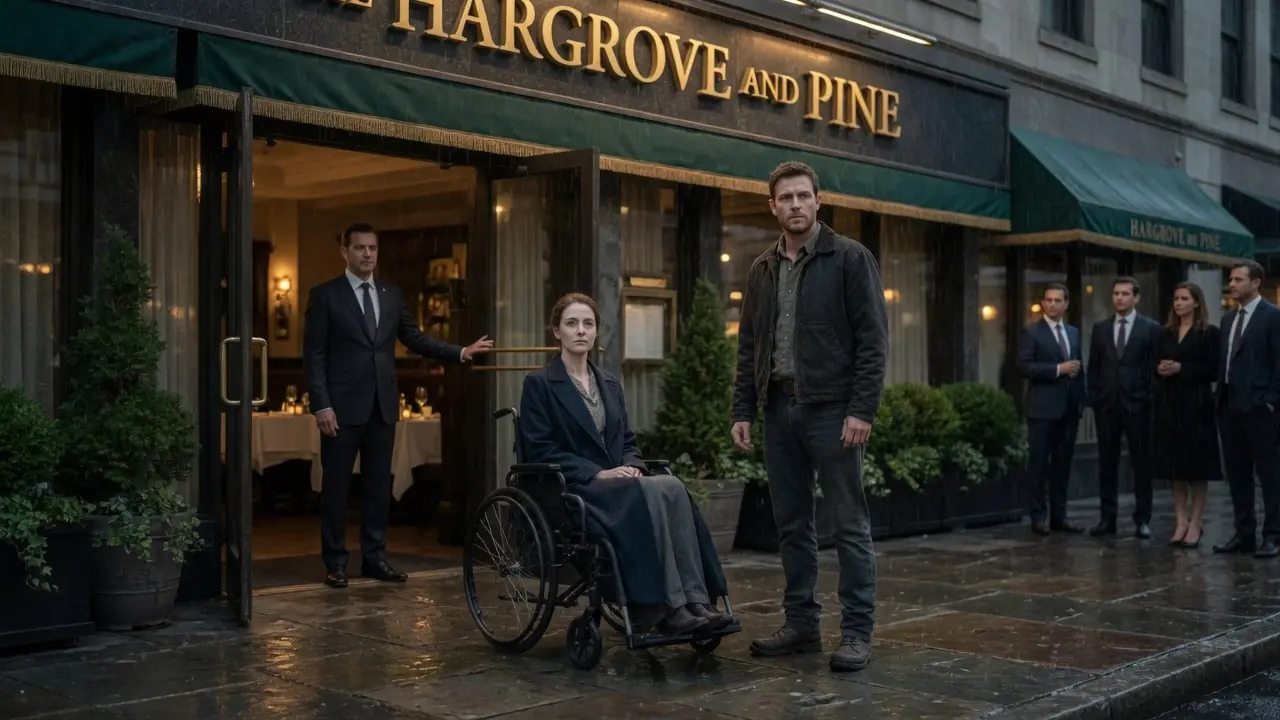
A woman in a wheelchair sat alone in the amber glow of the doorway, rain gathering on the sleeves of her navy coat and dripping from the edge of the green awning above her.
She was not there because she could not pay.
She was not there because she had failed to reserve a table.
She was not there because the restaurant was full.
She was there because someone had looked at her wheelchair, her plain coat, her quiet posture, and decided her presence did not fit the image.
Outside, the small crowd watched.
No one moved.
Then a single father stepped forward with his little daughter’s hand wrapped around his fingers. He did not shout. He did not threaten. He did not push his way through the door.
He asked one question.
And the entire courtyard went still.
Five minutes later, the manager’s face drained of color.
Ten minutes later, the truth changed everything.
The rain that evening was the kind that never quite decided what it wanted to be. Too fine to send anyone running for cover, too persistent to ignore. It clung to the brass letters above the entrance of Hargrove and Pine, turning each polished stroke into a wet reflection beneath the streetlights.
Hargrove and Pine had spent eleven years cultivating a reputation built on exceptional food and deliberate exclusivity.
Its awning was forest green, edged in gold. Two sculpted topiaries flanked the glass doors like sentries. The entry courtyard was paved with gray stone and warmed by gas lanterns mounted along the brick wall. Inside, the lighting was low and amber, the kind that made every guest look as if they had just returned from somewhere expensive and interesting.
The dining room was visible through tall windows.
White tablecloths.
Candlelight.
A bar lined with bottles that caught the glow like jewels.
Waiters in crisp shirts moved between tables with silent precision, carrying plates arranged like paintings.
The restaurant did not advertise itself as impossible to enter.
It did not need to.
Everyone in the city already understood.
You did not simply walk into Hargrove and Pine. You were accepted into it.
Charlotte Vance had eaten there exactly once before, three years earlier, when she attended as a silent observer rather than the woman who had ultimately signed the lease on the building and approved the capital restructuring that saved the restaurant group from collapse.
She had not announced herself then.
She did not plan to announce herself now.
That was the point.
She wore a dark navy coat over a simple gray blouse and tailored black trousers. Her chestnut hair was pulled back without ceremony, pinned low at the nape of her neck. The wheelchair she used was lightweight and unadorned. No polished chrome. No custom leather. Nothing that telegraphed wealth. Nothing that invited conversation.
Nothing that told people they should be careful.
Charlotte had learned many things in the fourteen months since the accident.
She had learned that some sidewalks were lies.
She had learned that the word accessible often meant technically possible but emotionally humiliating.
She had learned that people spoke louder to her now, as if wheels beneath her body had somehow changed the clarity of her hearing.
She had learned that some people bent over her chair to speak as if she were a child, while others avoided her eyes entirely.
Most of all, she had learned that people revealed themselves most completely when they did not know who they were talking to.
Before the accident, Charlotte had been called intimidating, strategic, brilliant, cold, impossible, visionary, and difficult, depending on who was speaking and whether she had just saved them money or cost them power. At thirty-two, she had become CEO of the Hargrove and Pine Group after the board finally admitted that the previous leadership had mistaken prestige for profitability.
Charlotte had not been born into the restaurant business. She had been born near it.
Her grandfather had opened the first Vance family dining room on a narrow street corner forty years earlier, back when hospitality meant wiping tables yourself and greeting customers by name because you actually knew them. Her father expanded too quickly. Her uncle nearly ruined the company. Charlotte studied law, finance, operations, and human behavior with the cold discipline of someone who knew sentiment alone could not keep doors open.
By the time she took over, the group had twelve restaurants, a mountain of debt, and a culture that smiled beautifully while quietly rotting from the inside.
She had spent the first year closing leaks.
The second year rebuilding trust.
Then came the accident.
A late-night ride after a board dinner.
A driver running a red light.
A hospital ceiling.
A doctor speaking in a gentle voice Charlotte hated immediately.
She survived.
That was what everyone said.
As if survival were a full sentence.
Charlotte survived, yes. But she woke into a body that required rebuilding, a schedule filled with therapy, a company that kept moving without waiting for her grief, and public spaces that seemed designed to remind her that independence was often conditional.
For months, her executives praised her resilience in public and tried to make decisions around her in private.
She noticed.
She noticed everything.
That was why she had started visiting Hargrove and Pine locations without warning, without announcement, without makeup suited for cameras or clothing selected by an assistant.
She wanted to know what the company had become when it did not know the owner was watching.
At 4:00 that afternoon, she had called the restaurant herself.
A young woman answered.
“Hargrove and Pine, good afternoon.”
Charlotte kept her voice neutral.
“I’d like to make a reservation for one. Tonight, eight o’clock.”
“One moment, please.”
There had been a pause, the tapping of keys, the soft hum of a busy restaurant preparing for service.
“Yes, we can accommodate one at eight. May I have the name?”
“C. Vance.”
“Noted. We’ll see you at eight.”
Charlotte thanked her and ended the call.
Now, at 7:43, she sat beneath the awning and looked through the glass doors at several open tables.
She was early.
She did not mind waiting.
What she minded was what happened next.
Madison Reed, the evening’s front-of-house host, spotted Charlotte through the glass and composed an expression that was not quite a smile before opening the door.
Madison was twenty-five, professionally dressed, slim, and carrying the tightly wound energy of someone whose performance review was overdue. Her hair was pulled into a glossy bun. Her black dress fit perfectly. Her tablet was held against her chest like a shield.
“Good evening,” Madison said. “Do you have a reservation?”
Charlotte looked up.
“Yes. C. Vance. Party of one. Eight o’clock.”
Madison’s eyes flickered once toward the wheelchair.
Then to Charlotte’s coat.
Then back to the tablet.
Her finger moved across the screen.
A pause followed.
Longer than necessary.
“I’m so sorry,” Madison said, her voice dropping into a register that managed to be simultaneously apologetic and final. “I’m afraid we’re fully booked for the evening.”
Charlotte looked past her.
At that exact moment, a couple stepped through the doors without being stopped. The man wore a black overcoat and a watch that flashed beneath the lantern light. The woman beside him laughed softly, shaking rain from her hair. Madison’s face changed instantly. She offered them warmth, not policy.
“Good evening, Mr. Callahan. Your table is ready.”
They were escorted inside.
Moments later, another pair arrived and received the same treatment. A smile. A quick scan of the tablet. The warm gesture inward.
Charlotte looked back at Madison.
“You have a reservation under Vance.”
Madison’s expression did not shift.
“I apologize for the confusion. Perhaps another evening.”
She began to turn back toward the host stand.
Charlotte did not raise her voice.
She simply stayed where she was, in the rain, watching.
Jason Miller emerged from near the back of the lobby with the practiced ease of a man accustomed to managing problems before they became public.
He was forty, broad-shouldered, clean-shaven, and dressed in a dark suit tailored tightly enough to suggest he believed elegance and control were the same thing. He had the posture of a man who had spent years believing he was the most important person in whatever room he occupied. His expression, when he looked at Charlotte, was one he almost certainly believed was sympathetic.
“Ma’am,” he said, stepping just outside the door. “We have a certain standard we maintain at Hargrove and Pine. I hope you understand.”
He did not elaborate.
The meaning was complete without him.
The rain tapped against the awning.
Charlotte looked at him for a moment.
“What standard?”
Jason’s expression tightened just slightly.
“A guest-experience standard.”
“And how have I failed it?”
Madison glanced down at her tablet.
Jason’s smile thinned.
“I don’t think this is the appropriate place for that conversation.”
“I agree,” Charlotte said. “The appropriate place would have been inside, at the table I reserved.”
A couple waiting near the courtyard fountain turned their heads.
Jason noticed.
His voice lowered.
“Ma’am, I’m going to ask you not to create a scene.”
Charlotte almost smiled.
That was another thing she had learned after the accident.
Some people called your existence a scene the moment it became inconvenient for them to ignore.
She rested both hands lightly in her lap.
“I am sitting still.”
“And we are respectfully declining service this evening.”
“Because you are full?”
“Yes.”
Charlotte looked through the glass again.
A waiter cleared a two-top near the window.
Another table near the bar sat empty.
“Your dining room suggests otherwise.”
Jason looked back at Madison.
Madison said nothing.
A few more people had begun to notice. Guests waiting for cars. A man smoking under the edge of the awning. Two young women taking shelter beneath a neighboring storefront. Most watched with the uncomfortable curiosity of people witnessing injustice in public but hoping it would resolve itself before it required them to become involved.
Thirty feet away, Wyatt Brooks stood with his daughter’s hand wrapped in his.
Wyatt was not a man who looked for trouble.
At thirty-four, he had built his life around the quiet architecture of avoiding it. Show up on time. Keep your head down. Do the work that needs doing. Do not start fights you cannot finish. Do not make promises you cannot keep.
He held a maintenance position at a mid-sized office complex downtown, mostly overnight shifts. The hours were hard, but they allowed him to walk his daughter to school in the mornings and pick her up in the afternoons when his neighbor Mrs. Alvarez could not help. He was good with his hands and better at silence. He could fix boilers, jammed doors, leaky pipes, old wiring, temperamental elevators, and most things that broke because people only noticed them after they had been neglected too long.
He had not always been a single father.
He had been a husband first.
Then a widower.
Then a man who reorganized his entire existence around a six-year-old named Ella, who had her mother’s eyes and an instinct for noticing things most adults had trained themselves to overlook.
They were not supposed to stop at Hargrove and Pine.
They had been on their way to a pizza place three blocks east, a small place with red booths and paper placemats where Ella liked to draw animals while waiting for garlic knots. She had earned the dinner by reading five library books in one week and tying her shoes without asking for help for three straight days.
But children notice stillness the way animals notice weather.
Ella had stopped first.
Her small hand tightened around Wyatt’s fingers.
“Daddy,” she said, tugging once. “Why won’t they let that lady in?”
Wyatt looked.
He saw the host’s turned back. The manager’s folded arms. The couple who passed inside without trouble while Charlotte remained in the rain. He saw the wheelchair. He saw the way people watched but did not act. He saw Charlotte’s face, calm and still, in a way that made the whole scene worse.
He understood it the way you understand a bruise, not because anyone explains it, but because you recognize the shape.
He stood still for a moment.
The rain gathered on his dark jacket.
He thought about moving on.
Not because he did not care.
Because caring did not pay legal fees. Caring did not protect his job. Caring did not stop a restaurant manager from calling security, or police, or from turning a simple act into something a single father could not afford.
Then Ella looked up at him.
Not frightened.
Not confused.
Waiting.
She was not asking him only what was happening.
She was asking what people were supposed to do when it happened.
Wyatt felt an old sentence rise inside him.
His mother had said it to him exactly once, when he was twelve years old and had watched a boy at school get pushed to the ground by three older kids. Wyatt had done nothing then. He had been scared. He had gone home quiet, and somehow his mother had known.
“The worst thing a person can do,” she told him that night, “is watch something wrong happen and decide it is not their business.”
He had never forgotten it.
He crouched to Ella’s level.
“Stay close to me,” he said quietly.
She nodded.
They walked toward the entrance together.
Jason was still standing near the door when Wyatt approached. Charlotte had not moved. Madison stood just inside the doorway, tablet pressed to her chest.
Wyatt stopped a few feet away and said nothing for a moment.
When he spoke, his voice was even.
There was no heat in it.
“Excuse me. Can you explain what the standard is? The one you mentioned?”
Jason’s posture stiffened.
“Sir, this is a private matter between the restaurant and the guest.”
“I understand,” Wyatt said. “I’m just asking you to explain the standard.”
Jason blinked.
Wyatt continued, still calm.
“What does it mean exactly?”
Jason’s eyes moved briefly to Ella, then back to Wyatt.
He said nothing.
Wyatt waited.
He was comfortable with silence in a way that made other people uncomfortable. His life had given him practice. Hospital rooms. Late-night bills spread across a kitchen table. Phone calls no parent wanted to receive. A child crying in the next room because she did not yet understand why her mother was not coming home.
Silence did not frighten him.
After a long moment, he asked the question that changed the evening.
“If this woman could stand up right now, if she did not need the chair, would she be allowed in?”
The question landed in the damp air like something dropped from a height.
Madison looked at the floor.
Jason’s jaw tightened.
He did not answer.
The answer was visible in the half second of stillness before his expression rearranged itself into something neutral.
Around them, the small cluster of onlookers had gone very quiet.
Charlotte, for the first time since arriving, looked directly at Wyatt.
He did not look back at her.
He was still watching Jason with a calm that held no aggression. No challenge. No performance. Just attention.
Ella stood beside him, her hand still in his, her eyes moving between the adults with the focused seriousness of a child who understood that something important was happening, even if she could not yet name every part of it.
Somewhere inside, a fork clinked against a plate.
The ordinary sound seemed strangely loud.
Jason Miller had been managing restaurants for sixteen years, and he had developed a particular skill: determining quickly whether a situation would resolve quietly or require escalation.
This situation required escalation.
Not upward.
Outward.
He straightened his shoulders.
“Sir, I’m going to need to ask you not to interfere in matters that don’t concern you. If you have a reservation, I’m happy to have Madison assist you.”
He gestured toward the host stand as if he were offering something generous.
“I do have a reservation,” Wyatt said. “But that’s not what I asked you.”
Jason’s gaze sharpened.
“You have a reservation?”
“At the pizza place down the street,” Ella said helpfully.
Wyatt looked down at her.
Ella pressed her lips together as if realizing she might not have improved the situation.
A few people in the crowd almost smiled.
Wyatt looked back at Jason.
“I asked you to explain the standard.”
Jason’s eyes moved to the phones appearing in the crowd. Most people in his position would have changed tactics. Jason Miller, who had spent too many years believing that his authority inside these walls was total, did not.
“Our policy is our policy,” he said with finality. “If you’re not satisfied with it, you’re welcome to dine elsewhere.”
Ella’s hand tightened around Wyatt’s fingers.
He felt the small pressure.
He glanced down. Her expression was not frightened. It was more precise than that. She was concentrating, the way she concentrated over a puzzle that did not yet make sense.
He looked back at Jason.
“This woman called ahead,” Wyatt said. “She made a reservation. She arrived on time. Is the reservation in the system or not?”
The question was simple enough that it could not be deflected without revealing the deflection.
Madison’s hand tightened around her tablet.
Jason said, “That information is not something I’m at liberty to discuss.”
“So it might be there,” Wyatt said.
He was not accusing.
He was simply noting.
“It might be there, and she is still sitting in the rain.”
The crowd had grown.
Guests who had stepped outside now lingered. A couple who had paused on the sidewalk moved closer. A man under the next awning stopped pretending to look at his phone. Jason could feel the geometry of the situation shifting against him.
He folded his arms.
“I don’t intend to debate our policies with you.”
“I’m not debating,” Wyatt said. “I’m just standing here.”
And he was.
Literally.
Just standing there.
A man on a sidewalk in the rain with his daughter, refusing to be moved by the social gravity that usually made situations like this collapse back into silence.
That refusal, quiet and inconvenient, became its own kind of force.
Jason looked at him with focused dislike, the expression of a man who wanted very much to say something sharp and could not find the angle.
Charlotte had been watching Wyatt carefully.
Not because she needed him to save her. She had not built a company, endured a hospital bed, navigated boardrooms, and learned to reenter the world in a wheelchair because she required rescue from a restaurant manager.
But there was a difference between not needing rescue and being relieved that someone had noticed.
She was not accustomed to being observed in difficulty without pity or discomfort coloring the face of whoever was looking.
What she saw in Wyatt Brooks was neither.
He was simply present.
He was refusing to let the moment pass the way moments like this usually passed, absorbed into the general noise of a city very skilled at moving on.
Charlotte Vance had hired and fired hundreds of people. She knew, with the particular certainty of someone who had spent years reading rooms, that she was looking at a genuinely good man.
The crowd on the sidewalk had grown enough now that it occupied the edge of the courtyard. A woman near the back said something quietly to the man beside her. Someone else lifted a phone higher. Jason looked out at the assembled faces and felt, for the first time, the specific cold of a situation that had moved past the point where he could manage it back into shape.
It was a guest, not an employee, who changed the shape of the evening.
He was a man in his sixties, silver-haired, wearing a dark suit and a raincoat that suggested he had been coming to Hargrove and Pine long enough for the staff to know his name.
He stepped forward with the unhurried authority of someone who had long ago stopped needing to perform confidence.
“I was near the host stand when she called,” the man said.
Jason turned.
“Mr. Whitcomb.”
The man ignored the attempt at warmth.
“She has a reservation. I heard the confirmation myself.”
Jason’s expression did not collapse.
It restructured.
A small, precise rearrangement of a man catching himself before something showed.
He looked at Mr. Whitcomb.
Then at Madison.
Then back.
Madison was already looking at her tablet.
The silence that followed lasted perhaps six seconds.
And in those six seconds, the entire texture of the evening changed.
Madison’s face did something complicated.
She looked up at Jason and said, in a voice she tried to keep private and failed, “It’s here.”
Jason did not move.
Madison swallowed.
“C. Vance. Party of one. Eight o’clock.”
She looked down again.
Her thumb moved.
Then her face drained.
“VIP flag,” she whispered.
The letters were small on the screen.
But enormous in the air.
Jason’s eyes moved to Charlotte.
Charlotte said nothing.
The rain continued.
Wyatt had not moved, and he did not move now. He had known, somewhere in the part of him that recognized wrongness by texture rather than detail, that the reservation existed. He was not surprised.
What surprised him, faintly, was that he felt no satisfaction at being confirmed right.
He felt tired.
The kind of tired a person feels when something that should not have happened has happened anyway.
Jason straightened.
His instinct now was the same one he had always trusted.
Contain.
Redirect.
Manage.
“There appears to have been an error in our system,” he said. “We apologize for the inconvenience. If you’d like to come in now, we can seat you.”
Charlotte did not move.
She looked at him with an expression that was not angry.
Anger would have been easier.
What sat in her face was quieter and considerably harder to absorb.
Disappointment.
Clear-eyed and specific.
“The table was there twenty minutes ago,” she said. “The system didn’t change. What changed?”
Jason had no answer.
He was not designed for questions that arrived already containing their own answer.
Mr. Whitcomb looked at the ground.
Madison studied her tablet with an attention it did not deserve.
The crowd had heard enough to understand the shape of what had happened, even those who had arrived late.
Wyatt was still standing precisely where he had been. He had not said anything in several minutes. He did not need to. The truth had arrived without his help, which he suspected was how truth usually worked when someone gave it enough room.
Ella had been watching Charlotte for a long time.
Children process the world in a different sequence than adults.
They feel first.
Then observe.
Then ask.
She had felt the wrongness before she could name it. She had observed Charlotte’s stillness, the way Charlotte held herself without crumbling, the set of her jaw that communicated something about endurance even to a six-year-old.
Now Ella asked.
She stepped forward, pulling slightly against her father’s hand, and looked up at Charlotte.
“Do you want to come eat with us?”
Her voice was the simple, matter-of-fact voice of a child who had not yet learned to treat kindness as a complicated decision.
“We were going for pizza,” Ella added. “You can come if you want.”
The offer was so uncalculated that it took the remaining air out of the moment entirely.
Jason did not speak.
Madison did not speak.
Mr. Whitcomb looked at Ella with the expression of a person remembering something he had forgotten about being human.
Charlotte looked at the child for a long moment.
Ella had her father’s stillness.
The same quality of simply being where she was without apology or performance.
Charlotte had spoken in front of boards of directors. She had negotiated contracts worth hundreds of millions of dollars. She had sat in hospital rooms after the accident and found words for things she did not know how to say. She was not easily undone.
But something in Ella’s face, the total absence of agenda, the clean simplicity of one person extending something toward another, moved through whatever composure Charlotte had maintained all evening and reached something underneath it.
She smiled.
Not the calibrated smile she used in conference rooms.
The other kind.
Smaller.
Involuntary.
The kind that arrived before she decided to allow it.
“That is very kind of you,” Charlotte said.
Ella nodded with the satisfied air of someone who had solved a problem and was ready to move on.
Wyatt looked at Charlotte.
“You don’t have to,” he said. “She means it, but you don’t have to.”
It was the kind of thing only a particular sort of person would add.
Someone who understood that generosity offered without respect for choice could become its own kind of pressure.
Charlotte looked at him.
She had assessed Wyatt Brooks in the first sixty seconds of watching him and had not revised her judgment since. He was exactly what he appeared to be.
That was rarer than it should have been.
“I appreciate the invitation,” she said.
She meant it in a way that encompassed more than pizza.
She was about to say something else when her phone, tucked into the side pocket of her coat, began to vibrate.
It was Marcus, her assistant.
She had instructed him to call only if something required immediate attention.
She answered.
“Yes?”
His voice was calm but clipped.
“Your driver circled the block. Dominic Hale is inside at a corner table. He has been there since before you arrived.”
Charlotte’s eyes did not move.
“Interesting.”
“He also just placed a call.”
“To whom?”
“I’m checking.”
Charlotte looked through the glass into the dining room.
At the back corner, a man in a charcoal suit sat alone over a half-finished plate, watching the entrance with far too much stillness.
Dominic Hale.
Deputy director of the Hargrove and Pine Group.
A man who occupied a position adjacent to power rather than above it, which was both his professional reality and his deepest irritation.
Charlotte said, “Come around front.”
“Now?”
“Now is fine.”
She ended the call.
Jason Miller received a call on his personal cell at 7:59, one minute before Charlotte’s reservation was set to begin. Whatever was said lasted less than ninety seconds. When he returned to the front, something had changed in his face.
Charlotte noticed.
She noticed most things.
Meanwhile, Madison had been approached by another staff member who leaned close and whispered something that made Madison go very still.
“There’s an unannounced corporate audit scheduled this month,” the woman said. “Tonight might be it.”
Madison looked at the tablet.
Then at Jason.
Then at Charlotte.
The word audit had a gravitational quality in the restaurant industry that few other words matched.
Charlotte gave nothing away.
She had spent fourteen months learning to wear patience the way other people wore armor.
Ella was examining the brass letters above the entrance with focused interest, sounding each one silently against her lips.
Inside, Dominic Hale had set down his fork with considerable deliberateness.
He had not known Charlotte would come here tonight.
He had suspected she would eventually visit one of the four locations under his unofficial policy shift, but he had expected enough warning to manage the room before she arrived. That was how things usually worked. People at the top liked to imagine they could surprise an organization, but organizations had veins. Information moved.
This time, information had not moved fast enough.
Dominic took out his phone.
The call he placed was brief.
The person on the other end was someone he had spoken to before about what Dominic called image-consistency standards and what the policy documents carefully called guest-experience optimization.
The policy had been quietly inserted into the operational guidelines of four Hargrove and Pine locations over the past eight months.
It had not come from Charlotte.
It had come from Dominic.
And it had been implemented by managers like Jason, who understood without being told explicitly what the policy was actually selecting for.
Not openly.
Never openly.
The language was always clean.
Redirect.
Manage expectations.
Protect experience.
Maintain premium atmosphere.
But everyone understood.
Guests who appeared visibly disabled, elderly, poor, unstable, unfashionable, awkward, or otherwise inconsistent with the image Dominic wanted were quietly discouraged, delayed, told the restaurant was full, or seated near service corridors if they were impossible to turn away.
No one wrote the cruel part down.
Cruelty rarely needed written instructions.
People understood the shape of permission.
What stood outside the restaurant tonight was not just one woman in the rain.
It was the thing Dominic had hoped would never arrive.
A black car pulled to the curb.
Understated.
No livery.
No logo.
Just the quiet quality of something expensive trying not to announce itself.
The driver opened the rear door, and Marcus O’Shea stepped out. He wore a dark vest beneath his coat and carried a leather folder under one arm. He moved with the quick competence of a man whose entire job was being useful at exactly the right moment.
He did not look at the crowd.
He looked at Charlotte.
“Miss Vance,” Marcus said, loud enough to be heard beneath the rain, “I have the documents you requested.”
The name reached Jason before the folder did.
Miss Vance.
C. Vance.
His face changed in stages.
Recognition.
Disbelief.
Calculation.
Fear.
Charlotte Vance, CEO of the Hargrove and Pine Group.
Since taking the position, she had rebuilt the company’s finances, cleaned up its debt, shut down failing vanity projects, and made enemies out of executives who preferred elegant decay to uncomfortable reform.
And now she had been sitting outside one of her own restaurants in the rain while her manager explained the restaurant’s standard.
Charlotte accepted the folder.
She opened it and reviewed the top page.
Then she looked up.
Not at Jason.
Not at the crowd.
At the entrance.
The topiary.
The brass lettering.
The warm amber light leaking through the glass.
She looked at the restaurant with the particular gaze of someone seeing a place and simultaneously seeing what the place should have been.
It was, Wyatt thought, the look of a person who owned something and was measuring the distance between ownership and responsibility.
When Charlotte finally looked at Jason, she did not raise her voice.
“How long has the image policy been in effect at this location?”
His mouth opened.
A sound came out that was not a word.
Charlotte waited.
“How long?” she asked again.
Not as a demand.
As a correction.
Jason swallowed.
“Six months.”
Charlotte looked at him.
He looked at the folder in her lap.
“Eight,” he said. “Maybe eight months.”
Charlotte nodded and wrote something down.
Mr. Whitcomb exhaled slowly.
Ella looked up at her father.
“Is that lady the boss?” she whispered.
Her whisper was not as private as she intended.
Wyatt said quietly, “Something like that.”
Ella appeared satisfied.
Charlotte moved her wheelchair forward until she was inside the entrance, inside the building that bore her name and had spent nearly eight months applying a policy she had never authorized.
She did not enter triumphantly.
She entered wet, patient, and deeply still.
Dominic Hale finally stood from his corner table.
He walked toward the entrance with the forward-leaning composure of a man who had decided to take the initiative rather than receive a summons.
“Charlotte,” he said warmly. “I didn’t know you were coming in tonight. Why don’t we find somewhere private?”
“Sit down, Dominic,” Charlotte said without looking at him.
He stopped.
The room seemed to stop with him.
Then he sat back down.
It was, in its way, the most decisive moment of the evening.
Not the revelation.
Not the folder.
Those three words.
Delivered without heat by a woman who had been sitting in the rain thirty minutes earlier and whose authority had never, for a single moment, been diminished by it.
Charlotte asked Marcus to pull the full incident logs for all locations covered by the image policy.
She had spent six weeks suspecting what the data would show and three weeks confirming it. What brought her here tonight, in person, dressed plainly, in the rain, was the final step.
Not the data.
The experience.
She had wanted to feel what it felt like from the other side of the door.
The policy, as Dominic had written it, used language that was clean and corporate. Guest experience optimization. Brand consistency standards. Alignment with premium service positioning.
What it meant operationally was that front-of-house staff at four locations had been given unofficial guidance, passed through middle management in conversations that left no written record, that certain guests should be redirected.
Not turned away.
Redirected.
The language was careful.
The effect was not.
People had been refused service at restaurants bearing Charlotte Vance’s family name because someone decided they looked wrong.
Charlotte turned to Jason.
“You’ve managed this location for how long?”
“Four years.”
“In those four years, were you ever given explicit written documentation of the policy you applied tonight?”
A pause.
“No.”
“Were you told the policy came from the executive level?”
“I was told it was aligned with brand direction.”
Charlotte did not look up when she said, “Your employment with the Hargrove and Pine Group is terminated effective tonight. You’ll receive documentation by morning.”
Jason said nothing.
He had known, somewhere beneath the level of articulation, that this was possible.
He retrieved his coat and left without looking at Wyatt, Ella, Charlotte, or the crowd.
Charlotte looked at Madison.
The young woman’s face was pale, her eyes bright with fear.
“You’re suspended pending review,” Charlotte said, “not terminated. You were trained poorly, but you still made choices. You’ll go through a full retraining program, and when it’s complete, you’ll decide whether you want to continue with this company.”
Madison nodded.
Her chin trembled once before she lowered it.
Marcus read from the folder.
“Four locations. Eight months. Estimated several hundred incidents of redirected guests based on visible disability, perceived socioeconomic status, age, and appearance.”
A heavy silence followed.
Charlotte set the folder down in her lap.
She looked at the room, at the white tablecloths, at the candlelight, at the bar lined with bottles.
“There is no standard at Hargrove and Pine that ranks above basic human respect,” she said. “If there is, it does not survive tonight.”
Then she looked across the dining room at Dominic.
“Stay in the city. My legal team will contact you tomorrow.”
Dominic picked up his phone.
Then seemed to think better of it.
He put it down.
Charlotte turned to Wyatt last.
He had remained near the entrance with Ella, not inserting himself, not performing the virtue of his earlier intervention, simply remaining.
Ella had sat on the bottom step of the entryway and was drawing invisible shapes on the marble with one finger, quietly self-contained in the way of children who are giving adults room to do their work.
Wyatt watched his daughter with the expression he wore when he thought no one was watching him.
Unguarded.
Soft.
The face of someone for whom love was not a complicated subject.
Charlotte moved toward them.
Wyatt looked up.
She stopped a few feet away.
“You did what anyone could have done,” she said. “That is not a small thing. It may be the whole thing.”
Wyatt looked at her with direct attention.
“You would have been fine,” he said. “You didn’t need me to do anything.”
“No,” Charlotte said. “But I was still in the rain.”
He held her gaze for a moment.
Something moved in his face, not quite a smile and not quite its absence.
He understood what she meant.
She did not mean she had needed saving.
She meant something more specific and more human.
Being seen, when you have been deliberately made invisible, has a weight independent of whether you could have survived without it.
“We’d like you to have dinner here tonight,” Charlotte said. “Both of you. Whatever you’d like. It would mean something to me.”
Wyatt glanced down at Ella, who had looked up from her invisible drawing at the word dinner.
Ella looked at Charlotte.
“Do they have pizza?”
For the first time that night, Charlotte laughed.
It was small but real.
“I believe they can manage something close.”
Ella considered this with appropriate gravity.
Then nodded.
Wyatt looked around the restaurant, the same room that had been, forty minutes earlier, a place that would not let Charlotte in. Something in the room’s relationship to itself had shifted, the way a room shifts after something true has been said in it.
“All right,” Wyatt said.
They were seated at a table near the window, the three of them.
The view looked out onto the street, where the rain had finally softened into mist. Amber light from inside fell through the glass and touched the wet pavement in a way that made the ordinary sidewalk look considered.
Ella pressed her face briefly against the window, then sat back with the satisfied expression of a naturalist confirming a hypothesis.
Charlotte had asked Marcus to handle the documentation and give her the evening. He had nodded in the way very good assistants nod, completely and without question, then excused himself with the folder.
The restaurant around them slowly resumed the sounds of itself.
Cutlery.
Low voices.
The specific acoustic warmth of a dining room being used the way it was designed.
Mr. Whitcomb, on his way past their table, paused and placed his hand briefly on Charlotte’s shoulder without saying anything.
She looked up and nodded.
That was sufficient.
Wyatt ordered club soda.
Ella studied the menu with the dedicated focus of someone approaching a legal document for the first time and wanting to get it right. Charlotte ordered water and watched Ella read, the way she moved her lips slightly over unfamiliar words, the way she looked up occasionally at her father for confirmation.
There was something in the child’s attention that settled something in Charlotte.
She had been alone for most of the past fourteen months.
Not in the simple sense of being without company.
In the more specific sense of moving through the world in a body that now required things of public spaces that public spaces did not always provide, and feeling the particular loneliness of that.
The evening had not been what she planned.
She had not planned to sit in the rain.
She had not planned to become the subject of a child’s uncalculated kindness or a quiet man’s uncalculated courage.
She was not sure, looking back over the past hour and a half, which part had moved her most.
She thought it might have been Ella’s offer.
That simple, direct invitation extended to a stranger in the rain with no theory behind it at all.
Ella had been building toward a question for some time, and when it arrived, it arrived with the directness that was her signature.
“You’re actually the big boss?”
Charlotte told her yes, of this restaurant and several others.
Ella’s eyebrows moved upward.
She looked at her father, who confirmed this with a small nod.
Then she looked back at Charlotte.
“So you can make things better?” Ella asked. “Like, for everybody? You can make things better for people who come here?”
Charlotte was quiet for a moment.
The question was the most honest thing that had been said in the restaurant all evening.
It was not complicated.
Children rarely asked complicated questions. They asked the questions adults had stopped asking because they had decided the answers were too uncertain.
Charlotte looked at Ella with the full weight of her attention.
“I’m working on it,” she said.
Ella nodded slowly, the nod of someone who had received an acceptable answer and intended to hold the speaker to it.
“Good,” she said.
Then she looked back at the menu.
Wyatt caught Charlotte’s eye across the table.
He said nothing.
There was, in the silence between them, something not yet definable. Not friendship. Not romance. Not the beginning of anything either of them was ready to name.
Only the acknowledgment between two people who had shared an unrepeatable evening and arrived on the other side of it changed in ways they had not yet finished measuring.
The rain had stopped by the time their food arrived.
Ella’s “almost pizza” came as a small flatbread with tomato, cheese, and basil. She examined it carefully, then announced that it was fancy pizza and acceptable.
Wyatt smiled.
Charlotte found herself watching that smile.
Not because it was handsome, though it was in a tired, unpolished way.
Because it was rare.
Wyatt did not smile to perform ease. He smiled because his daughter had made the world lighter for a second, and he had noticed.
They ate slowly.
Ella told Charlotte about the pizza place they had originally planned to visit, about her school, about how her father could fix almost anything except pancakes because he always burned the first one.
Wyatt objected mildly.
“The first pancake is a test pancake.”
Ella looked at Charlotte.
“He says that because he burns it.”
Charlotte listened.
She had been in rooms full of powerful people where every sentence was sharpened for advantage. This table had none of that. It had a child explaining pancakes, a father accepting correction with dignity, and a woman who had been turned away from her own restaurant slowly remembering that dignity could be restored in quiet ways too.
After dinner, Charlotte insisted they order dessert.
Ella chose chocolate cake after asking whether the strawberry on top was real.
The waiter, a young man who had approached the table with visible nerves, answered softly that it was.
Ella told him that was good because fake strawberries were “a betrayal.”
The waiter laughed before he could stop himself.
Charlotte noticed.
Then the waiter looked relieved, as if laughter had reminded him that service did not have to be fear.
When the cake arrived, Ella took the first bite with total seriousness.
Then her eyes widened.
Wyatt looked at her.
“That good?”
Ella nodded.
“Better than pizza.”
Charlotte watched Wyatt’s face.
For a moment, he looked undone.
He covered it by taking a sip of club soda.
But Charlotte had seen it.
The father who had walked through rain toward a stranger was also a man who had probably spent years measuring joy in small amounts he could afford.
A slice of cake.
A child’s laugh.
A night that did not end badly.
Before they left, Charlotte asked Wyatt what he did for work.
He hesitated, not embarrassed exactly, but cautious.
“Maintenance. Office complex downtown. Mostly overnight.”
“What kind of systems?”
“HVAC, electrical, plumbing, doors, elevators when they’re not complicated enough to require a specialist. Anything that breaks after everyone important goes home.”
Charlotte smiled faintly.
“That last part sounds familiar.”
Wyatt gave a small shrug.
“Buildings tell you the truth at night. During the day, people cover things up.”
The line stayed with Charlotte.
Two weeks later, Wyatt received a call from Marcus O’Shea.
At first, he thought it was about the dinner bill.
It was not.
Charlotte wanted to meet him.
Wyatt almost said no.
Not because he did not want to.
Because accepting meetings from CEOs rarely simplified a man’s life.
But Ella overheard enough to ask, “Is it the lady from the rain?”
“Yes.”
“Then you have to go.”
“I do?”
“She said she was working on making things better.”
Wyatt looked at his daughter.
“And?”
Ella lifted one shoulder.
“Maybe she needs help.”
So he went.
The meeting took place not at Hargrove and Pine, but in the company’s headquarters above a quieter restaurant near the river. Charlotte’s office was not large. Wyatt had expected something colder, more distant. Instead, he found bookshelves, a worktable covered in marked-up floor plans, two plants in the window, and a framed black-and-white photograph of an older man standing outside the first Vance family restaurant.
Charlotte sat behind her desk, but when Wyatt entered, she moved around it to meet him near the table.
She did not offer a formal speech.
She placed a file in front of him.
“I read your incident statement,” she said. “Then I asked Marcus to look into your work history.”
Wyatt’s expression tightened.
Charlotte noticed immediately.
“Nothing invasive,” she said. “Employment references. Building certifications. Safety records.”
He relaxed slightly.
“And?”
“And every person we spoke to used the same word.”
“What word?”
“Reliable.”
Wyatt looked down.
“That’s a plain word.”
“It’s an expensive one when it is true.”
He did not answer.
Charlotte opened the file.
“What happened that night exposed a cultural problem. I can write new policies. I can fire people. I can retrain staff. I can install ramps, widen aisles, lower host stands, audit reservation practices, and tear out every line of Dominic Hale’s ugly little image program.”
Her voice remained even, but Wyatt heard the steel under it.
“But culture changes in the moments when no executive is present. It changes when someone on the floor sees a problem and knows what to do before a lawyer writes a memo.”
Wyatt understood slowly.
“You want me to work for you.”
“I want you to help me build a guest dignity and access program for every location in the group.”
“I’m a maintenance guy.”
“Yes,” Charlotte said. “That is part of why I want you.”
Wyatt blinked.
Charlotte leaned back slightly.
“You understand buildings from the underside. You notice where access fails because you have repaired the places people ignore. You understand staff corridors, service doors, broken elevators, bad lighting, cold entryways, and the way systems treat people when they think nobody is important enough to notice.”
She met his eyes.
“And you stepped forward before you knew my name.”
Wyatt was quiet.
The offer was generous.
Too generous, at first glance.
Salary. Benefits. Daytime hours. School pickup flexibility. A role that combined facilities review, service conduct training, accessibility audits, and emergency response standards.
It sounded like the kind of thing men like Wyatt imagined belonged to other people.
People with degrees framed on walls.
People who used words like strategy without feeling awkward.
He said as much.
Charlotte listened.
Then she said, “I have enough people with degrees. I need one person who understands what it feels like to be ignored by a room full of people and still decide the room can do better.”
Wyatt looked at the file.
He thought about overnight shifts.
About Ella sleeping on Mrs. Alvarez’s couch when he worked late.
About mornings when his body felt heavier than it should and his daughter still needed breakfast, clean socks, and someone patient enough to braid her hair badly but lovingly.
He thought about Charlotte in the rain.
He thought about Ella asking, “Can you make things better?”
He said yes.
Not immediately.
But he said it.
The changes began quietly.
Hargrove and Pine closed one Monday for staff retraining and reopened Tuesday with a new host stand at wheelchair-accessible height, clearer reservation accountability, improved entry access, and a policy posted where every employee could see it.
Hospitality begins before the table.
Wyatt hated the wording at first.
Charlotte told him it was his sentence.
He said he had only muttered it while inspecting the entry slope.
She said good sentences often arrived by accident.
Dominic Hale resigned before the investigation concluded, though the legal consequences followed him longer than he expected. Jason Miller did not return to the restaurant industry in the same role. Madison Reed completed retraining, then asked to transfer to operations support, where she became unexpectedly good at identifying where policies failed staff before staff failed guests.
The silver-haired man, Mr. Whitcomb, became a regular again, but now he brought his sister, who used a walker and had once refused to come because she hated feeling like an inconvenience.
Charlotte saw them one evening from across the dining room.
She said nothing.
But Wyatt, standing beside her with a clipboard, noticed her hand rest briefly against the wheel of her chair.
“Good?” he asked.
Charlotte looked at the table.
“Yes,” she said. “Good.”
Months passed.
Ella visited the office often enough that Marcus began keeping colored pencils in a drawer. She developed strong opinions about restaurant seating, dessert presentation, and whether every location should offer at least one normal pizza.
Wyatt told her they were not adding pizza to every fine-dining menu.
Ella told Charlotte.
Charlotte said they would take it under advisement.
Wyatt told Charlotte not to encourage her.
Charlotte said she was not encouraging, only respecting stakeholder feedback.
Ella liked that and began calling herself a stakeholder.
One evening in early spring, nearly six months after the rainy night, Charlotte returned to Hargrove and Pine with Wyatt and Ella.
Not for an audit.
Not for a crisis.
For dinner.
The awning was still forest green.
The brass letters still caught the light.
But the entryway had changed. The stone path had been leveled. The doorway widened. The host stand lowered at one end. The topiaries moved farther apart so no one had to maneuver around them like decorative obstacles.
A small brass plaque had been placed inside the entrance.
It did not mention Charlotte.
It did not mention the incident.
It read:
Every guest enters whole.
Every guest is welcomed whole.
Ella read it aloud.
Then she looked at Wyatt.
“That’s better than the old standard.”
Wyatt smiled.
“There was never an old standard worth keeping.”
Charlotte looked at him.
“And yet you made me explain it.”
“I made Jason explain it.”
“You made the room explain it.”
Wyatt considered that.
“Maybe the room needed to hear itself.”
Charlotte was quiet for a moment.
Then she said, “Yes. It did.”
They were seated near the window, at the same table where they had eaten that first night after everything changed.
Ella ordered the fancy pizza again, though it had now been placed on the children’s menu under the name Ella’s Flatbread, a fact she pretended not to be proud of and failed completely.
Wyatt ordered pasta.
Charlotte ordered roasted fish and barely tasted it because she was watching the room.
An elderly man with a cane was being greeted warmly near the front.
A mother with a stroller was being helped to a table without fuss.
A woman in a wheelchair entered ten minutes later with three friends, and the host did not panic, apologize excessively, or make her feel like a logistical problem. He simply smiled and said, “Welcome. Your table is ready.”
Charlotte looked away before anyone could see her eyes fill.
But Wyatt saw.
He always seemed to see.
He did not say anything dramatic.
He simply placed the dessert menu between them and said, “Ella is going to pretend she needs help choosing cake.”
Charlotte laughed softly.
“I heard that,” Ella said without looking up from her flatbread.
Later, after dinner, they stepped outside into the cool spring air.
No rain this time.
The street was dry.
The lanterns glowed.
The restaurant behind them hummed with life.
Ella walked ahead a few steps, hopping carefully from one paving stone to the next as if the courtyard were a map only she could read.
Charlotte stopped beneath the awning.
Wyatt stopped beside her.
For a moment, neither spoke.
Then Charlotte said, “I think about that night often.”
“So do I.”
“I was angry,” she said. “At Jason. At Dominic. At the company. At myself for not seeing it sooner.”
“You saw it eventually.”
“That is not always enough.”
“No,” Wyatt said. “But it is where fixing starts.”
She looked at him.
He was not polished.
Not strategic.
Not the sort of man who entered a room and expected it to bend toward him.
But he was steady in a way Charlotte had come to trust more than polish. He noticed what others stepped over. He fixed what others ignored. He told the truth without making a performance of courage.
“Ella asked me that night if I could make things better,” Charlotte said.
“I remember.”
“I said I was working on it.”
“You were.”
“I still am.”
“We both are,” Wyatt said.
The words settled between them.
Not too heavy.
Not too light.
Ella turned back from the edge of the courtyard.
“Are you two coming?”
Wyatt looked at Charlotte.
Charlotte smiled.
“Yes,” she said. “We’re coming.”
They moved forward together.
A woman in a wheelchair who had once been left in the rain.
A single father who had asked one honest question.
A little girl who believed kindness should be simple.
Behind them, Hargrove and Pine glowed beneath its forest green awning, no longer quite the same restaurant it had been before.
And maybe that was how change often began.
Not with speeches.
Not with slogans.
Not with a perfect policy drafted in a boardroom.
But with one person refusing to let cruelty pass as a standard.
One child offering pizza to a stranger.
One woman deciding that power meant nothing if it could not open the door wider for someone else.
And one quiet question in the rain.
“If she could stand up right now, would you let her in?”
The question had exposed everything.
The answer rebuilt what came after.