The afternoon sun cast dappled shadows through the trees at Riverside Park, where children’s laughter created a symphony of joy that seemed to belong to everyone except Caroline Bennett and her daughter Emma.
Caroline sat on a bench in her crisp white blouse and beige skirt, looking perfectly put together despite the exhaustion that lived behind her eyes.
She watched her seven-year-old daughter sit motionless on a swing, staring at her hands while other children played around her.
At thirty-four, Caroline was the CEO of Bennett Communications, a tech startup she’d built from nothing into a multi-million-dollar company in just five years.
She was featured in business magazines, invited to speak at conferences, held up as an example of what women could achieve in the male-dominated tech world.
She had everything she’d worked for: the corner office, the impressive salary, the respect of her peers, everything except the sound of her daughter’s voice.
Emma had stopped speaking six months ago.
Shortly after Caroline’s divorce from Emma’s father was finalized, the pediatrician had run tests.
The child’s psychologist had conducted evaluations.
The diagnosis was selective mutism brought on by trauma and stress.
Emma could speak.
There was nothing physically wrong.
But she chose not to, retreating into silence as a way of coping with the upheaval in her life.
Caroline had tried everything.
Therapy, which Emma attended but didn’t participate in.
Special programs designed for children with selective mutism.
Gentle encouragement, patience, even begging.
Nothing worked.
Emma remained locked in silence, communicating only through nods, headshakes, and occasional written notes.
The worst part was knowing it was Caroline’s fault.
Not entirely.
Her ex-husband bore responsibility, too.
But Caroline knew her choices had contributed to Emma’s trauma.
The divorce had been bitter, full of arguments about custody and money, and who’d failed whom.
Emma had witnessed too much of it.
And before that, there had been years of Caroline prioritizing work over family, missing Emma’s school events, hiring nannies to cover the hours she couldn’t be home.
Always promising things would slow down after the next product launch or funding round.
She’d cut back her hours at work somewhat and insisted on spending quality time with Emma.
Hence, this trip to the playground on a Wednesday afternoon, something CEO Caroline Bennett never would have done two years ago.
But Emma wasn’t playing.
She just sat on the swing, gently rocking back and forth, isolated despite being surrounded by other children.
“Emma, sweetheart,” Caroline called gently. “Would you like me to push you?”
Emma shook her head slightly, not rude, just absent.
Somewhere else.
Caroline’s heart broke for the thousandth time.
This beautiful, intelligent child who used to chatter constantly about everything and nothing, who used to sing songs she made up, who used to have opinions about which cereal to eat and what dress to wear.
That child was gone, replaced by this silent version who seemed to be slowly disappearing.
A man approached the swings with a young girl of about eight or nine.
He was probably in his early thirties with dark hair and a warm smile, wearing casual jeans and a blue button-up shirt.
The girl wore a pink dress and had her hair in a long braid, and she was already talking animatedly about something, her hands gesturing as she spoke.
“And then, Dad, Mrs. Peterson said my drawing was the best one in the whole class. Can you believe it?”
“The whole class? I absolutely can believe it,” the man replied, his voice full of genuine pride. “You’re an incredible artist, Mia. Your mother would be so proud.”
They took the swings next to Emma and Caroline.
The man helped his daughter onto the swing, then noticed Emma sitting motionless on her own swing.
“Hi there,” he said kindly to Emma. “Would you like me to push you, too? I am an excellent pusher. Just ask Mia.”
Emma didn’t respond.
She didn’t even acknowledge he’d spoken.
Caroline stood up quickly, preparing to intervene, to explain, to protect her daughter from the inevitable questions and confusion.
“I’m sorry, she doesn’t…”
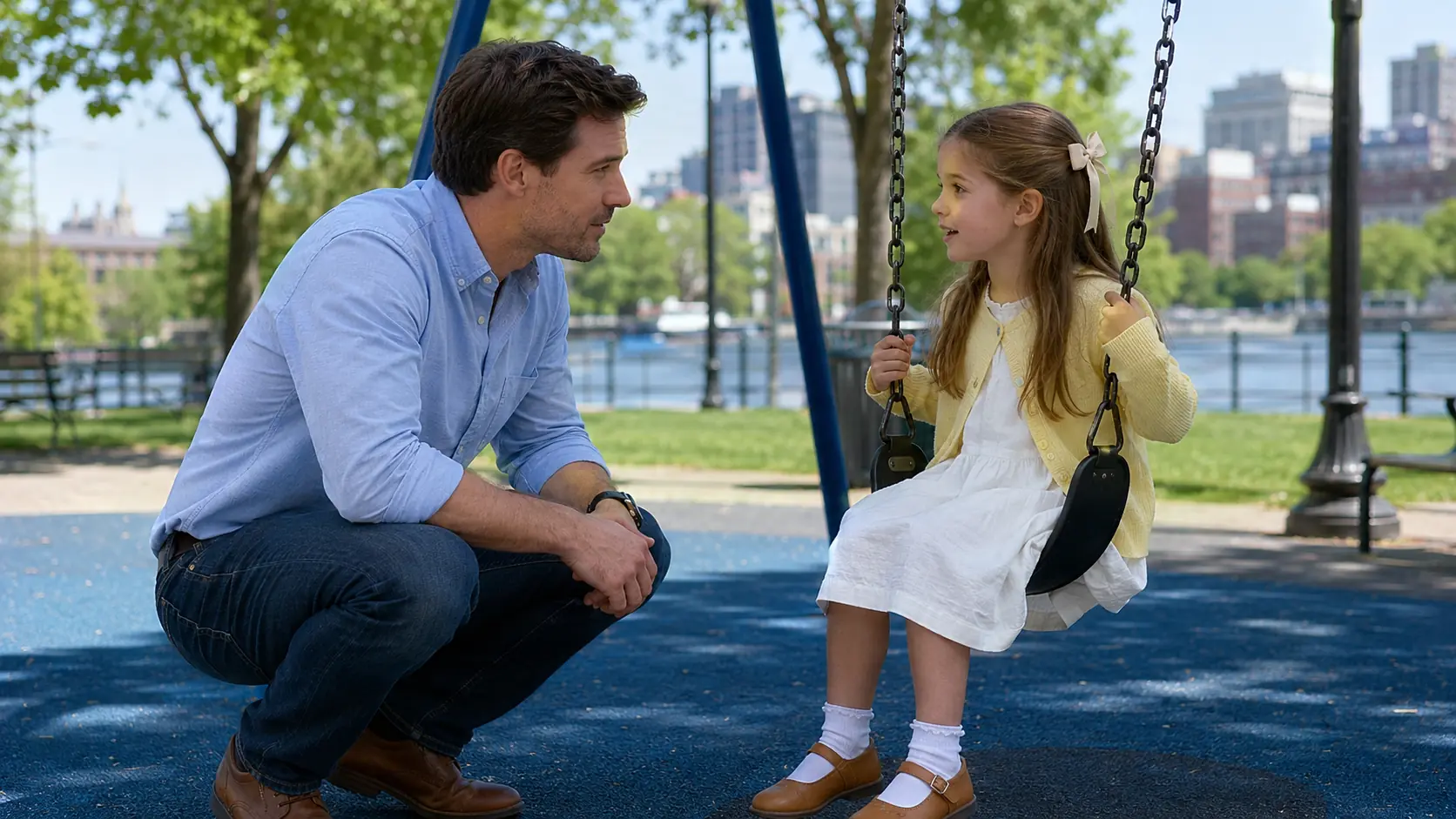
But before Caroline could finish, the man held up a gentle hand and knelt down in front of Emma’s swing so he was at her eye level.
He didn’t touch her or invade her space, just positioned himself where she could see him if she chose to look.
“My name is Daniel,” he said softly, with no expectation or pressure in his tone. “This is my daughter, Mia. We come to this park every Wednesday because it’s got the best swings in the whole city.”
“Some people might say that’s a silly reason to love a park, but I think the quality of the swings is very important. Don’t you?”
Emma didn’t respond.
But Caroline saw something shift, a slight tilt of her head, a flicker of attention.
Daniel continued, still kneeling, still at Emma’s level.
“Now, I’ve noticed something about you. You’re sitting very still on that swing, and that’s interesting to me.”
“Most kids are pumping their legs and trying to go as high as possible, but you’re sitting still, and I think that takes a different kind of courage.”
“It takes courage to be still when the world is moving all around you. I admire that.”
Caroline felt tears prick her eyes.
This stranger, this man she’d never met, had just articulated something about Emma that Caroline herself hadn’t quite grasped.
Her daughter wasn’t just silent.
She was holding herself still in a chaotic world, trying to find some sense of control.
“Emma doesn’t speak,” Caroline said quietly, feeling she owed this man an explanation after his kindness. “She hasn’t spoken in six months. It’s… it’s complicated.”
Daniel looked up at Caroline, and there was no judgment in his eyes.
No pity, just understanding.
“I imagine it’s very complicated,” he said. “Life usually is.”
He turned his attention back to Emma.
“Would it be okay if Mia and I swing next to you? We don’t need you to talk or do anything except sit there being still and courageous.”
“We’ll just be here, swinging and being friends with the quiet.”
Emma looked at him then, really looked at him, and gave the tiniest nod.
Daniel stood and began pushing Mia’s swing while also reaching over to give Emma’s swing a gentle push.
Not too high, not too fast, just a slow, steady rhythm.
Mia, taking her cues from her father, didn’t pepper Emma with questions or try to force interaction.
She just swung and occasionally commented on things she saw.
Birds, clouds, flowers, with no expectation of response.
Caroline watched, mesmerized, as something impossible happened.
Emma’s shoulders relaxed slightly.
Her death grip on the swing chains loosened.
She wasn’t participating exactly, but she wasn’t completely withdrawn either.
She was present, more present than Caroline had seen her in months.
After about ten minutes of comfortable silence, broken only by Mia’s occasional observations, Daniel spoke again, his tone conversational and easy.
“You know, Emma, my wife died two years ago. Mia’s mother.”
“And for a long time after that, Mia didn’t talk much either. Not because she couldn’t, but because words felt like too much, like they required more energy than she had.”
“I understood that sometimes the world asks us to explain ourselves when we don’t have explanations.”
“Sometimes being quiet is the only honest response to things that don’t make sense.”
Caroline’s breath caught.
She looked at this man with new understanding.
He wasn’t just being kind.
He was speaking from lived experience.
Mia piped up, her voice matter-of-fact.
“I used to talk to Mommy all the time, but then she died and I didn’t know how to talk without her listening. Dad says that’s okay. He says we all process things differently.”
“That’s exactly right,” Daniel confirmed. “And eventually Mia found her words again.”
“Not because anyone forced her, but because she was ready.”
“And in the meantime, I learned that silence can be its own kind of communication.”
“Silence can mean I’m hurting, or I need time, or I’m here, but I can’t perform being okay right now.”
“That’s all valid.”
Emma was looking at Daniel now.
Really looking at him.
Her eyes were wide and focused in a way Caroline hadn’t seen in months.
“The thing about words,” Daniel continued, pushing both swings in a steady rhythm, “is that they’ll be there when you need them.”
“They don’t go anywhere. They wait.”
“And when you’re ready, if you’re ready, they’ll come back. But there’s no rush.”
“The world can wait. Your mom can wait. We can all wait.”
He glanced at Caroline.
“Right, Mom? We can wait.”
Caroline nodded, tears now streaming down her face.
“We can wait as long as Emma needs.”
They swung in silence for a while longer.
Then Mia said, “Emma, would you like to see the flowers over there? They’re really pretty.”
“You don’t have to say anything. You could just come with me and look at them.”
To Caroline’s astonishment, Emma climbed off the swing and walked with Mia toward a patch of wildflowers near the edge of the playground.
Not running, not skipping, but walking with a purpose.
The first purposeful movement Caroline had seen from her daughter in weeks.
Caroline and Daniel stood side by side, watching the girls examine the flowers.
“Thank you,” Caroline said, her voice breaking. “I don’t know what you did, but thank you.”
“I didn’t do anything,” Daniel replied. “I just saw a child who was struggling and remembered what that struggle looked like.”
“Mia went through something similar. Like I said, losing her mother was devastating.”
“She withdrew completely for about four months. Barely ate, barely slept, barely engaged with anything.”
“What helped?” Caroline asked desperately. “What made her come back?”
“Time,” Daniel said simply. “And knowing that I wasn’t going to force her to be okay before she was ready.”
“I think kids pick up on adult anxiety. They know when we’re desperate for them to be better, and that pressure makes everything worse.”
“So, I had to learn to be okay with her not being okay, to trust that she’d find her way back when she could.”
“But you must have done something,” Caroline protested. “Therapy, programs, something.”
“We did therapy, yes, and that helped eventually. But the real turning point was when I stopped seeing her silence as a problem to fix and started seeing it as a communication in itself.”
“She was telling me without words that she was overwhelmed and hurt and needed space to process.”
“Once I really heard that message, I could respond appropriately. I could give her what she needed instead of what I thought she should need.”
Caroline felt something shift in her understanding.
“I’ve been so focused on getting Emma to speak again, on fixing what’s broken, I haven’t been listening to what her silence is actually telling me.”
“And what is it telling you?” Daniel asked gently.
Caroline thought about it.
Really thought about it, looking at her daughter examining flowers with this stranger’s child.
“That she needs safety, stability, predictability.”
“She needs to know that the adults in her life won’t fall apart or fight or disappear.”
“She needs to feel secure before she can risk being vulnerable again.”
“And speaking, engaging with the world, that’s vulnerable. That’s risky.”
“She won’t do it until she feels safe enough.”
“That sounds exactly right,” Daniel said. “And have you been providing that, the safety and stability?”
Caroline’s face crumpled.
“I’ve been trying, but I’m still working constantly.”
“Still stressed about the business. Still processing my own feelings about the divorce.”
“I’ve been trying to be there for Emma while simultaneously falling apart myself.”
“She can probably sense that.”
“Of course, she can,” Daniel said.
But there was no judgment in his tone.
“Kids are incredibly perceptive. They know when we’re pretending to be okay.”
“Maybe instead of pretending, you could be honest with her about your own struggles.”
“Not in a way that burdens her, but in a way that models that it’s okay to not be okay.”
“That grown-ups struggle, too. And struggling doesn’t mean you’re broken.”
They stood in comfortable silence for a moment, watching Mia show Emma different flowers, explaining their names and colors.
Not requiring any response, but clearly delighted to share her knowledge.
“Can I ask what happened?” Daniel said carefully. “You don’t have to tell me, but sometimes talking to a stranger is easier than talking to people who know you.”
Caroline surprised herself by actually wanting to talk about it.
“My husband, ex-husband, and I got married young.”
“I was building my company, working one-hundred-hour weeks, completely obsessed with success.”
“He was supportive at first, but eventually he felt neglected, which was fair. He was neglected. Emma was neglected.”
“I kept telling myself it was temporary, that once the company was stable, I’d pull back and focus on family.”
“But the company kept growing, and I kept working, and years passed.”
She paused, gathering her thoughts.
“My husband started an affair. When I found out, I was devastated, but also not surprised.”
“I’d given him every reason to look elsewhere for attention and companionship.”
“We tried counseling, but by then the damage was done.”
“The divorce was ugly. We fought about everything. Money, custody, who was more at fault.”
“And Emma saw and heard too much of it.”
“That’s when she stopped speaking?” Daniel asked.
“Three months into the divorce proceedings, yes.”
“She just stopped.”
“At first, I thought she was being stubborn or punishing me, but then I realized she was protecting herself.”
“Speaking meant engaging with a world that had become unpredictable and scary. Silence was safer.”
“Have things settled down since the divorce finalized?” Daniel asked.
“Somewhat. We have a custody arrangement now. Emma lives with me during the week, with her father every other weekend.”
“But the stability is fragile.”
“My ex is already talking about remarrying, introducing Emma to his girlfriend, and I’m still working too much, still stressed, still trying to be this impossible combination of CEO and present mother.”
“Emma needs consistency, but I keep failing to provide it.”
Daniel nodded thoughtfully.
“Can I share something that helped me?”
“After my wife died, I was drowning.”
“Running a business. I’m an architect, while caring for a traumatized child alone.”
“Everyone told me I needed to be strong for Mia, to keep everything together, to not let her see me struggle.”
“But that was killing me. I was holding myself together with duct tape and denial.”
“What changed?” Caroline asked.
“My sister told me something that shifted everything.”
“She said, you’re teaching Mia how to handle grief.”
“If you teach her to pretend it doesn’t exist, she’ll learn to bury her pain.”
“If you teach her it’s okay to fall apart and rebuild, she’ll learn resilience.”
“So, I started being honest with Mia about my own struggles.”
“I’d tell her when I was having a hard day. I’d let her see me cry sometimes, and I made changes to my work life so I could actually be present instead of just physically there while mentally at the office.”
He smiled slightly.
“It wasn’t easy. I had to cut back client work.”
“I had to delegate things I’d previously insisted on controlling.”
“I had to admit I couldn’t do it all.”
“But you know what? Mia got better.”
“Not because I found the perfect solution, but because she felt safe.”
“She knew I was struggling, too, but I wasn’t hiding it from her.”
“We were going through it together instead of her going through it alone while I pretended everything was fine.”
Caroline felt those words settle in her chest like truth.
“I’ve been pretending everything is fine. Emma can probably see right through it.”
“Almost certainly,” Daniel agreed. “Kids are smarter than we give them credit for.”
The girls returned from the flowers.
Mia was chattering about different varieties and their meanings.
Emma was quiet but more animated than before, actually looking at Mia while she talked.
Engaged, if not participating.
“Dad, can Emma come to the art store with us?” Mia asked suddenly. “You said we could go get supplies for my project.”
“Emma could come and help me pick colors. She doesn’t have to say anything. She could just point to the ones she likes.”
Daniel looked at Caroline questioningly.
Caroline was about to say no.
They had to get home.
She had work to finish.
They didn’t know these people.
But then she looked at Emma.
Really looked at her.
And saw something in her daughter’s eyes.
Hope, maybe interest.
The first spark of life in months.
“We’d love to,” Caroline heard herself say.
The art store was a riot of color and creativity, supplies stacked from floor to ceiling.
Mia led Emma through the aisles, showing her different paints and brushes and papers, asking Emma’s opinion by offering choices and watching for nods or headshakes or pointing.
“Do you like the blue or the green better?” Mia would ask, holding up two paint tubes.
Emma would point.
“Good choice. That’s my favorite, too.”
Caroline and Daniel followed at a distance, watching this interaction unfold.
“Mia’s wonderful with her,” Caroline observed. “So patient and accepting.”
“Mia understands what it’s like to be in that place Emma’s in,” Daniel explained.
“She remembers how awful it felt when adults pushed her to talk or express herself before she was ready.”
“So now, when she meets kids who are struggling, she just makes space for them to be however they need to be.”
“How long did it take?” Caroline asked. “Before Mia spoke again.”
“Four months. But everyone’s different. Don’t try to put Emma on Mia’s timeline.”
“I’m trying so hard not to pressure her,” Caroline said. “But I miss her voice so much.”
“I miss having conversations. I miss hearing her laugh. I miss her, the her she used to be.”
“She’s still there,” Daniel assured her. “Just hiding until it feels safe to come out.”
“Your job isn’t to drag her out of hiding. It’s to make the world safe enough that she chooses to come out.”
They spent over an hour in the art store.
At the checkout, Caroline tried to pay for Emma’s selections, but Daniel waved her off.
“Consider it a gift from one struggling parent to another,” he said with a smile.
Outside the store, Mia asked, “Can we do this again? Maybe next Wednesday at the park?”
“Emma and I could paint together. She wouldn’t have to talk. We could just create art side by side.”
Caroline looked at Daniel, who nodded.
“We’re always at the park on Wednesdays around three. You’re both welcome to join us anytime.”
As they prepared to part ways, something extraordinary happened.
Emma tugged on Caroline’s hand, then pointed at Daniel and Mia.
She held up her fingers in a gesture clearly meant to indicate next week and looked at Caroline questioningly.
“Yes,” Caroline said, tears streaming down her face. “Yes, we’ll come back next Wednesday.”
“I promise.”
Emma didn’t speak, but she smiled.
The first real smile Caroline had seen in months.
Over the following weeks, Wednesday afternoon at the park became sacred time.
Caroline would leave work early, actually leave, not just work remotely from a park bench, and Emma would light up when she saw Daniel and Mia approaching.
They’d swing, paint, explore the park, sometimes just sit in comfortable silence.
Daniel never pushed Emma to speak.
Neither did Mia.
They just created space for her to exist as she was, without expectation or pressure.
And gradually, things began to shift.
Emma started expressing more through gestures and drawings.
She’d paint pictures that told stories.
She’d play charades with Mia, communicating through exaggerated movements that would leave both girls giggling.
Caroline noticed changes in herself, too.
She’d started being honest with Emma about her own struggles.
“Mama’s having a hard day today,” she’d say. “I’m feeling stressed about working.”