Rowan Hale had lived for eight years with one rule stronger than exhaustion: never do anything that would make his son ashamed of his name. Every morning before sunrise, he packed Mason’s lunch, ironed a school shirt, made eggs or toast, and checked the boy’s backpack twice before driving him across Seattle to school. After that, Rowan went to Whitmore Systems, where he worked as an operations manager under one of the youngest CEOs in the city. He was not rich, famous, or powerful, but he was steady, and steadiness had carried him through grief when nothing else could.
His wife, Emily, had died three years earlier after a long illness that emptied their savings and left Rowan raising Mason alone. Mason was eight now, old enough to ask hard questions and young enough to still fall asleep holding the sleeve of Rowan’s hoodie on difficult nights. Rowan worked long hours because rent, school fees, medicine, and groceries never cared how tired a man was. Still, he never complained where Mason could hear him, because he wanted his son to believe hardship could be carried without becoming cruel.
Cassandra Whitmore, his boss, was everything the business magazines loved to praise. She was thirty-six, brilliant, sharp, and feared in every conference room she entered. Whitmore Systems had nearly collapsed before she took over, and within five years she turned it into a multimillion-dollar company with clients across the country. People called her cold, but Rowan had learned that some coldness was only armor worn too long.
He respected Cassandra, though he did not pretend she was easy to work for. She noticed every missed deadline, every weak report, every excuse dressed up as strategy. Yet she also remembered who stayed late, who solved problems quietly, and who protected the company when nobody applauded. Rowan had earned her trust slowly, not through flattery, but through reliability.
The night everything began was supposed to be a celebration. Whitmore Systems had just signed the largest contract in its history, and Cassandra rented a rooftop lounge overlooking downtown Seattle. The city glittered beneath them, music played softly through hidden speakers, and employees who usually lived under pressure finally laughed with champagne in their hands. Rowan had planned to leave early, but a vendor issue kept him at a side table checking final paperwork while the party continued around him.
Cassandra looked different that night, not because her hair was messy or her confidence had vanished, but because she seemed almost human beneath the polished mask. Her hair was neatly styled in smooth dark waves, her makeup still flawless, and she wore a revealing black evening gown with a deep neckline, a high slit, and one strap that shifted slightly when she moved. The dress was elegant but bold, the kind of outfit chosen by a woman trying to remind the room she still owned herself after years of being owned by work. Rowan noticed only in the careful way a decent man notices and then chooses respect.
As the night went on, Cassandra accepted more champagne than Rowan had ever seen her drink. At first, she only smiled more easily and allowed employees to tease her about finally taking a night off. Later, her laughter grew unsteady, her words slowed, and she stopped checking her phone every few minutes. By the time most employees had gone home, Cassandra was sitting alone near the glass railing, staring out at the city like she had forgotten why she was there.
Rowan finished the last vendor email and gathered his jacket, already thinking about Mason asleep on the couch at home. Then he saw Cassandra attempt to stand and nearly lose her balance. She caught the edge of the table, blinked hard, and laughed in a way that sounded closer to sadness than amusement. Rowan stopped, torn between leaving his boss alone and stepping into a situation that could easily be misunderstood.
“Ms. Whitmore,” he said carefully, keeping distance between them. “Do you have a driver coming?” Cassandra looked up at him, trying to focus. “I have a car,” she said, though her words blurred at the edges. Rowan glanced toward the parking garage and felt his stomach tighten. “You cannot drive like this.”
She waved one hand, proud even while drunk. “I’m fine, Rowan.” Then she took one step and nearly fell into a chair. Rowan moved only enough to keep the chair from sliding away, not touching her until she grabbed his sleeve for balance. Her fingers tightened around his jacket, and he knew immediately this was the kind of moment where kindness needed witnesses.
He called the building manager of Cassandra’s apartment complex from her phone after she mumbled the contact code. He also called a rideshare, but Cassandra kept insisting her car was in the garage, and reporters sometimes watched the front entrance after major company events. Rowan did not care about gossip for himself, but he understood that a young female CEO seen drunk and alone in public could become a headline by morning. So he made the safest choice he could think of: he would drive her home in her car, with the building manager waiting at the entrance.
The ride was quiet except for the soft hum of traffic and Cassandra’s uneven breathing from the passenger seat. Rowan kept both hands on the wheel and his eyes forward, speaking only when necessary. Twice, Cassandra muttered something about her father, then fell silent again. Rowan did not ask questions, because drunk pain was not an invitation.
At the apartment building, the night manager, Mr. Alvarez, was already waiting near the private entrance. He was an older man with silver hair and kind eyes, and he immediately understood the situation. “Rough celebration?” he asked softly. Rowan nodded. “She is too intoxicated to be alone in the garage. I just need to make sure she gets inside safely.”
Together, they helped Cassandra to the elevator, careful and slow. Rowan kept his hand at her elbow only when she wobbled, then released her as soon as she was steady. Cassandra’s black evening dress still looked expensive and composed, her smooth waves falling neatly over one shoulder, but her eyes were unfocused and exhausted. The contrast made Rowan even more careful, because dignity mattered most when someone could not protect it for themselves.
Inside her apartment, the city lights glowed through tall windows, turning the room silver and blue. The apartment was beautiful, with cream furniture, glass tables, and framed awards placed on shelves like proof she had conquered loneliness by decorating around it. Cassandra stumbled toward the sofa, one strap of her dress slipping slightly, and Rowan immediately looked away. He took off his own jacket and draped it over her shoulders without letting his eyes wander.
“You were too drunk to drive, Cassandra,” he said quietly, standing near the doorway. “I brought you home safely.” Cassandra blinked at him, confused and barely awake. “Rowan… why am I home? What happened tonight?” Her voice was small in a way he had never heard at the office.
“Your building manager opened the door,” Rowan said, stepping back with both hands visible. “I left water on the counter, and now I’m leaving.” Cassandra lowered herself onto the sofa, clutching his jacket over her dress. “Please… don’t let anyone see me like this.” Rowan looked toward the kitchen, placed a glass of water beside the sink, and kept his voice gentle. “No one will. You’re safe, and I won’t cross any line.”
He did not enter her bedroom. He did not open drawers, touch personal items, or linger in the room after she was safely on the sofa. Mr. Alvarez remained by the doorway while Rowan checked that the apartment door could lock behind them. By 11:47 p.m., Rowan walked out carrying nothing except his phone, keys, and the weight of a difficult choice done as carefully as possible.
When Rowan reached home, Mason was asleep on the couch with a half-finished drawing on his lap. The drawing showed Rowan in a superhero cape holding a lunchbox, which made Rowan smile despite the exhaustion in his bones. He covered Mason with a blanket, kissed his forehead, and whispered, “I’m home, buddy.” Then he sat alone in the kitchen for five minutes, wondering why doing the right thing sometimes left a person feeling afraid.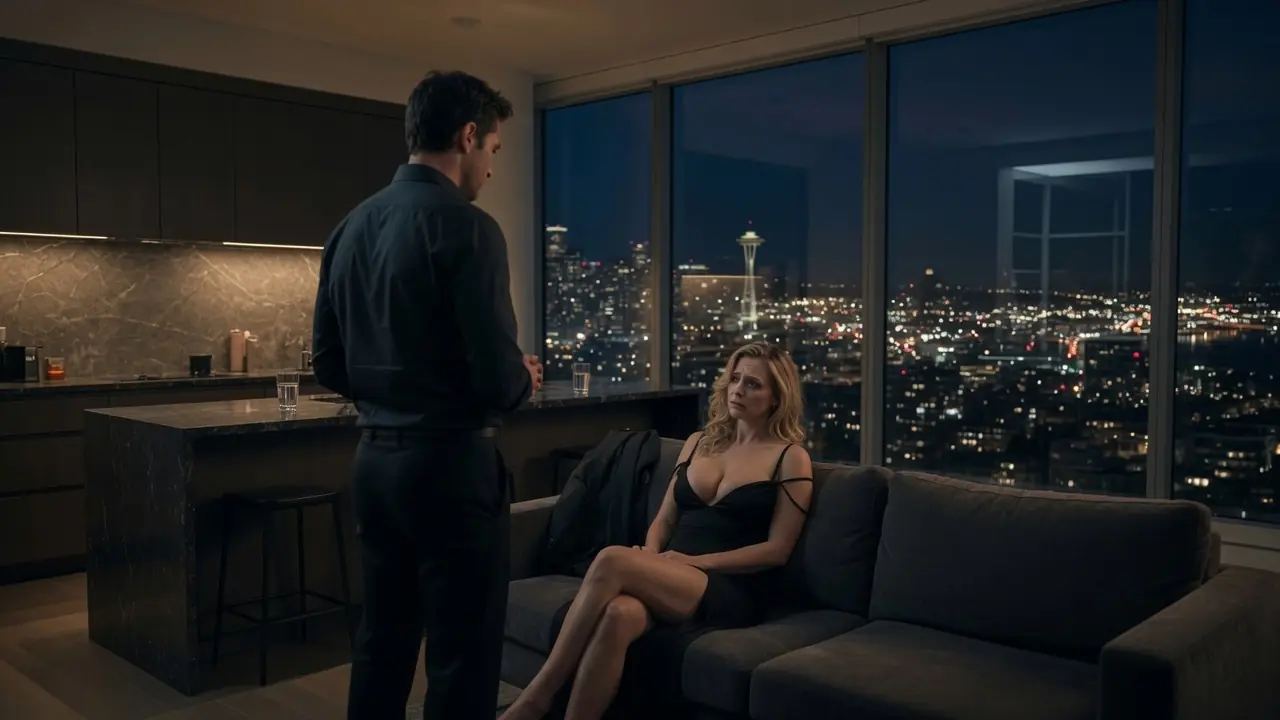
The next morning began normally, which made what happened later feel even more unreal. Rowan made pancakes, listened to Mason complain about spelling homework, and drove him to school with the radio playing low. Mason asked if Rowan would be home early that night, and Rowan promised he would try. He did not know that by afternoon, his son would be hearing whispers about him from other children.
At the office, the air felt different the moment Rowan stepped inside. People spoke quietly near the elevators, and two executives stopped talking when he passed. Cassandra had arrived late, pale and stiff, wearing a gray suit with her hair tied back neatly and no trace of the previous night’s vulnerability on her face. Her eyes moved toward Rowan once, then away quickly, as if looking at him hurt.
The emergency executive meeting started at 9:30. Rowan took his usual seat near the end of the conference table, prepared to discuss the new contract rollout. Cassandra stood at the head of the room with both hands pressed against the table, her face tense. She looked like a woman trying to assemble broken memories while everyone waited for leadership.
Then she looked directly at Rowan. “Did you touch me last night?” she asked. The question was quiet, but it struck the room harder than shouting. Every face turned toward him.
Rowan felt his throat close. His hands lifted instinctively, palms open, as if he needed to prove innocence before anyone had named a crime. “No,” he said, voice shaking. “You were too drunk to drive. I took you home safely, called your building manager, left water on your counter, and left before midnight.”
Cassandra’s face trembled with confusion, fear, and embarrassment. “I don’t remember everything,” she said. Someone at the table whispered. Another executive looked at Rowan with instant suspicion, the kind that forms before facts arrive. Rowan felt the room pulling away from him, chair by chair, breath by breath.
“I did not cross any line,” Rowan said, forcing himself to stay calm. “Mr. Alvarez was there. The building cameras will show it.” Cassandra looked down at the table, but panic had already entered the room. Human Resources requested that Rowan step outside while they began a formal review.
By lunchtime, the story had escaped the conference room. Nobody knew the truth, but everyone knew enough fragments to make their own version. A single father drove his drunk boss home. She could not remember what happened. He was suspended pending investigation.
Rowan left the building with his ID badge temporarily deactivated and his coworkers watching from behind glass walls. He felt every stare like a hand pushing against his back. His phone buzzed with messages he could not answer. By the time he reached his car, he sat behind the wheel and shook so badly he could not turn the key.
The worst part came at 3:30 when Mason’s school called. Mason had gotten into a fight after another boy said his father was a bad man. Rowan arrived to find his son sitting outside the principal’s office with red eyes and a split lip. Mason looked up and asked the question Rowan had feared most: “Dad, why are people saying you hurt someone?”
Rowan knelt in front of him, holding his son’s small shoulders. “I did not hurt anyone,” he said. “I helped someone get home safely, and people are confused.” Mason searched his face, wanting to believe him and already afraid of the world that had accused him. “Then why are they saying it?”
Because people fear scandal more than truth, Rowan wanted to say. Because rumors run faster than evidence. Because one question can destroy a man before the answer arrives. Instead, he pulled Mason into his arms and said, “Because sometimes people speak before they know.”
That night, Rowan barely slept. Mason curled beside him in the living room, refusing to sleep alone. Bills sat unopened on the table, and Rowan’s laptop showed an email confirming unpaid suspension until the investigation concluded. He looked at a framed photo of Emily and wondered what she would tell him to do.
Meanwhile, Cassandra was not sleeping either. She sat in her apartment, staring at the sofa where Rowan had left his jacket over her shoulders. Small flashes kept returning: Rowan looking away respectfully, Mr. Alvarez opening the door, a glass of water on the counter, the apartment door closing softly. Each memory weakened the fear that had made her ask the question, and guilt began filling the space it left behind.
The company board demanded proof before reversing any action. Cassandra agreed, though shame burned through her every time Rowan’s name appeared in an investigation email. Security requested footage from her apartment building, elevator cameras, lobby cameras, and hallway cameras. Mr. Alvarez gave a statement confirming Rowan had called him, kept distance, and left within minutes.
The footage arrived two days later. Cassandra watched it in the HR office with the board chair, legal counsel, and the head of security. The video showed Rowan helping her from the car only when she stumbled. It showed him stepping back whenever she stood steady. It showed Mr. Alvarez unlocking the door, Rowan placing water on the counter, draping his jacket over her shoulders, and leaving quickly.
There was no misconduct. No secret moment. No lingering touch. Only careful respect from a man who had protected her when she could not protect herself.
Cassandra covered her mouth as tears ran down her face. She saw herself drunk, vulnerable, and unaware. She saw Rowan choose dignity for her in every movement. Then she saw the timestamp: 11:47 p.m., Rowan leaving alone, head lowered, carrying nothing.
The next morning, Cassandra called an all-company meeting in the main lobby. Employees gathered on every floor balcony and across the open atrium. Rowan stood near the back with Mason beside him, because Cassandra had personally asked him to come and promised his son deserved to hear the truth too. Mason held his father’s hand tightly, still wounded by days of whispers.
Cassandra stepped onto the small stage, her face pale but steady. “Three days ago, I asked Rowan Hale a question in fear and confusion,” she began. “That question started a chain of suspicion that hurt an innocent man and his child.” The lobby went silent.
She took a breath, then continued. “The investigation is complete. Security footage, building records, and witness statements prove Rowan acted with integrity. He brought me home because I was too intoxicated to drive, called my building manager, left water for me, kept his distance, and left before midnight.” Her voice broke slightly. “He protected me when no one was watching.”
Rowan lowered his eyes, and Mason pressed closer to his side. Cassandra looked directly at them. “Rowan, I am deeply sorry. Mason, I am sorry that my fear allowed people to hurt your father’s name.” Mason stared at her, trying to understand how adults could break something and then fix it with words.
Cassandra did not hide behind corporate language. She admitted that the company moved too quickly on suspicion and too slowly on protection. She announced Rowan’s immediate reinstatement with back pay, legal support, counseling for Mason, and a full internal review of how rumors had spread. Then she stepped down from the stage, walked to Rowan, and apologized again without a microphone.
Rowan did not smile. His name was cleared, but his life did not instantly return to normal. “Thank you for telling the truth,” he said quietly. Cassandra’s eyes filled. “I should have found it sooner.”
Weeks passed before Rowan could walk into the office without feeling people look at him twice. Some coworkers apologized, and some avoided him because guilt made them cowardly. Mason slowly returned to school without fighting, though he still asked if people could make lies true by saying them loudly. Rowan told him no, but privately he knew lies could still leave bruises.
Cassandra visited Rowan’s modest home one Saturday afternoon with groceries, flowers, and a handwritten letter. She stood awkwardly on the porch, no longer the untouchable CEO, but a woman carrying remorse in both hands. Mason opened the door and looked at her carefully. “Are you here to say sorry again?” he asked.
Cassandra nodded. “Yes.” Mason thought about it, then stepped aside. “Dad says people who mean sorry have to do better after.” Cassandra’s eyes softened. “Your dad is right.”
Inside, Rowan made coffee while Cassandra sat at the kitchen table. The house was small, clean, and filled with evidence of love: school drawings on the fridge, Emily’s photo near the window, toy cars lined along the shelf. Cassandra looked at everything and understood more clearly what her frightened question had endangered. Not just a job, but a home, a child’s trust, and the fragile dignity of a man already carrying grief.
“I can’t undo it,” Cassandra said. Rowan sat across from her. “No.” She accepted the answer. “But I can change what happens next.”
And she did. Whitmore Systems created a new emergency assistance policy requiring documentation, third-party witnesses, safe transportation procedures, and protection for both vulnerable employees and those who help them. Cassandra also created a family support fund for workers facing crisis, naming Rowan as director of employee welfare after he returned fully to work. It was not a promotion born of pity. It was recognition that the man who suffered most from a broken system understood how to rebuild it.
Months later, Rowan stood in the same conference room where Cassandra had once asked the question that shattered him. This time, he led a training session on responsibility, documentation, and kindness with boundaries. He spoke plainly about how good intentions need protection, and how truth should be pursued before judgment hardens. Employees listened differently now.
Cassandra stood at the back of the room, watching him with quiet respect. She had changed too. She drank less, trusted more carefully, and stopped treating vulnerability like failure. She never again allowed fear to become accusation before evidence had a chance to speak.
One evening, after a long workday, Rowan found Mason waiting in the lobby with homework in his lap. Cassandra walked by and stopped to ask about his spelling test. Mason looked up and said, “I got an A.” Cassandra smiled. “Your dad must be proud.” Mason nodded seriously. “He always tells the truth.”
Rowan heard the words and felt something inside him finally loosen. Not fully. Some wounds remain as reminders. But his son still believed in him, and that mattered more than applause, job titles, or apologies.
People later told the story as if it was about a single father falsely accused after taking his drunk boss home. They remembered the conference room question, the security footage, and the public apology. But Rowan remembered smaller things: Mason’s trembling voice, Cassandra’s jacket slipping over her shoulder while he looked away, the glass of water on the counter, and the sound of her apartment door closing behind him before midnight.
Kindness had nearly cost him everything. Yet he did not regret choosing it. He only wished the world understood that good people need systems strong enough to protect truth from fear. Because the night Rowan Hale took Cassandra Whitmore home, he did not become a villain, a scandal, or a rumor.
He became what he had always tried to be: a father his son could trust, a man who did the right thing when no one was watching, and a reminder that one frightened question can wound deeply, but the truth, when finally spoken with courage, can still bring a life back from the edge.