At 6:00 in the morning, on the 43rd floor of Harrington Tech’s headquarters on Park Avenue, the cleaning crew had already come through at 5:00. Lucas arrived after them, the way he preferred it.
Quiet hallways. No one at their desks. Just the hum of the HVAC and the low blue glow of monitors left on overnight.
His job was the building itself, not the company inside it. Plumbing, electrical, climate control, physical hardware. He worked for the property management firm that leased the space to Harrington Tech.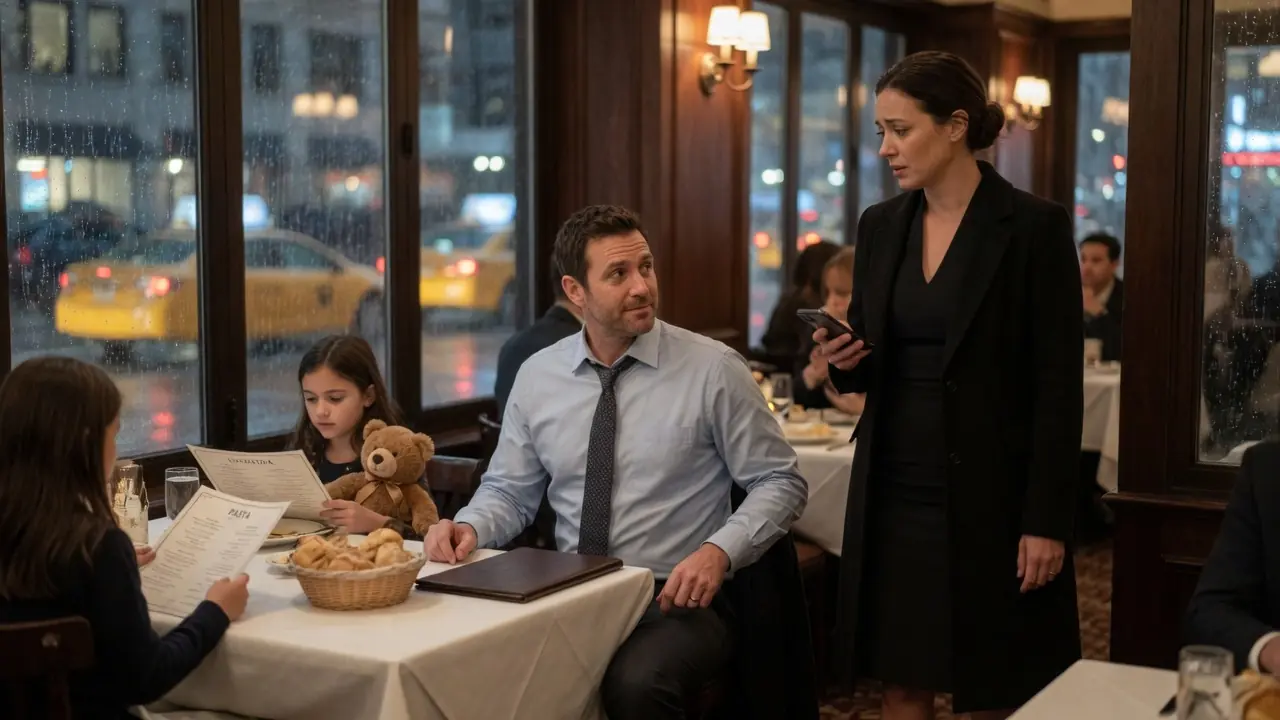
He knew the floor plan better than anyone who actually worked there. He knew which pipes ran cold in winter and which circuit breakers tripped if someone ran a space heater and a laptop charger on the same outlet.
He moved through the executive floor with a toolbox and a clipboard.
The corridor outside the CEO’s office had a lighting fixture that had been flickering for three days. He had submitted the work order twice. Nobody flagged it urgent.
So he came in early on his own time.
He was reaching up to unscrew the fixture cover when he heard it.
Through the closed glass door of the conference room adjacent to the CEO suite, a man’s voice came through. Low. Clipped. The kind of voice that practiced sounding calm.
Lucas wasn’t trying to listen. He was six feet up on a stepladder with a Phillips-head screwdriver.
But the building’s ventilation system ran along the ceiling, and in that particular corridor, sound traveled in ways the architects hadn’t intended. He had noticed it months ago when he heard a fired analyst crying on the phone two offices down.
The voice said, “Fourteen months. She doesn’t know about the restructure clause. Her lawyers missed it.”
A pause.
“By the time she figures it out, the secondary vote will already be certified.”
The man laughed once, short and dry.
“The girls are a different matter. I’ll handle that separately.”
Lucas replaced the bulb, screwed the cover back, and climbed down.
He wrote nothing on his clipboard. He said nothing to anyone.
But he stood in that hallway for a long moment after the voice went quiet, his hand flat against the wall, and something tightened in his chest that had nothing to do with exhaustion.
Now let me tell you about Bella.
Isabella Harrington had not slept more than four hours a night in six weeks. She kept a cup of green tea on her desk that went cold every morning before she remembered to drink it.
Her assistant, Emma, refilled it twice a day without being asked, one of the small mercies Bella never acknowledged out loud.
She had built Harrington Tech from a dorm room concept into a Series C company worth $420 million. She had done this while putting herself through a divorce, a custody negotiation, and a board restructure that her COO kept assuring her was routine.
The COO’s name was Victor Cain.
Her partner for six years. Her mentor before that.
He knew every clause in every contract the company had ever signed because he had helped draft most of them.
That morning, Bella sat across from her attorney on a video call and listened to him explain for the third time why the restructure clause in her founding agreement was “somewhat unusual, but not necessarily alarming.”
She pressed two fingers to the bridge of her nose.
“Somewhat unusual,” she repeated.
“Victor’s counsel is technically correct that the language allows for a secondary shareholder vote under certain conditions,” the attorney said. “The question is whether those conditions have been triggered.”
“Have they?”
A pause that lasted half a second too long.
“We’re reviewing it.”
She ended the call, walked to the window overlooking Park Avenue, pressed her forehead against the glass, and did something she never permitted herself in this office.
She closed her eyes.
Her phone buzzed.
A text from her sister, Caroline.
Sarah confirmed dinner. Lucas is a good guy. Go. You need to eat real food.
She had agreed to this two weeks ago in a weaker moment when Caroline and her yoga instructor, Sarah Reed, had double-teamed her over lunch. She had said yes mostly to make them stop.
Now she thought about canceling.
Then she thought about Mia and Zoe and how she had not sat across from another adult in weeks without a lawyer present.
She typed back, Fine, but I might be late.
She did not know how late.
That same afternoon, Lucas got a text from his sister, Sarah.
You’re still going tonight. Don’t even think about canceling. 7:00, The Crystal Room. I made the reservation.
He read it twice, then typed back, I only have one clean button-down.
Sarah replied, Then iron it.
His son, Caleb, was at the neighbor’s place after school. Mrs. Kowalski, 72, kept Caleb supplied with oatmeal cookies and nature documentaries until 6:00.
Lucas picked him up, made grilled cheese, helped with the math worksheet, read two chapters of a Roald Dahl book they had been working through together, then sat on the edge of Caleb’s bed until the boy fell asleep.
He looked at his son’s face in the dim light, the slight part of the lips, the way one hand always curled near his chin when he slept, the same way his mother used to.
Lucas sat there longer than he needed to.
Then he got up, put on the ironed shirt, knotted his tie three times before he got it right, and took the subway to Midtown.
He arrived at The Crystal Room at 6:58. The hostess looked at him the way people do when the outside of a person doesn’t match the inside of a building.
She found it.
She showed him to a table by the window without another word.
He sat down, looked at the menu, then closed it.
The bread basket arrived. He didn’t touch it.
At 7:14, his phone buzzed. A number he didn’t recognize.
Hi, this is Bella. I’m so sorry. I’m stuck outside on a work call. I’ll be there in 10 minutes. Please don’t leave.
He stared at the message.
He thought about the $11 in his wallet. He looked at the bread basket.
He typed back, I’m here. Take your time.
At 7:22, the door opened.
Not Bella.
Two little girls in matching cream coats walked in from the cold, cheeks red, eyes wide, scanning the room with the focused determination of small people on a mission.
The older one was five, maybe. She was pulling the younger one by the hand. The younger one clutched a stuffed bear against her chest with her free arm.
They walked to his table like they had coordinates.
The older one looked at him.
“Are you Lucas?”
He blinked.
“Yeah.”
“Mommy said to tell you she’s really sorry. She’s still on the phone.”
She pulled out the chair across from him and sat down. Then she helped her sister into the chair beside her.
“I’m Mia. She’s Zoe. Don’t worry, we know how to behave in restaurants.”
Through the glass, Lucas could see a woman standing on the sidewalk in a dark coat, phone to her ear, one hand pressed to her forehead. The rain had started again, and she wasn’t fully under the awning.
She didn’t seem to notice.
Mia was studying the menu with the seriousness of a small attorney reviewing a contract. Zoe had her bear on the table and was making quiet sounds he eventually identified as the bear introducing himself to the water glass.
There was something quietly motivational about the little girl’s confidence, the way she had walked into a room full of strangers and simply made herself at home.
Lucas found himself less anxious than he had expected to be.
“How did you two get in here?” he asked.
Mia looked up.
“Emma brought us. She’s Mom’s assistant. She dropped us off because Mom wouldn’t stop talking on the phone, and Emma said if she had to sit through one more conference call, she was going to quit.”
Mia considered this.
“She won’t quit. She’s been saying that for two years.”
“Right,” Lucas said.
“Do they have pasta?”
He flagged down their server and quietly asked whether the restaurant was part of Harrington Group’s hospitality portfolio.
It was, which meant Bella had a house account.
He exhaled.
“They have pasta.”
The door opened.
Bella walked in.
She saw him first. Then she saw her daughters. Something crossed her face that was not quite relief and not quite horror.
The specific expression of a mother who is furious and grateful in the exact same moment.
She reached the table and said very calmly, “We talked about this.”
Mia said, “Emma said it was fine.”
“Emma and I will be having a conversation.”
She turned to Lucas and put out her hand.
“I’m so sorry for all of this. I’m Bella.”
He stood.
She was shorter than he had expected. Her eyes were darker. There was a crease on the left side of her face from where the phone had pressed against her cheek, and her mascara was smudged at the corner of her right eye.
She didn’t know yet.
“Lucas,” he said. “It’s fine. We were working out the pasta situation.”
She stared at him for a moment, then sat down.
The evening unfolded in a way none of them had planned.
Mia ate her pasta. Zoe ate half of hers and fed small pieces to the bear. Bella ordered a glass of red without looking at the wine list, which told Lucas something about how often she came to places like this.
He ordered sparkling water and the roasted chicken, the second cheapest thing on the menu, calculating without appearing to.
“So, you work in the building,” Bella said, not quite a question.
“Maintenance. Electrical, HVAC, physical systems.”
“How long?”
“Coming up on two years.”
She nodded slowly.
Something shifted behind her eyes. Not condescension, more like recognition landing somewhere unexpected.
She had seen him before, she realized. A handful of times in the corridor near the server room. Once outside her office door with a ladder and a toolbox.
She had never learned his name. He had been in her mental shorthand as the man who fixed the lights.
“And before that?” she asked.
He was quiet for a beat.
“Different things.”
Mia, without looking up from her pasta, said, “Aunt Sarah says Uncle Lucas used to build things.”
Bella looked at him.
He looked at Mia.
“Aunt Sarah talks a lot.”
“She talks exactly the right amount,” Mia said.
Bella almost smiled, just the corner of her mouth, quick, like she caught herself.
That was the first time he saw it, the way her face worked when she forgot to manage it. A whole other person underneath the executive posture. Someone who laughed differently when nobody was watching.
Zoe tugged his sleeve.
He looked down.
She held the bear up to him.
“His name is Elliot,” she whispered, like she was sharing classified information.
“Hi, Elliot,” he said.
Zoe looked satisfied and returned to her water glass.
Something shifted at the table, the kind of thing that happens when a person expecting one evening gets an entirely different one and realizes, slowly, that the different one might be better.
Lucas had come here thinking about what to say to a woman he had never met. He had not expected to spend the first 20 minutes of their date making a little girl feel at ease in a restaurant that cost more than his rent.
He also hadn’t expected that doing exactly that would be the most natural thing he had done in years.
By the time the plates were cleared, both girls were leaning against Bella, drifting toward sleep the way children do, suddenly and without warning, like lights going out.
Bella had an arm around each of them. She was looking at the window.
“Tell me what you actually want to know,” Lucas said.
She looked back at him.
“You’ve asked three polite questions. None of them were what you were thinking.”
Four seconds of silence.
He counted.
“Sarah told me what you did before,” Bella said. “She didn’t tell me why you changed.”
“Personal reasons.”
“She also told me about your wife.”
He didn’t flinch.
Four years of practice.
“Then you know the basics.”
“I don’t want the basics,” she said.
The directness surprised him.
He had been in enough rooms adjacent to enough powerful people to know their particular flavor of communication. But this was different.
This was someone who had sat across tables full of people being careful around her for so long that an uncareful person was something she had forgotten to expect.
“Her name was Grace,” he said. “Car accident. Caleb was four. He’s eight now. He’s doing okay.”
“Are you?” she asked.
A different kind of question.
“Most days,” he said.
She nodded once.
She believed him.
Most people responded to that answer with follow-up comfort they hadn’t earned.
Zoe shifted in her sleep and made a small sound. Bella adjusted her arm without looking down, the automatic physics of a mother’s body that has learned a child’s weight.
“When’s the last time someone sat across from you without needing something?” Lucas asked.
She opened her mouth, then closed it.
“I don’t remember.”
He nodded like that was a reasonable answer, because it was.
Her phone lit up on the table.
She turned it face down, but not before he caught the name on the screen.
Victor.
Her jaw moved, just barely. The tendons in her neck changed shape for one second.
He filed it away.
“What was the call about?” he asked. “Outside, before you came in.”
“Restructuring.”
Careful. Edited.
“Of the company?”
“Routine board matter. My COO is managing it.”
Victor Cain.
He had heard that name that morning, spoken into a phone in the voice of a man who had already finished calculating.
Lucas picked up his water glass and said nothing.
Bella glanced down and smoothed a strand of hair back from Mia’s forehead with a touch so gentle it looked like it cost her something.
“She has your face,” he said.
Bella looked up.
Her expression did something he couldn’t classify.
“Everyone says Zoe does,” she said. “Mia is supposed to look like her father.”
“She doesn’t,” Lucas said.
Bella held his gaze.
“No,” she agreed quietly. “She doesn’t.”
They sat with that for a while.
The restaurant had thinned out. Outside, streetlights made the wet pavement glow in long orange streaks.
He thought about the words restructure clause and secondary vote and I’ll handle the girls separately.
He thought, She doesn’t know.
Whatever Victor Cain was doing, she didn’t know the shape of it yet.
At 9:15, Emma arrived to take the girls home. Mia woke immediately and accused Zoe of stealing her half of the armrest. Zoe denied this while still mostly asleep.
Lucas helped Mia into her coat. She submitted with the patience of a child who has been put into coats by strangers before.
Emma looked at Lucas with an expression of faint apology on behalf of the entire evening.
“She’s a great kid,” he told Emma.
He meant it.
Both of them were.
The kind of kids who reminded you what family actually looked like when nobody was performing for an audience.
Mia looked at him over her shoulder on the way out.
“You’re nicer than the last one.”
“Mia,” Bella said.
“It’s true,” Mia said, then walked out.
Bella covered her face with one hand for exactly two seconds.
Then she put it down.
The gesture made something in his chest go soft in a way he wasn’t ready for.
“The last one,” he said.
“Caroline set me up three months ago. He spent 40 minutes explaining how he optimized his portfolio.”
She picked up her wine glass, still half full from an hour ago.
“Mia asked him if he knew how to fix a leaky faucet. He said no. She lost interest immediately.”
“Smart kid.”
“Frighteningly so.”
Outside, they stood on the sidewalk. The air was cold and smelled like rain and exhaust, and somewhere down the block, roasted nuts from a corner cart.
She pulled her coat tighter. He turned up his collar.
“I’d like to do this again,” she said, “without the Greek chorus.”
“I like the Greek chorus,” he said.
She smiled, different from the laugh, quieter.
“Good night, Lucas.”
“Good night.”
He watched her car pull away.
Then he walked toward the subway, thinking about Victor Cain.
Lucas didn’t go home right away. He got off the subway three stops early and walked.
Movement helped him think in a way that stillness didn’t.
She doesn’t know about the restructure clause.
The girls are a different matter.
He turned it over.
A maintenance employee doesn’t stumble into corporate data. He had no access to Harrington Tech servers, no credentials, no window into their internal systems.
He was the man who checked whether circuit breakers were tripping and whether the server room temperature was holding at 68 degrees.
But two weeks ago, he had filed a report about something unusual in the physical infrastructure of the server room on the 14th floor.
A device he didn’t recognize, mounted to the rear of a network switch housing. Not one of the original components he had cataloged when he inventoried the room. Not on any maintenance records.
He had flagged it as a fire safety concern, an unlabeled piece of hardware generating heat in a controlled environment. He photographed it per protocol and submitted the images to the facilities director.
The facilities director forwarded it to the building’s IT liaison.
The IT liaison had not responded.
Lucas stopped walking.
He opened his maintenance documentation app and found the report. Found the photograph.
The small black device, rectangular, no more than three inches long, wedged between the switch housing and the wall bracket.
He was not a cybersecurity expert, but he had spent eight years before all of this working as an electrical engineer for a mid-sized infrastructure firm. He had sat in enough security briefings to know what a hardware keylogger looked like.
He knew that a device like this, mounted to a network switch, could intercept and store communications data as it passed through that physical node.
He knew what it was.
He just hadn’t known whose it was until tonight.
He stood on the wet sidewalk for a long time.
Then he called Sarah.
“How did it go?” she answered.
“I need to ask you something about Bella Harrington. What’s your actual connection to her?”
A pause.
“She joined my class eight months ago. We got close. She needed someone to talk to who wasn’t on her payroll. Lucas, what happened?”
“Nothing happened at dinner.”
He paused.
“But something happened this morning.”
He told her about the corridor, the voice, Victor Cain’s words moving through the ventilation system while he stood on a stepladder and changed a light bulb.
Then he told her about the device.
Sarah was silent for a long moment.
“You need to tell her.”
“I know, but I can’t walk up to a CEO with a maintenance photo and say I think someone’s intercepting her data. I need to go through the right channels first.”
“Then what are you going to do?”
He looked up at the city. A cab went by, then another.
“I’m going to formally escalate the hardware report first thing tomorrow. In writing, timestamped, copy to the building’s legal team. Then I’m going to let the building do what buildings do.”
A pause.
“And then I’m going to call Bella.”
“You got her number?”
“She texted me.”
A beat of silence.
“From the blind date?”
“Yes.”
“Lucas, you like her.”
He didn’t answer.
“Okay,” Sarah said. “Be careful, and don’t do anything that gets you fired before you figure this out.”
He stood in the cold with the photo on his screen.
He thought about Mia looking at him over her shoulder on the way out. He thought about Zoe and her bear named Elliot. He thought about Bella pressing her forehead to the glass 43 floors above Park Avenue.
He thought about a little girl who had walked into a stranger’s evening and rearranged it entirely, and how the most inspirational things in his life had always arrived without warning in the shape of something small.
He put his phone away and started walking again.
Three days passed.
Lucas filed the escalated hardware report Saturday morning. By Monday, the facilities director had forwarded it to Harrington Tech’s external IT security firm, a third-party vendor called Keller Associates, who audited physical infrastructure for data exposure risks.
The building had a legal obligation to report physical anomalies in shared infrastructure.
Lucas did not call Bella.
He waited.
Wednesday, Sarah texted.
She knows something’s wrong. Keller is doing an emergency audit. She’s asked Emma to find out who filed the initial report.
He typed back, She’ll find out.
Thursday morning, 31st floor, replacing a thermostat.
His phone rang.
“Is this Lucas Reed?”
A woman’s voice. Direct. Controlled.
“Yes.”
“This is Isabella Harrington.”
He set down the thermostat bracket.
“Good morning.”
“Emma tracked down your report. You flagged the device two weeks ago.”
A pause.
“Before our dinner?”
“Yes.”
The line went quiet. Not uncomfortable. More like someone recalibrating the geometry of a situation they thought they understood.
“Why didn’t you tell me at dinner?” she asked.
“Because I wasn’t sure what it was yet, and because I didn’t want to be the maintenance guy who panics a CEO based on a photograph of a box.”
“Keller confirmed it this morning. It’s a commercial network tap. Someone with physical access to the server room planted it.”
Her voice had changed, harder now.
“Victor has physical access to the server room. He uses it for his own office backup.”
A pause.
“Lucas, did you hear something before dinner? Something else?”
He thought about the ventilation, the voice.
He told her everything.
She was completely silent when he finished.
Not the silence of someone who is shocked. The silence of someone who already knew, somewhere deep and protected, and is now watching the last door between that knowledge and the surface come open.
“The girls,” she said, very quiet.
“He said the girls are a different matter.”
“Yes.”
She made a sound that was not quite a word.
He waited.
When she spoke again, her voice had settled into something flatter, colder. The voice people use when they have finished feeling the first wave of something and are starting to plan.
“I need to meet with you. Not in the building. Somewhere else.”
They met that afternoon in a coffee shop in the West Village.
She arrived before him. Corner table. A cup of something she wasn’t drinking. A legal pad with things already written on it.
He noticed her hands when he sat down, both flat on the table. He had come to understand that was what she did when she was working to hold still.
“Tell me the timeline again,” she said. “From the beginning, every detail.”
He told her.
She wrote things down, asked three clarifying questions, and did not interrupt.
He had expected panic. He got precision instead.
He understood in that moment why a company had trusted her with $420 million. Under pressure, she became very still and very clear.
When he finished, she looked at the legal pad. Then she looked at him.
And she saw his hand.
His right hand rested on the table. The scar ran from the base of his thumb across the heel of his palm, silver-white and slightly raised. Old. The kind that happens when soft tissue meets something hard and moving at speed.
She was looking at it the way people look at something they have seen before but couldn’t place.
“How did you get that?” she said.
He pulled his hand back slightly, the reflex of someone who doesn’t invite the question.
“Long time ago,” he said.
She was still looking at the space where his hand had been.
“There was an accident,” she said slowly. “Six years ago. I was a grad student. A delivery truck jumped the curb on West 72nd. There was a man.”
She stopped.
Her voice had become careful, like she was carrying something breakable.
“He pushed me out of the way. The truck clipped him. He was gone by the time the ambulance came. I never got his name.”
Lucas said nothing.
“He had a scar on his right hand. I thought about it for years. I thought I imagined it.”
He looked at the coffee cup between them, at the steam that had stopped rising because it had been sitting too long.
“You didn’t imagine it,” he said.
The silence was different from all the other silences that afternoon.
He hadn’t planned this. He had filed the report because he had seen something wrong, and that was what you did.
He hadn’t come here to be recognized.
She put her hand over her mouth briefly, then took it away.
Her eyes were clear.
She was not going to cry in this coffee shop in front of him.
He understood that about her completely.
“You left,” she said. “Why didn’t you stay?”
“Caleb was in school. Grace was at the hospital for a checkup.”
He paused.
“I had somewhere to be.”
“You were hurt.”
“I’ve been hurt worse.”
She looked at him for a long moment.
“You should have let me find you.”
“I wasn’t looking to be found, then or now.”
Outside the window, a dog on a leash was staring at the pastry case with focused longing.
Bella looked down at her legal pad.
“Okay,” she said.
Her voice was back, steady.
“Here’s what we’re going to do.”
She moved fast.
By Thursday evening, she had called Marcus Webb, senior partner at the legal firm she had hired herself before the company scaled. The one she had found before Victor had opinions about her attorneys.
Marcus was the kind of lawyer who did not use the word somewhat when reviewing contracts.
She walked him through the Keller findings, the corridor conversation, the restructure clause, the secondary shareholder vote, and what her current attorney had spent three weeks calling not necessarily alarming.
Marcus was quiet for 12 seconds.
“That vote could be certified in 72 hours under this clause if the conditions have been triggered.”
She set the phone down on her desk and looked at the ceiling.
Then she picked it up again.
“How do we stop it?”
“We need to prove he triggered the conditions fraudulently. If the network tap confirms he was intercepting your communications to manufacture contractual conditions, that’s not civil. That’s criminal.”
A pause.
“We need Keller’s documentation and a formal statement from your facilities contact. The fact that he’s employed by the property management firm, not Harrington Tech, actually helps. Independent of your organization. No conflict. Clean evidence.”
She called Lucas.
“Would you be willing to give a formal statement?”
“Yes,” he said, no hesitation.
She almost said something else.
She didn’t.
“Thank you.”
“Don’t thank me yet. Victor isn’t going to go quietly.”
He was right.
When Harrington Tech’s legal team formally notified Victor Cain that the secondary vote was being contested pending criminal investigation of the hardware anomaly, he called Bella directly.
She let it go to voicemail.
He left a message in the voice of a man who had not yet understood that the door had already closed.
She played it once, then handed the phone to Emma and asked her to document it and send it to Marcus.
Emma did this without a word.
Friday morning, the Keller report was complete.
The device had been planted approximately 14 months prior. Metadata confirmed that intercepted data had been routed to an external server registered under a shell company.
Marcus traced the shell company back to a personal account of Victor Cain through three layers of incorporation.
Victor had been patient. Careful. Thorough.
He had simply not accounted for a flickering light bulb in a corridor.
The emergency board meeting was called for Friday afternoon.
Bella did not bring Lucas into the room. She didn’t need to, and it would not have served either of them.
Marcus presented Keller’s findings and the formal statement from Lucas Reed, maintenance technician, licensed electrical engineer, registered with the state of New York.
Timestamped report filed 14 days prior.
Victor sat at the end of the table in his best suit and said almost nothing.
His attorney objected twice, then went quiet.
When the board voted to suspend Victor’s authority pending criminal referral, it was seven to one.
Victor stood, straightened his jacket, and looked at Bella across the table.
“I built half of this company,” he said.
“I know,” she said.
“You would have lost everything.”
“Maybe,” she said, “but I didn’t.”
He walked out.
In the hallway, he passed Lucas, who was waiting on a bench near the elevator because Bella had asked him to stay.
Victor stopped when he saw him.
He looked at the maintenance shirt, the toolbox, the posture of a man who had spent two years learning to take up a little less space.
Victor said nothing.
He pressed the elevator button and stood with his back to Lucas, waiting.
When the doors opened, he stepped in.
The doors closed.
Lucas looked at the closed doors for a moment, then looked at his hands.
Ten minutes later, Bella came out.
She walked to the bench and stopped in front of him. She looked like someone who had just carried something very heavy down a very long staircase.
“It’s done,” she said.
“I know. I heard the elevator.”
She made a sound that was almost a laugh.
“Marcus is filing the criminal referral this afternoon. The board is appointing an interim COO pending review.”
A pause.
“There’s going to be press.”
“I figured.”
“Your name will likely come up.”
“I filed a maintenance report and gave a statement. That’s it.”
“You know it’s more than that.”
He was quiet.
She sat down on the bench beside him, not close enough to be anything, just close enough to be there.
“What do you want?” she asked.
“From all of this?”
He thought about it honestly.
“Nothing. I heard something I wasn’t supposed to hear, and I reported something I was supposed to report. That’s what you do.”
She turned and looked at him.
Something moved in her face that he didn’t try to name because naming it felt like stepping onto ice he hadn’t tested yet.
“That’s not what most people do,” she said.
“Most people haven’t spent two years learning how a building’s pipes work. You pay attention to the small things, and eventually the small things tell you everything.”
She looked down at his hand, at the scar.
She didn’t say anything about it again.
She didn’t need to.
Six months later, the press lasted three days of sharp coverage, a week of follow-up, and then the next story arrived and the world moved on, as it always does.
Victor Cain’s case moved to federal court. These things take time, but the secondary shareholder vote was formally invalidated, the shell company dissolved, and the 14 months of intercepted communications were handed to prosecutors who knew what to do with them.
Harrington Tech named a new COO, Dr. Priya Acharya, three years with the company in a role Victor had consistently kept just below his own.
Bella’s words were, “The most qualified person in the building. I should have seen it 18 months ago.”
The company did not collapse.
It did not even stumble.
Bella slept five hours a night the first month, then six. Sometime in March, she woke at 7:00 and realized the green tea Emma had brought her was still warm.
She told Lucas about it at the West Village coffee shop, the table they had quietly come to think of as theirs, though neither of them used that word out loud.
“That’s a good sign,” he said.
“Emma nearly cried. Don’t tell her I told you.”
He smiled, the real one, slightly asymmetric on the left side.
She had learned to recognize the difference.
They had been meeting like this for six months. Not every week, but regularly. Sometimes with the girls, who had adopted Lucas with the confident ownership of children who do not bother asking permission for the things they want.
Mia had appointed herself the authority on what he should order. Zoe had begun requesting that Elliot sit next to him specifically.
It had started to feel less like dinners and more like family. The lowercase kind. The kind that assembles itself quietly out of habit and warmth before anyone thinks to name it.
Caleb had met them once, a Saturday in February in the park.
Eight years old and serious, he spent 45 minutes explaining the evolutionary biology of penguins to Mia, who received it with respectful attention.
In the car on the way home, Caleb looked out the window and said, “She’s pretty smart.”
“She is,” Lucas said.
“Is her mom nice?”
“Yeah, buddy. She’s nice.”
Caleb was quiet.
“Are you going to keep being friends with them?”
“I would like to.”
Caleb nodded slowly, the nod of someone running internal calculations.
“That’s okay with me.”
Lucas had to work very hard not to let his face do anything too visible.
In April, Harrington Tech announced a new initiative, a partnership with the property management firm that employed Lucas, establishing a small grant program supporting trade workers who identified infrastructure safety concerns and pursued further technical certification.
The announcement did not name Lucas Reed.
He had asked that it not.
Bella had respected that without argument. She knew exactly when not to push.
But Sarah saw it and called immediately.
“You know she did this for you,” Sarah said.
“She did it for anyone in a similar position. That’s better.”
“Do you like her?”
A long pause.
“Yeah,” he said. “I really do.”
“Then tell her.”
“I’m working on it.”
Sarah made the sound of someone who had run out of patience several months ago.
“You have been working on it since October.”
“Good things take time.”
“You are the most infuriating person I have ever loved.”
He was smiling when he hung up.
It was a Tuesday evening in May when it finally happened.
They were on the roof terrace of a building in Brooklyn, where Bella had recently signed a lease for a smaller, quieter apartment, closer to the girls’ school, away from the address that had come with her former life.
She had just finished telling him about the new commute, which she liked because she could walk part of it.
The sun went down over New Jersey in a long orange burn. The harbor caught it in pieces.
“I’ve been thinking about something,” she said.
“Okay.”
“Six years ago, when you pushed me out of the way, you didn’t know me. You just did it.”
“Yes.”
She turned to look at him.
“And then two years ago, you ended up in my building, and Sarah set this whole thing up, and then the device and Victor and the board meeting.”
She shook her head slightly.
“You could argue the entire chain of events is so improbable it borders on absurd.”
“You could,” he agreed.
“But you don’t think it’s absurd.”
He thought about it.
“I think the world’s smaller than it looks. I think people are in each other’s orbits longer than they realize. I think if you show up and pay attention and do the right thing when you can, eventually things connect in ways you didn’t plan for.”
She was quiet.
“I also think,” he said, “that the salmon is actually better than the chicken.”
She laughed.
The real one, rough around the edges, stored up, changing her whole face.
He looked at her.
She was looking at the harbor. The light was doing something very specific to the side of her face, and he was aware of it in a way that felt like the last room of a house he had been slowly exploring for months.
“Bella,” he said.
She turned.
He held her gaze.
“I’d like this to be something.”
The words were simple.
He didn’t dress them up. He had learned from four years alone and 37 years of being himself that the things that mattered didn’t need ornamentation.
Something moved in her face. Not the executive composure, not the careful public version. The other one, the one she kept further down.
“It already is something,” she said.
He nodded once.
“Good.”
A barge moved on the harbor. A siren sounded somewhere, going away. The last of the sunset made one final effort before the blue came in.
He reached over and covered her hand with his.
She turned her palm up.
They sat like that until the stars came out.
And that’s the part nobody put in the news article.
Not the board meeting. Not the criminal referral. Not the grant program that bears no one’s name. None of the things that were documented and timestamped and sent to prosecutors.
Just two people on a rooftop in Brooklyn watching the light change.
Here’s what I want you to take from this.
There is a version of Lucas Reed who, that morning in the corridor, kept walking. Who told himself it wasn’t his business, that no one was going to listen to a man in a work shirt anyway.
There are a thousand small moments in a life where you can decide you are not the kind of person something like this happens to.
He didn’t decide that.
He paid attention. He filed the report. He showed up to the dinner and stayed when he probably should have left.
He made a little girl feel like someone was listening when she talked about her stuffed bear, and a grown woman feel like someone was in her corner without needing anything in return.
None of that required a title, or a salary that had more zeros in it, or a suit that cost more than a month’s rent.
It just required him to be there.
Fully there.
Eyes open.
The world has a lot of people in it who look right past the man who changes their light bulbs and fixes their pipes and makes sure the building they work in stays standing.
And some of those people, if you knew what they had carried and survived and were quietly capable of, would stop you cold.
That’s what makes this story inspirational. Not the courtroom outcome, not the company saved, but the fact that a man who had every reason to look away chose not to.
That’s the motivational core of it.
Not talent. Not luck. Not connections.
Just the decision to pay attention and act on what you see.
If you’re a single dad tonight listening while the house is quiet and the dishes are done and you’re tired in that particular way that doesn’t go away with sleep, you are not invisible.
The work you do, the way you show up, the small decisions you make correctly when no one is watching, those things accumulate.
They matter.
They find their way into rooms you didn’t expect to enter.
Justice does not always arrive in a courtroom.
Sometimes it arrives on a Tuesday evening in May, on a rooftop in Brooklyn, when someone looks at you and says, “It already is something.”