“Your badge is dead, and that drive proves you stole from us.”
Celeste Whitmore’s accusation carried across the towering glass lobby of Holt Meridian Systems in Chicago. She stood before Graham Holt in a sharply tailored deep-crimson blazer, burgundy V-neck top, high-waisted beige trousers, and pointed black heels, looking every inch the powerful chief executive the financial press praised. Two police officers forced Graham against the marble reception counter while hundreds of employees watched steel handcuffs close around the wrists of the widowed single father who had founded the company eighteen years earlier.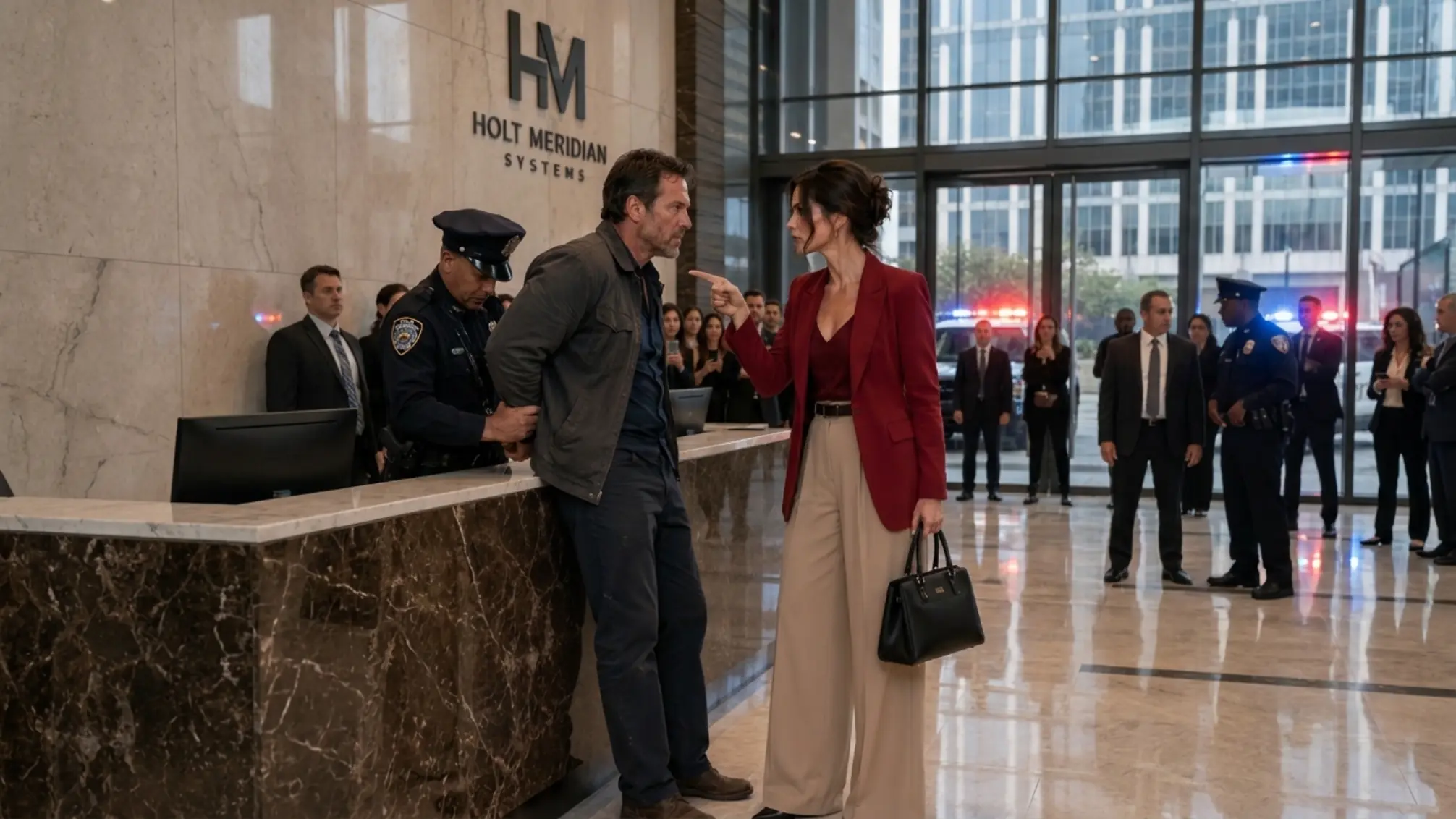
“You planted it because my signature can kill your sale,” Graham said.
Celeste did not flinch. “Cuff him now—before he destroys this company.”
Graham looked through the glass entrance as six black government vehicles stopped outside. Federal agents stepped onto the pavement, followed by a woman in a dark red blazer carrying a sealed warrant folder.
“Too late,” Graham said quietly. “They came for you.”
Eighteen years earlier, Holt Meridian Systems had existed only inside the garage of a rented house near the outskirts of Chicago. Graham wrote software at a folding table while his wife, Claire, balanced ledgers beside him and warmed bottles for their infant daughter between investor calls. Their first platform protected emergency communications from collapsing during hurricanes, blackouts, transit failures, and coordinated cyberattacks.
Claire understood contracts better than Graham understood people. She insisted that every agreement involving their central security platform required the founder’s direct signature and approval from the family trust they created together. Graham sometimes teased her for being overly cautious, but Claire always answered that a company built to protect cities should also protect itself from those who might one day try to control it.
The business expanded faster than either expected. Municipal hospitals adopted the platform, followed by transit authorities, emergency dispatch centers, and federal infrastructure agencies. Within twelve years, Holt Meridian became a nationwide security backbone valued at more than four billion dollars.
Then Claire became ill.
Their daughter, Layla, was twelve when doctors explained that treatment would slow the disease but not stop it. Graham spent two years moving between board meetings, hospital rooms, and school events while Claire slowly disappeared from their shared life. On the night she died, she made him promise that Layla would never believe the company mattered more than she did.
Graham kept that promise.
He remained founding chairman and controlling shareholder, but he stepped away from daily operations to raise his daughter. He personally recruited Celeste Whitmore from a competing technology company and appointed her chief executive. She was brilliant, disciplined, ambitious, and persuasive enough to hold a room filled with men who disliked taking orders from a younger woman.
For several years, Graham believed he had chosen well.
Under Celeste, Holt Meridian entered new markets, secured government contracts, and moved into the forty-eight-story headquarters now bearing the company’s name. She became the face of Holt Meridian while Graham slowly vanished from press releases, leadership pages, and company history displays. Even the lobby’s polished timeline mentioned the company’s founding without including Claire’s photograph.
Graham tolerated it because Layla was thriving.
He attended her school plays, cooked breakfast every morning, and helped her apply to college. He accepted that history often remembered whoever remained closest to the microphone. As long as the company protected the public and treated its employees fairly, he did not need applause.
Then his accountant called.
Fourteen unfamiliar vendors had received payments totaling eighty-four million dollars. Each transfer had been authorized with Graham’s electronic signature and hardware authentication key. At the same time, Celeste was finalizing the sale of Holt Meridian to Blackwell Crown Capital for $3.6 billion without requesting his approval.
Graham had never heard of most of the vendors. He had not authorized the transfers, and no one had asked him to approve the acquisition. Under the charter Claire helped write, the sale could not legally proceed without him.
He did not call Celeste.
He placed the financial records in a plain folder, drove his old pickup to headquarters, and entered the lobby shortly before nine. He wore a charcoal work jacket over a navy shirt, dark trousers, and worn brown shoes—the clothes of a man who expected to inspect servers rather than impress a boardroom.
His founder badge flashed red.
The receptionist tried it twice before looking up nervously. “Mr. Holt, your credentials were deactivated at 6:04 this morning.”
“By whom?”
“The system doesn’t show me.”
Graham stared at the red symbol on the screen. Someone had known he would come before he decided to make the drive. That frightened him more than the financial discrepancies.
Celeste descended from the executive floor surrounded by general counsel, chief financial officer Malcolm Sterling, and security director Dean Caldwell. Her deep-red blazer made her impossible to ignore. She stopped several feet from Graham and addressed him loudly enough for employees near the elevators to hear.
“You no longer have unrestricted access to this building.”
“My name is on the entrance.”
“Your name is part of the brand. It does not override security policy.”
Graham placed his folder on the reception counter. “Then answer four questions. Who created fourteen shell vendors? Who transferred eighty-four million dollars? Who copied our platform to Blackwell Crown servers? And who authorized a company sale using my signature?”
Malcolm tightened his grip on the documents beneath his arm.
Celeste remained composed. “The board amended the founder-control provisions two years ago.”
“I never approved an amendment.”
“You stepped away from governance.”
“I stepped away from daily management. I did not surrender my shares, signature authority, or Claire’s trust.”
Celeste turned slightly toward the watching employees. “This is exactly why founders must learn to let go. Graham cannot accept that the company grew beyond him, so he has arrived without notice to disrupt the largest transaction in our history.”
“I came because someone forged my name.”
“Or because you intend to sabotage the sale.”
She nodded toward Dean.
The security director stepped behind Graham and announced that company property had to be inspected before he could leave. Graham opened his jacket willingly. He emptied his pockets onto the counter: a wallet, truck keys, folded receipts, a pen, and Layla’s old college photograph.
Dean reached into the inner pocket and removed a small encrypted drive.
Graham had never seen it.
Dean held it up. “This device contains proprietary source code.”
Celeste immediately produced a formal complaint accusing Graham of unauthorized access and theft of intellectual property. The document was already printed, signed, and prepared for police.
“You wrote that before I arrived,” Graham said.
Celeste’s expression remained cold. “We were warned you might attempt this.”
“By whom?”
She did not answer.
Two officers entered the lobby. They had been told that an angry former executive possessed stolen technology and posed a risk to critical infrastructure. With a physical drive, a signed complaint, and the company’s security director demanding action, they detained Graham while the matter was reviewed.
Dean forced his arms behind him.
The handcuffs closed.
A murmur spread through the lobby as employees recognized the man from faded company photographs. Some lowered their phones in embarrassment, but others continued recording. Celeste positioned herself so every camera captured her standing confidently while the founder was restrained.
“Holt Meridian will prosecute anyone who steals its intellectual property,” she announced. “Past service does not grant immunity.”
Graham turned his head toward the lead officer. “Document exactly where the drive was found. Seal it on camera. Preserve this morning’s security footage. Record the timestamp when my badge was disabled, and do not allow company employees to handle the device again.”
The officer hesitated.
Most people shouted innocence when handcuffed. Graham spoke about chain of custody, timestamps, authentication protocols, and evidence preservation. His calmness did not resemble performance; it resembled the discipline of someone accustomed to managing emergencies while others panicked.
Celeste stepped forward. “He is attempting to control the investigation.”
“No,” Graham replied. “I’m stopping you from rewriting it.”
The officers began escorting him toward the revolving doors.
That was when the federal vehicles arrived.
Federal prosecutor Mara Keane entered first, followed by agents carrying evidence cases and a search warrant connected to government-contract fraud. She scanned the lobby, saw Graham in handcuffs, and stopped so suddenly that the agent behind her nearly walked into her.
“Take the cuffs off him,” she ordered. “Now.”
Celeste stepped into her path. “This man was caught stealing classified technology.”
Mara moved around her without acknowledgment. She opened a sealed federal folder and presented cooperation records to the officers.
“Graham Holt is a protected federal witness associated with an active infrastructure-security investigation. He is not the target of our warrant. He is the reason we obtained it.”
The lobby became silent.
Six years earlier, Graham had discovered that a government contractor was embedding hidden access points inside disaster-response software. The backdoors could allow private entities to intercept communications during emergencies and manipulate systems used by hospitals, power grids, and dispatch centers.
Graham spent eight months secretly working with Mara’s investigative team. He provided technical analysis, source records, and testimony that dismantled a national fraud network. To protect Claire and Layla from retaliation, his identity remained sealed under a confidential code name known to only a few federal officials.
Mara had never forgotten the grieving father who risked everything to protect strangers.
Seeing him handcuffed inside his own company transformed her professional calm into controlled fury.
The officers removed the restraints.
Graham rubbed his wrists but made no complaint. Instead, he pointed toward the encrypted drive and asked Mara to secure Holt Meridian’s accounting servers, signature vault, surveillance archive, and executive communications before anyone could erase them.
Celeste tried to recover her authority. “Your warrant does not give you permission to interfere with a legitimate acquisition.”
Mara finally faced her. “The warrant names Holt Meridian Systems, fourteen associated vendors, and multiple executive accounts. You may want to stop describing anything here as legitimate.”
Federal agents spread throughout the building.
A preliminary examination of the planted drive showed that it used an encryption protocol discontinued eighteen months earlier. Security logs confirmed Graham had walked directly from the entrance to reception and never approached a server room. The drive had been checked out three days earlier under an internal security account controlled by Dean.
The basis for Graham’s detention collapsed within minutes.
Yet Celeste had already achieved part of her objective.
A video showing Graham in handcuffs spread across financial news networks. The footage ended before Mara ordered his release, making it appear that federal officers arrived to arrest him. Holt Meridian’s stock fell sharply, and the board invoked a founder-misconduct clause suspending Graham’s voting rights pending investigation.
The arrest was never designed to send him to prison.
It was designed to create an image ugly enough to remove his power before the merger vote.
Layla called from college in tears.
“Let me tell the press what happened.”
“No.”
“Dad, they’re destroying your name.”
“They want you involved because you’re the only thing I care about more than the company.”
“I’m not a child anymore.”
“I know. That’s why I’m asking instead of ordering.”
After a long silence, she agreed to remain away from the cameras.
That night, compliance director Tessa Quinn contacted Graham through a private number. They met at a roadside diner far from headquarters, where she placed a worn ledger and signed resignation letter on the table.
“I saw the transfers months ago,” she admitted. “I was afraid.”
Graham opened the ledger.
Tessa had documented payments from Holt Meridian to shell companies tied to Blackwell Crown Capital. Malcolm Sterling approved the transfers. Celeste signed undisclosed contracts with the entities. Two board members received consulting payments before supporting the merger.
“Celeste is running the scheme publicly,” Tessa said, “but she did not build it.”
The architect was Conrad Blackwell, billionaire head of Blackwell Crown Capital. He had spent two years positioning allies inside Holt Meridian, including Malcolm. Celeste agreed to cooperate in exchange for leadership of the merged corporation, a sixty-million-dollar compensation package, and protection from scrutiny over earlier insider transactions.
Conrad’s real target was Meridian Shield.
The platform protected power grids, transit networks, hospitals, and emergency systems across the country. Once the acquisition closed, Conrad planned to transfer its ownership to an overseas shell entity beyond domestic oversight.
Tessa’s records showed the conspiracy but did not prove Conrad controlled every transaction.
Graham remembered a safeguard he built into Meridian Shield during its earliest federal certification. Every financial or ownership action involving the platform generated an invisible source pulse recording the device, account, physical location, and server responsible.
Executives could delete normal records.
They could not access the source-pulse archive stored inside a federally monitored backup network.
The archive would automatically overwrite at midnight.
At 11:57 p.m., the company’s primary servers began wiping themselves.
Mara expanded the warrant while Graham led agents through a restricted basement corridor to an isolated unit disguised as climate-control equipment. Celeste had once dismissed the cabinet as outdated mechanical infrastructure and never asked what it contained.
Graham inserted one half of a recovery key. Mara’s federal certification token completed the sequence.
Nine seconds before the overwrite, the archive opened.
The recovered data traced every fraudulent transfer to Blackwell Crown servers. It showed that Malcolm established the fourteen shell vendors, Celeste signed contracts without board disclosure, Dean disabled Graham’s access badge, and the planted drive had been checked out under security credentials.
It also revealed how Graham’s signature was stolen.
Two years earlier, company counsel asked him to insert his hardware key into a device for a routine security update. The device copied his credentials before returning the key. Graham had unknowingly authenticated every fraudulent document created afterward.
Mara discovered something else: a recorded conversation between Conrad and Malcolm.
Once the acquisition closed, Conrad intended to blame the entire fraud on Celeste. Her promised executive position and sixty-million-dollar package were lies. She had never been a partner; she was a future scapegoat.
Mara played the recording for her.
Celeste initially called it fabricated. Then she heard Conrad describe her weaknesses in the same casual tone he used during private meetings. He said she was ambitious enough to obey and vain enough to believe she was indispensable.
Her face changed.
“What protection can you offer me?” she asked.
“None today,” Mara replied. “But cooperation will be documented.”
Celeste surrendered private communications, bonus agreements, instructions to fabricate the complaint against Graham, receipts for the encrypted drive, and messages proving Malcolm and Dean planned the public arrest.
She admitted she ordered the humiliation because the board needed evidence of founder misconduct before suspending Graham’s voting rights.
“You could have confronted me,” Graham said.
“You would have stopped the merger.”
“That was the purpose of my signature.”
“You stepped away and left me to build the company.”
“I left you to lead it. I did not give you permission to sell its soul.”
Celeste lowered her eyes.
Conrad learned of her cooperation and immediately fired her. He installed Malcolm as acting chief executive and ordered the merger vote to proceed at nine the following morning.
The decisive meeting took place inside the top-floor boardroom.
Conrad sat at one end of the long table while Malcolm occupied the chief executive’s chair. Graham entered with outside counsel and Tessa. Mara and federal agents remained near the rear wall, waiting for every participant to reveal their position before acting.
A photograph still hung behind Graham’s former seat.
It showed Graham and Claire beside the first server rack they purchased with her life-insurance policy. Claire was laughing, one hand resting on the machine as if she already understood what it might become.
Conrad noticed Graham looking at it.
“Sentiment does not equal authority,” he said. “You abandoned management years ago and returned only when others created value.”
Graham sat down. “I stepped away to raise my daughter after her mother died.”
“An admirable personal decision. Also a business surrender.”
“I built a company, not a prison sentence.”
The board secretary called the merger vote.
Graham raised one hand.
“My voting rights were suspended using a misconduct clause requiring formal implication in criminal wrongdoing. I have not been charged with any crime.”
Conrad’s attorney produced the amended charter removing Graham’s veto power.
Graham placed the original certified charter beside it.
“This copy came from federal certification archives. Claire’s family trust must approve any transfer involving Meridian Shield. The veto can only be removed through my signature and the signature of the trust’s co-administrator.”
“Which was amended.”
“The co-administrator was Claire Holt.”
Several board members looked toward the photograph.
“She died eleven years ago,” Graham continued. “The amendment is dated two years ago. No living person had authority to sign it.”
Conrad pushed the merger documents forward. “That is a civil dispute. Proceed with the vote.”
A screen on the wall activated.
Celeste appeared by secure video beside her attorney. Her deep-crimson blazer was gone, replaced by a plain black jacket. Without the executive lobby surrounding her, she looked smaller but no less composed.
“Conrad Blackwell directed the fraud,” she said. “Malcolm Sterling created the vendors. Dean Caldwell planted the drive. I authorized the false complaint and arrest.”
Malcolm stood. “She is lying to save herself.”
Tessa placed her ledger on the table.
Graham displayed the source-pulse archive, showing independent federal records, banking paths, device signatures, and Blackwell Crown server locations. Four separate sources supported the same conclusion.
Mara stepped forward.
“Federal asset freezes are now active. Warrants have been issued for Conrad Blackwell, Malcolm Sterling, and Dean Caldwell on charges including fraud, conspiracy, obstruction, evidence fabrication, and attempted illegal transfer of protected infrastructure technology.”
Agents moved toward Conrad.
He remained seated.
“This is Graham’s revenge,” he said. “He created the system, controls the evidence, and now intends to reclaim the company.”
Graham shook his head. “The evidence came from federal servers, banking records, internal security logs, and testimony from your own partners. I did not create your crimes. I made them difficult to erase.”
Malcolm was escorted from the boardroom.
Conrad followed without resistance, though he looked back once at the company he had nearly acquired. The remaining board members voted unanimously to cancel the merger, remove every compromised executive, and restore Graham’s full voting rights.
They then offered him the position of chief executive.
Graham looked at the empty chair.
For a moment, he imagined returning permanently—controlling every decision so no one could betray the company again. Then he thought of Claire’s final request and Layla waiting for him.
“I built a company,” he said quietly. “Not a throne.”
He accepted the role of executive chairman three days a week.
Holt Meridian replaced compromised board members, created an independent auditing committee, expanded employee ownership, and established legal protections for whistleblowers. Every contract involving public infrastructure became transparent and independently reviewable.
Graham also limited his own authority.
He had learned that good intentions did not make concentrated power safe.
Celeste pleaded guilty to her role in the conspiracy. Her cooperation reduced her sentence, but she lost her position, wealth, and professional reputation. Graham never allowed the press to transform her into a hero merely because she betrayed Conrad after discovering he planned to betray her.
Tessa completed a lengthy internal review before joining a new compliance oversight committee. She did not escape accountability, but neither was her late courage dismissed as meaningless.
One year later, Graham and Layla walked through the same lobby where he had been handcuffed. Employees greeted him naturally by name rather than with staged applause. Behind reception hung a new plaque bearing six simple words:
No title stands above the truth.
Layla studied it, then looked toward her father.
“Does this finally feel like your company again?”
Graham watched engineers, guards, receptionists, and maintenance workers beginning another ordinary day.
“It doesn’t need to belong to me alone,” he said. “It only needs to stop belonging to people willing to sell it away.”
They continued toward the elevators.
At the glass entrance, Graham paused to hold the door for a young employee rushing inside with coffee and a laptop bag. The man thanked him without realizing that one year earlier, those same doors had rejected Graham’s badge.
The building still carried his name.
But the lesson Claire had written into its first charter mattered more than any name across the entrance.
Power could be borrowed.
Authority could be stolen.
Evidence could be planted.
Yet truth, protected carefully enough, could wait beneath every lie until the moment someone finally opened the right door.