“Move this flying junk,” Vanessa Sterling said, pointing toward the battered blue-and-white helicopter parked beside the executive terminal. Her black sunglasses concealed her eyes, but contempt sharpened every word. “And take that grease-stained child’s photograph with you. My investors shouldn’t have to look at either one.”
The man standing beside the helicopter became completely still.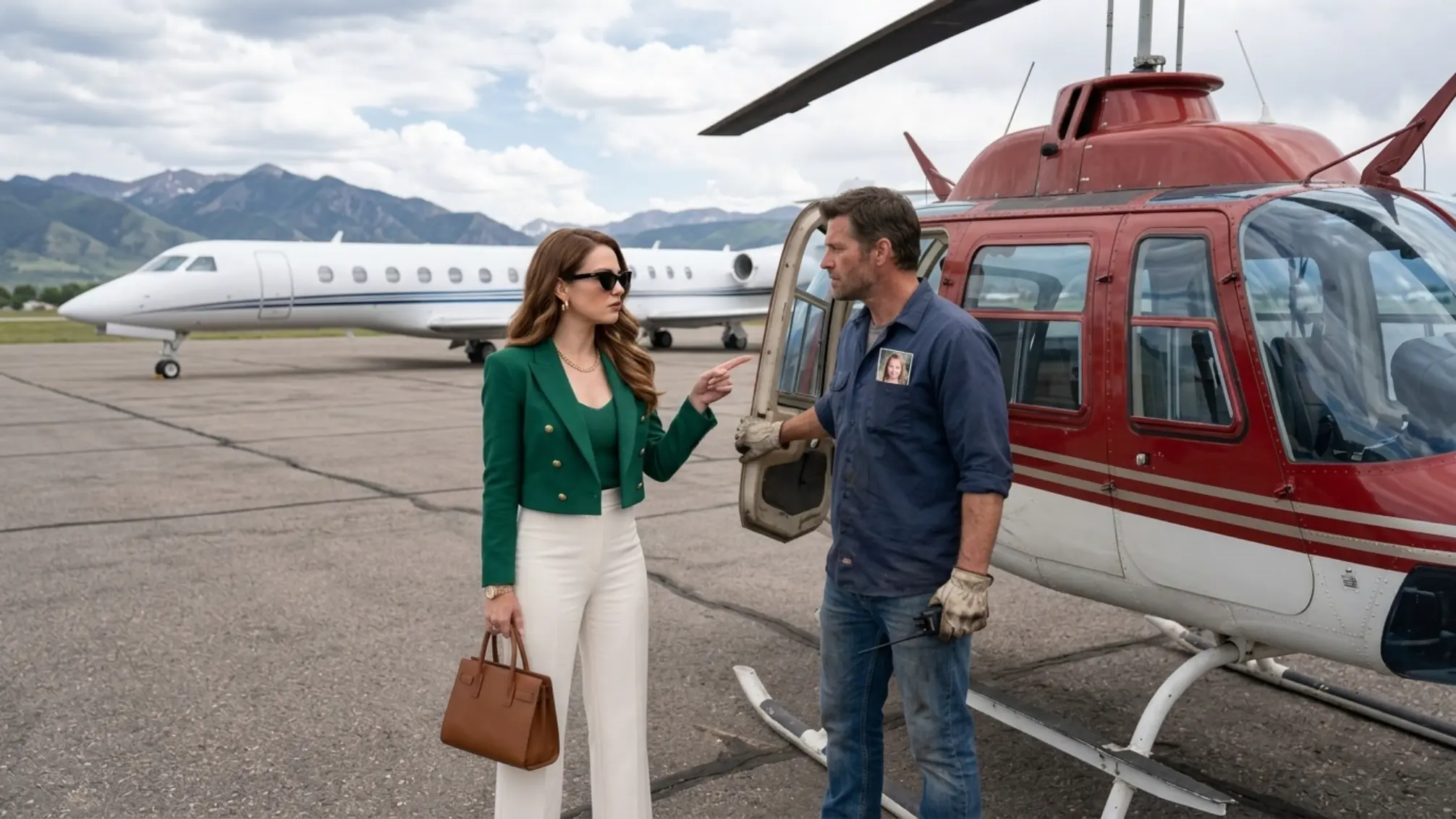
Caleb Mercer was thirty-nine, broad-shouldered, and dressed like an ordinary mechanic in a faded navy work shirt, worn jeans, and brown aviation boots. Grease darkened his gloves, beard stubble shadowed his weathered face, and a small photograph of his seven-year-old daughter, Emma, rested inside his chest pocket. Behind Vanessa, a sleek white corporate jet gleamed beneath the Colorado sun as though it belonged in another world.
Caleb stepped closer, his gray-blue eyes fixed on her. “Say one more word about my daughter, and your flight ends here.”
Vanessa gave a cold laugh and shoved two fingers against his chest. She was beautiful, polished, and visibly accustomed to watching people retreat whenever she raised her voice. Her emerald-green blazer carried gold buttons, her ivory trousers were perfectly pressed, and the structured brown handbag hanging from her wrist probably cost more than Caleb’s truck.
“A broke mechanic raising a nobody doesn’t threaten me,” she said. “I’ll have you both thrown off this airfield.”
Caleb slowly lifted the operations radio clipped to his belt.
“Try it,” he replied. “Then explain to my security why your jet is trespassing on my airfield.”
The wind seemed to stop.
Vanessa’s smile disappeared as two black airfield-security vehicles turned onto the tarmac. Their lights flashed silently beneath the wings of her aircraft, and the pilot standing at the top of the boarding stairs suddenly looked down at her with unmistakable concern.
Only then did Vanessa notice the name printed across the approaching vehicles.
MERCER RIDGE AIRFIELD OPERATIONS.
Six hours earlier, Vanessa Sterling had arrived in Aspen believing the day belonged entirely to her.
At thirty-four, she was the youngest chief executive in the history of Sterling Aeronautics, a luxury aviation company founded by her grandfather. She had inherited neither the position nor the controlling shares outright. Her father had required her to spend ten years proving herself through sales, operations, and international expansion before the board finally appointed her CEO.
Vanessa had doubled the company’s private-charter revenue in three years. She had closed deals in London, Dubai, Singapore, and New York, often in rooms where older men assumed her appearance mattered more than her judgment. She had learned to speak before anyone could interrupt, negotiate without revealing uncertainty, and treat hesitation as a weakness other people would exploit.
Those habits made her successful.
They also made her dangerous when she was wrong.
The flight to Aspen carried four investors considering a $180 million partnership with Sterling Aeronautics. Vanessa intended to show them a proposed mountain resort and private terminal that would serve wealthy clients across Colorado. The deal could push her company into a new class of international aviation services.
Everything had been planned carefully. A luxury vehicle would meet them at Mercer Ridge Airfield. Lunch would be served at a private lodge. The afternoon would include a helicopter tour of the proposed property, followed by contract discussions aboard the company jet.
Vanessa had never visited Mercer Ridge before. Her executive assistant had arranged the landing through a management firm that handled regional airport agreements. The document described Mercer Ridge as an independently owned private airfield with one long runway, two hangars, a maintenance facility, and a small executive terminal.
Vanessa skimmed the first page and signed the authorization.
She never read the owner’s name.
When the jet landed shortly after nine that morning, Vanessa immediately disliked the place. The runway was safe and well maintained, but the terminal was constructed from stone and timber rather than steel and glass. A line of older utility aircraft stood near the maintenance hangar, and ranchland stretched beyond the perimeter fence.
It lacked the polished exclusivity she expected.
Her investors, however, appeared impressed by the mountain view. Vanessa concealed her irritation and led them into the terminal, where coffee and breakfast had been prepared. A young operations manager named Tyler Reeves welcomed them and explained that afternoon winds could become unpredictable near the western ridge.
“Our helicopter tour leaves at three,” Vanessa said.
Tyler examined the itinerary. “Your charter operator hasn’t checked in yet.”
“They confirmed last week.”
“I’ll contact them, but there’s a weather system forming beyond the mountains. If it arrives early, the tour may need to leave before one.”
Vanessa disliked being advised by people who did not understand the value of her schedule. “The investors have meetings until two thirty. The weather will have to cooperate.”
Tyler paused, evidently uncertain whether she was joking.
“It usually doesn’t negotiate,” he said.
Vanessa turned away before he finished.
The morning presentation began inside the terminal conference room. Vanessa displayed architectural plans for a glass-walled resort overlooking the valley and described a membership program targeting executives, celebrities, and private aircraft owners. She spoke confidently about building a new luxury aviation corridor through the region.
One investor, Daniel Kim, asked who controlled the airfield.
Vanessa glanced at her assistant.
“The property is privately held,” the assistant answered. “Sterling Aeronautics is exploring a long-term operations partnership.”
“Has the owner agreed?”
“We have been communicating through the management office,” Vanessa said smoothly. “Today’s visit should clarify the available options.”
What she did not mention was that no formal negotiations had occurred. Her development director had sent three requests for a meeting, but the airfield’s owner had declined each one. Vanessa assumed the refusals were bargaining tactics.
She believed everyone eventually accepted the correct price.
During a short break, Vanessa walked outside to call the development director. That was when she first saw the old helicopter.
It sat twenty yards from the executive terminal, its paint faded by years of mountain weather. The body carried scratches, patched panels, and visible repairs. A tool case rested beside one landing skid, and Caleb Mercer was inspecting an open engine compartment.
Emma sat on a folding stool nearby, drawing in a notebook.
The little girl had light-brown hair tied into a loose ponytail and wore denim overalls over a yellow shirt. Protective earmuffs rested around her neck, and a pair of child-sized safety glasses sat on her face. She watched her father carefully as he explained the difference between two mechanical components.
Vanessa stopped near them.
“Why is that machine parked beside the executive terminal?” she demanded.
Caleb looked over his shoulder. “Because this is its assigned maintenance position.”
“It looks abandoned.”
“It flew this morning.”
“That does not improve its appearance.”
Emma lowered her pencil.
Caleb closed the inspection panel halfway. “Can I help you?”
“I’m Vanessa Sterling. My company jet is parked over there, and four major investors are using this terminal. Move your helicopter behind the maintenance hangar before they come outside.”
Caleb glanced toward the jet. “This parking area is reserved for local operations aircraft.”
“Then reserve somewhere else.”
“It doesn’t work that way.”
Vanessa removed her sunglasses and studied him. She saw the worn clothing, the tool case, and the grease on his hands. She assumed he was a mechanic accustomed to following instructions from wealthier clients.
“Speak to your supervisor,” she said.
“I don’t need to.”
“Everyone has a supervisor.”
“Not everyone.”
Emma tried to hide a smile.
Vanessa noticed. “Is this your daughter?”
Caleb’s expression softened slightly as he looked at the child. “Yes.”
“She shouldn’t be this close to active machinery.”
“She has permission, safety equipment, and more mechanical knowledge than most adults who visit this field.”
Emma proudly held up her notebook. It contained a careful drawing of the helicopter’s rotor assembly.
Vanessa barely looked at it. “This is a professional airfield, not a daycare.”
The softness vanished from Caleb’s face.
“My daughter isn’t disturbing anyone.”
“She is sitting beside an aircraft covered in rust while my clients are discussing a nine-figure investment. Appearance matters.”
“So does knowing the difference between surface wear and structural damage.”
Vanessa put her sunglasses back on. “Move it before lunch.”
She walked away without waiting for an answer.
Emma watched her enter the terminal. “She doesn’t like Bluebird.”
Bluebird was the name painted in small letters near the helicopter’s cockpit. Caleb crouched beside his daughter.
“Some people decide what something is worth before they understand what it has survived.”
“Is Bluebird ugly?”
Caleb considered the question. “She’s not new.”
“That isn’t what I asked.”
“No,” he said. “She’s not ugly.”
The helicopter had belonged to Caleb’s wife, Rachel.
Rachel Mercer had served as a flight nurse for a mountain-rescue organization. Bluebird was not luxurious, fast, or visually impressive, but its narrow body and reliable engine made it ideal for landing in difficult terrain. Rachel had spent hundreds of hours aboard it, carrying injured climbers, lost children, and stranded ranchers out of the mountains.
Eight years earlier, Rachel had been flying in a newer rescue helicopter during a winter evacuation. A rotor-control failure forced the pilot into an emergency descent above a steep ravine. The aircraft struck trees and broke apart.
Rachel died before rescuers reached the site.
Emma had been eleven months old.
Caleb could not save his wife, but the investigation revealed that a subcontractor had falsified inspection records on several components. He spent two years helping federal investigators reconstruct maintenance histories, supplier contracts, and certification failures. His testimony contributed to criminal convictions and a nationwide inspection order.
After the case ended, Caleb purchased the nearly abandoned airfield where Rachel had begun her rescue career. Mercer Ridge had been facing foreclosure, and most investors wanted the land for luxury development. Caleb used his settlement money, engineering patents, and everything he had saved to acquire it.
He rebuilt the runway, expanded the repair facility, and established a nonprofit mountain-rescue program in Rachel’s name. Bluebird became its primary training aircraft.
To a stranger, it looked old.
To Caleb, it carried his wife’s courage in every repaired panel.
By noon, the weather report had worsened. The western storm was accelerating, and Tyler informed Vanessa that her scheduled charter company had canceled the helicopter tour. The pilot considered the wind conditions too unstable for an unfamiliar mountain route.
Vanessa stared at him across the conference table. “Find another operator.”
“I have called three.”
“Call ten.”
“There are only two local aircraft approved for the higher landing zones. One is already on a medical transport.”
“And the other?”
Tyler hesitated. “Bluebird.”
Vanessa looked through the window toward the old helicopter.
“You cannot be serious.”
“It is fully certified and maintained beyond federal requirements. The pilot knows every ridge and canyon within fifty miles.”
“The mechanic?”
“Caleb Mercer.”
Vanessa crossed her arms. “I am not placing four investors inside that wreck.”
“Then the tour is canceled.”
“No. The tour is central to this presentation.”
“Ms. Sterling, safety is not part of the presentation. It is the condition that allows one to happen.”
Her investors had entered the room before Vanessa could answer. She forced a smile and told them the tour had been delayed while the team evaluated weather conditions.
Daniel Kim looked out the window at Bluebird. “Is that a rescue helicopter?”
Tyler nodded. “It has completed more than three hundred mountain-assistance flights.”
“It looks experienced,” Daniel said.
Vanessa heard admiration in his voice and disliked it.
During lunch, she called her company’s chief pilot and demanded a technical review of Bluebird’s registration. Fifteen minutes later, he reported that the helicopter had current inspections, excellent maintenance records, and several approved modifications designed by Mercer Aviation Systems.
“Who owns Mercer Aviation?” Vanessa asked.
“I’m checking.”
She ended the call before he answered.
At one thirty, snow began falling along the highest peaks. The helicopter tour was officially canceled, and the investors chose to continue negotiations inside the terminal. Vanessa blamed the airfield, the weather, and the management staff in equal measure.
Then another problem appeared.
The jet’s auxiliary power system developed a warning light.
The flight crew requested maintenance assistance, and Tyler sent Caleb to inspect it. Vanessa saw him approaching the aircraft with a diagnostic case and immediately blocked the stairs.
“You are not touching my jet.”
Caleb stopped. “Your captain requested airfield maintenance.”
“I’ll have a Sterling technician flown in.”
“From where?”
“Denver.”
“The storm will reach the valley before they arrive.”
“Then my crew will handle it.”
“Your crew already determined they need ground support.”
Vanessa looked toward the old helicopter. “You repair farm equipment. This aircraft is worth seventy million dollars.”
“I hold federal certifications for six turbine-engine platforms, including yours.”
“I don’t care what certificate you bought.”
Caleb’s jaw tightened. “Certificates aren’t purchased.”
“Everything is purchased.”
“Competence isn’t.”
Their argument drew the investors outside. Daniel asked whether there was a serious problem with the jet.
Vanessa immediately changed her tone. “Only a minor indicator. Our technicians are handling it.”
The captain descended the stairs. “Ms. Sterling, Mr. Mercer is the only qualified technician within immediate range.”
Vanessa turned on him. “You know this man?”
“By reputation. Mercer Aviation developed part of our engine-monitoring software.”
Caleb said nothing.
Vanessa felt the first uncomfortable movement of uncertainty, but pride prevented her from acknowledging it. “Fine. Inspect the warning system, but do not touch anything beyond the reported fault.”
Caleb climbed aboard.
Within twenty minutes, he identified a failing sensor rather than a mechanical defect. He replaced the component from the airfield inventory, tested the system, and provided the captain with documentation. The jet was safe to fly.
Daniel approached him afterward. “You designed the monitoring software?”
“My team did.”
“I thought Mercer Aviation had been acquired.”
“We sold a minority licensing division. The parent company is still independent.”
Vanessa looked at Caleb differently for the first time.
Not respectfully, but cautiously.
“How large is your company?” she asked.
“Large enough.”
“That is not an answer.”
“It’s the one you’ve earned.”
Daniel concealed a smile.
Vanessa’s embarrassment hardened into anger. She returned inside and ordered her assistant to locate every available record concerning Caleb Mercer. She expected to discover a modest engineering business inflated by local reputation.
Instead, the first report showed that Mercer Aviation Systems supplied emergency-location equipment, terrain-analysis software, and predictive maintenance technology to hospitals, rescue agencies, and private aircraft fleets across North America. The company’s annual revenue exceeded $240 million.
A second search revealed that Caleb owned eighty-two percent of the business.
Vanessa stared at the screen.
“Why didn’t anyone tell me?” she demanded.
Her assistant looked confused. “Tell you what?”
“That the mechanic was a technology owner.”
“You asked who maintained the helicopter. You did not ask who owned the company.”
Vanessa closed the report. “And the airfield?”
“The management agreement lists a private holding company called Rachel Ridge Properties.”
“Who controls it?”
“I’m still checking.”
Before the answer arrived, Vanessa received a call from her development director. The conversation worsened her mood immediately. Mercer Ridge had rejected the proposed resort partnership again, and the owner had filed an environmental-preservation notice covering land Vanessa intended to use for the new terminal.
“Then challenge it,” she said.
“We may not have standing.”
“Create standing.”
“The owner controls the runway easements and emergency-access corridor. Without cooperation, the resort project cannot support private aviation.”
“Everyone cooperates when the offer is high enough.”
“This owner has refused three offers without making a counterproposal.”
Vanessa looked through the terminal windows toward Caleb and Emma. The girl was helping her father return tools to the case.
“Find out who it is,” Vanessa said.
At three, the investors prepared to leave. The storm was nearing faster than predicted, and the captain recommended immediate departure. Vanessa wanted the trip to end before anyone learned how little control she possessed over the airfield negotiations.
Outside, Caleb was moving Bluebird toward a protected hangar position. Emma walked beside him carrying her notebook and a small tool pouch.
Vanessa’s jet could not begin taxiing until the helicopter cleared the marked service lane. The delay would last less than five minutes, but Vanessa had run out of patience.
She marched across the tarmac.
“Move this flying junk before it embarrasses my jet and my investors.”
Caleb turned slowly.
Emma stopped behind the helicopter door.
Vanessa saw the child’s photograph protruding from Caleb’s chest pocket and recognized it as a smaller copy of the picture on Emma’s tool pouch. Irritated by his silence, she allowed cruelty to replace judgment.
“And take that grease-stained child’s photograph with you,” she added. “My investors shouldn’t have to look at either one.”
Emma’s face fell.
Caleb stepped between Vanessa and his daughter.
“Say one more word about my daughter, and your flight ends here.”
Vanessa shoved two fingers into his chest. “A broke mechanic raising a nobody doesn’t threaten me. I’ll have you both thrown off this airfield.”
Caleb raised the radio.
“Try it. Then explain to my security why your jet is trespassing on my airfield.”
Two security vehicles arrived as Tyler and the investors hurried outside.
Vanessa looked from the vehicles to Caleb. “Your airfield?”
“This runway, both hangars, the terminal, the surrounding land, and the access road.”
Her assistant finally reached her, breathing hard. “Ms. Sterling, Rachel Ridge Properties is controlled by Caleb Mercer.”
The captain descended from the jet again.
Caleb spoke into his radio. “Suspend departure clearance for Sterling One.”
Vanessa stared at him. “You cannot hold my aircraft.”
“I can suspend private-field authorization while my safety team investigates an assault on the owner and verbal harassment of a minor inside a restricted operations zone.”
“I barely touched you.”
“Six cameras recorded it.”
Daniel Kim removed his glasses and looked toward the terminal roof. Vanessa followed his gaze and noticed the surveillance units pointed toward the tarmac.
Her investors had witnessed everything.
She lowered her voice. “Caleb, this is becoming unnecessarily dramatic.”
“You insulted my aircraft, my work, and my daughter. Then you put your hands on me.”
“I was under pressure.”
“Pressure reveals character. It doesn’t replace it.”
Emma remained behind the helicopter, trying not to cry. Caleb looked at her, and his anger became quieter but more dangerous.
Vanessa saw the change and understood that threatening him had been less damaging than hurting the child. She had spent years studying powerful men, aggressive investors, and hostile competitors, yet she had failed to recognize the kind of power standing in front of her.
Caleb did not need her approval.
She needed his runway.
Daniel walked toward Emma and crouched several feet away, careful not to invade her space. “Did you draw that helicopter?”
Emma nodded.
“May I see?”
She hesitated, then held out the notebook. Daniel examined the detailed rotor diagram and asked several sincere questions. Emma’s posture slowly relaxed.
Vanessa watched, feeling a discomfort she could not negotiate away.
Tyler returned from the operations vehicle. “The storm will close the western departure corridor in forty minutes. If the jet does not leave within fifteen, it may remain overnight.”
Vanessa turned to Caleb. “Release the aircraft.”
“No.”
“You would trap four investors here over a personal disagreement?”
“The investors are free to leave on another authorized aircraft or remain in the guest lodge. Your jet stays until security completes its report and your captain confirms that no crew member participated in unauthorized conduct.”
“This is retaliation.”
“It is procedure.”
“I can sue.”
“You can.”
Caleb’s calmness unsettled her more than anger would have.
One of the other investors, Margaret Ellis, stepped forward. “Vanessa, apologize.”
Vanessa looked at her. “This is a business matter.”
“No. It became personal when you insulted his child.”
“I did not mean—”
“You meant every word when you believed he had no power.”
The sentence landed harder than anything Caleb had said.
Vanessa looked toward Emma again. The girl was now standing beside Daniel, showing him where she had labeled the rotor components. Her small safety glasses had slipped down her nose.
For a moment, Vanessa remembered herself at eight years old, waiting outside boardrooms while adults dismissed her as the founder’s decorative granddaughter. She remembered promising that no one would ever make her feel small again.
Somewhere along the way, she had begun making other people feel exactly that way.
Vanessa removed her sunglasses.
She approached Emma slowly and stopped several feet away. Caleb watched every movement.
“Emma,” Vanessa said, “what I said about you was cruel and false.”
The girl looked at her father before answering. “You don’t know me.”
“No. I don’t.”
“Then why did you call me a nobody?”
Vanessa had answered hostile boards, aggressive journalists, and government regulators without hesitation. A seven-year-old child left her without a defense.
“Because I was angry,” she said. “And because I judged both of you by what I saw instead of learning who you were.”
Emma hugged the notebook against her chest. “Bluebird saved people.”
“I know that now.”
“You could have asked.”
“Yes,” Vanessa said softly. “I should have.”
She then turned to Caleb. “I insulted your daughter and treated you as though your clothes determined your value. I also touched you without permission. There is no excuse for any of it.”
Caleb studied her face.
“You’re apologizing because your jet is grounded.”
“That is part of why I stopped long enough to understand what I did,” she admitted. “But it isn’t why I’m ashamed.”
He said nothing for several seconds.
Then he looked at Emma. “What do you think?”
The decision surprised Vanessa. Caleb was not performing forgiveness for the investors. He was showing his daughter that her dignity mattered enough to be included.
Emma considered the apology seriously. “She should apologize to Bluebird too.”
Daniel turned away to hide a laugh.
Vanessa looked at the helicopter. “I’m sorry I called your aircraft junk.”
Emma nodded. “She’s old, but Dad says old doesn’t mean useless.”
“Your father is right.”
Caleb spoke into his radio. “Resume departure review. No further restrictions unless operations finds a safety issue.”
The storm allowed the jet to leave eleven minutes later.
Vanessa boarded last. Before entering the cabin, she looked across the tarmac and saw Caleb lifting Emma into Bluebird’s cockpit so she could secure the checklist beneath the instrument panel.
During the flight to New York, none of the investors discussed the resort proposal. Vanessa sat alone near the rear of the jet, staring at the reflection in the dark window.
Eventually, Daniel took the seat across from her.
“You nearly destroyed the deal,” she said.
“No. You did.”
“Are you withdrawing?”
“I haven’t decided.”
“Because of one argument?”
“Because your company wants to build a luxury aviation network, yet its CEO treated a mechanic, a child, and a rescue aircraft as visual pollution.”
Vanessa looked down.
Daniel continued, “I invested because I believed you recognized hidden value before competitors did. Today, you demonstrated the opposite.”
“What would restore your confidence?”
“That is the wrong question.”
“What is the right one?”
“What will you change even if we never invest?”
Vanessa did not answer before he walked away.
The board summoned her two days later. Video from the airfield had not been released publicly, but the investors provided written accounts of the incident. Her father, Chairman Richard Sterling, sat at the opposite end of the conference table.
He did not defend her.
“You insulted a child,” he said.
“I apologized.”
“After learning her father controlled your departure.”
“Yes.”
“Would you have apologized if he truly had been a poor mechanic?”
Vanessa remained silent.
The board suspended final approval of the Aspen expansion and ordered an independent review of Sterling Aeronautics’ workplace culture. Several directors privately suggested Vanessa take temporary leave.
She refused.
Instead, she requested every complaint filed against senior executives during the previous five years. The results were worse than she expected. Employees described public humiliation, class-based insults, impossible schedules, and managers who treated ground crews as disposable.
Many complaints mentioned Vanessa’s leadership style as the example others followed.
She had not built the cruelest company in aviation.
But she had given cruelty permission.
Vanessa spent the next three months making changes that cost money, authority, and pride. She dismissed two executives who had repeatedly retaliated against mechanics. She created an independent safety-reporting channel, increased family-leave protections, and required senior management to spend time working beside ground crews before receiving promotions.
She also canceled the proposed development surrounding Mercer Ridge.
Rather than fight Caleb’s environmental designation, Sterling Aeronautics contributed funds to protect the emergency corridor and support Rachel Mercer Mountain Rescue. The donation came without naming rights, advertising demands, or conditions.
Caleb accepted it only after the nonprofit’s board reviewed the agreement.
Vanessa did not return to Mercer Ridge until autumn.
She arrived on a commercial flight to Denver and drove the remaining distance alone. She wore jeans, boots, and a simple dark-green sweater rather than an executive suit. When she entered the maintenance hangar, Caleb was teaching Emma how to inspect a rotor linkage.
He looked surprised to see her.
“I didn’t schedule a meeting,” Vanessa said.
“I noticed.”
“I came to deliver something.”
She handed Emma a long rectangular package. Inside was a custom technical drawing set, child-sized drafting tools, and a scholarship certificate from an aviation education foundation. The document promised annual funding for children of rescue workers and mechanics who wanted to study aviation.
Emma looked at Caleb. “Is this because she called me a nobody?”
Vanessa winced.
“Partly,” she admitted. “But the scholarship isn’t named after me. It’s named after your mother.”
Caleb examined the certificate.
THE RACHEL MERCER AVIATION FUTURES PROGRAM.
“You researched her,” he said.
“I learned what Bluebird did and why you kept it flying.”
Caleb’s expression remained guarded, but not hostile.
Vanessa walked toward the old helicopter. A new rescue emblem had been painted near the door, though the scratches and repaired panels remained visible.
“You didn’t repaint the rest,” she observed.
“Scars are part of the record.”
She touched one faded section lightly, then pulled her hand back. “May I?”
Caleb nodded.
Vanessa rested her palm against the metal. “I’m sorry,” she said quietly. “Not because you own the airfield. Because I should never have needed to discover your power before recognizing your dignity.”
Emma smiled. “That apology was better.”
Caleb almost smiled too.
Vanessa remained at Mercer Ridge for the afternoon. She helped Emma organize tools, listened as Caleb explained the rescue program, and visited the memorial garden overlooking the runway. Rachel’s name was carved into a simple stone beside the names of pilots, nurses, and volunteers lost during mountain rescues.
Before Vanessa left, Caleb walked her to the parking area.
“The investors approved your partnership,” he said.
She looked at him. “How did you know?”
“Daniel called. He wants Mercer Aviation to provide safety technology.”
“I told him you would decide for yourself.”
“I haven’t decided.”
“That seems fair.”
Caleb glanced toward the hangar, where Emma was waving through the open door. “She believes people can become better.”
“Do you?”
“I believe actions matter more than declarations.”
Vanessa nodded. “Then keep watching.”
Over the following year, Sterling Aeronautics completed its cultural reforms. Accident reporting improved, employee turnover fell, and mechanics previously ignored by executives became part of safety-planning meetings. Vanessa spent one week every quarter working at terminals, maintenance facilities, and dispatch centers without an entourage.
She still negotiated aggressively.
She still expected excellence.
But she no longer mistook humiliation for leadership.
Mercer Aviation eventually signed the technology agreement, though Caleb required strict worker-protection and safety clauses. The partnership helped install predictive maintenance systems across Sterling’s entire fleet.
Bluebird remained at Mercer Ridge.
Its paint continued to fade, its panels still carried scratches, and wealthy passengers occasionally glanced at it with uncertainty when they arrived. Emma, however, learned to explain its history before anyone could dismiss it.
“This helicopter looks old,” she would say. “Because it stayed long enough to save people.”
Vanessa visited often. At first, the trips concerned business, then the scholarship program, and eventually no official reason at all. She and Caleb moved carefully around the possibility growing between them, both aware that respect had to exist before affection could mean anything.
One evening, they stood beside Bluebird while Emma completed a preflight checklist inside the cockpit.
Vanessa looked across the runway toward her company jet. “The first time I came here, I thought that aircraft proved I was the most important person on the field.”
“And now?”
“Now I know it was simply the most expensive machine.”
Caleb leaned against the helicopter door. “That sounds almost humble.”
“Do not become accustomed to it.”
He laughed, and the sound surprised them both.
Emma leaned out through the open door. “Dad, are you going to ask her?”
Vanessa looked between them. “Ask me what?”
Caleb sighed. “Emma believes we should have dinner.”
“I believe you both take too long,” Emma corrected.
Vanessa smiled. “She may understand operations better than either of us.”
Caleb held out his grease-stained hand. “Dinner?”
Vanessa looked at the hand she had once considered beneath her.
Then she placed hers inside it.
“Only if Emma chooses the restaurant.”
Emma grinned. “I already did.”
The three of them walked toward the terminal as evening light spread across the runway. Behind them stood the old helicopter that Vanessa had mocked and the airfield she had assumed could be purchased.
She had arrived believing wealth gave her the right to decide what belonged in her world.
Instead, a quiet single father and his daughter taught her that value was not measured by polished paint, expensive clothing, corporate titles, or the size of an aircraft.
It was measured by what remained dependable when lives depended on it.
Caleb never needed Vanessa to learn that he owned the runway beneath her jet.
He needed her to understand that even if he had owned nothing at all, she still had no right to treat him—or his daughter—as though they were nobody.