Jake Harper had just gotten his daughter to sleep when the knock came at the front door. It was close to midnight, and the old farmhouse was finally quiet after a long day of fence work, cattle checks, and helping seven-year-old Lily finish a spelling worksheet she had sworn was impossible. The night outside was cold but calm, with no rain, no storm, and no sound except the soft creak of the porch boards when the wind shifted. Jake stood in the kitchen with a half-cold plate of beans in front of him, wondering if he was too tired to eat or too hungry to sleep.
He was thirty-six, a single dad, and the kind of man who had learned to stretch everything: money, daylight, patience, and hope. His own farm sat on the edge of Pine County, Tennessee, not large enough to make him rich and not small enough to let him rest. Since Lily’s mother had left three years earlier, Jake had built his life around school drop-offs, late-night calf checks, unpaid invoices, and little-girl questions that always came when he had the fewest answers. Some nights, after Lily fell asleep, the whole house felt too big for one father trying to keep it warm.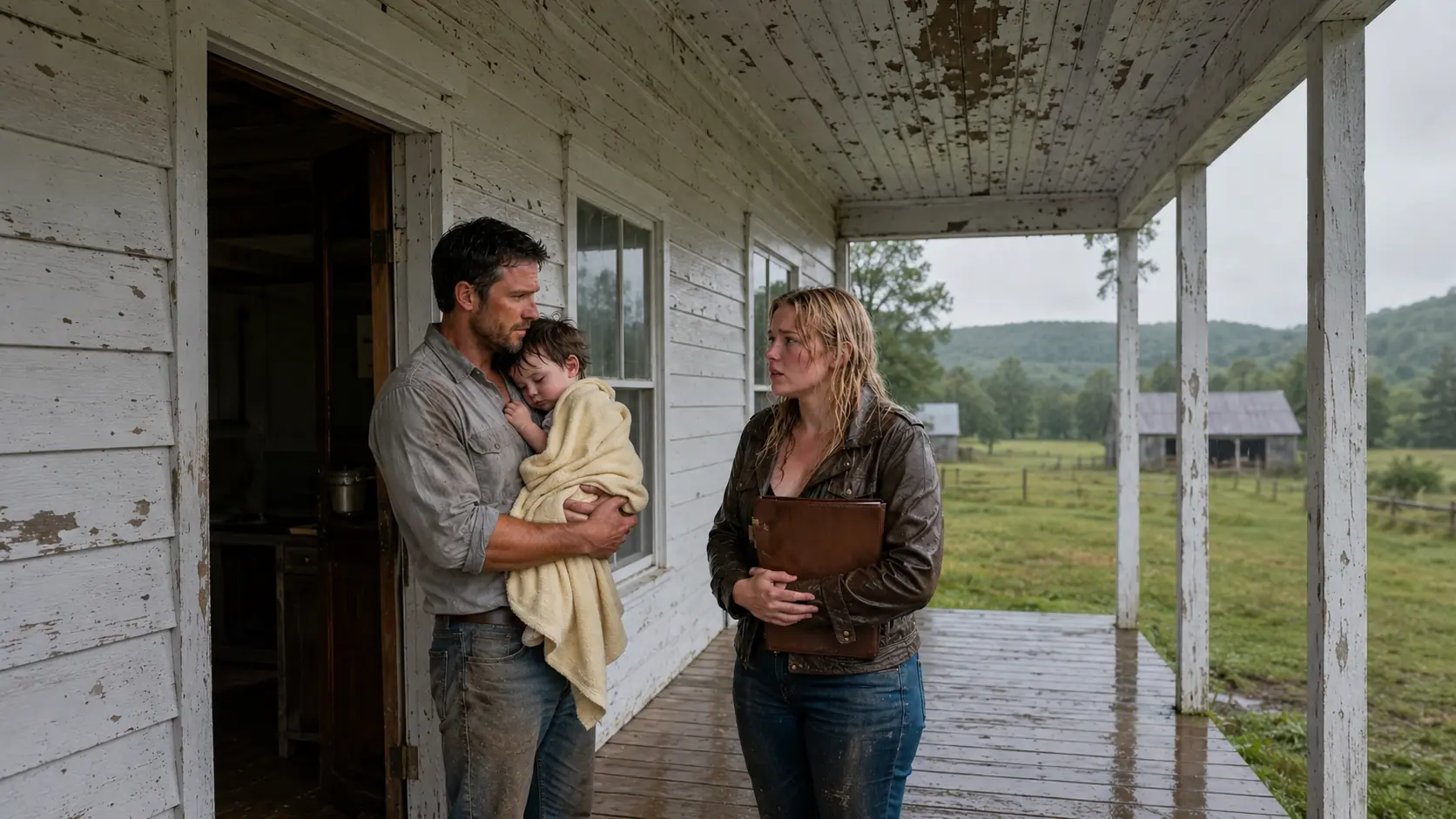
The knock came again, louder this time. Jake froze with his fork in his hand, listening. Nobody came out to his place that late unless something had gone wrong. Around that county, midnight at the door usually meant loose cattle, a truck in a ditch, or somebody carrying news they wished they did not have to deliver.
Jake walked down the hall and glanced into Lily’s room before answering. She was curled beneath her pink quilt, one arm around her stuffed rabbit, her curls spread across the pillow. He closed her door halfway, then went to the front entrance and opened it. Emily Walker stood on his porch, pale and trembling, clutching a brown folder against her chest like it was the only thing keeping her from falling apart.
For a second, Jake could not make sense of what he was seeing. Emily was the daughter of David Walker, his old neighbor, a man who had patched fence with Jake’s father years ago and later helped Jake through two hard winters without ever calling it charity. Emily had grown up between the Walker farm and college, moving through life with one foot in polished rooms and the other in work boots. Now she stood under the porch light with messy blonde hair, a thin jacket, and eyes red from fear.
“Emily?” Jake said, opening the door wider. “Why are you at my door this late?”
She swallowed hard and held the folder tighter. “Because Grant took my keys, and if I’m not married by Friday, he’ll sell my father’s farm.”
Jake stared at her, the words landing one by one but refusing to fit together. “Married?”
She nodded, her lips pressed tight. “It’s in Dad’s will. I didn’t know until today. If I’m not married by the deadline, I don’t get full control of the farm. Grant does.”
Jake looked past her toward the quiet yard, half expecting to see someone standing near the road. There was only darkness, his old truck, and the pale line of fence between his land and the Walkers’ property. “Come inside,” he said. “You’re freezing.”
Emily stepped into the front room like she was afraid the floor might reject her. Jake shut the door and led her into the kitchen, keeping his voice low so Lily would not wake. Emily sat at the table and opened the folder with shaking hands. Estate papers, legal copies, handwritten notes, and a sealed envelope spread across the yellowed wood.
Jake poured water into a glass and set it in front of her. “Start from the beginning.”
She tried to speak, but the first breath broke. She covered her mouth, furious with herself for crying. Jake pulled out the chair across from her and sat down, not pushing, not rushing. He had learned with Lily that fear sometimes needed a quiet room before it could become words.
“My dad added a condition,” Emily said finally. “The lawyer said he wrote it when he got sick. He thought it would protect me from Grant, I think. He wanted me to have someone steady beside me before I took full control.”
Jake rubbed one hand over his jaw. “And the deadline is Friday?”
“Friday afternoon.” Emily looked down at the papers. “Grant came back this morning. New truck, clean boots, acting like the farm was already his. He has buyers coming tomorrow. Developers.”
Emily pushed one page toward him. “Dad wrote your name in a note. Not in the will itself, but with it. He said if everything went wrong, you were the one neighbor who would understand.”
Jake did not touch the paper. “What are you asking me?”
Emily lifted her eyes to him. They were wet, scared, and brutally honest. “I’m asking you to marry me.”
The kitchen went so quiet Jake could hear the refrigerator humming. He sat back slowly, staring at her like she had just asked him to drive through a wall. In the hallway, the old floorboards settled under the cold night air. Behind one closed door, Lily slept, unaware that her father’s life had just been pulled toward a decision too large for the kitchen table.
“Emily,” Jake said carefully. “You can’t walk into a single dad’s house at midnight and ask him to become your husband by Friday.”
“I know how it sounds.”
“No,” he said, sharper than he meant to. “I don’t think you do.”
Her face tightened, but she did not look away. “I know it’s unfair. I know it’s strange. I know you barely have enough room in your own life for this. But I don’t have anyone else.”
Jake stood, then sat back down because standing made him feel like he was either leaving or surrendering. “You want a broke single dad to save your farm?”
Emily flinched, but she answered anyway. “Yes. But not because you’re broke. Because you understand what losing a home does to a person.”
That answer hit harder than a polished speech would have. Jake looked around his kitchen, at the chipped mug near the sink, the school papers Lily had left on the counter, and the unpaid feed bill half-hidden under a grocery list. He knew what it meant to fight for land before he felt ready. He knew what it meant to have people quietly waiting for him to fail.
“Are you trying to use me?” he asked.
Emily’s mouth opened, then closed. She looked down at the folder, then back at him. “Yes,” she whispered. “But not like that. I’m asking for help, and I won’t lie to you by pretending it’s anything else.”
Jake looked toward the hallway where Lily slept. Every decision he made had her name written somewhere inside it. A marriage on paper could become gossip at school, trouble in court, a fight with Grant, and a hundred questions Jake did not know how to answer. But turning Emily away meant letting David Walker’s farm fall into the hands of a man already bringing buyers to the pasture.
“Marriage means something,” Jake said.
“I know.”
“No, Emily. I mean it. It’s not just a paper you sign to stop your brother.”
“I know,” she said, voice smaller now. “But losing the farm means something too.”
That was the problem. She was right.
Jake stood and walked to the back door, staring through the glass into the dark. The fence line between his land and Walker land had been there longer than either of them had been alive. David Walker had run cattle honestly, paid late sometimes like everyone else, but kept his word and helped when help was needed. If Grant sold it, that fence line would turn into survey flags, machines, and houses with no memory of what had stood there before.
Jake turned back. “If I say yes, there are rules.”
Emily straightened.
“No lies between us,” he said. “Not in this house, not at this table. Outside, we do what has to be done. But between you and me, we stay clean. You don’t pretend this is love, and I don’t pretend I’m some hero.”
She nodded quickly, then slower, like she wanted him to know she understood. “Okay.”
“And my daughter comes first.”
“Of course.”
“I mean before the farm, before your brother, before the lawyers, before anyone’s pride.”
Emily’s eyes softened. “Jake, I would never ask you to put Lily second.”
He studied her face for a long moment, searching for panic, manipulation, anything that told him to shut the folder and send her away. He only saw fear, exhaustion, and a daughter trying to protect what her father had left behind. Finally, Jake pulled the paper closer and read David Walker’s note. The handwriting was shaky, but the meaning was clear.
Jake, if she gets cornered, help her remember she is stronger than she thinks.
He closed his eyes.
“All right,” he said. “We’ll go to the courthouse in the morning.”
Emily’s face changed, but not into relief exactly. It looked more like the weight had shifted and she was trying not to collapse under the new shape of it. “Thank you.”
Jake nodded once. “Don’t thank me yet.”
The next morning, Jake told Lily only what she needed to understand. Emily was in trouble with her farm, and Jake was going to help her in a way that might look confusing for a while. Lily sat at the breakfast table with cereal in front of her, studying Emily across the room. Emily looked terrified of the child’s judgment.
“Are you going to live here?” Lily asked.
Emily glanced at Jake. “Maybe for a little while.”
“Do you know how to braid hair?”
Emily blinked. “A little.”
Lily considered that. “Then okay.”
Jake nearly laughed despite everything. Emily looked like she might cry from kindness that simple.
At the courthouse, there were no flowers, no music, and no family smiling from wooden benches. Jake wore his cleanest shirt, though one cuff still showed a stubborn grease mark. Emily wore a blue dress under a brown coat and held herself like a woman trying not to shake. The judge said the words in a tired voice, and Jake took Emily’s cold hand when he was told to.
When it was done, they stood outside by his old truck with the marriage certificate between them. Emily stared at the paper like it might disappear. Jake looked at her and said, “Now we keep your farm standing.”
She nodded, but her eyes were on him, not the certificate. That was the first moment Jake understood this was not going to stay simple.
The whole county knew by the end of the day. Small towns did not need newspapers; they had feed stores, church parking lots, gas stations, and women like Marlene Pierce, who could learn three family secrets while ringing up fence staples. By noon, people were already looking at Jake differently. Some looked curious, some amused, and some like they were waiting for the punchline.
Grant Walker came to the Walker farm the following morning. His black pickup was too clean, his boots too polished, and his smile too practiced. Jake saw him near the main barn speaking to two hired men like he owned their attention already. Emily stiffened beside him.
“Keep walking,” Jake said quietly.
She did, but he saw her fingers tighten around the clipboard.
Grant turned as they approached. “Well,” he said, dragging his eyes from Emily to Jake. “Here they are. The happy couple.”
Emily lifted her chin. “Why are you here?”
“This is still my father’s property,” Grant said. “Somebody responsible needs to keep an eye on it.”
“It’s my property to manage.”
Grant laughed once. “You got married overnight to a neighbor with more debt than sense, and now you think you can run cattle?”
The two workers looked down. That bothered Jake more than the insult. They were good men, but they were waiting to see who had power. Emily opened her mouth, then stopped.
Grant saw it and stepped closer. “You’re making this harder than it needs to be. Sell the land. Take the money. Go build a clean life somewhere that doesn’t smell like hay and fear.”
Jake moved half a step without thinking. Emily noticed. So did Grant.
“And you,” Grant said, smiling at Jake. “Nice move, Harper. Marry the younger sister and suddenly you’re standing on Walker land like you belong here.”
Jake’s hands curled once, then relaxed. He had learned a long time ago that anger did not fix a gate, pay a bill, or win an argument in front of witnesses. “I’m standing beside my wife,” he said. “That’s all.”
Emily glanced at him when he said it. Wife. The word landed between them heavier than it had at the courthouse.
Grant rolled his eyes and turned toward the workers. “Nobody makes major changes until this mess is settled.”
Emily’s voice came out shaky, but it came out. “That’s not your call.”
Grant looked amused. “Isn’t it?”
“No,” she said. “It isn’t.”
One of the workers, Ray, looked at her differently then. Not convinced, not fully, but listening. Jake noticed it and stayed quiet. If he fought every battle for her, the farm would become his shadow instead of her inheritance.
After Grant left, Emily walked into the barn and gripped the edge of a stall door. “I froze.”
“You answered.”
“Barely.”
“Barely counts the first time.”
She looked at him. “You could have shut him down.”
“I could have.”
“Why didn’t you?”
“Because then they would all learn to look at me instead of you.”
She did not like the answer at first. He saw it in her face. But she did not argue.
Over the next week, Jake taught Emily the parts of the farm nobody romanticized. Feed accounts. Repair schedules. Fence lines. Supplier calls. Which bills could wait three days and which ones would turn ugly if they were ignored. Emily listened, took notes, asked questions, and made mistakes with the kind of embarrassment that only came from truly trying.
At night, she sat at Jake’s kitchen table with folders spread around her while Lily did homework beside her. The arrangement was strange at first. Emily slept in the spare room down the hall, and Jake slept in his room with the door cracked so he could hear Lily if she woke. But strange things could become ordinary faster than a person expected.
Lily liked Emily almost immediately. She liked that Emily answered questions seriously and did not pretend children were not listening. One night, Lily asked if Emily was really married to her dad or just pretend-married to stop a bad man. Jake nearly choked on his coffee.
Emily looked at Jake, then back at Lily. “It started as something we had to do,” she said carefully. “But I respect your dad very much.”
Lily thought about that. “He makes pancakes on Saturdays.”
Emily smiled. “Then I respect him even more.”
Jake looked away before either of them could see what that did to him.
The first real test came with a broken stretch of fence along the west pasture. Three posts leaned badly, and one wire had sagged low enough for trouble. Jake brought Emily because she needed to see how small problems became expensive ones when people looked away too long. Ray was already there with tools.
When Emily told him she wanted the corner brace replaced, Ray looked straight past her at Jake. “You want it done today?”
Jake did not answer.
Ray waited. Emily looked at Jake too, panic flashing across her face. Jake bent down and picked mud from his boot with a stick.
Finally, Emily cleared her throat. “Ray, I said replace the brace today. If we patch it, we’ll be back here after the next wind.”
Ray shifted. “It’ll cost more.”
“I know,” Emily said. “Do it right.”
There was a long second where nobody moved. Then Ray nodded. “Yes, ma’am.”
Emily held still until he walked away. Then she turned on Jake. “You could have helped.”
“I did.”
“You stared at your boot.”
“Exactly.”
She looked angry for three seconds, then the corner of her mouth moved. “That was awful.”
“Yep.”
“I hated it.”
“Yep.”
“But he listened.”
“He did.”
Grant waited almost a week before making his next move. Jake was repairing a water line behind his barn when Emily came across the yard fast, holding her phone in one hand and her hat in the other. She did not slow down at the gate.
“He’s at the farm,” she said. “Grant. With two men I don’t know. Ray says they’re walking the south pasture.”
Jake shut off the valve. “Buyers.”
Her face tightened, and beneath the anger he saw the same fear from the night she came to his door. Not as wild now, but still there. He grabbed his keys.
When they pulled into the Walker yard, Grant was standing near the cattle pens with two men in clean jackets. One had shiny shoes, which told Jake everything he needed to know. Grant turned and smiled when he saw them.
“Emily,” he called. “Good. Saves me a phone call.”
She got out of the truck and slammed the door harder than she meant to. “What are you doing?”
“Showing interested parties the property.”
“It’s not for sale.”
“It will be,” Grant said, strolling toward her. “Once the estate stops entertaining this little courthouse performance.”
Emily’s fingers curled around her coat. Jake stepped beside her, but not ahead of her. Everyone looked at him anyway.
Jake kept his voice low. “It’s your land. Say it.”
Her eyes stayed on his, wide and scared. Then she turned back to Grant. “This farm is not for sale.”
Grant laughed. “You hear that? She’s been married five minutes and already thinks she’s an owner.”
“I am the owner,” Emily said, voice shaking but clear. “And you don’t bring strangers through my pastures without asking me.”
Grant’s smile thinned. “Your confidence is fake. Your marriage is fake. And when Jake gets tired of playing hero, you’ll be alone with bills you can’t pay and men you can’t manage.”
The words struck where he wanted them to. Jake saw Emily take the hit. Her shoulders dropped slightly, and he wanted to answer so badly that his jaw hurt.
But Emily raised her chin before he could.
“Then I guess you’d better leave before you waste any more of their time,” she said.
The yard went quiet. One buyer cleared his throat. “Grant, maybe we should…”
Grant glared at him, then back at Emily. “You’ll regret this.”
“Maybe,” Emily said. “But I’ll regret selling it more.”
That was the first time Jake saw Ray smile at her.
That evening, after Grant left angry and the buyers followed with less confidence than they had arrived, Emily stood in Jake’s kitchen wearing one of his old sweatshirts because her jacket had torn on a nail. Lily had fallen asleep on the couch, and the house was dim except for the light above the stove. Emily looked exhausted, but different. Less lost.
“Do you still see me like that first night?” she asked.
Jake leaned against the counter. “What do you mean?”
“The scared woman on your porch with a folder. The one who had to ask a single dad with his own problems to fix hers.”
Jake looked at her for a long moment. The scared woman was still part of her, sure. But now there was the woman who told Grant to leave. The woman who stood in mud and gave orders with a shaking voice. The woman who sat with Lily and helped her spell difficult words after spending all day trying to keep a farm alive.
“No,” Jake said. “I don’t.”
Her eyes held his. Something quiet moved between them, something neither of them had written into their rules. They were still sleeping in separate rooms. They were still telling themselves this was about a farm, a will, and a deadline.
But by then, Emily knew how Jake took his coffee, and Jake knew she tapped her pen twice before making a call that scared her. Lily had started leaving Emily a clean mug in the morning. The house had begun to hold three lives instead of two.
The final estate meeting happened on Thursday morning. Grant arrived like a man who had practiced his winning expression in the mirror. He sat in the lawyer’s office above the bank with one ankle resting on his knee, polished shoe shining under the fluorescent lights. Jake sat beside Emily at the conference table, a thick folder of farm records between them.
Mr. Callahan, the estate lawyer, adjusted his glasses. “We are here to review compliance with Mr. Walker’s estate condition and address operational control of the farm.”
Grant leaned forward. “Good. Then let’s address the obvious. This marriage is a stunt. She panicked, grabbed the nearest broke single dad, and now we’re pretending this is a family.”
Emily’s hand tightened around the folder. Jake wanted to put his hand over hers, but he did not. Not yet.
Grant pointed at Jake’s boots. “A poor neighbor with a little girl and a failing farm doesn’t suddenly become loyal family because Emily needed a husband by Friday.”
Jake looked at him steadily. “She came to me because you were already trying to sell what your father left behind.”
Grant smirked. “You expect me to believe you married her out of kindness?”
“No,” Jake said. “I expect you to read the records before you laugh.”
Emily opened the folder. One by one, she laid out paid invoices, feed records, vet bills, fencing orders, repair plans, worker schedules, supplier notes, and signed statements from Ray and two neighbors confirming the farm was operating under her direction. Her voice shook only once, and even then she kept going. Jake sat beside her, silent, proud, and more afraid of losing her than he had expected to be.
Grant grew restless with every page. “You rehearsed this well.”
Emily looked directly at him. “Don’t interrupt me again.”
The room went still.
Mr. Callahan reviewed the papers slowly. Grant checked his watch, shifted in his chair,