The snow fell heavily over Boston that Christmas evening.
It came down in thick white sheets, covering the sidewalks, softening the sharp edges of the city, and turning the streetlights into glowing circles in the dark.
Cars moved slowly along the slick roads, their tires cutting black tracks through the fresh snow.
People hurried past restaurant windows with collars raised and bags tucked under their arms, trying to reach warmth before the storm grew worse.
Inside the Golden Oak restaurant, everything looked perfect.
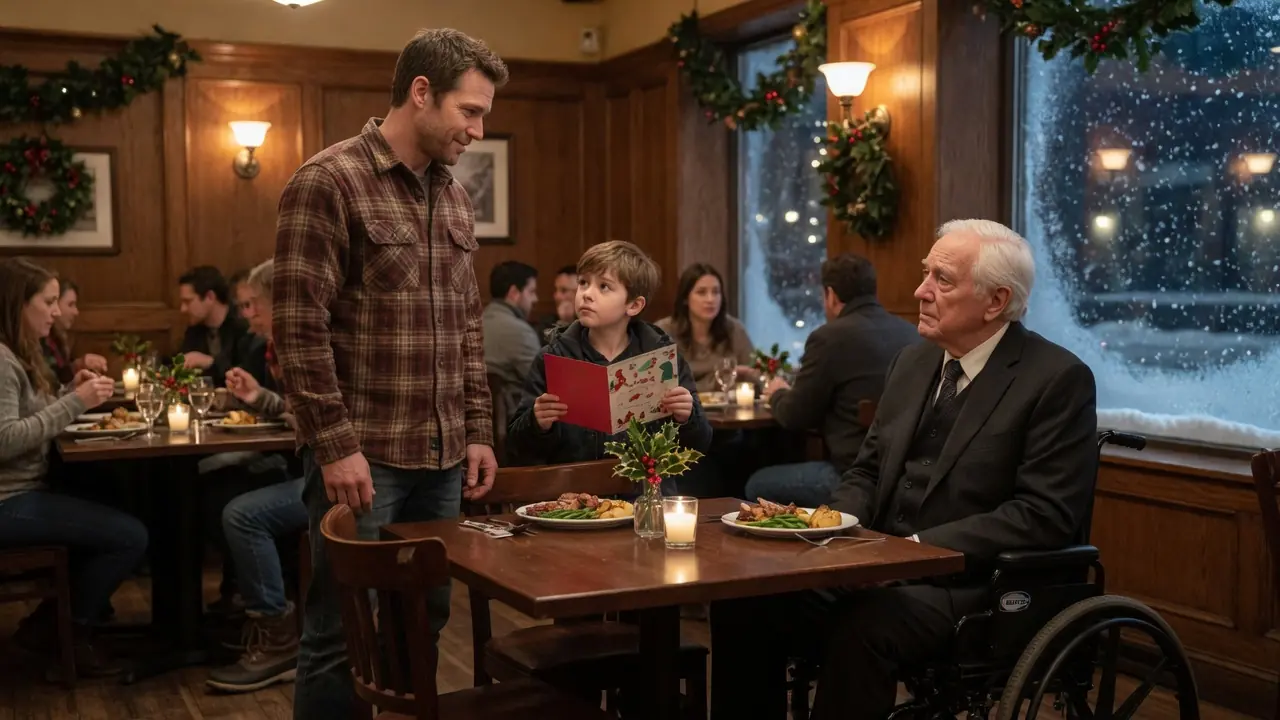
Soft lights glowed against dark wood panels. Candles burned on tables decorated with holly and small red ribbons. Families laughed over roast turkey, prime rib, mashed potatoes, and thick slices of pie. Children leaned against their parents, cheeks bright with excitement, while waiters moved between tables carrying trays that smelled of butter, cinnamon, and roasted meat.
At table twelve, Harold Whitmore sat alone.
He was seventy-four years old, a white-haired man in a dark navy suit, sitting in a wheelchair that looked expensive but could not make him feel less trapped inside it. His shoulders were still broad from a lifetime of carrying himself like someone important, but age had thinned him. His hands rested on the arms of the chair, long fingers trembling slightly beneath the warm restaurant lights.
In front of him sat a Christmas dinner he had not touched.
Prime rib.
Potatoes.
Green beans.
A roll with butter melting beside it.
The plate had been placed in front of him thirty minutes earlier. Now the meat was cold, the gravy had thickened, and the steam was gone. Harold stared at the empty chair across from him as if someone might appear there if he waited long enough.
No one did.
Five years earlier, his wife Eleanor would have been sitting there.
She would have complained that the restaurant used too much rosemary. She would have told him to stop checking his watch. She would have stolen the first bite of his dessert and pretended she had only wanted to taste it. Then she would have reached across the table, squeezed his hand, and said, “Harold, for once in your life, just be here.”
He had spent most of their marriage failing at that.
He had built Whitmore & Hale Properties from one small construction office into one of the biggest real estate companies in New England. He had built hotels, apartment towers, office buildings, and luxury developments that appeared in magazines. He had been praised as a visionary, a self-made man, a builder of cities.
But he had not been a good husband.
Not in the ways that mattered.
He had missed anniversaries because investors flew in from Chicago. He had missed birthdays because a project in New York was behind schedule. He had missed family dinners because the phone rang, and because he always believed there would be another night, another chance, another season when life slowed down.
Then Eleanor became ill.
Even then, Harold tried to manage her suffering like a project. He hired the best doctors, paid for private nurses, upgraded the house, and arranged every comfort money could buy. But when she wanted him to sit beside her and talk, he often had one eye on his phone. When she asked him to read to her, he said he had a call in ten minutes.
By the time he finally understood that presence was not something he could delegate, her voice was already weak.
Her last words to him were not bitter.
That made them worse.
“Don’t spend what’s left of your life surrounded by things and empty of people.”
He had promised her he would not.
Then he had done exactly that.
A waiter approached table twelve with careful politeness.
“Mr. Whitmore, is everything all right with your meal?”
Harold looked up slowly.
The waiter was young, maybe twenty-five, with kind eyes and the tired smile of someone working while other people celebrated.
“It’s fine,” Harold said.
His voice sounded rough.
He had not spoken to anyone since the hostess seated him.
“Would you like me to warm it for you?”
“No.”
“Coffee? Dessert?”
Harold looked at the empty chair again.
“No. Just the check.”
The waiter hesitated, glancing at the untouched plate.
“It’s Christmas, sir. The kitchen made fresh apple pie. On the house, if you’d like a slice.”
Harold almost smiled at the effort.
Almost.
“No, thank you.”
The waiter nodded and stepped away.
Harold’s phone sat on the table beside his water glass.
No messages.
No missed calls.
His daughter, Rachel, had sent a text that morning from Seattle.
Merry Christmas, Dad. Sorry we couldn’t make it. The boys have the flu, and Mark’s parents are in town. We’ll talk this week. Love you.
We’ll talk this week.
She had said that before.
Harold did not blame her.
Not fully.
Rachel had grown up learning not to expect him. She had sat through school plays scanning audiences where he was not sitting. She had blown out birthday candles while he stood in airports. She had graduated college with Eleanor beside her and a voicemail from Harold apologizing for a delayed flight.
By the time Harold tried to become a father who showed up, Rachel had already become a daughter who stopped waiting.
He picked up his water glass.
His hand shook.
The ice clicked against the rim.
He set it down carefully before he spilled it and made every happy family in the restaurant turn to look at the old man who could not even hold a glass steady.
The shame of that almost broke him.
He reached inside his coat pocket and pulled out Eleanor’s wedding ring.
He carried it everywhere now.
The small gold band lay in his palm, simple and worn thin from decades of use. He remembered buying it when he was twenty-four and poor, back when he and Eleanor lived in a third-floor apartment with a radiator that hissed like an angry cat. He had been embarrassed that the ring was so plain, but she had cried when he gave it to her and said, “It’s perfect because it’s ours.”
Now it was only his.
The tears came before he could stop them.
He turned his face toward the window, pressing a napkin quickly to his eyes. Outside, snow blurred the city into softness. Inside, laughter rolled around him from tables full of people who had somewhere to belong.
An old man crying alone in a fine restaurant.
How pathetic, he thought.
“Excuse me, sir.”
Harold lowered the napkin.
A little boy stood beside his table.
He was perhaps seven years old, with light brown hair sticking out from beneath a green knit hat and cheeks pink from the cold. He wore a brown winter coat with one missing button and snow still melting on the shoulders. His eyes were blue, direct, and far too serious for a child his age.
Behind him stood a man in his mid-thirties.
A white American man with tired gray eyes, sandy blond hair, and a flannel shirt under a worn winter jacket. He had the rough hands of someone who worked with tools, the posture of someone used to protecting what little he had, and the exhausted gentleness of a father who had been holding himself together for a long time.
“Noah,” the man said softly. “Come on, buddy. Don’t bother him.”
The boy did not move.
He looked at Harold’s untouched dinner.
Then at the empty chair.
“Are you alone?” the boy asked.
The father’s face flushed.
“Noah.”
Harold should have been offended.
He was not.
There was no cruelty in the child’s question. No curiosity meant to hurt. Only concern, plain and simple, the way children offer truth before the world teaches them to wrap it in manners.
“Yes,” Harold said quietly. “I suppose I am.”
The boy’s face changed.
It was not pity exactly.
It was decision.
“No one should be alone on Christmas,” Noah said.
The words struck Harold somewhere deeper than he expected.
The father stepped closer, one hand resting on the boy’s shoulder.
“I’m sorry, sir. My son has a big heart and very little filter. We were just leaving.”
Harold looked at him.
“It’s all right.”
“Noah,” the father said again, gently but firmly. “Let’s go.”
But Noah reached into the pocket of his coat and pulled out a folded piece of construction paper. It was red, creased at the corners, and decorated with green crayon Christmas trees. A crooked star had been drawn on the front, along with three stick figures standing under falling snow.
The boy held it out to Harold.
“I made this for my dad,” Noah said. “But I think you need it more.”
The father went still.
Harold took the card with both hands because his fingers were not steady enough for one.
Inside, written in uneven letters, were the words:
Nobody should be alone when love can make room.
Merry Christmas.
Harold stared at the card until the red paper blurred.
Something old and frozen inside him shifted.
The father cleared his throat.
“Noah made that this morning,” he said quietly. “The third person in the picture is supposed to be his mother. She passed away three years ago.”
Harold looked up.
The man’s eyes held a grief Harold recognized immediately.
Not fresh grief.
Not the kind that screams.
The kind that has learned to wake up, make breakfast, pay bills, answer questions, and keep breathing because a child still needs socks and cereal and bedtime stories.
“I’m sorry,” Harold said.
The father nodded.
“Thank you.”
“What is your name?”
“Matthew Hayes,” the man said. “And this is my son, Noah.”
“Noah Hayes,” the boy added, as if official introduction required both names.
Harold’s mouth trembled.
“Harold Whitmore.”
Noah looked at the empty chair again.
“Mr. Harold, did your family forget to come?”
Matthew closed his eyes briefly.
“Noah, buddy.”
Harold surprised himself by answering.
“No. They did not forget. They simply have other places to be.”
Noah frowned.
“That sounds like forgetting with extra words.”
For the first time that evening, Harold laughed.
It came out rough and small, but it was real.
Matthew looked embarrassed and amused at the same time.
“He gets that from his mother,” he said.
Harold looked at the untouched plate in front of him.
Then at the father and son standing beside his table, both wearing coats too thin for a Boston Christmas storm. Matthew’s boots were wet, and Noah’s gloves did not match. They did not look like people who had planned to eat at the Golden Oak. They looked like people who had stepped inside for warmth, perhaps directions, perhaps a moment away from the cold.
“Would you sit with me?” Harold asked.
Matthew’s face changed.
“Oh, no. Sir, we couldn’t.”
“You could.”
“It’s very kind, but this place is…” Matthew glanced around at the linen napkins, crystal glasses, polished silverware, and families dressed for photographs. “It’s not exactly our kind of place.”
“It is not mine tonight either.”
Matthew did not answer.
Harold looked at Noah.
“I have far too much food, and I cannot finish it alone. Your card says love can make room. Would you help me prove it?”
Noah looked up at his father.
“Dad.”
Matthew sighed softly.
Harold could see pride fighting hunger, gratitude fighting embarrassment, caution fighting the desire to give his son something good on Christmas.
Finally, Matthew nodded.
“Only if you let me pay for something.”
Harold almost smiled.
“You may pay by telling me one true thing about yourself.”
Noah climbed into the chair across from Harold immediately, as if the matter had been settled in court.
“My true thing is I like pancakes better than Christmas ham,” Noah announced.
Matthew sat down more slowly.
“That is both true and not what he meant.”
“It counts,” Harold said.
He signaled the waiter, who returned with surprise written all over his face.
“Could we have two more menus?” Harold asked. “And please warm my dinner. I have decided not to waste Christmas after all.”
The waiter smiled.
“Yes, sir.”
Noah removed his hat and placed it carefully on his lap.
His hair stood up in every direction.
Harold looked at him and felt a tenderness he had not expected.
“How did you two end up here tonight?” he asked.
Matthew rubbed the back of his neck.
“We were looking for Murphy’s Diner down the street. I promised Noah a Christmas dinner out. Nothing fancy, just something different from what we’ve been eating at home.”
“Mac and cheese,” Noah said.
Matthew smiled faintly.
“A lot of mac and cheese.”
“We got turned around because of the snow,” Noah continued. “Then I saw you through the window.”
“You saw me?”
Noah nodded.
“You looked like the Christmas tree after all the presents are gone.”
Matthew’s eyes filled with sudden pain.
Harold lowered his gaze.
Out of all the descriptions thrown at him in his life, no boardroom insult, newspaper headline, or business accusation had ever cut him so cleanly.
Because the boy was right.
The waiter brought menus.
Matthew opened his, saw the prices, and immediately closed it a little.
Harold saw the calculation pass through his face.
The same calculation Harold had known long before wealth made it unnecessary.
What can I afford without embarrassing myself?
“Order anything,” Harold said.
Matthew shook his head.
“No. Really. We don’t need much.”
“I insist.”
“I can’t let you do that.”
Harold leaned back in his wheelchair.
“Mr. Hayes, I am seventy-four years old, alone on Christmas, and deeply in need of company. If you deny an old man the pleasure of buying dinner for the two people who rescued him from a very miserable evening, you will be behaving cruelly.”
Noah gasped.
“Dad, don’t be cruel on Christmas.”
Matthew gave his son a look.
Harold nearly laughed again.
“All right,” Matthew said at last. “But nothing ridiculous.”
Noah pointed to the children’s menu.
“They have chicken fingers.”
“That seems reasonable,” Matthew said.
“They also have chocolate cake.”
“That is less dinner and more negotiation.”
Harold looked at the waiter.
“Chicken fingers, fries, and chocolate cake for the young gentleman. Whatever his father will allow himself to order, and coffee for us both.”
Matthew exhaled, defeated.
“A burger,” he said. “Medium. Thank you.”
As they waited for the food, Noah pulled two crayons from his coat pocket and began drawing on the back of an unused napkin. His tongue poked slightly from the corner of his mouth. Harold watched him draw a lopsided snowman beside a table with three people sitting together.
Matthew saw him watching.
“He draws when he’s thinking.”
“What is he thinking about?”
“That people look better when they’re not alone,” Noah said without looking up.
Matthew’s face softened.
Harold folded the red Christmas card carefully and placed it beside Eleanor’s ring.
“Your mother must have been a very kind woman,” Harold said.
Noah nodded.
“She was the kindest. She sang songs when it rained and made soup when Dad got sad.”
Matthew looked down.
“She was a school librarian,” he said. “Her name was Emily. She loved books, old houses, and feeding people who said they weren’t hungry.”
“A wise woman,” Harold said.
“The best.”
“How long has she been gone?”
“Three years,” Matthew said.
His voice remained steady, but Harold heard what it cost.
“She got sick when Noah was four. Fast. Faster than anyone was ready for.”
Noah stopped drawing.
“Mom said fast things are not always bad. Like race cars. But sickness fast is bad.”
Matthew placed a hand gently over his son’s.
“Yeah, buddy.”
Harold looked at the little boy, then at the father whose grief had not stopped him from showing up for his child.
“I lost my wife five years ago,” Harold said.
Matthew looked up.
“Eleanor. We were married forty-eight years.”
“That’s a long time,” Noah said.
“Not long enough.”
Noah considered that with the seriousness of a judge.
“No. Probably not.”
Matthew gave Harold an apologetic look.
But Harold waved it off.
“He’s right.”
The food arrived.
Steam rose from Matthew’s burger and Noah’s chicken fingers. Harold’s dinner returned warm, the plate refreshed with new gravy and a fresh roll. For a moment, nobody spoke because hunger had its own dignity.
Noah ate like a boy who had been promised a rare treat and intended to respect it.
Matthew ate slowly, almost cautiously, as if worried the meal might disappear if he enjoyed it too much. Harold cut a small piece of prime rib and finally took his first real bite of the night. It tasted better than he expected. Not because the kitchen had changed anything, but because he was no longer eating alone.
“So, Matthew,” Harold said after a while. “What do you do?”
“I’m a carpenter. Mostly restoration and repair work. Old houses, cabinets, stair rails, built-ins. Whatever jobs I can get.”
“Your own business?”
Matthew gave a small shrug.
“Trying to be. Hayes Custom Woodwork. It’s mostly me, my old truck, and a set of tools that have seen better days.”
“He makes broken things pretty again,” Noah said proudly.
Matthew smiled at his son.
“I try.”
Harold’s attention sharpened.
“Historic restoration?”
“Sometimes. When people will hire me.”
“And do they?”
Matthew looked down at his plate.
“Not as often as I’d like.”
“Why?”
Matthew wiped his mouth with his napkin, buying time.
“Because I don’t have the right background. I learned from my father and from job sites, not from college. A lot of bigger firms want degrees, certifications, connections. I have skill, but skill doesn’t always get through the first door.”
There was no bitterness in his voice.
That made Harold respect him more.
“I’ve applied to restoration companies all over the city,” Matthew continued. “Some call me in after seeing the photos of my work. Then they ask about formal training, management experience, software systems, corporate projects.”
“And?”
“And then they go in another direction.”
Noah frowned.
“That means no.”
Harold nodded slowly.
“Yes. It often does.”
Matthew gave his son a gentle look.
“It’s okay.”
“No, it isn’t,” Noah said. “Your staircases are better than the ones in magazines.”
Harold’s eyes moved from the boy to the father.
“You build staircases?”
“Restore them, mostly. Old brownstones. Townhouses. Sometimes people buy historic homes and want everything ripped out because modern is easier. I try to convince them old things still have life if you know how to care for them.”
Harold looked at the red card beside his plate.
Old things still have life if you know how to care for them.
The words landed somewhere near his heart.
“What about you?” Matthew asked. “What did you do before retirement?”
Harold hesitated.
He had spent decades answering that question with polished ease.
Founder.
Chairman.
Developer.
Builder.
Tonight, those words felt smaller than they used to.
“I built a company,” he said. “Whitmore & Hale Properties.”
Matthew’s eyes widened slightly.
“You’re that Harold Whitmore?”
“I am.”
Noah looked confused.
“Is that famous?”
“Kind of,” Matthew said.
Harold smiled without humor.
“Fame is just loneliness with more people watching.”
Matthew studied him.
“That sounds expensive.”
“It was.”
For the next hour, they talked.
Not like strangers forced into politeness.
Like people who had unexpectedly found the same language.
Matthew told Harold about Emily, about how she could make a classroom of noisy children go quiet just by opening a book. He told him about the hospital bills, the apartment in Dorchester, the one-bedroom he and Noah shared because it was all he could afford. He told him about taking jobs at night, building shelves after Noah fell asleep, and waking at dawn to pack school lunches.
Harold told Matthew about Eleanor.
About their first apartment with bad heat.
About his early years working construction before he became the man in suits who signed contracts instead of carrying lumber.
About Rachel, his daughter, and the distance between them that had begun as missed dinners and grown into years of careful phone calls.
He did not tell everything.
But he told more than he had told anyone in a long time.
Noah listened while drawing.
Every so often, he interrupted with a question only a child would ask.
“Did your wife like pancakes?”
“Why don’t rich people fix lonely?”
“Do wheelchairs have snow tires?”
“Can grown-ups say sorry even if they waited too long?”
That last question silenced both men.
Harold looked at Matthew.
Matthew looked at Harold.
Then Matthew answered softly, “Yes. But they still have to mean it.”
Harold nodded.
“Your father is right.”
When dessert arrived, Noah insisted that Harold share the chocolate cake.
“I already gave you my card,” he said. “So now we’re basically Christmas friends.”
Harold accepted a bite.
Then another.
At some point, people at nearby tables began watching them. Not in mockery. In the quiet way people watch kindness and wish they had noticed it first. A woman near the window wiped her eyes. The waiter smiled every time he passed.
Noah, noticing none of this, finished his drawing and pushed it toward Harold.
It showed three people at a table.
A tall man.
A small boy.
An old man in a wheelchair.
Above them, in uneven letters, Noah had written:
Christmas got bigger.
Harold pressed the napkin flat with trembling fingers.
He could not speak for a moment.
Matthew saw his face.
“Noah,” he said softly, “I think Mr. Harold likes it.”
“I do,” Harold whispered. “More than you know.”
When dinner ended, Harold paid the check before Matthew could object. Then he handed Matthew a business card, thick cream paper with raised lettering.
“I would like you and Noah to come to my home tomorrow,” he said.
Matthew looked at the card.
His face became cautious.
“For what?”
“Coffee. Conversation. And perhaps to show me photographs of your work.”
Matthew’s pride returned immediately.
“Mr. Whitmore, if this is about giving us money because you feel sorry—”
“It is not.”
“Because we’re okay.”
Harold looked at his worn coat, then at Noah’s mismatched gloves, then back at Matthew’s guarded face.
“I believe you have made sure of that. But okay is not always the same as supported.”
Matthew’s jaw tightened.
Harold softened his voice.
“I am not offering pity. I am asking for a conversation with a craftsman. If your work is as good as your son says, I may have use for it.”
Noah gasped.
“Dad, he wants to see the staircase pictures.”
Matthew looked at his son.
Then at Harold.
“Tomorrow,” he said slowly. “After lunch.”
“Two o’clock.”
Noah leaned over and hugged Harold before anyone could stop him.
Harold went completely still.
The boy’s arms were small around his neck, warm and trusting.
“Merry Christmas, Mr. Harold,” Noah whispered.
Harold lifted one trembling hand and rested it gently on the boy’s back.
“Merry Christmas, Noah.”
When Matthew and Noah left, Harold watched them through the window.
The father held his son’s hand tightly as they stepped into the snow. Noah skipped once, then slipped, and Matthew caught him with practiced ease. The boy laughed. Matthew laughed too, bending down to brush snow from his son’s pants before they disappeared into the white evening.
Harold looked down at the red card.
Nobody should be alone when love can make room.
For the first time in five years, he did not dread going home.
Harold did not sleep much that night.
His penthouse overlooked Boston Harbor, twenty-two floors above streets softened by snow. Everything in the apartment was expensive. The furniture had been chosen by designers. The art had been insured for more than some people’s homes. The kitchen had marble counters no one used.
It was quiet enough to hear the elevator hum behind the walls.
Harold wheeled himself to the window and looked out at the city.
He thought of Matthew Hayes.
A carpenter with tired eyes and capable hands.
A father who had lost his wife and still found a way to teach his son kindness.
He thought of Noah.
A boy who looked at an old man in a restaurant and saw what adults had trained themselves not to see.
At six in the morning, Harold called his assistant, Andrea.
She answered on the second ring, as she always did, even on Christmas week.
“Mr. Whitmore?”
“I need you to find someone for me. Matthew Hayes. Carpenter. Lives in Dorchester. Has a son named Noah.”
There was a brief silence.
“Is everything all right?”
“For the first time in a while,” Harold said, “possibly.”
By noon, Andrea had gathered a file.
Harold opened it in his study with a mug of coffee growing cold beside him.
Matthew Hayes, age thirty-six.
Born in Massachusetts.
White American.
Widowed.
One son, Noah Hayes, age seven.
No criminal record.
Registered sole proprietor: Hayes Custom Woodwork.
Business income irregular.
Debt high.
Most of it medical.
Harold turned the pages slowly.
Emily Hayes’s illness had drained everything. Savings. Retirement. The small house Matthew had once owned in Quincy. After Emily died, Matthew sold the house to cover debts and moved into the Dorchester apartment. Since then, he had worked steadily but never securely.
There were photographs of his projects.
Harold paused over them.
A staircase in a Beacon Hill townhouse, restored so beautifully the carved banister looked like it had remembered its youth.
A library wall of walnut shelves fitted around uneven old plaster.
A fireplace mantel recreated from a single surviving photograph.
A church door repaired with such care that the new wood disappeared into the old.
Harold leaned closer.
Matthew was not merely competent.
He had an eye.
A reverence for materials.
A patience most contractors considered too expensive.
He did not erase age from buildings. He honored it.
That mattered to Harold more than he expected.
Then he saw the employment records.
Matthew had applied to established restoration firms, construction companies, and development groups across Boston. He had been called for interviews. He had been praised for his portfolio. Then rejected because he lacked formal credentials, corporate management experience, or the right contacts.
One rejection email used the phrase not the right fit.
Harold had seen that phrase in hiring files for decades.
It often meant no one wanted to take a chance.
He closed the folder slowly.
His own company had three historic buildings sitting unused because no one on the board could decide whether to preserve them or gut them. The original Whitmore Building, built in 1894, had been empty for twelve years. Harold had avoided it because it reminded him of the early days with Eleanor, when hope had been cheap and work had been honest.
Maybe it was time to stop avoiding old things.
Maybe old things still had life if someone knew how to care for them.
At two o’clock, the doorbell rang.
Harold wheeled himself to the door and opened it.
Matthew stood there in clean jeans, a button-down shirt frayed at the collar, and the same careful expression he had worn the night before. Noah stood beside him holding a folder almost as big as his chest.
“I carried the pictures,” Noah announced.
“So I see,” Harold said. “Come in.”
Noah stepped inside and stopped dead.
The penthouse opened around him in glass, polished wood, and winter light. Boston spread beyond the windows, bright and white beneath the snow. A grand piano sat near one wall, untouched for years. Bookshelves lined another, filled with leather volumes Eleanor had loved and Harold had rarely opened.
Noah whispered, “Dad, he lives in the sky.”
Matthew looked uncomfortable.
“Buddy.”
Harold smiled.
“It does feel that way sometimes.”
“Do you ever get lonely in the sky?” Noah asked.
Matthew sighed.
Harold looked at the boy.
“Yes,” he said. “Very.”
Noah nodded as if this confirmed a theory.
“Then you need more chairs.”
The simplicity of that answer nearly undid Harold.
Andrea had arranged coffee, hot chocolate, sandwiches, and cookies on the dining table. Noah gravitated toward the cookies with respectful longing, and Harold told him he could take two before Matthew had a chance to limit him to one.
Matthew sat across from Harold and placed the folder of photographs on the table.
“I brought some examples,” he said. “Nothing fancy.”
Harold opened the folder.
“People often say that before showing me something worth seeing.”
The work was even better in print.
Matthew explained each project with quiet precision. He spoke of grain direction, original joinery, hidden water damage, old-growth wood, and the mistake people made when they treated historic buildings like outdated furniture. His hands changed when he spoke. They became more animated, more certain, as if the tools were still in them.
Harold listened carefully.
The more Matthew spoke, the clearer Harold became.
This was not charity.
This was opportunity meeting talent the market had ignored.
After nearly an hour, Harold closed the folder.
“I have a job for you.”
Matthew stiffened.
“What kind of job?”
“I own a building near the old waterfront. The first headquarters of Whitmore & Hale. Built in 1894. Empty for years. The board wants to convert it into luxury offices or sell it. I want it restored properly.”
Matthew stared at him.
“You want me to work on it?”
“I want you to lead it.”
Matthew’s face went blank.
“No.”
Harold lifted his eyebrows.
“No?”
“No, sir. I appreciate it, but no. I’m not qualified to lead a project like that.”
Noah looked alarmed.
“Dad.”
Matthew shook his head.
“I’m serious. I can do the woodwork. I can restore stair rails, doors, built-ins. But lead the whole project? Budgets, crews, permits, engineers? I can’t walk into your company and pretend I belong there because we had Christmas dinner together.”
Harold respected him more for that.
“I am not asking you to pretend.”
“That is what it would look like.”
“To whom?”
“To everyone.”
Harold leaned back.
“Matthew, I spent my life sitting in rooms with men who looked qualified and lacked care. They wore better suits than you. They had better degrees than you. They knew all the right words. And many of them did work that was soulless, wasteful, and ugly because they saw buildings as numbers dressed in brick.”
Matthew said nothing.
“You see what things are worth beneath the damage,” Harold continued. “That is rarer than credentials.”
Matthew looked down at his hands.
“I have a son to take care of. I can’t risk failing in public.”
Harold glanced at Noah, who had chocolate on his upper lip and fierce belief in his eyes.
“Then don’t fail alone.”
Matthew looked up.
“I would give you a team,” Harold said. “A project manager for corporate procedures. An architect. An engineer. A budget officer. You would lead the restoration vision and the craft team. You would hire apprentices. You would build a department that values hands-on skill.”
Matthew’s expression changed at that.
“Apprentices?”
“Yes.”
“There are kids out there who could learn trades if someone paid them fairly while teaching them.”
“I agree.”
“You do?”
“I do now.”
Harold pushed a folder across the table.
Inside was a written offer.
Director of Historic Restoration and Craft Preservation.
Salary higher than Matthew had ever made.
Health insurance.
Education fund for Noah.
Debt restructuring support through a legal financial counselor.
Matthew read the first page.
Then the second.
His hand began to shake.
“This is too much.”
“No,” Harold said. “It is structured.”
“This is because you feel bad.”
“No. This is because your son gave me a Christmas card, you gave me company, and your work gave me a reason to look at a building I had abandoned. Gratitude opened the door, but skill kept it open.”
Matthew pressed his lips together.
“I don’t want my son thinking kindness is something you sell.”
Harold’s eyes softened.
“Then teach him kindness is something that grows when people honor it properly.”
Noah climbed down from his chair and walked to his father.
“Dad,” he said softly, “Mom said when someone opens a good door, you shouldn’t stand outside freezing.”
Matthew closed his eyes.
Harold looked away for a moment to give him privacy.
When Matthew spoke again, his voice was rough.
“I want to earn it.”
“You will.”
“If I’m not good enough, you tell me.”
“I will.”
“If your board hates me—”
“They will survive the discomfort.”
Matthew almost laughed.
Then he looked at Noah.
The boy smiled hopefully.
Matthew turned back to Harold.
“All right,” he said. “I’ll try.”
Harold extended his hand.
Matthew shook it.
Noah jumped once in place.
“Does this mean Dad has a sky job?”
“It means your father has a very serious job,” Harold said.
“Can serious jobs still have cookies?”
“Mine apparently does.”
The first day at Whitmore & Hale headquarters was almost enough to make Matthew quit before lunch.
The building was glass, steel, and polished confidence. Everyone seemed to move quickly, speak in acronyms, and wear clothes that cost more than his monthly rent. Matthew arrived in his best jacket and work boots he had cleaned twice, carrying his portfolio in a leather bag he had bought secondhand.
Harold met him in the lobby.
Not upstairs.
Not through an assistant.
In the lobby.
That mattered.
“Ready?” Harold asked.
“No.”
“Good. Honest start.”
They rode the elevator to the executive floor.
The conference room was already full.
Board members, division heads, legal counsel, finance staff, and several people who looked at Matthew as if someone had brought in a delivery man and forgotten to send him back out.
Harold wheeled himself to the head of the table.
“This is Matthew Hayes,” he said. “He will lead the Historic Restoration and Craft Preservation division.”
A man in a charcoal suit leaned back.
Richard Hale.
Harold’s longtime business partner’s son, now chief financial officer, and a man who had been waiting years for Harold to step aside.
“Lead?” Richard said. “That is an interesting word.”
“It is the correct one,” Harold replied.
Richard glanced at Matthew.
“With all respect, Mr. Hayes, what is your formal education?”
Matthew felt every eye turn toward him.
He could have lied in fancy language.
He did not.
“High school diploma. Trade experience. Twenty years on job sites if you count summers starting at sixteen.”
Richard smiled thinly.
“So no degree.”
“No.”
“No corporate management background.”
“Not in a company this size.”
“No experience managing multimillion-dollar budgets.”
“No.”
Richard looked at Harold.
“And this is your choice?”
“Yes.”
“Based on what? A portfolio and a Christmas dinner?”
The room went silent.
Matthew felt heat rise in his face.
Harold’s expression did not change, but his voice became cold enough to freeze the windows.
“Careful, Richard.”
Richard spread his hands.
“I am only asking what everyone is thinking. We are responsible for company assets. Sentiment is not a hiring strategy.”
“No,” Harold said. “But arrogance has been ours for too long.”
A woman near the end of the table shifted.
Margaret Sullivan, head of development, sharp-eyed and precise.
“I have concerns,” she said. “Not personal ones. Operational ones. This division needs structure.”
“Then help build it,” Harold said.
She looked at Matthew.
“Can you take criticism?”
Matthew swallowed.
“Yes.”
“Can you admit what you don’t know?”
“Yes.”
“Can you learn corporate process without resenting it?”
“I can.”
“Can you lead skilled people who may know more than you in certain areas?”
“If they know more, I’d be stupid not to listen.”
Margaret studied him for a long moment.
Then she nodded once.
“That answer is better than half the men we promote.”
Richard looked displeased.
Harold allowed himself a small smile.
“Then we begin.”
The first weeks were brutal.
Matthew learned budgets, reporting systems, insurance forms, city permit language, preservation rules, contractor negotiations, and how many meetings a company could invent before noon. He made mistakes. He asked questions that made younger analysts hide smiles. He misread a spreadsheet formula and nearly approved a materials order that would have doubled a cost line.
But he learned.
He arrived early.
Stayed late.
Visited the old Whitmore Building every day.
The building stood near the waterfront, red brick darkened by weather, arched windows boarded, carved stone worn but not ruined. Inside, dust covered the floors, but the bones were strong. The main staircase curved through the center like a memory waiting to be polished. Sunlight fell through stained glass that had somehow survived neglect.
Matthew stood inside it the first time and whispered, “You’re still here.”
Jennifer, the young assistant assigned to him, overheard.
“Do you always talk to buildings?”
“Only the ones that talk first.”
Instead of laughing, she smiled.
“My dad’s a plumber. He talks to pipes.”
Matthew liked her immediately.
He hired apprentices from community programs in Dorchester, Roxbury, and East Boston. Young people who had been told they were difficult, unfocused, not college material, not professional enough. Matthew saw hands that wanted to learn and eyes that sharpened when work became real.
He paid them fairly because Harold insisted.
He taught them to sand with the grain, measure twice, listen to old wood, and never call old damage ugly before understanding what caused it.
One apprentice, a nineteen-year-old named Marcus, asked him one afternoon, “Why are you giving us this chance?”
Matthew thought of Christmas night.
Of Harold alone at table twelve.
Of Noah’s red card.
“Because someone gave me one,” he said. “And I don’t want to be the kind of man who forgets.”
At home, life changed slowly.
Matthew and Noah moved from their cramped one-bedroom into a modest two-bedroom apartment closer to Noah’s school. Not luxury. Not excessive. Just clean, warm, with a small room Noah could decorate himself. The first night, Noah sat on his new bed and cried because he had a door he could close.
Matthew sat beside him and cried too.
“Happy tears?” Noah asked.
“Mostly.”
“Mom would like this room.”
“She would love this room.”
Noah placed the red Christmas card’s second drawing on his desk.
Christmas got bigger.
Harold became part of their life in small ways before anyone named it.
He called Matthew about work, then asked how Noah was doing.
He invited them for Sunday dinners, pretending he had “too much food” every week.
He sent Noah books about architecture, then model trains, then a child-sized tool belt that Matthew said was too much and Noah said was destiny.
Noah started calling him Grandpa Harold by accident one evening.
The room went still.
Harold looked as if someone had placed a hand over his heart.
“I can call you Mr. Harold if you want,” Noah said quickly.
Harold’s voice was soft.
“No. Grandpa Harold is fine.”
Matthew looked away because he knew what grief looked like when it became gratitude.
The project moved forward.
Under budget.
Ahead of schedule.
Even Richard had to stop openly predicting disaster, though he continued searching for weakness.
He found it in Harold.
Harold’s health was not as strong as he pretended. Some days his hands shook more. Some days pain kept him from the office. One afternoon, Matthew arrived at the penthouse and found him pale, exhausted, and angry at his own body.
“You need rest,” Matthew said.
“I need to finish what I started.”
“You can do both.”
“Men always say that when they are young enough to believe time negotiates.”
Matthew did not know what to say.
Harold looked toward the window.
“I wasted so much of it.”
“With Rachel?”
“With Eleanor. With Rachel. With every person who loved me before I knew how to receive it.”
“Call your daughter.”
Harold’s jaw tightened.
“She’s busy.”
“Maybe. Call her anyway.”
Harold looked at him.
“You speak boldly for an employee.”
Matthew held his gaze.
“Then fire me after you call.”
Harold stared at him.
Then laughed, quietly and painfully.
That night, Harold called Rachel.
The first conversation lasted seven minutes.
The second, three days later, lasted twenty.
The third lasted nearly an hour.
By spring, Rachel flew to Boston with her two sons.
Harold met them in his lobby, wearing his best suit and sitting in his wheelchair with Eleanor’s ring in his pocket. When Rachel stepped out of the elevator, she looked older than he remembered and younger than his guilt had made her. For a moment, neither moved.
Then Harold said, “I am sorry I made you learn not to wait for me.”
Rachel’s face crumpled.
She crossed the lobby and hugged him.
Matthew watched from a distance with Noah beside him.
“Did Grandpa Harold fix it?” Noah whispered.
“He started,” Matthew said.
“That counts?”
“That counts.”
The Whitmore Building reopened in November.
Not as luxury offices.
As the Whitmore Center for Restoration and Trades.
The first floor held community classrooms and workshop space. The second floor became offices for the new preservation division. The upper floors housed apprenticeships, design studios, and a small museum honoring the workers who had built Boston with their hands.
At the opening ceremony, hundreds of people filled the restored hall.
Former board skeptics stood beneath the staircase Matthew’s team had brought back to life. Reporters took photographs. Apprentices stood in clean work shirts with their families beside them. Noah sat in the front row next to Rachel’s children, holding a program and trying to look official.
Harold rolled to the podium.
He looked older than he had the year before.
But fuller somehow.
Less empty.
“Last Christmas,” he began, “I sat alone in a restaurant with a cold dinner and a colder heart.”
The room quieted.
“I had built buildings across this city. I had money, reputation, and control. I had mistaken those things for success.”
He paused, looking toward Matthew and Noah.
“Then a young boy walked to my table and gave me a card that said nobody should be alone when love can make room.”
Noah slid lower in his chair, embarrassed.
People smiled.
“His father joined me for dinner. A carpenter. A widower. A man the professional world had underestimated because his education came through tools, responsibility, and survival rather than the right institutions.”
Harold looked around the restored hall.
“This building exists because Matthew Hayes saw life where others saw inconvenience. He did not erase its age. He honored it. He did not hide its scars. He made them part of its strength.”
Applause rose.
Harold lifted a hand.
“More importantly, this center exists because I was wrong. Wrong about what success means. Wrong about what care requires. Wrong about how many talented people we exclude because they do not arrive with polished credentials and familiar connections.”
His voice roughened.
“From this day forward, Whitmore & Hale will fund paid apprenticeships in restoration trades for young people across Boston. No unpaid labor. No empty promises. Real training. Real wages. Real futures.”
The applause grew louder.
Matthew felt his throat tighten.
Harold turned toward him.
“Matthew, come here.”
Matthew froze.
Noah pushed his arm.
“Go, Dad.”
Matthew walked to the podium, uncomfortable under the attention.
Harold handed him a small wooden box.
Inside was an old carpenter’s pencil, worn nearly to nothing.
“This belonged to me,” Harold said. “Before I became a man in boardrooms. Before I forgot the dignity of work done by hand. I used it on my first job site.”
Matthew stared at it.
“I want you to have it.”
“I can’t—”
“You can,” Harold said. “And you will, because I am old and stubborn and have a microphone.”
The room laughed.
Matthew took the box carefully.
“Thank you.”
“No,” Harold said quietly, away from the microphone now. “Thank you for not letting an old building be thrown away. Or an old man.”
Matthew’s eyes filled.
Noah could not stand it anymore.
He ran onto the stage and hugged Harold around the shoulders.
The applause became thunder.
That Christmas, one year after the night at the Golden Oak, Harold’s penthouse was full.
Not with expensive silence.
With life.
Rachel came with her husband and sons. Matthew cooked with Harold’s chef but insisted on making the mashed potatoes himself because Noah claimed restaurant mashed potatoes tasted too smooth. Noah wore a red sweater and carried a stack of handmade cards for everyone.
Harold sat by the window, Eleanor’s ring in his pocket, watching the people move through his home.
Rachel laughing in the kitchen.
Matthew helping Noah hang a crooked paper snowflake.
His grandsons arguing over a board game.
Andrea drinking coffee by the fireplace.
The air smelled of cinnamon, roast chicken, pine branches, and something Harold had nearly forgotten.
Home.
Noah climbed onto the chair beside him.
“Grandpa Harold?”
“Yes?”
“I made you another card.”
Harold accepted it.
This one was green construction paper with a drawing of a large table. Around it sat many stick figures. In the center was an old man in a wheelchair holding a cup of cocoa.
Inside, Noah had written:
Christmas stayed bigger.
Harold pressed the card to his chest.
For a moment, he could not speak.
Noah leaned against him.
“Are you sad?”
Harold looked around the room.
At his daughter.
At Matthew.
At the children.
At the love that had made room and then kept widening.
“No,” he said softly. “Not sad.”
“Happy tears?”
“Yes.”
Noah nodded.
“Those are allowed.”
Harold laughed through the tears.
“Yes, they are.”
Later, after dinner, Harold asked everyone to gather near the window.
Snow fell over Boston again, just as it had the year before. The city glowed beneath it, softened and bright. Harold lifted his glass with a trembling hand, and this time, when it shook, Matthew quietly steadied it without making him feel weak.
Harold looked at him with gratitude.
Then he looked at everyone else.
“A year ago,” he said, “I thought family was something I had lost because I had failed to care for it properly. Perhaps that is partly true. But I have learned something since then.”
He looked at Noah.
“Family can also be something that walks up to your table when you are too lonely to ask for help.”
Noah smiled.
Harold continued.
“It can be a boy with a handmade card. A father with tired eyes and honorable hands. A daughter brave enough to forgive slowly. Grandchildren willing to meet an old man again. Friends who become kin not by blood, but by showing up.”
Rachel wiped her eyes.
Matthew looked down.
Harold raised his glass slightly.
“To second chances,” he said. “To work that restores what others abandon. To children who see the truth. And to never again letting someone sit alone when love can make room.”
“To second chances,” everyone echoed.
That night, after the house quieted and the guests began gathering coats, Matthew stayed behind for a moment.
Harold sat near the fireplace with Noah asleep against his side, the boy’s head resting on Harold’s shoulder.
“He wore himself out,” Matthew whispered.
“He gave away twelve cards and ate three desserts,” Harold said. “A warrior’s Christmas.”
Matthew smiled.
Then his face grew serious.
“You changed our lives.”
Harold looked at him.
“No, Matthew. Your son changed mine. You helped me keep it changed.”
Matthew sat in the chair across from him.
“I used to think I had to do everything alone. After Emily died, I thought asking for help meant I wasn’t strong enough.”
“So did I,” Harold said.
“What changed your mind?”
Harold looked down at Noah sleeping peacefully.
“A child saw me crying and did not look away.”
Matthew swallowed.
Outside, snow continued falling.
Inside, the fire burned steady.
Harold thought of Eleanor. He imagined her standing somewhere just beyond sight, smiling with that knowing expression she wore whenever he finally learned something she had tried to teach him years earlier.
Don’t spend what’s left of your life surrounded by things and empty of people.
He was not empty anymore.
He had lost much.
He had failed often.
He had come late to wisdom.
But Christmas had come anyway, carrying a little boy in a green knit hat and a father with a worn coat, and they had sat at his table when the world felt finished.
They had not fixed everything in one night.
Life rarely works that way.
But they had opened a door.
And Harold Whitmore, who had spent so many years building walls of glass and steel and money, finally learned to let people walk through.
Because no one should be alone on Christmas.
Not an old man with a cold dinner.
Not a widowed father carrying too much.
Not a little boy missing his mother.
Not anyone.
Not when love can make room.