Rain hammered the highway outside Maple Hollow, Tennessee, turning the asphalt into a black mirror beneath the headlights of passing cars. Rebecca Lawson saw the motorcycle only because lightning flashed across the sky, illuminating a red-and-black Harley tilted on the shoulder and a massive man standing beside it with his head bowed. Drivers swept past without slowing, throwing curtains of water over the stranded rider. Rebecca tightened both hands around the steering wheel of her aging Ford station wagon, hesitated for one breath, then pulled onto the shoulder.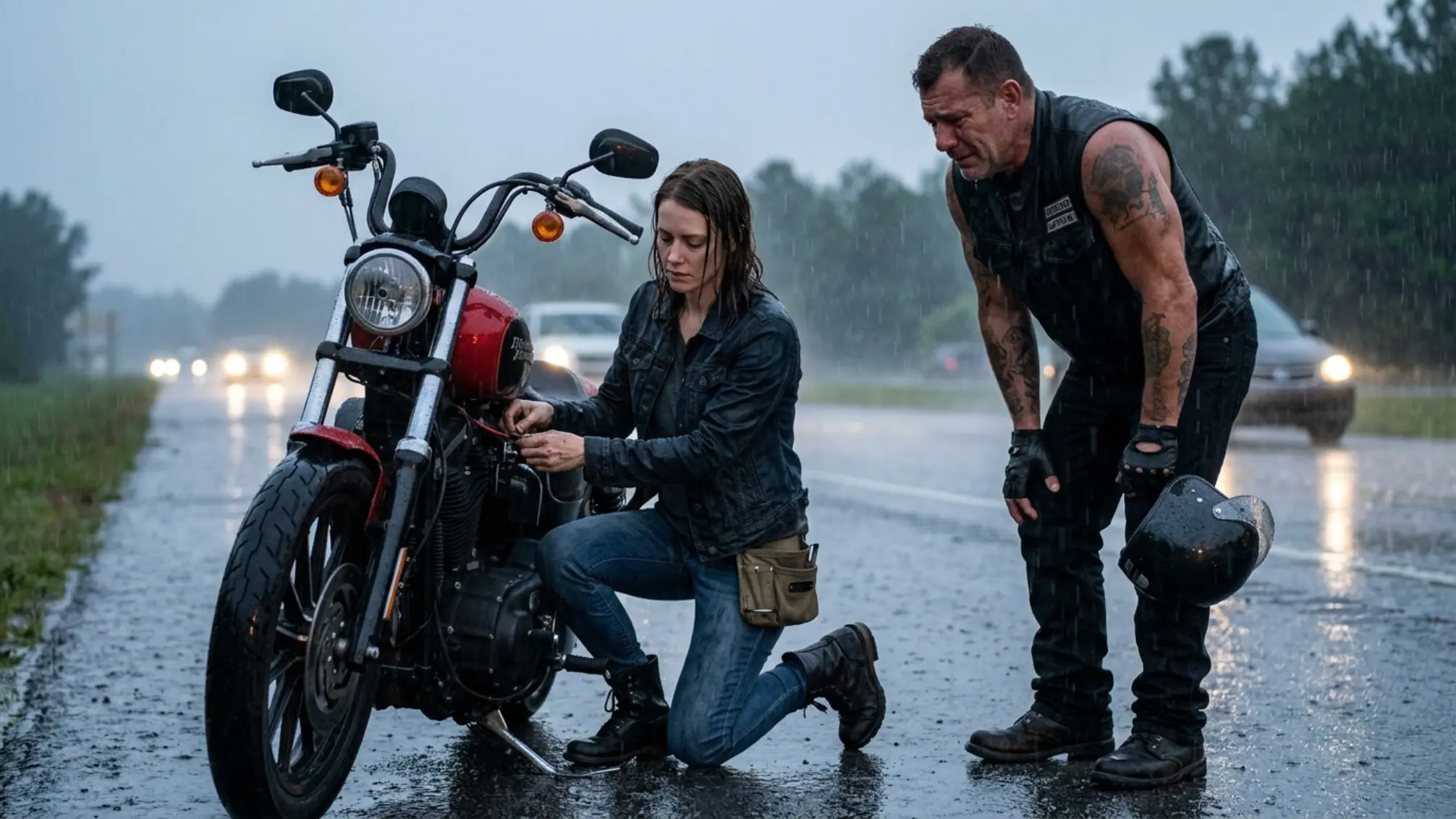
She was thirty-five, a single mother, and a mechanic who survived by repairing whatever people could afford to bring her. Her soaked dark-brown hair clung to her cheeks as she climbed out wearing a denim jacket, faded jeans, and worn black work boots. The biker was nearly twice her width through the shoulders, with tattooed arms, short dark hair, and a sleeveless leather vest darkened by rain. Yet the closer Rebecca came, the less dangerous he appeared, because tears were running openly down his weathered face.
The biker’s name was Caleb Mercer, though Rebecca did not know that yet. He stood silently as she crouched beside the Harley and opened the tool pouch clipped at her waist. The bike had not failed from one obvious problem; water had entered beneath the seat, a connector had worked loose, and an ignition wire had split near the housing. It was the kind of fault that looked small until it left a thousand-pound machine dead on a highway in the middle of a storm.
Rebecca worked by the beam of a flashlight held between her teeth. Her fingers moved confidently despite the cold water running down her sleeves. She stripped the damaged wire, twisted the copper cleanly, wrapped it, secured the connector, and checked the battery terminals before closing the compartment. Caleb watched her without speaking, his helmet hanging from one hand while the other rested on the motorcycle’s wet handlebar.
“You do this for a living?” he finally asked.
“When people pay me,” Rebecca said. “The rest of the time, I do it because broken things bother me.”
That answer reached him more deeply than she intended. Caleb looked away toward the road, where headlights dissolved into the rain. His older brother, Daniel, had said something similar whenever they repaired motorcycles together. Daniel believed nothing mechanical was truly useless if someone patient enough was willing to understand what had failed.
Rebecca turned the key. The Harley coughed once, sputtered, then roared back to life beneath her hands. The engine’s deep vibration rolled through the wet shoulder and stood defiantly against the storm. Caleb closed his eyes for a moment as though the sound carried a voice he had feared he would never hear again.
Rebecca rose and wiped her hands on her jeans. “It should get you home, but replace that wire properly before another long ride.”
Caleb stared at her. “How much?”
“Nothing.”
“I can pay.”
“I believe you.”
“Then let me.”
Rebecca glanced toward her station wagon. “I have a fifteen-year-old daughter waiting for me, and I promised I would be home before the storm got worse. Getting you off this road is payment enough.”
Caleb reached inside his vest and pulled out several folded bills. Rebecca stepped back before he could offer them. Something in her expression made him stop. It was not pride exactly, nor embarrassment. It was the firm dignity of someone who had spent years being treated like poverty gave other people permission to decide what she needed.
“Get home safely,” she repeated.
The words almost broke him again. Caleb gripped her hand, rough fingers closing around grease-stained ones. His eyes filled, but this time he did not look away.
“You don’t know what you stopped tonight,” he said.
Rebecca assumed he meant an accident. She nodded, returned to her car, and drove toward Maple Hollow while Caleb remained beside the running Harley. In her rearview mirror, the motorcycle’s headlight became smaller until the rain swallowed it completely.
Rebecca lived with her daughter Hannah in a narrow one-story house at the edge of town. The paint had faded from white to gray, the porch steps leaned slightly to the left, and a blue tarp covered part of the roof above the laundry room. The house was not beautiful, but it was theirs for as long as Rebecca could continue making the mortgage payments.
Hannah opened the door before Rebecca reached it. She was fifteen, slim, sharp-eyed, and wearing the same oversized college sweatshirt she used as pajamas. Her expression moved quickly from relief to alarm when she saw her mother dripping onto the floor.
“You look like you fell in a river.”
“Close enough.”
Rebecca removed her jacket and hung it over a chair. Hannah brought a towel without being asked and watched her mother rub rain from her hair.
“What happened?”
“A biker broke down.”
Hannah froze. “You stopped for a biker alone at night?”
“He was stranded.”
“He could have been dangerous.”
“He was crying.”
That answer changed Hannah’s face. Rebecca sat at the kitchen table while her daughter heated soup on the stove. The room smelled of damp denim, tomato broth, and the faint electrical dust of an old space heater. Unpaid bills sat beneath a ceramic bowl near Rebecca’s elbow.
“Why was he crying?” Hannah asked.
“His brother died.”
“And you fixed his bike?”
“I fixed the wire.”
Hannah placed a bowl in front of her mother. “You always act like those are the same thing.”
Rebecca smiled faintly. “Machines are easier.”
After Hannah went to bed, Rebecca spread the bills across the table. The electricity was two weeks late, the roof repair estimate remained impossible, and the landlord of the small garage where she worked had raised the monthly rent again. Her employer paid her by completed job, which meant slow weeks left little money after parts and shop fees.
Rebecca had trained under her father, a mechanic who could identify engine problems by sound before diagnostic computers became common. He died when Hannah was six, leaving behind a set of tools, a collection of repair manuals, and the belief that his daughter deserved her own shop someday. Rebecca carried that dream through a failed marriage, a painful divorce, and years of taking whatever work she could find.
Her ex-husband stopped sending regular support shortly after moving to another state. He called Hannah on birthdays and sometimes at Christmas, usually with promises that faded as quickly as the conversations. Rebecca learned not to expect rescue.
She also learned not to complain.
Miles away, Caleb rode through the storm toward a private clubhouse built inside a converted warehouse. Twenty-seven motorcycles stood beneath the metal awning outside, their engines silent. The riders inside belonged to the Iron Saints, a motorcycle brotherhood Caleb had led for nine years.
The club had a reputation that frightened outsiders, but most of its members were veterans, tradesmen, mechanics, truck drivers, and fathers. They organized funeral escorts, raised money for injured riders, and helped families whose lives had collapsed after accidents. Daniel Mercer had helped create those traditions before a heart attack killed him without warning two nights earlier.
Caleb entered carrying his helmet. Conversations stopped when the men saw his face.
A tall rider called Moose walked toward him. “We were looking for you.”
“I needed the road.”
“On Daniel’s bike?”
Caleb nodded.
Moose looked outside at the rain. “You could have called.”
“The bike died.”
“Then how did you get here?”
Caleb sat at a long wooden table and looked down at his hands. “A woman stopped.”
He told them about Rebecca. He described the station wagon, her soaked denim jacket, the way she knelt in the water without hesitation, and how she refused payment despite clearly having little. Most importantly, he told them what she said when he admitted he was grieving.
You shouldn’t be alone out here.
The room remained quiet after he finished.
“She didn’t know who you were?” Moose asked.
“She didn’t even ask my name.”
“And she fixed Daniel’s Harley for free?”
Caleb nodded again. “She brought it back to life when I wasn’t sure I wanted to keep riding.”
One of the older members leaned forward. “Find her.”
Caleb had memorized the faded lettering on the station wagon’s rear window: LAWSON MOBILE REPAIR. Beneath it was a partially worn phone number and the name Maple Hollow.
By midnight, three members had searched local business listings. By morning, they knew Rebecca worked part-time at Cooper’s Auto Service, lived on Pine Ridge Road, and was raising a teenage daughter alone. They also learned that her mobile repair permit had expired because she could not afford the renewal fee.
Caleb did not want to invade her privacy. He wanted to understand what kind of woman refused money while standing in a storm wearing boots with cracked soles. What the riders discovered made his gratitude turn into determination.
Rebecca arrived at Cooper’s Auto Service at seven the next morning. The storm had passed, leaving puddles across the gravel lot and wet leaves clinging to the shop doors. Her manager, Dennis Cooper, was waiting beside a rusted pickup.
“You’re late.”
“It’s seven-oh-two.”
“Customer’s been waiting.”
The customer had not arrived yet, but Rebecca did not argue. Dennis had owned the shop for twenty-three years and believed every employee should be grateful simply to stand beneath his roof. He gave Rebecca the most difficult repairs, paid her less than the male mechanics, and introduced her to customers as “the girl who helps with wiring.”
Rebecca opened the pickup’s hood and began tracing a charging-system failure. By nine, she had found a damaged ground cable, replaced it, and restored the truck’s electrical system. Dennis collected the full labor charge and handed Rebecca less than half her usual share.
“You deducted eighty dollars.”
“Shop expenses.”
“What expenses?”
“Use of the lift, tools, electricity.”
“I used my own tools, and the truck never touched the lift.”
Dennis shrugged. “Then consider it overhead.”
Rebecca wanted to walk out. She also knew the mortgage was due in five days. She folded the money into her pocket and returned to work.
At noon, the sound of motorcycles shook the shop windows.
Every mechanic stopped.
Thirty riders entered the gravel lot in two orderly lines, led by Caleb on the red-and-black Harley Rebecca had repaired. They parked without blocking a single service bay. Neighbors emerged from nearby businesses, and Dennis stepped outside with the pale expression of a man calculating whether his insurance covered whatever was coming.
Rebecca came through the open garage door holding a wrench.
Caleb removed his helmet.
“You,” she said.
He smiled. “Me.”
Her eyes moved across the riders. “Is there something wrong with the bike?”
“No.”
“Then why did you bring an army?”
“Because I didn’t thank you properly.”
Rebecca lowered the wrench. “You thanked me.”
“Not enough.”
Dennis stepped between them. “This is private property. If you people are here to cause trouble—”
Caleb looked at him once. Dennis stopped talking.
Moose carried a wooden toolbox forward and placed it on the ground. Another rider unloaded a new diagnostic scanner. A third brought a heavy rolling cabinet filled with professional equipment.
Rebecca stared. “What is this?”
Caleb folded his arms. “A beginning.”
“I can’t accept tools like these.”
“They belonged to my brother.”
That silenced her.
Caleb placed one hand on the Harley’s fuel tank. “Daniel and I rebuilt our first motorcycle in our mother’s shed. He kept every tool he ever bought, even after we could afford better ones. He believed tools should belong to someone who knew what they were for.”
Rebecca touched the wooden toolbox but did not open it. “Why me?”
“Because you knelt in freezing rain to help a stranger who looked like someone most people would fear.”
“I did what anyone should have done.”
“But they didn’t.”
Caleb handed her a small cloth patch, red and white with worn edges. “Daniel carried this for twenty years. He gave one like it to people who reminded him the road still had good souls on it.”
Rebecca took the patch carefully.
Dennis watched from the garage entrance. The attention irritated him more than the riders frightened him. For years, he had treated Rebecca as replaceable. Now thirty men stood in his lot honoring her as though she mattered.
“She is on company time,” Dennis said.
Rebecca looked at the clock. “It’s my lunch break.”
“You don’t have a scheduled lunch today.”
Caleb’s expression hardened, but Rebecca raised one hand before he could respond. She turned to Dennis.
“I repaired the Dawson truck this morning.”
“I know.”
“You charged four hundred and twenty dollars.”
“That is business information.”
“You paid me ninety.”
Dennis glanced toward the watching riders. “We can discuss compensation privately.”
“No. We can discuss it now.”
He stepped closer. “Be careful, Rebecca.”
The words had controlled her before. They carried the mortgage, Hannah’s school expenses, and every unpaid bill hidden beneath the bowl at home. But something had changed while she stood holding Daniel Mercer’s patch.
Rebecca removed the shop key from her ring and placed it in Dennis’s palm.
“I quit.”
He stared at the key. “You walk out now, you will never work in another garage in this county.”
Caleb moved beside her, not in front of her. “She won’t need to.”
Rebecca looked at him. “What does that mean?”
“You’ll see.”
The riders loaded her personal tools into the back of her station wagon. Dennis shouted about contracts and abandoned work, but no one touched him or threatened him. Rebecca drove away with Caleb and the Iron Saints following in formation.
They did not take her home.
They led her to an abandoned service garage on the southern edge of Maple Hollow, a brick building Rebecca had passed hundreds of times. The former owner closed two years earlier after retiring. Weeds grew through cracks in the lot, and dust covered the front windows, but the roof was solid, the service bays were wide, and two hydraulic lifts remained inside.
A FOR SALE sign leaned beside the road.
Caleb stopped at the entrance and held out a set of keys.
Rebecca did not take them. “What have you done?”
“The club purchased the property this morning.”
“You bought a garage?”
“We bought a building.”
“For what?”
“For you to lease.”
Her face tightened. “I cannot afford this.”
“One dollar a year for the first five years.”
“No.”
“Rebecca—”
“No. You cannot build my life because I fixed one wire.”
Caleb studied her carefully. “You think this is charity.”
“What else would it be?”
“Investment.”
“In me?”
“In the woman who diagnosed a drowned ignition system in a highway storm with a flashlight between her teeth.”
Despite herself, Rebecca nearly smiled.
Caleb continued. “Our bikes need maintenance. Thirty riders here today, hundreds across the region. We need someone we trust. You need a shop where nobody takes most of what you earn.”
Rebecca looked through the dusty window. She saw cracked concrete, abandoned benches, and an empty office. She also saw possibility: Hannah doing homework at a desk near the front, customers entering beneath her own sign, and tools arranged exactly where she wanted them.
“What is the catch?”
“You repair our bikes at a fair rate.”
“That’s all?”
“You let us help clean the place.”
Rebecca looked at the thirty men waiting behind him. “You already decided I’d say yes.”
Moose raised a broom. “We came prepared.”
The work began that afternoon.
Some riders cleared weeds and trash. Others repaired the garage doors, replaced broken lights, and pressure-washed years of dirt from the floor. Electricians inspected the wiring. Carpenters rebuilt the office wall and constructed a small waiting area.
Rebecca worked beside them, still uncertain whether she was dreaming. She repaired one lift herself, replacing a hydraulic seal and correcting a damaged control line. Caleb remained close but never tried to command her space.
Hannah arrived after school in a car driven by one of Rebecca’s neighbors. She stepped out, saw thirty motorcycles outside the abandoned garage, and froze.
“Mom?”
Rebecca walked toward her. “It is a long story.”
Hannah entered slowly. When Caleb explained what they were building, her suspicion softened into wonder.
“This is ours?”
“Not exactly,” Rebecca said.
Caleb handed Hannah a small key. “This one opens the office.”
The girl closed her fingers around it. “Then it feels ours.”
For the next week, the garage transformed. The Iron Saints returned every morning with supplies, food, and more volunteers. Hannah painted the office walls pale blue and created a sign from reclaimed wood.
LAWSON MOTOR & REPAIR.
Below the name, in smaller letters, she painted: FIXING MORE THAN MACHINES.
Rebecca pretended not to cry when she saw it.
Caleb visited daily, sometimes working, sometimes sitting quietly beside Daniel’s Harley. Grief still lived in him. Rebecca recognized it in the moments when his eyes drifted toward the motorcycle or when he reached for his phone before remembering the person he wanted to call was gone.
One evening, after the others left, she found Caleb alone near the open bay door.
“You were trying to reach the lake that night,” she said.
He nodded.
“The place you visited with Daniel?”
“Yes.”
“Did you ever get there?”
“No.”
Rebecca picked up two helmets from the workbench and handed him one.
They rode beneath a clear dawn the following morning. Caleb drove Daniel’s Harley while Rebecca sat behind him, hands resting lightly against his sides. The road curved through pine forest and opened onto a quiet lake reflecting a pale orange sky.
Caleb parked near the shore and removed a photograph from his vest. It showed two younger brothers sitting on an unfinished motorcycle, laughing with grease across their faces.
“He raised me after our father left,” Caleb said. “Every road I know, he showed me first.”
Rebecca stood beside him without speaking.
“I thought reaching this lake would make losing him real,” he continued. “Then the bike died, and I was relieved. I could blame the machine instead of admitting I was afraid to say goodbye.”
Rebecca looked at the water. “You don’t have to say goodbye all at once.”
Caleb’s face tightened.
“You carry pieces,” she said. “One memory today. Another tomorrow. Eventually the weight changes shape.”
“How do you know?”
“My father taught me to fix engines. He died before I could show him I was good enough to own a shop.”
Caleb looked back toward the road.
“Maybe he knows now.”
Rebecca smiled through the ache in her chest. “Maybe Daniel does too.”
Caleb placed the photograph against a smooth stone near the lake instead of releasing it into the water. He was not ready to let the image go, and Rebecca did not ask him to.
Lawson Motor & Repair opened three weeks later.
The first customer was an elderly veteran with a motorcycle that had not started in six years. Rebecca rebuilt the carburetor and returned the bike for less than half what a dealership had quoted. The second customer was a single father whose truck failed before payday. She allowed him to pay in installments.
Word spread.
Farmers brought tractors. Teenagers brought dirt bikes. Riders came from three states. Women who had been ignored or overcharged by other garages trusted Rebecca because she explained repairs without condescension.
Hannah handled appointments after school and learned to read service manuals. Rebecca taught her how to use a torque wrench, test voltage, and listen for the subtle changes that revealed an engine’s condition.
Caleb and the Iron Saints never treated the shop as something they owned. They paid every invoice, brought referrals, and stepped aside whenever Rebecca made a decision. The lease remained one dollar per year, but the business became profitable enough that Rebecca began saving toward purchasing the building outright.
Six months after the storm, Caleb arrived with the entire brotherhood.
A trailer followed behind Moose’s truck. Beneath a heavy black cover sat a custom motorcycle built from parts donated by riders across the region. The frame was deep charcoal, the trim silver, and the fuel tank carried an airbrushed image of a woman and teenage girl standing beneath a storm while a motorcycle’s headlight burned in the distance.
Along the side were four words:
SHE REFUSED TO DRIVE PAST.
Rebecca covered her mouth.
Hannah touched the painted image. “That’s us.”
Caleb placed the keys in Rebecca’s palm.
“This is too much,” she whispered.
“No,” he said. “This is what your choice became.”
“I only stopped once.”
“That is all kindness needs—a place to begin.”
Rebecca looked around the garage. Photographs covered an honor wall Hannah had created for riders, mechanics, parents, and friends who had died. Daniel’s picture occupied the center. Beneath it hung the faded patch Caleb had given her.
She understood then that the motorcycle was not payment. Neither was the garage. They were proof that kindness could travel farther than the person offering it could ever see.
A year after the storm, Lawson Motor & Repair employed two mechanics and one apprentice. Rebecca purchased the building with profits from the business and a fair loan arranged through a local credit union. Hannah began studying mechanical design and talked about attending engineering school after graduation.
Caleb still visited the lake, but no longer alone. Sometimes Rebecca rode beside him on the motorcycle the brotherhood built. Their friendship grew slowly, grounded not in rescue or debt, but in two people who understood grief, work, and the courage required to accept help.
One evening, Caleb stood beneath the shop sign while Rebecca closed the final garage door.
“You saved my life that night,” he said.
“I repaired one wire.”
“You keep saying that.”
“Because it is true.”
He stepped closer. “The bike stopped me from reaching the lake before I was ready. You stopped me from believing grief was the only road left.”
Rebecca looked at the man who had once cried openly in the rain and now stood steady beneath a clear sky.
“You gave me a place to build the life I thought I had missed,” she said. “So maybe we repaired each other.”
Caleb smiled. “Mechanic’s diagnosis?”
“Professional opinion.”
From inside the office, Hannah called that she was ready to leave. Rebecca laughed and reached for her jacket.
Before turning away, Caleb touched her hand.
No dramatic promise followed. Neither of them needed one. Some bonds were built the same way reliable machines were rebuilt—carefully, piece by piece, with patience and honest work.
The red-and-black Harley waited outside, polished and strong. Rain had once left it silent on the edge of a highway. Now its engine started on the first turn, carrying the memory of two brothers and the kindness of a single mother who refused to drive past a stranger in pain.
Rebecca locked the shop, looked at the sign bearing her name, and realized she was no longer merely surviving.
She had built a future from the moment she stopped in the storm.