The last bus had already come and gone.
Sienna Carter stood beneath the buzzing streetlight with her three-month-old daughter pressed against her chest, staring down the empty Richmond road as if another bus might appear through sheer pity.
Her phone showed the same thing it had shown five minutes earlier: no more service tonight.
The ride-share prices were too high, the wind was getting colder, and the few dollars in her purse were supposed to buy milk for Lily the next morning.
Sienna closed her eyes and shifted the baby’s weight from one arm to the other. She was twenty-eight, widowed for only four months, and still learning how to breathe inside a life that no longer had Michael in it.
The car he had left behind sat outside her apartment needing repairs she could not yet afford, and every day felt like a list of small emergencies stacked on top of grief.
She was about to start walking when she heard the sobbing.
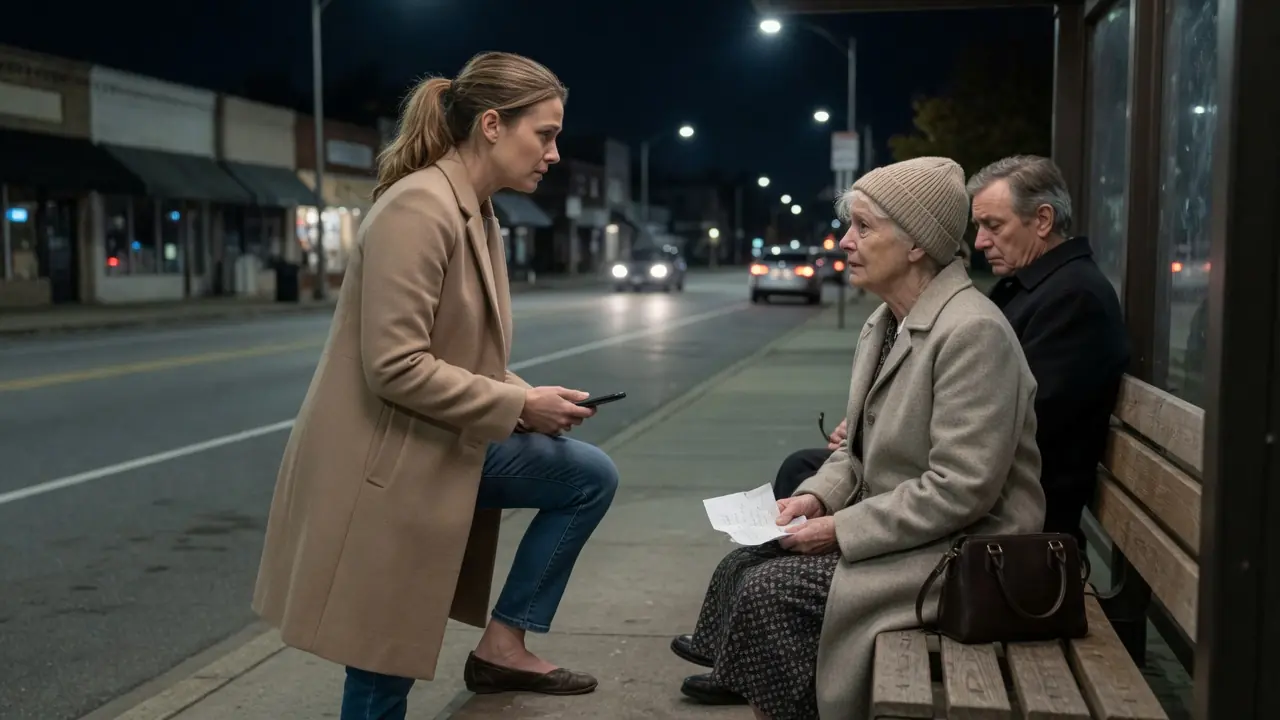
At first, it was soft enough to be mistaken for the wind. Then it came again, low and broken, the kind of crying that did not come from a scraped knee or a bad mood. Sienna turned toward the far end of the bus stop and saw an elderly couple sitting together on a wooden bench, trembling in the freezing dark.
The woman had her face buried against the man’s shoulder. The man sat rigid beside her, one arm wrapped around her, his jaw tight and his eyes fixed somewhere across the road. They were both white-haired, thin, and dressed in coats too light for the cold. Everything about them looked fragile, as if one more disappointment might break whatever strength they still had left.
Sienna hesitated for only a moment.
She had her own problems. She had a baby, an unpaid car bill, an empty apartment, and grief waiting in every quiet room. But she looked at those two old people clinging to each other in the dark and knew she could not walk away.
“Excuse me,” she said gently, stepping closer. “Are you two okay?”
The man looked up. His eyes were red, but kind. “We’re fine,” he said, in the way people speak when they are anything but fine.
“I’m Sienna,” she said, adjusting Lily against her chest. “I missed the same bus you missed.”
The woman lifted her head and wiped her eyes with shaking fingers. “I’m Elizabeth,” she whispered. “This is my husband, William.”
When Sienna asked how long they had been sitting there, William looked down at his watch and seemed almost ashamed to answer. They had been there since two o’clock in the afternoon. It was nearly eight at night.
Their son, Cole, had promised to come back in an hour. He had dropped them off there and given them a folded piece of paper with an address written on it, telling them it was where they would be staying temporarily. Their phone had died hours ago, and neither of them could remember Cole’s number by heart.
“So we waited,” Elizabeth said, her voice trembling. “He said he would come back.”
Sienna looked at the crumpled paper in William’s hand. The address was written in hurried block letters: Acacia Gardens, Flower Street. Something about it made her stomach tighten.
She did not make a speech. She did not let them protest for long. She opened the ride-share app, looked at the price, and felt the weight of the milk money in her purse. Then she booked the ride anyway.
Elizabeth immediately shook her head. “No, dear, we couldn’t ask you to do that.”
“You didn’t ask,” Sienna said softly. “I offered. There’s a difference.”
In the back of the car, the city slid past in dark windows and blurred lights. Lily slept against Sienna’s chest. Elizabeth sat in the middle, hands folded tightly in her lap, and after a while, she looked at the baby with the aching softness of someone who had once held children of her own.
“How old is she?” Elizabeth asked.
“Three months,” Sienna said.
Elizabeth’s eyes moved to the wedding ring still on Sienna’s finger. “And her father?”
The question settled heavily in the car.
“He passed away four months ago,” Sienna said.
Elizabeth covered her mouth. William reached over and patted Sienna’s hand once, without saying anything else. She was grateful for that. She had heard enough well-meaning phrases since Michael’s funeral to know that silence, when offered kindly, could be a gift.
When the driver turned onto Flower Street, William leaned forward, reading house numbers from mailboxes. “It should be the corner house,” he said. “White fence. Cole said we couldn’t miss it.”
They went around the block once. Then again.
There was no white fence. No corner house. No warm porch light waiting for them.
The address on the paper belonged to an empty lot, fenced off and overgrown with weeds. A weather-beaten real estate sign leaned crookedly near the curb. The driver stopped and looked back in the mirror.
Elizabeth made a sound Sienna would never forget. It was small and collapsed, like something inside her had simply given way. William stared at the empty lot, then down at the paper, then back at the lot again, as if the house might appear if he looked long enough.
There was no mistake. Cole had given his elderly parents a false address, left them at a bus stop with no late service, and disappeared.
Sienna felt something cold settle in her chest. She looked at William’s shaking hands and Elizabeth’s face as she fought not to break down completely. Then she made the second decision of the night.
“I have a two-bedroom apartment about twenty minutes from here,” she said. “It isn’t big, but it’s warm. There’s food. I’m not leaving you out here.”
Elizabeth shook her head immediately. “We’re strangers. We can’t impose.”
“I’m a woman on a dark road with a three-month-old baby,” Sienna said quietly. “And I just watched the two of you wait six hours for someone who never came back. I am not leaving you here.”
William looked at Elizabeth. A wordless conversation passed between them, the kind only people who had loved each other for decades could have. Then he folded the paper, tucked it into his jacket pocket, and said, “Thank you, Sienna.”
Her apartment was small, clean, and warm. Sienna gave them the second bedroom without discussion, pulled extra blankets from the hall closet, and put the kettle on while they sat at the kitchen table in stunned silence. No one pushed for conversation that night. Some wounds were too fresh to touch before morning.
After Lily was fed and asleep, Sienna checked on them once more. Elizabeth looked up from her mug with tears in her eyes. “I don’t know how to thank you.”
“Get some rest,” Sienna said.
But Sienna did not sleep for a long time. She lay awake staring at the ceiling, thinking about the bench, the empty lot, the piece of paper, and the terrible loneliness of waiting for someone who was not coming back. She knew that feeling too well. Since Michael’s passing, part of her had been waiting for a life that would never return.
In the morning, the apartment felt different. Fuller.
William was already standing at the kitchen window when Sienna came out, his hands in his pockets, his face turned toward the street below. Elizabeth appeared a few minutes later, her white hair pinned neatly, her posture composed in a way that must have cost her dearly.
Over coffee and toast, with Lily in her little seat between them, the full story came out.
William and Elizabeth had lived in the same Richmond house for forty years. They had raised their children there, paid the mortgage slowly and carefully, and planned to spend the rest of their lives behind the dark green front door William had painted himself. The house was paid off and entirely theirs.
Then Cole came to them eight months earlier with a plan.
He told them the house had serious problems they had not noticed. Foundation concerns, roofing issues, structural risks. He said it was smarter to sell before the value dropped. He said he knew an investor who could turn the sale into a guaranteed return.
They trusted him because he was their son.
Cole sold the house for two hundred eighty thousand dollars, far below market value. He told his parents it had sold for three hundred twenty thousand and promised they would receive nearly half a million within six months once the investment matured. He kept the documents, handled the calls, and told them not to worry about anything.
Then, the previous week, he drove them across town, left them at a bus stop, and gave them the address of a house that did not exist.
When William finished, the kitchen was silent.
Sienna looked at the two people sitting across from her and understood that they had not only lost a house. They had lost the belief that their own child would protect them from the world.
“I know someone,” Sienna said after a long moment. “A lawyer. His name is David. He helped me after Michael passed. I trust him.”
William looked up slowly. “You would really call him for us?”
“Yes,” Sienna said. “Today.”
She called David from the hallway while Elizabeth sat with Lily in the living room. She explained everything: the house sale, the missing documents, the false address, the empty lot, the elderly couple left behind in the cold. David listened carefully, then said the words Sienna had already feared.
“That sounds like deliberate financial fraud.”
He agreed to pull the property records and help without charge. Sienna thanked him, but he told her not to thank him yet. “Just send me everything you have,” he said.
She had barely ended the call when the doorbell rang.
Sharon, Michael’s mother, stood outside with a casserole dish in her hands. She had been coming twice a week since the funeral to help with Lily. She was strong, steady, and grieving in her own way, pouring all the love she had left for her son into his daughter.
But when she looked past Sienna and saw two elderly strangers at the kitchen table, her face changed.
Sienna explained quickly. Sharon listened without interrupting, but her expression hardened with every sentence. Then she set the casserole down, drew Sienna onto the porch, and said the words plainly.
“You brought strangers into the home where my granddaughter sleeps.”
“They had nowhere else to go,” Sienna said.
“That is not your problem.”
“I made it my problem.”
Sharon stared at her. “Then you need to understand something. I love Lily. I loved Michael. But I cannot keep coming here if this is what your home becomes.”
The words landed like a door closing.
Sienna looked at the woman who had held her at Michael’s graveside and brought meals without being asked. She understood the cost of what she was choosing. Still, when she went back inside and saw Elizabeth already holding her coat, ready to leave before causing more trouble, Sienna shook her head.
“You are not going anywhere,” she said.
Elizabeth’s eyes filled. William watched her carefully.
Sienna poured herself more coffee and sat back down at the table. “We’ll figure this out. All of it. Together.”
Three days later, David called back with worse news. Cole had sold the house for even less than he claimed, pocketed money from the sale, and hidden documents from his parents. Public records suggested similar patterns connected to his name in other cases. William and Elizabeth were not his first victims.
When Sienna told them, William sat still for a long time.
“Forty years,” he whispered.
He was not speaking to anyone. He was saying the number aloud because some truths need to be heard before they can be believed. Forty years in that house, and his son had reduced it to a number.
The practical crisis came the following Monday. Sharon called at dawn and said she would not be coming anymore. No apology. No argument. Just a decision.
Sienna sat on the edge of her bed and thought through every option. She had to be at work by 8:30. Lily needed care all day. Infant daycare waitlists in Richmond were months long, and emergency private care cost more than she could absorb. Every path ended at a wall.
Two nights later, at 2:00 in the morning, the answer came quietly.
Sienna was feeding Lily in the living room when Elizabeth appeared in the doorway, robe tied loosely, white hair falling around her shoulders. “I heard her,” Elizabeth said softly. “May I sit with you?”
Sienna nodded.
A few minutes later, Lily began crying in that sharp, escalating way Sienna had learned meant stomach pain. Elizabeth watched for a moment, then asked if she could try something. Sienna handed Lily over, surprised by how natural it felt.
Elizabeth settled the baby face down along her forearm and began rubbing slow circles along Lily’s back. Then she took a small bottle from her robe pocket.
“Chamomile,” she said. “Just a few drops.”
Within five minutes, Lily stopped crying. Within eight, she was asleep.
Sienna sat across the room feeling something she had not felt since Michael passed. Relief. Not happiness exactly, but the physical relief of not being the only capable adult in a hard situation.
By morning, she had a proposal.
At breakfast, she told William and Elizabeth the truth. She needed help caring for Lily during the day. They needed a stable place to stay while David pursued the case, which could take months. So they would care for Lily while Sienna worked, and she would provide housing, food, and everything they needed.
“No charity,” Sienna said. “An exchange. Equal both ways.”
William set down his mug. “You would trust us with her after less than two weeks?”
“After last night?” Sienna said. “Yes.”
He looked at Elizabeth, and that old silent conversation passed between them again. Then he turned back to Sienna.
“You are not doing this out of pity?”
“No,” she said. “I need experienced people. You are the most experienced people I have. That is common sense.”
Elizabeth reached across the table and covered Sienna’s hand with both of hers.
William nodded once. “Then we accept.”
The weeks that followed settled into a rhythm none of them expected. William repaired the apartment in quiet ways, fixing a loose cabinet hinge, a dripping faucet, and a window that had never closed properly. He never announced the work. Sienna would simply come home and find something broken had become whole.
Elizabeth cared for Lily with the natural confidence of a woman who had raised children and remembered the small wisdoms others forgot. She knew when Lily was tired before the crying started. She knew how to soothe pain, how to make a baby feel secure, how to move through a room without making fear larger than it already was.
The apartment slowly became a home with four people in it.
Then Cole was arrested in Tennessee while attempting a similar scheme. The relief on William and Elizabeth’s faces was real, but complicated. It is a hard thing to be grateful your child has been caught. It is harder still to know that being caught may be the only thing that stops him.
Not long after, Adult Protective Services arrived at Sienna’s door following an anonymous report. A county worker named Catherine explained that concerns had been raised about two elderly individuals living in unsuitable conditions with a young single mother who had no formal elder-care background.
Sienna let her in.
Catherine was professional and careful. She inspected the apartment, asked questions, observed William reading in the armchair and Elizabeth doing tummy time with Lily on the living room floor. Every question was reasonable, but Sienna could hear the shape of the report being built.
A young widow. A baby. Two vulnerable elders. A rushed informal arrangement.
When Catherine left, Sienna called David.
He told her plainly that the county could recommend placement in a supervised facility if the home was deemed inadequate. Then he said there was a way to protect William and Elizabeth legally: guardianship.
“It means you become legally and financially responsible for them,” David said. “It is not a small commitment.”
Sienna was quiet for three seconds.
“I want to do it.”
That night, she told William and Elizabeth. Elizabeth covered her mouth as the tension she had carried since the bus stop seemed to release all at once. William looked at Sienna for a long time, trying to understand what kind of person kept choosing strangers until they were no longer strangers.
“Why?” he asked.
Sienna thought about Michael, about grief, about waiting for someone who would never come back. Then she answered honestly.
“You were left on a bench in the dark by someone who should have protected you. I know what it feels like to wait for someone who isn’t coming back. I couldn’t become the person who left you there.”
Elizabeth stood, crossed the kitchen, and wrapped her arms around Sienna.
“You are the daughter I wish I’d had,” she whispered.
Sienna held on. “And you are the parents I wish Lily had.”
The guardianship was approved, but the fight was not over.
Patricia, William and Elizabeth’s oldest daughter, arrived from New York with her husband and a plan. She spoke with the clean precision of someone used to being obeyed. She thanked Sienna for helping during an emergency, then explained that her parents would be moved to a well-regarded residential facility near her home in Westchester.
Sienna remained calm. “I hold legal guardianship. Any decision about where they live must involve them and go through the proper legal channels.”
“I am their daughter,” Patricia said.
“I understand,” Sienna replied. “Then speak to them like they are people who still have a choice.”
At first, Patricia tried to present the facility gently. Staff ratios, medical support, structured activities, proximity to family. But while she spoke, Elizabeth’s hands tightened in her lap, and William’s face went still.
“We do not want to go to a facility,” Elizabeth said.
“Mom,” Patricia said patiently, “after what Cole did, you may not be in the best position to know what kind of care you need.”
Elizabeth lifted her chin. “Being deceived does not mean I cannot decide where I want to live.”
Patricia’s husband looked at Sienna. “You have to understand how this looks. A stranger stepped in after a crisis and secured guardianship.”
“The documentation is clear,” Sienna said. “Every dollar spent, every appointment, every receipt. My lawyer can provide all of it.”
When Patricia reached for her mother’s arm and tried to pull her up, Sienna stood.
“Let go of her right now.”
The room went silent.
“If you remove them from this home against their expressed wishes,” Sienna said, “this stops being a family disagreement and becomes a legal matter. Sit down and listen to your parents, or leave.”
Patricia released Elizabeth’s arm.
Six weeks later, they faced a judge.
Patricia came with attorneys and an expert witness. Their argument was serious: William and Elizabeth had been traumatized, vulnerable, and possibly overly attached to the young woman who rescued them. The guardianship, they said, had moved too quickly.
David presented Sienna’s binder.
Doctor’s appointments. Medication logs. Blood pressure readings. Receipts. Photos of the apartment. Community center schedules. Witness statements. Everything Sienna had done had been recorded, not for praise, but for protection.
William testified first. He told the judge he was seventy-five years old, sound of mind, and fully aware of what the hearing meant. He said Sienna treated him with dignity, asked his opinion, valued his skills, and gave him a place where he was needed instead of managed.
Elizabeth testified next. She said Sienna had not taken advantage of them. She had given them purpose. Caring for Lily had helped her feel alive again after losing her house and nearly losing herself. Home, Elizabeth said, was not only a building. It was the place where you were known, needed, and safe.
When Sienna stood, she looked directly at the judge.
“They are my parents, Your Honor,” she said. “Not by blood. I understand that. But family is not only blood. It is who shows up, who stays, and who keeps caring when caring costs something real. By every measure that matters to me, William and Elizabeth are my family.”
The judge upheld the guardianship.
Patricia sat very still. Then she crossed the room, hugged her parents, and held them both for a long time. When she finally looked at Sienna, there was no victory left in her face, only regret and reluctant respect.
“Take care of them,” Patricia said.
“I already am,” Sienna answered.
Three months later, Sienna received a job offer in Charlotte. Senior accountant. Better salary. Stability. A future.
She brought it up at dinner and asked William and Elizabeth if they would come with her.
William said he had lived in Richmond all his life and had once assumed he would die there. Then he looked around the apartment that had become their safe place.
“The Richmond I was tied to is gone,” he said. “Cole made sure of that. So yes. I think we go.”
They moved in February to a modest three-bedroom rental on a quiet Charlotte street. William claimed the south fence for a garden within the first hour. Elizabeth found a watercolor class by the second week. Lily grew into a toddler who carried toys to William, climbed into Elizabeth’s lap, and loved them with the unquestioning certainty of a child who knows who is safe.
One evening, Lily looked at Elizabeth and said, clear as a bell, “Grandma.”
Elizabeth froze, then laughed and cried at the same time.
William stepped into the doorway to ask what had happened. Lily turned toward him and said, “Grandpa.”
William looked at the ceiling for a long moment, the way he did when something good had found its way past his defenses. Then he sat down, and Lily climbed into his lap like it had always belonged to her.
Julian came into their lives quietly. He was a nurse at the hospital where Elizabeth had a checkup, kind without being soft, patient without being condescending. He answered William’s medical questions in the hallway and later asked Sienna if the family needed directions to the parking garage.
They talked for eleven minutes beside the elevators. Two days later, he texted to ask if they had made it home safely.
Months later, he took Sienna to dinner and listened to the full story without interrupting. When she finished, he said, “That makes sense.”
“What does?”
“You,” he said. “You’re the kind of person who shows up and stays until it isn’t hard anymore.”
Two years after the move, Julian asked Sienna to marry him in the living room. Lily sat on the rug watching solemnly. William pretended to read the newspaper. Elizabeth held a book she had not turned a page of in ten minutes.
Sienna said yes, then gave one condition.
“William walks me down the aisle. Elizabeth stands beside me.”
William folded the newspaper carefully and set it on the side table. “It would be my honor.”
Their wedding was small, held in a garden outside Charlotte. Patricia came, quieter and softer now, carrying complicated love instead of control. William walked Sienna down the aisle with steady pride. Elizabeth stood beside her, holding Lily’s hand.
The following spring, Sienna found out she was pregnant again. She told them at breakfast by placing the test on the table between the coffee cups. Elizabeth made a sound of pure joy, and William smiled so openly that Sienna had to look away for a second.
Olivia arrived in December, loud and certain of her own importance. William called her “the General” by the end of the first week, and the name stuck immediately.
The household reorganized itself around newborn chaos. This time, Sienna did not face it alone. Julian handled night feeds with calm efficiency. Elizabeth knew what to do before anyone asked. William walked the floor with Olivia pressed against his shoulder, humming old songs he claimed not to remember learning.
Years passed. Not easily, but fully.
William faced a heart diagnosis and surgery, then recovered slowly with more complaints about garden restrictions than about pain. Julian monitored him carefully, and William eventually admitted that he was good at explaining medical things without making a person feel foolish.
Elizabeth’s decline began more quietly. Forgotten words. Repeated questions. A misplaced cup. Then the diagnosis came: early-stage Alzheimer’s.
In the car afterward, Sienna looked at Julian and said, “She stays home.”
“I know,” Julian said. “I wasn’t going to argue.”
They told Elizabeth at the kitchen table, where the important things had always been said. Elizabeth listened, then looked at William with her usual dry composure.
“Well,” she said, “I suppose I’ll have to stop pretending I remember things I don’t.”
William took her hand.
The years that followed were hard. There is no honest way to watch someone you love lose pieces of herself and call it anything else. But Elizabeth was never alone inside the confusion. Someone was always nearby, not hovering, not managing, just present.
She knew Lily’s face until the end. She knew William’s voice even on days when his name slipped away. She knew, in the deepest place that remained untouched, that she was safe.
Elizabeth passed away on a Tuesday morning in October, two weeks before her eighty-first birthday. She was in her own bed, with William holding her hand, Sienna and Julian nearby, and Lily and Olivia close enough for love to fill the room completely. It was quiet, peaceful, and whole.
William grieved with dignity. He kept Elizabeth’s houseplant alive on the kitchen windowsill, watering it every morning with the same patience he gave everything that mattered.
Six months later, Cole came back.
Sienna saw him first from the front window. He stood at the end of the path, thinner than the photograph she had once seen in William’s wallet, his hands at his sides, looking at the door as if he did not have the right to knock.
When Sienna opened the door, he spoke before she could.
“I’m not here to ask for anything,” he said. “I just need to see my father. If he’ll let me.”
Then he swallowed hard and said, “I’m sorry.”
Sienna thought of the bench in Richmond, the cold night, William’s shaking hands, and Elizabeth saying they had wanted to believe the best of him. Then she thought of something Elizabeth had said in one of her last clear days.
Tell him the door stays open.
“Come in,” Sienna said.
She led him to the backyard, where William was turning soil near the fence. When William saw his son, he went completely still. Sienna stepped back inside and left them alone.
Cole stood on the back steps for a long moment. Then he said, “Dad, I’m sorry.”
William set down his trowel. He looked at the face of the son who had taken everything and left him in the dark. Then he crossed the garden and put his arms around him.
Cole broke completely.
Later, at the kitchen table, Cole asked about his mother. William told him gently. Cole closed his eyes as he received the truth that could not be softened.
“I missed the last years of her life,” Cole said.
William nodded. “On one of her last clear days, she told me to tell you the door stays open.”
Sienna watched him absorb that, and she finally understood Elizabeth differently. Wanting to believe the best of someone was not weakness. Sometimes it was the hardest kind of love, the kind that held a door open even when reason said to close it.
“You can stay,” Sienna told Cole. “Not because what you did was acceptable. It wasn’t. It cost people I love something they can never fully get back. But your father’s time is not unlimited, and spending it in anger is a waste of something no one can replace.”
Cole nodded, unable to speak.
William covered his son’s hand with his own. “Family isn’t a place you earn your way back into,” he said. “It’s a place that waits for you. That’s the point.”
In the months that followed, Cole stayed nearby. He found work, rented a small apartment fifteen minutes away, and came on weekends and evenings. He and Sienna were never entirely easy with each other. Too much had happened for that. But they were honest, and honesty was enough to build something functional.
William declined slowly, but with the same quiet dignity he had brought to everything else. He spent more time in his chair by the window than in the garden. Cole sat with him often, talking when there were words and sitting silently when there were not.
William passed away on a quiet Sunday morning in spring, in the chair by the window where he liked to watch the garden. Sienna found him facing the morning light, peaceful in the middle of the life he had chosen to stay for.
After the calls were made and the tears had come, Sienna sat at the kitchen table beneath Elizabeth’s houseplant and thought about a bus stop in Richmond. A cold night. Two old people on a bench. A baby in her arms. A few dollars meant for milk.
She had almost kept walking.
She was grateful for the rest of her life that she had not.
Family is not always the people assigned to you at the beginning. Sometimes it is the people you choose again and again, especially when choosing them costs something real. It is the door that stays open after someone has walked out of it. It is the table with enough chairs. It is the place that holds your failures beside your best moments and still calls you home.
That is what Sienna learned from William and Elizabeth.
That is what Lily and Olivia grew up knowing.
And that is what began on a freezing night when a young widow, nearly broke and carrying her baby, heard someone crying in the dark and chose not to walk away.