Clara Bennett had learned to count every dollar before it left her hand.
At thirty-one years old, she could add grocery prices in her head faster than the scanner at the checkout line.
She knew which gas station lowered its price on Tuesday mornings.
She knew how long she could stretch a rotisserie chicken, how many school lunches could be packed from one bag of apples, and exactly which bills could be paid three days late without someone calling.
She was not poor enough for strangers to pity her at first glance.
That was part of the problem.
Clara looked like she was managing.
She kept her brown hair tied back neatly, even when she had washed it with hand soap because the shampoo ran out.
She ironed her navy work blouse under a towel because the iron had started staining clothes.
She smiled at her daughter every morning like the world was steady, even when the rent notice sat folded under the toaster like a secret she was afraid would catch fire.
Her daughter, Lily, was seven years old and believed her mother could fix anything.
A broken zipper.
A bad dream.
A missing library book.
A rainy morning with no umbrella.
Clara loved that belief more than anything, and it terrified her more than anything, too.
Because there were things she could not fix.
The car was one of them.
It was a faded silver Honda with a passenger door that only opened from the outside and a heater that worked when it felt generous. Clara called it “the old mule” because it complained every morning but usually kept going. That Friday afternoon, however, the old mule coughed twice, shuddered at a red light on Main Street, and died with the calm finality of something that had kept its last promise.
Clara sat behind the wheel, one hand on the steering wheel and the other pressed to her mouth.
“Not today,” she whispered.
The light turned green.
A truck behind her honked.
Then another car honked.
Clara turned on the hazard lights and closed her eyes for one second, just one second, because if she allowed herself two, she might start crying. She was on her lunch break from the dental supply warehouse where she worked in customer returns. She had thirty-eight minutes to eat something, put six dollars of gas in the car, and get back before her supervisor noticed.
Now she had no car.
By the time a kind mechanic named Ron helped push the Honda to the curb, Clara’s hands were shaking. Ron owned the repair shop three doors down. He had gray hair, a grease-darkened cap, and the careful voice of a man used to giving bad news.
“Could be the alternator,” he said. “Could be worse. I can look at it, but I can’t promise cheap.”
Clara nodded like she understood, though all she heard was money.
“How cheap is not cheap?” she asked.
Ron rubbed the back of his neck. “I won’t know till I check. But if it’s what I think, maybe four hundred. Maybe more.”
Four hundred dollars might as well have been four thousand.
Clara thanked him anyway because she had been raised to thank people even when the news they gave her cracked the floor under her feet. Then she walked down Main Street with her purse pressed under her arm and her phone in her hand, trying to calculate how many buses she would need to take to get Lily from school by six.
The wind smelled like rain.
The sky over Cedar Falls, Ohio, had that low gray look that made the whole town seem tired. Main Street had once been cheerful, with flower baskets hanging from lampposts and painted signs above family stores. Now half the windows had lease notices taped inside them, and even the open businesses looked like they were bracing for winter.
Clara passed the pharmacy, the thrift store, and the old movie theater that only opened on weekends.
Then she stopped in front of Maple Street Café.
The café had a green awning, fogged windows, and a chalkboard outside advertising tomato soup and grilled cheese for $7.99. Clara had not planned to eat there. She had planned to buy a banana and a small coffee from the gas station, then spend the remaining change on fuel.
But the gas station was now half a mile away, and her legs felt hollow.
She checked her wallet.
Eleven dollars.
A twenty-dollar bill had been there that morning, but she had used it to pay for Lily’s class picture envelope because Lily had looked at her with hopeful eyes and said, “Only if we can, Mommy.”
Clara stood outside the café and thought about the rent notice, the dead car, the unpaid electric bill, and the little girl who needed her mother to come home with a smile.
Then she went inside.
The bell above the door gave a soft ring.
Warm air wrapped around her immediately, carrying the smell of coffee, buttered toast, cinnamon, and wet wool from coats hung near the entrance. The café was crowded, not full enough to be loud in a happy way, but crowded enough that every table seemed occupied by someone with somewhere to go.
A line had formed at the counter.
Clara stepped into it and looked at the menu.
The tomato soup was too expensive.
The grilled cheese was too expensive.
Even a muffin felt irresponsible.
She ordered the cheapest thing that could count as lunch, a plain bagel with cream cheese and a small black coffee. The young man at the register looked barely twenty, with tired eyes and a name tag that read NOAH. He smiled quickly, then turned away before the smile reached anything real.
“Next,” he called.
Clara moved aside to wait for her order.
That was when the old woman came in.
At first Clara noticed only the coat.
It was pale lavender, old-fashioned and carefully buttoned, the kind of coat that had probably been beautiful twenty years earlier. The woman wearing it was small and thin, with silver hair pinned at the back of her head. Her shoes were polished, but the left heel was worn down unevenly. She carried a brown leather purse in both hands as if it were something fragile.
She paused just inside the door.
People moved around her.
A man in a business jacket brushed past without looking up from his phone. Two college girls squeezed by, laughing about something on a screen. The old woman stepped aside, then looked toward the counter with a concentration that made Clara pay attention.
The woman’s lips moved silently.
She lifted one hand, then lowered it.
There was nothing dramatic about it.
No fall.
No cry for help.
No sudden emergency.
Just a small old woman standing in a busy café, trying to understand how to enter a world that had already decided to move too fast for her.
Clara looked away because she had problems of her own.
Then she looked back.
The old woman joined the line.
She stood behind a man in a red jacket and held her purse tighter. When the line moved, she moved slowly, watching the people ahead of her. Twice, she leaned a little to the side, trying to see the menu board. Twice, someone behind her sighed.
Clara’s order came up.
“Plain bagel, black coffee,” Noah called.
Clara took the bag and cup.
She should have left.
She had twenty-two minutes to figure out the bus route, text her supervisor an excuse, and call Lily’s school. She should have sat somewhere, swallowed the bagel in five bites, and gone back into survival mode.
But the old woman reached the register.
Noah said, “Hi. What can I get you?”
The old woman watched his mouth.
Noah repeated, louder this time. “What can I get you?”
The woman opened her purse and pulled out a small notepad. Her fingers trembled. She flipped through several pages, then looked up.
“I…” she began.
Her voice was soft, uneven, as if she did not use it often.
Noah leaned forward. “Sorry?”
The woman touched her ear and shook her head. Then she pointed toward the glass water pitcher sitting near the pickup counter.
“Water?” Noah asked.
The woman watched his lips, uncertain.
Someone behind her muttered, “Come on.”
The woman flinched.
She pointed again, then opened her notepad. But the pen clipped to the cover slipped free and fell to the floor. It rolled under the counter.
Noah glanced behind her at the growing line.
“Ma’am, do you want water? Like bottled water? Sparkling? Tap?” he asked, too quickly.
The old woman’s face tightened.
She did not understand.
Noah tried again, louder. “Water?”
The man behind the old woman leaned around her. “She wants water. Just give her water.”
The old woman turned, startled by the movement more than the sound.
“I need to take the next orders,” Noah said, though he did not sound cruel. He sounded overwhelmed.
The woman’s cheeks reddened.
She reached for her purse again, but her hands were shaking so badly she could not open it.
Clara felt the familiar tug in her chest.
It was not convenient compassion.
It was the kind that arrived at the worst possible moment, demanding something from a person who already felt empty.
She looked at her coffee, then at the door, then at the old woman.
And then she stepped forward.
“Excuse me,” Clara said gently, coming beside the old woman but not touching her. “May I help?”
The old woman turned to her.
Clara pointed to herself and spoke slowly, not loudly. “My name is Clara.”
The woman watched her lips.
Clara pulled her phone from her pocket, opened a blank note, and typed in large letters.
Hi. I’m Clara. Do you want help ordering?
She held the screen where the woman could read it.
The old woman’s face changed.
It did not relax exactly, but something inside it loosened, like a hand unclenching after holding on too long.
She nodded.
Clara typed again.
Do you want a cup of water?
The woman nodded quickly, then raised one finger. She opened her purse with effort and took out a folded card. On it, in careful handwriting, were the words:
I am deaf. Please write things down. I need still water. No ice. Thank you.
Clara read it and looked at Noah.
“She needs still water, no ice,” Clara said. “Just a cup is fine.”
Noah’s face flushed. “Oh. Yeah, of course.”
He reached for a cup.
The man behind the old woman sighed again, louder this time. “All that for water?”
Clara turned to him.
She had planned to be polite. She had intended to say nothing. She was tired, broke, late, and not in the mood to fight a stranger over human decency.
But something about the old woman’s lowered eyes made Clara’s voice sharpen.
“Yes,” Clara said. “All that for water.”
The man blinked.
Noah filled the cup and set it on the counter.
The old woman reached for her purse.
“No charge,” Noah said.
The woman did not hear him.
Clara typed it.
No charge. Water is free.
The old woman read the screen, then looked at Noah. She put her hand over her heart and bowed her head slightly. Noah swallowed and gave a small nod.
Clara thought that would be the end.
But when the old woman lifted the cup, her hand trembled hard enough that water sloshed over the rim. She closed her eyes. Her face had gone pale.
Clara noticed the tiny orange prescription bottle in her purse.
“Do you need to sit?” Clara asked, typing the question as she spoke.
The woman read it and hesitated.
Then she nodded.
There were no empty tables.
Clara looked around the café. At a corner table, a young man sat alone with a laptop, an empty plate, and headphones around his neck. Clara walked over, keeping her phone in her hand.
“Excuse me,” she said. “Would you mind if this lady sat here for a few minutes? She needs to take medicine.”
The young man looked annoyed for half a second, then saw the old woman behind Clara.
“Oh. Sure. Yeah.”
He gathered his laptop and moved to the counter.
Clara guided the old woman with a gesture, careful not to grab her arm. The woman sat slowly, setting her purse on the chair beside her. Clara placed the water on the table and typed again.
Are you okay? Do you need someone called?
The woman read the message.
Then she took the phone gently and typed with one finger.
Thank you. I am okay. I needed water for medicine. Too much noise. I cannot read lips here.
Clara nodded.
The old woman typed again.
People become angry when I am slow.
Clara looked at the words for a long moment.
Then she typed back.
People become angry when they forget they will be slow someday, too.
The old woman read it.
For the first time, she smiled.
It was a small smile, but it changed her whole face. The lines around her mouth softened. Her eyes, a pale blue-gray, filled with humor and sadness at once.
She took her pill with the water.
Clara stood beside the table, suddenly unsure what to do next. She had helped. The woman was seated. The water had been ordered. Her lunch break was collapsing around her like wet paper.
The old woman looked at the bag in Clara’s hand, then at Clara’s face.
She pointed to the chair across from her.
Clara shook her head and typed.
I have to get back to work soon.
The old woman read it and pointed again, more firmly.
There was something in the gesture that reminded Clara of her grandmother, who had died when Clara was nineteen and pregnant and terrified. It was not a request. It was a command wrapped in kindness.
Clara sat.
“My name is Ruth,” the old woman said.
Her voice had the soft, careful rhythm of someone who could not hear herself fully. The “r” was gentle, almost swallowed. She opened her notepad and wrote the name, then turned it toward Clara.
Ruth Alden.
Clara smiled. “Nice to meet you, Ruth.”
Then she typed it as well, so Ruth would not have to catch every word from her lips.
Ruth pointed to Clara’s bagel.
Clara opened the bag and tried not to feel embarrassed about how plain it looked. Ruth watched her for a moment, then opened her purse and pulled out a small wrapped peppermint. She placed it on the table and pushed it toward Clara.
Clara laughed softly.
“Dessert?” she asked, typing the word.
Ruth read it and nodded with great dignity.
Clara accepted the peppermint like it was a chocolate truffle.
For seven minutes, they sat together in the corner of the café while the rest of the world hurried around them.
Ruth wrote more than she spoke.
She wrote that she had lost most of her hearing after an illness in her forties. Before that, she had taught art at Cedar Falls Elementary for twenty-six years. She wrote that she still signed some words, but not enough for long conversations. She wrote that she came to Maple Street Café on the first Friday of every month because her husband, Thomas, had brought her there on their first date when it had still been called Miller’s Lunch Room.
Clara wrote that she had a daughter named Lily, age seven.
When Ruth read Lily’s name, she tapped the page twice and smiled.
Pretty name.
Clara’s phone buzzed.
Her supervisor.
She stiffened.
The message read:
Where are you? Your lunch ended 5 min ago.
Clara closed her eyes.
Ruth noticed.
Clara typed quickly.
I’m late for work. My car died. I need to go.
Ruth’s expression shifted from warmth to concern.
She wrote something on her notepad, tore out the page, folded it, and pushed it into Clara’s hand.
Clara started to say no, though she did not yet know what she was refusing.
Ruth shook her head.
Then she pointed to the door, telling Clara to go.
Clara stood, slung her purse over her shoulder, and hesitated.
“I’m glad I met you,” she said, slowly and clearly.
Ruth watched her lips.
Then Ruth lifted one hand and signed something Clara did not understand.
Seeing Clara’s confusion, Ruth wrote it down.
Thank you.
Clara’s throat tightened.
She nodded once, then hurried out into the gray afternoon.
Outside, rain had started.
Not heavy rain.
Just enough to make the sidewalk shine and the air smell like cold concrete.
Clara opened the folded paper as she walked.
Inside, Ruth had written:
Clara, kindness should not cost you lunch. Please buy something warm next time. Ruth.
A ten-dollar bill was tucked inside the paper.
Clara stopped under the café awning.
For one second, she felt insulted.
Then ashamed for feeling insulted.
Then deeply, painfully grateful.
She looked through the fogged window.
Ruth was still at the corner table, both hands wrapped around her cup of water like it was something precious.
Clara slipped the ten-dollar bill into her wallet and whispered, “Thank you, Ruth.”
That evening, everything went wrong in the ordinary way.
Ron called to say the Honda needed an alternator and a battery. The estimate was five hundred and twenty dollars. Clara thanked him, hung up, and sat on the edge of her bed while Lily colored at the kitchen table in the next room.
The landlord texted that rent could not be late again.
Her supervisor warned her that another long lunch would go in her file.
The school sent a reminder about Lily’s upcoming field trip payment.
Clara made macaroni with canned peas for dinner and pretended it was because she had been craving macaroni with canned peas all day.
Lily believed her.
After dinner, Lily climbed into bed with her stuffed rabbit and asked, “Did your car get sick?”
Clara tucked the blanket under Lily’s chin.
“Yes,” she said. “Very sick.”
“Can the car doctor fix it?”
“I think so.”
“Will it cost all the dollars?”
Clara smiled even though her chest hurt. “Not all of them.”
Lily studied her mother’s face with the serious attention children give when they sense an adult is hiding weather behind a window.
“Mommy?”
“Yes, baby?”
“Are we okay?”
Clara leaned down and kissed her forehead.
“Yes,” she said.
It was not a lie exactly.
It was a promise she had not yet figured out how to keep.
The next month, Clara saw Ruth again.
It was not planned.
By then the Honda had been fixed because Ron let Clara pay in installments, and because Clara sold her old wedding ring to a pawn shop across town. The ring had been thin, with a tiny diamond that looked more like a mistake than a jewel, but it had still made Clara’s hand feel strangely bare after it was gone.
She told herself she did not care.
The man who had given it to her had left when Lily was two.
He sent birthday cards sometimes.
He sent money rarely.
He sent promises often.
Clara had learned the difference.
On the first Friday of the next month, Clara had no reason to go to Maple Street Café. She had packed a turkey sandwich in a plastic container. She had instant coffee at work. She had no extra money for a café table and no time for sentimental habits.
But at 12:18, she found herself standing in line under the green awning.
She told herself she only wanted to return Ruth’s ten dollars.
Inside, the café was less crowded than before. Noah stood behind the counter again. When he saw Clara, his expression changed.
“Hey,” he said. “You’re the lady from last month.”
Clara gave a cautious smile. “I guess I am.”
“She came back,” Noah said.
“Who?”
“That older woman you helped. She’s in the corner.”
Clara turned.
Ruth sat at the same corner table, wearing the same lavender coat. This time, a small white card lay on the table in front of her. In large print, it read:
I am deaf. Please tap the table or write to get my attention. Thank you for your patience.
Beside it was a cup of water, no ice.
Clara felt something open in her chest.
She ordered a small coffee, then walked over.
Ruth looked up as Clara approached. At first her face was blank. Then recognition dawned slowly, beautifully.
She smiled.
Clara sat down and placed a ten-dollar bill on the table.
Ruth looked at it, then at Clara.
Clara typed on her phone.
You gave me this last time. I came to return it.
Ruth read the message.
Then she pushed the bill back with two fingers and shook her head.
Clara pushed it toward her again.
Ruth reached into her purse, took out her notepad, and wrote with firm strokes.
No. It was not a loan.
Clara laughed under her breath.
“I can’t keep taking money from old ladies,” she said, then typed it.
Ruth read it, lifted one eyebrow, and wrote:
Good. Then stop needing it.
Clara stared at the page.
Ruth’s mouth twitched.
The old woman was teasing her.
Clara laughed for real then, and the sound surprised her.
It surprised Noah, too, who glanced over from the counter.
Ruth wrote again.
Tell me about Lily.
So Clara did.
She showed Ruth a picture of Lily in purple rain boots, standing beside a chalk drawing of a unicorn. Ruth held the phone carefully and smiled so long at the photo that Clara wondered when someone had last shown her a child’s face with pride instead of obligation.
Ruth opened her purse and removed a small tin of colored pencils.
Not cheap colored pencils, either.
They were short from use but beautifully kept, each one sharpened, each one arranged by color. She took a napkin and drew a rabbit in less than a minute. Not a cartoon rabbit, but a soft, lively little creature with alert ears and gentle eyes.
Clara stared.
“That’s beautiful,” she said.
Ruth read her lips, or maybe her face.
She wrote:
For Lily.
Then she folded the napkin carefully and gave it to Clara.
That evening, Lily taped the rabbit drawing above her bed.
“Who made this?” she asked.
“A lady named Ruth.”
“Is she your friend?”
Clara almost said no.
Friend felt too big for two meetings in a café.
But the word rose in her chest and rested there, unexpectedly warm.
“Maybe,” Clara said. “I think she might be.”
After that, Clara started stopping by Maple Street Café on the first Friday of every month.
She never called it a tradition.
Traditions sounded like something stable families had.
She simply found reasons.
One month, she had to buy coffee because the warehouse machine was broken. Another month, she needed to ask Noah whether the café had part-time evening work, which it did not. Another month, she brought Lily because school was closed for a teacher planning day and childcare was too expensive for a full morning.
That was the month Lily met Ruth.
Clara worried at first.
Children could be careless without meaning to be. They could stare, ask loud questions, grow impatient, forget to look at someone’s face when speaking. Clara had explained on the drive over that Ruth could not hear well, that they would write things down, that kindness meant slowing down without making someone feel like a burden.
Lily listened solemnly.
When Ruth arrived, Lily stood on her chair and waved both hands like she was greeting a ship at sea.
Ruth laughed.
It came out as a small breathy sound, but her eyes shone.
Lily had made a card before they came. On the front was a purple rabbit. Inside, in uneven first-grade writing, it said:
Dear Miss Ruth, Thank you for my bunny. I hope you like this bunny. Love, Lily.
Ruth read the card.
Then she read it again.
Then she pressed it flat against her chest.
Clara looked away, giving the old woman privacy she had not asked for but seemed to need.
Ruth taught Lily three signs that day.
Thank you.
Friend.
Water.
Lily practiced them all afternoon.
At bedtime, she showed Clara again.
“Thank you,” she signed.
Then “friend.”
Then “water.”
Clara smiled. “That’s right.”
Lily frowned thoughtfully. “Why did Miss Ruth need help ordering water? It’s just water.”
Clara sat on the edge of the bed.
“Sometimes the smallest things become hard when the world isn’t made for you,” she said.
Lily considered this.
Then she said, “Then the world should scoot over.”
Clara looked at her daughter.
“What?”
“If someone can’t fit, the world should scoot over and make room.”
Clara laughed softly.
Then she kissed Lily’s forehead and whispered, “Yes, baby. It should.”
Spring came slowly to Cedar Falls.
The trees along Main Street turned green at the edges first, like they were unsure whether they could trust the season. The potholes filled with rainwater. The café changed its chalkboard from soup specials to strawberry muffins and iced tea.
Clara kept working.
She worked until her feet hurt and her back ached. She answered customer return emails about cracked dental trays and missing invoice numbers. She packed Lily’s lunches, washed uniforms at midnight, filled out school forms, called the electric company, and learned which bus route could get her across town if the Honda died again.
But something had changed.
It was small at first.
Once a month, Clara sat across from Ruth and remembered she was more than a person trying not to drown.
Ruth asked questions with her notepad.
Not shallow questions.
Not the questions people asked single mothers when they were looking for a lesson or a warning.
She did not ask where Lily’s father was.
She did not ask whether Clara had made poor choices.
She asked what Lily loved to read.
She asked whether Clara liked her job or only needed it.
She asked what Clara had wanted to be before life became a list of bills.
Clara did not answer that question the first time.
She pretended to be distracted by Lily’s spilled orange juice.
Ruth waited until the next month and asked again.
Clara looked at the page for a long time.
Then she typed on her phone.
I wanted to own a little children’s bookstore. One with story time and art tables. It was silly.
Ruth read the words.
Her expression sharpened.
She wrote back:
Why silly?
Clara shrugged.
Because she had no degree.
Because she had a child.
Because she had debt.
Because people like her were supposed to want practical things, not soft-lit little shops where children sat on rugs and learned that books could be doors.
She typed only:
Because life happened.
Ruth read it, then wrote:
Life always happens. Dreams have to happen inside it.
Clara stared at the sentence.
Ruth underlined it once.
Then she changed the subject by pulling a small picture book from her purse.
The cover showed a little fox standing in front of a red mailbox. The title was The Fox Who Sent the Moon a Letter. Clara recognized the illustration style immediately, the same softness as the rabbit napkin, the same gentle eyes, the same careful use of color.
She looked at the author’s name.
Written by Margaret Lane. Illustrated by R. Alden.
Clara’s head snapped up.
“You illustrated this?”
Ruth smiled.
Clara flipped through the book, stunned.
Each page was tender and detailed, filled with forests, stars, teacups, birds, and small animals wearing expressions so human that Clara felt something twist in her heart. It was the kind of book parents wanted to keep after their children outgrew it. The kind that smelled like bedtime and blankets and a lamp left on.
Ruth wrote:
A long time ago.
Clara turned another page.
“How many books did you illustrate?”
Ruth paused, then wrote:
Seventeen. A few sold well. Most disappeared. That is how books are.
Clara laughed softly.
But when she looked at Ruth, she noticed something sad beneath the old woman’s smile.
“Do you still draw?” Clara asked, typing the question after she spoke.
Ruth’s fingers rested on the pencil tin.
For a moment, Clara thought she would say yes.
Instead, Ruth wrote:
Not much. My hands hurt. And no one asks anymore.
Clara looked at the old woman’s hands.
They were thin, with swollen knuckles and blue veins raised beneath papery skin. But they were still elegant hands. Hands that had made worlds for children.
Clara thought of all the things a person could lose before anyone noticed.
Hearing.
Work.
A spouse.
Usefulness.
Being asked.
She typed:
Lily asks. She wants you to teach her how to draw a fox.
Ruth read it.
Her eyes filled so quickly that Clara panicked.
“I’m sorry,” Clara said.
Ruth shook her head.
Then she wrote:
Next Friday?
Clara blinked.
They had never met outside the first Friday of the month.
Ruth tapped the page.
Next Friday. Fox lesson. Bring Lily.
Clara should have said they were busy.
She should have checked her schedule.
She should have worried about gas and time and the cost of buying café drinks.
Instead, she typed:
We’ll be here.
The fox lesson became the beginning of something neither of them named.
Every Friday afternoon, if Clara could manage it, she and Lily met Ruth at Maple Street Café. Sometimes they bought one muffin and split it three ways. Sometimes Noah brought extra toast and claimed it had been made by mistake. Sometimes Ruth arrived with paper, pencils, old books, postcards, or stories written in careful lines across her notepad.
Lily learned to draw foxes, rabbits, sparrows, houses, and teacups.
Clara learned to sign the alphabet slowly.
Ruth learned that Lily hated raisins, loved thunderstorms, and believed every old house had at least one secret room.
Noah learned to keep a stack of order cards near the register.
One card said:
Water, no ice.
Another said:
Tea, hot, no lemon.
Another said:
Please write your question.
Ruth used them with quiet pride.
Other customers began noticing.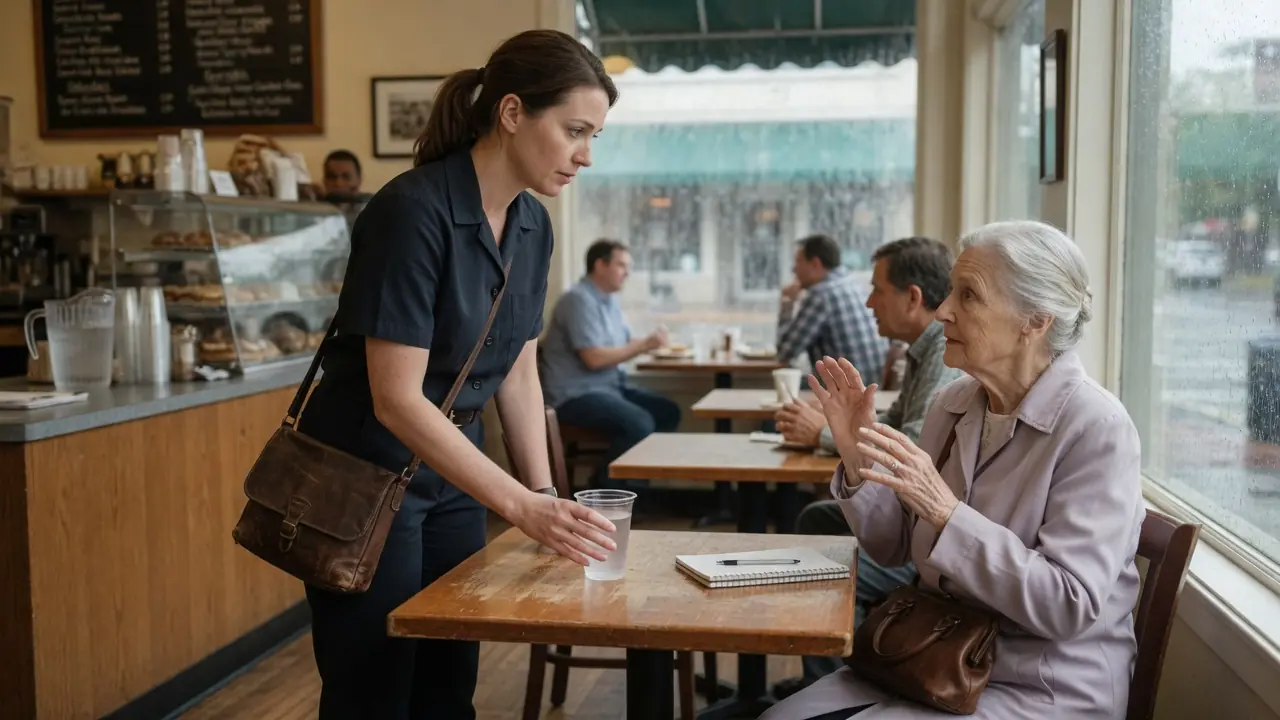
Some smiled.
Some ignored them.
A few looked uncomfortable, as if patience at the next table were a mirror they did not want to face.
One afternoon, a woman in expensive sunglasses watched Lily signing “friend” to Ruth and said to Clara, “That is so sweet of you, teaching your daughter charity.”
Clara looked at Ruth.
Ruth had not heard the woman, but she had seen the shape of the comment in Clara’s expression.
Clara replied evenly, “It’s not charity. It’s friendship.”
The woman flushed and returned to her latte.
Ruth asked what had happened.
Clara typed it.
Ruth read the words, then smiled in a way Clara had come to recognize as trouble.
She wrote:
Friendship is charity with better manners. But yes, she was rude.
Clara laughed so hard she nearly spilled her coffee.
By summer, Ruth had become woven into their lives.
She came to Lily’s school art show and stood quietly beside Clara while Lily explained a drawing of a purple fox in a yellow boat. She brought homemade lemon cookies in a tin lined with wax paper. She sent Clara home with books, never too many at once, always saying they were “extras,” though Clara suspected each one had been chosen.
Ruth never asked for anything large.
A ride home when rain came unexpectedly.
Help reading a voicemail transcript from her doctor.
Someone to sit with her when the café was too crowded.
Clara gave what she could.
She did not think of it as repayment.
She thought of it as breathing.
Then July arrived, hot and cruel.
The warehouse cut Clara’s hours.
Not permanently, her supervisor said.
Just for the season.
Just until orders picked up.
Just enough to ruin everything.
Clara smiled through the meeting and said she understood.
Then she went to the bathroom, locked herself in the stall, and pressed her fist against her mouth until the need to cry passed.
At home, she spread the bills across the kitchen table after Lily fell asleep.
Rent.
Electric.
Car payment to Ron.
School supplies soon.
Childcare.
Phone.
Food.
There was no way to make the numbers behave.
She tried three times.
Each time, the math ended with a hole.
The next morning, the landlord taped an official notice to the door.
Not an eviction yet.
A warning.
A thirty-day demand.
Clara stood in the hallway holding the paper while Mrs. Alvarez from across the hall carried groceries up the stairs and pretended not to see.
That was the kindness of apartment buildings.
People gave you privacy when your life was falling apart because they hoped you would do the same for them.
Clara folded the notice and put it in her purse.
At work, she made mistakes.
She sent the wrong return label to a dentist in Indiana. She forgot to log a damaged shipment. She stared at the same email for eleven minutes without understanding a single line.
At three o’clock, her supervisor called her in.
“Clara, I know you’ve got things going on,” he said.
He was not an unkind man, which somehow made it worse.
“But I need you focused. We all have problems.”
Clara nodded.
“I understand.”
“Good.”
She returned to her desk with shame burning behind her eyes.
That Friday, she almost skipped the café.
She could not afford coffee.
She could not afford gas.
She could not afford to sit across from Ruth and pretend her life was not collapsing one quiet notice at a time.
But Lily had drawn a fox wearing rain boots and wanted to show it.
So Clara went.
Ruth knew immediately.
The old woman took one look at Clara’s face and wrote:
What happened?
Clara shook her head.
Ruth waited.
Lily, sensing grown-up weather, became very interested in sharpening a green pencil.
Clara typed:
Work cut my hours. Rent is behind. I’m trying to fix it. I don’t want to talk about it in front of Lily.
Ruth read the message.
Her face changed.
Not pity.
Never pity.
Something heavier.
She reached across the table and placed her hand over Clara’s for just one second. Then she withdrew it, respecting the boundary before Clara had to make one.
Ruth wrote:
May I help?
Clara felt her pride rise like a wall.
She typed quickly.
No. Thank you. I’ll figure it out.
Ruth studied her.
Then she wrote:
You helped me order water. Was I weak because I needed help?
Clara looked away.
The café blurred.
Lily hummed softly over her drawing.
Clara typed:
That was different.
Ruth wrote:
No. It was smaller. That is all.
Clara swallowed hard.
She wanted to tell Ruth everything.
She wanted to say she was tired of being brave in affordable shoes. Tired of smiling at school forms that asked for “father’s signature.” Tired of measuring fruit, gas, electricity, and hope in dollars. Tired of carrying fear so carefully that Lily would not notice its shape.
But she could not.
Not there.
Not with Lily beside her drawing a fox in rain boots.
So she typed:
I don’t know how to accept help without feeling like I failed.
Ruth read it.
Her pencil moved slowly.
Then practice with me. I will not mistake need for failure.
Clara pressed her lips together.
Lily looked up.
“Mommy?”
Clara forced a smile. “I’m okay, baby.”
Ruth tore the page from her notepad, folded it, and handed it to Clara.
Clara did not open it until later that night.
After Lily was asleep.
After the dishes were washed.
After the apartment was quiet except for the hum of the refrigerator and a car passing below the window.
Inside the folded paper, Ruth had written:
Come to my house tomorrow at ten. Bring Lily. This is not charity. I have something to ask you.
Below that was an address.
Clara read it three times.
Then she sat at the kitchen table for a long while, listening to the old refrigerator and wondering what kind of help came disguised as a question.
Ruth lived on Hawthorn Lane.
Clara had driven past that neighborhood before, usually when avoiding road construction, but she had never had a reason to turn into it. The houses were old but cared for, with deep porches, tall trees, and lawns that looked soft enough to sleep on. Ruth’s house sat at the end of the lane, a pale yellow Victorian with white trim and a red front door.
Lily gasped from the back seat.
“Mommy, it looks like a dollhouse for giants.”
Clara smiled despite herself.
“It kind of does.”
The porch had two rocking chairs and a hanging basket of ferns. A brass fox door knocker sat at eye level. Clara lifted it and knocked.
No answer.
Then she remembered.
She rang the doorbell, which made a light flash inside near the front window.
A moment later, Ruth opened the door.
She wore a blue cardigan over a flowered dress and looked nervous.
That surprised Clara.
Ruth was many things: quiet, funny, stubborn, gentle. But Clara had never seen her nervous.
The old woman smiled at Lily and signed “friend.”
Lily signed it back proudly.
Ruth led them inside.
The house smelled like lemon polish, old paper, and lavender soap. Sunlight fell through lace curtains onto hardwood floors. The walls were covered with framed illustrations: foxes, moons, forests, children in boats, birds carrying ribbons, a small girl looking through a keyhole.
Lily turned slowly in the hallway.
“She made all of these?” she whispered.
Ruth watched her face and smiled.
Clara nodded. “Yes.”
They followed Ruth into a back room that must once have been a formal dining room.
Now it was filled with boxes.
Not messy boxes.
Organized ones.
Some were labeled BOOKS.
Others ART SUPPLIES.
Others DONATION RECORDS.
On the table sat a folder, a ring of keys, and a plate of lemon cookies.
Ruth gestured for them to sit.
Clara’s stomach tightened.
Ruth took a seat across from her and opened the folder.
Inside were photographs of a storefront.
The windows were dusty. The sign above the door was faded beyond reading. Inside, empty shelves lined the walls. In the back, there was a small room with old wallpaper and a sink.
Clara looked up.
Ruth wrote:
My husband and I bought a building on Maple Street in 1978. The café uses the front corner. The other side has been empty for nine years.
Clara stared at the photos.
Ruth continued writing.
I wanted to make it a reading room for children and older people. A place with books, art, tea, quiet, and help for people who need the world to slow down. Thomas died before we began. I stopped trying.
Clara read the words slowly.
Lily reached for a cookie, then looked at Clara for permission.
Clara nodded absently.
Ruth wrote another page.
Then a young mother helped me order water when everyone else was impatient. Not because she worked there. Not because she had time. Not because anyone was watching. Because she saw me.
Clara felt heat rise in her face.
“Ruth,” she whispered.
Ruth held up one finger.
She was not finished.
I do not want to run the reading room. My hands are old. My energy is small. I need someone practical, kind, stubborn, and not afraid of tired children or lonely old women.
Clara’s heart began to pound.
Ruth turned the page.
I want to hire you. Part-time at first. Flexible hours. More if we can get grants. I have funds set aside for one year of salary. After that, we build.
Clara could not move.
The words sat on the page like they belonged to someone else’s life.
Hire you.
Flexible hours.
Salary.
Reading room.
Build.
She looked at Ruth, then at the keys.
“No,” Clara said softly.
Ruth frowned.
Clara grabbed her phone with shaking hands and typed.
You can’t hire me because I helped you once. That’s too much.
Ruth read it.
Then she wrote with such force the pencil nearly tore the paper.
I am not paying you for water. I am offering you work because you are good at something rare. You notice what people need before they ask. That is a skill.
Clara’s eyes filled.
Ruth wrote again.
Also, you are organized. You know how to stretch money. You know children. You are learning access. You respect pride. I need all of that.
Clara looked down.
Lily was watching silently now, cookie forgotten in her hand.
Clara tried to swallow the ache in her throat.
“What would I even do?” she asked, typing it afterward.
Ruth smiled slightly, as if she had been waiting for the practical question.
She opened another folder.
There were plans inside.
Real plans.
A small lending library.
After-school story hours.
Art mornings for seniors.
A quiet-order counter with picture cards and writing pads.
Free water always available near the door.
A shelf of books in large print.
A weekly “slow hour” with no music, no loud machines, and patient service for anyone who needed extra time.
Clara read each page.
The more she read, the more impossible it became to dismiss the offer as charity.
This was not a handout.
This was a dream with walls.
A dream someone had kept folded away for years.
Ruth was asking Clara to help unfold it.
“I don’t have a degree,” Clara said.
Ruth read her lips and waved the concern away.
Clara typed anyway.
I don’t have experience running a place like this.
Ruth wrote:
Neither did I. That is why it is still boxes. We will learn.
Lily leaned toward Clara.
“Mommy,” she whispered, though Ruth could not hear. “It sounds like your bookstore.”
Clara closed her eyes.
Her daughter had seen straight through the heart of it.
Not a bookstore exactly.
Not the dream Clara had imagined at twenty.
Something stranger.
Something kinder.
Something built from a cup of water.
Clara turned to Ruth.
“I’m scared,” she said.
She typed it too.
Ruth read the words.
Then she wrote:
Good. Bring your fear. We have room.
Clara began to cry.
Not loudly.
Not dramatically.
Just tears slipping down her face before she could stop them.
Lily climbed into her lap, all elbows and worry.
“Mommy, is it bad crying?”
Clara held her daughter close and laughed through the tears.
“No, baby,” she said. “I think it might be good crying.”
Ruth passed her a cloth napkin.
Clara took it, wiped her face, and looked at the keys on the table.
“Okay,” she said.
Ruth watched her mouth.
Clara typed it.
Okay. I’ll help.
Ruth smiled.
Then she pushed the keys across the table.
The smallest key had a red tag.
On it, Ruth had written:
The Alden Room.
The first month was chaos.
Clara kept her warehouse job while helping Ruth in the evenings and on weekends. Lily did homework at a folding table while Clara sorted books, swept dust, scrubbed shelves, and made lists of everything the space needed. Noah came after café closing and helped move heavy boxes. Ron fixed a broken hinge and refused payment, saying Clara’s car had introduced them and that had to count for something.
The empty storefront slowly became a room.
They painted the walls a soft cream color.
They polished the floor.
They found rugs at estate sales and chairs at the church basement sale.
Ruth’s old illustrations were framed and hung low enough for children to see.
Lily made a sign for the water station:
Water Is Free. Kindness Is Free, Too.
Clara almost cried when she saw it.
Ruth insisted it go near the entrance.
News spread quietly.
A retired librarian donated books.
A teacher brought extra crayons.
A mother from Lily’s school gave a box of puzzles after admitting her son had outgrown them.
Noah created a simple café menu with pictures for customers who struggled with words, hearing, English, or anxiety.
The first “slow hour” at Maple Street Café was awkward.
Three people came.
Ruth.
Clara.
And Mr. Jenkins, an old man from the pharmacy who had trouble speaking after a stroke.
Noah turned off the music. He placed notepads at every table. He stood behind the counter and waited without rushing.
Mr. Jenkins ordered coffee by pointing to a card.
When Noah brought it to him, the old man’s eyes filled with tears.
The next week, six people came.
Then eleven.
Then twenty.
Some were elderly.
Some were parents with autistic children.
Some were people learning English.
Some were just tired human beings who wanted one hour of the week when slowness was not treated like a crime.
Clara watched it happen with wonder.
She had thought Ruth needed help ordering water because Ruth was fragile.
Now she understood something deeper.
Ruth had been revealing a crack in the world.
Once Clara saw the crack, she could not unsee it.
By September, the warehouse offered Clara her hours back.
She declined half of them.
Her supervisor looked shocked.
“You sure?” he asked. “You said you needed money.”
“I still do,” Clara said.
“Then why cut hours?”
Clara thought of the Alden Room, of Lily reading to Ruth in a sunlit corner, of Mr. Jenkins pointing to a coffee card, of a mother crying because her son had drawn at the art table for forty minutes without anyone telling him to hurry.
“Because I found better work,” she said.
The salary Ruth paid was modest, but it was steady. More importantly, the schedule allowed Clara to pick Lily up from school three days a week. The rent was still hard. The car still complained. Bills still arrived with their usual lack of mercy.
But Clara no longer felt like every day was a hallway with no doors.
Then, just before Thanksgiving, the landlord called.
The building had been sold.
All tenants would have sixty days to leave.
Clara sat on the kitchen floor after the call and stared at the cabinet under the sink.
Lily was at school.
Thank God Lily was at school.
Clara did not cry.
She had cried too much that year and had grown suspicious of tears that did not come with solutions.
She called five apartments.
Too expensive.
No openings.
No children.
No pets, though they had no pets.
Application fee.
Deposit.
First month.
Last month.
Credit check.
Proof of income.
Each phrase was a locked door.
That afternoon, Clara went to the Alden Room and moved through the tasks with a strange blank calm.
She helped a little boy choose a book about trains. She refilled the water pitcher. She sorted donated markers. She smiled at Ruth from across the room and pretended nothing had happened.
Ruth did not believe her for a second.
After closing, Ruth tapped the table.
Clara looked over.
Ruth pointed to the chair across from her.
Clara sat.
Ruth wrote:
What happened?
Clara typed:
We have to move. Building sold. I’m looking. It’s fine.
Ruth read it and gave Clara a look sharp enough to cut thread.
She wrote:
Do not lie to a deaf woman. We read faces.
Clara let out a broken laugh.
Then she covered her mouth.
The laugh turned into something else.
Ruth waited.
Clara typed everything.
The sale.
The sixty days.
The deposits.
The fear.
The way Lily had just started sleeping without asking whether they were okay.
The way Clara did not know how to tell her they might not be.
Ruth read slowly.
When she finished, she folded her hands over the notebook.
For a long time, she did not write.
Clara’s heart sank.
She had burdened her.
That was what happened when you opened the door even a little. Your trouble walked into someone else’s room and stood there dripping on the floor.
“I’m sorry,” Clara said.
Ruth lifted her head.
Then she wrote:
I have been waiting to ask. Now I will.
Clara frowned.
Ruth continued.
The apartment over the Alden Room is empty. It was storage. Noah and Ron helped clear it last week. It has two bedrooms, a small kitchen, and windows facing the maple tree.
Clara stopped breathing.
Ruth wrote on.
I planned to rent it someday. I would rather rent it to someone I trust. Reduced rent for building manager duties. You would lock up, receive deliveries, and keep an eye on things.
Clara stared at the page.
No.
The word rose automatically.
Too much.
Too kind.
Too dangerous to hope for.
Ruth saw it before Clara typed anything.
She wrote:
This is a business arrangement. I need a manager. You need a home. Do not insult us both by calling it charity.
Clara pressed both hands over her face.
Ruth waited.
The room around them was quiet.
On the wall, one of Ruth’s fox illustrations looked down from a painted hill. The water station stood near the door. Lily’s sign hung above it, slightly crooked.
Water is free.
Kindness is free, too.
Clara lowered her hands.
“How much?” she asked.
Ruth wrote the number.
It was not free.
That mattered.
It was low enough for Clara to manage, but real enough for her dignity to stand upright.
Clara looked at Ruth.
Then she looked around the Alden Room.
This place had begun because Ruth could not order water in a crowded café and Clara had decided, for one exhausted moment, not to walk away.
Now it had become a job.
A community.
A possible home.
A future Lily could sleep inside.
Clara typed with trembling fingers.
Can Lily paint her room purple?
Ruth read the question.
Her smile came slowly.
She wrote:
Only if she lets me help choose the shade.
When Clara told Lily, her daughter did not understand at first.
“We’re moving into the book place?”
“Above it,” Clara said. “There’s an apartment upstairs.”
“With Miss Ruth?”
“No, Miss Ruth lives in her house. But we’ll see her a lot.”
Lily stood in the middle of their old living room, processing this with great seriousness.
“Will the fox pictures come too?”
“Some of them.”
“Can I help with slow hour?”
“Yes.”
“Can I paint my room purple?”
“Yes.”
Lily’s eyes grew wide.
Then she asked the question Clara had been dreading.
“Are we okay now?”
Clara knelt in front of her.
For once, she did not have to manufacture the answer out of fear and willpower.
“Yes,” Clara said, her voice breaking. “We’re okay now.”
Lily threw her arms around her mother’s neck.
Clara held her tightly and cried into her daughter’s hair.
This time, she did not hide it.
They moved in two weeks before Christmas.
The apartment above the Alden Room was not fancy.
The stairs creaked. The kitchen cabinets were old. The bathroom tile had cracks shaped like lightning. The heat clanged in the pipes at night like someone tapping a spoon against metal.
But the windows were tall.
The afternoon light filled Lily’s purple room.
At night, the sign from Maple Street Café glowed softly through the living room curtains, and the old maple tree brushed the glass when wind moved through its branches.
Lily called it their treehouse.
Clara called it home only after the first rent check cleared.
Ruth came the day after they moved in, carrying a housewarming gift wrapped in brown paper.
Inside was the original illustration of the rabbit she had drawn for Lily on a café napkin, recreated in watercolor. The rabbit stood beside a tiny cup of water, looking bravely toward an open door.
At the bottom, Ruth had written:
For Lily and Clara, who made room.
Clara hung it in the hallway.
On Christmas Eve, the Alden Room hosted its first community gathering.
Nothing expensive.
Cookies, donated cider, paper snowflakes, story time, and a table where children could make cards for people spending the holiday alone.
Ruth sat near the front in a green dress, a red scarf around her neck. Lily sat beside her, signing the words she knew whenever someone spoke. Noah brought trays from the café. Ron set up extra chairs. Mr. Jenkins came with his daughter and pointed proudly to the coffee card he had helped redesign.
Clara stood near the water station and looked around.
A year earlier, she had believed survival meant needing as little as possible.
Need less.
Ask less.
Hope less.
Take up less space.
But Ruth had taught her another kind of survival.
The kind where people made room for each other before loneliness hardened into habit.
The kind where a cup of water became a doorway.
The kind where help did not move in one direction, from strong to weak, but circled back, again and again, until no one could remember who had saved whom first.
Ruth tapped the table.
The room quieted gradually.
She stood.
Clara moved to her side, ready to read aloud if Ruth wanted. Ruth had written something on a sheet of paper in large, careful handwriting. Her hands trembled, but her chin was high.
Clara took the paper.
Ruth nodded.
Clara began to read.
“When I lost my hearing, I thought the world had become silent,” Clara read. “But that was not true. The world was still loud. Too loud. Too fast. Too impatient. I was the one who had been pushed outside of it.”
The room became very still.
Clara continued.
“One day, I came into a café and could not order a cup of water. I was embarrassed. I was frightened. I was tired of being treated like a problem to solve quickly. Then a young mother, who had every reason to walk away, stopped and helped me.”
Clara’s voice shook.
Lily reached for her free hand.
“She did not know I had once dreamed of opening this room. She did not know I owned the empty space next door. She did not know I had money saved for a project I had become too lonely to begin. She only knew someone needed water.”
Ruth looked at Clara.
Clara had to pause.
Noah wiped his eyes with the back of his sleeve and pretended he had something in them.
Clara read the last lines.
“Many people think kindness is small unless it arrives with a grand gesture. But sometimes kindness is a chair pulled out. A phone screen turned around. A cup filled with no ice. A few extra minutes given to someone the world is rushing past. The Alden Room exists because Clara Bennett gave me those minutes. I hope this place gives them back to many others.”
For a moment, no one moved.
Then Lily began clapping.
Others joined.
Ruth sat down quickly, embarrassed, but she was smiling.
Clara turned away and pressed the paper to her chest.
Later, after the cookies were gone and the chairs had been stacked, Clara found Ruth sitting alone near the front window.
Snow had started falling outside, soft and slow beneath the streetlights.
Clara sat beside her.
For a while, neither of them wrote.
That had become easier over time.
Silence with Ruth was not empty.
It was a room they could share.
Finally, Clara took out her phone and typed:
You changed our lives.
Ruth read it.
Then she took the phone and typed back:
You changed mine first.
Clara shook her head.
Ruth tapped the screen, insisting.
I was becoming invisible. You saw me. That is not small.
Clara looked through the window at the falling snow.
Across the street, Maple Street Café glowed warmly. Inside, Noah was wiping down the counter. Near the register sat the order cards: water, tea, coffee, please write your question.
Simple things.
Life-changing things.
Clara thought about the woman she had been that first Friday, standing in line with eleven dollars, a dead car, and fear packed so tightly inside her that she could barely breathe. She had thought helping Ruth would cost her time she did not have.
It had.
It cost her seven minutes.
Seven minutes, a little patience, and the willingness to stand between a stranger and humiliation.
In return, she had received a friend.
A job.
A home.
A dream reassembled into something better than the original.
But the greatest gift was not the apartment upstairs or the key with the red tag or even the work that let her pick Lily up from school.
The greatest gift was that Lily had seen it happen.
Her daughter had watched the world scoot over.
Years later, when people asked Clara how the Alden Room began, she never started with the building, the trust fund, the grant applications, or the day Ruth handed her the keys.
She started with water.
She would tell them about a rainy afternoon in a crowded café, about a deaf old woman in a lavender coat, about a line of impatient strangers, and about a single mother who almost walked away because she was tired, late, broke, and scared.
Then Clara would smile and say, “I helped her order a cup of water.”
People always waited for the bigger part.
So Clara gave it to them.
“And somehow,” she would say, “that cup of water became a home.”