When Kesha Williams saw the stranded biker at the gas station, she had twenty dollars to her name and an empty tank.
Most people would have minded their own business, but Kesha was not most people.
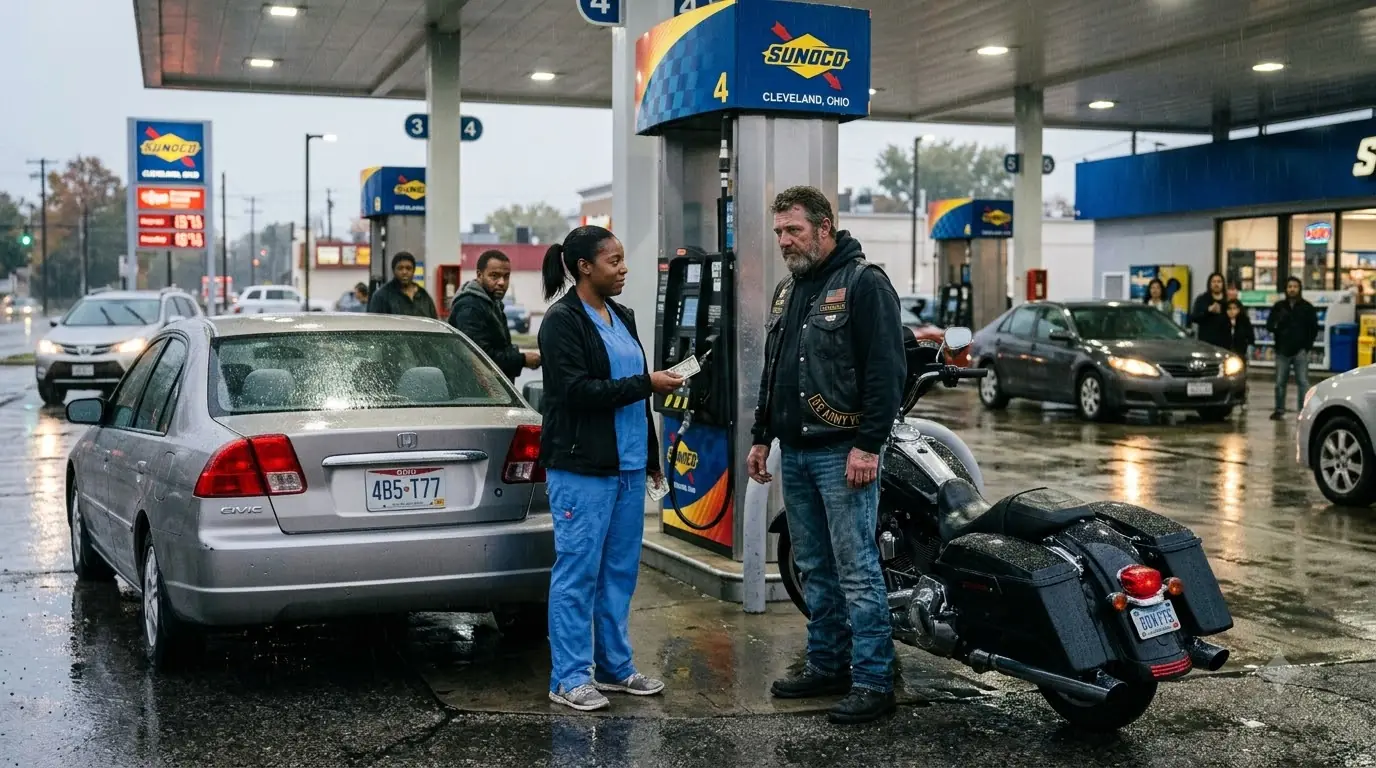
“You don’t know me from Adam,” the weathered man in the leather jacket said. “Could be dangerous offering help to strangers.”
Kesha smiled and thought about the last twenty dollars she had been saving for groceries. “Everyone deserves help when they’re stuck.”
She had no idea she was talking to Bobby Kowalsski, president of the Iron Serpents Motorcycle Club. She could not have known that her simple act of kindness, using the time and fuel she barely had to help get him moving again, was about to change everything.
What happened next would challenge everything her neighbors believed about bikers, everything her community thought they knew about who deserved help, and everything Kesha thought she understood about the price of doing good. Sometimes, when you help someone without expecting anything in return, the universe has a way of remembering.
Every morning at 5:30 a.m., Kesha Williams’s alarm pierced the pre-dawn darkness of her cramped two-bedroom apartment in East Cleveland. The radiator clanked its familiar protest against the October cold. She slipped her feet into worn slippers, careful not to wake eight-year-old Zara, and padded to the kitchen where yesterday’s dishes waited in the sink.
Her morning coffee was instant, mixed with powdered creamer that was supposed to taste like vanilla but mostly tasted like hope deferred. On the kitchen counter, bills stared back at her like accusers. Rent was due in three days, the utilities were overdue, car insurance had to be paid because she could not drive without it, and Zara still needed school supplies for the Halloween party.
The calculator on her phone told the same story it always did. Not enough. Kesha worked the morning shift at Mercy General Hospital, wheeling patients to X-ray and helping nurses with daily care. The work was steady, but it barely covered the basics.
Her afternoon job cleaning offices downtown paid cash, which helped, but it meant she did not get home until after 8:00 p.m. most nights. Mrs. Rodriguez next door watched Zara for twenty dollars a week, a kindness Kesha knew was worth much more. But money was not the hardest part anymore.
The hardest part was the fear that followed her everywhere since Deshawn started his campaign of psychological warfare. Three months earlier, when Kesha finally got the courage to leave him, she thought the nightmare was over. She was wrong. It had only changed form.
It started with phone calls at all hours, dozens of them. Then he began appearing at her workplace, claiming he just wanted to talk. Security would escort him out, but he would return the next day with flowers and apologies that fooled no one except himself.
The restraining order was supposed to stop it, but paper does not protect you when someone knows where you live, where you work, and where your daughter goes to school. Last week, she had found him sitting in his car outside Zara’s elementary school, just sitting there and watching. When she confronted him, he smiled the same smile that had once made her feel special, but now made her skin crawl.
“Public street, Kesha,” he said. “Can’t stop a man from sitting in his car.”
His friends started helping with the harassment. Marcus would coincidentally be at the grocery store when she shopped. Trevor jogged past her apartment building every morning, always looking up at her window. They never touched her and never even spoke to her directly. They just existed everywhere she needed to be.
The police were sympathetic but clear. Until Deshawn actually violated the restraining order in a provable way, their hands were tied. Following someone on public streets was not illegal. Sitting outside a school was not illegal. Making someone feel like prey in their own life apparently fell into a legal gray area that offered no protection.
“You need to be more careful,” her coworker Denise had said. “Maybe stay with family for a while.”
But Kesha had no family left. Her grandmother, who had raised her, passed away two years ago. The foster system had not exactly built her a network of supportive relatives. It was just Kesha and Zara against the world.
“Why can’t Daddy just leave us alone?” Zara asked one night, her eight-year-old voice small and confused.
Kesha held her daughter close and felt the weight of inadequacy press against her ribs. “Some people have trouble letting go, baby. But we’re strong, remember? We’ll figure it out.”
In her community, there was constant pressure about self-reliance. A strong Black woman did not need anyone, the older women at church would say. You handled your own problems. But what happened when your own strength was not enough? What happened when the system designed to protect you treated your terror like paperwork?
Kesha lay awake most nights listening for footsteps in the hallway, for her car alarm, for anything that might signal escalation. She installed new locks, bought pepper spray, and researched self-defense classes she could not afford. The worst part was watching it affect Zara.
Her bright, chatty daughter had started asking why Mommy looked so tired, why they always had to check the parking lot before leaving, and why they could not go to the park after dark anymore. Children sense fear even when you think you are hiding it. Kesha knew that, and it broke her heart.
That morning, as she got ready for another day of looking over her shoulder, she caught her reflection in the bathroom mirror. The woman looking back seemed smaller than Kesha remembered, more brittle. Dark circles ringed her eyes, but her gaze still held determination.
She touched the small cross necklace her grandmother had given her, the only thing of value she owned, worn every day for protection and memory. Grandma Moses had always said, “Baby, we help because we can, not because we should. And we don’t judge folks by what they look like on the outside.”
Those words felt especially important in a neighborhood where assumptions came quickly and forgiveness came slowly. People looked at the bikers who sometimes passed through and saw trouble. They looked at young men on street corners and saw criminals. Everyone had their own ideas about who deserved help and who deserved suspicion.
As she braided Zara’s hair and packed her lunch, Kesha made the same promise she made every morning. Somehow, some way, she would build a better life for them both. She had survived foster care, survived teenage pregnancy when everyone said she would never amount to anything, and survived putting herself through nursing assistant training while raising a baby alone.
She could survive Deshawn too. She just needed to stay strong long enough to figure out how. But Kesha did not know that sometimes the help we need comes from the most unexpected places, and sometimes accepting that help requires more courage than facing our problems alone.
By 3:00 p.m., Kesha’s twelve-hour day was finally winding down. The October sky threatened rain as she pulled her 2008 Honda Civic into the GetGo station on Euclid Avenue. The car made that grinding noise again, another problem for the ever-growing list.
She checked her phone. 3:15 p.m. If she hurried, she could grab gas and still make it to pick up Zara by 3:45.
At pump six, Kesha slid her credit card through the reader. The machine beeped its rejection. Declined. Her stomach dropped as she tried her debit card. Also declined.
She fumbled for her banking app. The automatic car insurance payment had gone through that morning, leaving her account twelve dollars overdrawn. Her next paycheck was not until Friday, three days away.
Standing there with cars lining up behind her, Kesha felt the familiar heat of embarrassment creeping up her neck. Someone honked. The dashboard showed less than a quarter tank, maybe thirty miles’ worth. Thirty miles that had to last until Friday.
That was when she noticed the man at pump seven. He was maybe fifty, wearing a worn leather jacket despite the unseasonable warmth. His motorcycle, a massive Harley-Davidson, gleamed even under the overcast sky. He had a salt-and-pepper beard, weathered hands, and something about his posture that suggested both power and weariness.
He had been trying to start his bike for several minutes. Even from her pump, Kesha could hear that it was not turning over. The distinctive patch on his jacket caught her eye, a skull with wings surrounded by text she could not quite read.
In their neighborhood, everyone knew to be wary of bikers. They meant trouble, drugs, and violence. At least, that was what people said. But watching this man’s frustration, Kesha saw something different. She saw someone having the same kind of day she was having.
The man pulled out his phone, clearly agitated. She heard fragments of his conversation. “Twenty miles from nowhere,” and, “Send a truck.” Then his phone died mid-sentence. He stared at the black screen, then at his bike, then up at the darkening sky.
The first drops of rain began to fall. Kesha should have minded her own business. She had problems of her own, bigger problems than a stranded biker. Every warning voice in her community echoed the same thing. Stay away from those people.
But her grandmother’s voice was louder. Baby, we help because we can, not because we should.
Kesha approached carefully, aware of how this might look. “Excuse me. You okay?”
Up close, she noticed more details. His jacket was expensive, real leather. His boots were well-maintained. The bike itself was pristine, clearly well cared for, but his expression was genuinely worried, not threatening.
“Battery’s dead,” he said, his voice carrying a slight rasp. “Phone too. I was supposed to meet my group an hour ago.”
He paused and studied her face. “They’ll be worried.”
The way he said group carried weight, like it meant more than just friends meeting for coffee. There was responsibility in his voice. Authority.
“I could give you a jump,” Kesha offered, then realized the obvious problem. “Oh, wait. Cars don’t really work on motorcycles, do they?”
Despite his frustration, he almost smiled. “Not so much, no. But I appreciate the thought.”
He extended a weathered hand. “Name’s Bobby.”
“Kesha.”
His handshake was firm but respectful.
“There’s an auto parts store about two miles down Euclid,” she said. “They might have a battery charger you could borrow.”
Bobby shook his head. “No car, remember?”
The rain intensified, drumming against the gas station’s canopy. Other customers hurried inside for shelter. Bobby looked up at the sky, then back at his dead phone, then at his bike. She could practically see him calculating options and coming up short.
Every practical voice in Kesha’s head screamed warnings. Do not get involved. You do not know this man. He is a biker. They are all trouble. What would Deshawn say if he found out? What would the neighbors think?
But louder than all of those voices was a simple truth. Someone needed help, and she could provide it.
“Look,” she said, surprising herself. “I could drive you to the auto parts store. Or wherever you need to call for help.”
Bobby studied her for a long moment as rain began to spot his leather jacket. “You don’t know me from Adam,” he said carefully. “Could be dangerous offering rides to strangers.”
“Could be,” she agreed, rain starting to dampen her scrubs. “But you seem more frustrated than dangerous. And everyone deserves help when they’re stuck.”
The rain came harder now, forcing them both to speak louder. Bobby looked at his bike, clearly reluctant to leave it unattended.
“It’ll be fine here,” Kesha said, reading his hesitation. “I’ll pull my car up, and we can get you sorted out.”
“Why?” he asked simply, his eyes searching her face.
Kesha thought about her morning, about Deshawn, about feeling powerless and alone. “Because someone helped me once when I needed it. Seemed like the right thing to pass on.”
Bobby nodded slowly, something shifting in his expression. Surprise, maybe even respect.
“All right, Kesha. I accept your kindness. But let me at least put gas in your car first.”
“Oh, you don’t have to.”
“I insist.” He was already walking toward her pump, pulling out a substantial wallet. “Least I can do.”
That was how Kesha Williams, with twenty dollars to her name and an overdrawn account, found herself about to receive help from the very person she was trying to help. Bobby pumped forty-three dollars of premium gas into Kesha’s Honda, more than she had put in at once in months. The numbers climbed on the display, and Kesha felt a mix of gratitude and embarrassment.
When the pump clicked off, her tank was completely full for the first time since summer.
“Thank you,” she said quietly. “You really didn’t need to.”
“Yes, I did.” His tone was final, but not unkind. “Now, about that ride.”
As they loaded into her car, Kesha became hyperaware of the other customers at the gas station. An elderly woman pumping gas two spots over kept glancing their way, her eyebrows raised. A teenager getting snacks shot them curious looks through the convenience store window. In their neighborhood, a Black woman talking to a white biker was the kind of thing people noticed and remembered.
The auto parts store, O’Reilly’s, sat in a strip mall between a Chinese restaurant and a laundromat. Bobby directed her there with the confidence of someone familiar with the area. The rain drummed steadily against the windshield.
“Been in Cleveland long?” Kesha asked as they drove.
“Off and on for about fifteen years. You?”
“Born here. Never left.” She signaled into the parking lot. “Sometimes I wonder what that says about me.”
Bobby looked at her profile as she parked. “Says you know the value of home.”
Inside O’Reilly’s, the teenager behind the counter recognized Bobby immediately. “Hey, Mr. Bobby. Haven’t seen you in a while.”
“Hey, Danny. Listen, my bike’s dead over at GetGo. You still got that portable jump starter in the back?”
“Sure do, but…” Danny glanced at the clock. “I can’t leave until six, and Marcus doesn’t get in until then.”
Bobby’s jaw tightened slightly. Kesha could see him calculating time, distance, and obligations. Whatever meeting he was missing, it mattered. People were counting on him.
“I could take you back,” she offered. “With the jump starter, I mean.”
“That’s asking a lot,” Bobby said. “You’ve already done more than enough.”