The old man’s voice was so faint that Clara Bennett almost missed it beneath the sharp beeps of Register 4. Dalton Fresh Market was crowded that Thursday evening, filled with tired workers buying dinner, parents tugging impatient children past candy displays, and carts squeaking over the polished floor. Clara had been standing for ten hours in a wrinkled green cashier vest, her feet aching inside cheap black shoes, her smile worn thin from saying thank you to people who rarely heard her. But when she looked up at the man in front of her, every bit of tiredness left her face.
He was painfully thin, with sunken cheeks and gray hair flattened beneath an old brown cap. His coat hung loose on his shoulders, frayed at the cuffs, as if it had once fit a stronger man in another season of life. His hands trembled over the counter while he tried to gather the nickels, pennies, and crumpled dollar bills he had spread beside the card reader. A small basket sat between them, holding bread, milk, apples, canned soup, and two bottles of medicine from the pharmacy aisle.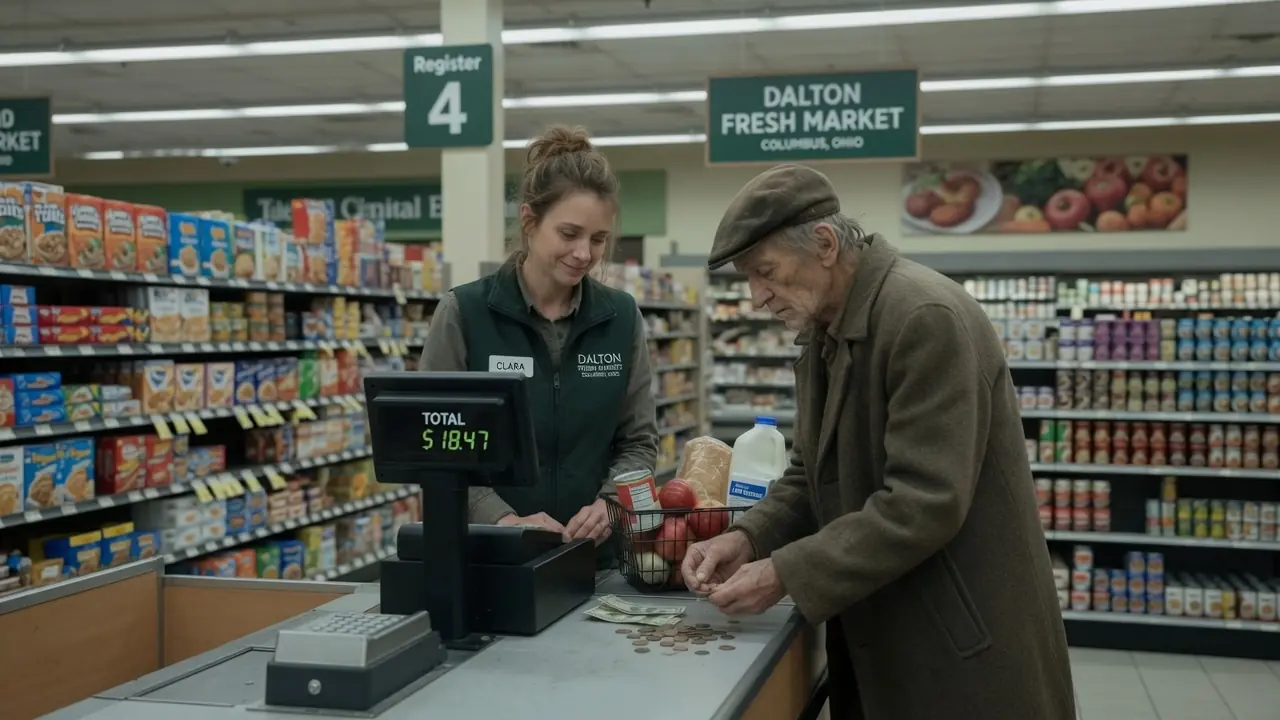
The total on Clara’s screen read twenty-three dollars and seventy-eight cents. The old man had seventeen dollars, forty-two cents, and a look of shame that made Clara’s throat tighten. He did not ask for help. He simply stared at the money, swallowed hard, and reached for the medicine first, as if pain was the easiest thing to surrender.
“I can put these back,” he said, lifting the medicine with trembling fingers. “I just need the bread.”
Clara looked at the medicine, then at his face. His lips were dry, his eyes watery from exhaustion, and his breathing came shallowly, like even standing in line had cost him something. There were people behind him, and she could already feel their impatience pressing forward. A woman in a red coat sighed loudly. A man with a phone tucked to his ear muttered that some people should learn to count before shopping.
Clara ignored them.
“Sir,” she said softly, placing one hand over the medicine before he could move it, “please don’t put that back.”
He looked up at her then, startled by the gentleness. “Miss, I can’t pay for it.”
“I know.”
His face flushed with humiliation. “I thought I had more. I counted before I left. Maybe I dropped some on the bus.”
Clara could picture it too clearly: this old man sitting alone on a cold bus bench, counting folded bills with stiff fingers, hoping he had enough for food and relief. Her own wallet sat under the register with thirty-one dollars inside, meant to buy diapers, peanut butter, and gas after her shift. Her six-year-old son Lucas was waiting at her neighbor’s apartment, probably asking when Mommy was coming home. Clara could not afford to be generous.
But she could not watch this man choose between eating and healing.
She opened the register drawer, then paused. Store policy was strict. Cashiers could not cover customer purchases through the drawer, could not adjust totals without manager approval, could not use personal money during active transactions without permission. Richard Dalton, the manager, loved rules more than people because rules never asked him to feel anything. Clara knew what he would say if he saw.
Still, she reached for her wallet.
The old man shook his head quickly. “No, no. I can’t let you do that.”
Clara smiled, though her eyes were already wet. “Then let me do for you what I hope someone would do for my father.”
His mouth trembled. “Do you still have your father?”
“No,” Clara said. “But I still remember what he needed.”
She took out seven dollars and paid the remaining balance. The receipt printed with a soft hiss. Clara folded it carefully and placed it in the thin plastic bag with the bread, milk, apples, canned soup, and medicine. Then she handed the bag across the counter with both hands, as if she were handing him back more than groceries.
The old man stared at her name tag. “Clara.”
“Yes, sir.”
“My name is Arthur Whitman.” His voice cracked. “I don’t know how to thank you.”
“You don’t have to,” Clara said. “Just go home safe.”
Arthur held the bag close to his chest. For a moment, his eyes filled so deeply that Clara thought he might cry right there at Register 4. Instead, he lowered his head, whispered, “God bless you, Miss Bennett,” and shuffled toward the exit.
Clara watched him go until the sliding doors opened and the cold evening swallowed him.
Then Richard Dalton appeared.
He had been standing near the customer service desk, arms folded, his tie perfectly straight and his expression cold enough to freeze every warm thing Clara had just done. Richard was forty-five, neat, ambitious, and fond of reminding everyone that Dalton Fresh Market was not a church, shelter, or charity. He walked toward Register 4 slowly, holding authority like a weapon he enjoyed polishing.
“Clara,” he said.
She finished scanning the next customer’s items before turning to him. “Yes?”
“Step away from the register.”
The woman in the red coat looked delighted. The man on the phone finally lowered his voice. Clara felt heat rise in her face, but she locked the register and followed Richard to the small office near the break room. He closed the door behind them with too much care.
“What did you just do?” he asked.
Clara stood with her hands clasped in front of her. “I paid the difference for a customer.”
“You interfered with a transaction.”
“He didn’t have enough money.”
Richard laughed once, without humor. “Customers often don’t have enough money. That does not make it your job to rescue them.”
“I used my own cash.”
“That is not the point.”
“It should be.”
His eyes sharpened. “You’re a cashier, Clara, not a social worker. Not a charity office. Not some neighborhood saint handing out blessings in my checkout lane.”
Clara breathed slowly. “He needed food and medicine.”
“He needed to shop within his budget.”
The words hit her so hard that for a second she could not answer. She thought of Arthur’s shaking hands, the way he had reached for the medicine before the bread, the shame in his bent shoulders. Then she thought of Richard’s office: clean desk, leather chair, framed sales certificates, a small refrigerator stocked with sparkling water. Some people could say cruel things easily because hunger had never sat across from them with empty pockets.
“He was short six dollars and thirty-six cents,” Clara said. “That’s what you’re angry about.”
Richard leaned forward. “I am angry because you made a scene.”
“No,” Clara said quietly. “He was ashamed. The line was impatient. I made it stop.”
Richard’s face hardened. “Do not get poetic with me. You are already hanging by a thread here.”
Clara looked at him. “Because I asked for Saturdays off when Lucas had asthma treatments?”
“Because you are unreliable.”
“I have missed one shift in eleven months.”
“You bring your personal life into work.”
“My personal life is a child. I cannot leave him in a closet when I clock in.”
Richard’s mouth tightened. He opened a drawer, pulled out a disciplinary form, and placed it on the desk. “Sign this.”
Clara looked down. “What is it?”
“A written warning for violating transaction procedure and creating customer delay.”
She stared at him. “Creating customer delay?”
“Sign it.”
“No.”
Richard blinked, as if the word had come from the chair instead of her mouth. “Excuse me?”
Clara’s hands trembled now, but she kept her voice steady. “I won’t sign a lie.”
Richard stood. “Then you can go home.”
“My shift ends at eight.”
“It ends now.”
Clara felt the floor tilt beneath her. “Are you firing me?”
“I am suspending you pending review.”
That was how managers punished poor employees without taking responsibility for the word fired. Clara thought of rent due Monday, Lucas’s inhaler refill, the electric bill folded in her purse. Fear rose fast, cold and familiar. But beneath it, something steadier held.
“I paid for groceries and medicine,” she said. “That is all I did.”
Richard opened the office door. “Clock out.”
Clara walked through the store with every eye on her. Some customers looked away. Some watched with open curiosity. Her coworker Mel whispered, “What happened?” but Clara shook her head because if she spoke, she might break. She clocked out, took her coat from the break room, and walked into the cold.
The bus ride home felt longer than usual. Clara counted the remaining money in her wallet twice, then stopped because the number did not change. Twenty-four dollars and sixty-four cents. That was what kindness had left her, along with a suspended job and a rent notice waiting on the kitchen table.
At Mrs. Alvarez’s apartment, Lucas ran to her as soon as the door opened. “Mommy!”
Clara crouched and hugged him tightly. He smelled like crayons and toast. Mrs. Alvarez, who watched him after school for half what she deserved, looked at Clara’s face and immediately knew something was wrong.
“You lost the shift?” she asked softly.
“Maybe more than the shift.”
Mrs. Alvarez’s eyes softened. “Come in. I made soup.”
Clara wanted to refuse, but pride had already cost enough people too much that day. She sat at the small kitchen table while Lucas showed her a drawing of a rocket ship with uneven stars. He talked about school, about a boy who took his pencil, about how Mrs. Alvarez let him stir soup but not touch the stove. Clara smiled in the right places, but her mind kept returning to Arthur Whitman walking into the cold with one small bag of groceries.
That night, after Lucas fell asleep, Clara sat at her own kitchen table and cried quietly with her hand over her mouth. She cried because she was tired. She cried because she was scared. She cried because doing the right thing had made her life harder, and she hated that the world worked that way.
But she did not regret it.
The next morning, Clara woke before her alarm. Her phone had no messages from Richard, no schedule update, no official notice. She dressed anyway, not in her cashier uniform but in a clean blue blouse and dark pants. She walked Lucas to school, kissed his forehead, and promised she would be there after class.
“Do you work today?” he asked.
Clara hesitated. “I’m going to find out.”
At Dalton Fresh Market, the morning crew was restocking produce when Clara entered. Mel saw her and hurried over. “Richard said you weren’t supposed to come in.”
“I need to ask about my job.”
Mel lowered her voice. “He’s in a mood.”
“He can be in two moods. I still need rent.”
Before Clara reached the office, the sliding doors opened behind her. A woman in a cream coat walked in, followed by an older man using a cane.
Arthur Whitman.
He looked better than the night before, though still frail. His coat was buttoned properly, his face had a little color, and his eyes found Clara immediately. Beside him stood a woman in her early fifties with silver-streaked dark hair, elegant posture, and the kind of calm expression that made people straighten without knowing why.
“Miss Bennett?” the woman asked.
Clara turned fully. “Yes.”
The woman stepped closer and held out her hand. “My name is Evelyn Whitman. Arthur is my father.”
Clara shook her hand carefully. “Is he all right?”
Arthur smiled faintly. “Better because of you.”
Evelyn’s eyes softened. “Dad told me what happened yesterday. He told me he came here short on money, that he tried to put back his medicine, and that you paid for everything he needed.”
Clara glanced toward the office. Richard had appeared behind the glass door, watching. “It was only a few dollars.”
“No,” Evelyn said. “It was dignity.”
Richard stepped out quickly, smoothing his tie. “Good morning. Can I help you?”
Evelyn turned toward him. “Are you Richard Dalton?”
“I am the store manager.”
“Good.” She opened her leather handbag and removed a business card. “Evelyn Whitman. Director of Whitman Senior Care Foundation.”
Richard’s expression shifted, trying to calculate the importance of the name. “Of course. How can we assist you?”
Evelyn did not smile. “You can begin by explaining why the employee who helped my father was suspended.”
The store seemed to quiet around them. Mel stopped arranging oranges. A stock clerk near the bakery froze with a tray of rolls in his hands. Clara felt every heartbeat in her throat.
Richard gave a practiced laugh. “I think there has been a misunderstanding. We appreciate compassionate employees, but we also have procedures.”
“My father said she used her own money.”
“Yes, but transactions must be handled appropriately. We cannot have employees making emotional decisions at the register.”
Evelyn looked at Arthur. “Dad, is this the man?”
Arthur’s hand tightened on his cane. “Yes. He was watching.”
Richard’s smile faltered. “Watching what?”
“My humiliation,” Arthur said quietly.
The words moved through the store like a bell.
Richard’s face reddened. “Sir, I assure you—”
Arthur lifted one shaking hand. “I counted wrong. I was embarrassed. I reached for the medicine because I thought pain was cheaper than hunger. She stopped me. You punished her.”
Clara’s eyes filled, but she looked down before anyone could see.
Evelyn turned back to Richard. “My father has Parkinson’s. He should not have been shopping alone, but he is stubborn and proud. Yesterday, he got confused, missed the cash I had placed in his coat pocket, and came up short. Your employee treated him like a human being.”
Richard opened his mouth, but Evelyn continued.
“And you treated compassion like a workplace violation.”
“I did not fire her.”
“You suspended a single mother for spending her own money on an elderly man’s groceries and medicine.” Evelyn’s voice remained calm, which somehow made it stronger. “That tells me everything I need to know about this store.”
Richard’s eyes flicked toward the other employees. “Mrs. Whitman, perhaps we can discuss this privately.”
“No,” Evelyn said. “Your correction can be as public as your punishment.”
Clara looked up.
Evelyn turned to her. “Miss Bennett, are you currently employed here?”
Clara’s lips parted. “I… I don’t know.”
Richard quickly said, “Clara’s status is under review.”
Evelyn nodded once. “Then I would like to offer her a position.”
The whole front of the store went still.
Richard blinked. “Excuse me?”
Evelyn looked only at Clara now. “Whitman Senior Care Foundation runs meal delivery, medication support, and home assistance programs for low-income seniors throughout Columbus. We need people who can recognize suffering before it becomes a report on someone’s desk.”
Clara could barely breathe.
“The position is client intake coordinator,” Evelyn continued. “Full-time. Health insurance. Predictable hours. Starting pay is twenty-four dollars an hour. Training included. And if you need childcare assistance, we have a family support stipend.”
Clara stared at her. “I’m just a cashier.”
“No,” Arthur said softly. “You are the woman who saw me.”
That broke something open inside Clara. She covered her mouth with one hand, but tears spilled anyway. For eleven months, Richard had made her feel replaceable. Customers had snapped at her, schedules had shifted without warning, and every bill at home had reminded her that one missed paycheck could collapse everything. Now a stranger was offering not charity, but a door.
Richard stepped forward. “Clara, before you make any decisions, we value you here.”
Mel coughed.
The stock clerk looked away.
Clara turned to Richard slowly. For the first time, she saw him clearly: not powerful, not important, just a man who had used a small desk and a name tag to make tired people feel smaller. Yesterday, his opinion had frightened her. Today, it had become strangely light.
“You suspended me,” Clara said.
“That was procedural.”
“You wrote that I created customer delay.”
“I was following policy.”
Clara glanced at Arthur. “Then I hope policy can run Register 4.”
Mel made a sound that was almost a laugh.
Richard’s face went stiff.
Clara took off her cashier name tag. She held it for a moment, remembering every shift, every aching foot, every time she had swallowed disrespect because Lucas needed dinner. Then she placed it on the counter.
“I resign.”
Evelyn’s eyes softened, but she did not interrupt.
Richard lowered his voice. “You’re making a mistake.”
Clara looked at him. “No. I made seven dollars worth of kindness. You made it expensive.”
Arthur smiled.
Clara walked out of Dalton Fresh Market beside Evelyn and Arthur. Outside, the morning air felt cold but clean. She expected to feel panic, but instead she felt something like space opening around her. Evelyn invited her to the foundation office that afternoon. Clara asked if she could pick up her son first.
“Bring him,” Evelyn said. “My father owes him a thank-you too.”
At three-thirty, Clara arrived at Whitman Senior Care Foundation with Lucas holding her hand. The office was warm, bright, and filled with people who spoke gently without sounding fake. There were maps of delivery routes on the walls, shelves of donated groceries, medical reminder charts, and a bulletin board covered in photos of seniors smiling with volunteers. Lucas whispered, “Mommy, is this a hospital?”
“No,” Clara said. “It’s a helping place.”
Arthur was waiting in a chair near the window with a small paper bag on his lap. When he saw Lucas, he smiled and waved him over.
“You must be the young man whose mother helped me.”
Lucas looked at Clara first. She nodded.
Arthur handed him the bag. Inside was a small wooden toy car, polished smooth but old-fashioned. “I made that years ago,” Arthur said. “My hands shake too much now, but that one still rolls straight.”
Lucas’s eyes widened. “For me?”
“For you.”
“Thank you, sir.”
Arthur looked at Clara. “Good manners. You raised him well.”
Clara’s throat tightened. “I try.”
Evelyn gave Clara a tour of the office, explained the work, and introduced her to the team. The job was not glamorous. It involved phone calls, intake forms, delivery scheduling, emergency referrals, and listening to people who were often scared to admit what they needed. But as Clara listened, she realized something stunning.
This was work she already knew how to do.
She knew the sound of shame in a voice. She knew how people apologized when they were hungry, late, sick, or afraid. She knew how to ask questions without making someone feel small. She knew what it meant to need help and still want dignity.
Evelyn seemed to understand that. “We can teach software,” she said. “We cannot teach someone to see people the way you saw my father.”
Clara accepted the job before leaving.
That evening, she took Lucas out for grilled cheese and tomato soup at a small diner near their apartment. It was not expensive, but it felt like a celebration. Lucas rolled Arthur’s toy car along the edge of the table while Clara filled out the first employment forms. Every few minutes, she had to stop and look at the hourly wage again, just to convince herself it was real.
“Are you happy?” Lucas asked.
Clara smiled. “I think I’m relieved.”
“What’s that mean?”
“It means Mommy can breathe better.”
He nodded seriously, as if that made perfect sense.
Over the next weeks, Clara’s life did not become easy, but it became possible. She started training at the foundation, learned the client database, shadowed meal delivery coordinators, and took phone calls from seniors who sounded exactly like Arthur had sounded at Register 4. Some apologized for needing food. Some apologized for needing rides. Some apologized for still being alive and inconvenient.
Clara always answered the same way.
“You don’t need to apologize. Let’s see what we can do.”
She said it because she meant it. She said it because she wished someone had said it to her sooner. She said it because dignity, she learned, could be returned in small sentences before any paperwork was filed.
One Friday afternoon, three weeks after leaving Dalton Fresh Market, Clara received a call from Mel. Richard Dalton had been transferred to another store after multiple employees complained about his treatment of staff. Corporate had reviewed the incident with Arthur, and while the company did not admit wrongdoing, they had suddenly begun a “community care initiative” that allowed cashiers to refer struggling customers to local support programs.
“They’re acting like it was their idea,” Mel said.
Clara laughed softly. “Maybe it will still help someone.”
“That’s what you care about?”
“Yes.”
Mel was quiet for a moment. “I miss you at Register 4.”
“I miss you too.”
“But I don’t miss watching him talk down to you.”
Clara looked across the foundation office, where Evelyn was helping Arthur with his coat after a checkup visit. “I don’t either.”
Months passed. Clara paid rent on time for the first time in years. Lucas’s asthma medication was refilled before it ran out. Mrs. Alvarez cried when Clara insisted on paying her properly for childcare. Clara still bought carefully, still saved coupons, still checked her bank account with caution, but the constant terror began to loosen its grip.
Arthur became a regular part of her life. He visited the foundation twice a week, partly for programs and partly, Evelyn joked, to supervise Clara’s success. He told stories about his late wife, his years repairing radios, and how he once danced badly enough at a wedding that a bride’s grandmother asked him to sit down. Lucas adored him and called him Mr. Arthur.
One afternoon, Clara found Arthur sitting by the office window, looking at the street with a distant expression. She sat beside him.
“You all right?” she asked.
He nodded. “Just thinking about that day.”
“At the store?”
“Yes.” His hands trembled over his cane. “I have lived seventy-nine years. Raised a daughter. Worked forty-two years. Paid taxes. Buried friends. Buried my wife. And still, one bad moment at a cash register made me feel like I was nothing.”
Clara’s eyes softened.
Arthur turned to her. “Then you looked at me like I was still somebody.”
“You were.”
“I know that now.” He smiled faintly. “Needed reminding.”
Clara reached over and gently covered his shaking hand with hers. “So did I.”
That evening, Clara walked home with Lucas under a soft spring sky. He held Arthur’s wooden car in one hand and a library book in the other. Their apartment building still had peeling paint, the hallway still smelled faintly of old carpet, and the radiator still clanked at night. But when Clara unlocked the door, she no longer felt like she was entering a life she was barely holding together.
She felt like she was building one.
On the kitchen counter, she placed her new work badge beside the grocery list. Clara Bennett, Client Intake Coordinator. The title looked almost too official, but she liked the weight of it. Lucas climbed onto a chair and asked if they could have apples with dinner.
Clara smiled.
“Yes,” she said. “Apples, soup, and grilled cheese.”
As she opened the refrigerator, she thought again of Arthur standing at Register 4, embarrassed over bread, milk, apples, canned soup, and medicine. She thought of the seven dollars she had spent, money she had been afraid to lose. She thought of Richard calling her kindness a violation.
Then she thought of the door that had opened the next morning.
Clara had not helped Arthur because she expected reward. She had helped because suffering had stood in front of her, trembling, and she could not look away. But sometimes kindness returned not as repayment, not as a miracle, but as proof that one small act could reveal who everyone really was.
Arthur had been more than a poor old man short on money.
Richard had been less powerful than he seemed.
And Clara Bennett, single mother, cashier, tired woman at Register 4, had been more than the life that kept underestimating her.
She had seen someone.
And because of that, someone finally saw her.