When Rowan Hail bought the dead land outside Ember Ridge, people laughed so loudly that some of them brought folding chairs to the roadside just to watch her fail. The property was 480 acres of cracked dirt, dry creek beds, broken fence posts, and hills so stripped by old farming that even weeds seemed reluctant to grow there. No mature trees stood anywhere on the land, and the old farmhouse leaned against the wind like it was tired of staying alive. But Rowan stood at the county auction with her fifteen-year-old daughter, Tessa, beside her and raised her hand anyway.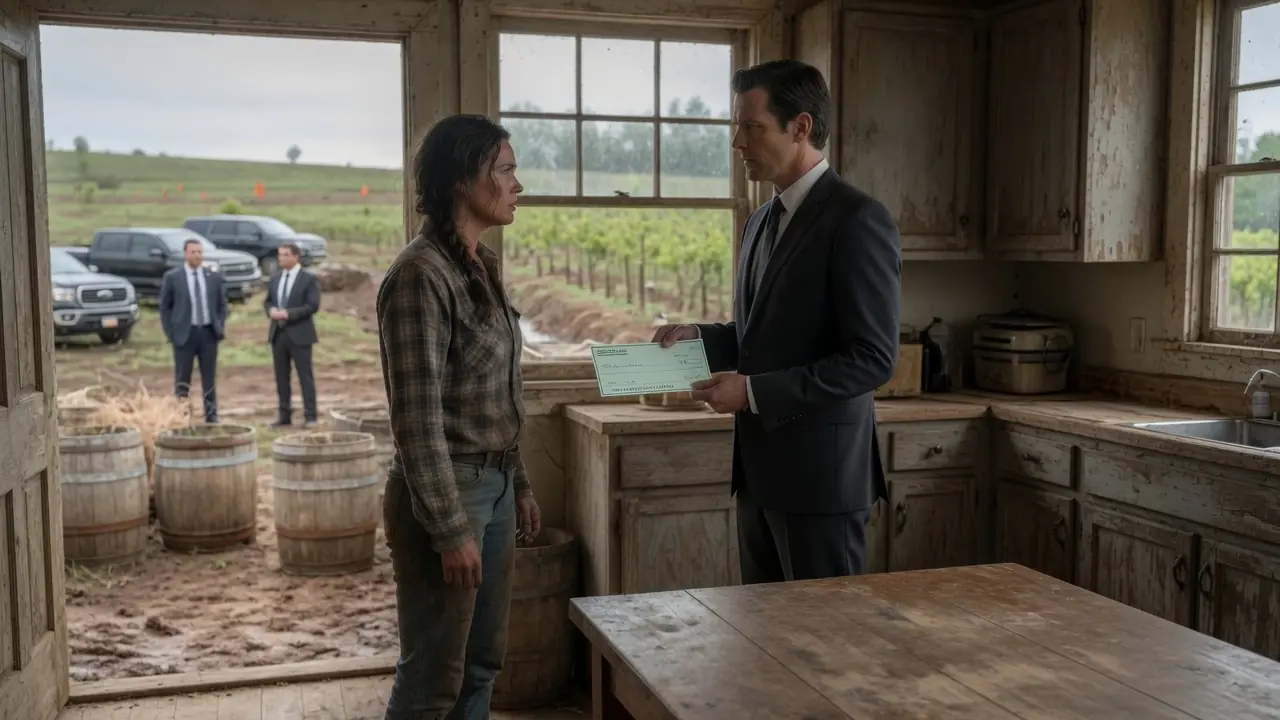
She paid eighty-four thousand dollars for land that most people in town would not have taken for free. Heath Danner, the biggest cattle rancher in the county, laughed right in the auction room and said she had bought herself a desert with no water, no shade, and no future. A few men in the back made bets on how long the single mother would last before winter drove her out. Rowan heard every word, but she only signed the papers, folded them carefully, and walked out with her daughter.
The first night in the farmhouse, Tessa stood in the doorway of the kitchen and stared at the dry hills beyond the window. “Mom,” she said softly, “what if they’re right?” Rowan set a lantern on the table and looked out at the land she had just tied their future to. “Then we’ll find out by working,” she said.
Rowan had not bought the land because she was sentimental. She had spent months studying maps, old county records, rainfall paths, and faded survey drawings from before the land had been ruined. Long before the wheat farm failed, three natural drainage lines had once crossed the property, carrying water through the low ground and feeding a shallow creek. The land was not dead in Rowan’s mind. It was wounded.
So she began by listening to it. While other farmers turned soil for planting, Rowan drove stakes along the curves of the hills and dug shallow trenches across the slopes. People driving by shook their heads because it did not look like farming to them. It looked like a desperate woman carving lines into dirt that had already refused to give anything back.
For weeks, she worked from sunrise until the stars came out. She borrowed an old tractor when she could, used a shovel when the tractor broke, and marked every trench by hand. Her palms blistered, her shoulders burned, and more than once she stood alone in the dust wondering if hope was just another kind of foolishness. But Tessa kept bringing her water and sandwiches, and Rowan kept digging.
Then the first heavy rain came. In the past, rain had rushed off the hard slopes, cutting shallow scars into the ground before vanishing down the road. This time, the water slowed. It filled the trenches, spread sideways, and sank quietly into the earth.
The next morning, Rowan walked across the land and found a dark patch of damp soil near one of the trenches. She crouched down and pressed her palm into it like a mother checking a child’s fever. For the first time, the land felt less like stone. She called Tessa outside, and together they knelt beside that small patch of mud as if they had discovered treasure.
That spring, Rowan planted her first two thousand seedlings. They were not beautiful trees then, only thin, fragile sticks of gamble oak, piñon pine, juniper, hackberry, and willow. She planted them in clusters, wrapped mulch around their bases, and watered them through a drip system made from secondhand barrels and patched tubing. Heath and his friends parked along the road more than once, laughing that she was pouring money straight into the dirt.
By midsummer, the heat came hard. The sun hammered the hills, the wind pulled moisture from the ground, and more than half of Rowan’s seedlings died. One evening, Tessa found her mother sitting among the brown sticks, her gloves in her lap, her face dusty and unreadable. “Are we done?” Tessa whispered.
Rowan picked up one dead seedling and studied the roots. “No,” she said quietly. “We’re learning.” She dug up several more and realized the water was not the only problem. The soil was so compacted that the roots had never been able to spread.
The next year, she changed everything. She dug wider holes, mixed compost and homemade biochar into the dirt, planted shrubs to block the wind, and grouped the trees so they could protect one another. She stopped trying to prove people wrong and started trying to understand what the land was telling her. Slowly, almost invisibly, the survival numbers improved.
By the end of the second year, green grass began to appear along the lower slopes. Birds returned first, then rabbits, then small tracks in the mud after rain. The creek bed still looked dry from a distance, but Rowan noticed the soil around it stayed cooler and darker longer than it should have. She wrote everything down in notebooks: rainfall, temperature, survival rates, soil moisture, wind patterns, and where each living tree stood.
The town kept laughing, but the laughter changed. At first, they mocked her because nothing was growing. Then they mocked her because something was growing and they did not want to admit it mattered. Heath hung a chalkboard in the diner predicting how many days remained before Rowan went broke and gave up.
Calvin Rusk, the county commissioner, publicly called her project emotional and economically useless. He denied her request for a land restoration tax adjustment and said the county could not reward “gardening experiments.” Rowan said nothing when she heard about it. She simply went home, marked another row on her map, and planted again.
Four years passed that way. Rowan repaired other farmers’ irrigation lines for cash, sold native seedlings from a roadside stand, and spent every spare dollar on compost, tubing, and saplings. Tessa grew taller, learned to drive the old truck, and could identify the trees by leaf shape before most kids her age could name state capitals. Together, they planted the ten-thousandth tree without a newspaper, speech, or crowd.
Only June Bell from the farm supply store came to watch. She stood near the fence with her arms folded and tears in her eyes, though she pretended the wind was bothering her. Tessa pushed a small wooden sign into the soil with the date carved into it. Rowan stood back and looked at the rows of young trees moving in the afternoon wind, still small, still fragile, but alive.
Then Rowan noticed the creek. It had not rained in weeks, yet beneath the stones in the lowest bed, water was moving slowly. Not much, not enough to call a stream, but enough to make her kneel and hold her breath. Something was waking beneath the land.
She sent soil samples and years of data to Dr. Mara Keen, a hydrologist who had once worked for the state. Mara called three days later and told Rowan not to sell anything, sign anything, or let anyone pressure her until the survey was complete. Rowan asked why. Mara only said, “Because your land may be doing something people thought was impossible here.”
Before Mara finished her report, the black vehicles arrived. Six SUVs rolled through Rowan’s front gate, raising dust along the same road where Heath used to sit and laugh. Sterling Blackwood stepped out of the first vehicle in a tailored suit that looked absurd against the muddy tracks and young trees. Behind him came lawyers, surveyors, assistants, and men who looked as if they were paid to stand silently.
Rowan met him in the yard wearing work boots, sun-faded jeans, and gloves stained with soil. Sterling smiled as if he had already decided she would be impressed. He praised the property, complimented the trees, and spoke about opportunity in a voice polished smooth by money. But he never asked how she had restored the land.
Inside the farmhouse kitchen, Sterling placed a check on the scratched wooden table. Fifteen million dollars. For a moment, Rowan could not speak. That amount of money could erase every debt, secure Tessa’s future, buy a clean house, a working tractor, medical insurance, and peace.
Sterling leaned forward. “Fifteen million dollars for dead farmland and a few young trees,” he said. “A woman in your position should be grateful.” Rowan looked at the check, then through the window at the orange survey flags his team had placed near the old creek bed. Her voice stayed calm. “You didn’t come here for my trees, Sterling.”
His smile thinned. “Excuse me?”
Rowan removed her gloves slowly. “You came because my land is holding water your project can’t survive without.” For the first time since arriving, Sterling’s expression shifted. Only for a second, but it was enough.
He tapped the purchase agreement beside the check. “This offer expires in forty-eight hours.” Rowan did not touch the papers. “Then you wasted a trip bringing them here.” Sterling’s eyes cooled. “Careful, Ms. Hail. Refuse this offer, and this whole county will blame you when the jobs disappear.”
Rowan stepped closer to the table, mud still drying on her boots. “Then let them watch a farmer protect this valley better than a billionaire ever protected his promises.” Sterling stared at her as if no one had spoken to him that way in years. Then he gathered his papers, left the check on the table for one dramatic second longer, and walked out.
After his vehicles disappeared down the road, Rowan found the map one of his surveyors had dropped near the porch steps. Her property was outlined in red and labeled ecological buffer parcel essential. The words were small, but they told her everything. Sterling was not offering fifteen million because he admired her forest.
He needed it.
Mara’s full report arrived two days later. Rowan’s trenches, mulch, roots, and ground cover had allowed rain to soak deep into the earth instead of running away. The land was rebuilding a shallow underground aquifer local records had considered gone. The effect was not limited to her property; it was beginning to influence thousands of acres down the valley.
Mara also discovered Blackwood Dominion’s filing for a luxury resort and residential project called Terra Reserve. It was valued at more than two billion dollars. The project needed an ecological corridor, proof it would not drain the aquifer, and a protected restoration zone to offset construction damage. Rowan’s forest was the only parcel in the region that satisfied all three.
The next morning, Rowan mailed a formal refusal. By evening, the retaliation began. Her property taxes were reassessed at a higher rate. Her trenches were suddenly under investigation for permits no one had ever mentioned before. The county announced possible road maintenance that could close her only access route.
Fuel deliveries stopped. Her seedling supplier canceled her standing order. The bank requested a review of her loan terms. A local newspaper published a story suggesting she was blocking hundreds of jobs because she wanted more money.
Ember Ridge turned on her faster than she expected. People who had laughed at her forest now complained that she was standing in the way of prosperity. Flyers were taped to her gate. Someone painted SELL on a fence post near the road.
Tessa found it first and tried to scrub it off before Rowan saw. Rowan stood beside her daughter, looking at the red letters. “Leave it,” she said. Tessa turned. “Why?” Rowan looked across the young forest. “Because one day they’ll need to remember which side they chose before they understood what they were protecting.”
Then the storm came. It dropped more rain in one afternoon than Ember Ridge had seen in years. At Blackwood’s cleared construction site, mud and runoff surged across the county road. But Rowan’s land absorbed the rain through trenches, roots, and softened soil.
The difference was impossible to ignore. The county road near Heath’s ranch stayed intact only because floodwater diverted into Rowan’s restored land instead of ripping through his pastures. The next morning, Heath Danner walked onto Rowan’s property without a trace of his old smirk. He stood near the creek bed, staring at clean water moving through land he had called dead.
Rowan did not ask for an apology. She showed him how her trench system worked, how the trees slowed wind, and how his own ranch could hold more water if he stopped fighting the land and started working with it. Heath listened in silence. When he finally spoke, his voice was low. “I spent four years laughing at the only person who knew what was happening.”
Rowan looked at him. “Then spend the next four doing better.”
At the county hearing, the room was packed. Sterling sat in front with his lawyers, Calvin Rusk at the center table, and half the town pressed against the walls. Blackwood’s consultants presented charts claiming Rowan’s trenches might destabilize future water flow. Calvin questioned her credentials with a thin smile, calling her work “well-meaning but amateur.”
Rowan did not defend her pride. She defended the land. She showed four years of soil data, storm photographs, creek readings, survival maps, and satellite images. Mara testified that Rowan’s work had not harmed the aquifer but had helped bring it back.
Then Rowan placed Blackwood’s leaked permit map on the projector. The room went quiet when everyone saw her property labeled essential before Sterling had ever bought it. Heath stood from the back of the room and spoke loudly enough for every reporter to hear. “Her forest saved my ranch road during the storm. If that’s amateur work, then this county needs more amateurs.”
The hearing shifted after that. People who had mocked Rowan began looking at Sterling instead. Calvin postponed the decision, pretending it was procedure, but everyone knew he had lost control of the room. Outside, reporters surrounded Rowan.
Sterling approached her privately near the courthouse steps. “Twenty-five million,” he said coldly. “Final offer.” Rowan did not look impressed. “You still think this is about my price.”
“It is always about price.”
“No,” Rowan said. “That’s why you’re losing.”
Blackwood Dominion paused hiring the next day, and the town split in two. Some blamed Rowan for lost jobs. Others began asking why one billionaire wanted control of every important water corridor in the valley. More landowners came to Rowan quietly, asking how to build trenches, plant windbreaks, and protect their wells.
Rowan founded the Dry Creek Restoration Cooperative. Heath joined first, then June Bell, then a handful of ranchers who had once laughed from the roadside. They planned a nursery, paid restoration jobs, water monitoring, training programs, and protections that would keep the valley’s future in local hands. Rowan did not need to sell her land to create value.
She sent the cooperative’s proposal directly to Blackwood’s investors. The message was simple: the project could move forward only if the valley’s water was protected, Rowan’s forest was placed under conservation, and local restoration workers were hired for long-term land repair. Sterling called it extortion. The investors called it risk management.
The final state hearing drew officials, reporters, investment representatives, county leaders, and a gallery packed with Ember Ridge residents. Sterling stood first, accusing Rowan of using environmental concerns to force a higher payment. He predicted she would name a larger number and prove this had always been about money. Then Rowan stepped to the front with a map of her forest behind her.
“My land is not for sale,” she said.
The room went still.
She laid out her terms clearly. Blackwood Dominion would place fifteen million dollars into the Dry Creek Watershed Restoration Fund, publicly audited and controlled independently. The company would hire the local cooperative to restore thousands of acres across the valley. Groundwater extraction would be capped, annual water data would be public, and Rowan’s forest would remain protected under a ninety-nine-year conservation agreement.
Sterling laughed once. “You have no authority to dictate terms for a multi-billion-dollar development.” One of the investment representatives stood immediately. “Without her restoration corridor, the project does not meet funding requirements.” A state official added, “And without legal protection for that corridor, it does not meet environmental conditions either.”
Sterling’s face remained calm, but his hands tightened around the edge of the table. In that moment, he understood what Rowan had done. She had not beaten him with money. She had made the truth more valuable than his offer.
Every month of delay was costing him millions. Every acre he had quietly bought around the valley depended on the one parcel he could not bully, buy, or break. In front of the same town that had watched Rowan fail, Sterling signed the agreement. The fifteen million dollars that was supposed to buy her silence became the fund that protected the valley.
One year later, the cooperative opened its nursery beside Rowan’s front gate. A long line of trucks stretched down the gravel road, filled with people waiting for seedlings and instructions. Some of them were the same people who had once brought chairs to watch her fail. Rowan handed them trees anyway.
Calvin lost his seat in the next election after his ties to Blackwood became public. Heath took down the diner chalkboard that had counted the days until Rowan’s bankruptcy and used the wood to make a sign for the nursery. It read: Dry Creek Restoration Cooperative — Water Belongs to the Valley.
Rowan’s forest was still young. The tallest trees had not yet reached the roof of the farmhouse, and every summer still tested them. Some seedlings died, some trenches needed repair, and some parts of the land remained stubborn and dry. But water stayed longer in the creek bed each year, and birds nested where dust once rolled across empty ground.
On the anniversary of the ten-thousandth tree, Tessa helped Rowan hang a new sign at the entrance. Hail Watershed Forest — Planted by One, Protected by Thousands. Rowan stood beside her daughter, looking across the land that everyone had once called worthless. The young trees moved in the wind like a promise finally strong enough to be seen.
A reporter asked Rowan how it felt to defeat a billionaire. Rowan thought of the first damp patch of soil, the dead seedlings, the nights she nearly gave up, and the check Sterling had placed on her kitchen table. Then she looked at the forest. “I never planted these trees to defeat anyone,” she said. “I planted them so the land could live.”
And now, at last, the whole valley understood.