Grace Whitaker stood in the open doorway with one hand gripping the frame and the other holding her cardigan closed against the winter air. Snow blew sideways across the porch of her small house in Dayton, Ohio, gathering on the steps, the railing, and the shoulders of the elderly woman standing beneath the yellow porch light. The woman looked to be in her late seventies, maybe older, wrapped in a gray coat too thin for the weather and a blue scarf tied tightly around her head. Her gloved hands trembled against a worn brown leather purse pressed to her chest.
The old woman lowered her eyes. “I didn’t mean to knock, ma’am,” she whispered. “I just needed one place where the light was still on.”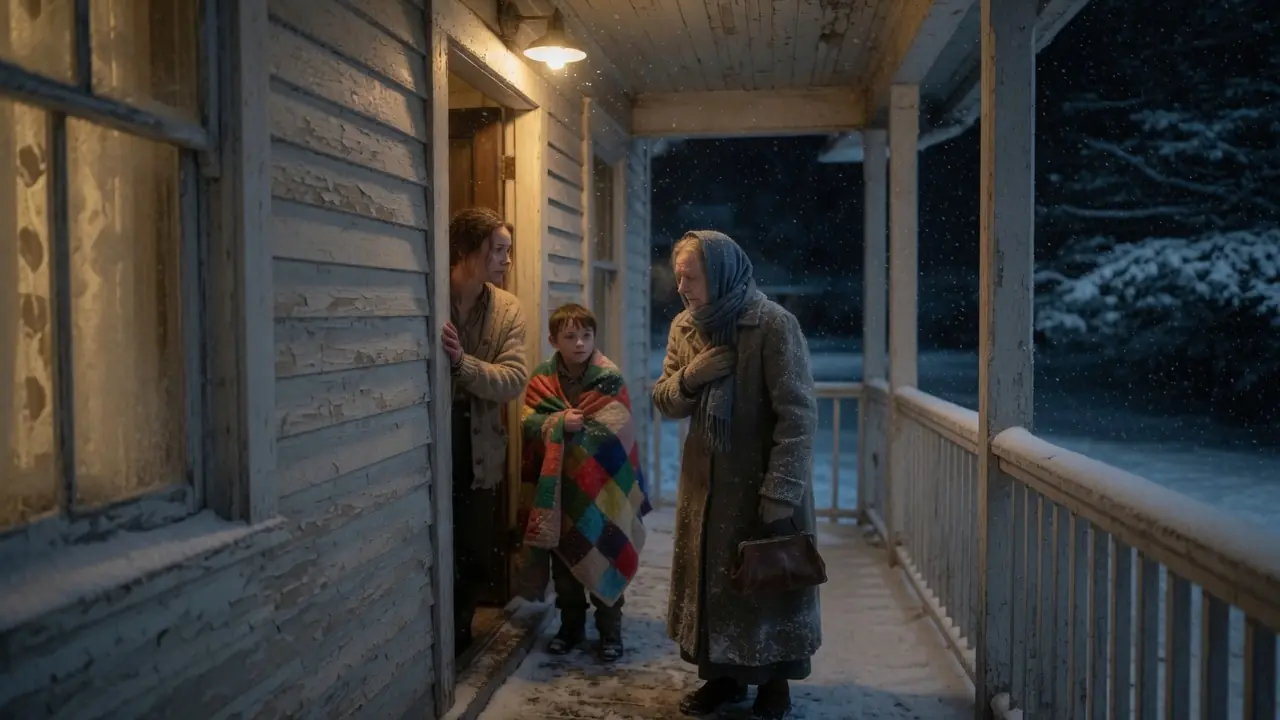
Grace looked past her into the dark street. Most houses on Maple Row had gone quiet hours ago, their windows black, their driveways buried under fresh snow. The wind had pushed drifts against the curb, and the only footprints leading to Grace’s porch were the old woman’s uneven ones, shaky and half-covered already. There was no car, no taxi, no neighbor standing nearby, no one calling after her.
Behind Grace, her seven-year-old son Ethan stood in the hallway holding his dinosaur blanket around his shoulders. He had been asleep ten minutes earlier, until the knock shook both of them awake. Now his brown eyes were fixed on the stranger’s pale face, his own face full of fear and pity. He stepped closer and whispered, “Mom… she’s shaking.”
Grace had learned to be careful since Ethan’s father left three years ago. Single motherhood had made her hear danger in ordinary sounds: a knock after dark, tires slowing near the curb, footsteps too close behind her at the grocery store. She had no husband in the house, no savings worth mentioning, and a front door that stuck unless she leaned her shoulder against it. Still, the woman on the porch looked less like danger than someone danger had already found.
Grace opened the door wider. “Come inside before the cold decides for us.”
The old woman lifted her face, startled. “I don’t want to trouble you.”
“You already knocked,” Grace said gently. “That means you needed someone.”
The woman stepped over the threshold with careful, aching movements. Snow fell from her shoes onto the worn rug by the door, and she winced as if embarrassed by every flake. Grace closed the door quickly, shutting out the wind, then turned up the old space heater near the living room. The house was small, drafty, and plain, but compared to the porch, it felt like mercy.
Ethan hurried forward with the blanket. “You can use this,” he said.
The old woman stared at him as though no child had offered her anything in years. “Oh, sweetheart, I can’t take your blanket.”
“It’s okay,” Ethan said. “I have another one with sharks.”
Grace watched her son place the colorful blanket around the woman’s shoulders. The old woman’s mouth trembled, and for a second Grace thought she might collapse from gratitude alone. Instead, she clutched the blanket with both hands and whispered, “Thank you. My name is Margaret Ellis.”
“I’m Grace,” she said. “That’s Ethan.”
Margaret looked at Ethan again. “You’re a kind boy.”
Ethan shrugged in the embarrassed way children do when praised too seriously. “Mom says you’re supposed to help people when it’s cold.”
Grace felt a small ache in her chest. She said things like that often, though usually while trying to explain why they dropped cans at the church pantry even when their own cupboards were thin. She wanted Ethan to grow up generous, but generosity was easier to teach when the electric bill was not due Friday. Tonight, she had half a pot of soup, four slices of bread, and enough heat to get through the night if the power did not fail.
Margaret stood near the doorway as if waiting to be sent back outside. Her gray coat was wet at the hem, and her cheeks had the waxy look of someone who had been cold too long. Grace guided her toward the couch and helped her sit. When Margaret’s knees bent, she made a quiet sound of pain and tried to hide it with a cough.
“Where is your family?” Grace asked.
Margaret’s hands tightened around the purse. “They have a house,” she said. “I’m just not welcome inside it anymore.”
Ethan looked at Grace, confused. To him, family was supposed to be the place you came back to, even when things were difficult. Grace knew better, but she wished he did not. She took a blanket from the back of the chair and laid it over Margaret’s lap.
“Did someone put you out tonight?” Grace asked.
Margaret looked toward the window, where snow pressed against the glass in soft white bursts. “My daughter-in-law said I was making everyone miserable. My son said maybe some fresh air would calm things down.” She gave a small, bitter smile. “Then he locked the door.”
Grace went still. “They locked you outside in this?”
Margaret’s eyes filled, but she blinked the tears away before they fell. “I walked until I found a light.”
For a moment, Grace did not trust herself to speak. She thought of her own mother, who had died before Ethan was born, and how she would have emptied every drawer in the house to keep her warm. She thought of the kind of son who could look at the woman who raised him and turn a lock while snow fell. Then she thought of Ethan listening, absorbing the shape of adult cruelty.
“We’ll call someone,” Grace said. “Maybe a shelter, or the hospital, or—”
“No police,” Margaret said quickly.
Grace frowned. “Margaret, they left you outside.”
“I know.”
“That’s dangerous.”
“I know that too.” Margaret looked down at her purse. “But if police come, my son will smile and say I wandered off. He’ll say I’m confused. He’ll say I exaggerate. And people believe the person who speaks firmly, not the old woman who shakes.”
Grace understood that more than she wanted to. After her husband, Ryan, left, people had believed his calm explanations before they believed her exhaustion. He told friends she was dramatic, that money was tight because she could not budget, that he needed space because she made home unbearable. Grace had learned that a steady voice could hide a thousand betrayals.
“Do you have somewhere safe to go tomorrow?” Grace asked.
Margaret hesitated. “Maybe.”
That word was not an answer. Grace walked into the kitchen and ladled soup into a chipped bowl. It was potato soup stretched with onions and too much water, but it was hot. She toasted two slices of bread, buttered them lightly, and carried the food back to Margaret with a spoon.
Margaret stared at the bowl. “I don’t want to take your dinner.”
“You’re not taking it,” Grace said. “I’m giving it.”
Ethan sat on the floor near the coffee table, still watching Margaret with quiet concern. “Do you like dinosaurs?” he asked suddenly.
Margaret blinked. “Dinosaurs?”
He nodded. “My blanket has them. That one you’re using. The green one is a T. rex, but Mom says he looks like he’s smiling.”
Margaret looked down at the blanket, and a fragile laugh escaped her. “I suppose he does.”
That laugh changed the room. It did not erase the cold or the cruelty, but it reminded Grace that Margaret was not only an abandoned old woman. She was a person who had once laughed easily, maybe baked cookies, maybe scolded children for muddy shoes, maybe danced in a kitchen before age and betrayal bent her shoulders. Grace sat across from her and waited while she ate.
Margaret’s hands shook so badly that soup spilled on the napkin beneath the bowl. She apologized each time. Grace told her not to. Ethan, trying to help without making her feel watched, brought another napkin and placed it beside her elbow.
After a few minutes, color returned faintly to Margaret’s cheeks. She looked around the small living room, at the stack of library books, the basket of laundry, the Christmas lights Ethan had taped crookedly along the window though it was only November. Her gaze settled on a framed photo of Grace and Ethan at the county fair, both of them laughing with powdered sugar on their shirts. Something soft and sad moved across her face.
“You two live alone?” Margaret asked.
Grace nodded. “Yes.”
“No husband?”
“No.”
“I’m sorry.”
Grace almost laughed, but not because it was funny. “Some absences are easier than their presence.”
Margaret studied her, then nodded slowly. “Yes. They are.”
Ethan yawned and leaned against Grace’s leg. She smoothed his hair. “You need to go back to bed.”
“But what about Mrs. Margaret?”
“She’ll sleep on the couch tonight.”
Margaret straightened. “Oh no, I couldn’t possibly—”
“You can,” Grace said firmly. “And you will.”
Ethan smiled sleepily. “Mom uses that voice when it’s already decided.”
Margaret looked at Grace, and this time her tears did fall. She wiped them quickly with the edge of the dinosaur blanket. “I haven’t had someone decide kindness for me in a long time.”
Grace helped Ethan back to bed, tucked him in, and promised the old woman would still be there in the morning. When she returned to the living room, Margaret was standing near the window, holding her purse against her chest. Outside, the streetlight shone through falling snow, turning the whole neighborhood into something quiet and unreal.
“You should rest,” Grace said.
Margaret did not turn. “My son’s name is Daniel. He was a sweet boy once.”
Grace stayed silent.
“I keep trying to remember when he changed,” Margaret continued. “Maybe it was after his father died. Maybe it was when money became something he could smell from across a room. Maybe it was when he married Vanessa, who never raised her voice but could cut skin with a sentence.”
Grace folded her arms, not from judgment, but from cold. “Do they live in your house?”
Margaret nodded. “My husband built it. Daniel said I shouldn’t be alone after my fall last year. He said he and Vanessa would move in to help.” She swallowed. “Within two months, my bedroom was moved downstairs beside the laundry room. Within four, my bank card disappeared. By summer, I was asking permission to buy toothpaste.”
Grace’s jaw tightened. “Margaret…”
“I signed papers,” Margaret said. “I thought they were for medical access. Daniel said he needed to speak with insurance and my doctor. Later, I learned I had signed over power of attorney.”
Grace felt anger rise hot and immediate. “You need a lawyer.”
Margaret gave a tired smile. “I had one. Or rather, my husband had one. Samuel Price. He retired, then passed his practice to his daughter, Rebecca. I wrote to her last month. I don’t know if the letter reached her.”
“Did you tell her what was happening?”
“I tried.”
Grace looked at the purse. “Do you have her number?”
Margaret’s hand shifted protectively. “I have papers.”
“Then tomorrow we call.”
Margaret turned toward her. “Why would you help me?”
Grace could have given many answers. Because you were freezing. Because your son is cruel. Because Ethan was watching. Because someone should have helped my mother when she was sick, and no one did. But the truest answer was simpler.
“Because you knocked,” Grace said.
Margaret closed her eyes as if the words had hurt and healed at the same time. Grace made up the couch with extra blankets, set a glass of water nearby, and gave Margaret a pair of wool socks from her own drawer. They were too big, but Margaret held them as if they were expensive. Before Grace turned off the lamp, Margaret reached for her hand.
“If I’m gone before you wake,” Margaret said, “don’t think badly of me.”
Grace frowned. “Why would you be gone?”
“Old habits,” Margaret whispered. “When people make you feel unwanted long enough, staying begins to feel rude.”
Grace squeezed her hand. “You are not unwanted in this house tonight.”
Margaret stared at her for a long time. Then she nodded and lay down under the blankets.
Grace slept badly. Every creak in the house woke her. Every gust of wind made her imagine Margaret back outside, walking alone through snow until her footprints vanished. Around dawn, she finally drifted into a heavier sleep and woke to Ethan shaking her shoulder.
“Mom,” he whispered. “Mrs. Margaret is gone.”
Grace sat up instantly. “What?”
“She’s not on the couch.” Ethan held out a folded paper with both hands. “And I found this on the porch.”
Grace’s heart dropped. She threw on her cardigan and hurried to the living room. The blankets were folded neatly on the couch. The bowl and spoon had been washed and set upside down by the sink. The wool socks were gone, and so were Margaret’s wet shoes.
The front door was unlocked.
Grace opened the folded paper Ethan had found. The handwriting was careful but uneven, slanting downward as if the hand had tired before the heart did. At the top, it said: To the woman who opened the door.
Grace read while Ethan stood beside her, silent.
Dear Grace, if I leave before morning, it is not because your kindness was small. It is because I am afraid my son will come here and bring trouble to your porch. You have a child, and I will not repay warmth by putting him in danger.
I placed Rebecca Price’s business card under the flowerpot outside. She is the lawyer I tried to reach. Please call her if you can. Tell her Margaret Ellis was at your home on Maple Row and that Daniel and Vanessa locked me out during the snowstorm.
There is one more thing. In my purse, I still carry the original letter my husband wrote before he died. Daniel does not know I kept it. It says the house was never meant to become his while I am alive, and it names a fund he was not supposed to touch. If I do not reach Rebecca, he may destroy everything.
Grace stopped reading, her pulse pounding.
Ethan looked up at her. “Is Mrs. Margaret in trouble?”
Grace folded the note carefully. “Yes.”
“Are we going to help her?”
Grace looked at her son, his hair messy from sleep, his dinosaur pajamas too short at the ankles. She thought of the mortgage notice on her table, the empty gas tank, the fear that had become her daily weather. Then she thought of Margaret standing in the snow because her own son had made cruelty feel normal.
“Yes,” Grace said. “We are.”
Under the flowerpot, just as Margaret had written, Grace found a damp business card sealed in a plastic sandwich bag. Rebecca Price, Attorney at Law. Elder Rights, Estates, Family Protection. Grace called before breakfast, expecting voicemail, but a woman answered on the second ring.
When Grace explained, Rebecca’s voice changed immediately. “Margaret Ellis was with you last night?”
“Yes.”
“Is she still there?”
“No. She left before dawn.”
Rebecca exhaled sharply. “I’ve been trying to find her for three weeks. Her son blocked my calls and told me she was in a memory care facility.”
Grace looked toward Ethan, who was pretending not to listen while listening to every word. “She said he locked her out.”
“Do you have that in writing?”
“She left a letter.”
“Keep it safe,” Rebecca said. “And Grace, listen carefully. If Daniel Ellis realizes she contacted someone, he may try to force her into a facility today. I’m calling Adult Protective Services now. Can you send me a photo of the letter?”
Grace did. Within an hour, the quiet of Maple Row broke open. A caseworker named Joanna Fields called, then Rebecca called again, then a hospital social worker confirmed that an elderly woman matching Margaret’s description had been brought into St. Anne’s Emergency Room by a bus driver who found her confused and weak near the transit station. Grace covered her mouth when she heard.
“She’s alive?” Ethan asked.
Grace nodded, tears filling her eyes. “She’s alive.”
By noon, Grace was at the hospital with Ethan, though she had nearly talked herself out of going ten times. She did not belong in Margaret’s family mess, she told herself. She was just a cashier, just a mother trying to stay afloat, just a stranger who had opened a door. But every time she thought that, she saw Margaret’s handwriting: To the woman who opened the door.
Margaret lay in a hospital bed with an IV in her arm and Grace’s wool socks still on her feet. When she saw Grace, her face crumpled. “You came.”
Grace moved to her bedside. “You left my house in a snowstorm.”
“I was trying not to burden you.”
“You failed,” Grace said, but her voice was gentle. “Now I’m worried and stubborn.”
Ethan stepped forward and held up the dinosaur blanket. “You forgot this.”
Margaret reached for it with shaking hands. “Oh, sweetheart.”
Before anyone could say more, a sharp voice cut through the doorway. “What is she doing here?”
A tall man in an expensive coat stood at the entrance, his face tight with anger disguised as concern. Beside him was a woman with perfect hair, a red wool coat, and eyes that moved over Grace like she was dirt on a clean floor. Grace knew without being told that they were Daniel and Vanessa Ellis.
Daniel stepped into the room. “Mother, you scared us half to death.”
Margaret shrank against the pillow.
Grace saw it, and something inside her hardened.
Vanessa looked at Grace. “Are you the woman who took her in?”
Grace lifted her chin. “I’m the woman who found her freezing on my porch.”
Daniel smiled tightly. “My mother gets confused. She wanders. We’ve been dealing with this for months.”
Margaret whispered, “I don’t wander.”
Daniel ignored her. “We appreciate your concern, but this is a family matter.”
Rebecca Price entered behind him before Grace could answer. She carried a leather briefcase and wore the calm expression of someone who had brought documents to a knife fight. “Then it’s fortunate I’m the family attorney.”
Daniel turned pale for half a second before recovering. “Rebecca. This is unnecessary.”
“Locking your mother out during a snowstorm was unnecessary,” Rebecca said.
Vanessa laughed once. “That is not what happened.”
Grace reached into her purse and removed Margaret’s letter. “She wrote down what happened.”
Daniel’s eyes snapped to the paper.
Rebecca took it from Grace, slid it into a folder, and looked at Margaret. “Mrs. Ellis, do I have your permission to speak on your behalf?”
Margaret’s mouth trembled, but she nodded. “Yes.”
Daniel stepped forward. “Mother, don’t do this. You’re tired. You don’t understand what you’re signing.”
Margaret looked at him then, really looked at him. “I understand locks, Daniel.”
The room went silent.
Rebecca opened her briefcase. “I also have a copy of your father’s letter, Daniel. The one you claimed didn’t exist. Margaret mailed it to me three weeks ago.”
Vanessa’s expression changed. “What letter?”
Daniel’s jaw clenched. “Not now.”
“Oh,” Rebecca said. “Now is exactly when.”
She explained it clearly, with Joanna Fields from Adult Protective Services arriving halfway through. Margaret’s husband had left the house in a trust for Margaret’s use and protection for the rest of her life. Daniel had no right to sell it, mortgage it, or remove her from it. The fund he had been using for renovations, vacations, and Vanessa’s “consulting expenses” had been established for Margaret’s care.
Daniel tried to interrupt. Rebecca kept speaking. Vanessa tried to blame confusion. Joanna asked Margaret direct questions, and Margaret answered every one. Grace stood near the wall with Ethan’s hand in hers, watching the old woman on the bed become less fragile with every truth spoken aloud.
Finally, Daniel turned on Grace. “This is your fault.”
Grace felt Ethan flinch beside her. She stepped slightly in front of him. “No. This is what happened when you left your mother in the snow and she knocked on the wrong poor woman’s door.”
Daniel’s face flushed. “You don’t know anything about our family.”
“I know she apologized for eating soup,” Grace said. “I know she was afraid to sleep on a couch because staying felt rude. I know your mother shook harder when she heard your voice than she did when she stood on my porch in the cold.”
Margaret covered her mouth with one trembling hand.
Daniel looked around the room and realized no one was standing with him. Not Rebecca. Not Joanna. Not the nurse at the door. Not even Vanessa, who had gone quiet as soon as money and legal consequences entered the conversation.
Rebecca closed her folder. “Mrs. Ellis will not be released to your care. Emergency protective measures are being filed today. The financial records will be reviewed.”
Daniel said nothing.
Vanessa grabbed his arm. “We should leave.”
They left with the stiff dignity of people who had lost control but not arrogance. After they were gone, Margaret began to cry. Not loudly. Not dramatically. Just the quiet, exhausted crying of someone who had been holding fear in her body for too long.
Grace sat beside her. “You’re safe.”
Margaret shook her head. “You don’t know what you did.”
“I opened a door.”
“No,” Margaret whispered. “You believed me.”
That sentence stayed with Grace for weeks.
Margaret did not return to Daniel’s house. With Rebecca’s help, the locks were changed, the accounts frozen for review, and temporary care arranged in Margaret’s own home with a visiting nurse. Daniel and Vanessa moved out under legal pressure, though not without threats. Margaret insisted Grace and Ethan come for dinner once she was strong enough.
The Ellis house was not a mansion, but to Grace it felt grand: old brick, polished wood floors, shelves of books, framed black-and-white photographs, and a kitchen that smelled of cinnamon tea. Margaret moved slowly with a cane, but she stood taller there than she had on Grace’s porch. She showed Ethan a box of wooden trains that had belonged to Daniel when he was little, before greed had entered the rooms.
Ethan played carefully on the rug while Margaret and Grace sat at the kitchen table. “I want to ask you something,” Margaret said.
Grace smiled. “If it’s about more soup, I can’t cook much beyond survival food.”
Margaret laughed softly. “No. Rebecca says I need a household assistant a few days a week. Someone to help with groceries, appointments, mail, and making sure no one talks me into signing foolish things again.” She folded her hands. “I would like to offer the job to you.”
Grace stared at her. “Margaret, I already have work.”
“At the grocery store.”
“Yes.”
“How much do they pay you?”
Grace looked down. “Not enough.”
“I can pay more than not enough.”
Grace shook her head. “I didn’t help you for a job.”
“I know,” Margaret said. “That is why I trust you with one.”
Grace looked toward Ethan, who was making a train cross an imaginary bridge. She thought of evening shifts, missed school meetings, cheap meals, overdue bills, and the constant terror of one emergency ruining everything. She also thought of pride, and how often pride had kept her hungry for no noble reason. Margaret reached across the table and touched her hand.
“Grace, kindness should not always leave empty-handed,” she said.
Grace accepted the job two weeks later. It started as three days a week and soon became steady work with flexible hours, better pay, and enough dignity to make Grace realize how little she had been given before. She helped Margaret sort mail, attend appointments, review bills with Rebecca, and slowly reclaim the rooms that had become prisons under Daniel’s control. Ethan came after school and did homework at Margaret’s kitchen table.
In time, the house grew warm again. Margaret taught Ethan to make apple muffins. Grace learned that Margaret had once been a school librarian and still remembered the favorite books of children who were now grandparents. On snowy evenings, Margaret would stand by the window and watch the porch light, never forgetting the night she had walked until she found one.
One year later, on the first snowfall of the season, Grace came home from Margaret’s house to find Ethan standing on their porch with his dinosaur blanket around his shoulders. He was looking at the porch light. Snow gathered in his hair, and for one frightening second Grace saw the memory of Margaret standing there again.
“What are you doing out here?” Grace asked.
Ethan turned. “I wanted to make sure the light was on.”
Grace’s throat tightened. “Why?”
He looked down the street, where snow softened the dark edges of every house. “Because someone might need one.”
Grace stepped onto the porch and wrapped her arm around him. The house behind them was still small. The door still stuck. The heater still rattled when the wind came from the north. But the light above the porch burned steady and gold against the snow.
A year earlier, Grace had thought she was too poor to save anyone. She had thought kindness required extra money, extra time, extra safety, extra strength. But Margaret had taught her something different. Sometimes kindness was just refusing to let fear close the door.
Margaret had knocked because she was alone.
Grace had opened because she understood loneliness.
And because of that, an elderly woman found her way home, a mother found a better life for her son, and a little boy learned that the smallest porch light could become the beginning of someone’s rescue.