Rain struck the windows of Dalton’s Highway Diner so hard that the passing headlights looked like pale smears across the glass. It was almost ten at night, and the booths along the front wall had been empty for more than an hour. Only a truck driver drinking coffee near the register and an elderly couple sharing pie remained inside. Hannah Carter was wiping the counter when the bell above the entrance rang.
The man who entered looked as though the storm had dragged him there.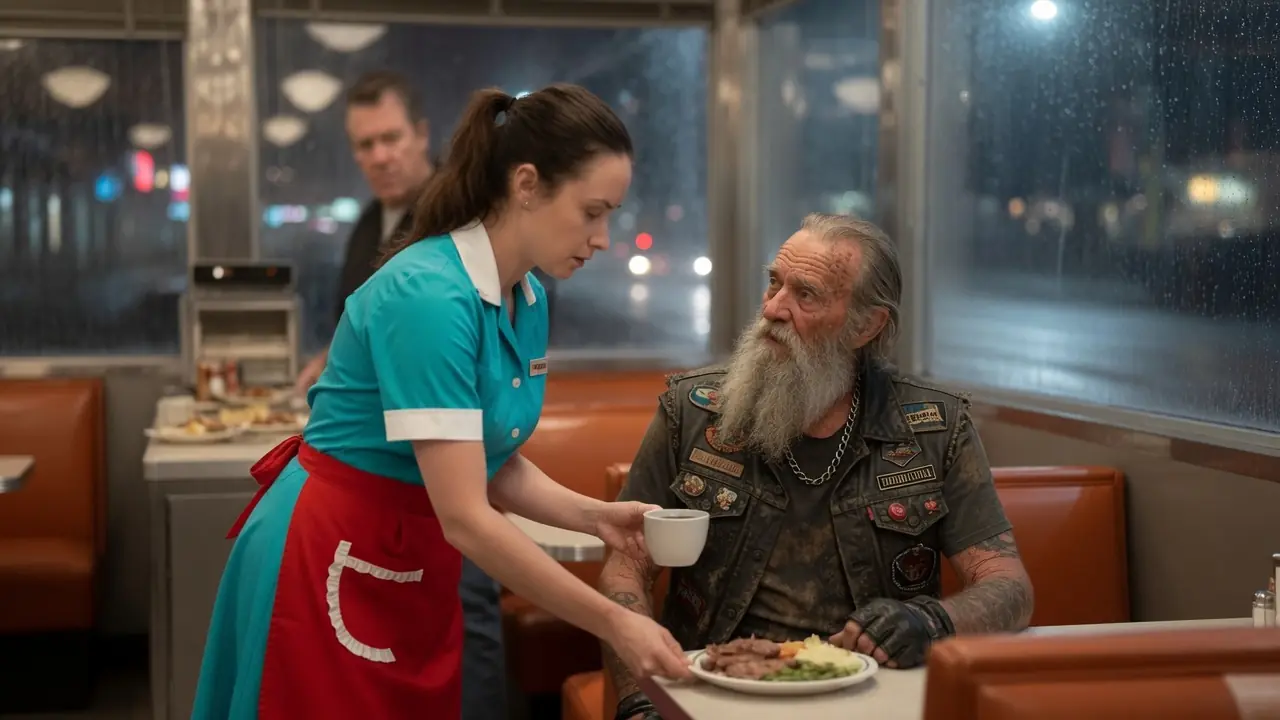
He was tall and broad, with a soaked black leather vest hanging heavily from his shoulders. Rainwater ran from his beard, and a dark bruise covered one side of his face. His jeans were stained with mud, while his right hand remained pressed against his ribs as though every step hurt.
A patch on his vest showed a silver wheel beneath two crossed roads. Smaller patches had been torn away, leaving pale outlines in the leather. Hannah noticed his motorcycle helmet, but there was no motorcycle visible through the windows.
“Sit anywhere,” she said.
The man chose the booth closest to the door. He lowered himself carefully, placed the helmet beside him, and stared at the menu without opening it. When Hannah approached, he pushed the menu back and asked for hot water.
“Coffee is free with a meal,” she explained. “Hot water is free either way.”
“That’s all I need.”
Hannah filled a heavy white mug and placed it in front of him. The man wrapped both hands around it but did not drink. His fingers trembled against the ceramic, and his gaze repeatedly drifted toward a plate of roast beef waiting beneath the kitchen heat lamp.
“Why are you sitting here starving instead of asking someone for help?” Hannah asked softly.
The biker looked embarrassed that she had noticed.
“Because I’ve been turned away all day,” he said. “And I’m too tired to be humiliated again.”
His name was Cole Maddox. His motorcycle had failed nearly nine miles west of the diner after a damaged fuel line caused the engine to stop. He had spent the previous night beneath an abandoned service-station awning, then walked most of the day searching for help.
His wallet had disappeared after a crash two days earlier. Cole believed it had fallen from his jacket while paramedics examined him beside the road, but the county hospital had no record of it. His phone had been destroyed in the same accident, leaving him unable to access his bank account or contact anyone.
“You haven’t eaten since the crash?” Hannah asked.
“I had half a candy bar yesterday morning.”
“That isn’t food.”
“It kept me moving.”
Hannah looked toward the kitchen.
A plate of pot roast, mashed potatoes, green beans, and bread remained beneath the heat lamp. The order had been prepared incorrectly for a customer who requested chicken instead. Roy Dalton, the manager, usually charged employees for food that had already been entered into the system.
Hannah had twelve dollars when her shift began.
Seven had gone toward gas so she could reach work and collect her son afterward. The final five-dollar bill was folded inside her apron pocket, reserved for the cereal and milk six-year-old Noah would need the following morning. She could stretch the meal at home one more night, but breakfast would be more difficult.
Hannah touched the bill through the fabric.
Then she carried the roast-beef plate to Cole.
“Eat this,” she said. “You don’t have to beg here.”
Cole stared at the food but did not reach for the fork.
“I told you I can’t pay.”
“I heard you.”
“I won’t take food meant for someone else.”
“It was an incorrect order. I’ll cover the employee charge.”
His eyes moved toward her apron pocket.
“That money was all you had, wasn’t it?”
Hannah sat the bread basket beside the plate.
“My son and I have survived mornings with less.”
Cole’s expression tightened.
“Then I can’t accept it.”
“You can accept it, eat, and remember that being hungry does not make you worthless.”
The words seemed to strike something inside him.
Cole lowered his head for several seconds. When he finally picked up the fork, his hand shook too badly to cut the meat. Hannah quietly divided it into smaller pieces without making him ask.
He ate slowly at first.
Then hunger overwhelmed caution.
Within minutes, half the plate was gone. Hannah brought another cup of hot water and found an old towel so he could dry his hair. The truck driver near the register glanced toward them but said nothing.
The kitchen door opened.
Roy Dalton walked into the dining room carrying a clipboard.
He was forty-eight, heavy through the middle, and permanently irritated by anything that did not increase profits. Roy owned no part of the diner despite speaking as though every chair and coffee spoon belonged personally to him. The building was owned by an investment group in Omaha that rarely visited.
Roy noticed Cole immediately.
His eyes moved across the leather vest, wet clothing, bruised face, and empty plate.
“What is he doing here?”
“He ordered dinner,” Hannah replied.
Cole looked up.
Roy inspected the register screen.
“There is no order.”
“I was about to enter it.”
“With what payment?”
Hannah removed the five-dollar bill and placed it beside the register.
Roy picked it up and laughed.
“That plate costs fourteen ninety-five.”
“It was the incorrect order from table six.”
“The food still has inventory value.”
“It would have been thrown away.”
“That decision is not yours.”
Cole pushed the plate away.
“I’ll leave.”
Hannah placed one hand near the edge of the table.
“Finish eating.”
Roy’s face hardened.
“Why did you waste your last five dollars feeding a filthy biker?”
The elderly couple near the window stopped speaking.
Hannah looked directly at her manager.
“Because he was hungry, and nobody else cared.”
Roy pointed toward Cole.
“Men like him make customers nervous.”
Cole glanced down at his damaged vest.
“I haven’t threatened anyone.”
“You walked in looking like trouble.”
“I walked in looking hungry.”
Roy turned toward Hannah again.
“You were warned about giving away food.”
“It was going into the trash.”
“That does not matter.”
“It should.”
Roy pulled the plastic name badge from the front of Hannah’s uniform. The pin caught in the fabric before tearing free.
“Then you’re fired,” he said. “Take your charity somewhere else.”
Hannah stared at the badge in his hand.
For one suspended moment, the noise of the rain disappeared. She saw Noah sitting inside the after-school office, swinging his legs beneath a plastic chair. She saw the rent notice clipped to the refrigerator and the nearly empty inhaler inside the bathroom cabinet.
Roy expected her to apologize.
He expected fear to restore her obedience.
Instead, Hannah untied her apron.
“Pay me for every hour I worked.”
“You’ll receive whatever payroll shows.”
“I also want the tips from tonight.”
Roy gestured toward the door.
“Leave before I call the police.”
Cole rose slowly from the booth.
Pain crossed his face, but his voice remained controlled.
“She lost her job because she fed me.”
“She lost her job because she ignored management.”
Cole stepped closer to the counter.
“What’s your name?”
Roy smiled contemptuously.
“You planning to complain?”
“No. I’m planning to remember.”
Roy called the security guard from the motel next door. By the time the guard arrived, Hannah had collected her coat and small purse. Cole folded the remaining bread inside a napkin and placed it carefully in his vest.
Outside, the rain had weakened but the air remained cold.
Hannah stood beneath the diner awning and checked the time. The after-school center had closed forty minutes earlier. Noah’s teacher had agreed to wait, but another delay would cost money Hannah no longer possessed.
Cole approached her.
“I’m sorry.”
“You didn’t fire me.”
“I brought the problem through the door.”
“Roy has been looking for a reason for months.”
Cole removed a metal pin from the inside of his vest. It carried the same silver wheel symbol as the larger patch.
“Keep this.”
Hannah looked at it.
“What is it?”
“A promise.”
“I don’t need a promise.”
“You gave me food when you couldn’t afford it.”
“I gave you a meal, not a debt.”
Cole closed her fingers around the pin.
“Then call it a way for me to find you.”
A passing sheriff’s deputy stopped after noticing the injured man beneath the awning. Cole explained the broken motorcycle, and the deputy agreed to take him to a repair shop that also offered inexpensive rooms. Before leaving, Cole asked Hannah for her full name.
“Hannah Carter.”
He repeated it once.
Then he climbed into the patrol car and disappeared into the rainy night.
Hannah collected Noah from his teacher’s apartment instead of the school. The boy ran toward her wearing a red jacket and carrying a paper bag containing crackers. His dark curls were flattened on one side from sleeping against the couch.
“You’re late,” he said.
“I know. I’m sorry.”
“Did the car break?”
“No.”
“Was the diner busy?”
Hannah knelt and zipped his jacket.
“I don’t work there anymore.”
Noah’s small face became serious.
“Did you quit?”
“They fired me.”
“Why?”
She considered inventing a softer explanation.
“Because I bought food for someone who was hungry.”
Noah looked confused.
“Isn’t that what diners do?”
Hannah almost laughed.
“That’s what I thought.”
At home, she made scrambled eggs with the last three eggs in the refrigerator. Noah ate most of them while Hannah claimed she had eaten at work. She drank water and calculated how long the remaining food might last.
Her former husband called before midnight.
Travis Carter had not spoken to Hannah in nearly two weeks, but news of her job loss reached him through Roy’s assistant manager, whose sister dated one of Travis’s coworkers. Their town was large enough for strangers but small enough for humiliation to travel quickly.
“I heard you were fired,” Travis said.
“That was fast.”
“You lost another job.”
“I worked there fourteen months.”
“You were dismissed for giving away company property.”
“I bought one meal.”
“You’re always making emotional decisions and expecting other people to absorb the consequences.”
Hannah looked toward Noah’s bedroom.
“What do you want?”
“I want our son living somewhere stable.”
The sentence carried the same threat Travis had used since their divorce. He rarely paid support on time, yet he kept photographs of his new apartment and truck as evidence that he offered the better household. Whenever Hannah struggled, Travis suggested he could seek full custody.
“You missed your last two support payments,” she said.
“My lawyer says financial support and custody are separate matters.”
“Your lawyer also told you to stop threatening me.”
Travis lowered his voice.
“If you cannot pay rent, call me before you expose Noah to homelessness.”
He ended the call.
Hannah did not sleep.
The following morning, she applied for seven jobs. One café offered twelve hours a week. A gas station manager promised to call after reviewing her references, while a hotel restaurant told her holiday hiring had ended.
Roy delayed her final paycheck.
The emergency assistance office said she needed formal proof of termination. Roy refused to provide it until the next payroll period. Every system required one more form, one more appointment, or one more week than Hannah had.
Cole spent that same morning inside a small repair shop west of Des Moines.
The mechanic replaced the motorcycle’s fuel line and allowed him to use a phone. Cole made one call to a number in Colorado.
The woman who answered demanded to know where he had been.
“My bike went down,” he explained.
“We’ve had chapters looking for you in four states.”
“I lost my phone.”
“You also missed the regional planning meeting.”
Cole looked through the repair-shop window.
“I found something more important.”
Cole Maddox was not merely another member of a motorcycle club. Twelve years earlier, he founded Iron Route Relief after riders from three states delivered emergency supplies to towns cut off by flooding. The organization had grown into a national network of more than twenty thousand motorcyclists.
They transported medicine after storms, escorted children to medical fundraisers, repaired homes for injured veterans, and delivered food to isolated communities. Most members held ordinary jobs as mechanics, nurses, electricians, teachers, and drivers.
Cole had been traveling alone because he wanted to inspect new relief routes without an entourage.
The crash left him stranded before anyone knew where to search.
He told regional coordinator Dana Brooks about Hannah, the five-dollar meal, and the firing. Dana listened silently.
Then she asked one question.
“What does she need?”
“Not charity.”
“What, then?”
“A chance.”
Iron Route Relief held more than forty regional events each year. Their previous food-service company had recently ended its contract after being purchased by a national corporation. The organization needed a dependable catering partner for training weekends, charity rides, rebuilding crews, and mobile food stations.
Cole did not know whether Hannah could manage that work.
He intended to find out.
On the second day after the firing, Hannah received an eviction warning.
She was only eighteen days late, but the landlord had grown tired of promises. The notice gave her five days to pay or agree to a formal departure plan.
Travis arrived that afternoon.
He brought his attorney’s business card and a temporary custody proposal. Under the arrangement, Noah would live with Travis until Hannah proved she had stable income and housing.
“You planned this quickly,” Hannah said.
“I’m thinking about our son.”
“You’re thinking about control.”
“I’m offering you time to recover.”
“With a paper that gives you full decision-making authority.”
“It’s temporary.”
“Then why does it require me to surrender school and medical decisions?”
Travis’s expression hardened.
“You have no job.”
“That does not make me an unfit mother.”
“No, but your choices show poor judgment.”
Hannah looked at the custody document.
“One meal.”
“It cost you your job.”
“Roy cost me my job.”
Travis stepped toward the door.
“Sign by Friday, or I’ll file for emergency custody.”
Hannah tore the proposal in half.
He left without saying goodbye to Noah.
The third morning began with a low sound outside town.
At first, Hannah believed thunder was approaching. Then the sound deepened, multiplied, and rolled across the road in waves. People stepped outside stores and gas stations as motorcycles appeared beyond the eastern hill.
There were dozens at first.
Then hundreds.
They rode in organized lines, headlights shining through the pale morning mist. Black, blue, red, and silver motorcycles filled the highway shoulder. Riders wore different club colors, but each displayed the silver-wheel emblem of Iron Route Relief.
Five hundred motorcycles entered the diner parking lot.
Roy Dalton ran outside before the first engines had stopped.
He had heard rumors online that bikers were coming because of a waitress he fired. Believing they intended to threaten the diner, he called police, the building owner, and a local television station.
Hannah knew nothing about their arrival until Emma, a former coworker, called.
“You need to see this.”
“See what?”
“There are motorcycles everywhere.”
Hannah borrowed her neighbor’s car and drove toward the diner with Noah beside her. Traffic slowed nearly half a mile away. Riders stood quietly around the parking lot while police officers observed from the road.
Nobody damaged anything.
Nobody entered without permission.
At the center of the crowd stood Cole Maddox.
His bruises remained visible, but he wore a clean leather jacket with the Iron Route Relief founder patch across the chest. Beside him were Dana Brooks, a lawyer, a culinary operations manager, and representatives from twelve regional chapters.
Roy spotted Hannah first.
He pointed toward her.
“This is your fault!”
Hannah stopped near the edge of the crowd.
“My fault?”
“You sent these people to intimidate me.”
Cole walked forward.
“She didn’t send anyone.”
Roy looked at him.
“You’re the vagrant she fed.”
“I was hungry and stranded.”
“You caused a disturbance in my restaurant.”
“I sat in a booth and ate roast beef.”
Several riders laughed.
Roy’s confidence weakened.
Cole held out a thick folder toward Hannah.
“You gave me one meal,” he said. “Our organization wants to hire you.”
Hannah did not take the folder.
“For what?”
Dana stepped beside him.
“Iron Route Relief needs a catering partner for events in five states. We need someone who understands food, logistics, and the fact that feeding people is not a favor.”
Hannah looked at the motorcycles filling the street.
“You don’t know whether I can run a catering company.”
“That’s why this is an offer to build one,” Dana said.
The contract began with a six-month trial covering eight events. Iron Route Relief would guarantee minimum orders, provide access to a licensed commercial kitchen owned by a retired riders’ association, and supply initial equipment through a repayable business advance.
Hannah would own the company.
She would hire her staff.
No one would control her personal income or home.
The contract value was enough to pay her rent, purchase insurance, and create a stable salary within the first month.
Roy grabbed the folder.
“This is ridiculous. She’s a waitress.”
Cole took it back.
“She’s the waitress who treated a hungry stranger better than this diner treated either of us.”
Roy looked toward the television camera.
“I was enforcing policy.”
Cole’s voice became cold.
“You used policy to excuse cruelty.”
The investment group that owned the diner sent a representative after watching the livestream. She interviewed employees, reviewed the security recording, and discovered Roy had repeatedly removed food from unpaid employee meals while charging those items as losses.
He had also withheld tips and manipulated time records.
Roy was suspended before noon.
His later termination did not return Hannah’s job.
She no longer wanted it.
Hannah spent the next week reviewing the catering agreement with an independent attorney. She rejected two provisions, changed the repayment schedule, and insisted that Iron Route Relief could not represent her business as its property.
Cole accepted every reasonable revision.
“You’re not offended?” Hannah asked.
“I’d be disappointed if you signed without reading.”
The commercial kitchen stood inside an old union hall near Des Moines. It needed cleaning, new refrigeration, and more confidence than Hannah possessed. She hired Emma from the diner and a retired school cook named Gloria Reyes.
Their first event fed three hundred riders rebuilding tornado-damaged homes.
The potatoes arrived late.
Two ovens failed.
The first batch of gravy was nearly inedible.
Yet everyone ate, and the second meal went better.
Within six months, Hannah Carter Catering employed nine people. The company provided meals for relief crews, hospital charity rides, veterans’ housing projects, and flood-response teams.
Hannah repaid the equipment advance ahead of schedule.
Travis still filed for emergency custody.
His attorney argued that Hannah’s new work involved unpredictable motorcycle events and unsafe people. Hannah’s lawyer presented her signed contract, business insurance, tax records, stable housing, and testimony from school officials confirming Noah remained healthy and consistently cared for.
Cole did not arrive with five hundred riders at court.
He submitted one quiet affidavit.
The judge denied Travis’s emergency request and ordered him to pay overdue support. She also warned him that using financial pressure to control Hannah could affect future custody decisions.
Outside the courthouse, Travis accused her of replacing one dependent life with another.
Hannah shook her head.
“I am not dependent on Cole.”
“He gave you a business.”
“He gave me a contract. I built the business.”
That distinction became the foundation of everything that followed.
A year after the night Cole entered the diner, Iron Route Relief held its annual gathering in the same county. More than eight hundred riders attended.
Hannah’s company served dinner.
Noah stood beside the dessert table wearing a small apron and proudly announcing which cookies he had decorated. Cole paid for every meal according to the contract, despite Hannah once joking that he had already earned free food for life.
“No,” he said. “That would turn kindness into a bill you keep paying.”
After the event, Hannah found the silver-wheel pin inside a frame near the kitchen office. Beneath it was a small plaque.
ONE MEAL. NO DEBT. ONE OPEN DOOR.
Hannah hung it beside her first business license.
People later told the story as though five hundred bikers had arrived to frighten a cruel manager and rescue a helpless woman. That version made better gossip, but it was not true.
The riders did not threaten Roy.
Cole did not hand Hannah a fortune.
Nobody arrived to solve her entire life while she stood waiting.
They arrived with work.
Hannah accepted it, negotiated it, failed several times, learned quickly, and built something strong enough to belong to her.
Her five dollars did not purchase the future.
They revealed her character at the moment she believed no powerful person was watching.
Cole’s return did not repay the meal.
It proved that sometimes the best response to kindness was not to create obligation, but to recognize ability and open a door that had previously remained closed.
Years later, Hannah still kept emergency meal vouchers inside every catering truck. Any employee could give one to a person who was hungry without requesting managerial approval.
The policy contained only one sentence.
Feed them first.
Because Hannah remembered a stormy night, an injured stranger, and the final five-dollar bill she could not afford to spend.
She also remembered that while kindness might not always feed a family immediately, cruelty had never built anything worth keeping.