“I haven’t eat for 3 days. Water is enough—I can’t pay for this.”
Cole Maddox sat hunched inside the last orange booth of Rosie’s Highway Diner, rainwater dripping from his gray-streaked beard onto a black leather vest covered in faded motorcycle patches. One hand remained pressed against his ribs, and his exhausted blue eyes followed the steaming plate of roast beef, mashed potatoes, and green beans that Hannah Carter had placed before him. Outside, a violent Oklahoma storm hammered the diner windows and turned the empty highway into a silver river beneath the streetlights.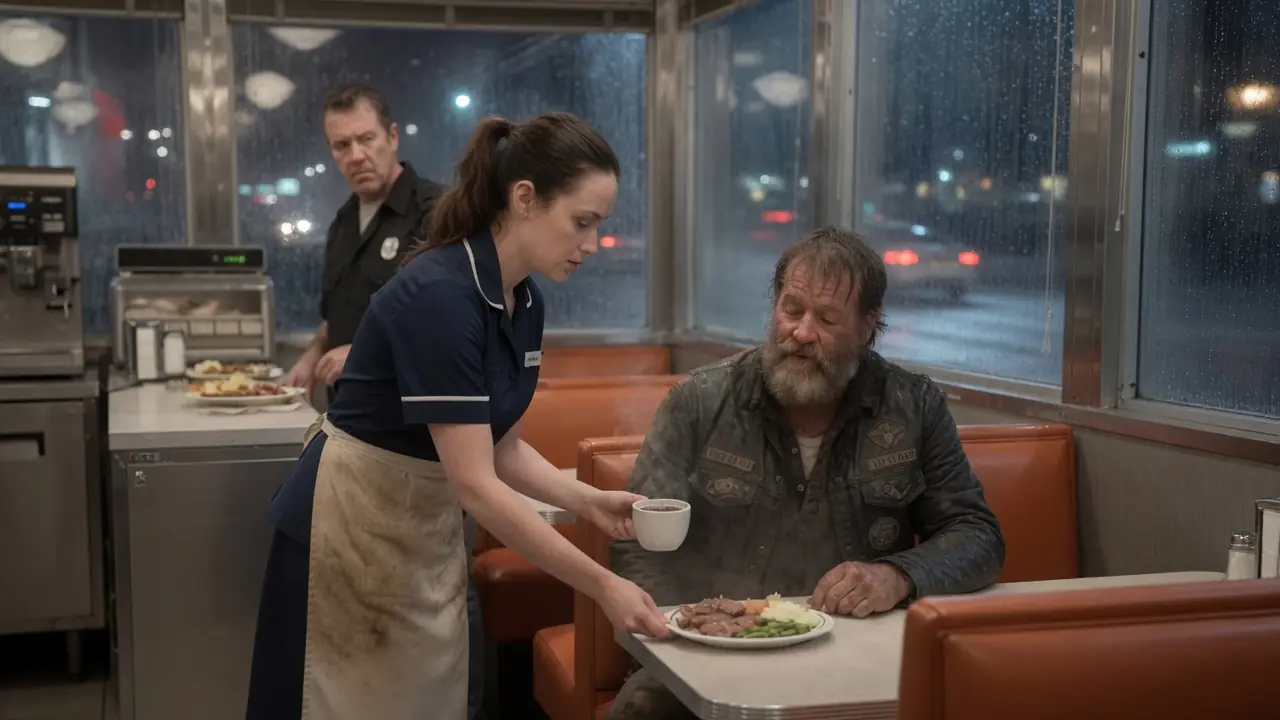
Hannah pushed the plate closer. “Eat. My son can forgive one missed breakfast, but I won’t forgive myself if you collapse.”
Cole looked toward the register, where Hannah had placed a crumpled five-dollar bill beneath the receipt. It was the final money inside her purse, meant to buy cereal and milk for her seven-year-old son after her shift ended. She had rent due in four days, an overdue electricity notice hidden beneath her mattress, and less than twelve dollars remaining in her checking account.
“That’s everything you have,” Cole said. “Helping me could cost you your job.”
Hannah glanced toward the kitchen doorway, where her manager, Wayne Pritchard, stood watching with his arms crossed. “Then let him fire me. Just promise you’ll still be alive when this night is over.”
Cole studied her face for several seconds before lifting the fork. He ate slowly at first, as though his body had forgotten what to do with food, then faster when hunger overcame caution. Hannah poured coffee into his cup and pretended not to notice the tremor in his hands.
Wayne waited until Cole had swallowed half the meal before marching across the diner.
“What do you think you’re doing?” he demanded.
Hannah straightened beside the booth. At thirty-two, she was used to making herself smaller around angry men, but she had spent the previous year trying to break that habit. “Serving a customer.”
“A customer pays.”
“I paid.”
Wayne glanced toward the five dollars beside the register and laughed without humor. “That money doesn’t cover the meal, coffee, or the time you’re wasting.”
“Take the difference from my tips.”
“You don’t have enough tips.”
Cole set down his fork. “The lady said she paid.”
Wayne turned on him. “Nobody asked you, old man.”
The diner became silent except for the rain. Hannah saw something harden behind Cole’s tired eyes, but he did not rise. He was injured, hungry, and likely in no condition to fight even if he wanted to.
Hannah stepped between them. “He’s finishing his meal.”
Wayne’s face reddened. “No, he isn’t. And you’re finished too.”
She stared at him. “What?”
“You heard me. Take off the apron, leave your key, and get out.”
Hannah’s throat tightened. She had worked at Rosie’s for fourteen months, often taking the graveyard shift because it allowed her to be home when her son woke for school. The pay was low and Wayne regularly stole portions of the servers’ tips, but it was the only nearby job that fit around childcare. Losing it meant more than embarrassment; it meant the fragile life she had built could collapse within days.
“You can’t fire me for buying someone food,” she said.
“I can fire you for giving away diner property, disobeying management, and bringing trouble into my restaurant.”
“You don’t own this place.”
“I run it, which means tonight I own your job.”
Cole slowly reached inside his vest. Wayne stepped backward, but the biker removed only a worn leather wallet. He opened it, revealing an empty bill compartment and a small card bearing the emblem of the Iron Brotherhood Motorcycle Association.
“What’s your name?” Cole asked Hannah.
“Hannah Carter.”
“And your boy?”
She hesitated. “Eli.”
Cole nodded as if committing both names to memory. “I’ll repay you.”
“You don’t owe me anything.”
“I always repay what matters.”
Wayne pointed toward the entrance. “Both of you, out.”
Hannah removed her apron with trembling fingers and folded it on the counter. Before leaving, she packed the remainder of Cole’s meal into a paper container and placed it inside a plastic bag so the rain would not soak through. Wayne watched with disgust but did not stop her.
Outside, Cole’s motorcycle rested beneath the diner sign, tilted awkwardly against the curb. The front wheel was bent, one mirror was missing, and scratches ran along the fuel tank. Hannah realized he had probably crashed somewhere along the highway before walking the final distance.
“You need a hospital,” she said.
“I need a phone.”
Hannah handed him hers. Cole dialed a number from memory and spoke only four words when someone answered.
“Found shelter. Need pickup.”
He ended the call and returned the phone.
“Someone coming?”
“My family.”
Hannah looked at the empty highway. “You have family nearby?”
“Closer than they were ten minutes ago.”
The storm weakened shortly before sunrise. A black pickup arrived towing a covered motorcycle trailer, driven by a broad woman named Ruth Maddox. She climbed out, embraced Cole carefully, then examined his injuries with the authority of someone accustomed to his stubbornness.
“You disappeared for three days,” Ruth said. “Five hundred people have been looking for you.”
“Road took me down outside Bristow.”
“And your phone?”
“Destroyed.”
Ruth glanced at Hannah. Cole explained what had happened inside the diner in fewer than twenty words. The woman’s expression changed when she heard Hannah had spent her final five dollars feeding him and lost her job because of it.
Ruth reached into her coat, but Hannah shook her head.
“I don’t need payment.”
“You have a child,” Ruth said.
“I’ll find another job.”
“Before breakfast?”
Hannah looked away.
Ruth placed two hundred dollars into her hand. “This isn’t payment. It’s enough breathing room for you to choose what comes next instead of letting panic choose for you.”
Hannah tried to refuse again, but Cole closed her fingers around the money.
“I owe you a meal,” he said. “The rest is from my sister because arguing with her is more dangerous than starving.”
For the first time that night, Hannah smiled.
Ruth loaded the damaged motorcycle while Cole climbed carefully into the passenger seat. Before they departed, he looked back through the open window.
“Seventy-two hours,” he said.
“For what?”
“You’ll see.”
Hannah assumed hunger, pain, or medication had made him speak strangely. She watched the pickup disappear, then walked three miles home because she could not afford to waste any of Ruth’s money on a taxi. The rain had stopped, but her uniform remained soaked, and each step made the reality of losing her job feel heavier.
Eli was asleep on the living-room sofa when she entered their apartment. Her neighbor, Mrs. Alvarez, had stayed with him during Hannah’s shift and left a note explaining that he had refused to sleep in bed until his mother returned. A school drawing rested on his chest, showing Hannah wearing a superhero cape beside the diner.
She knelt and brushed his dark hair away from his forehead.
“Mom?” he murmured.
“I’m here.”
“Did you bring cereal?”
Hannah’s eyes burned. “Not yet, baby. But I brought money for breakfast.”
He smiled sleepily and wrapped both arms around her neck.
Hannah did not tell him she had been fired until after school. She cooked eggs and toast, helped him with his spelling words, then explained that she would be looking for a new job. Eli listened seriously, as he always did when he sensed she was afraid.
“Was it because you helped somebody?”
“Yes.”
“Then your boss is stupid.”
Hannah almost laughed. “We don’t call people stupid.”
“Can I call what he did stupid?”
“That would be more accurate.”
Their conversation was interrupted by heavy pounding against the apartment door.
Hannah knew who it was before opening it.
Derek Sloan, her former husband, stood in the hallway wearing an expensive raincoat and the smug expression he used whenever he believed her circumstances had finally made him powerful again. He was thirty-six, handsome in the polished way that once disguised his cruelty, and he still carried himself as though every room belonged to him.
“I heard you got fired,” he said.
News traveled quickly in a town where Wayne spent most mornings complaining at the gas station.
Hannah stepped into the hallway and closed the door behind her. “Why are you here?”
“To discuss Eli.”
“Our custody arrangement hasn’t changed.”
“Your employment has.”
“I’ll find another job.”
Derek smiled. “You said that the last time you left me.”
Hannah felt the old fear enter her chest. Derek had controlled the bank accounts during their marriage, decided which clothes she could buy, and demanded receipts for every dollar spent on Eli. When she finally left, he told everyone she was unstable and ungrateful.
The divorce court awarded Hannah primary custody after Derek missed several hearings, but he never stopped threatening to take their son whenever money became tight.
“You lost your income,” Derek continued. “You’re behind on rent, and I heard the power company sent another notice. A judge will not leave Eli with a woman who can’t keep food in the house.”
“You haven’t paid child support in two months.”
“I’ve been busy.”
“Apparently not too busy to monitor my job.”
He leaned closer. “Bring Eli to my house tonight, and I won’t file for emergency custody.”
“No.”
“Think carefully. You have no job, no savings, and no family here.”
“I said no.”
Derek’s smile disappeared. “Then I’ll make sure you lose more than a diner shift.”
Hannah waited until he left before allowing herself to breathe fully. She returned inside, locked the deadbolt, and found Eli standing near the sofa.
“Dad wants me to live with him?”
“No.”
“He sounded angry.”
“Your father often sounds angry when people tell him no.”
Eli looked worried. “Are we going to lose the apartment?”
Hannah crouched before him. “Not today. And we are not going to solve tomorrow’s problems before tomorrow arrives.”
She spent the afternoon applying for jobs online. Two restaurants offered interviews, but neither position matched Eli’s school schedule. A grocery store needed an overnight stocker, and a motel offered housekeeping work at minimum wage.
By evening, she had accepted both interviews.
The following morning, Wayne called.
For one foolish second, Hannah believed he might apologize and offer her job back.
“You left your locker full,” he said. “Come clear it out before I throw everything away.”
“I’ll be there after nine.”
“Come after closing tonight. I don’t need you causing another scene during business hours.”
“I didn’t cause the first one.”
“Midnight. Back entrance.”
Hannah nearly refused, but her locker contained Eli’s inhaler, family photographs, and an envelope holding copies of legal documents she kept away from Derek. She agreed to arrive at midnight.
That afternoon, Derek appeared at Rosie’s.
Wayne knew him from the town business association. They sat inside a corner booth, speaking quietly while the lunch crowd thinned. Derek explained that Hannah had embarrassing documents stored in her locker, including messages proving he had hidden income during their divorce.
Wayne had his own reason to dislike her.
Two months earlier, Hannah had discovered that he routinely altered the servers’ time records to avoid paying overtime. She photographed several payroll sheets and warned him that she would report him if he continued stealing wages. Wayne believed those photographs were also inside the locker.
Both men wanted the same envelope destroyed.
Derek suggested trapping Hannah inside the diner after she collected her belongings. Wayne could claim she broke in, and Derek could tell the custody judge that she had become desperate and unstable after losing her job. Neither planned to hurt her physically, they told themselves.
They only intended to frighten her, take the documents, and create a police report that would destroy her credibility.
At 11:58 that night, Hannah parked Ruth’s borrowed money inside her shoe, since her purse had a broken zipper. The diner looked dark from the highway, but Wayne’s truck remained behind the building.
He opened the back door and pointed toward the employee lockers.
“Make it quick.”
Hannah entered cautiously. Chairs rested upside down on tables, the grill was cold, and the only light came from the kitchen. Wayne stood between her and the exit.
“Where’s my locker key?” she asked.
“Inside.”
She opened the metal door and found the photographs, inhaler, spare uniform, and sealed envelope exactly where she had left them. Hannah placed everything into a canvas bag.
Then the lights went out.
The back door slammed.
Hannah heard the deadbolt turn from the other side.
“Wayne?”
No answer came.
She used her phone flashlight and returned to the kitchen. The door would not open, and the front entrance had been secured with a chain. Through the glass, she saw Wayne’s truck leaving the parking lot.
A sharp chemical smell reached her from the storage area.
Hannah followed it and found liquid spreading beneath several stacked boxes near the water heater. A small flame flickered along a pile of oily kitchen rags. Wayne had not merely trapped her.
Someone had set the diner on fire.
She called emergency services, but the dispatcher warned that a fallen tree was blocking the nearest county road. Fire crews were responding from another district and might need twenty minutes to reach her.
Smoke began filling the kitchen.
Hannah wrapped a wet towel across her mouth and tried breaking a window with a metal chair. The glass cracked but did not shatter. Her hands slipped, her chest tightened, and panic told her to keep striking even as each attempt weakened her.
Then she heard a distant rumble.
At first, Hannah assumed it was thunder.
The sound grew louder, spreading across the highway until the diner windows vibrated. One headlight appeared through the smoke, followed by ten, fifty, and then hundreds.
Motorcycles filled both lanes.
Cole Maddox rode at the front.
Behind him came members of the Iron Brotherhood from Oklahoma, Texas, Arkansas, Kansas, and Missouri. Some wore black leather, others denim vests, but every rider carried the same silver road emblem across the back.
Five hundred motorcycles turned into Rosie’s parking lot before sunrise.
Cole had spent three days in a hospital after the crash. The organization he once led had planned a gratitude ride to the diner, intending to repay Hannah, leave an enormous tip, and publicly embarrass the manager who fired her.
They arrived seconds after flames became visible through the windows.
Cole saw Hannah striking the glass from inside.
“Get her out!” he shouted.
Riders moved instantly. Several used emergency hammers from their road kits to break the front window while others carried extinguishers toward the kitchen. Ruth called the fire department again and directed arriving deputies around the blocked road.
The glass collapsed outward.
Cole climbed through before anyone could stop him.
Hannah had fallen near the counter, overcome by smoke but still conscious. He lifted her beneath the arms while two riders supported her legs. Together, they carried her through the shattered window into the cold morning air.
She coughed violently as Ruth placed an oxygen mask over her face.
Cole knelt beside her. “I told you I’d still be alive when the night was over.”
Hannah managed a weak smile. “You brought too many friends.”
“This is fewer than wanted to come.”
Fire crews arrived and contained the flames before they destroyed the entire building. Investigators quickly determined that the fire had been set deliberately. Security cameras across the highway captured Wayne leaving minutes before smoke appeared, while a fuel-station camera showed Derek’s car parked behind the diner earlier that evening.
The most damaging evidence came from Wayne himself.
He had forgotten that the diner’s upgraded security system automatically stored audio with its kitchen footage. Investigators recovered the conversation in which Wayne and Derek discussed locking Hannah inside, stealing her documents, and creating a false burglary report.
Wayne insisted he never meant for the fire to grow so quickly.
Derek claimed he did not know Wayne intended to use flames.
Neither explanation protected them.
Wayne was charged with arson, unlawful confinement, evidence tampering, and attempted theft. Derek faced conspiracy charges, child-support enforcement, and an immediate review of his custody rights.
Hannah spent one night in the hospital for smoke inhalation. Cole remained in the waiting room despite his own fractured ribs, while Ruth organized riders to watch Eli and repair the broken front door of Hannah’s apartment.
When Hannah awoke, five hundred names filled a card beside her bed.
Cole entered carrying a diner tray.
“I brought breakfast.”
She looked at the eggs, toast, coffee, and bowl of fruit. “Can you afford it?”
“No. I stole it from the hospital cafeteria.”
Hannah raised an eyebrow.
Cole smiled. “Ruth paid.”
He then placed a thick envelope beside the tray.
“What is that?”
“The tip.”
Inside was more than forty thousand dollars collected by the riders. Some contributed hundreds, others only five or ten, but every donation carried the same message: kindness should not leave someone weaker than before.
Hannah tried to return it.
Cole shook his head. “Three nights ago, I was injured, starving, and invisible. You had almost nothing, yet you treated me like my life mattered.”
“It was one meal.”
“It was the first reason I had to believe I would reach morning.”
Cole revealed that he had not merely crashed by accident. After losing his wife to illness the previous year, he had ridden aimlessly for months, avoiding his club and ignoring everyone who tried to help. His motorcycle went down because exhaustion and hunger finally overcame him.
Hannah’s five dollars had not purchased only food.
It had interrupted a man’s decision to disappear.
Rosie’s Diner remained closed after the fire, and the elderly owner discovered the full extent of Wayne’s payroll fraud. She terminated his management contract and offered Hannah the position once repairs were completed.
Hannah accepted under three conditions: stolen wages had to be repaid, every employee received transparent tip records, and no hungry person would ever be turned away because they lacked money.
The owner agreed.
The Iron Brotherhood volunteered to rebuild the damaged kitchen. Mechanics repaired electrical equipment, carpenters replaced burned walls, and painters gave the dining room a cleaner, brighter appearance.
Three weeks later, the diner reopened under a new name:
HANNAH’S HIGHWAY TABLE
Beneath the sign were smaller words:
NO ONE LEAVES HUNGRY.
The forty thousand dollars paid Hannah’s overdue bills, covered legal fees, and created an emergency savings account she had never imagined possessing. She also established a suspended-meal board where customers could purchase food for strangers in advance.
Derek lost unsupervised visitation after investigators uncovered years of financial manipulation and threats. He was ordered to repay child support, and Eli began seeing a counselor who helped him understand that his father’s anger was never his responsibility.
Wayne eventually accepted a plea agreement that sent him to prison and required restitution to every employee whose wages he stole.
Cole visited the diner every Sunday.
He always ordered roast beef, mashed potatoes, green beans, and coffee, regardless of what specials Hannah offered. He paid the bill and left exactly five dollars beneath the cup.
One afternoon, Eli asked why the biker never left a larger tip.
Cole leaned closer. “Because five dollars can be worth more than forty thousand when it is all someone has.”
Years later, travelers passing through Oklahoma still told the story of the morning five hundred motorcycles surrounded a burning roadside diner. Many remembered the roar of engines, the shattered window, and the bikers carrying a single mother through the smoke.
Hannah remembered what came before all of that.
A broken man sitting alone in an orange booth.
A final five-dollar bill resting beside the register.
And six simple words spoken with shame:
“I haven’t eat for 3 days.”
The money did not make Hannah heroic. She had been frightened, poor, exhausted, and uncertain about the future when she gave it away.
That was precisely why it mattered.
Kindness offered from abundance was generosity.
Kindness offered when sacrifice could cost everything was character.
Hannah had believed she was buying one hungry stranger a meal.
She never imagined she was feeding the man whose five hundred brothers would return three days later—and refuse to let her die alone.