“My son would rather miss one lunch than watch his mother treat another human being like trash.”
The luxury jewelry boutique fell completely silent after Maya Brooks said those words. She stood beside an elderly woman in a faded gray coat while her manager, Vanessa Cole, glared at her from across a glass counter filled with diamonds. Twenty dollars—the last money in Maya’s purse—rested inside the old woman’s trembling hand.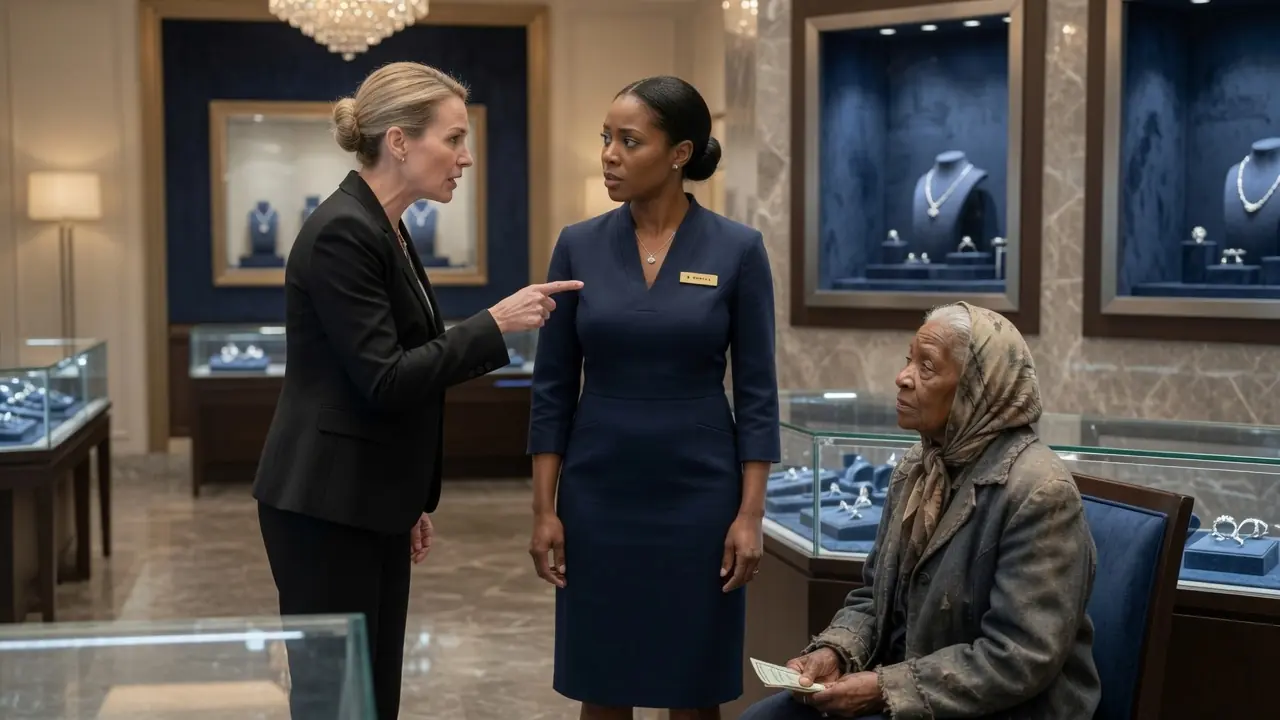
Vanessa’s lips curled into a cold smile.
“Then you and your son can both be poor outside,” she said. “Pack your things. You’re fired.”
Maya’s chest tightened, but she refused to cry in front of the people who had spent months trying to break her. She removed the silver name badge from her navy uniform and placed it carefully on the counter. Then she helped the elderly woman to her feet and guided her toward the boutique’s glass doors.
The old woman looked back once.
Not at Maya.
At Vanessa.
There was something in her gentle brown eyes that made the manager’s smile weaken, though she quickly covered it with a laugh.
Maya Brooks was thirty-four years old and had been raising her eight-year-old son, Jordan, alone since his father disappeared before the boy’s second birthday. She had no wealthy relatives, no savings account, and no one waiting to rescue her when life became too expensive. Every morning, she packed Jordan’s lunch before catching two buses to the boutique on Chicago’s Magnificent Mile.
The store was called Aurelia House.
It occupied the ground floor of a marble building where customers arrived in chauffeured cars and rarely asked the price before selecting jewelry. Diamond necklaces rested beneath white lights, security guards stood at every entrance, and even the air smelled expensive.
Maya had worked there for eleven months.
She was good at her job.
She listened carefully, remembered anniversaries, and treated nervous customers with patience instead of pressure. Couples often returned and asked specifically for her. Yet whenever Maya earned a large commission, Vanessa found a reason to transfer the sale to a senior employee.
“You assisted,” Vanessa would say. “You didn’t close.”
Other times, Maya was sent to purchase coffee, collect dry cleaning, or clean display cases while coworkers served wealthy customers. They mocked her simple clothes and laughed when she brought homemade food instead of buying lunch from the expensive restaurants nearby.
Maya endured it because Jordan needed stability.
Their small apartment was warm, his school was safe, and her salary—though reduced by stolen commissions—barely covered rent, food, and after-school care. She told herself humiliation could be survived as long as her son never felt the full weight of it.
Then the elderly woman entered the boutique.
She wore a worn coat buttoned to her throat, thin black shoes, and a faded scarf over her silver hair. Her hands were rough, and one heel dragged slightly as she crossed the polished marble floor.
Every employee noticed her.
No one welcomed her.
One saleswoman covered her nose and whispered that a homeless shelter must have sent her to the wrong address. Another moved a tray of rings farther from the counter.
Vanessa approached with her arms folded.
“You cannot wait here,” she said. “The public library is three blocks away.”
The old woman smiled politely. “I’m not looking for the library.”
“This is a private luxury boutique.”
“I can see that.”
Vanessa looked her up and down. “Then you should understand that we serve customers who can afford our merchandise.”
Maya felt anger rise inside her.
She had been standing near the diamond case, arranging necklaces for a private appointment. She set down the velvet tray and walked over.
“Would you like some water, ma’am?” she asked.
The old woman’s face softened. “That would be lovely.”
Vanessa gave Maya a warning look, but Maya ignored it. She brought a cold glass of water and helped the woman sit in one of the velvet chairs usually reserved for preferred clients.
“What may I call you?” Maya asked.
“Eleanor.”
“I’m Maya. Take all the time you need.”
The old woman studied her name badge, then noticed the handmade necklace around Maya’s throat. It consisted of a small silver-colored heart threaded onto a black cord.
“That is beautiful,” Eleanor said.
Maya smiled. “My son made it from a craft kit.”
“You wear it in a diamond store?”
“It’s the most valuable piece I own.”
Eleanor touched Maya’s hand gently.
“Then your son understands jewelry better than most people here.”
Across the showroom, the other employees laughed.
Eleanor finished her water and asked to see several pieces from the most expensive collection. Maya did not question her. She brought out sapphire earrings, gold bracelets, custom rings, and a diamond necklace worth more than Maya would earn in twenty years.
For nearly an hour, she treated Eleanor with the same respect she would have offered any wealthy customer.
She explained the craftsmanship, adjusted clasps around the old woman’s wrist, and found a matching pair of earrings for the sapphire necklace. Eleanor listened carefully and eventually selected ten complete sets.
“I’ll take them all,” she said.
The showroom became quiet.
Vanessa stepped closer, clearly expecting entertainment.
Maya entered the pieces into the register. “The total comes to three million, four hundred and eighty thousand dollars.”
Eleanor patted the pockets of her coat.
“Oh, dear,” she said. “I don’t have my wallet.”
Laughter erupted.
One employee turned away to hide her smile, while another openly pointed at Maya. Vanessa approached slowly, enjoying every second of Maya’s embarrassment.
“You spent an hour serving a woman who cannot afford bus fare,” she said.
Eleanor looked troubled. “My money is with my son.”
“Of course it is,” Vanessa replied. “And I assume he is a prince?”
“He runs a company.”
“Which company?”
Eleanor smiled. “A large one.”
The employees laughed harder.
Maya felt heat rise into her face, but when she looked at Eleanor, she saw no mockery. The old woman appeared tired and vulnerable, as though humiliation had followed her into a place where she had hoped to find dignity.
“It’s all right,” Maya said. “Nothing was damaged.”
Vanessa stared at her. “You are defending this?”
“She asked to see jewelry. I showed it to her.”
“She wasted company time.”
“No. She was treated like a customer.”
Vanessa stepped so close that Maya could smell her expensive perfume. “People like her are not our customers.”
Maya looked at the woman’s worn shoes.
Then she opened her purse.
Inside were twenty dollars, a bus card, and a photograph of Jordan smiling without one front tooth. The money was supposed to buy groceries and school lunches until payday.
Maya placed the bills in Eleanor’s hand.
“Please take a cab home.”
The old woman’s eyes widened. “My dear, you need this.”
“I’ll manage.”
“You have a child.”
“Yes.”
“And you would give me his lunch money?”
“My son knows what hunger feels like. That’s why he would want me to help.”
Vanessa’s expression hardened.
She pointed toward the exit and fired Maya in front of the entire staff.
Maya gathered her handbag and coat without begging. She knew an argument would not restore the job or change Vanessa’s heart. Her only regret was that she had no idea what she would tell Jordan.
Outside, the cold afternoon wind struck them both.
Eleanor stood beneath the boutique awning, still holding the money.
“You should not have lost your job because of me,” she said.
“I lost it because my manager finally found an excuse.”
“What will you do?”
“Find another job.”
“And your son?”
Maya swallowed. “I’ll make sure he’s all right.”
Eleanor reached for her arm. “Let me return this money.”
“No.”
“At least tell me where you live.”
Maya smiled sadly. “You do not owe me anything.”
She hailed a taxi, opened the door for Eleanor, and placed the twenty dollars into the driver’s hand.
“Please make sure she gets home safely.”
The taxi disappeared into traffic.
Maya began walking toward the bus stop with no money for the fare.
What she did not know was that the taxi was carrying Eleanor Bennett toward a gated estate overlooking Lake Michigan.
The driver glanced repeatedly into the rearview mirror as they passed through iron gates and followed a private road toward a stone mansion. Uniformed staff rushed outside before the car stopped.
A tall man in a charcoal suit descended the front steps.
Adrian Bennett was thirty-eight years old and one of the most recognizable business figures in Chicago. As chief executive of Bennett Holdings, he controlled hotels, commercial properties, technology investments, and Aurelia House—the jewelry empire founded by his late father.
“Mother, where have you been?” he demanded.
Eleanor stepped out of the taxi. “Testing one of your stores.”
Adrian looked at her coat. “Why are you dressed like this?”
“Because people reveal their character when they believe you have nothing to offer them.”
Inside the mansion, Eleanor told him everything.
She described Vanessa’s insults, the employees’ laughter, and the single mother who treated her with dignity. Then she placed Maya’s twenty dollars on the desk.
“This was all she had,” Eleanor said. “She gave it to me so I would not walk home.”
Adrian stared at the bills.
“They fired her?”
“In front of everyone.”
His face became cold.
“Which store?”
Eleanor told him.
Within minutes, Adrian’s security director retrieved the boutique footage. He watched Maya bring water, display the jewelry, and defend his mother while employees mocked them both.
Then he watched Vanessa fire her.
“Find Maya Brooks,” Adrian ordered.
His assistant hesitated. “How?”
“Payroll records, emergency contacts, security footage—whatever is legal and necessary. Find her before tonight.”
Maya was halfway home when a black sedan stopped beside her.
She stepped away immediately.
The passenger window opened, and a professionally dressed woman introduced herself as Caroline Reed, executive assistant to Adrian Bennett.
“Mr. Bennett would like to meet you.”
Maya tightened her grip on her purse. “Why?”
“Because Eleanor Bennett asked him to.”
The name meant nothing at first.
Then Caroline explained.
The elderly woman Maya had helped was the mother of the billionaire who owned Aurelia House.
Maya stared at the car.
“This is a joke.”
“It is not.”
“I don’t want trouble.”
“You are not in trouble.”
“That is usually what people say before someone is in trouble.”
Caroline almost smiled. “Mrs. Bennett asked me to tell you that kindness is more valuable than diamonds.”
Maya recognized the words Eleanor had spoken inside the store.
She entered the car.
At the mansion, Eleanor embraced her before Maya could say anything. Adrian stood nearby, watching the woman who had given away her last money without knowing anyone powerful was observing.
“I owe you an apology,” he said.
“You didn’t fire me.”
“My company did.”
“Vanessa fired me.”
“Vanessa represented my company when she did it.”
Maya respected the distinction.
Adrian offered her the stolen commissions, several months of salary, and a substantial settlement. Maya accepted only what the store legally owed her.
Then he offered her a car.
She refused.
A designer wardrobe.
She refused again.
Finally, Adrian placed a job offer on the table.
It was not a charity position. His executive office needed a client-relations coordinator to review customer treatment across all luxury properties. The salary was more than double what Maya had earned, with health insurance and predictable hours.
“Why me?” she asked.
“Because you understood our customers better than the people we trained.”
“You only saw one hour of my work.”
“I reviewed eleven months of sales records. You had the highest returning-customer rate in the store, despite receiving almost no commissions.”
Maya looked at the documents.
Adrian had done his research.
“I have a son,” she said. “I cannot work unpredictable evenings.”
“Your hours will end at five.”
“I will not be anyone’s symbol of generosity.”
“You will have authority, measurable responsibilities, and a six-month performance review.”
She read every page before agreeing.
The following morning, Adrian arrived at the boutique without warning.
Vanessa rushed forward wearing a bright smile.
“Mr. Bennett, what an honor.”
Eleanor entered behind him in a tailored cream suit, diamond earrings sparkling beneath her silver hair.
The employees froze.
Vanessa’s smile disappeared.
“This,” Adrian said, “is Eleanor Bennett, chairwoman emeritus of Aurelia House and my mother.”
No one spoke.
Eleanor looked around the showroom where she had been called poor, dirty, and unwanted.
Vanessa began apologizing.
Adrian stopped her.
“You are not sorry for what you did. You are afraid of who she turned out to be.”
He dismissed Vanessa and every employee who had participated in the humiliation. The remaining staff were required to complete customer-respect training under Maya’s supervision.
When Maya entered wearing a simple gray suit, Vanessa stared at her in disbelief.
“You planned this,” she whispered.
Maya shook her head. “I did not even have bus money after you fired me.”
Vanessa’s eyes filled with anger. “You think you belong above me now?”
“I think no one belongs beneath you.”
Vanessa left carrying a cardboard box.
Maya’s new position changed her life, but not instantly.
She struggled with executive meetings, unfamiliar software, and colleagues who assumed Adrian had hired her because of his mother. Some whispered that the single mother had manipulated an old woman to reach a billionaire.
Maya responded by working.
She redesigned the customer-service complaint system, created anonymous store evaluations, and ensured commissions went to the employees who earned them. Within six months, customer satisfaction rose across the jewelry division.
Adrian noticed more than her performance.
He noticed that Maya never accepted praise she had not earned. She challenged him when company policies harmed hourly workers and refused to remain silent simply because he was the CEO.
One evening, they worked late reviewing a proposal.
“You disagree with me,” Adrian said.
“Yes.”
“Most employees take longer to admit it.”
“Most employees are afraid you’ll fire them.”
“Are you?”
“I have been fired for giving someone water. Your reason would need to be better.”
Adrian laughed.
It was the first time Maya saw him as something other than a powerful executive. Beneath the tailored suits and reserved manner was a man who had spent years surrounded by people eager to please him and very few willing to tell him the truth.
Their professional respect gradually became friendship.
Adrian met Jordan at a company family event. The eight-year-old immediately asked why a man who owned jewelry stores wore such a plain watch.
“It tells time,” Adrian replied.
“So does the microwave.”
Maya apologized, but Adrian laughed.
Jordan showed him the craft necklace he had made for his mother. Adrian examined it seriously and asked the boy what made jewelry valuable.
“The person who gives it to you,” Jordan answered.
Eleanor, standing nearby, smiled.
“My grandson needed that lesson.”
Months later, Adrian invited Maya to dinner.
“Is this a business dinner?” she asked.
“No.”
“Is your mother arranging this?”
“She encouraged me.”
“That sounds like arranging.”
“I am asking because I want to know you outside the office.”
Maya hesitated.
She had spent years protecting Jordan and herself from unreliable men. Adrian’s wealth did not make him safer; in some ways, it made trusting his intentions more difficult.
“I don’t want gifts,” she said.
“Understood.”
“I don’t want my son photographed.”
“Understood.”
“And I will not become a secret because dating a single mother looks inconvenient for your company.”
Adrian held her gaze. “You would never be hidden.”
She agreed to one dinner.
Then another.
Their relationship grew slowly. Adrian came to Maya’s apartment for spaghetti, sat on a chair Jordan had repaired with tape, and washed dishes without being asked. Maya attended formal events but refused to let stylists turn her into someone unrecognizable.
For the first time in years, she felt supported without feeling owned.
That peace ended when Lydia Grant, a senior executive who had long imagined herself beside Adrian, began spreading rumors.
She told reporters Maya was a gold digger who had manipulated Eleanor. Anonymous articles accused her of using her son to secure sympathy and a wealthy husband.
Employees began whispering again.
Maya considered resigning.
“I survived Vanessa,” she told Adrian. “But I will not let Jordan grow up reading strangers call his mother a thief.”
Adrian wanted to issue threats and lawsuits.
Maya refused.
“I do not need you to silence everyone who dislikes me. I need the truth to remain visible.”
Eleanor proposed a public interview.
She appeared beside Maya and described exactly what happened inside the boutique. Security footage showed Maya offering kindness before she knew Eleanor’s identity.
Then the company released Maya’s performance record.
She had increased customer retention, reduced employee turnover, and recovered thousands of dollars in commissions previously stolen from junior staff.
The rumors weakened.
Lydia, however, was not finished.
A priceless sapphire necklace disappeared from the Bennett family vault during a charity gala. Hours later, security guards found it inside Maya’s coat pocket.
The room turned toward her.
Maya’s face went pale.
“I did not take that.”
Lydia covered her mouth in false shock. “How could you?”
Adrian stepped between Maya and the guards.
“No one touches her until the entire security record is reviewed.”
His mother agreed.
For six hours, Adrian’s security team examined footage, access logs, and staff movements. One corridor camera showed Lydia entering the coatroom with the necklace concealed inside a napkin.
She had planted it.
When confronted, Lydia claimed she acted out of love.
Adrian looked at her without emotion.
“You do not love me. You love the position you imagined beside me.”
Police escorted her from the estate.
Maya’s name was cleared, but humiliation had reopened every wound she carried from Aurelia House. She returned to her apartment and told Adrian she needed space.
Three days later, Eleanor visited.
She did not bring jewelry, money, or promises.
She brought groceries and sat at Maya’s kitchen table while Jordan completed homework.
“I once believed wealth protected a family,” Eleanor said. “It often only attracts people who want access to it.”
Maya looked toward her son.
“I don’t want him living inside someone else’s world.”
“Then make Adrian build one with you.”
Maya considered the words.
Adrian had never asked her to abandon her independence. He had defended her publicly, trusted her when evidence appeared against her, and respected every boundary she created.
That evening, he came to the apartment alone.
“I love you,” he said. “But I will not ask you to accept a life that makes you feel purchased.”
Maya’s eyes filled.
“What are you asking?”
“To build something neither of us controls alone.”
He did not bring a diamond ring.
He held Jordan’s handmade silver heart.
“I asked his permission to borrow this.”
Jordan peeked from the hallway.
Adrian lowered himself onto one knee.
“Maya Brooks, you taught my company that dignity cannot depend on what someone can afford. You taught my mother that kindness still exists, and you taught me that love is not generosity from the powerful to the powerless.”
He opened his hand, revealing a simple ring designed around the same imperfect heart shape Jordan had created.
“Will you marry me as my equal?”
Maya cried before she answered.
“Yes.”
Their wedding was elegant but private.
Jordan walked his mother down the aisle. Eleanor wore the sapphire necklace Lydia had attempted to use against Maya, then removed it during the reception and placed it around Maya’s neck.
“This belongs to the woman who protected me when she thought I had nothing,” she said.
Maya touched the necklace.
Then she removed Jordan’s handmade pendant from beneath her dress and held both pieces together.
“This one is still more valuable.”
Eleanor laughed through her tears.
One year later, Maya opened the Brooks Bennett Foundation for single parents returning to work. It provided childcare grants, career training, legal assistance, and emergency housing support.
She also became president of Aurelia House’s retail division.
The boutique where Vanessa had fired her was transformed into the foundation’s first employment-training center. Applicants were not judged by clothing, address, age, or employment gaps.
Above the entrance hung a simple sentence:
Every person who enters deserves dignity before they prove their value.
On opening day, Maya stood beside Jordan, Adrian, and Eleanor.
Jordan looked up at the sign.
“Mom, did all of this happen because you gave Grandma Eleanor twenty dollars?”
Maya smiled.
“No. It happened because people finally saw what twenty dollars revealed.”
“What did it reveal?”
“That kindness is easiest when it costs nothing. Character is what remains when kindness costs you something.”
Jordan thought about that.
Then he reached into his pocket and handed a few dollars to a tired woman standing outside with two children.
“For lunch,” he said.
Maya watched the woman’s face change.
Adrian placed one arm around her shoulders, while Eleanor smiled beside them.
The finest diamonds inside Aurelia House were worth millions. They could be polished, insured, displayed, and locked behind reinforced glass.
But none of them had transformed four lives the way one single mother’s last twenty dollars had.
Maya entered the boutique believing she needed the job badly enough to endure humiliation.
She left without money, employment, or any guarantee that her son would be fed the following week.
Yet she walked away with the one thing Vanessa could never take from her.
Her character.
And in the end, that became the most valuable thing anyone in the jewelry empire had ever found.