Maya Reynolds had twelve dollars in her purse, a seven-year-old daughter waiting at after-school care, and a manager who believed kindness was bad for business.
At twenty-nine, Maya had learned to smile while her feet hurt. She had learned to say “Of course” when customers blamed her for things she did not control.
She had learned to stretch one roasted chicken into three dinners, one tank of gas into five workdays, and one tired heart into enough love for a little girl who still believed her mother could fix anything.
Her daughter, Sophie, was the reason Maya kept moving.
Every morning, Sophie stood on a chair in their tiny kitchen in Columbus, Ohio, and helped Maya pack lunch. She placed crackers in a plastic bag, tucked an apple beside a sandwich, and drew little stars on napkins with purple marker.
“This is for you, Mommy,” Sophie would say, sliding one napkin into Maya’s work bag.
Maya always pretended to be surprised.
“Oh, for me? A famous artist made this?”
Sophie would grin with one missing tooth. “Yes. Very famous.”
Maya worked at Bellweather’s, a polished downtown restaurant attached to a boutique hotel. It had marble counters, tall windows, soft lighting, and prices that made Maya feel guilty just reading the menu. Businessmen came in wearing expensive watches. Women in tailored coats ordered salads they barely touched. Hotel guests complained if the coffee foam was too low or the lemon slice faced the wrong direction on the glass.
Maya was not a server there.
She was a hostess.
That meant she stood near the entrance in a black dress and low heels, welcomed people who often looked through her, answered the phone, managed reservations, smiled at complaints, and pretended not to notice when customers judged her by the name tag on her chest.
The job paid more than the diner she had worked at before.
Not enough to breathe easily.
But enough to keep the rent current if nothing else went wrong.
Nothing else had to be a big disaster. A school field trip fee could ruin a week. A flat tire could ruin a month. A winter heating bill could make Maya sit at the kitchen table after Sophie fell asleep, pressing her hands against her eyes until the numbers stopped swimming.
Still, she was holding on.
That was what people praised single mothers for, as if holding on did not tear skin from the inside.
“Strong woman,” they said.
“You’re doing amazing,” they said.
Maya smiled when people said that.
Then she went home and washed socks in the sink because she did not have quarters for laundry until Friday.
On the morning everything changed, rain fell hard enough to turn the street outside Bellweather’s into a river of gray reflections. Cars hissed past the curb. Umbrellas flipped inside out in the wind. The hotel doorman kept opening and closing the brass-framed door with a strained smile, letting in gusts of cold air and the smell of wet pavement.
Maya arrived fifteen minutes early.
She always arrived early because being late was a luxury for people with backup plans.
Her manager, Darren Cole, was already there, standing near the host stand with his tablet tucked under one arm. Darren was thirty-eight, sharp-faced, always clean-shaven, always dressed like he had been assembled in a store window. He believed every problem could be solved by sounding disappointed enough.
“Maya,” he said without greeting her. “Tonight is important.”
Maya hung her damp coat in the narrow employee closet. “Yes, I know.”
“The Winter Donor Dinner is at seven. Private room. Thirty-two guests. The hotel owner’s office called twice already.”
“I confirmed the seating chart last night.”
Darren’s eyes flicked over her shoes.
“They’re clean,” Maya said before he could ask.
He looked annoyed that she had guessed.
“I need the front entrance perfect today,” he said. “No confusion, no delays, no… distractions.”
Maya understood what he meant.
Bellweather’s did not like distractions.
A crying child was a distraction.
An elderly person moving too slowly was a distraction.
Someone counting bills before ordering was a distraction.
Someone without the right coat, the right shoes, or the right confidence was a distraction before they even opened their mouth.
“I’ll handle it,” Maya said.
Darren gave a small nod and walked away.
By eleven, the lunch rush began.
Maya seated a group of attorneys, a couple celebrating an anniversary, four hotel guests from Chicago, and a man who seemed offended that his table was near a window because “weather is visually depressing.”
She smiled through all of it.
At one o’clock, her phone buzzed in her pocket.
It was Sophie’s school.
Maya’s stomach tightened.
She could not answer at the host stand, so she waited until Darren stepped into the dining room, then slipped behind the coat wall and called back.
“Hi, this is Maya Reynolds. I missed a call.”
The school secretary’s voice was kind but tired.
“Sophie is okay. She just says her stomach hurts a little. No fever. She wanted us to call you.”
Maya closed her eyes.
“Can she stay until dismissal?”
“I think so. She mostly wanted to hear your voice.”
Maya swallowed.
“Can you tell her Mommy loves her and I’ll pick her up after work?”
“Of course.”
Maya hung up and pressed Sophie’s purple-star napkin inside her pocket.
She wanted to leave.
She wanted to run through the rain, gather her daughter, and take her home to soup and cartoons and a blanket on the couch.
Instead, she returned to the host stand and smiled at a man who said, “Finally,” even though he had been waiting less than thirty seconds.
At two-thirty, the old woman appeared outside the glass doors.
At first, Maya noticed only movement in the rain.
A small figure stood near the hotel entrance, half under the awning, half exposed to the weather. People moved around her without slowing. She wore a long gray coat that looked too thin for December, a knitted hat pulled low over silver hair, and shoes that had taken in too much water.
She carried two plastic bags.
One had a tear near the bottom, and every few seconds she adjusted her grip to keep something inside from falling out.
The hotel doorman frowned.
Maya watched through the glass as he stepped toward the woman and said something. The old woman looked up at him. She seemed confused, or maybe simply exhausted. She shook her head once, then pointed weakly toward the restaurant windows.
The doorman shook his head.
The woman did not move.
Maya felt a familiar pull in her chest.
No.
She could not get involved.
Not today.
Not with the donor dinner coming.
Not with Darren already watching everything like a hawk with a clipboard.
But the woman swayed slightly.
Not enough for others to notice.
Enough for Maya.
She left the host stand and walked quickly to the door.
“Maya,” Darren called from across the lobby.
She pretended not to hear.
Outside, the cold hit her immediately.
“Ma’am?” Maya said gently.
The old woman turned.
Up close, she looked older than Maya first thought. Maybe seventy-five. Maybe eighty. Her face was deeply lined, but not hardened. Her blue eyes were watery from the wind, and her hands trembled around the plastic bags.
“I’m sorry,” the woman said. “I don’t want trouble.”
Her voice was soft, educated, and tired.
“You’re not trouble,” Maya said. “Are you okay?”
The doorman gave Maya a warning look.
“She can’t stand here,” he said quietly. “Hotel policy.”
Maya ignored him.
The old woman looked embarrassed.
“I was only hoping to sit somewhere dry for a few minutes,” she said. “I can pay for tea. I think I have enough.”
She tried to open one of the plastic bags.
Her fingers were too stiff.
Maya glanced through the window.
Darren was watching from inside.
Every sensible thought in Maya’s head told her to step back.
She had rent due in five days.
Sophie needed new winter shoes.
The electric bill was already marked past due.
One bad report from Darren could cost her hours.
One big mistake could cost her job.
The old woman looked down at her wet shoes.
“I understand,” she whispered. “I’ll go.”
Maya thought of Sophie asking that morning, “If someone is cold, do they get colder when people don’t see them?”
It had been a child’s question about a cartoon.
Now it felt like a test.
“Come inside,” Maya said.
The doorman stiffened. “Maya.”
“She’s going to sit for tea,” Maya said.
The old woman looked startled. “Are you sure?”
“Yes.”
Maya opened the door and guided her into the lobby.
The warmth inside made the woman close her eyes for one second.
It was such a small thing, that moment of relief.
But it went through Maya like a needle.
Several people turned to look.
A woman in a cream coat wrinkled her nose.
A man near the concierge desk moved his suitcase farther from the old woman’s wet bags.
Darren arrived before Maya reached the host stand.
His smile was tight and empty.
“Maya,” he said. “A word.”
The old woman immediately stepped back. “I can leave.”
“No,” Maya said softly. “Please wait here.”
Darren’s jaw tightened.
“Maya. Now.”
She followed him three steps away, close enough to keep the old woman in sight.
“What are you doing?” Darren whispered.
“She asked to buy tea and sit somewhere dry.”
“This is not a shelter.”
“I know.”
“Then why are you treating it like one?”
Maya looked at him.
The answer seemed so obvious she almost could not form it.
“Because she’s cold.”
Darren’s eyes hardened.
“We have a private donor event tonight. The owner’s office is watching. We cannot have random homeless people sitting at the front of the restaurant.”
Maya felt heat rise in her face.
“She is a customer if she buys tea.”
“With what money?”
“You don’t know what she has.”
“I know how this looks.”
Maya turned slightly toward the old woman.
She was standing alone near the host stand, clutching her bags, listening without looking like she wanted to hear. Rainwater dripped from the hem of her coat onto the polished floor.
Maya hated that she noticed the floor.
She hated that Darren had made her notice it.
“I’ll seat her in the corner,” Maya said. “I’ll clean anything myself.”
“No.”
“Darren—”
“No. Get her out.”
Maya stared at him.
He did not blink.
For a moment, the lobby sounds seemed to pull away. The soft music, the elevator bell, the rain against the windows, the low chatter from the bar, all of it faded behind the pounding in Maya’s ears.
She thought of Sophie’s stomach ache.
She thought of rent.
She thought of the twelve dollars in her purse.
Then she thought of the old woman outside in the rain, apologizing for needing warmth.
Maya walked back to the host stand.
The old woman watched her carefully, already understanding.
“It’s all right,” she said. “I’ve been moved along from nicer places than this.”
Something inside Maya cracked.
Not loudly.
Not dramatically.
Just enough.
“No,” Maya said. “You haven’t been moved along from me.”
She picked up a menu.
Then she led the old woman to the quietest corner table near the back wall, away from the lobby, away from the windows, away from Darren’s line of sight as much as possible.
The old woman lowered herself into the chair with a small breath of pain.
Maya pretended not to notice, because dignity sometimes needed the gift of being unseen.
“What kind of tea do you like?” Maya asked.
“Whatever is least expensive.”
Maya smiled softly.
“Today, that happens to be chamomile.”
The old woman gave her a knowing look.
“Does it?”
“It does.”
Maya brought a pot of tea, a cup, a small plate of bread, and a bowl of soup the kitchen had made too much of. She paid for the tea with her own money and told the line cook the rest was for staff waste.
The old woman placed both hands around the cup.
“Thank you,” she said.
“You’re welcome.”
“What is your name?”
“Maya.”
The old woman smiled faintly. “Maya. That means illusion in some languages, doesn’t it?”
“I guess so.”
“You don’t seem like an illusion.”
Maya laughed quietly. “No, ma’am. I’m pretty real.”
“I’m Eleanor.”
Maya nodded. “Nice to meet you, Eleanor.”
The old woman dipped bread into the soup with careful, shaking fingers.
Maya should have gone back to the host stand.
Instead, she stood there for a moment.
There was something about Eleanor that did not fit the word homeless in the way people usually used it. Not because homelessness had a certain face. Maya knew better than that. But Eleanor carried herself like someone who had spent a lifetime being listened to and had only recently been placed among those the world talked over.
“Do you have somewhere to go tonight?” Maya asked.
Eleanor looked into her tea.
“For tonight, yes.”
It was not exactly an answer.
Maya did not push.
She took a clean napkin from her apron and set it beside the bowl.
Eleanor touched it with two fingers.
“My daughter used to fold napkins into swans,” she said.
Maya smiled. “That sounds beautiful.”
“She was impatient with everything except paper.”
There was a silence.
Maya heard grief in it and stepped carefully around the edge.
“My daughter draws stars on napkins,” she said.
“Then she is an artist.”
“She thinks so.”
“Children are often right before the world teaches them doubt.”
Maya looked at Eleanor more closely.
Before she could answer, Darren appeared at the table.
The warmth left the corner.
“Ma’am,” he said, with a polished voice that made every word colder. “I’m afraid we cannot serve you here.”
Eleanor looked down.
Maya stepped between them slightly.
“She has tea and soup.”
“Maya,” Darren said, “you are needed at the front.”
“I’m handling this.”
“No,” he said. “You are causing this.”
Several nearby customers had turned to watch.
Maya felt her face burn.
Eleanor pushed her chair back.
“I don’t want to be the cause of trouble,” she said.
“You’re not,” Maya said.
Darren gave a sharp little laugh.
“She is not the problem, Maya. Your judgment is.”
Maya stared at him.
He leaned closer, voice low.
“You were told not to seat her. You ignored me. This is insubordination.”
The word sounded ridiculous and terrifying at the same time.
Maya knew what was coming before he said it.
Still, when Darren straightened and spoke clearly, the floor seemed to tilt beneath her.
“You can gather your things. You’re done here.”
The old woman inhaled sharply.
Maya stood very still.
Around them, the restaurant went quiet in the way expensive rooms do when people want drama but not involvement.
“You’re firing me?” Maya asked.
“Yes.”
“For giving an old woman soup?”
“For refusing instruction.”
Maya looked at the faces turned toward them.
No one spoke.
No one stood.
No one said this is wrong.
People were very brave with opinions when nothing was required of them. They became silent when courage had a price.
Eleanor gripped the edge of the table.
“Please,” she said to Darren. “Do not punish her for my sake. I will leave.”
Darren did not even look at her.
“Maya, collect your belongings.”
Maya’s throat tightened.
She wanted to beg.
For one terrible second, she nearly did.
She nearly said, I have a child.
She nearly said, I need this job.
She nearly said, Please, I’m sorry, I’ll never do it again.
But Sophie’s purple-star napkin was still in her pocket.
And somehow, Maya could not imagine going home and telling her daughter that she had apologized for kindness.
So she removed her name tag, set it on the table beside Eleanor’s tea, and said, “I hope one day you need mercy from someone who ignores policy.”
Darren’s face darkened.
“Maya.”
“I’m leaving.”
She walked to the employee closet with her back straight and her hands shaking.
In the narrow room, she took her coat from the hook, grabbed her work bag, and pressed both hands to her mouth.
She had six dollars left now because she had paid for the tea.
Six dollars.
No job.
A child in after-school care.
Rent due.
For a moment, panic rose so fast she thought she might be sick.
Then she heard the closet door open.
Eleanor stood there with her plastic bags.
“I’m so sorry,” the old woman said.
Maya quickly wiped her face.
“No. Don’t be.”
“You lost your job because of me.”
“I lost it because my manager thinks basic decency is optional.”
Eleanor’s eyes filled.
She reached into her coat pocket and took out a small folded handkerchief. It was clean but worn thin from years of washing. Embroidered in one corner was the letter E.
She held it out.
Maya shook her head. “You keep that.”
“Please.”
Maya hesitated, then accepted it.
Eleanor took Maya’s hand in both of hers.
Her skin was cold.
“You have a daughter?” she asked.
“Yes. Sophie.”
“Then Sophie has a good mother.”
The words broke through Maya’s control.
She looked away.
“I hope that matters enough,” she whispered.
“It matters more than you know.”
Eleanor opened one of her plastic bags and searched carefully inside. She pulled out a small card, damp at the edges. For a second, Maya thought it was an old business card, but the print had faded too much to read clearly.
Eleanor frowned, then tucked it back.
“I had something,” she murmured. “Never mind.”
“Do you need me to call someone?”
“No.”
“Are you sure?”
Eleanor looked toward the restaurant.
“Oh, yes,” she said softly. “I believe someone will be calling very soon.”
Maya did not understand.
She was too frightened to try.
She walked Eleanor to the side exit because Darren had positioned himself near the front as if guarding the restaurant from compassion. Under the awning, the rain had slowed to mist.
Maya gave Eleanor the umbrella from her work bag.
It was cheap and bent at one rib, but it opened.
“Take this,” Maya said.
“No, dear.”
“Please.”
Eleanor looked at her for a long moment.
Then she took the umbrella.
“What will you do now?” she asked.
Maya forced a smile.
“Pick up my daughter. Make dinner. Figure out how to survive tomorrow.”
Eleanor’s eyes softened.
“That is not a small list.”
“No,” Maya said. “It never is.”
Eleanor reached up and touched Maya’s cheek with the gentlest hand.
“I will remember your face,” she said.
Then she stepped into the mist and walked away.
Maya watched until the gray coat disappeared around the corner.
Then she went to pick up Sophie.
The after-school room smelled like crayons and crackers.
Sophie sat at a low table, drawing on pink construction paper. When she saw Maya, she ran across the room and wrapped both arms around her waist.
“Mommy, my stomach stopped hurting.”
“That’s good, baby.”
Sophie leaned back and studied her face.
“Did your stomach start hurting?”
Maya almost laughed.
“No. I’m okay.”
Sophie narrowed her eyes.
Children could detect lies the way smoke detectors sensed heat.
“Are we having noodles tonight?”
“Yes.”
“With peas?”
“Probably.”
“Then you are a little sad.”
Maya crouched in front of her.
“Why does noodles with peas mean sad?”
“Because we eat it when money is being quiet.”
Maya closed her eyes for one second.
Money is being quiet.
That was the kind of phrase a child invented when adults tried too hard to hide truth.
At home, Maya made noodles with peas.
She let Sophie sprinkle powdered cheese from the packet like fairy dust. They ate at the tiny kitchen table while rain tapped against the window. Sophie told her about a boy named Lucas who had put glue on his own sleeve and pretended it was a science experiment.
Maya laughed in the right places.
She nodded.
She washed dishes.
She helped Sophie with spelling homework.
She folded laundry.
She did everything in the order a mother does when the world has collapsed but bedtime still exists.
Only after Sophie was asleep did Maya sit at the table with the bills.
She opened her laptop and applied for jobs until midnight.
Hostess.
Cashier.
Receptionist.
Bakery counter.
Dental office front desk.
Hotel laundry.
Customer service.
Anything.
Everything.
At 12:43, she checked her bank account.
The number looked smaller than it had any right to be.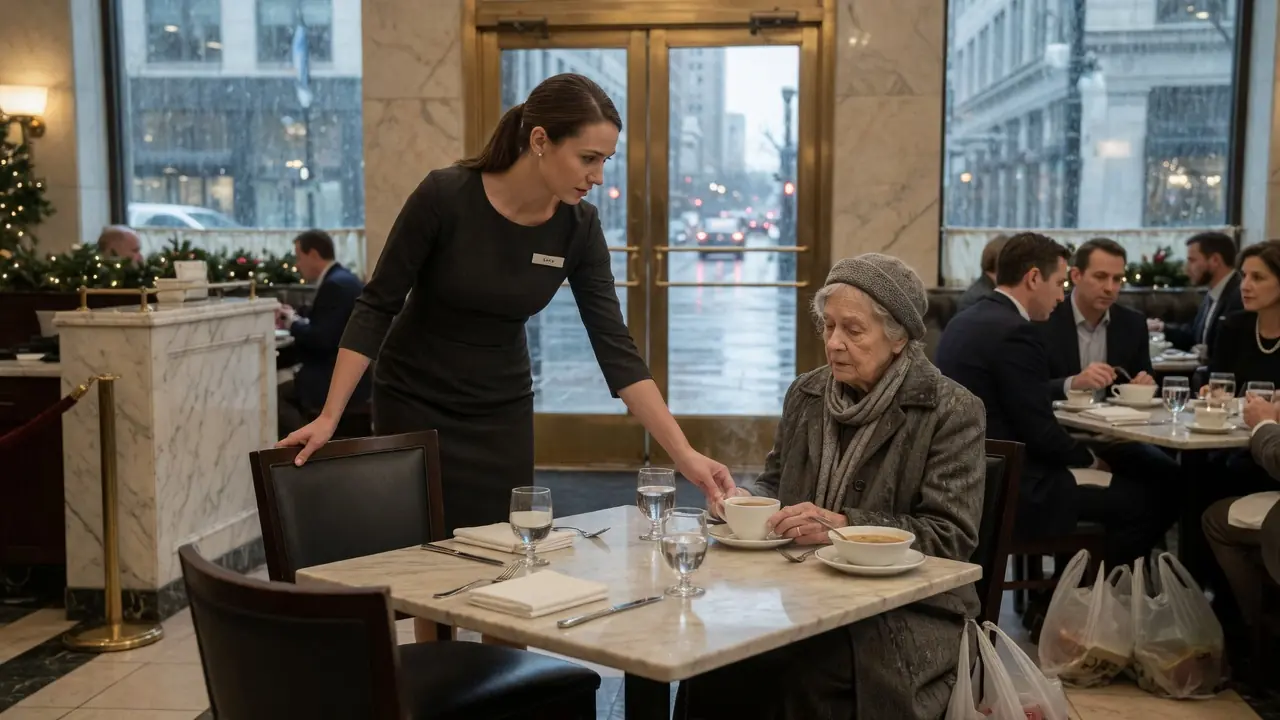
Maya took Eleanor’s handkerchief from her coat pocket and unfolded it on the table.
The embroidered E was delicate, stitched by hand. Something small fell from inside the folded cloth and landed near Maya’s wrist.
A button.
No.
A pin.
It was oval, gold at the edge, with a tiny dark blue stone in the center. On the back, in letters so small Maya had to hold it under the light, were the initials E.W.
Maya stared at it.
Eleanor must have accidentally wrapped it in the handkerchief.
It looked valuable.
Not flashy, but old.
Personal.
Maya immediately felt uneasy.
She would have to find Eleanor and return it.
But how did you find an old woman who had disappeared into the rain with two plastic bags and a broken umbrella?
Maya placed the pin in a small bowl by the sink so she would not lose it.
Then she rested her head on the kitchen table and finally cried.
The next morning began badly.
Sophie could not find her left shoe.
Maya burned toast.
Her phone buzzed with an email from Bellweather’s payroll saying her final check would be processed according to standard schedule.
No apology.
No explanation.
Just standard schedule.
Maya borrowed gas money from the jar where Sophie kept coins for a future aquarium visit and promised herself she would put it back before Sophie noticed.
At 8:15, she dropped Sophie at school.
At 8:32, she parked two blocks from Bellweather’s.
She had no intention of begging for her job back.
She only wanted to return Eleanor’s pin if the old woman came back looking for it. Also, Maya needed her final schedule records, which Darren had “forgotten” to print.
The street outside the hotel looked different.
At first, Maya could not understand why.
Then she saw them.
Black SUVs.
One parked at the curb.
Another behind it.
Then another.
Four in total, glossy and silent, their windows tinted, their engines low. They lined the street in front of Bellweather’s like something from a world Maya had only seen in movies.
A man in a dark suit stood near the hotel entrance speaking into an earpiece.
Another held the door open.
Hotel staff moved nervously inside.
Maya slowed.
Her first thought was that someone famous had arrived.
Her second thought was that this had nothing to do with her.
Then the man in the suit turned and looked directly at her.
He walked down the steps.
“Ms. Reynolds?”
Maya froze.
“Yes?”
“My name is Daniel Price. I work with the Whitmore family office. Mrs. Eleanor Whitmore would like to speak with you.”
Maya stared at him.
“I’m sorry. Who?”
“Mrs. Eleanor Whitmore.”
The name meant nothing for half a second.
Then the hotel sign above the entrance seemed to sharpen in her vision.
Bellweather’s was owned by Whitmore Hospitality Group.
Maya had seen the name on training documents, employee forms, and framed plaques in the lobby.
Whitmore.
Eleanor.
E.W.
Her hand went cold around the strap of her bag.
“The woman from yesterday?” she whispered.
Daniel’s expression softened slightly.
“Yes.”
Maya looked at the black SUVs, then at Bellweather’s front doors.
Inside, Darren stood near the lobby.
His face had gone pale.
The owner’s office was watching today.
Maya almost laughed.
Daniel said, “She asked that we bring you in through the front.”
Maya’s heart pounded.
“I don’t work here anymore.”
“I’m aware.”
“That manager fired me.”
“I’m aware of that too.”
The front doors opened.
Every person in the lobby seemed to turn as Maya stepped inside.
The marble floor shone beneath her worn shoes. The chandeliers glowed overhead. The host stand where she had stood for two years looked suddenly small and far away, like a stage from a play she had left unfinished.
Darren approached quickly.
“Maya,” he said, voice tight. “There seems to have been a misunderstanding.”
Maya stopped.
Daniel stood beside her.
“What misunderstanding?” Maya asked.
Darren’s smile trembled.
“Yesterday was a difficult service environment. Things were said under pressure.”
“You fired me.”
“Well, technically, the paperwork has not been completed.”
“You told me to gather my things.”
Darren glanced at Daniel.
“I think we can discuss this privately.”
A voice from the lounge said, “No.”
Everyone turned.
Eleanor Whitmore sat in an armchair near the fireplace.
She was not wearing the thin gray coat.
She wore a deep navy dress, a pearl necklace, and a cream-colored wrap over her shoulders. Her silver hair was brushed neatly back. The plastic bags were gone. In their place, a leather handbag rested beside her chair.
But her eyes were the same.
Tired.
Clear.
Kind.
Maya took one step toward her.
“Eleanor?”
The old woman smiled.
“Good morning, Maya.”
Darren looked as if he might disappear through the floor.
Behind Eleanor stood two women in suits and one older man with silver glasses. Hotel executives, Maya guessed. People whose names appeared in emails Darren forwarded with urgent exclamation marks.
Eleanor held out a hand.
Maya walked to her slowly.
“I don’t understand,” Maya said.
“No,” Eleanor said. “I imagine you don’t.”
Maya took the gold pin from her bag.
“You left this in the handkerchief. I was going to try to return it.”
Eleanor looked at the pin in Maya’s palm.
For the first time, her composure cracked.
“Oh,” she said softly. “My mother’s pin.”
Maya placed it in her hand.
“I’m sorry. I didn’t know it was there until last night.”
Eleanor closed her fingers around it.
“You could have sold it.”
Maya frowned. “It wasn’t mine.”
Eleanor looked at her for a long moment.
Then she turned to the room.
“Do you all hear that?” she asked.
No one answered.
Eleanor’s voice remained gentle, which somehow made it stronger.
“She lost her job here yesterday for giving an old woman tea and soup. She went home with six dollars and a child to feed. And when she found something valuable that belonged to me, her first thought was to return it.”
Maya’s face burned.
Darren said, “Mrs. Whitmore, with respect, we were not informed of your identity.”
Eleanor looked at him.
The whole lobby seemed to become colder.
“My identity should not have mattered.”
Darren swallowed.
“Of course.”
“But it did.”
No one moved.
Eleanor lifted the pin slightly.
“Yesterday, I came here dressed as a woman this hotel would rather not see. Not because I enjoy games. Not because I wanted drama. I came because for months I have received letters about the behavior inside properties carrying my family name. Letters from guests. Former employees. Vendors. Even one from a housekeeper who said she was told to enter through the back so important people would not see her.”
Darren’s mouth opened, then closed.
Maya listened, stunned.
Eleanor continued.
“My son built the company larger than my husband and I ever imagined. After he died, advisors told me to stay out of operations. I listened too long. Yesterday, I wanted to know what kindness cost inside my own building.”
Her eyes moved to Maya.
“I found out.”
The older man with silver glasses stepped forward.
“Mrs. Whitmore, we have already begun an internal review.”
“Good,” Eleanor said. “Start here.”
Darren’s face tightened.
“Mrs. Whitmore, I have served this restaurant for nine years.”
“And did those nine years teach you to remove a hungry elderly woman from a dining room?”
“I was protecting the guest experience.”
Eleanor’s expression did not change.
“Which guest?”
Darren looked confused.
“What?”
“Which guest’s experience were you protecting? The woman who needed soup? Or the people who preferred not to look at her?”
The question hung in the air.
Darren had no answer.
Eleanor turned to Daniel.
“Please make sure Ms. Reynolds receives full pay for the next six months while she decides whether she wishes to return under new management.”
Maya’s breath caught.
“Six months?”
Eleanor looked at her. “Yes.”
“I can’t accept that.”
“You can.”
“No, I mean… I didn’t do this for money.”
“I know. That is why I trust you with it.”
Maya shook her head, overwhelmed.
Darren stepped forward. “Mrs. Whitmore, if I may—”
“You may not,” Eleanor said.
He stopped.
She looked at the executives.
“Mr. Cole is to be placed on leave pending review. If the review confirms what I suspect, his employment ends immediately.”
Darren’s face turned gray.
Maya felt no joy.
Only sadness that it took black SUVs and a powerful name to make people recognize cruelty they had watched in silence.
Eleanor slowly stood.
Daniel moved as if to help, but she waved him off.
She walked to Maya and took both her hands.
“I owe you an apology.”
Maya blinked. “For what?”
“For testing a world that already tests women like you every day.”
Maya did not know what to say.
Eleanor’s hands were warm now, unlike yesterday.
“I did not know you were a single mother,” Eleanor said. “I did not know you were one paycheck from fear. But I knew enough. I saw you choose kindness when it cost you. I should have stopped it sooner.”
Maya shook her head.
“You were cold. You needed help.”
“I was never in true danger,” Eleanor said quietly. “You were.”
Those words landed too deeply.
Maya looked away.
Across the lobby, a few employees watched from behind the coffee station. Some looked ashamed. Some looked hopeful. One of the servers, Paula, wiped her eyes quickly when Maya glanced over.
Eleanor followed Maya’s gaze.
“Would you like your job back?” she asked.
Maya looked at the host stand.
Two years of aching feet.
Two years of swallowing insults.
Two years of smiling at people who thought kindness was service they had purchased.
She thought of Sophie asking if money was being quiet.
She thought of the noodles with peas.
She thought of Darren saying, Get her out.
“I don’t know,” Maya answered honestly.
Eleanor nodded.
“That is a fair answer.”
Daniel handed Eleanor a folder.
She opened it and removed a single sheet.
“There is another position,” Eleanor said. “One I created this morning, though perhaps it should have existed years ago.”
Maya stared.
“A guest care liaison,” Eleanor said. “Not just for wealthy guests. For all guests. Someone responsible for accessibility, dignity, staff training, and making sure no person is treated like an inconvenience because they are elderly, poor, disabled, overwhelmed, or simply out of place.”
Maya’s throat tightened.
“I’m not qualified for something like that.”
Eleanor smiled faintly.
“Yesterday, every supposedly qualified person in this lobby failed. You did not.”
Maya looked at the paper.
The salary printed near the bottom made her dizzy.
It was more than she had ever earned.
Not rich people money.
But breathing money.
Rent-on-time money.
New-shoes-before-the-soles-split money.
Sophie-can-take-art-class money.
Maya pushed the paper back slightly.
“I need time.”
“Of course.”
“And I need to pick up my daughter by five every day.”
Eleanor’s smile deepened.
“Then the position ends at four.”
Maya looked at her.
“I’m serious.”
“So am I.”
For the first time that morning, Maya laughed.
It came out shaky, almost broken.
Eleanor squeezed her hands.
“Bring Sophie to meet me someday.”
“She’ll ask you many questions.”
“I look forward to surviving them.”
That afternoon, Maya did not return to work.
She went home.
She sat at the kitchen table with the folder from Eleanor Whitmore in front of her and stared at it until the words became real.
Paid leave.
New position.
New management.
Formal apology.
Six months salary guaranteed either way.
She called Sophie’s school and asked if she could pick her daughter up early.
Then she drove there with tears drying on her face and a strange, weightless feeling in her chest.
Sophie ran out of the classroom wearing her backpack crookedly.
“Mommy! Why are you early?”
Maya crouched and opened her arms.
Sophie crashed into her.
“I just wanted to see you,” Maya said.
Sophie leaned back.
“Are we having noodles?”
Maya smiled.
“No.”
Sophie’s eyes widened.
“Pizza?”
“Maybe.”
“With cheese sticks?”
“Don’t get greedy.”
Sophie gasped. “Something happened.”
“Yes,” Maya said softly. “Something happened.”
At home, Maya told the story in pieces her daughter could understand.
An old woman was cold.
Mommy helped her.
Mommy’s boss got angry.
The old woman turned out to own the restaurant.
The boss was in trouble.
Mommy might have a better job.
Sophie listened with both hands pressed to her cheeks.
“So the old lady was a secret queen?”
Maya laughed.
“Not exactly.”
“But kind of.”
“Maybe kind of.”
Sophie thought about it.
Then she said, “Did you help her because she was a queen?”
“No.”
“Good,” Sophie said firmly. “Because then it doesn’t count.”
Maya stared at her daughter.
Out of the mouths of children came truths adults built entire speeches trying to reach.
“You’re right,” Maya said.
Sophie nodded, satisfied.
“Can we have pizza now?”
“Yes.”
“With cheese sticks?”
Maya smiled.
“With cheese sticks.”
Two weeks later, Maya accepted the position.
Not because Eleanor pressured her.
Not because the salary solved every problem.
But because Maya had spent too many years standing at doors, watching people decide who belonged inside.
Now someone was asking her to change the door.
The first month was uncomfortable.
Some employees welcomed her.
Others avoided her.
A few whispered that she had gotten Darren fired.
Maya did not correct them at first.
Then one day, she overheard a bartender say, “Must be nice to cry to a rich lady and get promoted.”
Maya turned around.
The bartender froze.
Maya walked over calmly.
“I didn’t get promoted because I cried,” she said. “I got promoted because when an elderly woman asked for soup, I remembered she was human. If that feels threatening, maybe ask yourself why.”
No one whispered near her after that.
Under new management, Bellweather’s changed slowly.
Not perfectly.
Never perfectly.
But noticeably.
A table near the entrance was redesigned for guests who needed easy access.
Staff received training on how to assist people without embarrassing them.
A simple meal voucher system was created through a local outreach group, allowing the restaurant to serve a limited number of people each day who needed food, quietly and respectfully.
Leftover food was donated safely instead of discarded.
The employee break room got real chairs.
The back entrance rule disappeared.
Dignity became a word on paper first, then in meetings, then in practice.
Maya fought for every inch of it.
Some days, she went home exhausted in a new way.
But it was better exhaustion.
The kind that came from building instead of merely enduring.
Eleanor came often.
Sometimes in pearls.
Sometimes in her gray coat.
Once, just to annoy the executive team, she arrived carrying the same two plastic bags.
Maya raised an eyebrow.
Eleanor smiled.
“I like to keep them alert.”
Sophie met Eleanor on a Saturday afternoon in February.
She wore her best purple sweater and brought a drawing of a woman in a crown holding a bowl of soup.
Eleanor studied it seriously.
“Is this me?”
“Yes,” Sophie said. “Mommy said you are not a queen, but I made you one anyway.”
Eleanor looked at Maya.
“I accept the promotion.”
Sophie climbed into the chair across from her.
“Do you live in a castle?”
“No.”
“Do you have a driver?”
“Sometimes.”
“Do you have secret tunnels?”
“Sadly, no.”
“Can you buy secret tunnels?”
Eleanor considered this.
“Perhaps, but I suspect they come with paperwork.”
Sophie nodded wisely. “Grown-ups ruin things with paperwork.”
Eleanor laughed so hard Daniel looked over from the lobby.
Maya watched them from the side, her heart full in a way that frightened her.
Happiness still felt temporary.
Like something that might notice it had come to the wrong address and leave.
But week after week, it stayed.
The bills became manageable.
Sophie started art class on Thursdays.
Maya bought winter boots before snow came, not after.
She replaced the broken lamp in the living room.
She put money back into Sophie’s aquarium jar, with interest, because Sophie insisted fish were affected by inflation too.
Spring arrived.
The rain softened.
The street trees outside Bellweather’s began to bud.
One afternoon, Maya stood near the entrance watching a young employee help an elderly man read the menu without rushing him. The employee wrote down the soup options in large print, then waited while the man decided.
No one sighed.
No one rolled their eyes.
No one called him a distraction.
Maya felt Eleanor step beside her.
“You see?” Eleanor said.
Maya nodded.
“I see.”
“This is your doing.”
“No,” Maya said. “It’s everyone doing better.”
Eleanor smiled. “That is the best kind of your doing.”
Maya looked at the entrance.
A memory came back clearly.
Eleanor in the rain.
The gray coat.
The shaking hands.
Darren saying, Get her out.
Maya saying, You haven’t been moved along from me.
She had not known that sentence would change her life.
Most life-changing sentences did not announce themselves first.
Eleanor reached into her handbag and took out the handkerchief.
The embroidered E had been repaired. The fabric had been cleaned and pressed. Wrapped inside was the gold pin.
“I want you to keep these,” Eleanor said.
Maya stepped back. “No. That was your mother’s pin.”
“Yes.”
“Then I can’t.”
“You can.”
Maya shook her head.
Eleanor held the handkerchief out.
“My mother used to say wealth is only useful when it carries memory forward. This pin reminds me of women who opened doors. My grandmother opened a boarding house for factory girls. My mother opened a kitchen during the Depression. I opened restaurants, then forgot some doors close quietly from the inside.”
Her eyes held Maya’s.
“You reminded me.”
Maya’s throat tightened.
“I don’t need a reward.”
“This is not a reward. It is a charge.”
“A charge?”
“A reminder. Keep opening doors. And when you become tired, remember there were women before you who did the same.”
Maya looked at the handkerchief.
Then she accepted it with both hands.
“Thank you,” she whispered.
Eleanor nodded.
“No, Maya. Thank you.”
Years later, people told the story differently depending on what part mattered to them.
Hotel staff said Maya Reynolds was the hostess who became the conscience of Bellweather’s.
Executives said Eleanor Whitmore’s surprise visit transformed company policy.
Customers said the restaurant became kinder after the day black SUVs filled the street.
Darren Cole, wherever he went next, probably told a different story.
Maya did not care.
Sophie told the best version.
She told people her mother fed a secret queen and defeated a mean boss with soup.
Maya always laughed when she heard that.
“That’s not exactly what happened,” she would say.
Sophie would shrug. “It’s emotionally true.”
And maybe it was.
But when Maya told the story herself, usually to new employees during training, she did not start with the black SUVs.
She did not start with Eleanor’s last name.
She did not start with the promotion, the apology, or the six months of pay that kept her and Sophie safe.
She started with rain.
She told them about a cold afternoon in December, about a woman standing outside with wet shoes and plastic bags, about a manager who said kindness would ruin the guest experience, and about the terrifying cost of doing the right thing when you are already one paycheck from losing everything.
Then Maya would look around the training room and say, “You will meet people here who look like they belong, and people who look like they don’t. Your job is not to decide who deserves dignity. Your job is to remember that everyone does.”
Sometimes the new employees nodded politely.
Sometimes they looked uncomfortable.
Maya hoped both reactions meant they had heard her.
On the wall behind her desk, she kept Sophie’s old purple-star napkin in a frame.
Beside it was Eleanor’s embroidered handkerchief.
Pinned carefully in the center was the oval gold pin with the tiny blue stone.
Every morning, before opening the doors, Maya looked at those three things.
Her daughter’s stars.
An old woman’s gratitude.
A reminder from women who had opened doors before her.
Then she stepped into the lobby, straightened her name badge, and welcomed the world in.
Not only the polished parts.
Not only the easy parts.
All of it.
Because she knew better than anyone that sometimes the person everyone wants moved along is the person carrying the key to everything.
And sometimes a single mother with six dollars, a tired heart, and a child waiting after school can still become the reason a whole street fills with black SUVs.
Not because she knew who she was helping.
Because she didn’t.