At twenty-eight, Rachel Morgan had learned that being a single mother meant noticing cold before anyone else did.
Cold in a child’s fingers.
Cold in a small apartment when the heater made strange clicking sounds.
Cold in the silence after a bill arrived.
Cold in the way people looked through you when you were carrying too many bags, pushing a stroller, and trying not to look tired.
She had learned to notice because her life required it.
Rachel was a young single mother living in the small town of Brookhaven, Ohio, where the winters came early and the wind seemed to know exactly how to slip under a coat collar.
She was a white American woman with fair skin, tired blue-gray eyes, and long light brown hair usually tied into a loose ponytail because her three-year-old son, Noah, liked to pull at it when he was sleepy.
She was not poor in a dramatic way.
She had a job.
She paid rent.
She kept food in the kitchen.
She remembered daycare forms, doctor appointments, laundry days, library story hour, and which grocery store discounted milk on Wednesday evenings.
But everything was close.
Too close.
One missed paycheck could matter.
One broken tire could ruin a week.
One fever could mean choosing between work hours and her son’s health.
Rachel worked as a cashier at Miller’s Grocery on Main Street.
The job was not her dream, but it was steady.
She stood for eight hours a day under fluorescent lights, scanning bread, apples, canned soup, diapers, paper towels, frozen dinners, and whatever else people needed to get through the week.
She smiled at customers even when her feet hurt.
She counted change carefully.
She helped elderly shoppers lift heavy bags into carts.
She quietly covered the last fifty cents for a mother buying baby formula once, then pretended it was a register mistake so the woman would not feel ashamed.
Rachel knew what shame felt like.
She knew how it settled in the chest when someone offered help too loudly.
So when she helped, she tried to make it soft.
Her son Noah was the center of her world.
He had round cheeks, brown curls, and a habit of asking serious questions at inconvenient moments.
“Why do clouds follow us?”
“Do ants have grandmas?”
“Can soup be sad?”
Rachel answered every question as if she had time, even when she did not.
She wanted Noah to grow up believing the world was not only hard.
She wanted him to see kindness as something ordinary, like tying shoes or saying thank you.
Her own mother had raised her that way.
“Kindness does not need an audience,” her mother used to say.
“It only needs a person close enough to receive it.”
Rachel carried that sentence with her, especially after her mother passed away when Noah was only six months old.
Some days, grief felt like a coat she could not take off.
But she kept moving.
Single mothers often did.
The evening that changed her life came in late November, two days before Thanksgiving.
Brookhaven’s Main Street was already decorated with wreaths on lampposts and white lights wrapped around bare tree branches.
The shops looked warm from the outside.
The bakery window glowed yellow.
The pharmacy sign blinked red and blue.
The diner smelled like coffee, fried potatoes, and cinnamon pie.
But the air was sharp enough to sting.
Rachel had finished her shift at Miller’s Grocery at six-thirty.
Her hands smelled faintly of paper bags and register tape.
Her back ached.
Her feet throbbed.
Noah sat in his stroller wrapped in a small puffy jacket, holding a plastic dinosaur in one mittened hand and a half-eaten cracker in the other.
Rachel had one grocery bag hanging from the stroller handle.
Inside were eggs, a loaf of bread, a small carton of milk, discounted apples, and a package of turkey slices she planned to stretch into lunches.
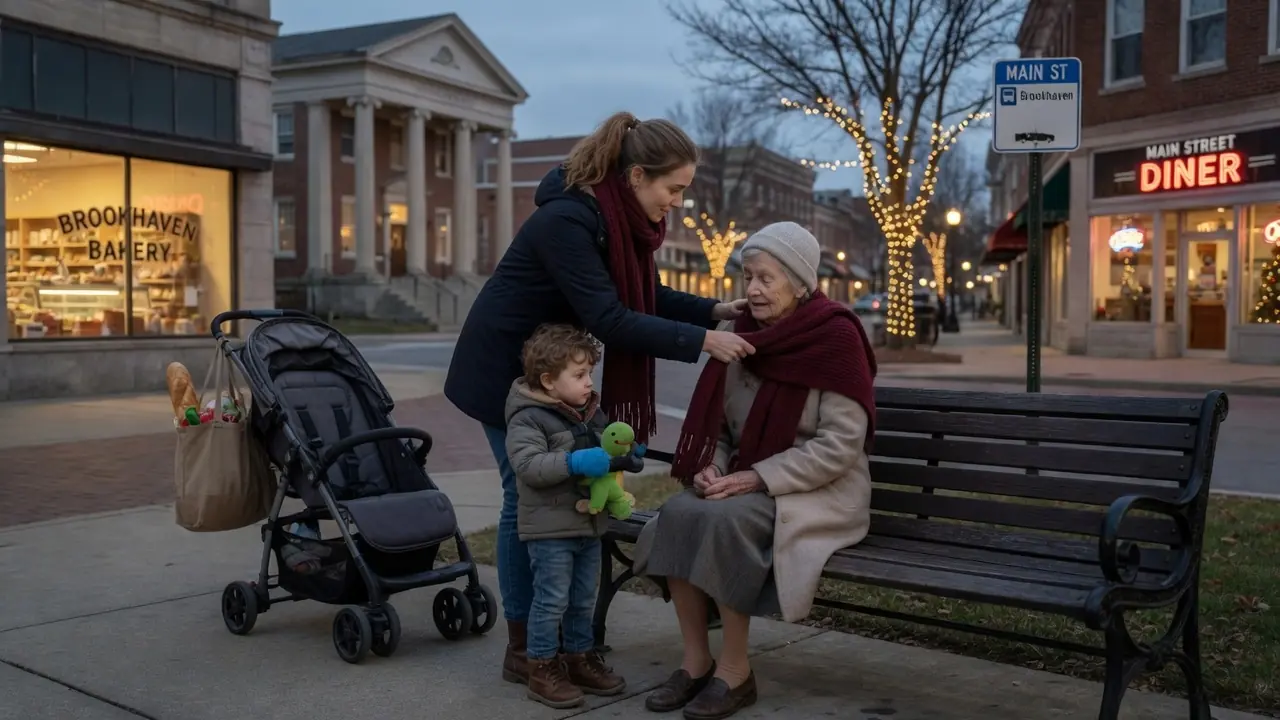
She wore a dark navy coat, old black boots, and a thick burgundy scarf her mother had knitted years ago.
The scarf was not fashionable.
It was too long, slightly uneven, and one end had a loose thread Rachel kept meaning to fix.
But it was warm.
More than warm.
It felt like memory.
Every winter, when Rachel wrapped it around her neck, she felt, for a second, as if her mother’s hands were still near her.
She pushed Noah’s stroller down Main Street, heading toward the bus stop near the courthouse square.
The bus came at 6:45.
If she missed it, the next one would not arrive for forty minutes.
Noah was already sleepy.
Rachel was already tired.
All she wanted was to get home, heat soup, give Noah a bath, and sit down for five quiet minutes before folding laundry.
Then she saw the old woman.
The woman sat alone on a wooden bench near the courthouse square, under a streetlamp that flickered every few seconds.
She was white, probably in her late seventies or early eighties, small and thin, with silver hair tucked beneath a pale gray knit hat.
Her coat was light beige and clearly not warm enough for the evening.
Her hands were bare.
Her fingers curled inward against the cold.
A small black handbag sat on her lap.
Beside her feet was a paper grocery bag with one corner torn.
No one sat beside her.
No one seemed to be waiting with her.
People passed.
Some glanced.
Most kept walking.
Rachel slowed.
At first, she told herself the woman might be waiting for someone.
Maybe a daughter.
Maybe a taxi.
Maybe a bus.
But something about the way the old woman sat made Rachel’s chest tighten.
She was not sitting like a person waiting comfortably.
She was sitting like someone trying not to shake.
Her shoulders were raised toward her ears.
Her lips were pressed together.
Her eyes stared across the street without seeming to see anything.
Noah noticed her too.
“Mommy,” he said. “Lady cold?”
Rachel stopped completely.
The bus stop was half a block away.
The time on her phone read 6:39.
Six minutes.
Rachel looked at the old woman.
Then at the bus stop.
Then at Noah.
Then back at the woman’s bare hands.
Her mother’s voice rose inside her.
Kindness does not need an audience.
Rachel took a breath and pushed the stroller toward the bench.
“Ma’am?” she said gently.
The old woman startled, blinking as if she had been far away.
“Oh,” she said. “I’m sorry. Am I in your way?”
Rachel’s heart twisted.
“No. Not at all. I just wanted to ask if you’re all right.”
The woman tried to smile.
“Yes, dear. I’m fine.”
Her voice shook from the cold.
Rachel knew that answer.
Fine often meant, Please do not make me explain.
Fine often meant, I am embarrassed.
Fine often meant, I do not know what else to say.
Noah pointed his dinosaur toward the woman.
“Cold,” he announced.
Rachel gave him a soft look.
“Yes, baby.”
Then she unwound the burgundy scarf from her neck.
The cold hit her immediately, slipping into her collar.
She ignored it.
She stepped closer and held the scarf out.
“Please take this.”
The old woman stared at it.
“Oh, no. No, dear. I couldn’t.”
“You can.”
“No, you need it.”
“I’m walking. You’re sitting.”
The woman shook her head, embarrassed.
“I don’t want to take your things.”
Rachel did not argue.
She simply leaned forward and gently wrapped the scarf around the old woman’s shoulders.
The wool settled over the beige coat like a small blanket.
The woman inhaled sharply.
Not from fear.
From warmth.
Rachel tucked the loose end across her chest.
“There,” she said softly.
The old woman’s eyes filled.
Noah watched seriously.
“Better?” he asked.
The woman looked at him.
A fragile smile moved across her face.
“Yes, little one. Better.”
Rachel crouched slightly in front of her.
“My name is Rachel. This is Noah.”
“I’m Eleanor Whitman,” the old woman said.
“It’s nice to meet you, Eleanor.”
The old woman touched the scarf with trembling fingers.
“It’s very warm.”
“My mother made it.”
Eleanor looked stricken.
“Oh, dear. Then I really shouldn’t—”
“My mother would be mad at me if I didn’t give it to someone freezing.”
Eleanor let out a tiny laugh that broke halfway.
“She sounds like a good woman.”
“She was.”
Rachel glanced toward the bus stop.
6:42.
Three minutes.
She should go.
She had to go.
But Eleanor’s hands were still shaking.
“Are you waiting for someone?” Rachel asked.
Eleanor looked down at her handbag.
“I thought I was.”
Rachel’s attention sharpened.
“What do you mean?”
“My niece was supposed to pick me up after my appointment.”
“What appointment?”
“At the clinic.” Eleanor gestured vaguely toward the medical office two blocks away. “It ran late. Then my phone died. I waited inside until they closed, but the receptionist had to leave. I thought my niece would come. Maybe I misunderstood the time.”
Rachel looked toward the street.
“Do you know your niece’s number?”
Eleanor opened her handbag and searched carefully.
Her hands were stiff from cold.
She pulled out a small paper address book, the kind with a faded floral cover.
“I have it here.”
Rachel looked at the bus stop.
A bus turned onto Main Street in the distance.
Her bus.
Noah lifted both arms.
“Bus, Mommy.”
Rachel closed her eyes for one second.
If she missed it, Noah would be cranky, dinner would be late, and bedtime would become a battle.
If she left, Eleanor might still be on that bench in forty minutes.
The choice was not really a choice.
Rachel waved the bus past.
Noah watched it go with great concern.
“Bus gone.”
“I know, baby.”
“Home?”
“Soon.”
Eleanor looked horrified.
“Was that your bus?”
“It’s okay.”
“No, dear. No. You must go.”
“We missed it already.”
“Because of me.”
“Because I chose to stay.”
Eleanor’s eyes filled again.
Rachel pulled out her phone.
“Let’s call your niece.”
Eleanor gave her the number.
Rachel dialed.
It rang and rang.
No answer.
She tried again.
No answer.
She left a message.
“Hi, this is Rachel Morgan. I’m with your aunt Eleanor near the courthouse square. She’s safe, but she’s cold and her phone died. Please call this number back as soon as you can.”
Eleanor looked smaller after the call.
“She is probably busy.”
“Maybe.”
“She has children. A job.”
“I understand.”
“I don’t want to be a bother.”
Rachel sat beside her on the bench, keeping one hand on Noah’s stroller.
“Eleanor, needing a ride after a medical appointment is not being a bother.”
The old woman looked down.
“It feels that way when people sigh.”
Rachel did not know what to say at first.
Then she said the truth.
“People can love you and still fail to be gentle.”
Eleanor looked at her.
That sentence seemed to reach her.
“Yes,” she whispered. “They can.”
The cold wind blew across the square.
Rachel shivered without the scarf.
Eleanor noticed immediately.
“You’re cold now.”
“I’m fine.”
Eleanor gave her a look.
Rachel almost laughed.
“I deserved that.”
Noah began fussing in the stroller.
“Hungry.”
“I know.”
Rachel opened the grocery bag and gave him another cracker.
Then she looked toward the diner.
It was still open.
Warm light spilled through the windows.
“Eleanor, would you come inside the diner with us? We can wait there where it’s warm.”
“Oh no. I don’t want to make you spend money.”
“I was going to get Noah home for dinner. We can afford one bowl of soup.”
Eleanor shook her head.
“I can pay for myself.”
“Good. Then we’ll both be stubborn inside instead of freezing outside.”
For the first time, Eleanor laughed properly.
Rachel helped her stand.
Eleanor was unsteady at first.
Rachel held her elbow gently, careful not to make her feel handled.
She pushed Noah’s stroller with one hand and walked slowly beside Eleanor across the square.
Inside the diner, warm air wrapped around them.
The place smelled like coffee, toast, gravy, and apple pie.
A waitress named Marcy, who knew Rachel from grocery store shifts, looked up.
“Rachel? You missed your bus?”
“Long story.”
Marcy looked at Eleanor, the scarf, the stroller, and Rachel’s tired face.
Then she nodded like women who worked long hours often nodded when they understood without needing details.
“Booth by the heater?”
“Please.”
They sat in a corner booth.
Noah sat beside Rachel with his dinosaur.
Eleanor held the scarf around her shoulders like it was something precious.
Rachel ordered one bowl of chicken noodle soup for Eleanor, a grilled cheese for Noah, and coffee for herself.
When Marcy walked away, Eleanor opened her handbag.
“I’ll pay.”
“We’ll sort it out after you eat.”
“I’m not helpless.”
“I know.”
“I mean it.”
“I believe you.”
Eleanor studied her.
“You say that differently than most people.”
“Do I?”
“Yes. Like you actually mean it.”
Rachel looked down at Noah, who was making his dinosaur walk across the table.
“My mother needed help sometimes. She hated when people acted like help erased everything she could still do.”
Eleanor’s face softened.
“She taught you well.”
“I’m trying to teach him,” Rachel said, nodding toward Noah.
Noah looked up.
“Dino kind.”
Rachel smiled.
“Yes. Dino kind.”
Eleanor laughed again.
The soup arrived.
Eleanor tried to eat slowly, but hunger showed.
She had probably been sitting outside longer than she admitted.
Rachel did not comment.
She simply pushed the crackers closer.
Eleanor finished half the bowl before speaking again.
“My husband used to bring me here.”
“What was his name?”
“Arthur.”
The name changed the whole shape of her face.
Softened it.
Aged it.
Lit it from somewhere painful.
“He liked the meatloaf. Said it tasted like something a church lady would defend.”
Rachel smiled.
“That’s very specific.”
“He was a very specific man.”
“When did he pass?”
“Three years ago.”
“I’m sorry.”
“Thank you.”
Eleanor stirred the soup slowly.
“After he died, everything became logistics. Papers. Appointments. Ride schedules. Who can take me where. Who can call whom. Who has time. I never imagined old age would involve so many arrangements.”
Rachel understood that more than she wanted to.
“Life becomes hard when everything needs arranging.”
“Yes,” Eleanor said. “And if you ask too often, people begin answering before you finish.”
Rachel looked at her.
“What do they answer?”
“No.”
The word sat between them.
Small and heavy.
Eleanor looked embarrassed that she had said it.
Rachel reached across the table and gently touched the edge of the scarf.
“You should not have been left on that bench.”
“I may have confused the time.”
“Maybe.”
“I may have forgotten to charge my phone.”
“Maybe.”
“I may have caused the problem.”
Rachel shook her head.
“You had a medical appointment, no working phone, and no ride. Whatever small mistake happened, you still deserved warmth.”
Eleanor’s eyes filled.
“You speak like someone who has needed kindness before.”
Rachel smiled sadly.
“I have.”
Noah fell asleep before finishing the grilled cheese.
His cheek rested against Rachel’s sleeve.
The second bus would come in fifteen minutes.
Rachel still needed to get home.
But Eleanor’s niece still had not called back.
Rachel tried again.
No answer.
She called the clinic, but it was closed.
She asked Eleanor if there was anyone else.
Eleanor gave her a neighbor’s number.
No answer.
A church friend.
No answer.
Finally, Rachel asked, “Where do you live?”
“Maple Terrace Apartments.”
Rachel knew the building.
It was on the other side of town.
Too far to walk in the cold with Noah, Eleanor, groceries, and a stroller.
A taxi would cost more than Rachel wanted to spend, but she was already calculating how much was left in her checking account.
Before she could decide, Marcy came over with a coffee pot.
“You need a ride?”
Rachel looked up.
“I’m figuring it out.”
Marcy nodded toward the kitchen.
“My brother’s picking me up at eight. He has a van. We can drop you all.”
Rachel exhaled.
“Are you sure?”
“Rachel, you covered my groceries once when my card declined.”
Rachel blinked.
“That was two dollars.”
“It was dignity.”
Eleanor looked between them.
Marcy smiled at Eleanor.
“Finish your soup, honey. We’ll get you home.”
Eleanor lowered her head.
For a moment, Rachel thought she was praying.
Then she realized she was crying again.
At eight-fifteen, Marcy’s brother drove them through the dark streets.
Noah slept against Rachel.
Eleanor sat beside the window, wrapped in the burgundy scarf, watching the town pass.
At Maple Terrace Apartments, the lobby lights glowed dimly.
Rachel walked Eleanor inside while Marcy’s brother waited.
Eleanor’s apartment was on the first floor.
She unlocked the door with shaking hands.
Inside, the apartment was neat and quiet.
A lamp glowed beside a blue armchair.
Framed photographs lined a shelf.
Arthur in a gray suit.
Eleanor younger, laughing in a yellow dress.
A group of children around a Thanksgiving table.
A wedding photo.
A small ceramic bowl near the door held keys, buttons, and old coins.
Eleanor turned on the lamp and looked suddenly ashamed.
“I can manage from here.”
“I know.”
“I really can.”
“I believe you.”
Rachel helped her plug in her dead phone.
Then she wrote her own number on a notepad by the phone.
“If you can’t reach your niece next time, call me.”
Eleanor stared.
“You have a child. Work. Your own life.”
“Yes.”
“I don’t want to lean on you.”
“Then don’t lean. Just call if you’re on a bench in the cold.”
Eleanor laughed softly.
“That is a narrow condition.”
“We can widen it later.”
The phone began charging.
Almost immediately, it rang.
Eleanor jumped.
Rachel answered with permission.
A woman’s frantic voice came through.
“Aunt Eleanor?”
“Hi, this is Rachel Morgan. Eleanor is home safe.”
The woman gasped.
“Oh, thank God. I was in the ER with my son. My phone was on silent. I forgot—oh God, I forgot to pick her up.”
Eleanor closed her eyes.
Rachel spoke gently but firmly.
“She was very cold when I found her. She’s home now. She ate soup, and her phone is charging.”
The niece began crying.
“I didn’t mean to leave her.”
“I understand. Please call her now and arrange a safer backup plan for appointments.”
“I will. I promise.”
Rachel handed the phone to Eleanor.
The old woman listened.
Her face softened, then trembled.
“It’s all right, Linda,” she said. “No, don’t cry. I’m home.”
Rachel stepped toward the door to give her privacy.
Eleanor covered the phone.
“Rachel.”
“Yes?”
“The scarf.”
Rachel smiled.
“Keep it tonight.”
“No.”
“Bring it to Miller’s Grocery when you’re ready.”
Eleanor looked at the scarf.
Then at Rachel.
“I will bring it back.”
“I know.”
Rachel carried Noah into the van and went home with groceries, wet boots, no scarf, and a strange ache in her chest.
Her apartment was small and cold when she arrived.
She heated soup.
She changed Noah into pajamas.
She tucked him into bed.
Then she sat at the kitchen table and cried quietly, not because she regretted stopping, but because the whole evening had reminded her how close everyone was to needing someone.
The next week, Eleanor came to Miller’s Grocery.
Rachel was scanning canned beans when she saw her.
Eleanor wore a warmer coat this time, dark blue, with gloves and a charged phone hanging from a lanyard around her neck.
The burgundy scarf was folded in a paper bag.
She waited until Rachel’s register lane was empty.
Then she stepped forward.
“I brought your mother’s scarf back.”
Rachel smiled.
“You look warmer today.”
“I am. Linda bought me this coat and has apologized twenty-three times.”
“That sounds thorough.”
“Exhausting, but thorough.”
Rachel laughed.
Eleanor handed her the bag.
Inside, the scarf had been washed, folded, and tied with a ribbon.
There was also an envelope.
“Open it later,” Eleanor said.
Rachel did.
That night after Noah fell asleep, she opened the envelope at her kitchen table.
Inside was a handwritten letter.
Dear Rachel,
The night you saw me on the bench, I was colder and more frightened than I wanted to admit.
You did not ask whether I deserved help.
You simply gave warmth first.
Your scarf felt like being remembered.
I have thought often about that.
You are raising your son with the kind of courage that can change a whole town, one quiet act at a time.
Thank you for wrapping me in kindness before I had the words to ask for it.
With gratitude,
Eleanor Whitman
Rachel cried over the letter.
Then she placed it in the drawer where she kept Noah’s birth certificate, her mother’s old recipes, and the few things she considered too important to lose.
After that, Eleanor became part of Rachel’s life in small ways.
She came through Rachel’s register every Thursday.
Sometimes she bought groceries.
Sometimes only tea and bread.
Sometimes she brought Noah a sticker book or a small toy car from the thrift shop.
Rachel protested at first.
Eleanor ignored her.
One Thursday, Eleanor asked, “Do you still take the bus after work?”
“Yes.”
“With Noah?”
“Yes.”
“In the cold?”
Rachel smiled.
“Sometimes.”
Eleanor frowned.
“That is unacceptable.”
“It’s life.”
“Many unacceptable things are.”
A week later, Eleanor brought Rachel a flyer.
Brookhaven Family Resource Center was hiring a part-time intake assistant.
Evening hours.
Better pay.
Child-friendly office environment.
Training provided.
Rachel looked at the flyer.
“I don’t have office experience.”
“You handle people at their worst every day at the grocery store,” Eleanor said. “That is experience.”
“I don’t know if they’d hire me.”
“Apply.”
“I don’t have a good resume.”
“I do.”
Rachel blinked.
“You do?”
“I was a school secretary for thirty-four years. I have corrected resumes that would make your eyes beg for mercy.”
Rachel laughed hard enough that a customer turned around.
Eleanor helped her write the resume.
They met at the library on Saturday.
Noah colored at the children’s table while Eleanor sat beside Rachel at a computer, adjusting wording with the authority of a retired professional who still had standards.
“Do not say ‘cashier only,’” Eleanor said.
“I am a cashier.”
“You manage transactions, solve customer issues, support elderly shoppers, maintain accuracy under pressure, and handle confidential payment situations.”
Rachel stared at her.
“That sounds like a different person.”
“No,” Eleanor said. “It sounds like you, translated into employer language.”
Rachel applied.
She got an interview.
Eleanor watched Noah while Rachel went.
Rachel got the job.
It was only part-time at first, but it paid better than the grocery store and connected her to the kind of work she had secretly wanted for years.
At the Family Resource Center, Rachel helped parents apply for childcare support, seniors arrange rides, and families find emergency food assistance.
She learned forms.
Systems.
Programs.
She learned how many people were one cold bench away from crisis.
She learned that kindness could be organized.
Not controlled.
Not turned cold.
Organized, so it could reach more people.
Eleanor encouraged her constantly.
“You have the instinct,” she told Rachel. “Now learn the structure.”
Rachel wrote that sentence down.
Over the next two years, Rachel worked hard.
She moved from intake assistant to outreach coordinator.
She helped create a winter ride list for seniors after medical appointments.
She started a small “warm corner” at the center with donated scarves, gloves, socks, and hand warmers.
She named it The Scarf Shelf.
Eleanor insisted the name was too plain.
Rachel said plain names were easier to remember.
The Scarf Shelf became popular.
People donated winter items.
Grocery customers donated.
Library patrons donated.
The diner placed a basket near the register.
Noah, now five, helped sort children’s mittens by color.
Eleanor became the program’s unofficial quality inspector.
“This scarf is decorative nonsense,” she said once, holding up a thin glittery scarf. “No warmth. Reject.”
Rachel laughed.
The program grew.
It became more than winter clothing.
It became a check-in point.
If someone came for a scarf, staff asked gently whether they had heat at home, transportation, food, phone access, or a safe ride from appointments.
No shame.
No pressure.
Just warmth first.
Questions second.
Exactly as Rachel had done on the bench.
Three years after that cold November night, Eleanor came to the Family Resource Center with Linda.
She carried a folder.
Rachel immediately felt nervous.
“Why do people always bring life-changing things in folders?”
Eleanor smiled.
“Because envelopes are too small.”
Inside was a letter from the Brookhaven Community Foundation.
Eleanor, Linda, Marcy from the diner, and Rachel’s supervisor had nominated Rachel for a family outreach fellowship.
The fellowship would pay for Rachel to complete a community service certification, provide a stipend, and fund expansion of The Scarf Shelf into a countywide winter support program.
Rachel stared at the letter.
Her eyes blurred.
“I can’t accept this.”
Eleanor sat across from her, wearing a deep red coat and a familiar look of gentle command.
“Yes, you can.”
“It’s too much.”
“No,” Eleanor said. “Too much was sitting on a bench wondering whether anyone would notice I was cold. Too much is a town where people apologize for needing warmth. This is the proper size of response.”
Linda smiled through tears.
“She practiced that all morning.”
“I improved it,” Eleanor said.
Rachel cried.
The fellowship changed everything.
She completed her certification.
The Scarf Shelf expanded into libraries, clinics, churches, grocery stores, bus stops, and the community college.
Each location had winter items, ride information, appointment backup cards, and emergency contact forms.
Rachel trained volunteers to recognize cold as more than temperature.
Cold could mean isolation.
Missed rides.
Shut-off notices.
Unpaid heating bills.
Empty refrigerators.
Dead phones.
People pretending to be fine because they did not want to burden anyone.
The program helped hundreds of residents in its first winter.
Then thousands over the next few years.
Rachel became a respected community outreach leader.
Noah grew up watching his mother build something from a scarf.
He told people, with great seriousness, “My mom helps people get warm.”
Rachel always said that was the best job description anyone had ever written.
Eleanor lived long enough to see The Scarf Shelf become a county program.
She attended the ribbon-cutting wrapped in the burgundy scarf.
Rachel had tried to keep it after Eleanor returned it, but years later she gave it back to Eleanor for the ceremony.
“My mother would want you to wear it,” Rachel said.
Eleanor touched the wool.
“Then I will not offend her.”
They both cried.
Eleanor passed away peacefully two winters later.
At her memorial, Linda placed the burgundy scarf beside Eleanor’s photograph.
After the service, she handed Rachel an envelope.
“Aunt Eleanor wrote this for you.”
Rachel opened it later at home, after Noah had gone to bed.
Dear Rachel,
The night you found me, I had almost convinced myself that being cold was my own fault.
You did not lecture me.
You did not question me first.
You gave warmth.
Then you stayed long enough to learn my name.
That is what changed me.
The fellowship was not repayment.
It was my way of helping your warmth reach farther than one bench.
Keep giving warmth first.
Questions can come after.
With love,
Eleanor Whitman
Rachel framed the letter at The Scarf Shelf office.
Beside it, she placed a photograph of Eleanor wearing the burgundy scarf at the ribbon-cutting ceremony.
Years later, whenever people asked how The Scarf Shelf began, Rachel told them the truth.
“It began with an old woman on a bench, a cold November evening, and my mother’s scarf.”
Then she would show them Eleanor’s letter.
The gift Rachel received was not a house.
Not a car.
Not a fortune.
It was a chance.
A fellowship.
A future wide enough for one quiet act of warmth to become a program that helped an entire county.
And every time Rachel saw someone sitting alone in the cold, pretending they were fine, she remembered Eleanor’s trembling hands on that bench.
She remembered Noah asking, “Lady cold?”
She remembered unwinding her mother’s scarf and choosing to miss the bus.
Because sometimes help did not begin with a grand rescue.
Sometimes it began with wool.
A bench.
A tired single mother.
A small child watching.
A stranger too cold to ask.
And sometimes, wrapping a scarf around someone’s shoulders was the first thread in a future no one could see yet.