“Either she leaves or I leave. I’m not sharing this house with this woman.”
Holly Johnson’s voice cut through the birthday music so sharply that every conversation in the living room stopped. The white woman stood beneath clusters of blue-and-silver balloons, one arm folded across her emerald dress while the other pointed toward the front door. Her face was flushed with anger, but her eyes were cold and deliberate.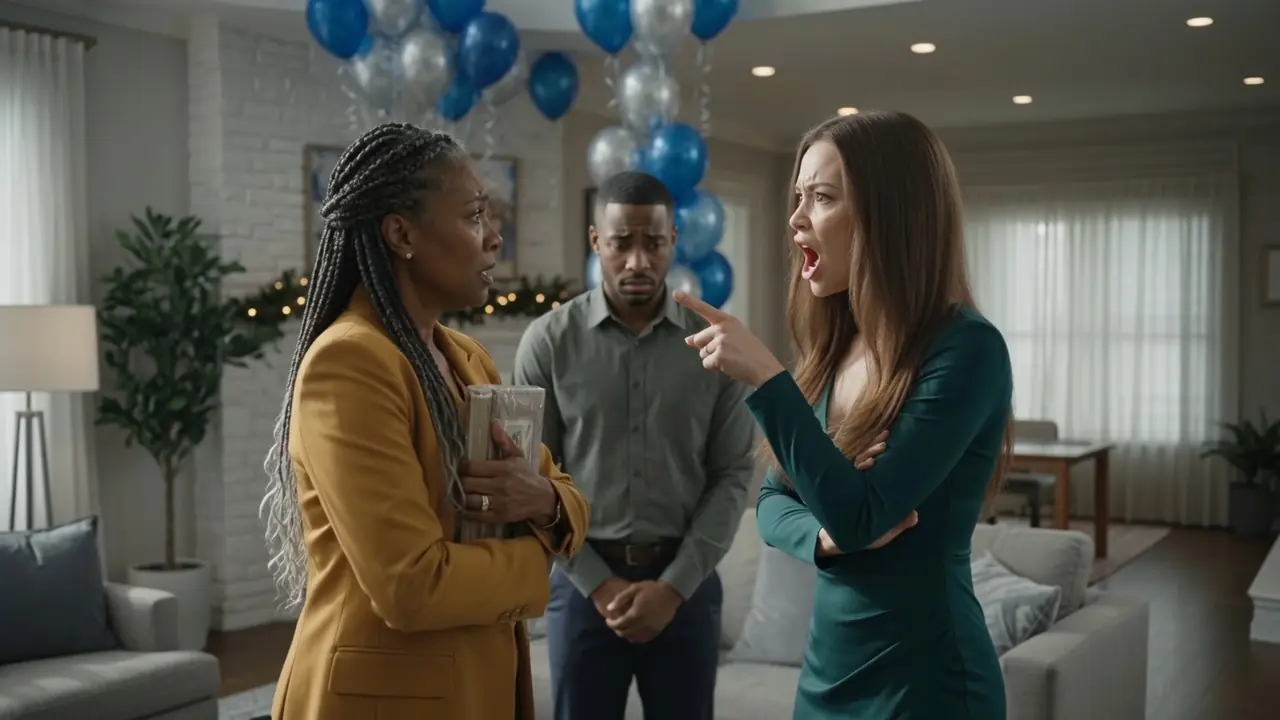
Robert Johnson looked from his wife to the woman standing beside the doorway.
His mother, Eleanor, still held the suitcase she had carried through a twelve-hour bus ride from Dallas to Miami. Against her chest rested a thick family album she had spent months assembling for her grandson Ethan’s sixth birthday. Inside were photographs of Robert as a baby, handwritten stories from relatives, and empty pages where Ethan could one day add his own memories.
“Mom…” Robert said, lowering his eyes. “Maybe it’s better if you go.”
Eleanor felt something inside her become completely still.
She had imagined many things during the long journey. She had pictured Ethan running into her arms, Robert smiling when he saw the old photographs, and the three of them sitting together while she told her grandson stories about the father he resembled so closely. She had not imagined standing outside her son’s home while he chose his wife’s anger over his mother’s dignity.
“I traveled twelve hours just to give Ethan these family memories,” Eleanor said quietly.
Holly stepped forward, snatched the album from Eleanor’s hands, and threw it onto the hardwood floor.
“He doesn’t need your memories,” she snapped. “Take your things and get out of my house!”
The album struck the floor and opened.
Several photographs slid across the room, including one of six-year-old Robert standing beside Eleanor in a schoolyard. In the picture, he was missing two front teeth and holding her hand as if letting go would make the whole world disappear.
Robert stared at the photograph.
He did not pick it up.
Eleanor bent slowly, gathered the loose pictures, and closed the damaged album. The room remained silent except for the soft hiss of a balloon rubbing against the ceiling.
“It’s all right, son,” she said. “I’ll go.”
She turned before either of them could see the tears filling her eyes.
Ethan appeared at the end of the hallway wearing a paper birthday crown. His small face looked confused as he watched his grandmother walk toward the door.
“Grandma, where are you going?”
Eleanor stopped.
Every part of her wanted to cross the room, kneel beside him, and give him the gift she had carried across two states. But Holly moved between them before Eleanor could answer.
“Grandma has to leave,” Holly said.
Ethan looked at his father. “But she just got here.”
Robert swallowed. “Go back to your friends, buddy.”
The child hesitated before slowly returning to the party.
Eleanor stepped outside.
The door closed behind her.
She stood alone on the sidewalk with her suitcase in one hand and the album pressed against her chest. Through the front window, she could see the balloons swaying and children beginning to move again as if nothing important had happened.
The music resumed.
Robert never came after her.
Eleanor found a small hotel near the bus terminal. She locked herself inside the room, placed the damaged album on the bed, and finally allowed herself to cry.
She cried for the twelve-hour journey, for the unopened present, and for the photograph Robert had watched fall without touching. Most of all, she cried because the frightened young man standing beneath those birthday balloons had not looked like the son she had raised.
Robert had once defended her against anyone.
When he was nine, a neighbor mocked Eleanor’s old car, and Robert had refused to play with the neighbor’s children for two months. When he was fourteen, he took a weekend job to help pay the electricity bill, even though Eleanor told him school was enough responsibility. When he graduated from college, he lifted her onto the stage after receiving his diploma and told the audience that every achievement belonged to her too.
That son had disappeared behind a closed door in Miami.
Eleanor opened the album and examined the damage. The cover was cracked, two pages were bent, and one photograph had torn across the corner.
She smoothed the picture carefully.
Robert’s father, James, had left before Robert was born. He disappeared with another woman when Eleanor was seven months pregnant, leaving behind an unpaid mortgage and a note containing six meaningless sentences.
Eleanor had been twenty-five and terrified.
She worked as a substitute teacher during the day and cleaned offices at night until she earned a permanent position at an elementary school. She raised Robert inside a small Dallas house where the roof leaked during storms and the refrigerator sometimes held more hope than food.
Yet she never allowed him to feel unwanted.
Every birthday had a homemade cake. Every school play had Eleanor sitting in the front row. Every disappointment ended with her reminding him that difficult seasons did not define an entire life.
She had protected him so completely from abandonment that perhaps she had never taught him how deeply it wounded the person left outside.
The next morning, Eleanor boarded the first bus to Dallas.
She sat beside the window and spoke to no one for the entire journey. Her phone remained silent for twelve hours.
No apology came from Robert.
No message asked whether she arrived safely.
When Eleanor reached home, she placed the unopened birthday gift in the hall closet. She repaired the album as carefully as possible, then returned it to the shelf beside Robert’s childhood photographs.
For one week, she continued her life.
She taught reading twice at a community center, attended a retirement luncheon for a former colleague, and watered the small garden behind her house. She smiled when neighbors greeted her, but at night she replayed the birthday party until sleep became impossible.
At two o’clock the following Friday morning, her phone rang.
Robert’s name appeared on the screen.
For one hopeful second, Eleanor believed he was calling to apologize.
She answered immediately.
“Mom, are you there?”
His voice sounded broken.
“Yes, son. I’m here.”
“I need your help.”
Eleanor sat upright in bed. “What happened?”
“I need fifty thousand dollars by tomorrow morning.”
The amount cleared the last traces of sleep from her mind.
“Fifty thousand?”
“It’s urgent. If we don’t get it, we could lose the house.”
Eleanor remained silent.
Robert continued speaking rapidly, tripping over his own words. “There’s a payment problem. Holly invested in something, and the money was supposed to come back before the loan was due. It didn’t. The bank is threatening legal action.”
“What did she invest in?”
“A luxury event company. Weddings, corporate parties, private celebrations. She said it was guaranteed.”
“Did you know she used the house as collateral?”
Another silence.
“No.”
Eleanor closed her eyes.
Half of her life savings sat inside a retirement account she had built dollar by dollar over thirty years. Robert knew about it because she once told him she wanted enough money to remain independent as she grew older.
“You have always been there for me,” Robert whispered. “You’ll be there this time too, right?”
Eleanor saw the birthday doorway again.
She saw Holly throwing the album and Robert lowering his eyes.
Then she answered with five words.
“Ask the woman you chose.”
Robert stopped breathing for a moment.
“Mom…”
“You chose her demand over my dignity,” Eleanor said. “Now ask her to save the house she said I was not welcome inside.”
“This isn’t only about Holly. Ethan lives here.”
“Do not use my grandson to frighten me into paying for decisions you hid from me.”
“I didn’t know about the loan.”
“But you knew how your wife treated me.”
“That was different.”
“No, Robert. It came from the same place. You surrendered your judgment because confronting her was harder than disappointing me.”
His voice became desperate. “Are you really going to let your son’s family collapse over one bad night?”
Eleanor looked toward the shelf holding the damaged album.
“It wasn’t one bad night. It was the moment you showed me what my place in your life had become.”
She ended the call.
Her hands trembled afterward, but she did not call back.
At six that morning, Holly telephoned.
Eleanor almost ignored the call, but she answered because she wanted to hear what kind of woman demanded fifty thousand dollars from someone she had thrown into the street.
“You need to stop punishing Robert,” Holly said without greeting her.
“Good morning to you too.”
“This is his family’s home. Ethan’s home.”
“And how did you place it at risk?”
“That is none of your business.”
“It became my business when you asked for my retirement money.”
Holly exhaled sharply. “You have the money. You live alone in a paid-off house and barely spend anything. What exactly are you saving it for?”
“My old age.”
“Robert would care for you.”
Eleanor almost laughed.
“The son who sent me onto a Miami street after a twelve-hour bus ride?”
“You caused that scene.”
“I rang a doorbell.”
“You have always made me feel judged.”
“I barely know you.”
“Exactly. You never tried.”
Eleanor remembered every invitation Holly had rejected, every holiday visit shortened, and every phone call interrupted by an excuse. For years, Holly had told Robert that his mother was controlling, even when Eleanor carefully avoided offering advice.
“What happened to the investment?” Eleanor asked.
Holly’s voice tightened. “My partner mishandled the funds.”
“How much did you lose?”
“That doesn’t matter.”
“How much?”
“Eighty-three thousand.”
Eleanor gripped the phone.
Robert had asked for fifty because that was the amount needed to delay foreclosure proceedings. The total loss was much larger.
“Did Robert sign the loan documents?”
“He signed several business papers.”
“Did he know the house was collateral?”
“He should have read them.”
That sentence revealed everything Eleanor needed to know.
Holly had placed the papers among other documents and allowed her husband to sign without explanation. Now she expected his mother to erase the consequences.
“I will not give you fifty thousand dollars,” Eleanor said.
“You selfish old woman.”
“And now I understand why you feared me entering your house.”
“What is that supposed to mean?”
“You didn’t want family memories near Ethan because memories would remind Robert who he was before you taught him to fear you.”
Holly ended the call.
Later that morning, Robert called again.
Eleanor did not answer.
Instead, she contacted her longtime attorney, Samuel Green, and explained the situation. Samuel advised her not to transfer money, sign documents, or make promises until she understood the legal position of the house and the business.
By noon, Eleanor had requested copies of every document connected to Holly’s company.
Robert sent them reluctantly.
The papers confirmed that Holly had borrowed against the Miami home six months earlier. She had invested the money in an event-planning company owned by a former college friend named Vanessa Reed.
Most of the funds had not gone toward equipment or business property.
They had paid for luxury office furniture, designer advertising campaigns, a leased sports car, and extravagant launch parties. Holly and Vanessa had attempted to build the appearance of success before earning a single profitable contract.
Three months later, Vanessa disappeared with the remaining capital.
Holly had hidden every warning letter from Robert.
The bank had not yet begun foreclosure, but a fifty-thousand-dollar payment was required to restructure the loan. Without it, the house would likely be sold.
Eleanor felt sympathy for Ethan.
She also understood that rescuing Holly without conditions would only move the disaster into the future.
That evening, Robert appeared at Eleanor’s front door.
He had flown from Miami and looked as though he had not slept since their call. His gray shirt was wrinkled, his beard uneven, and his eyes were swollen from crying.
Eleanor opened the door but did not invite him inside immediately.
“Where is Holly?”
“At home with Ethan.”
“Did she send you?”
“She said you would listen to me.”
Eleanor stepped aside.
Robert entered the living room and saw the album on the table. He immediately recognized the cracked cover.
His face changed.
“Mom…”
“I repaired what I could.”
He touched the damaged corner. “I should have picked it up.”
“You should have stopped her before she threw it.”
Robert lowered his head. “I know.”
“Do you?”
He sat on the edge of the sofa. “Holly was crying before you arrived. She said your visit would ruin the party because the two of you never got along.”
“She and I had spoken three times that year.”
“She told me you criticized her parenting.”
“When?”
“I don’t know.”
“Because it never happened.”
Robert rubbed both hands over his face.
Eleanor watched him struggle with a truth he had avoided for years. Holly had not transformed overnight. She had simply become more confident each time Robert remained silent.
“I was trying to keep peace in my marriage,” he said.
“You did not keep peace. You moved every conflict onto the person least likely to abandon you.”
Robert looked at her.
“You knew I would forgive you,” Eleanor continued. “So you allowed Holly to hurt me because disappointing your mother felt safer than confronting your wife.”
Tears filled his eyes.
“I’m sorry.”
Eleanor had imagined those words throughout the bus journey home. Hearing them now brought no immediate relief.
“Would you be here if you didn’t need money?”
The question left him speechless.
“That is what I thought,” she said.
Robert slid from the sofa and knelt before her.
“Mom, please. I know how this looks, but Ethan could lose everything.”
“Ethan will not lose me.”
“He could lose his home.”
“A home is not merely a building. You taught him that family members can be discarded when they become inconvenient. Losing that lesson would benefit him.”
Robert placed the foreclosure notice on the table.
“Please. I need fifty thousand dollars by morning.”
Eleanor touched the album’s damaged cover.
“You watched her throw our family memories away, then told me to leave.”
“I made one mistake. Are you really going to let your son’s family fall apart?”
Eleanor reached for a sealed bank envelope she had prepared earlier.
Robert stared at it with sudden hope.
She slid it away from him.
“Ask the woman you chose.”
Robert’s shoulders collapsed.
“The envelope isn’t a check,” Eleanor explained. “It contains the name of a family-law attorney and a financial counselor in Miami.”
“You want me to leave my wife?”
“I want you to stop asking other people to pay for your fear of confronting her.”
“What about the house?”
“Sell it before the bank takes it. Use the equity to settle as much of the debt as possible. Rent something smaller. Rebuild honestly.”
“Holly will never agree.”
“Then you must decide whether you are her husband or her hostage.”
Robert sat silently for a long time.
Eleanor went to the hall closet and returned carrying Ethan’s unopened gift. She placed it beside him.
“This belongs to my grandson.”
Robert lifted the package. “Can I give it to him?”
“No.”
He looked up.
“I will give it to him myself when I am invited into his life with respect.”
Robert nodded slowly.
Before leaving, he stood near the front door where Eleanor had once watched him return from school every afternoon.
“I don’t deserve another chance,” he said.
“No one deserves forgiveness before earning it.”
“Do you still love me?”
Eleanor’s composure nearly broke.
“Love is not the question, Robert. I loved you when you told me to leave. I loved you when I refused the money. Love does not require me to finance your destruction.”
He left without the fifty thousand dollars.
Three days later, Holly came to Dallas.
She entered Eleanor’s home wearing the same emerald dress from the birthday party, as though she believed confidence could recreate control. Robert followed several steps behind her.
“You’re enjoying this,” Holly accused. “Watching us suffer because Robert chose his wife.”
Eleanor remained seated.
“No. I am watching my son face the cost of refusing to choose what was right.”
Holly placed several loan documents on the table. “One transfer solves everything.”
“For how long?”
“We can rebuild the business.”
“There will be no business.”
Holly’s face hardened. “You don’t decide that.”
“Neither does Robert, apparently.”
Robert flinched.
Holly turned toward him. “Are you going to let her speak to me like that?”
For the first time, Robert did not answer immediately.
Eleanor watched the familiar fear move across his face. Then something else replaced it.
“No,” he said quietly.
Holly smiled with satisfaction.
Robert continued. “Because we are leaving.”
Her smile disappeared.
“What?”
“I met with the attorney Mom recommended. The house is going on the market. The business is finished, and I have frozen our joint accounts.”
“You had no right.”
“I had every right after discovering you hid eighty-three thousand dollars in debt.”
“I did it for us.”
“You did it for an image.”
Holly pointed at Eleanor. “She poisoned you against me.”
“No,” Robert said. “She was the only person honest enough to let me face what I had become.”
Holly stared at him in disbelief.
Then she reached for the damaged album.
Robert moved between them.
“Don’t touch it.”
The words were quiet, but they changed the entire room.
Holly slowly lowered her hand.
“You’re choosing her again,” she whispered.
“I should never have forced a choice between my wife and my mother. But when you humiliated her, I should have chosen decency.”
Holly grabbed her handbag and stormed from the house.
Robert did not follow.
The Miami home sold two months later. After the bank and legal costs were paid, little remained.
Holly filed for separation when Robert refused to ask Eleanor for money again. She moved to Atlanta and left Ethan primarily in Robert’s care while she attempted to rebuild her business connections.
Robert rented a modest two-bedroom apartment near Ethan’s school.
For the first time in years, he handled every bill himself. He cooked simple dinners, packed school lunches, and learned how exhausting it was to become the dependable parent in a child’s life.
He called Eleanor every Sunday.
At first, their conversations lasted only a few minutes. He did not ask for money, defend Holly, or pressure her to forgive him.
He simply told her about Ethan.
Three months after the birthday party, Robert invited Eleanor to Miami again.
This time, he purchased her plane ticket himself.
When she reached his apartment, Ethan opened the door before Robert could.
“Grandma!”
He ran into her arms.
Eleanor held him tightly, closing her eyes against the tears. Behind him stood Robert, holding the repaired family album with both hands.
“I kept it safe,” he said.
Eleanor entered the small apartment.
There were no expensive decorations, no polished furniture, and no blue-and-silver balloons. A few paper streamers hung crookedly across the wall because Ethan had insisted they celebrate his grandmother’s arrival.
Eleanor gave him the birthday gift she had carried home unopened months earlier.
Ethan tore away the paper and found a wooden box filled with copies of family photographs. His favorite was the picture of Robert at six years old, missing two front teeth and holding Eleanor’s hand.
“He looked like me,” Ethan said.
“He still does,” Eleanor replied.
Robert sat beside them.
“I’m sorry you didn’t receive this on your birthday,” he told his son.
“Why didn’t I?”
Robert looked at Eleanor before answering.
“Because I made Grandma feel unwelcome, and that was wrong.”
Ethan frowned. “Did you say sorry?”
“Yes.”
“Did she forgive you?”
Robert’s voice softened. “We’re still working on that.”
Eleanor placed one hand over her son’s.
Forgiveness did not arrive as a sudden emotional miracle. It came through small evidence: weekly calls, honest apologies, and Robert’s willingness to accept consequences without demanding rescue.
Eleanor never gave him the fifty thousand dollars.
Instead, she created a protected education account for Ethan that neither Robert nor Holly could access. The money remained hers while she lived, and the rest of her savings continued securing her own future.
Robert found a smaller house after two years of rebuilding his credit.
He never again asked his mother to sacrifice her security to cover another adult’s deception. More importantly, he never again allowed anyone to humiliate her in the name of keeping peace.
The damaged album remained in his living room.
He refused to replace the cracked cover because it reminded him of the night he nearly lost the woman who had never abandoned him.
Eleanor eventually forgave him, but she did not forget.
She understood something she had missed while raising her son: unconditional love did not mean unconditional access, obedience, or money.
Sometimes the most loving word a mother could say was no.
And sometimes five quiet words could save a son more completely than fifty thousand dollars ever would.
Ask the woman you chose.