“Why are you sticking your nose into our fight, little mechanic?” The largest man in the group stepped forward, a steel pipe hanging from his right hand as five others spread behind him across the cracked pavement of an abandoned gas station outside Red Creek, Colorado. Twenty-four-year-old Samantha Reed stood between them and the injured gray-bearded biker beside the black motorcycle, grease still streaked across her blue coveralls and a heavy motorcycle chain hanging from one hand. She raised her other palm toward the men and said, “Because six cowards beating one man makes it my problem.” The leader tightened his grip on the pipe. “Walk away now, or you’re hitting the ground beside him.”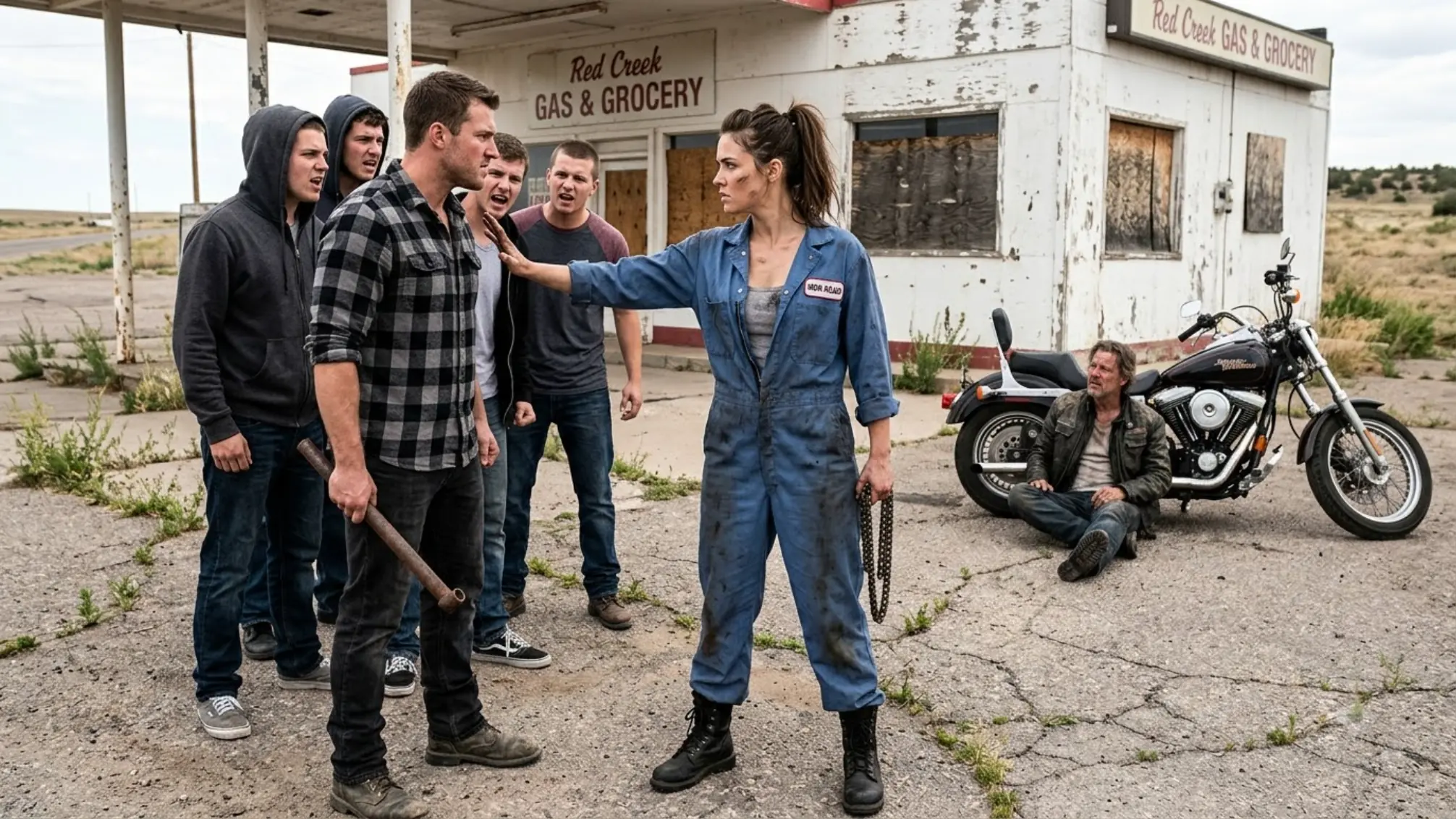
Samantha’s green eyes never left his hands. “Take one more step—let’s find out which one of us drops first.” Behind her, the older biker pushed himself painfully against the motorcycle, blood streaking one cheek and one sleeve of his leather vest torn almost completely open. The six men laughed again, but their confidence had changed because Samantha was not backing away. She had arrived expecting to drive home after another fourteen-hour shift at Iron Road Motorcycle Garage, not stand on Highway 62 facing six men twice her size.
Ten minutes earlier, Samantha had nearly kept driving. She was exhausted, hungry, and thinking about the fourteen hundred dollars she still owed her landlord when she saw headlights surrounding a single motorcycle at the abandoned station. Her father’s voice rose from memory before logic could stop it: If you ever see somebody standing alone against the world, be the person who stops. Douglas Reed had been dead eighteen months, but some things he taught Samantha had become instincts instead of memories. She braked, pulled onto the gravel, and grabbed the heavy repair chain from behind her truck seat.
Now the leader took that step. Samantha moved sideways instead of backward, keeping distance between herself and the steel pipe while forcing him to turn toward her. He swung once, wide and angry, and Samantha slipped beyond the arc before the pipe struck nothing but empty air. She used the chain only to knock his wrist aside and create space, then drove her shoulder into him as his own momentum carried him off balance. He stumbled against the hood of an abandoned car and dropped the pipe with a metallic crash.
The laughter stopped. Two of the other men rushed forward, but Samantha never tried to overpower them; she kept moving, forcing them into one another’s path while refusing to become trapped against the gas pumps. One grabbed at her sleeve, and she tore free, sending him stumbling over a broken concrete parking stop. The second hesitated when the injured biker finally forced himself upright behind her. Samantha heard him say, “Your left,” and she shifted just before another attacker tried to close in from that side.
The older biker was hurt, but he was still dangerous enough that the remaining men began recalculating. The leader recovered near the car, furious now, and pointed at Samantha. “You have no idea who you just stepped in front of.” Samantha tightened her grip on the chain, her breathing quick but controlled. “Funny,” she answered, “I was about to say the same thing about you.”
A truck engine roared behind the attackers. One of them looked toward the highway, then toward the biker, and whatever plan had brought them there suddenly seemed less certain. They helped the leader back toward their vehicle, throwing threats over their shoulders without attempting another rush. Samantha did not chase them. She stood between the truck and the injured man until its taillights disappeared around the bend.
Only after the truck vanished did Samantha realize her hands were trembling. Adrenaline had hidden the fear while she needed to move, but now every possibility she had ignored was arriving at once. She dropped the chain back into her repair bag and turned toward the injured biker. “Can you stand without falling?”
He looked at her for several seconds before answering. He was somewhere in his early sixties, heavily built despite his age, with a weathered face, gray beard, and old scars visible beneath fresh bruises. His black leather vest carried faded patches Samantha recognized enough to understand that his past was complicated. “I can stand,” he said. “Question is whether I should.”
“Sit.” Samantha crouched beside his motorcycle instead. “Your bike took a hit?” He blinked, almost offended by the question considering what had just happened, but then looked toward the machine. “They wanted it intact.”
Samantha studied the motorcycle. It was an old Harley-Davidson Sportster, cared for by someone who understood exactly what he owned, and the attackers had clearly avoided seriously damaging it. That told Samantha something important. This had not been a random roadside robbery performed by panicked amateurs.
“They were after you,” she said. The biker nodded. “Looks that way.” Samantha ran one hand near the primary drive without touching the hot casing. “You’ve also got a bearing going bad.”
For the first time, the man almost smiled. “You diagnose motorcycles thirty seconds after facing six guys?” Samantha looked at him flatly. “Machines make more sense than people.” He laughed once, then winced and pressed a hand against his ribs. “Name’s William Dawson.”
“Samantha Reed.” She pointed toward the dark highway. “My garage is twelve minutes east. Iron Road.” William’s expression changed slightly. “Douglas Reed’s place?”
“It’s mine now.”
William looked at her differently after that. He remembered Douglas because almost every serious rider who had crossed this part of Colorado during the previous twenty years had heard of him. Douglas Reed had been known for two things: understanding engines other mechanics gave up on, and refusing jobs he believed were dishonest. Samantha had inherited both habits, along with a struggling business and enough debt to keep her awake most nights.
“You his daughter?” William asked. Samantha stood. “I’m Samantha Reed. I own the shop.” The correction was quiet, but William understood it.
He nodded. “Fair enough.”
They got William and the motorcycle to Iron Road before midnight. Samantha cleaned the cuts on his face, refused his attempt to call himself fine, and told him he needed a doctor if the pain in his ribs became worse. Then she moved immediately to the motorcycle. The primary-drive bearing was failing, the chain had stretched, and whoever serviced it previously had adjusted around the problem rather than actually repairing it.
William sat on an old stool watching her work. “You always this stubborn?” he asked. Samantha never looked up. “Only when I’m awake.”
“You should’ve kept driving tonight.”
“That what you would’ve done?”
William went quiet.
Samantha glanced toward him. “Thought so.”
By five in the morning, the motorcycle was running cleanly. Samantha listened to the engine with her head tilted slightly, then shut it down and started checking the final bolts. William had barely spoken for the previous hour, but he had watched every movement. He knew enough about machines to recognize that she was not pretending to be her father’s replacement.
She was better than most people who had ever worked on his bike.
“How much?” he asked. Samantha gave him a number. It was fair, not discounted because she felt sorry for him and not inflated because he looked like he could afford it.
William placed cash on the workbench.
Then he added another hundred.
Samantha pushed the extra bill back. “I said the price.”
“That’s for Highway 62.”
“No.”
He stared at her. “You saved me.”
“I stopped because six men were beating someone on the ground. I didn’t stop because there was a fee.”
William slowly picked the hundred back up.
Something in his expression changed.
At eight that morning, Raymond Carter arrived carrying two coffees and found Samantha leaning against the workbench with barely enough energy to remain upright. Raymond had worked beside Douglas for eleven years and stayed at Iron Road after his death, partly because the shop needed him and partly because Samantha did. He looked at William, the repaired Harley, Samantha’s bruised sleeve, and the heavy chain lying near her repair bag. “What happened?”
“Long night,” Samantha said.
Raymond looked directly at William.
William answered, “Your mechanic stopped six men from putting me in the hospital.”
Raymond looked back at Samantha. “Six?”
“Technically they decided leaving was smarter.”
Raymond closed his eyes for one second.
“Your father is going to haunt me because I failed to keep you alive.”
Samantha took one of the coffees. “Your coffee might finish the job.”
William laughed harder than his ribs appreciated. Before leaving, he stood beside Samantha near the garage door. “Those men weren’t random.”
“I figured that out.”
“They may come looking for me again.”
“That sounds like your problem.”
William nodded. “They may also come looking for you.”
Samantha met his eyes. “Then that becomes mine.”
He stared at her, then handed her a plain piece of paper with a number written across it.
“If you need something, call.”
“I don’t usually call strangers.”
“You stopped your truck for one.”
William climbed onto the Sportster and started the engine.
It sounded perfect.
Samantha allowed herself a small smile. “Don’t destroy that bearing again.”
He rode west toward Flagstaff.
By noon, word of the roadside confrontation had already begun traveling through circles Samantha did not understand. The first evidence arrived when a compact man in a county-security jacket walked into Iron Road and introduced himself as David Whitfield. He claimed he consulted for businesses along Highway 62 and had heard about several men attacking travelers around the corridor. His questions were polite, but Samantha recognized the difference between concern and information gathering.
“Were you warning me or checking how scared I am?” she asked.
Whitfield paused.
Raymond looked up from his stool.
Samantha continued tightening a bolt.
Finally Whitfield said, “Maybe both.”
“Then you have your answer.”
He studied her for a few seconds and left.
At 11:47 the following morning, three motorcycles rolled into Iron Road together. The men wore leather cuts and moved with the deliberate calm of people accustomed to being watched. Samantha stepped into the bay doorway, wiping her hands on a rag. “Something wrong with the bikes?”
The man in front shook his head. “We came because William Dawson called.”
Samantha’s posture changed slightly.
“My name’s Curtis.”
He looked around the garage.
“We knew your father.”
Samantha had heard that sentence too many times to be impressed.
“How?”
Curtis smiled faintly. “Douglas rebuilt my Ironhead in 2009 after three shops told me to scrap it.”
“What was wrong?”
“Cracked case where nobody had looked.”
Samantha nodded.
That sounded like Douglas.
Curtis continued. “William told us about Highway 62.”
“Apparently everybody knows.”
“Certain stories travel faster.”
He paused.
“He said you stopped without knowing who he was.”
“I still barely know who he is.”
“That’s why it matters.”
Samantha folded the rag and placed it on the workbench. “What do you want?”
“Nothing today.”
“That means something later.”
Curtis smiled for real this time. “You’re difficult.”
“I’m busy.”
He leaned against the doorway. “The men you met belong to a group that’s been hitting riders and freight vehicles along that corridor for months. William wasn’t chosen randomly. Somebody wanted to send a message.”
Samantha’s eyes hardened.
“Who?”
“A freight operator named Garrett Voss works part of it. Another man, Roy Briggs, handles intimidation. People around here know pieces, but nobody has enough evidence to close the whole thing.”
Raymond stopped drinking his coffee.
Samantha looked toward him.
He knew Garrett’s name.
Seven years earlier, Garrett had offered Douglas Reed significant money to modify several transport motorcycles and support vehicles in ways Douglas believed were illegal. Douglas refused. Garrett responded by spreading rumors that Iron Road performed unsafe work.
The rumors failed because Douglas had decades of customers who knew better.
Samantha suddenly understood something she had never known about her father.
He had been standing against the same people long before she stepped onto Highway 62.
Curtis reached into his pocket and placed a phone number on the workbench. “If anything changes, call me.”
Samantha glanced down.
“I already have William’s number.”
“This one gets answered faster.”
“How fast?”
“Eight minutes from anywhere around Red Creek.”
She looked up.
“That sounds rehearsed.”
“It’s accurate.”
Curtis and the others left.
Three hours later, a pickup parked across the highway from Iron Road and remained there for almost forty minutes. Nobody exited. Samantha memorized the plate without stopping her work.
The next morning, she found a piece of cardboard tucked beneath the windshield wiper of a customer’s motorcycle.
Three words were written in thick black marker.
LET IT GO.
Raymond read it and immediately said, “Call Curtis.”
Samantha stared at the number for several seconds. Calling meant accepting that the people who had stepped into her life were no longer strangers. She hated owing anyone.
Raymond understood.
“You’re not asking them to fight your battle,” he said. “You’re telling people who already know the battlefield that it moved.”
Samantha called.
Curtis arrived seven minutes and forty seconds later.
He examined the cardboard, then looked toward the highway.
“Garrett.”
“You sure?”
“No.”
“Then don’t say it like you are.”
Curtis gave her a grudging nod.
“Fair.”
He explained that a sheriff’s deputy named Karen O’Malley had spent seven months quietly building a case against the corridor operation. She lacked a clean civilian witness who could directly place Briggs’s men at a documented assault. Samantha’s statement could change that.
“And what happens after I give it?” Samantha asked.
“Pressure.”
“That’s already happening.”
“More pressure.”
She looked toward the note.
“Still sounds like it’s already happening.”
Curtis gave her Deputy O’Malley’s number.
Samantha called that afternoon.
O’Malley came to Iron Road in an unmarked sedan after closing. She sat inside Douglas Reed’s old office with a yellow legal pad and listened as Samantha described every second of the Highway 62 attack without embellishment. Samantha explained where every man stood, which direction the truck arrived from, what William said, and how the attackers behaved.
When she finished, O’Malley stared at her notes.
“There’s a camera.”
Samantha frowned.
“Where?”
“Southeast corner of the abandoned station.”
The camera had remained active because an old solar-powered security system continued uploading footage to a remote server long after the station closed. O’Malley knew about it but needed an event and witness strong enough to justify pulling the archive formally. Samantha’s statement provided the missing foundation.
“Your testimony plus that footage changes the case,” O’Malley said.
“How much?”
“Enough that people are going to get nervous.”
Samantha leaned back.
“They already are.”
That night, somebody broke into Iron Road.
Nothing expensive disappeared. Thousands of dollars in tools remained untouched, as did customer motorcycles worth far more than anything in Douglas’s office. The intruder entered through a poorly secured rear window and searched only the old desk.
Samantha arrived after Raymond discovered the break-in.
She opened the bottom drawer.
Empty.
Her face changed.
“What was there?” Raymond asked.
“A folder.”
Inside that folder had been something Samantha found six months after her father died: several pages of names, dates, business names, vehicle numbers, and dollar amounts written in Douglas Reed’s handwriting. At the time she assumed they were unfinished business records. Now she understood.
Douglas had been documenting suspicious jobs Garrett offered years earlier.
The original papers were gone.
Curtis arrived shortly afterward and looked at the empty drawer.
“They knew.”
Samantha pulled out her phone.
“No.”
Curtis looked at her.
“They thought they knew.”
Six months earlier, Samantha had photographed every page before returning the folder to the drawer. Douglas had taught her to photograph complicated repairs before touching anything so she always knew how the machine looked when it arrived. She had applied the same habit to paperwork without knowing why.
The photographs still existed in cloud storage.
Within fifteen minutes, Samantha had sent copies to O’Malley, Curtis, Raymond, and two separate email accounts. O’Malley arrived that evening and began matching the handwritten entries against records already inside her investigation. Douglas’s dates aligned with freight movements, contractor payments, and vehicle registrations detectives had been unable to connect.
The missing folder had not killed the case.
Stealing it had confirmed someone feared what was inside.
Forty-eight hours later, state investigators joined the operation. Highway cameras, bank records, Douglas’s notes, Samantha’s statement, and the gas-station footage created a timeline investigators could finally defend from beginning to end. The video clearly showed William being surrounded before Samantha arrived. It also showed the attackers fleeing together afterward.
Roy Briggs was arrested first.
Garrett Voss followed several hours later.
Four associates connected to previous highway assaults were detained during coordinated searches.
Whitfield cooperated when confronted with communications tying him to Garrett’s informal security network.
For the first time in months, Highway 62 became quiet.
Samantha learned the news from Curtis while replacing a clutch at Iron Road.
“That’s it?” she asked.
“That’s it.”
She continued working.
Curtis frowned. “You don’t look relieved.”
“I am.”
“You’re replacing a clutch.”
“The customer still wants his motorcycle.”
Curtis laughed.
“You’re impossible.”
“No. I’m behind schedule.”
Two weeks later, more than fifty motorcycles filled the gravel lot outside Iron Road. Riders from several Colorado towns had come because William Dawson and others wanted to acknowledge the mechanic whose single decision on Highway 62 had helped break open a case that had hurt people for months. Samantha hated being the center of anything and nearly refused.
Raymond convinced her with one sentence.
“Sometimes accepting respect is part of respecting the people giving it.”
William returned from Flagstaff on the same repaired Sportster.
He looked different.
Samantha noticed immediately.
“You saw your daughter.”
He nodded.
“We talked until two in the morning.”
“Good.”
“She said you told her I believed in her.”
“I told her what you told me.”
William smiled.
“She believed you before she believed me.”
“That sounds like a problem you should fix.”
“I’m working on it.”
A senior rider named Michael Turner eventually stood before the crowd. He did not make a dramatic speech about violence or courage. Instead, he spoke about Douglas Reed keeping records for years because he believed truth mattered even when nobody was ready to hear it.
Then he spoke about Samantha.
“She did not know William Dawson when she stopped,” Turner said. “She did not know who the men attacking him were. She didn’t know there was an investigation, a freight operation, or evidence sitting inside her father’s desk.”
The lot became completely quiet.
“She knew one thing.”
Turner looked directly at Samantha.
“One man was on the ground, six men were standing over him, and she had a choice.”
Samantha looked toward Raymond.
He was holding one of his terrible coffees.
Turner continued.
“She stopped.”
Nobody cheered.
Instead, something quieter happened.
Dozens of men and women who understood what standing alone could cost simply looked at Samantha Reed with respect.
For fourteen months after her father died, Samantha had watched customers walk into Iron Road and ask whether a man was available. She had watched them leave for competing garages without allowing her to touch their motorcycles. She had read the newspaper article asking whether “Douglas Reed’s daughter” could maintain his reputation.
Now nobody in the lot was asking whose daughter she was.
They knew her name.
Turner handed her a small emblem showing a road crossing a wrench. “This doesn’t make you part of anything,” he said. “It doesn’t ask anything from you. It only means people here know what you did.”
Samantha held it in her palm.
“My father told me something when I was eleven,” she said.
Everyone waited.
“He said if you see somebody standing alone against the world, be the person who stops.”
She looked toward Iron Road.
“I thought that lesson was about helping strangers.”
Her voice softened.
“Turns out it was also about deciding what kind of person you’re going to be before the hard moment arrives.”
Raymond lowered his coffee.
Samantha looked at him.
“And everything that happened afterward—the evidence, the case, people getting arrested—that wasn’t why I stopped.”
She closed her hand around the emblem.
“I stopped because I couldn’t drive past.”
The gathering ended before sunset.
Monday morning, Iron Road opened at eight.
At 8:03, Samantha was already beneath a vintage Triumph adjusting a valve when a truck pulled into the lot. A young woman climbed out beside a badly running Honda motorcycle.
She entered nervously.
“Are you Samantha Reed?”
Samantha rolled out from beneath the Triumph.
“Yes.”
“My boyfriend said I should take this somewhere else.”
Samantha stood.
“Why?”
“He said you’re too young to know what you’re doing.”
Raymond nearly laughed into his coffee.
Samantha looked at the Honda.
“Start it.”
The woman did.
Samantha listened for eight seconds.
“Cam-chain timing. Probably jumped one tooth.”
The woman stared.
“You can tell that from listening?”
“I can tell where I need to start looking.”
She wiped her hands.
“You want me to fix it or do you want to prove your boyfriend right?”
The young woman smiled.
“Fix it.”
Samantha pointed toward the paperwork desk.
“Leave your number.”
The woman did.
Outside, Highway 62 stretched west beneath the Colorado sky, ordinary again. Trucks moved through Red Creek, motorcycles crossed the county line, and the abandoned gas station slowly returned to being nothing more than an empty building beside the road. Inside Iron Road, Samantha picked up a wrench and went back to work.
The small emblem Turner gave her eventually went into the bottom drawer of Douglas Reed’s old desk.
Exactly where his missing folder had once been.
Samantha never displayed it on the wall.
She did not need customers to see it.
She knew what it meant.
Months later, Iron Road was busier than it had been at any point since Douglas died. Some customers came because they had heard what Samantha did on Highway 62, but they returned because their motorcycles left running better than when they arrived. Billy Crane began sending complicated jobs he could not solve, and Samantha sent work back when his shop was better equipped for something.
That pleased Raymond more than any ceremony.
One evening, he sat on his usual stool watching Samantha rebuild an old Harley engine.
“You stopped counting,” he said.
She looked up.
“Counting what?”
“People who don’t believe you.”
Samantha thought about it.
Raymond was right.
For years, every insult had registered somewhere inside her. Every customer who asked for a male mechanic, every person who mentioned Douglas as though she were merely borrowing his garage, every laugh when she offered an opinion had added itself to an invisible total.
She no longer knew the number.
She smiled.
“When did that happen?”
Raymond looked toward the road.
“Probably the night you stopped the truck.”
Samantha considered that.
Maybe.
But she suspected the answer was slightly different.
It happened when she finally understood that Douglas had never built Iron Road so the world would approve of him.
He built it because he knew how to do the work.
Samantha finally understood that she could do the same.
The next morning, she unlocked Iron Road before sunrise. Light slowly filled the garage, catching on steel tools, old photographs, motorcycle frames, and the worn wooden desk where Douglas had kept records nobody understood until years after his death. Samantha made coffee terrible enough to make Raymond complain even though he drank every cup.
Then she opened the bay door.
A motorcycle waited outside.
The rider looked toward her and asked, “Mechanic here?”
Samantha picked up her wrench.
“You’re looking at her.”
This time, nobody laughed.