Daniel Brooks had imagined this moment so many times that he could almost hear Alicia laughing before he opened the front door. He stepped into the sunlit living room with his duffel over one shoulder and called, “Surprise! I’m home!” The electric clippers stopped so suddenly that the silence seemed to press against his ears. His wife stood behind her mother’s chair, and the towel around Denise’s shoulders was scattered with dark strands of hair.
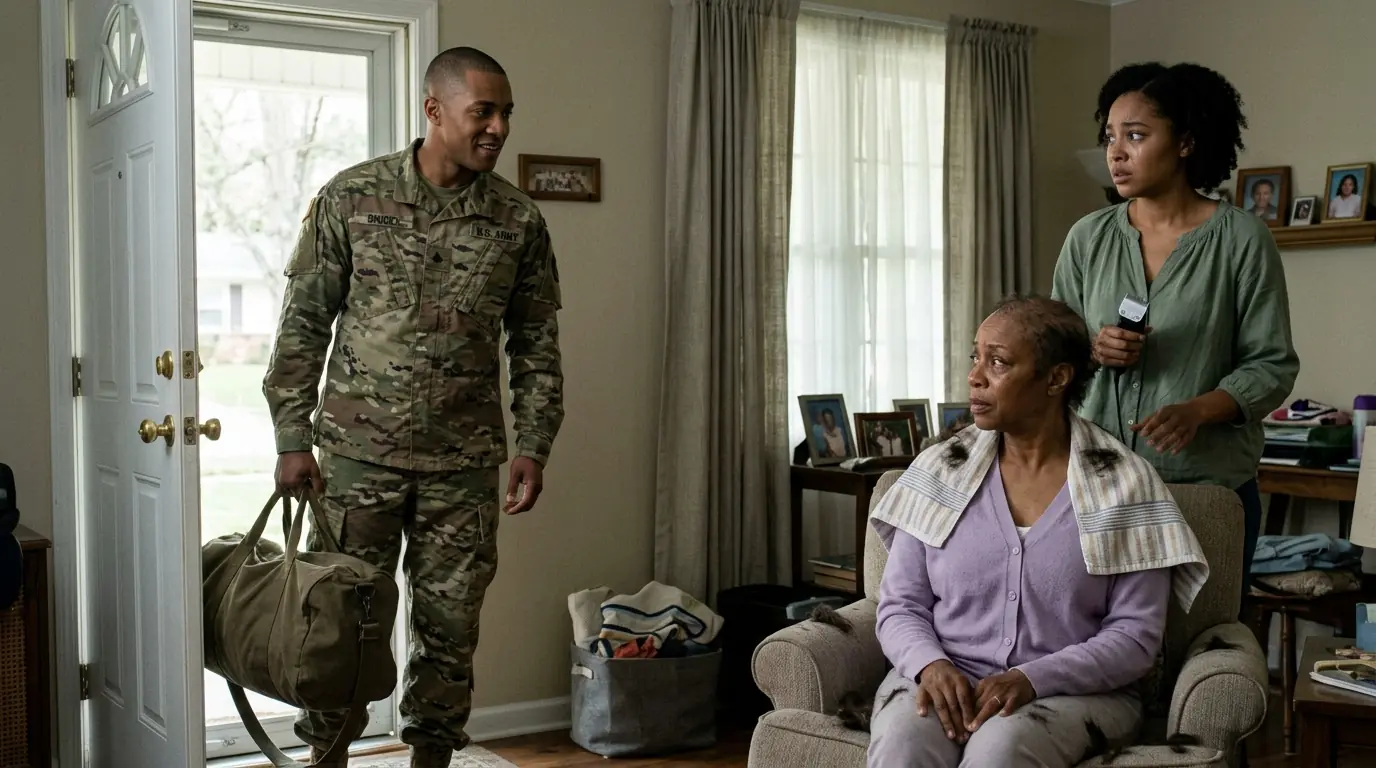
During the immediate aftermath, Daniel Brooks noticed the doorway, a detail that had seemed unimportant until the last conversation changed its meaning. Alicia Brooks remained close enough to notice the hesitation, but neither of them could pretend the room felt the way it had before. “Tell me what you actually saw,” Daniel Brooks said, and the words hung between them longer than either expected. Outside, ordinary sounds continued, indifferent to the difficult choice taking shape indoors.
Alicia Brooks had once believed that a person could separate a frightening event from the rest of life simply by refusing to discuss it. Now the military duffel brought the whole memory back with uncomfortable precision, including the things that had been said and the things left unfinished. Denise Carter asked a careful question, and Alicia Brooks answered only after weighing whether the answer would help or merely postpone another argument. What mattered most was no longer winning the exchange, but deciding whether the next sentence would be true.
The question of family love, illness, fear, honesty, endurance had become less abstract with every passing hour. Denise Carter crossed the room toward the towel across Denise’s shoulders, stopped, and thought about how differently the same scene could appear to someone arriving without warning. Ruth Carter watched that small movement and finally admitted that fear had shaped more of the story than either had wanted to acknowledge. They did not agree, but the admission opened a narrow space where an honest explanation might eventually fit.
By then, Ruth Carter could recall the exact tone of the earlier conversation, though not every word. Dr. Helena Moore had described the problem as something temporary, something they might endure without making it larger, yet a folded appointment card remained where everyone could see it. “You cannot ask me to trust a silence,” Dr. Helena Moore whispered, sounding more tired than defiant. The answer came slowly, because each of them understood that the next decision would have consequences beyond this one room.
What troubled Dr. Helena Moore was not only what had happened, but how quickly everyone had started constructing a different account of it. Caleb Brooks pointed to the military duffel and asked for the sequence again, from the first moment rather than from the part that hurt most. In telling it, Dr. Helena Moore noticed a missing connection, a detail that might alter the meaning of what they thought they knew. Neither spoke for several seconds after that discovery, and the quiet was no longer empty.
Caleb Brooks tried to imagine explaining this day to someone who had not been there. The account would need to include a half-written letter, the interrupted conversation, and the uncomfortable possibility that a sincere intention could still cause lasting harm. Daniel Brooks listened without interrupting, then asked whether the same decision would be made again with the benefit of hindsight. The question was harder than any accusation, because it required an answer without excuses.