At the family dinner, my son Michael looked across the table at me and said, “Your job is to watch my kids while I enjoy my life with my wife. It’s that simple. If you have a problem with it, the door is right there.” His hand was pressed against the polished dining table, his expensive watch catching the light as if even time belonged to him. Jessica stood beside him in her peach dress, silent but satisfied, while the roast chicken I had spent four hours preparing sat untouched between us. My three grandchildren froze with their forks in their hands, too young to understand the full cruelty of what had just been said.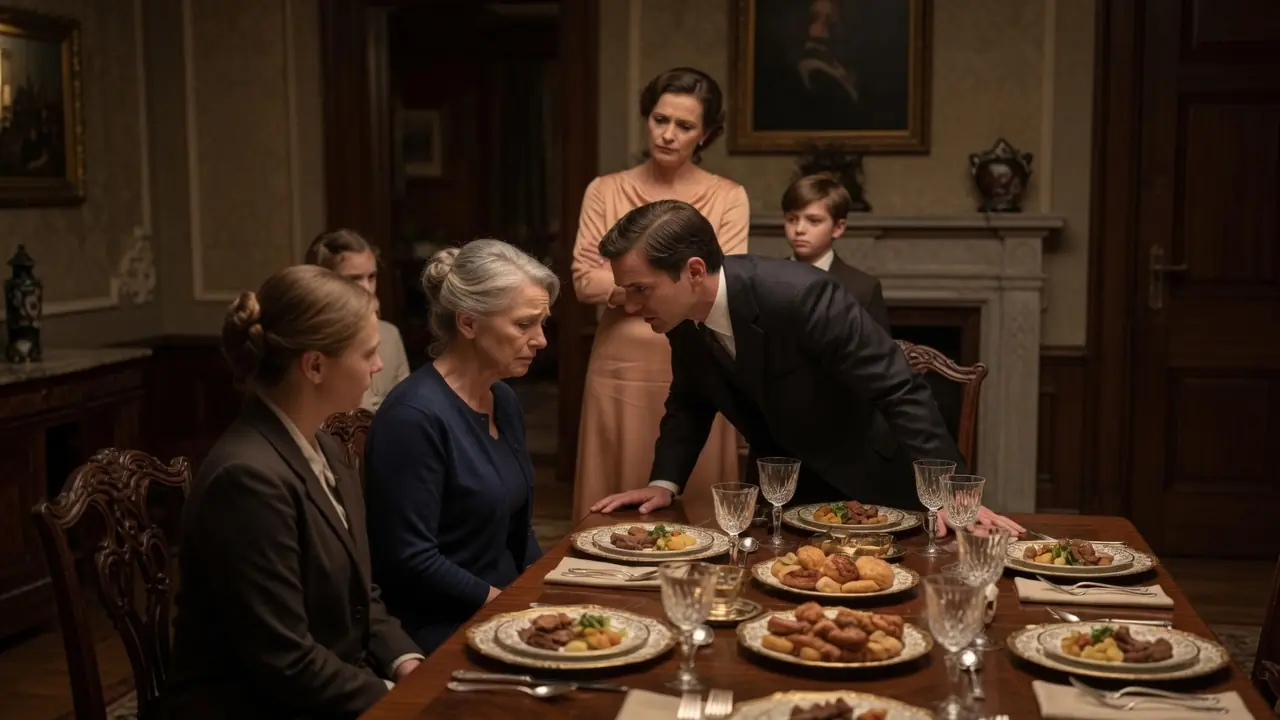
I looked at Michael, the boy I had once carried through fever nights, the boy whose shoes I patched so he could walk into school without shame, and for a moment I could not find my voice. Then something inside me, something old and buried under years of forgiveness, finally stood up before my body did. I folded the cloth napkin on my lap, placed it beside my untouched plate, and looked directly at him. “Perfect,” I said quietly. “I’m leaving, and you two can start paying your own bills. It’s that simple.”
Michael stopped breathing for half a second. Jessica dropped her fork, and the sharp sound of metal against porcelain echoed across the room. My youngest grandson, Oliver, glanced from his father to me with confusion in his wide eyes. But Clare, my sixteen-year-old granddaughter, did not look confused at all.
She looked proud.
That was what almost broke me. Not Michael’s words, not Jessica’s silence, not the months of exhaustion that had turned my hands rough and my back stiff. It was Clare’s expression, the quiet relief in her eyes, as if she had been waiting for me to remember who I was. I had spent three months pretending the children did not see what was happening in that house, but children always see more than adults want to admit.
Michael pushed back his chair. “Mom, wait. Don’t be dramatic.” His voice had already changed, softening into the tone he used when he wanted something. The same tone he had used three months earlier when he called and said, “Mom, I need you.” Back then, those words had been enough to make me sell my little house, pack my life into boxes, and drive toward the city believing I was saving my son’s family.
I had loved that little house. It sat upstate beside a narrow road lined with maple trees, with a porch where I drank coffee every morning and watched the fields turn gold under sunrise. After my husband Robert died, that house became my proof that grief did not have to turn into loneliness. I planted basil, tomatoes, lavender, and roses, and every room carried a small memory of the life I had built with my own hands.
Then Michael called.
He told me Jessica was exhausted. He said the three children were too much for her, his work trips were getting longer, and they only needed help for a little while. “Just a few months, Mom,” he said. “Until we find the right nanny. Until Jessica feels like herself again. We need you.”
A mother hears “we need you” differently than the rest of the world. To someone else, it may sound like a request. To a mother, it sounds like a door opening back into the heart of the child she raised. I sold my house in less than a month for far less than it was worth, because Michael said things were urgent and I believed him.
When I arrived, Jessica hugged me with perfume on her neck and relief in her voice. Michael carried one suitcase upstairs and told me the guest room would be mine “for now.” The room was smaller than he had described, with exercise equipment in the corner and boxes stacked against the wall, but I did not complain. I told myself families make room slowly.
At first, I was grateful to be useful. I cooked breakfast, packed lunches, picked up the children, folded laundry, and sat beside Oliver while he practiced spelling words. I helped nine-year-old Lily with math and listened to Clare talk about college applications when her parents were too busy. In those first weeks, I thought I was being welcomed into a family that simply needed time to breathe.
Then the requests began changing. Michael asked if I could cover the electricity bill because his bonus was delayed. Jessica asked if I could pay for the children’s after-school fees “just this once.” The grocery list grew longer, the receipts became mine, and soon I was paying for half the household while being told I was lucky to have a roof over my head.
My pension disappeared into their life piece by piece. I paid the gas bill, then the water bill, then the credit card Jessica said was “mainly household expenses.” When I asked Michael when they would pay me back, he kissed my forehead and said, “Soon, Mom. You know I’m good for it.” I wanted to believe him so badly that I treated his promise like money in the bank.
But the house told the truth. Packages arrived daily for Jessica, designer shoes, skin creams, dresses she wore to brunch while I cleaned the breakfast dishes. Michael came home late in new suits and complained about stress while leaving his coffee cups wherever he pleased. They called me “Mom” when they needed something and “your grandmother” when they wanted the children to obey me.
The grandchildren were the reason I stayed longer than I should have. Oliver still crawled into my lap when he had nightmares. Lily brought me drawings of our old garden because she wanted to know what basil smelled like. Clare saw everything, though she said little, and sometimes I caught her quietly washing dishes after dinner because she did not want me standing too long.
One afternoon, I heard Jessica speaking on the phone in the kitchen. “Honestly, having Evelyn here is better than a nanny,” she said, laughing softly. “She pays for things, cooks, cleans, and feels guilty if we act overwhelmed.” I stood in the hallway holding a basket of folded laundry, unable to move. That was the first time I understood I had not moved into my son’s home as family.
I had moved in as convenience.
Still, I made excuses. Jessica was tired. Michael was pressured. The children needed stability. I told myself that love sometimes feels thankless before it is appreciated, but deep down, I knew I was lying to survive the shame.
The final week before that dinner, Michael asked me to transfer fifteen thousand dollars from the money I had received for my house. He called it a short-term loan. He said they had fallen behind on several payments because of “cash flow timing,” and if I helped now, everything would settle by the end of the quarter. When I asked for something in writing, he stared at me as if I had slapped him.
“I’m your son,” he said. “You need paperwork with your own son?”
I said no. But later that night, while everyone slept, I opened my bank folder and began adding numbers. The truth sat there plainly once I stopped trying to hide from it. In three months, I had paid more than twenty-seven thousand dollars toward their household, not counting groceries, gas, school supplies, and the unpaid labor of every day.
That Sunday dinner was supposed to be peaceful. I cooked because Michael said he wanted us all to “feel like a family again.” I made roasted chicken, soup, vegetables, potatoes, and the lemon cake Clare liked. I set the table with Jessica’s expensive plates and polished the glasses until they shone.
But Michael had been drinking before dinner. Jessica was irritated because her spa weekend had been canceled after one of their cards was declined. The children were quiet, and Clare kept watching me as if she knew something was about to happen. Then Michael complained that the soup was not warm enough, the chicken was too dry, and the children were too dependent on me.
I tried to stay calm. “I can reheat the soup,” I said.
That was when he said it.
“Your job is to watch my kids while I enjoy my life with my wife. It’s that simple. If you have a problem with it, the door is right there.”
The words did not hit me loudly. They landed coldly, cleanly, like a key turning in a lock. For three months, I had been waiting for proof that I mattered to my son as more than help. Instead, he had finally told me exactly what I was.
So I answered.
“Perfect. I’m leaving. And you two can start paying your own bills. It’s that simple.”
When I walked to my room, Michael followed me halfway down the hall. “Mom, come on. I was frustrated.” I opened my suitcase without looking at him. “No, Michael. You were honest.” He stood in the doorway, his anger shifting into panic as he watched me fold my clothes.
Jessica appeared behind him. “Evelyn, don’t make this uncomfortable in front of the children.” I placed my nightgown into the suitcase. “You both made it uncomfortable months ago. The children are only seeing me stop pretending.” Jessica crossed her arms. “Where are you even going?”
“Back to myself,” I said.
Of course, I did not have my house anymore. That was the first painful truth I had to face. I had sold the porch, the garden, the sunrise view, and the quiet rooms because my son had said he needed me. But I still had dignity, and I realized that night it was more important to protect what remained than mourn what was gone.
I packed slowly, not because I owned much, but because I refused to look rushed. I took my clothes, my documents, my old recipe book, Robert’s photograph, and the small wooden box where I kept my mother’s pearl earrings. Clare came into the room while I was closing the suitcase. She stood there in silence, her eyes shining.
“Grandma,” she whispered, “are you really leaving?”
I looked at her and felt my heart pull in two directions. “Yes, sweetheart.”
Her lips trembled. “Good.”
That one word nearly brought me to my knees. She walked over and hugged me so tightly I had to close my eyes. “I’m sorry,” she said into my shoulder. “I wanted to say something, but Dad gets so angry.” I held her face in my hands and told her the truth every young girl should hear before the world tries to teach her otherwise.
“Clare, love is not proved by how much disrespect you can swallow.”
She cried then, silently, like someone older than sixteen. I told her I would not disappear from her life, that she could call me any time, and that none of this was her fault. Then I pulled an envelope from my purse and handed it to her. Inside was five hundred dollars I had saved for her college application fees.
She shook her head. “Grandma, you need this.”
“I need you to keep believing you have a future,” I said. “Let me have that.”
At 9:12 that night, I walked out of Michael’s house with one suitcase, one purse, and Robert’s photograph tucked under my arm. Michael stood near the stairs, his face dark with anger. Jessica would not look at me. Oliver and Lily cried from the hallway, and Clare stood between them like a small, brave guard.
Michael said, “You’ll come back when you calm down.”
I looked at him one last time. “No, Michael. You will calm down when the first bill arrives.”
Then I left.
I spent that night at a modest hotel near the bus station. The room smelled faintly of bleach, the blanket was thin, and the heater clicked all night like it was arguing with itself. Yet I slept better than I had in months because nobody knocked on my door asking where the clean socks were, why dinner was late, or whether I could transfer money before morning. I woke up at dawn feeling sad, frightened, and strangely free.
The first thing I did was call the bank. I stopped every automatic payment tied to Michael’s household. I canceled the card Jessica had been using for groceries and “family needs.” I changed passwords, froze transfers, and scheduled an appointment with a financial advisor who specialized in elder financial protection.
The second thing I did was call a real estate agent upstate. My little house was gone, but maybe something small remained within reach. The agent remembered me and was quiet when I explained what had happened. She said she would look for rentals near my old town, nothing fancy, just safe and clean.
By noon, Michael began calling.
I let the phone ring.
He texted first with anger. Then disbelief. Then insult. Then apology. By evening, he sent, “Mom, the mortgage payment bounced. Call me.” I read it, placed the phone face down, and made myself a cup of tea.
Jessica called the next morning. Her voice was sharp and breathless. “Evelyn, this is ridiculous. The school payment didn’t go through, and the grocery account was declined.” I stirred sugar into my tea. “Then you should pay them.” She laughed once, bitterly. “You know Michael is under pressure.”
“I know,” I said. “So was I.”
She lowered her voice. “The children are upset.”
That hurt because she knew it would. I closed my eyes and thought of Oliver crying in the hallway. Then I reminded myself that being manipulated through love was still manipulation. “Tell them I love them,” I said. “And tell Clare she can call me directly.”
Michael called an hour later, furious. “You’re punishing your own grandchildren.”
“No,” I said. “I am refusing to let their parents hide behind them.”
“You abandoned us.”
“I came when you said you needed your mother. I left when you told me I was staff.”
He was silent for a moment. Then he said, “I didn’t mean it like that.”
“Yes, Michael. You did. That is why it hurt less than it should have. At least the truth was finally clean.”
Over the next two weeks, the life Michael and Jessica had built on my money began to crack. Their mortgage company called. The private school demanded payment. Jessica returned several luxury purchases, though Clare told me she complained the entire time. Michael discovered that pretending to be successful costs more than actually being honest.
I did not celebrate their struggle. That surprised people later when they asked me about it. They expected me to say I felt powerful, vindicated, triumphant. But there is no triumph in watching your child face consequences you warned him about with your whole life.
There was only grief and relief living side by side.
My financial advisor, Mrs. Patel, was a calm woman with silver glasses and a voice that made shame feel unnecessary. She reviewed my accounts and frowned more than once. “Mrs. Carter, many of these payments were not small acts of help. They were a pattern.” I looked down at my hands. “I know.”
She helped me document every transfer, every household payment, and every withdrawal tied to Michael’s family. She asked if I wanted legal action. At first, I said no because mothers are trained to protect even when they are the ones harmed. Then she asked one question that changed my mind.
“If this were happening to your granddaughter Clare one day, what would you tell her to do?”
I filed the report that afternoon.
Not to destroy Michael, but to protect myself. That distinction mattered to me. I did not ask for revenge. I asked for acknowledgement, repayment, and clear boundaries that could not be softened by guilt.
Clare called me almost every night. Sometimes she cried. Sometimes she whispered because Michael and Jessica were arguing downstairs. Sometimes she told me ordinary things about school, homework, and a boy in her history class who thought speaking loudly made him smart. I listened the way I had always listened, but now I also told her the truth.
“Do not learn marriage from your parents’ worst days,” I told her.
She sighed. “Then where do I learn it?”
“From respect,” I said. “Anywhere you see it.”
A month after I left, I found a small rental cottage twenty minutes from my old town. It had no grand porch, but it had a little front step wide enough for a chair, a kitchen window facing the morning light, and a patch of soil where basil might grow again. The first night I slept there, I placed Robert’s photograph on the windowsill and cried because beginning again at sixty-eight is both brave and unfair.
Then I bought basil seeds.
The cottage slowly became mine. I found secondhand furniture, hung clean curtains, and bought two mugs from a thrift store because one felt too lonely. The neighbors were kind without being intrusive. A woman named Helen brought soup, and a retired teacher named Frank fixed the loose gate after seeing me struggle with it.
For the first time in months, my days belonged to me. I woke up when I wanted. I cooked when I was hungry. I read books without being interrupted by laundry timers and school pickups. Some mornings, I missed the children so much that the silence hurt, but even that pain was honest.
Then one Saturday afternoon, Clare appeared at my door with a backpack over one shoulder.
Michael’s car was parked at the curb, but he did not get out. Clare walked up the path alone, chin lifted, eyes determined. “Dad said I could stay for the weekend,” she said. Then her voice dropped. “But I think he only said yes because he wants me to convince you to come back.”
I opened the door wider. “And are you here to convince me?”
She stepped inside and hugged me. “No. I’m here because I miss you.”
That weekend, we planted basil together. Clare told me more than she had ever said before. She told me Jessica had been talking about hiring help but could not find anyone willing to work the hours she expected for the money she offered. She told me Michael had been sleeping in the guest room after a terrible argument about finances. She told me Oliver still asked when Grandma was coming home.
I held those details carefully, not letting them pull me back into a house where I had been erased. “I miss him too,” I said. “But missing someone does not mean returning to harm.” Clare nodded slowly, absorbing the lesson like a seed being planted.
On Sunday evening, Michael came to pick her up. He finally stepped out of the car. He looked thinner, tired, and less polished than usual. For a second, I saw the boy again, the one who once cried after breaking a neighbor’s window because he was more afraid of disappointing me than being punished.
“Mom,” he said.
“Michael.”
He looked around the cottage, perhaps realizing I had created a home without him. “It’s nice.”
“It’s peaceful.”
The word landed between us. He glanced toward Clare, who wisely took her backpack to the car and gave us space. Michael rubbed the back of his neck. “Things have been hard.”
“I imagine they have.”
He looked at me, waiting for the old me to rescue him from the discomfort. I stayed silent. Finally, he said, “I’m sorry for what I said at dinner.”
I nodded. “That is a start.”
His face tightened. “A start?”
“Yes. Because what you said at dinner was only the sentence. The life around it was the problem.”
He looked away, ashamed or annoyed. Maybe both. “I didn’t realize how much you were doing.”
“No,” I said gently. “You realized. You just benefited from not saying it out loud.”
That hurt him. I saw it. But the truth often hurts people who have been protected from it too long.
He asked if I would consider helping with the children sometimes. I told him I would gladly be their grandmother, but I would no longer be unpaid staff, emergency banker, housekeeper, or emotional cushion for his marriage. If he wanted help, he would ask respectfully, plan ahead, and never attach money or guilt to the request. He listened without interrupting, which was new.
“And the bills?” he asked quietly.
“You and Jessica will pay your own bills.”
He exhaled. “That simple?”
I looked at him steadily. “That simple.”
Months passed. Michael did not become a perfect son. Real life rarely repairs itself that neatly. Sometimes he slipped into old tones, then caught himself. Sometimes he apologized too late, but he apologized. Jessica remained distant, perhaps embarrassed, perhaps resentful, but she no longer called me when payments were due.
The grandchildren visited often. Oliver loved my little cottage because I let him water the basil even when he drowned it slightly. Lily drew pictures of the porch I used to have and the front step I had now. Clare became bolder, clearer, less willing to shrink herself around adult tension.
One afternoon, Clare sat with me at the kitchen table and said, “Grandma, I think the night you left changed everything.”
I smiled sadly. “It changed me first.”
“No,” she said. “I think you were already changed. That was just the night everyone else saw it.”
I reached across the table and squeezed her hand. Sometimes grandchildren return wisdom that skipped a generation. Sometimes they become the witnesses who prove our pain was real.
A year later, I bought the cottage. It was smaller than my old house and the garden was still young, but it was mine. On the day I signed the papers, I brought home a wooden rocking chair from a secondhand shop and placed it by the front window. That evening, I sat there with tea in my hand and watched the sun fade behind the trees.
Michael called as the sky turned pink.
“We paid off the school balance,” he said. His voice carried a quiet pride that did not demand applause. “And we’re working with a financial counselor.”
“That’s good,” I said.
There was a pause. “Mom?”
“Yes?”
“I’m sorry you had to leave for me to understand what you were giving.”
I looked at the basil growing in a clay pot by the window. “I am sorry too,” I said. “But I am glad I left before I forgot what I was worth.”
He was quiet for a long moment. “I don’t want my children to remember me the way you had to see me that night.”
“Then give them something better to remember.”
“I’m trying.”
“For their sake,” I said softly, “keep trying.”
After we hung up, I sat in the quiet and thought about motherhood. People often speak of it as endless sacrifice, as if a good mother is measured by how much of herself she can give away before disappearing. I had believed that once. I had mistaken exhaustion for devotion and silence for peace.
But love that requires your erasure is not love. Family that survives only when one person carries all the weight is not family. And a mother does not stop being a mother when she finally refuses to be used.
Now, when Clare visits, we cook together, but she washes the dishes because she wants to, not because I am expected to disappear into the kitchen. When Oliver spills juice, Michael gets up to clean it before I can move. When Jessica speaks to me, her voice is careful, and though warmth may never fully return between us, respect has taken the place where entitlement used to sit.
As for me, I still miss my old house sometimes. I miss the porch, the fields, the birds at dawn. But I no longer believe I lost everything when I sold it. I lost a place, yes, but I found the line inside myself that should never have been crossed.
That Sunday dinner became a story my family rarely mentions, but everyone remembers. Michael remembers the night his mother stopped funding the life he confused with success. Clare remembers the night her grandmother stood up without trembling. And I remember the moment I finally understood that the door Michael pointed to was not an insult.
It was an exit.
And walking through it saved me.