I woke up from emergency surgery to the sound of a machine beeping beside my bed and the dry taste of medicine in my mouth. For a few seconds, I did not remember where I was. The ceiling was white, the curtains were pale blue, and my body felt heavy, as if someone had folded me into the mattress and forgotten to unfold me. Then the pain in my side reminded me, and the word surgery came back like a cold hand touching my shoulder.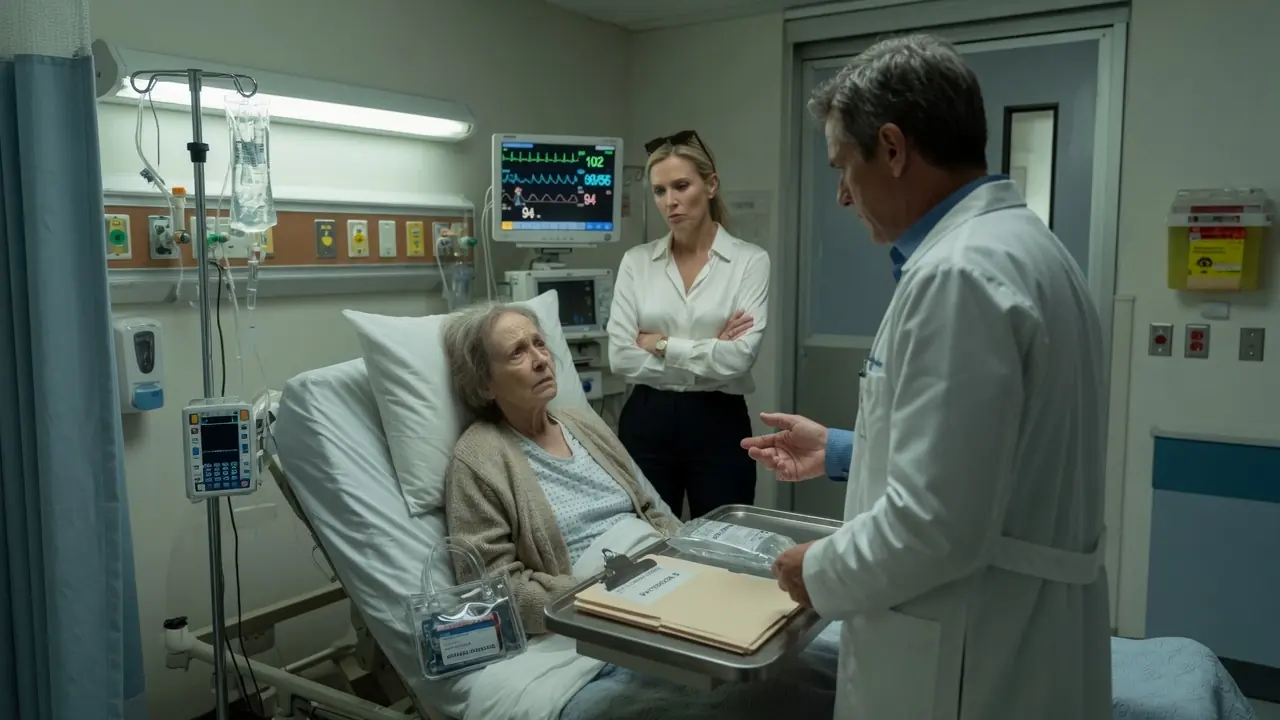
My name is Barbara Patterson, and I was seventy-two years old when I finally understood the difference between being loved and being used. Before that night, I had spent most of my life believing a mother should always give one more time. One more loan, one more favor, one more weekend babysitting, one more quiet forgiveness. I thought sacrifice kept a family together, until my own family left me alone in a hospital bed and took my emergency credit card to Disney World.
When I turned my head, I expected to see my son Michael sitting beside me. He had promised he would be there when I woke up. He had held my hand before they wheeled me away and told me everything was going to be fine. But the chair beside my bed was empty, and the folded blanket on it had never been used.
At first, I told myself there had to be a reason. Maybe the doctor had sent him out. Maybe Tiffany needed to take a call. Maybe the twins were scared, and he had gone home to reassure them. A mother’s heart is very good at building excuses before it is willing to look directly at betrayal.
A nurse named Kelly came in a few minutes later, smiling gently as she checked the monitor and adjusted the IV line. “You’re awake, Mrs. Patterson,” she said. “Surgery went well. You gave everyone a scare, but you’re doing okay.” I tried to smile back, but my throat felt too tight.
“Has my son come back?” I asked.
Kelly paused just long enough for me to notice. “He was here before you went in,” she said carefully. “I haven’t seen him since my shift started.” She looked at the whiteboard near the foot of my bed. “Would you like me to call him?”
“No,” I whispered. “I’ll call.”
My purse sat on the chair beside the bed, exactly where Michael had placed it before surgery. I reached for it slowly, wincing as the movement pulled at the soreness in my side. My wallet was inside, my insurance card was there, my driver’s license was there. But the emergency credit card was gone.
For a moment, I stared at the empty slot as if my eyes had simply skipped over it. That card had always been tucked behind my library card, never used unless absolutely necessary. I had kept it for medical emergencies, home repairs, or one terrible day when life turned sharp. I had not given it to Michael, not this time.
My hands began to shake as I opened the banking app on my phone. It took me three tries to type the password correctly because my fingers felt weak and clumsy. When the account loaded, the room seemed to tilt. The screen was filled with charges from Orlando.
Theme park tickets. Hotel deposits. Restaurant meals. Souvenir shops. A luxury family package. More meals. More souvenirs. A charge at a gift store that made my stomach twist harder than the surgery pain ever had.
I whispered, “Disney?”
The word sounded foolish in that quiet hospital room. Disney was bright colors, smiling children, fireworks, and music. It did not belong beside an IV bag, a heart monitor, and a seventy-two-year-old widow waking up alone after emergency surgery. Yet there it was, glowing on my phone like proof that my son had chosen magic for his children over basic decency for his mother.
I called Michael.
He answered on the third ring, but not with worry. There was noise behind him, loud voices, cheerful music, children laughing, and Tiffany saying something sharp in the background. “Mom?” he said quickly. “Are you okay?”
I closed my eyes. “Where are you?”
There was silence, then a forced little laugh. “We had to go ahead with the trip. The kids were devastated, and everything was already booked.” He spoke as if he were explaining a traffic delay, not why he had abandoned his mother after surgery. “Tiffany said you’d be sleeping most of the day anyway.”
I looked at the empty chair beside my bed. “You took my emergency card.”
“Mom, we were going to put it back,” he said, lowering his voice. “The hotel needed a card at check-in, and mine had a temporary issue. It’s not a big deal. I’ll handle it when we get home.”
“A temporary issue,” I repeated.
Tiffany’s voice came through clearly behind him. “Ask her if she wants the kids to miss the whole vacation because she’s being dramatic.”
Something inside me went very still.
For years, I had tried to be reasonable with Tiffany. I had excused her coldness as stress, her entitlement as confidence, her disrespect as personality. She had never liked me, but she had always liked what I could provide. Free childcare, school clothes, holiday gifts, emergency money, groceries when they were short, and now apparently a Disney vacation while I lay in a hospital bed.
Michael came back on the line. “Mom, look, you’re in the hospital. You’re safe. The doctors are there. We’ll call you tonight.”
I looked down at the banking app. Another charge appeared while we were speaking. A restaurant in Orlando. Seventy-eight dollars and twenty-four cents. I had not eaten anything since the day before.
“Michael,” I said slowly, “that card was for emergencies.”
He sighed, annoyed now. “This is an emergency. We couldn’t cancel without losing money.”
Those words ended something in me. Not loudly, not dramatically, but completely. I did not shout. I did not beg him to come back. I did not ask how he could do this to me, because suddenly I understood that if I had to ask, he would never have an answer that mattered.
“Enjoy your trip,” I said.
“Mom, don’t be like that.”
I hung up.
Then I opened the banking app again and tapped the card control menu. My finger hovered over the lock button. For one final second, the old Barbara tried to rise inside me, the Barbara who would think of the twins, who would worry about hotel embarrassment, who would tell herself that family meant swallowing pain until it stopped having a shape. But the old Barbara had woken up alone.
I tapped “Lock Card.”
A small message appeared on the screen: Card temporarily locked.
I stared at those words for a long time. They were so simple, so ordinary, and yet they felt like the first sentence of a new life. My hand was still trembling, but my mind was suddenly clear. If Michael and Tiffany could leave me alone after emergency surgery and use my money for a vacation, then they had already made their choice.
Now I would make mine.
The next call I made was not to Michael. It was to my neighbor Helen, a retired school secretary with sharp eyes and a heart that had never needed an audience. She answered breathlessly, as if she had been waiting near the phone. “Barbara? Thank God. I went by your house and saw the ambulance yesterday. Are you all right?”
“I’m in the hospital,” I said. “The surgery went well.”
“Where is Michael?”
I looked at the window, where the evening light was beginning to fade. “In Orlando.”
Helen did not speak for several seconds. Then she said, “I’m coming.”
I told her she did not need to, but she was already gathering her keys. Helen had lived next door to me for nine years. She knew which days Michael dropped the children off without asking, which weekends Tiffany arrived late to pick them up, and how often I said, “It’s fine,” when my face said otherwise. She arrived forty minutes later with a sweater, a phone charger, and the kind of anger that made me feel less alone.
She sat beside my bed and held my hand. “Tell me everything.”
So I did.
When I finished, Helen’s mouth was pressed into a thin line. “Barbara, this is financial abuse.”
The word abuse made me flinch. I wanted to push it away because it sounded too harsh, too ugly, too serious for a family matter. But then I looked at the charges again. I looked at the empty chair again. I remembered Michael saying, “You’re in the hospital. You’re safe.”
“No,” I said softly. “I’m not safe with them.”
Helen nodded, and something in her face softened. “Then we make you safe.”
The next morning, before Michael called again, I asked Helen to bring the folder from my desk drawer at home. It held my will, insurance papers, account information, and the contact card for my attorney, Ruth Mendoza. Ruth had helped me update my documents after Robert died. She was kind, direct, and not easily shocked, which turned out to be exactly what I needed.
Ruth arrived at the hospital just after lunch, wearing a dark suit and carrying a leather folder. She listened carefully while I explained what happened. I showed her the charges, the missing card, the call log, and the text Michael had sent that morning.
Mom, unlock the card. We’re stuck at the hotel desk. This is embarrassing.
There was no How are you feeling? No Did the doctor say you’re okay? No I’m sorry I left. Just embarrassment, as if my refusal to fund his vacation had inconvenienced him.
Ruth read the message, then looked at me over her glasses. “Do you want to protect your assets from him?”
“Yes,” I said.
The word came out stronger than I expected.
Ruth nodded. “Then we will update your will, revoke any informal access he has, change your emergency contacts, and document the unauthorized use of the card. We can also notify the bank that the charges were not approved.”
I swallowed. “He’s my only son.”
“I understand,” Ruth said gently. “But being your son does not give him the right to treat your life as an account balance.”
That sentence stayed with me.
By the time Michael called again, I had already started signing papers. Ruth had arranged for proper witnesses. Helen sat by my side, squeezing my hand when my eyes filled with tears. I removed Michael as the primary beneficiary of most of my estate and placed the house in a protected trust, with funds reserved for my grandchildren’s education under an independent trustee. If Jake and Emma needed help one day, they would receive it without Michael or Tiffany touching it.
Then I changed my emergency contact to Helen.
That hurt more than changing the will. A will speaks to the future. An emergency contact speaks to fear. For decades, I believed Michael was the person who would come when life became frightening. But when life became frightening, he went to Disney.
Michael called sixteen times that afternoon.
I did not answer.
Tiffany texted once: You are ruining this for the kids.
I stared at the sentence until the letters blurred. For years, that had been the hook they used to pull me back. The kids need shoes. The kids need camp money. The kids want to see you. The kids will be disappointed. But children do not need grandparents who are financially drained and emotionally discarded.
They need adults who tell the truth.
So I replied only once.
I am recovering from surgery. Do not contact me unless it is respectful and necessary.
Then I blocked Tiffany.
The next day, I was discharged. Michael thought I would go home, where he could find me, apologize just enough to unlock my guilt, and begin pulling me back into his version of family. Instead, Helen drove me to her sister’s quiet guest cottage two towns away. Ruth had arranged it before I left the hospital.
I disappeared, not because I was afraid, but because I needed silence long enough to hear myself think.
The cottage was small, with yellow curtains, a soft green sofa, and a porch overlooking a pond. Helen stocked the refrigerator with soup, yogurt, tea, and applesauce. She placed my medications on the kitchen counter and wrote the schedule in large letters because she knew I would pretend I remembered. Then she hugged me carefully and said, “Rest. Let them feel the empty space you always filled.”
The first night in that cottage, I cried harder than I had cried in years. Not because of the surgery, though the pain still pulled when I moved. Not because of the money, though the charges were humiliating and frightening. I cried because my son had made me see how little he thought my loneliness would matter.
He had counted on my forgiveness before I had even woken up.
In Orlando, the card being locked caused exactly the kind of chaos Michael had assumed I would never allow. The hotel refused the next incidental hold. Their dinner reservation was declined. The souvenir store transaction failed. Michael’s own cards were either maxed out or unavailable, and Tiffany’s emergency card apparently existed only in theory.
At 10:42 that night, Michael left a voicemail.
“Mom, this is not funny. The kids are upset. Tiffany is crying. We need the card unlocked now. I don’t know what kind of point you’re trying to prove, but you’re hurting your own family.”
I listened to it once.
Then I deleted it.
The next voicemail came an hour later, softer. “Mom, please. I know you’re upset. I should have handled things differently. Just unlock the card so we can get through the trip, and we’ll talk when we get home.”
That was Michael’s pattern. First anger. Then guilt. Then a small apology shaped just large enough to reopen my wallet. For years, it had worked because I wanted peace more than fairness. But lying in that hospital bed had changed the order of my needs.
Peace without dignity was only silence.
The bank called two days later after I reported the unauthorized charges. The representative was professional, careful, and kinder than I expected. She explained the process, confirmed the card lock, and helped me dispute several pending charges. She also recommended closing the account and issuing a new card with additional protections.
When she asked whether the card had been taken by someone I knew, I hesitated.
“Yes,” I said finally. “By my son.”
There was a pause, then her voice softened. “I’m sorry, Mrs. Patterson. We’ll help you secure the account.”
I had expected shame. Instead, I received procedure. There was comfort in that. Paperwork did not ask why I had tolerated so much. It simply made the next wrong thing harder to do.
On the fourth day, Michael found my house empty.
He called Ruth because he could not reach me. That was when he learned I had changed my legal documents. Ruth told me later that his voice went flat when she explained that all communication regarding my finances should go through her office. He asked if I was “mentally well enough” to make decisions.
Ruth replied, “Your mother was clear, alert, and recovering appropriately when she signed the documents.”
He did not like that.
Of course, he drove to Helen’s house next. Helen did not open the door fully. She told him I was safe and recovering, and that he needed to leave. Michael apparently said, “She’s my mother.” Helen answered, “Then you should have acted like her son.”
I wish I had heard it.
Two weeks passed before I agreed to speak with him. By then, I was stronger. I could walk slowly around the pond, heat my own soup, and sit on the porch without feeling dizzy. My stitches were healing, but something deeper was still raw.
The call was arranged through Ruth. That may sound cold to some people, but boundaries often sound cold to the people who benefited from you not having any. Michael called at exactly 3:00 p.m. His voice was different, not truly humble, but less confident.
“Mom,” he said. “Where are you?”
“Recovering.”
“Why won’t you tell me where?”
“Because I need space from you.”
He breathed sharply. “You’re acting like I abandoned you.”
I closed my eyes. “You did.”
“No, I left you in a hospital with doctors. We had a trip planned for months. The kids were excited. Tiffany said—”
“Stop,” I said.
The word surprised both of us.
For once, Michael stopped.
“You left before I woke up from surgery,” I said. “You took my emergency card without permission. You used it for a vacation while I was in a hospital bed. Then when I locked it, you called me dramatic.”
He said nothing.
“I spent years helping you because I believed that was love,” I continued. “But love does not steal. Love does not disappear during surgery. Love does not turn an old woman’s emergency fund into park tickets.”
His voice cracked slightly. “Mom, I messed up.”
“Yes,” I said. “You did.”
“I’ll pay it back.”
“That is not the same as understanding.”
There was a long silence. Then Michael said quietly, “The kids keep asking why Grandma is mad.”
“I am not mad at them.”
“They think you stranded us.”
“No, Michael. I stopped paying for the trip you took while I was recovering from emergency surgery. If you felt stranded, it is because you built your comfort on money that was not yours.”
He did not answer.
I thought of Jake and Emma then, eight years old, innocent in some ways and already learning dangerous lessons in others. They had watched their parents treat Grandma’s resources as a backup plan. They had watched Disney become more urgent than a hospital. I did not blame them, but I could no longer protect them by pretending their parents were right.
“Tell the children I love them,” I said. “Tell them they may call me anytime. But you and Tiffany will not use them to reach my bank account again.”
Michael’s breathing grew uneven. “Are you cutting me out of your life?”
“No,” I said. “I am removing your access to the parts of my life you kept misusing.”
For the first time, I heard him cry.
I wish I could say it felt satisfying, but it did not. It hurt. A mother’s heart does not stop being a mother’s heart just because it finally grows a spine. His tears reached the old soft place in me, the place that remembered pancake mornings, Little League games, and a little boy asleep with his glove in his lap.
But memory is not permission.
“I love you, Michael,” I said. “But I will not finance my own neglect.”
After we hung up, I sat on the porch for a long time. The pond was still, the sky pale, and somewhere in the reeds a bird called once and went quiet. I felt lighter and lonelier at the same time. That is the strange truth about freedom when you earn it late.
It gives you back your life, but first it shows you how much of it was taken.
Months later, I returned home. Not to the same life, but to the same house with new locks, new account numbers, and new rules. Ruth helped me set up protections. Helen helped me organize the kitchen. I replaced the emergency credit card and kept it in a small locked box that only I could open.
Michael and Tiffany did pay back part of the charges after the bank investigation began. Not all at once, and not gracefully, but enough to show they understood I was no longer asking. Tiffany never apologized. She sent one message through Michael saying she had been “under pressure” and hoped I could “move forward for the children.”
I moved forward.
That did not mean moving backward into the same role.
Jake and Emma visited me later that summer. Michael dropped them off and stayed in the driveway, uncertain if he was allowed to come in. I let the children run to me first. They hugged me tightly, and Emma whispered, “I’m sorry you were sick, Grandma.”
I held her close. “Thank you, sweetheart.”
Jake looked at me with serious eyes. “Dad said the card stopped working because of bank stuff.”
I looked toward the driveway, where Michael stood beside his car, unable to meet my eyes. Then I knelt carefully in front of my grandson. “The card stopped working because Grandma needed to keep her emergency money safe.”
He frowned. “For hospitals?”
“Yes,” I said. “For hospitals. For broken furnaces. For things people need, not things people simply want.”
Emma looked down. “Mom bought me Minnie ears.”
“That is not your fault,” I said gently. “Children are not responsible for adult choices.”
They spent the afternoon baking cookies and drawing pictures at my kitchen table. For the first time in a long while, they asked before opening the pantry. They helped carry plates to the sink. Small things, maybe, but small things are where respect begins.
When Michael picked them up, he stood on my porch and looked older than he had a year before. “Mom,” he said quietly, “thank you for letting them come.”
“They are my grandchildren,” I said. “They are welcome here.”
He nodded. “Am I?”
I looked at him for a long time. “You may come in when you understand that this house is not a bank, not a hotel, and not a backup plan.”
His eyes filled with shame. “I’m trying.”
“I hope so.”
He did not come in that day. But a month later, he asked if he could visit alone. He sat at my kitchen table with no requests, no envelopes, no children used as shields. He apologized more clearly than he had before.
“I told myself you didn’t mind helping,” he said. “Then I started acting like you owed it to me. Disney was…” He stopped, swallowed hard, and looked at his hands. “Disney was the ugliest thing I’ve ever done to you.”
“Yes,” I said.
He winced, but he did not argue.
That was the beginning of something. Not forgiveness, not fully. Not trust. Trust is not a light switch; it is a garden, and some gardens do not grow back the same after a hard winter. But it was the beginning of honesty, and honesty was more than we had before.
Now, when people ask why I changed my will, I tell them the truth. A will is not punishment. It is a final statement about what you value. I value my grandchildren’s future, my own safety, and the dignity Robert and I worked all our lives to build.
I do not value entitlement.
I still love my son. That is the complicated part people often misunderstand. Walking away from being used does not mean love disappears. It means love is no longer allowed to stand alone without respect beside it.
Sometimes I think about that hospital room, the glowing phone screen, the Disney charges appearing one by one while the heart monitor beeped behind me. I remember how my hand shook before I tapped the lock button. I remember the fear, the grief, and the terrible clarity of realizing I had been abandoned by the person I trusted most.
Then I remember what happened after.
I called Helen. I called Ruth. I changed the papers. I protected the house. I recovered in a quiet cottage by a pond and learned that silence can be healing when it no longer belongs to neglect.
Michael and Tiffany thought I would wake up alone and forgive them before the anesthesia fully wore off. They thought I would unlock the card, pay the bill, and let them return from Orlando with souvenirs and excuses. They thought being a mother meant I would never let them face the consequences of leaving me behind.
They were wrong.
Being a mother taught me how to give.
But that hospital bed taught me when to stop.