Earl Patterson heard the truck before he saw it. The sound came rolling over the low hill beyond the north pasture, heavy and metallic, with the slow groan of a loaded trailer climbing the gravel road toward the farm. He was standing beside the old red fuel tank, tightening a hose clamp with fingers stiff from age and weather, when the engine noise made him stop. At seventy-four years old, Earl knew the sound of every machine that belonged on Patterson Family Farm, and that one did not belong there.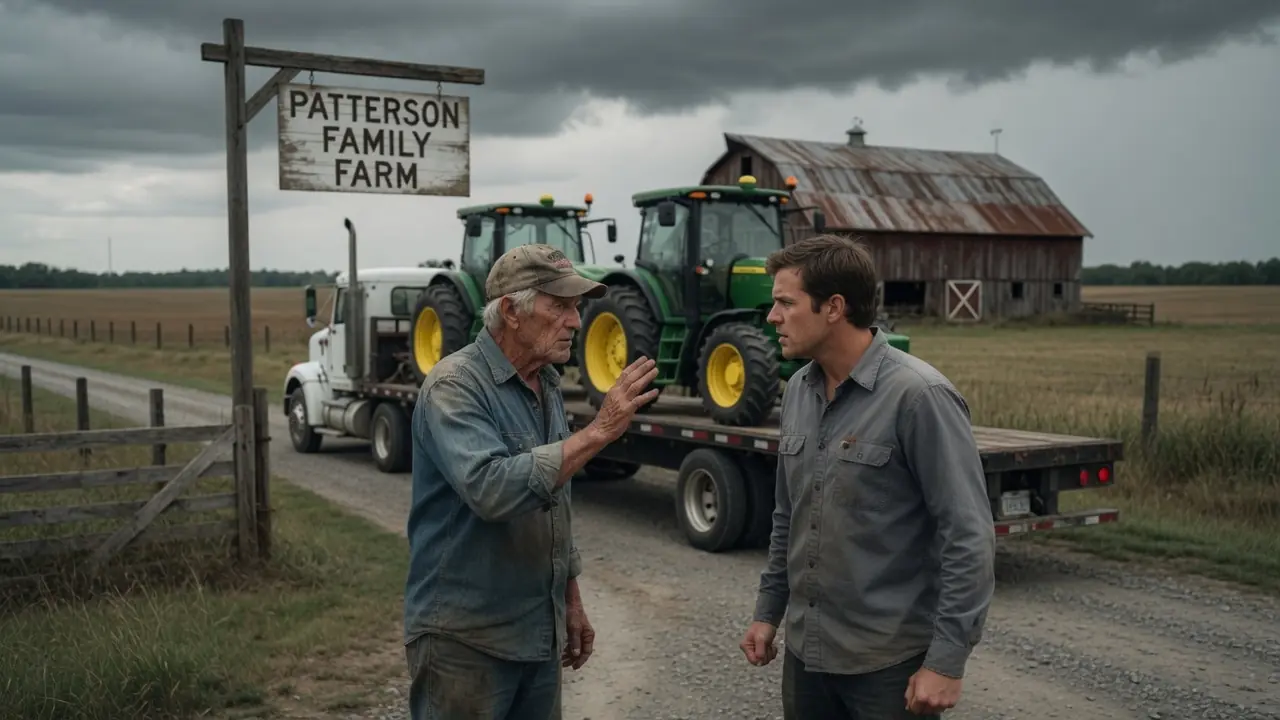
He wiped his hands on his jeans and walked toward the gate. The morning sky was gray, the kind of Ohio spring gray that promised rain without saying when. Beyond the fence, a long flatbed trailer appeared, carrying two brand-new John Deere tractors, green paint shining even beneath the dull clouds. Their yellow wheels were spotless, their cabs still wrapped with shipping plastic, and they looked far too expensive to be coming down Earl Patterson’s driveway.
Earl did not wave the driver in. He stepped into the middle of the gravel lane and raised one hand. The truck slowed, air brakes hissing, until the trailer stopped twenty feet from the gate. The driver leaned out the window with a clipboard in his hand, smiling like this was a normal delivery on a normal morning.
“Patterson Family Farm?” the driver called. “Two units from Dayton Ag Supply.”
Earl looked at the tractors, then back at the driver. “Who signed for them?”
The driver glanced down at the paperwork. “James Patterson.”
Earl felt something cold settle in his chest. He did not shout. He did not move. He simply looked at the two shining tractors sitting on the trailer like a pair of beautiful problems someone had gift-wrapped in debt.
Behind him, the farmhouse screen door slammed. James Patterson came down the porch steps fast, boots crunching over the gravel, face already tight with anger. He was thirty-eight, broad-shouldered, clean-shaven, and dressed in a gray work shirt that looked newer than anything Earl owned. He had Earl’s eyes, his mother’s jaw, and a temper that had grown sharper the more he believed the farm should already be his.
“What are you doing?” James snapped.
Earl did not turn around. “Stopping a delivery.”
James walked around him and pointed toward the trailer. “Those tractors are ours.”
“No,” Earl said quietly. “They’re not.”
The driver looked from father to son and wisely said nothing. Earl could see James trying to hold himself together in front of the stranger, but anger moved through him like heat through dry grass. He stepped closer, lowering his voice, though not enough to hide the insult inside it.
“Move, old man,” James said. “Those tractors are the future of this farm, not your rusty memories.”
Earl finally turned to face him. For a second, he saw not the grown man in front of him, but the boy who once rode on his knee in the old combine, laughing whenever Earl let him steer across an empty field. That boy had loved the farm because it smelled like soil, hay, rain, and home. The man standing in front of him loved the idea of owning it more than the work it took to keep it alive.
“You ordered debt with my name on it,” Earl said, “and called it progress.”
James’s face hardened. “You’re too scared to change, and that’s why this farm is dying.”
Earl looked past him at the barns, the fields, the grain bins, the old machine shed, and the house where his wife Mary had raised their children before cancer took her nine years earlier. “No, son,” he said. “This farm survived drought, storms, and bad years. But it won’t survive your ego.”
The words hit James harder than Earl expected. For a moment, his son’s mouth opened, then closed. The truck idled behind them, the tractors shining like temptation. A cold wind moved across the fields, carrying the smell of damp earth and diesel.
James recovered quickly. “I got a financing plan.”
Earl’s eyes narrowed. “You got permission?”
“I don’t need permission to improve this farm.”
“You do when the land is still in my name.”
James laughed once, bitterly. “That’s the problem, isn’t it? Everything is still in your name. The land, the barns, the accounts, the decisions. You keep telling people this is a family farm, but you still run it like I’m twelve years old.”
Earl felt the accusation, because there was truth buried somewhere inside it. He had been slow to hand over control. He had questioned James’s ideas, delayed upgrades, and insisted on repairing old machines long after younger farmers would have traded them in. But slow was not the same as foolish, and caution was not the same as fear.
“You ordered two tractors we don’t have cash flow for,” Earl said. “How much?”
James looked away.
“How much?” Earl repeated.
“One hundred eighty-seven thousand each.”
The driver shifted uncomfortably in the cab. Earl let out a slow breath. Nearly four hundred thousand dollars before interest, insurance, service packages, attachments, and delivery. It was not the price of progress. It was the price of pride wearing a green coat.
“And what did you use for collateral?” Earl asked.
James’s silence answered before his mouth did.
Earl’s voice dropped. “Tell me you didn’t touch the east field.”
James looked back at him. “It’s just land sitting there.”
Earl stepped closer. “That field was your mother’s inheritance.”
“It’s twenty-six acres of underused ground.”
“It’s paid-for ground.”
James pointed toward the old machine shed. “And what are we supposed to do, Dad? Keep patching the same old tractors until we lose another planting window? Keep begging neighbors for backup when the clutch goes out? Keep pretending sentiment pays bills?”
Earl looked at the flatbed again. Those tractors could do good work. He knew that. He was not blind to the way farming had changed. He knew bigger equipment, better technology, and faster planting could mean survival in a world where margins were thinner every season.
But the farm’s problem was not only equipment. It was timing, grain prices, fuel costs, loan exposure, unpredictable weather, and one son who thought looking successful was the same as being stable. Earl had spent fifty years learning that farms were not lost all at once. They were lost one proud decision at a time.
The driver cleared his throat. “Sir, I need to know if I’m unloading or turning around.”
Earl looked at him. “You’re not entering this gate.”
James spun toward him. “You can’t do that.”
“I just did.”
“The contract is signed.”
“Then we’ll unsign what can be unsigned and fight what can’t.”
James’s face flushed. “You’re humiliating me.”
Earl’s expression did not change. “Better humiliated at the gate than bankrupt at the courthouse.”
The driver climbed down slowly, carrying the clipboard. “Mr. Patterson, there may be restocking and transport fees if delivery is refused.”
“I’ll deal with fees,” Earl said. “I won’t deal with two tractors sitting on this farm like we agreed to a lie.”
James stepped between Earl and the driver. “Unload them.”
Earl’s voice sharpened for the first time. “No.”
The word cracked across the gravel yard. Even the driver stopped moving. James stared at his father, breathing hard, as if he could not believe the old man still had enough authority to stop him in front of everyone.
From the porch, Earl’s daughter-in-law, Rachel, appeared with her arms folded. She had married James fourteen years earlier and had spent most of that time caught between his ambition and Earl’s stubbornness. She did not come down the steps. She simply watched, her face pale, because she knew something Earl did not.
Earl saw her expression and turned back to James. “What else did you sign?”
James looked furious now. “Nothing you need to worry about.”
“That means plenty.”
Rachel came down one step. “James.”
He turned on her. “Stay out of it.”
Earl’s eyes moved between them. “Rachel, what did he sign?”
She swallowed. James glared at her, but the look in her eyes had already changed. She was tired. Not angry, not dramatic, just deeply tired of carrying secrets that were too heavy for one house.
“He signed a service contract,” Rachel said quietly. “And a technology package. And a precision planting lease.”
Earl closed his eyes.
James snapped, “Because that’s how modern farms run.”
Earl opened his eyes again. “Modern farms still read the fine print.”
“I did read it.”
“No,” Earl said. “You read the payment amount they wanted you to see.”
The driver looked down at the clipboard, then away. Earl noticed. “You know something?”
The driver hesitated. “I just deliver, sir.”
“But you’ve seen this before.”
The man rubbed his jaw. “I’ve seen farms take on more machine than they can carry.”
James barked, “You’re a delivery driver. Don’t act like you know my operation.”
Earl’s voice turned cold. “That man knows enough to look ashamed delivering what you ordered.”
The tension sat heavy in the driveway. The tractors towered above them, beautiful and silent, while the old farmhouse stood behind Earl like a witness. James looked from his father to his wife to the driver, realizing the moment was slipping away from him.
“You don’t understand,” James said, voice lower now. “People in town laugh at us. They see that old 4440 smoking in the field and they know we’re behind. Banks don’t respect farmers who look broke. Buyers don’t respect operations that look old.”
Earl stared at him. “Since when did you start farming for people watching from the road?”
James’s face changed. That question cut deeper than the others.
Earl continued, “Your grandfather started with two mules and a rented field. I started with an old Allis that burned oil and a banker who told me I wouldn’t last three years. Your mother and I built this place by making sure every dollar had a job before it left our hands.”
James looked toward the fields. “And now it’s my turn.”
“Yes,” Earl said. “But taking your turn doesn’t mean burning down everything that got you here.”
James’s fists tightened. “You never trust me.”
Earl’s expression softened for a moment. “I trusted you with seed orders, fertilizer timing, grain contracts, and the south acreage rotation. I trusted you more than you noticed because you kept looking for the one thing I had not handed over yet.”
“The final say,” James said.
“The burden,” Earl corrected. “You keep wanting the final say because you think it feels like power. It doesn’t. It feels like lying awake at two in the morning wondering if one bad storm can take what three generations built.”
James looked away, jaw working.
Earl turned to the driver. “Take them back to the dealer for now.”
The driver nodded, relieved to have a clear instruction. “Yes, sir.”
James stepped forward. “No. Wait.”
But the driver was already climbing back into the cab. The truck hissed, the engine groaned, and the flatbed began reversing slowly down the lane. James watched the new tractors roll backward away from the gate, their bright green bodies retreating like a dream he had almost forced into reality.
When the truck turned onto the county road, James looked at Earl with open bitterness. “You just cost us the future.”
Earl shook his head. “No. I bought us a day to read what you signed.”
That afternoon, Earl called the dealership, the bank, and an old farm accountant named Vince Malone, who had helped Patterson Farm through two bad seasons and one tax mistake that nearly broke Earl’s spirit. Vince arrived after supper with a leather folder, a calculator, and the expression of a man who expected trouble. James sat at the kitchen table with his arms crossed.
Rachel sat beside him, quiet. Earl placed coffee in front of Vince and spread the papers James had printed. The house felt like it did before a storm, when the air goes still and every animal on the farm knows something is coming.
Vince read in silence for twenty minutes. Then thirty. James grew restless, tapping his fingers against the table. Earl said nothing.
Finally, Vince took off his glasses. “James, did anyone explain the balloon structure in year four?”
James frowned. “The salesman said we could refinance.”
“He said could. Not would.”
James’s face tightened.
Vince turned a page. “The equipment payment alone might be manageable in a strong corn year. But paired with the technology lease, mandatory service plan, software subscription, insurance increase, and collateral exposure on the east field, you’d be one poor harvest away from default pressure.”
Rachel whispered, “I told you it sounded too easy.”
James looked at her, wounded. “You said we needed change too.”
“I said we needed a plan,” she replied. “Not a surprise at the gate.”
Earl leaned back in his chair. He felt no pleasure in watching James shrink beneath the numbers. A father might win an argument and still lose something if his son felt crushed instead of taught. Earl wanted James to understand, not surrender.
Vince tapped the documents. “There’s a cancellation window, but it’s tight. Delivery refusal helps. You’ll pay some fees, but not ruinous ones if you act quickly.”
James stared at the papers. “So I’m just stupid.”
“No,” Earl said.
James laughed bitterly. “That’s what everyone’s thinking.”
“No,” Earl repeated. “You were proud, scared, and impatient. That’s dangerous, but it ain’t the same as stupid.”
James’s eyes flicked to his father.
Earl leaned forward. “You saw real problems. The equipment is aging. We do lose time fixing things. We do need a modernization plan. Where you went wrong was believing the biggest purchase meant the strongest answer.”
Vince nodded. “There are used options. Lease partnerships. Co-op equipment sharing. Retrofit kits. Repair schedules. Tax planning. Phased upgrades. A farm doesn’t modernize by swallowing the whole dealership in one bite.”
For the first time all day, James did not argue.
The next morning, Earl found him in the machine shed standing beside the old John Deere 4440. The tractor’s green paint was faded, the seat was cracked, and one rear tire needed replacing before fall. James had one hand on the hood, the same way Earl often did when thinking through a problem.
“I was embarrassed by it,” James said without turning.
Earl stood in the doorway. “I know.”
“It smokes when it starts. The cab rattles. Everyone else has GPS screens and climate control and planters that practically think for them.”
Earl stepped inside. “This tractor paid for half the north barn.”
James looked at him. “That doesn’t mean it can carry us forever.”
“No,” Earl said. “It means we owe it respect, not worship.”
James was quiet.
Earl walked closer and rested a hand on the old machine. “Your mother used to say the same thing about me.”
Despite himself, James almost smiled. “That you smoked when you started?”
“That I rattled too much and needed replacing.”
James let out a small breath, nearly a laugh, then looked down. “I wanted you to see I could lead.”
Earl’s voice softened. “Then lead by facing the books with me.”
James turned. “You’d let me?”
“I should have sooner.”
That admission seemed to surprise James more than the refusal at the gate. Earl was not a man who apologized easily, partly because the old farm life had taught him to show regret through work instead of words. But he saw now that silence had created a space where James filled in his own worst fears.
“I held too tight,” Earl said. “After your mother died, this farm was the last thing I knew how to protect. Sometimes I protected it from weather, debt, pests, and markets. Sometimes I protected it from you when I should have been teaching you how to carry it.”
James swallowed. “I went behind your back.”
“You did.”
“I put the east field at risk.”
“You tried to.”
James looked at the old tractor again. “I’m sorry.”
Earl nodded slowly. “Good. Now be useful.”
Over the next week, father and son did something they had avoided for years. They opened every account, every debt schedule, every maintenance record, every equipment need, and every crop plan. Vince returned twice. Rachel joined them with a notebook because she understood household numbers better than both men cared to admit.
They discovered things Earl had ignored and things James had exaggerated. The farm was not dying, but it was not safe either. Two tractors were too much. No upgrades were too little.
They canceled the purchase contracts, paid the transport and restocking fees, and saved the east field from being tied up in collateral. James made the calls himself. Earl sat nearby but did not speak for him.
That mattered.
Then they built a new plan. They bought one used tractor from a retiring farmer two counties over, not new enough to impress anyone from the road but strong enough to reduce breakdown risk. They upgraded the old planter with used precision parts instead of signing a full lease. James negotiated a seasonal equipment-sharing arrangement with a neighbor who needed hay help more than cash.
Earl hated some of the technology. James hated some of the caution. But they kept talking anyway.
At the diner, word of the stopped delivery spread quickly. Heath Morgan, a nearby farmer with too much opinion and too little tact, joked that Earl had saved James from “green paint fever.” James heard it and stiffened. Earl expected him to snap back, but James surprised him.
“Laugh if you want,” James said. “At least we stopped before the banker laughed harder.”
The table went quiet. Then an older farmer nodded. “That’s worth something.”
By planting season, the farm had changed. Not dramatically, not in a way that would impress a magazine, but in ways that mattered. The used tractor ran steady. The old 4440 still smoked at startup but no longer carried every burden. James managed the planting schedule, and Earl let him make decisions even when his hands twitched with the urge to interfere.
One evening, after a long day in the field, James parked beside the barn and climbed down from the used tractor. Earl was sitting on the tailgate of the pickup, drinking lukewarm coffee from a thermos. The sun was setting behind the west pasture, turning the sky orange over the same fields Earl’s father had once worked.
James sat beside him. For a while, neither spoke.
Finally, James said, “Those new John Deeres would’ve looked good coming through the gate.”
Earl nodded. “They would’ve.”
“Would’ve felt good too.”
“For about a month,” Earl said.
James smiled faintly. “Then the bill.”
“Then the bill.”
They watched the fields in silence.
James rubbed his hands together. “I still want to modernize.”
“I know.”
“I still think you wait too long sometimes.”
“I do.”
James looked at him. “You admit that?”
Earl shrugged. “I’m old, not blind.”
James laughed, and this time it came easily.
A few months later, Earl took James to the east field. It lay beyond the low stone wall, twenty-six acres of rich soil that had belonged to Mary’s family before it became part of Patterson Farm. Earl had always treated it as sacred ground, but he had never explained why fully enough for James to understand.
They stood near the edge while soybeans moved in the summer wind. Earl took off his cap and held it in both hands.
“Your mother wanted this field protected,” he said. “Not because land should never be used, but because land should never be risked for vanity.”
James looked over the crop. “I didn’t think of it that way.”
“No,” Earl said. “You thought of it as collateral. A number on a form.”
James lowered his eyes. “I’m sorry.”
Earl nodded toward the field. “One day this will be yours. Not because you forced me to admit it. Because I’m getting tired, and you’re learning the difference between control and responsibility.”
James looked at him, startled.
Earl continued, “We’ll start the transfer plan this winter. Slowly. Legally. With Vince and Rachel involved. You’ll take more management each year.”
James’s voice was quiet. “You mean that?”
“I do.”
“What changed?”
Earl looked at his son. “You let the truck leave.”
James took that in.
The following winter, they signed the first phase of the succession plan at the kitchen table. Not in a lawyer’s office with cold lights and polished floors, but in the room where farm arguments, family prayers, seed orders, and funeral casseroles had all passed through at one time or another. Rachel signed as witness. Vince explained each page twice because Earl pretended not to need it and James actually did.
When it was done, Earl felt both lighter and older. James looked both proud and frightened. That pleased Earl, because fear finally meant his son understood the weight.
The story of the two new John Deeres did not disappear. People in the county still mentioned it, especially when a young farmer got carried away at auction or a salesman drove too slowly past a family farm. But over time, the story changed.
At first, people told it as the day Earl Patterson humiliated his son at the gate. Later, they told it as the day James Patterson nearly buried the farm in debt. But the people who understood farming best told it differently.
They said it was the day a father stopped a truck because he could see beyond the shine. It was the day a son learned that the future of a farm cannot be delivered on a flatbed without permission, planning, or humility. It was the day Patterson Family Farm almost split in two at the gate, then found a way to keep going.
Years later, James would stand in that same gravel driveway with his own grown son, watching a delivery truck roll toward the farm. This time, the machine on the trailer had been chosen carefully, budgeted properly, and paid for without risking the east field. Earl, older and slower, sat on the porch with a blanket over his knees, watching from a distance.
James raised one hand and waved the truck through.
Then he glanced back at his father.
Earl lifted two fingers from the armrest, the smallest blessing a farmer could give without embarrassing himself. James smiled, then turned toward the gate.
He still loved new equipment. He still loved progress. But now he knew what Earl had tried to teach him that gray morning years before.
A farm’s future is not the shiniest thing that rolls through the gate.
It is the wisdom to know what must never be risked to bring it in.