“Whoops. Maybe now you’ll look a little cleaner.”
Melissa Fontaine’s voice carried across the entire lobby, bright and performative in the way voices become when someone wants an audience.
She held an iced coffee with the lid already off and walked directly toward the elderly Black security guard crouched beside the revolving door.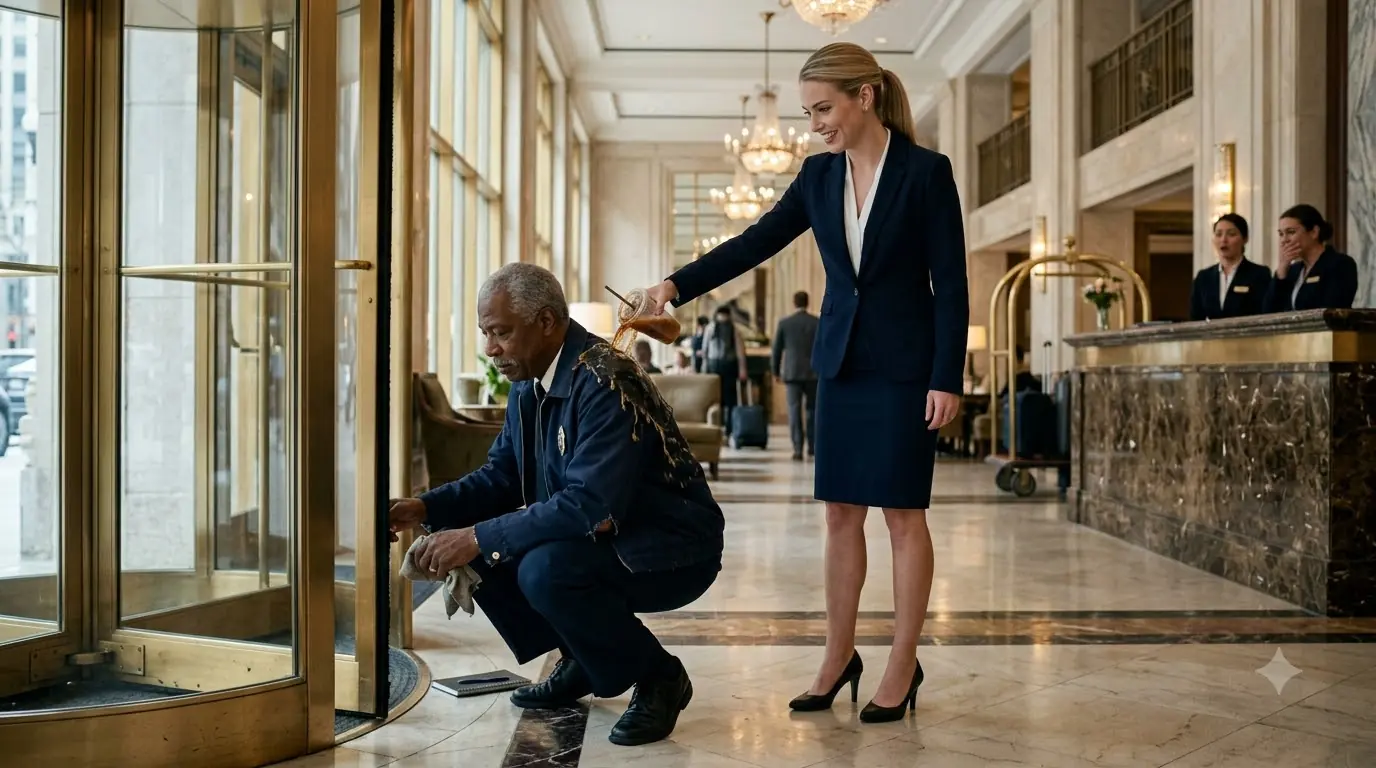
Without breaking stride, Melissa tilted the cup.
Cold coffee poured across the back of his navy uniform, spreading into a wide dark stain.
Two associates at the front desk looked up.
Melissa smiled at them.
Then she looked down at the man still crouched near the floor.
“You know what? I actually did you a favor. Maybe now you’ll smell a little better.”
She tilted her head as if evaluating him.
“I don’t know what they’re paying you, but this is a five-star hotel. It deserves better than some worn-out old man in a uniform that looks older than he does.”
One of the associates laughed.
Melissa glanced toward him, encouraged.
“Honestly, the revolving door moves faster than he does. Maybe we should just replace him with that.”
The laughter grew louder.
The old guard said nothing.
He reached for the cloth attached to his belt and quietly cleaned the coffee from his shoulder.
Nobody told Melissa to stop.
Nobody stepped between them.
Nobody in that lobby understood that the man they were laughing at had signed every one of their paychecks for the previous seven years.
And Friday was only three days away.
The Meridian Grand Hotel rose over Chicago’s Magnificent Mile like a monument built from glass, steel, and ambition. Forty-two stories stood above Michigan Avenue beneath gold lettering that announced the hotel’s name over its entrance. Its marble lobby floor was resurfaced every two years whether it needed it or not.
Three hundred eighty guest rooms.
Five stars for eleven consecutive years.
A restaurant on the fortieth floor with reservations booked six weeks in advance.
By nearly every measure used in luxury hospitality, the Meridian Grand was among the finest hotels in the Midwest.
Every morning at exactly six o’clock, Walter Eugene Callaway entered through the service entrance on the east side of the building, scanned his employee badge, and began his security shift.
Walter was sixty-nine years old.
He stood close to six feet tall, though age had taken a little from his posture. He moved with a slight forward lean, the kind developed after a lifetime of paying attention to what lay ahead of him.
His shoes were always polished.
That detail never quite matched the image people formed when they saw the rest of his uniform, but almost nobody looked closely enough to notice.
His navy security jacket had a small frayed section at the right cuff.
The plastic badge holder carried a thin crack across the top.
His trousers were pressed every morning with a sharp crease, but the fabric around his left knee had faded after years of laundering.
The condition of the uniform was not accidental.
Eight months earlier, Walter had authorized a thirty-percent reduction in the hotel security attire budget through the proper internal channels.
Then he waited.
He wanted to know whether anyone in management would notice.
Would someone submit a supply request?
Would a supervisor complain that employees representing a five-star hotel deserved proper uniforms?
Would anyone speak up for the men and women wearing those clothes every day?
Nobody did.
That absence of concern told Walter more than the budget itself.
The Callaway Hospitality Group no longer actively pursued publicity around its founder. Walter had stepped away from public life in 2018, saying he preferred privacy.
That was true.
But there was another reason.
Walter had discovered that one week working anonymously inside one of his own hotels could reveal more about the real condition of the company than months of executive presentations.
He called it the floor test.
He had been conducting these tests for sixteen years, rotating quietly among the fourteen properties in the Callaway portfolio.
The Meridian Grand was the flagship.
Opened in 1994, it had been the fifth hotel in the company and the property that transformed the Callaway name into a serious force in American luxury hospitality.
The Callaway Hospitality Group was now valued at approximately $1.8 billion.
The name printed on every paycheck, vendor agreement, ownership document, and executive contract was Walter Eugene Callaway.
Almost nobody at the Meridian Grand knew that the founder of the company arrived every morning through the service entrance wearing an aging security uniform.
Only three people knew the truth.
The first was Agnes Wu.
Agnes was sixty-one and had served as Walter’s executive assistant for twenty years. She operated from a private suite on the thirty-eighth floor, a level absent from the guest-elevator panel and accessible only through an internal code Walter had established years earlier.
Agnes managed his calendar, correspondence, confidential projects, and silence with the same precision she brought to everything else.
Walter trusted her completely.
The second person was Raymond Torres.
Ray was fifty-six, the night security captain, a disciplined man with a slight tremor in his left hand that he never discussed.
On Walter’s first morning working anonymously in uniform, Ray had taken one long look at him.
The posture.
The eyes.
The particular calm of someone accustomed to being responsible for things.
Ray simply nodded.
From then on, he greeted Walter every morning with a small respectful salute.
Walter always returned it.
Neither had ever felt the need to explain the arrangement aloud.
The third person was Sandra Pierce, chair of the Callaway Hospitality Group board.
She called Walter every Sunday evening at seven.
Those three people knew.
Nobody else did.
Whenever someone eventually learned about Walter’s floor tests, they usually assumed his reason must be eccentric or theatrical.
It was neither.
The reason was Gloria Callaway.
November 1965.
The Palmer House Hotel.
Two miles from where the Meridian Grand would eventually stand.
Gloria Callaway was forty-three years old, a Black hotel maid working multiple jobs while raising her son alone.
One afternoon she was pushing a linen cart through a guest corridor when a floor manager deliberately knocked the cart over.
Clean sheets and towels scattered across the marble.
Six guests stood nearby.
The manager looked down at Gloria and spoke to her in a racially demeaning, humiliating way, ordering her to smile while she cleaned up the mess.
Several guests laughed.
One stepped over the fallen linens to reach the elevator.
Gloria picked up everything.
She refolded every towel.
She finished her shift.
Walter was eight years old.
He was waiting near the service entrance and saw the entire thing through the glass.
He remembered every detail.
The way his mother’s hands moved without rushing.
The way she refused to look at the manager.
The way she completed her work as though the humiliation belonged to somebody else’s story.
Walter carried that image for the rest of his life.
Not as an open wound.
As a compass.
Gloria died in 1991.
She left Walter a small house in Bronzeville and a faded plastic employee badge from the Palmer House. Her photograph was barely visible, and her name was printed in worn block letters beneath it.
Walter kept the badge in his breast pocket every morning.
Before beginning his rounds, he touched it once.
Every day.
There was another reason Walter was paying particular attention to the Meridian Grand that week.
Six months earlier, while reviewing operating expenses on a Sunday evening, he had noticed three vendor names repeatedly appearing across the hotel’s accounts.
Ghost Horizon Consulting.
Lakefront Vendor Solutions.
Apex Facilities Group.
The invoices looked legitimate.
Professional formatting.
Plausible descriptions.
Reasonable individual amounts.
But Walter traced all three billing addresses to the same registered agent in Naperville, Illinois.
He told nobody except Agnes.
Then he watched.
By Monday morning, that investigation was nearly complete.
Walter touched Gloria’s badge through his jacket, entered through the service corridor at six, and began his rounds.
He had no idea that twenty-nine-year-old Melissa Fontaine had already decided that this would be the week she finally got rid of him.
Monday, 8:14 a.m.
The Meridian Grand lobby had been active for roughly forty minutes. Early checkouts were thinning. The concierge desk was coming alive. Elevators opened and closed in their steady rhythm.
Morning light reflected across the marble floor.
Walter crouched beside the revolving entrance door, inspecting the lower pivot bracket.
The door had been catching slightly for three days.
Most guests would never notice.
Walter did.
He opened his small leather notebook.
“East entrance revolving door. Lower bracket. Maintenance request.”
Then he heard Melissa Fontaine.
Melissa moved through the lobby with the confidence of someone who had decided the space belonged to her.
She was twenty-nine and had served as front desk manager for two years. She wore the hotel’s navy blazer, her hair pulled back neatly, her attention usually fixed on her phone.
That morning she carried an iced coffee.
The lid was off.
The straw had been removed.
She came within three feet of Walter before looking up.
She saw him.
The faded uniform.
The frayed cuff.
The slightly worn badge holder.
The crouched posture of a sixty-nine-year-old man working near the floor.
A slow smile appeared.
Then she poured the coffee over him.
“Whoops.”
She did not sound sorry.
Two front-desk associates looked over.
Melissa glanced toward them as if inviting them into the joke.
“You know, I actually did you a favor. Maybe now the smell is a little more manageable.”
Walter remained still.
Melissa continued.
“This is a five-star hotel. We deserve better than somebody who looks like he came straight out of a donation bin.”
An associate laughed.
Melissa pointed toward the revolving door.
“Honestly, that door gets around faster than he does.”
More laughter.
Walter reached for his cloth.
He cleaned his jacket slowly.
Then he returned to the hinge bracket.
The door needed a quarter-turn adjustment on the lower bolt.
Walter made it.
He tested the door with his palm.
Satisfied.
“Don’t forget to clean the floor too, sweetheart,” Melissa called.
Then she returned to the desk.
Walter opened his leather notebook.
He did not write down the insult.
He wrote the date.
The time.
Melissa Fontaine.
Beside the name, one word:
Unprovoked.
Then he closed the notebook and continued his rounds.
Behind the front desk, Keisha Monroe had watched everything.
Keisha was twenty-five and had worked at the Meridian Grand for eighteen months.
She noticed things.
Guest names.
Booking discrepancies.
Problems before they became visible problems.
That instinct made supervisors consider promoting her and occasionally made coworkers uncomfortable.
She was the only employee behind the desk who did not laugh at Walter.
Not even reflexively.
Keisha watched him disappear through the service corridor.
Then she looked back at her computer.
She said nothing.
But she remembered.
At 9:30, Melissa sat in the second-floor break room with Devon Ashby and two associates from the morning shift.
Before spilling the coffee, one employee had photographed Walter crouched near the entrance.
The picture clearly showed the frayed cuff and worn uniform.
Devon Ashby studied the image.
Devon was thirty-four, assistant hotel manager, and the kind of professional who had read numerous books on organizational leadership while absorbing very little from any of them.
“The security contract renewal is in twelve days,” he said.
Melissa nodded.
“I know.”
“I’ve been looking for something I can document.”
Devon returned her phone.
“Three incidents. Appearance. Responsiveness. Guest interaction. Make each one specific. Once we have three, I take it to Scott and we move on the contract.”
Melissa placed her phone face down.
“You’ll have them by Thursday.”
It was not phrased as a possibility.
At 12:45, Walter sat alone inside the lower parking-level security booth eating the lunch he had packed that morning.
Turkey on wheat bread.
An apple.
Water.
He opened the leather notebook to the morning entry.
Melissa Fontaine.
Devon Ashby.
He left space beneath them.
Then he thought about Gloria.
He remembered that she had eaten her own lunches on an overturned supply bucket for eleven years because the management break room at one of her workplaces was not available to staff like her.
She had never spoken bitterly about it.
Walter finished the apple.
Closed the notebook.
Returned to work.
By four that afternoon, a video recorded across the lobby had already been posted online by someone in Melissa’s circle.
The caption read:
“Monday energy at the Meridian.”
It collected tens of thousands of views.
Tuesday had not even begun.
Tuesday began with a group chat.
At 7:53 a.m., Melissa created a private WhatsApp group named Meridian Moments.
She added front-desk associates.
Concierge employees.
Valet workers.
Devon Ashby.
Eleven people initially.
Eighteen by nine.
Twenty-six by noon.
Thirty-one before lunch ended.
Its purpose became obvious almost immediately.
Photograph Walter.
Mock Walter.
Document anything that could later be framed as evidence against Walter.
The first photo appeared at 8:11.
Walter stood near the elevator bank checking his clipboard.
Caption:
“Day Two Fossil Update. No movement detected.”
Laughing reactions followed.
More photographs appeared before ten.
Walter inside the parking booth eating lunch.
Walter walking a service corridor.
A zoomed image of the frayed cuff on his security jacket.
Caption:
“Five-star uniform standards at the Meridian Grand.”
Then a poll.
“Rate the guard’s uniform for guest presentation. One to ten.”
Twenty-three employees voted.
The average was barely above two.
Devon voted.
Then he saved a screenshot of the result inside a folder labeled:
Performance Documentation.
That was not the worst thing Devon did on Tuesday.
At 11:15, he visited the maintenance supervisor’s office in the sub-basement.
He requested that the tension on the lobby revolving door be loosened.
“Guests are complaining it feels stiff. Ease it off a little.”
The maintenance supervisor had no reason to question a routine request from an assistant manager.
The adjustment was made that afternoon.
The revolving door now moved faster.
Manageable for a healthy younger adult.
Far less forgiving to a sixty-nine-year-old man with an aging knee.
At 2:40, Walter entered the revolving door.
The unexpected speed caught him slightly off balance.
He recovered immediately by placing one hand against the frame.
Nothing more happened.
Devon had been watching from the mezzanine with his phone already raised.
Within forty seconds, the image appeared in Meridian Moments.
“Hazard identified. Safety liability confirmed.”
Reactions flooded in.
Fifteen minutes later, Gerald and Margaret Henderson entered the hotel.
They were an elderly couple from Indianapolis celebrating their forty-third wedding anniversary.
Gerald encountered the same overly fast revolving door.
He stumbled.
Walter was nine feet away.
He moved immediately.
He steadied Gerald gently by the arm.
Guided both guests toward the desk.
Carried their bags.
Found a chair for Margaret while the check-in was completed.
Nobody photographed that.
At 3:30, a formal notice appeared in Walter’s locker.
“Failure to maintain professional uniform appearance in guest-facing areas. Observed difficulty managing lobby entrance mechanism, creating potential safety liability for hotel guests. Recommend formal review prior to security contract renewal.”
Signed:
Devon Ashby
Assistant Hotel Manager
Walter read the document twice.
Then he folded it carefully.
He placed it inside his notebook between the page containing Melissa’s name and the blank page beneath it.
At 4:15, Pamela Osei opened her email in the Human Resources department.
Devon’s write-up had been forwarded for processing.
Pamela read it once.
Then she opened Walter’s personnel file.
Eleven months of service under the identity being used for the floor test.
No previous incidents.
No performance concerns.
No complaints until that week.
Pamela paused.
Then she opened another personnel file.
Marcus Webb.
Sixty-three.
Kitchen porter.
Eighteen years at the Meridian Grand.
Terminated four months earlier for repeated failure to meet performance benchmarks.
Pamela examined his records.
His last nine annual reviews had been clean.
The negative documentation appeared only during the thirty-one days before his termination.
She opened another.
Dorothea James.
Sixty-five.
Housekeeping.
Fourteen years of service.
Terminated six months earlier.
The same pattern.
Excellent evaluations for more than a decade.
Then sudden performance concerns during the final five weeks.
Both cases had passed through Devon Ashby’s department.
Pamela opened a new document.
She typed their names.
Then she left a third line blank.
Underneath, she wrote:
How many more?
She saved the document under an intentionally ordinary file name.
She did not send it yet.
She was still counting.
At five o’clock, Agnes Wu received the latest confidential report from outside auditors.
She read it twice.
Then she called Walter through the secure line.
“The third company is confirmed.”
Walter was inside the security booth nearing the end of his shift.
He had removed his jacket.
Gloria’s faded badge rested on the counter.
“Same registered agent,” Agnes continued. “Same Naperville address. Transfers go back nineteen months.”
Walter looked at his mother’s photograph.
“It’s Travers,” Agnes said. “The evidence is clean.”
“How much?”
“Two-point-one million confirmed. Possibly more once the subsidiary accounts are complete.”
Walter was silent.
“Call Sandra.”
“All right.”
“Then contact the investigators.”
Agnes paused.
“Friday?”
“Friday.”
“The ballroom?”
“Two o’clock.”
Walter picked up Gloria’s badge.
“All employees, Agnes. Every one.”
“Yes.”
“And tell accounting I want the paychecks printed.”
“All of them?”
“All three hundred forty.”
Another pause.
“Yes, sir.”
Walter replaced the badge in his pocket.
Outside, Chicago moved toward evening.
Cab headlights appeared.
Pedestrians pulled jackets tighter against the wind coming from the lake.
Walter thought about Friday.
Three hundred forty envelopes.
Three hundred forty names.
By the end of the week, those paychecks would mean something very different from what they had meant the Friday before.
Wednesday was coming first.
The Meridian Grand had spent three days preparing for the arrival of Hartwell and Associates, a two-hundred-person financial consulting firm from New York booked for a three-day corporate event.
Contract value:
$340,000.
Every department received preparation instructions from Devon.
Housekeeping.
Catering.
Front desk.
Security.
The word flawless appeared four times in a single paragraph.
By eleven Wednesday morning, the lobby operated at controlled maximum intensity.
Two hundred Hartwell employees arrived in clusters.
Senior partners moved toward check-in first.
Junior staff hovered nearby.
Luggage carts crossed the lobby constantly.
The concierge desk had a line.
Walter worked near the east lobby column.
He held an elevator for a guest struggling with a large suitcase.
Redirected an analyst toward the conference registration desk.
Helped manage a luggage-cart bottleneck.
Performed dozens of small tasks that kept the lobby functioning without most guests noticing him at all.
At 11:12, a catering cart rounded the corner from the service corridor.
It carried coffee, juice, glassware, and supplies destined for breakout rooms on the fourth floor.
The cart came around too quickly.
At least that was how the incident appeared on security footage.
Melissa had spent fifteen minutes the previous afternoon studying the camera angle.
The cart tipped.
Two trays struck the floor.
Glasses shattered.
A full coffee carafe and pitcher of orange juice spilled across the marble approximately six feet from Walter’s position.
At least thirty Hartwell employees could see it.
“Oh, no.”
Melissa’s voice carried across the lobby.
“Walter? We need you over here. Major spill. Right now.”
Walter responded immediately.
Broken glass first.
He removed every piece carefully.
Then he knelt on the marble and absorbed the coffee and juice with towels, moving deliberately until the floor was safe.
Melissa stood ten feet away with her arms folded.
She caught the eye of a senior-looking Hartwell executive.
Her expression suggested reluctant embarrassment over an employee problem.
The executive glanced toward Walter.
Then gave Melissa a small sympathetic nod.
One of Melissa’s associates already had a phone out.
Within a minute, another photo appeared in Meridian Moments.
“Day Three. Still going.”
Dozens of reactions followed.
Near the back of the check-in line stood a family of three.
A father in a casual jacket.
A mother beside a rolling suitcase.
A girl about ten years old wearing a yellow coat.
The girl watched.
Children sometimes recognize cruelty before they have the vocabulary to describe it.
She watched Melissa.
Watched the nearby adults.
Watched Walter kneeling alone on the floor.
Then she reached for her mother’s hand.
Her mother followed the child’s gaze.
Something changed in the woman’s expression.
Not surprise.
Recognition.
She had seen this kind of arrangement before.
Different room.
Different people.
Same humiliation.
She squeezed her daughter’s hand and continued watching Walter until he stood again.
At 1:30, Devon summoned him into the assistant manager’s office.
Devon leaned back in his chair.
“I want to be direct.”
Walter stood quietly.
“Your presence in the lobby during major client events has become a measurable concern.”
“I understand, sir.”
“The feedback I’m receiving from events and guests is that your presentation is affecting the guest experience.”
Walter remained expressionless.
“A formal review is underway.”
“Yes, sir.”
“That’s all.”
Walter nodded.
He walked out.
Devon immediately opened his documentation folder and added three more sentences.
Ray Torres arrived for the evening shift at three.
He found Walter completing the end-of-day security log in the booth.
Every field was filled in with careful handwriting.
Ray sat opposite him.
For a while he said nothing.
Walter continued writing.
“Two more days,” Walter said.
Ray studied him.
“Two more days of what?”
Walter finished a line.
“This.”
He closed the log.
“After Friday afternoon, nothing in this building will be the same.”
Ray looked through the narrow booth window.
Hartwell employees crossed the lobby in evening clothes.
Chandeliers reflected across the marble.
Everything looked composed.
Normal.
Successful.
Then Ray looked back at Walter.
Worn uniform.
Polished shoes.
Leather notebook.
“I’ll be there Friday.”
Walter met his eyes.
“Whatever you need,” Ray added.
“I know.”
Walter touched the breast pocket containing Gloria’s badge.
“I’m counting on it.”
Thursday morning looked ordinary from outside.
The lobby was polished before six.
Breakfast service began on the fortieth floor.
The revolving door caught early Michigan Avenue light.
Everything appeared efficient.
What changed that morning was the second-floor employee break room.
A large rolling whiteboard usually displayed schedules, catering notes, and shift reminders.
Someone had drawn a caricature in the lower-right corner.
An elderly security guard.
Oversized crooked badge.
One foot dragging behind the other.
Above it:
THE MERIDIAN’S FINEST
Below it, in a speech bubble:
I’M GETTING THERE. GIVE ME A WEEK.
Three associates sat nearby when Melissa entered at 8:32.
She looked at the drawing.
Then photographed it.
She made sure the words were visible.
She poured coffee.
Sat down.
Said nothing.
Devon entered at 8:50.
He saw the drawing.
Photographed it as well.
Smiled.
Left it untouched.
Pamela Osei entered at 9:15.
She stopped.
Looked at the whiteboard for several seconds.
Then picked up the eraser.
Four deliberate strokes removed the caricature completely.
Three employees watched her.
Pamela replaced the eraser.
“That isn’t funny.”
Her voice was level.
Not loud.
Not theatrical.
Certain.
Nobody answered.
She left.
The drawing was gone.
Devon’s photograph remained.
It appeared inside Meridian Moments at 9:58.
At eleven, Melissa entered a lower-level cleaning-supply room located between laundry intake and bicycle storage.
Most hotel employees had no reason to visit it.
Melissa had been there two weeks earlier.
She knew Walter stored his lunch bag on the lowest shelf.
Brown paper.
His name written in black marker.
She found it.
Melissa removed a bottle of industrial surface cleaner intended for equipment degreasing.
She poured enough into the paper bag to ruin everything inside.
Then she photographed the bag.
At 11:14, the picture appeared in Meridian Moments.
Caption:
“Upgraded his lunch.”
More than thirty people reacted.
Four did not.
Keisha Monroe was among them.
She stared at her phone.
Then opened a new message addressed to Pamela Osei.
“I need to tell you something about what’s been happening this week.”
Keisha looked at the message.
Her thumb hovered.
Then she closed the application.
The message remained unsent.
She placed the phone face down.
At 12:40, Walter entered the supply room.
He found the soaked lunch bag.
He understood immediately.
He did not open it.
He folded it.
Disposed of it safely.
Washed his hands thoroughly.
Then he sat alone inside the security booth for his full twenty-minute lunch break.
He ate nothing.
He said nothing.
He looked at the wall.
And thought about Gloria.
The Palmer House.
The linen cart.
His mother picking up sheets one by one while strangers watched.
Walter thought about Gloria walking home on cold Chicago evenings.
Stopping at the neighborhood store to buy bread and inexpensive lunch meat.
Counting coins through her coat pocket.
He thought about how she never allowed what people did to her at work to follow her home and take possession of her voice.
Until Walter began his floor tests, he had never fully understood how much that restraint must have cost her.
He picked up the leather notebook.
Looked at it.
Then put it down without writing.
Some things, Walter had learned, were carried differently from the things that belonged in a report.
At 5:15, the secure line vibrated.
Agnes.
“Six investigators,” she said. “Parking structure tomorrow morning.”
Walter listened.
“Sandra will be in the board room by one. The envelopes are already on the ballroom table. I checked every name personally.”
“Twice?”
“Twice.”
Walter looked toward the last strip of evening light visible through the parking structure entrance.
Chicago daylight was fading from orange into gray.
“Agnes.”
“Yes, sir?”
“Thank you.”
She did not answer immediately.
“For all of it,” Walter continued. “For all these years.”
When Agnes finally spoke, the precision briefly disappeared from her voice.
“She would have been proud of you, Walter.”
He placed his hand over Gloria’s badge.
“I hope so.”
Friday began the way every Friday had begun for seven years.
Walter arrived through the service entrance at 6:05.
Five minutes later than usual, the tiny variation he allowed himself at the end of each week.
He scanned in.
Entered the locker room.
Dressed carefully.
Navy security jacket straight.
Badge level.
Trousers pressed.
Shoes polished.
When he entered the service corridor, Ray Torres was finishing the overnight shift.
Ray looked up.
“Morning, Mr. C.”
“Morning, Ray.”
“You good today?”
Walter considered the question.
“Better than I’ve been in a long time.”
Ray nodded slowly.
“After this afternoon?”
Walter looked at him.
Ray stood.
“I’m staying for the afternoon shift.”
“I need you there.”
“I’ll be there.”
Walter began his rounds.
Lobby.
Brass handles.
East entrance.
He tested the revolving-door mechanism.
The correct tension had been restored after the inappropriate adjustment ordered by Devon.
Walter tested it four times.
Then he continued.
Floors two through eight.
Elevator banks.
Stairwell landings.
Service corridors.
North loading dock.
Nothing in his routine suggested what was coming.
At 7:22, Gerald and Margaret Henderson entered the lobby with their luggage.
Their anniversary trip was ending.
Gerald still moved a little carefully after his earlier stumble.
They saw Walter.
Margaret crossed toward him.
“We were hoping to find you.”
Walter smiled politely.
“You were so kind on Tuesday,” she said. “When Gerald stumbled, you carried our bags all the way to the desk.”
“Happy to help, ma’am.”
Gerald extended his hand.
Walter shook it.
“You’re a good man,” Gerald said.
He did not say it casually.
“I hope this place knows that.”
Walter looked at him.
“Safe trip home.”
The couple left through the revolving door.
Walter watched them for a moment.
Then continued working.
On the thirty-eighth floor, Agnes had been at her desk since 5:30.
The Grand Ballroom had been prepared overnight.
Three hundred forty chairs arranged in rows.
Display screens tested.
Presentation table at the front.
Three hundred forty white envelopes organized in precise stacks.
Each envelope carried an employee name.
Housekeeping.
Kitchen.
Maintenance.
Valet.
Front desk.
Security.
Concierge.
Management.
Every person whose paycheck had carried the Callaway name at that hotel.
At 9:20, an all-staff notice appeared in the internal system.
GRAND BALLROOM
THIRD FLOOR
2:00 P.M.
ALL DEPARTMENTS
ATTENDANCE REQUIRED
No explanation.
One final line:
Mr. Walter Callaway, Founder and Chairman, Callaway Hospitality Group, will be present.
Melissa read the memo at 9:27.
She forwarded it to Devon.
“Who is Walter Callaway?”
Devon replied several minutes later.
“Corporate founder. Probably quarterly all-hands. We’ll be done by three.”
Melissa returned to her report.
Neither looked at the name again.
Neither noticed that the same surname appeared in small print on every paycheck they had deposited electronically for years.
At 10:19, six investigators entered through the parking structure.
Plain dark clothing.
Nothing obvious that would attract guest attention.
Ray opened the barrier.
No questions.
They took the service elevator to thirty-eight.
Agnes met them.
At 11:03, Scott Travers received a call from his attorney.
Scott was a senior executive responsible for hotel operations.
He listened for nearly ninety seconds.
Said little.
Ended the call.
Then opened three folders on his computer.
Ghost Horizon Consulting.
Lakefront Vendor Solutions.
Apex Facilities Group.
Scott stared at the screen.
His palms rested flat on the desk.
No matter how many times he mentally recalculated the situation, the outcome remained the same.
He did not close the files.
He did not call anyone.
He simply sat there.
At 1:45, Walter entered the service elevator.
He rode to the thirty-eighth floor.
Agnes waited outside his private office.
A brass plaque beside the door read:
W. E. CALLAWAY
It had been there for years.
Almost nobody below had ever had a reason to notice it.
Agnes carried a garment bag.
They entered.
Walter removed the security jacket.
Agnes handed him a charcoal suit.
White shirt.
Deep burgundy tie.
Walter dressed.
Agnes straightened the small gold hotel-key lapel pin, the Callaway Hospitality emblem worn only during important corporate occasions.
Then she stepped back.
Walter reached toward the folded security jacket.
He removed Gloria’s Palmer House badge.
The plastic was worn smooth.
The photograph barely visible.
Her name still readable.
He held it between both hands.
Then placed it inside the suit jacket directly over his heart.
Walter adjusted his cuffs.
“Now,” he said, “let’s go to work.”
At two o’clock, the Grand Ballroom held hundreds of Meridian Grand employees and a silence nobody had expected.
Three hundred forty staff members sat or stood among the rows of chairs.
At the front was the long presentation table.
White envelopes were stacked across it.
At the head sat an elderly Black man in a charcoal suit.
Walter Callaway.
He opened each envelope.
Removed the check.
Signed the bottom-right corner with a gold pen.
Placed it aside.
Then reached for another.
Scratch.
Scratch.
Scratch.
The sound of his pen seemed unusually loud.
Employees entered carefully.
Housekeeping.
Catering.
Kitchen.
Security.
Valet.
Front desk.
Management.
Near the presentation table sat Agnes Wu with a legal pad.
Sandra Pierce sat beside her.
Two plainclothes investigators waited near one wall.
Melissa Fontaine entered at 1:59.
Devon Ashby followed.
They pushed through the doors confidently.
Then stopped.
Melissa looked at the envelopes.
Agnes.
Sandra.
The men near the wall.
Then she looked toward the head of the table.
Charcoal suit.
Gold pen.
Polished shoes.
An elderly Black man whose posture she recognized instantly.
The man she had poured coffee on Monday.
The man she mocked at the revolving door.
The man she had watched kneeling on the floor Wednesday.
Walter continued signing.
Scratch.
Scratch.
Devon stopped approximately three feet inside the ballroom.
Scott Travers entered shortly afterward.
Irritation remained visible on his face until he noticed the two investigators.
Then his complexion changed.
The screens behind Walter came alive.
Agnes had quietly started the presentation.
The first slide showed a black-and-white photograph from 1989.
A Black man in his early thirties standing at a groundbreaking ceremony on South Michigan Avenue.
Hard hat.
Huge smile.
One hand extended toward the camera.
Caption:
WALTER E. CALLAWAY
FOUNDING CEREMONY
CALLAWAY HOSPITALITY GROUP
CHICAGO, ILLINOIS
1989
Next slide.
Opening of the Meridian Grand.
Fortune magazine.
Black Enterprise.
The tenth Callaway property.
The fourteenth.
The face aged from image to image.
But it was unmistakably the man sitting at the table.
Walter Eugene Callaway.
The founder.
The chairman.
The owner.
The man whose signature appeared on their paychecks.
Silence spread through the ballroom.
Employees looked at the screen.
Then Walter.
Then back at the screen.
Recognition moved through the room in waves.
Somebody whispered, “Oh.”
Melissa’s coffee cup slipped from her hand.
It landed on the carpet.
Liquid spread across the floor.
Nobody moved to clean it.
Devon’s face lost its color.
Scott Travers remained completely still.
In the fourth row from the back, Keisha Monroe sat quietly.
Her eyes filled.
Not because she had just learned Walter’s identity.
Because she suddenly understood the cost of her own silence.
She had seen Melissa’s behavior.
Seen the jokes.
Seen the photographs.
Opened messages she never sent.
Again and again, she had chosen the safer response.
Say nothing.
Walter placed the gold pen down.
He folded his hands.
Then looked across the room.
“Good afternoon.”
His voice was quiet.
“Please sit down.”
People sat.
“We have some paychecks to finish.”
Walter paused.
“Then there are several things we need to discuss.”
He reached for a black leather folio.
He slid it across the polished table.
It stopped directly in front of Scott Travers.
“Open it.”
Scott did not move.
The investigators stood.
One stepped behind Scott.
“Mr. Travers, please stand.”
Scott stared at the folio.
Inside were records for Ghost Horizon Consulting, Lakefront Vendor Solutions, and Apex Facilities Group.
Nineteen months of transactions.
Incorporation documents linked to an associate of Scott’s.
$2.1 million accounted for.
Walter looked at him.
Scott tried to speak.
Nothing came.
“Mr. Travers.”
The investigator repeated the instruction.
Scott slowly stood.
He was formally placed under arrest and informed of his rights.
Hundreds of employees watched as the hotel executive was escorted toward the side exit.
A kitchen employee covered her mouth.
The door closed.
Nobody spoke.
Walter looked toward Agnes.
She changed the presentation.
Video appeared.
Ray Torres had recorded several minutes of employee behavior involving Walter earlier that week.
The footage showed Melissa.
A group of employees.
Mocking comments.
Laughter.
A deliberate attempt to humiliate the elderly security guard.
Walter himself appeared in the center of it, quietly cleaning the floor while employees treated the moment like entertainment.
The video ended.
The ballroom remained silent.
Several housekeeping employees were crying.
A valet worker covered his face with both hands.
Keisha watched without blinking.
Walter turned toward Devon Ashby.
General counsel Patricia Voss placed a folder on the table.
Walter opened it.
“Marcus Webb.”
He looked toward Devon.
“Twenty-two years of service.”
Another page.
“Ruth Barker. Seventeen years.”
Another.
“Evelyn Marsh. Fourteen years.”
Walter closed the folder slightly.
“Fifty-three combined years working for this company.”
Devon sat rigidly.
“All three were terminated through your department during the last eighteen months.”
Walter continued.
“In every case, performance complaints suddenly appeared in the final weeks before termination.”
He tapped the documents.
“In every case, previous annual reviews had been consistently positive.”
Devon did not answer.
“Scott Travers issued pressure to reduce benefits exposure involving older employees.”
Walter’s voice remained calm.
“You implemented it.”
Devon stared toward the table.
“You did not challenge it.”
Nothing.
“You did not ask whether what you were doing was lawful.”
Walter paused.
“Or decent.”
Devon swallowed.
“This week, you attempted to add another older employee to that pattern.”
Walter looked directly at him.
“Me.”
The room remained completely still.
“The difference, Mr. Ashby, is that I happen to own the company.”
Patricia Voss slid another document across the table.
Devon’s termination notice.
“For cause,” Walter said. “Effective immediately.”
Devon stared at it.
“The company will also cooperate fully with the wrongful-termination claims involving the former employees affected by these practices.”
Devon lowered himself into the closest chair.
His eyes stayed on the floor.
Walter turned toward another part of the ballroom.
“Ms. Osei.”
Pamela stood.
She looked surprised when hundreds of people turned toward her.
Walter held her gaze.
“You noticed the pattern.”
Pamela said nothing.
“You reviewed files other people had stopped reviewing.”
Walter continued.
“You attempted to raise concerns even when they were dismissed.”
Then his expression softened slightly.
“And yesterday morning, you erased something from a whiteboard that almost everyone else had been willing to walk past.”
Pamela’s eyes filled.
“That kind of integrity costs something.”
Walter paused.
“This company has not valued it properly.”
He looked toward Sandra Pierce.
Then back to Pamela.
“Beginning Monday, you will report directly to the board.”
Pamela stared at him.
“Your new title will be Chief People Officer.”
Applause began.
Tentative at first.
Then louder.
Pamela sat down with both hands covering her mouth.
Walter waited until the room quieted.
Then he reached inside his jacket.
He removed the old Palmer House badge.
Gloria Callaway.
The photograph was faded.
The edges worn.
Walter held it where the front rows could see.
“My mother’s name was Gloria Callaway.”
His voice changed slightly.
“In November 1965, she cleaned hotel rooms two miles from where we are sitting now.”
Walter looked toward the badge.
“One day, a manager knocked her linen cart onto the floor in front of several guests and humiliated her.”
The room remained silent.
“She picked up every piece.”
Walter swallowed.
“She finished her shift.”
His fingers tightened slightly around the badge.
“I was eight years old, watching through a service entrance.”
He looked toward the audience.
“I built this company because I never wanted anyone working under the Callaway name to be made invisible in the place where they gave their labor.”
His eyes moved toward Melissa.
“That was the point.”
Melissa was shaking.
Tears had streaked her makeup.
Walter placed the badge gently on the table.
Then he addressed her.
“Ms. Fontaine.”
Melissa stood slowly.
Walter explained the disciplinary choices available to her.
Immediate termination for cause, with no positive reference and no severance.
Or a six-month corrective program involving regular service at a Chicago senior-care facility, formal accountability, and a public unscripted apology acknowledging exactly what she had done.
Melissa answered immediately.
“The program.”
Her voice shook.
“Please. Whatever you need.”
She began to turn away.
Then stopped.
Melissa walked toward Walter.
She stood directly across the table from him.
“Mr. Callaway…”
She struggled to speak.
“I am deeply sorry.”
Walter looked at her for a long moment.
“The apology does not belong only to me, Ms. Fontaine.”
Melissa waited.
“It belongs to every person you believed had less value because of age, position, appearance, or uniform.”
She lowered her eyes.
“Go learn what that means.”
Walter paused.
“Then come back.”
Melissa left.
Walter looked toward the fourth row.
“Ms. Monroe.”
Keisha stood.
“You never laughed.”
Her eyes were wet.
“You did not participate.”
Walter continued.
“But you were afraid to speak.”
Keisha nodded slowly.
“I understand fear.”
Walter looked at her.
“But silence has consequences too.”
“Yes, sir.”
“Ms. Fontaine’s management position will be vacant.”
Keisha’s expression changed.
Walter continued.
“If you want it, it’s yours.”
Keisha did not hesitate.
“Yes, sir.”
Her voice was steady.
“I want it.”
Walter nodded.
Then he picked up the gold pen.
He pulled the next paycheck toward him.
Signed:
Walter E. Callaway.
Three months later, Scott Travers stood inside a federal courtroom in downtown Chicago.
He entered a guilty plea involving wire fraud, money laundering, and falsification of corporate records.
His attorney spoke briefly about remorse and executive pressure.
The court imposed a prison sentence, full restitution of the $2.1 million, and permanent consequences for his ability to hold similar positions in the hospitality industry.
Walter attended alone.
Dark gray suit.
Back row.
Near the door.
When Scott was escorted toward the side exit, he turned.
He saw Walter.
Their eyes met.
Walter showed no anger.
No triumph.
No pity.
Only the quiet expression of a man who had known what he was seeing and had waited until the evidence was complete.
Scott looked away first.
Devon Ashby’s termination remained in effect.
The wrongful-dismissal cases involving Marcus Webb, Ruth Barker, and Evelyn Marsh were eventually settled for a combined $840,000.
Marcus placed part of his settlement into his daughter’s college fund.
Ruth paid off the remaining balance on her mortgage and immediately called her sister in Milwaukee.
Evelyn used part of hers to bring her grandchildren to Chicago for Christmas for the first time in six years.
Devon never returned to hotel management.
Melissa Fontaine began her corrective program at Greenfield Senior Living Center in Humboldt Park the Monday after the ballroom meeting.
Tuesday and Thursday evenings.
Twenty hours each week.
Twenty-four consecutive weeks.
No missed sessions.
During her first assignment, Melissa was asked to read aloud to ninety-one-year-old Albert Simmons.
Albert had spent decades working in passenger service, carrying luggage and helping travelers who often never bothered learning his name.
He asked Melissa where she worked.
“The Meridian Grand.”
Albert nodded slowly.
“I know that building.”
He looked toward the ceiling.
“I’ve known it longer than you’ve been alive.”
Melissa read to him every week.
By week eighteen, their routine had become comfortable.
One evening, Albert fell asleep in the middle of a chapter.
Melissa noticed.
She could have stopped.
Instead, she continued reading quietly.
Not for him.
Maybe for herself.
She finished the chapter.
Closed the book gently.
Then sat in the quiet room.
Footsteps moved through the corridor.
A television played somewhere farther down the hall.
Melissa remembered the ballroom.
Walter’s words.
The apology does not belong only to me.
For the first time, she understood.
Not as an abstract moral.
Not as something she could repeat in a training seminar.
She understood the human weight of treating someone as though their life mattered less because they appeared powerless.
At week twenty-two, the Greenfield center director sent a letter to the Callaway board.
Melissa did not know about it.
The letter said, in part:
“In thirty-one years managing this facility, I have rarely watched a young professional change as visibly as Ms. Fontaine. She arrives early. She stays late. She learned every resident’s name within her first two weeks.”
When the six months ended, Melissa returned to the Meridian Grand.
She did not return to front-desk management.
She met Walter in his office.
“I want to work in events coordination.”
Walter looked at her.
“Why?”
“I want to work beside catering, housekeeping, and the staff I spent two years treating like they were furniture.”
Walter studied her.
Then approved the transfer.
He did not offer a speech.
He did not tell her she had been forgiven.
He allowed Melissa to write the next part herself.
In November, the Gloria Callaway Foundation was formally established.
Initial endowment:
$2 million.
Thirty-four scholarships were awarded during the first year, one representing every year Walter had led the company in his mother’s memory.
The program was open to children and grandchildren of hotel housekeepers, kitchen workers, valets, maintenance staff, and other service employees throughout Illinois, Indiana, and Wisconsin.
At the dedication ceremony, Walter stood in front of approximately three hundred people.
He carried a letter.
The final letter Gloria had written him from a hospital bed during the winter of 1991.
Walter read aloud.
He made it through most of the letter.
Then his voice broke.
The room stood before he reached the final sentence.
Ray Torres became Director of Security for the entire Callaway Hospitality Group.
All fourteen properties reported through him directly to Walter.
Agnes Wu accepted the board seat Walter had believed she deserved for years.
He took her to the same Chicago steakhouse where he had hired her two decades earlier.
They raised their glasses.
“Twenty years,” Walter said.
Agnes smiled.
“To the man who kept watching.”
Walter lifted his glass slightly higher.
“And the woman who remembered everything.”
For once, Agnes did not immediately have a response.
She simply nodded.
That was enough.
Keisha Monroe became one of the most successful front-desk managers in the Callaway organization.
Within her first quarter, guest-satisfaction scores placed the Meridian Grand’s front-desk operation among the top three percent across all Callaway properties.
Keisha remembered regular guests.
But she also remembered employees.
Housekeepers.
Maintenance workers.
Security officers.
Dishwashers.
Every morning, she greeted them by name.
And meant it.
One afternoon in spring, the family Walter had noticed during the Hartwell incident returned to the Meridian Grand.
The father.
The mother.
And the little girl who had been wearing the yellow coat.
The girl walked directly toward Keisha’s desk.
“Is the older security guard here today?”
Keisha smiled.
“He is.”
The girl brightened.
“I’ll make sure he knows you asked about him.”
Six months after the ballroom reveal, Walter put on a security uniform again.
This time at the Callaway Grand in Detroit.
The newest property in the portfolio.
His first floor test there.
Service entrance.
Six in the morning.
Same routine.
Same careful observations.
At 7:40, Walter was struggling slightly with a heavy trash bag near a service corridor door.
A twenty-two-year-old kitchen prep worker, only two weeks on the job and with no possible reason to know Walter’s identity, saw him.
The young man immediately walked over.
“Let me get the other end, sir.”
Together they carried the bag to the collection point.
When they finished, the worker wiped his hands against his apron.
“You like this job?”
Walter stopped.
He considered the question.
He thought about South Wabash Avenue in 1965.
A woman picking clean linen from a marble floor.
A little boy watching through glass.
Thirty-four years of polished shoes.
Early mornings.
Fourteen hotels.
Three hundred forty names on white envelopes.
A gold pen moving across paper in a ballroom where the truth finally became visible.
Walter smiled.
“More than I could ever explain.”
The young worker nodded.
Satisfied.
Then he went back toward the kitchen.
Months earlier, two new photographs had been mounted beside the main entrance of the Meridian Grand.
Same size.
Plain dark wooden frames.
The photograph on the left showed Walter Callaway at thirty-two years old during the 1989 groundbreaking ceremony.
Hard hat.
Huge smile.
Hand extended toward the camera.
The photograph on the right showed a woman in a hotel maid’s uniform.
Palmer House Hotel.
Chicago.
Kind eyes.
Tired face.
Completely present.
Below the photograph was a small engraved plate.
GLORIA CALLAWAY
1922–1991
SHE MADE THE BEDS.
HE BUILT THE HOTELS.
SHE TAUGHT HIM EVERYTHING THAT MATTERED.
Walter had spent most of his life watching people measure one another by what could be seen quickly.
Title.
Salary.
Age.
Uniform.
Shoes.
Office.
Car.
But he had learned from Gloria that the real measure of someone was quieter.
It appeared when there was no advantage to being kind.
When the person in front of you seemed to have nothing you wanted.
No authority.
No influence.
No money.
No ability to reward or punish you.
That was when character became visible.
Melissa Fontaine had believed Walter was powerless.
Devon Ashby believed older employees were expendable.
Scott Travers believed nobody important would examine his transactions closely enough.
Keisha learned that witnessing cruelty without joining it was better than participating, but not always enough.
Pamela Osei learned that integrity sometimes began with being the only person willing to erase something from a whiteboard.
Walter Callaway had known all of that before the ballroom doors opened.
He had simply been waiting to learn who everyone else was.
Because in every workplace, every lobby, every ordinary Monday morning, the question was eventually the same:
How do you treat the person you believe has no power over you?
Walter’s mother had answered that question for him decades earlier.
And by the time Friday arrived at the Meridian Grand, everyone else had answered it too.