The first black government SUV appeared over the hill while State Trooper Calvin Rourke tightened the handcuff around Maya Scott’s right wrist. Three more vehicles followed in disciplined formation, their headlights cutting through the evening haze on the divided highway outside the state capital. Calvin did not notice them because he was too busy forcing Maya against the side of her own luxury SUV. Her valid driver’s license and registration lay on the pavement beside his polished boot.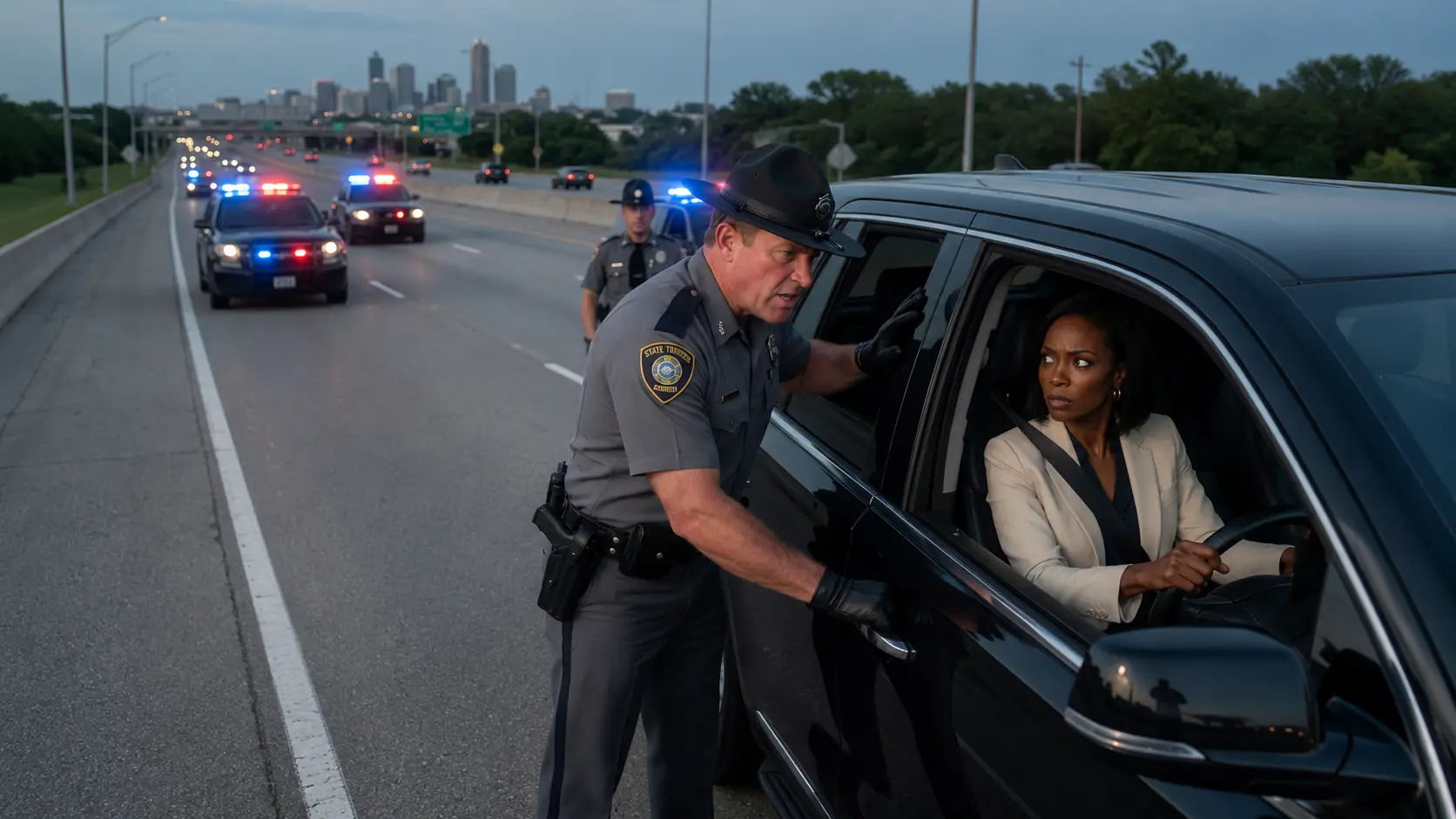
Maya was forty-two years old, a former civil-rights attorney, and the wife of Governor Jonathan Scott. She wore a cream tailored blazer over a navy blouse, dark trousers, and gold earrings small enough to avoid attention. Her straight shoulder-length hair remained neat despite the wind rushing past from the open lanes. She had been driving to pick up her husband from the executive offices after an unusually late budget meeting.
The black SUV belonged to Maya personally. Its registration matched her license, its insurance was current, and its plate had returned without a single warning when Calvin entered it into his patrol terminal. Nothing about the vehicle suggested theft. The only thing that bothered him was the woman sitting behind its wheel.
Calvin had stopped her at 6:17 p.m. after following her for nearly four miles. He later claimed she had changed lanes without signaling, though his dashboard footage would show the indicator blinking clearly before every movement. He also claimed the rear plate was partially obscured. The plate was clean, visible, and illuminated.
Maya pulled onto the shoulder immediately. She lowered the window, placed both hands on the steering wheel, and waited while Calvin approached with one hand resting near his holster. His campaign hat cast a shadow across his eyes. Without greeting her or explaining the stop, he ordered her to turn off the engine.
She complied.
“License and registration.”
“My license is inside my purse, and the registration is in the glove compartment.”
“Move slowly.”
Maya retrieved both documents and handed them through the window. Calvin studied her license longer than necessary, then looked from the photograph to her face several times. The name Maya Scott appeared clearly beneath the state seal, yet the recognition he should have shown never came.
Instead, he glanced into the leather interior of the SUV.
“Whose vehicle is this?”
“Mine.”
“You expect me to believe that?”
“The registration is in your hand.”
Calvin looked down at the document, then folded it against his ticket book. “This vehicle is registered to a residence in the governor’s district.”
“That is my home.”
His expression sharpened. “Now you’re telling me you live near the governor?”
“I live with him.”
Maya did not add more. She had learned years earlier that announcing her husband’s office during police encounters could be interpreted as an attempt to demand special treatment. She wanted Calvin to evaluate the facts already in his hand. The documents proved ownership without requiring any reference to political power.
Calvin stepped closer to the window.
“Get out of the car now.”
“Officer, may I ask why I was stopped?”
He struck the door with his palm hard enough to make the mirror shake. “People like you don’t question an officer with my authority.”
Maya’s eyes narrowed.
“People like me?”
Calvin ignored the question and reached for the door handle. It remained locked because Maya had not yet received a lawful explanation requiring her to exit. He pulled twice, then ordered her to unlock it.
A second patrol car stopped behind his cruiser.
Trooper Aaron Mills stepped out but remained several yards away. At thirty-one, Aaron had worked beneath Calvin for less than a year and already understood that challenging the senior officer publicly could carry consequences. He had witnessed Calvin turn simple traffic stops into confrontations, especially when drivers refused to become frightened quickly enough.
“Everything all right?” Aaron called.
Calvin looked back. “Possible stolen vehicle.”
Maya raised her voice enough for the second trooper to hear. “The registration matches my license.”
Aaron moved closer.
Calvin blocked his view of the documents.
“She’s giving conflicting statements.”
“I said the SUV belongs to me.”
“You claimed you live with the governor.”
“I do.”
Calvin laughed. “And I suppose you run the state on weekends.”
Maya glanced toward Aaron. The younger trooper’s expression changed slightly, but he said nothing. She could see a body camera glowing on his chest. Calvin’s camera showed no indicator light.
“Is your body camera active?” she asked.
Calvin leaned toward the window. “You don’t give me instructions.”
“I asked a question.”
“That’s your problem. You ask too many questions.”
He pulled the door handle again and ordered her to unlock it. Maya considered remaining inside, but she could see the anger in his posture and understood that a shattered window would place her in greater danger. She unlocked the door and stepped out slowly with both hands visible.
Calvin immediately grabbed her wrist.
“I am cooperating,” she said.
“Stop resisting.”
“I am not resisting.”
He twisted her arm behind her back and pushed her toward the SUV. Maya placed her left palm against the door to keep her face from striking the glass. Aaron moved one step forward.
“Calvin, she’s calm.”
“Stay out of it.”
“Her documents appear valid.”
“You checked them?”
“No, because you’re holding them.”
Calvin turned toward him. “Then don’t tell me how they appear.”
The handcuff closed around Maya’s right wrist. He reached for her left arm, but she kept her voice steady.
“Officer Rourke, your badge number is 417.”
His grip tightened.
“You planning a complaint?”
“I am preserving details.”
“You should worry about preserving your freedom.”
Calvin kicked her license and registration farther across the shoulder. The papers slid toward the painted line, nearly catching the wind from a passing truck. Maya watched them move but did not struggle.
A delivery driver in the next lane slowed after seeing her pressed against the SUV. Another motorist lifted a phone through an open passenger window. Calvin pointed at them and shouted for traffic to keep moving.
Maya looked toward Aaron again.
“Please retrieve my documents before they enter the roadway.”
Aaron hesitated.
Calvin snapped the second cuff around her left wrist. “Nobody touches evidence.”
“They are my license and registration.”
“They became evidence when I said so.”
“Evidence of what?”
Calvin pushed her shoulder against the SUV. “I’m investigating whether you stole this vehicle.”
“The owner’s name is printed on both documents.”
“Criminals forge documents.”
“Then verify the vehicle identification number.”
“I don’t need you teaching me my job.”
Maya exhaled slowly. She had represented clients whose fear became evidence against them because an officer described every movement as aggression. She knew that anger, even justified anger, could be rewritten inside a report. Her greatest protection was to remain controlled while every camera captured the contrast.
Aaron retrieved the documents despite Calvin’s warning.
He read Maya’s license first, then the registration. His eyes moved toward the name twice. He entered the information into his handheld terminal and waited for the return.
“Calvin,” he said quietly.
“What?”
“They match.”
“Run them again.”
“I did.”
“Check the VIN.”
Aaron walked toward the windshield and read the identification plate through the glass. The number matched the registration exactly.
“The vehicle belongs to her.”
Calvin’s jaw tightened. “That doesn’t explain why she lied about where she lives.”
Maya turned her head as far as the cuffs allowed. “I gave you the address printed on my license.”
“She said she lives with the governor.”
Aaron looked at the name again.
Then understanding reached him.
“Maya Scott,” he whispered.
Calvin glared. “What?”
Aaron stepped closer and lowered his voice. “The governor’s wife is named Maya Scott.”
The senior trooper’s expression did not change immediately. He looked at Maya, then at the documents, then toward the SUV. Disbelief became calculation.
“She could be using the name.”
Aaron stared at him. “Her photograph is on the license.”
“Political families have impersonators, stalkers, people who steal personal information.”
Maya almost smiled at the desperation of the theory, but the steel around her wrists was too tight for amusement. “Call the governor’s protective detail.”
Calvin grabbed her upper arm. “You’re not directing this stop.”
“I’m giving you the fastest method to verify my identity.”
“You’re trying to intimidate me with a name.”
“No. I’m trying to prevent you from making the next mistake.”
Far behind them, the line of black vehicles moved closer.
They had not been sent because Maya secretly activated an alarm or called her husband. Her SUV’s safety system had automatically notified the state protective detail when Calvin opened the driver’s door during a roadside stop. Under normal circumstances, an agent would have called Maya and confirmed she was safe.
Her phone remained inside the vehicle.
When she failed to answer three calls and the GPS showed her stationary on the highway shoulder, the protective detail notified Governor Scott’s convoy. He had just departed the executive office after learning Maya was already on her way.
Jonathan ordered the convoy rerouted.
The lead security SUV approached first, emergency lights flashing behind its grille. Two dark sedans and another protective vehicle followed. Calvin finally noticed the reflection moving across Maya’s SUV.
He turned toward the highway.
“What did you do?”
“Nothing.”
“Who did you call?”
“My hands have been behind my back.”
The convoy slowed and stopped in a staggered formation that shielded the roadside scene from passing traffic. Doors opened quickly. State protective agents stepped out first, their movements controlled but urgent.
Governor Jonathan Scott emerged from the second vehicle.
He was forty-six years old, tall, broad-shouldered, and dressed in a dark navy suit with his tie loosened after the day’s meetings. He had expected to see Maya standing beside her SUV discussing a minor traffic issue. Instead, he saw her handcuffed against the door while Calvin held her arm.
Jonathan stopped.
His face became completely still.
“Why is that woman handcuffed?”
Calvin looked at the armed security detail and then at the governor. “Sir, remain behind the vehicles. This is an active investigation.”
Jonathan moved closer.
Lead Agent Rebecca Shaw positioned herself half a step ahead of him but did not block his path. She recognized Maya immediately and signaled two agents to secure the scene without drawing weapons.
Jonathan asked again, more quietly.
“Why is that woman handcuffed?”
Calvin released Maya’s arm but did not remove the restraints. “Governor, this driver is being investigated for possible vehicle theft and providing false information.”
Jonathan looked at Maya.
“Are you hurt?”
“My wrists.”
His gaze moved to the cuffs, then to Calvin.
“That woman is my wife. Release her.”
Calvin’s face lost color.
Aaron lowered his eyes toward the documents in his hand.
For several seconds, nobody moved. The passing traffic sounded strangely distant, as though the entire highway had paused around the scene.
Calvin recovered first.
“Governor, I had no way of knowing.”
“You had her license.”
“Identity documents can be fraudulent.”
“You had the registration.”
“The vehicle seemed inconsistent with the driver.”
Jonathan’s eyes hardened. “Explain that sentence.”
Calvin opened his mouth but produced nothing.
Maya spoke before the governor could continue. “Jonathan, don’t make this about my title.”
He looked at her.
“The documents proved the car was mine before he knew who you were.”
Jonathan nodded slowly.
She turned toward Aaron. “Please tell them what happened.”
The younger trooper looked at Calvin, then at the governor’s protective agents. Fear and responsibility pulled his expression in opposite directions.
Calvin pointed at him. “You watched her resist.”
Aaron inhaled.
“No, sir.”
Calvin stepped toward him. “Choose your next words carefully.”
Agent Shaw moved between them. “Do not threaten a witness.”
“I’m speaking to my subordinate.”
“You are speaking to a state trooper while holding a civilian in restraints after her identity was verified.”
Calvin reached for his cuff key.
His hands shook slightly.
Maya watched him unlock the first restraint. The steel had left a deep red mark around her wrist. When the second cuff opened, Jonathan stepped toward her, but she raised one hand.
“Give me a moment.”
She rubbed her wrists and drew a controlled breath. She did not want her husband’s anger to become the story or Calvin’s excuse. The facts were already strong enough.
Agent Shaw requested both officers’ body-camera footage.
Aaron touched the active camera on his chest. Calvin claimed his unit had malfunctioned during the stop.
Maya looked toward him. “I asked whether it was active before you handcuffed me.”
“I told you not to interfere.”
“That wasn’t an answer.”
Shaw examined the body camera. The power switch had been manually moved into the off position.
“It did not malfunction,” she said.
Calvin folded his arms. “Battery issue.”
“The battery indicator shows seventy-eight percent.”
Jonathan’s security driver retrieved dashboard footage from the convoy’s live system, while Aaron preserved his recording. The video contained the entire conversation from the moment he arrived, including Calvin saying that “people like” Maya did not question someone with his authority.
Calvin attempted to explain the words as a reference to detained motorists.
Maya did not argue.
She simply asked Aaron to read the time at which the registration returned as valid.
“Six twenty-one,” he said.
“What time was I handcuffed?”
Aaron checked the body-camera display. “Six twenty-six.”
“So he had confirmation for five minutes before restraining me.”
Calvin looked toward the highway. “The situation was still developing.”
Jonathan’s voice remained dangerously controlled. “What developed after you confirmed the vehicle belonged to her?”
“She continued challenging my instructions.”
Maya faced him. “There it is.”
The governor looked toward Agent Shaw.
She understood.
The stop had stopped being about traffic, identification, or ownership long before the cuffs appeared. It became a punishment for questioning him.
State Police Superintendent Laura Benton arrived twelve minutes later. She had been attending a security briefing at the capitol when the protective detail notified her. Her vehicle entered without sirens, and she walked toward the shoulder carrying no visible anger.
She did not greet Calvin.
“Trooper Mills, give me the license and registration.”
Aaron complied.
Benton examined both documents, reviewed the computer return, and watched a portion of his body-camera recording through a secure tablet. Calvin attempted to interrupt twice, but she ordered him to remain silent.
After three minutes, she looked at him.
“Why did you disable your camera?”
“I believed the battery was failing.”
“The system log records manual deactivation before you approached the vehicle.”
Calvin said nothing.
“Why did you claim the SUV was stolen?”
“It did not appear to belong to her.”
Benton stared at him. “The database said it did.”
“I used officer discretion.”
“Discretion does not overturn registration records.”
He shifted his weight. “She was confrontational.”
The superintendent turned the tablet so he could see the video. Maya’s voice remained calm while Calvin shouted through the open window.
“Show me the confrontation.”
Calvin looked away.
Benton removed his badge before he understood what she intended.
“You are suspended immediately pending investigation. Surrender your duty weapon, body camera, radio, and vehicle keys.”
His head snapped toward her. “You cannot do this on the side of the road.”
“I can suspend an officer wherever misconduct occurs.”
“This is because she is the governor’s wife.”
Maya stepped forward.
“No. It happened because I am the governor’s wife. It is being investigated because the cameras survived you.”
Calvin’s expression twisted with anger. “You think your husband’s office makes you untouchable?”
Maya held up her reddened wrists. “Clearly not.”
Jonathan started toward the officer, but Maya touched his arm.
She continued looking at Calvin.
“I did not need to be married to a governor for my license to be valid. I did not need a convoy for you to read a registration. Every woman you stopped before me deserved the same verification you refused to give.”
Calvin surrendered his equipment.
A supervisor placed him in the rear of an unmarked state police vehicle—not under arrest, but no longer permitted to leave on his own. He stared through the glass as Maya retrieved her documents.
Jonathan opened the passenger door of the government sedan.
“You’re coming with me.”
“I’m driving my SUV.”
“Maya.”
“I was stopped while driving legally. I’m leaving the same way.”
He understood why it mattered.
Agent Shaw inspected the SUV, confirmed it had not been damaged, and arranged an escort. Maya returned to the driver’s seat while Jonathan rode beside her instead of rejoining the convoy.
Before she pulled away, Aaron approached the window.
“Mrs. Scott, I’m sorry.”
“You verified the documents.”
“I should have stopped him sooner.”
“Yes.”
The honesty of her answer surprised him.
Maya continued, “Next time, don’t wait until a convoy arrives.”
Aaron nodded. “I won’t.”
The investigation began that night.
Calvin’s report claimed Maya had driven erratically, refused repeated commands, made inconsistent statements, and physically resisted arrest. Aaron’s body-camera footage contradicted every significant allegation.
She had signaled before changing lanes.
She provided documents immediately.
She explained her movements before making them.
She never raised her voice or pulled away.
Investigators reviewed Calvin’s prior stops. A pattern emerged within days. Drivers from minority communities were searched more frequently, detained longer, and cited for vague violations at significantly higher rates than others assigned to the same highway district.
Several complaints had already been filed.
A Black nurse had reported being ordered from her car after Calvin refused to believe she owned a new luxury sedan. A Latino business owner said Calvin held him for forty minutes because his work truck contained expensive equipment. An Asian American college professor had been accused of using a fraudulent university parking credential despite providing valid identification.
Each complaint had been dismissed after Calvin described the driver as hostile or noncompliant.
Most encounters lacked video because his body camera had allegedly malfunctioned.
Technical logs showed repeated manual deactivations.
Superintendent Benton reopened every case.
Maya refused to remain only a witness in her own complaint. She asked the governor’s counsel to avoid interfering with the investigation and hired an independent attorney. She also requested that every previous complainant receive legal support from a privately funded civil-rights organization rather than from state political offices.
Jonathan initially resisted her distance from his administration.
“He cuffed you after confirming who you were.”
“And that is exactly why your office cannot control the review.”
“I’m the governor.”
“You’re my husband. Tonight, that’s enough.”
He looked at the bruising around her wrists.
“I wanted him arrested.”
“I know.”
“Didn’t you?”
“I wanted him stopped. Those are not always the same thing.”
The footage became public after investigators completed the preliminary review. News stations focused first on the dramatic arrival of the governor’s convoy, but Maya redirected every interview toward the five minutes before it appeared.
“The important fact is not that Trooper Rourke handcuffed the governor’s wife,” she said. “The important fact is that he ignored valid documents because he believed the driver did not look like someone who should own that vehicle.”
Her words changed the public conversation.
Drivers who had remained silent came forward. Some had paid unnecessary towing fees after Calvin impounded their cars. Others described roadside searches without clear consent, threats of arrest, and insults never included in official reports.
One elderly veteran produced audio recorded by his dashboard camera. Calvin could be heard demanding cash for an alleged permit violation, then reducing the amount when the veteran threatened to call an attorney.
The investigation expanded into corruption.
Financial records showed unexplained deposits into Calvin’s account and regular payments from a towing company that received most of his impound calls. The company sold several vehicles after owners struggled to challenge the seizures quickly enough.
Maya’s SUV had not been selected randomly.
Calvin had been searching for another high-value vehicle he could label suspicious, tow, and place inside the company’s costly storage system. Even if the theft accusation collapsed, the owner might pay thousands to recover the vehicle rather than fight.
He never imagined its registered owner would bring the governor’s convoy to the shoulder.
Six months later, Calvin faced charges for falsifying official records, unlawful detention, bribery, evidence tampering, and civil-rights violations. The state revoked his law-enforcement certification, and the towing company owner was charged separately.
Aaron testified before the review board.
He admitted that fear of retaliation delayed his intervention. His honesty did not erase the delay, but it prevented Calvin’s version from becoming the only official account.
The state police changed its policies.
Body cameras now activated automatically when patrol lights engaged or vehicle doors opened. Officers could not manually disable them without triggering an immediate supervisor alert. Registration disputes required secondary verification before detention unless there was clear evidence of danger.
The department also created an independent review unit for complaints involving discriminatory enforcement.
Maya insisted the reform include public reporting. She did not want policies that sounded impressive but remained invisible to the communities expected to trust them.
A year after the stop, she returned to the same highway shoulder with no cameras or official announcement. Aaron met her there in uniform, now assigned to a training division after completing additional instruction in intervention and ethical policing.
“I remember your last words,” he said.
“Which ones?”
“Don’t wait for the convoy.”
Maya looked across the road.
“Have you?”
“No.”
He told her about stopping a senior officer from searching a teenager’s car without consent. The confrontation damaged his standing with several colleagues, but the search did not happen.
Maya nodded.
“That matters more than apologizing to me.”
She drove away alone in the same black SUV.
The lane markers passed steadily beneath the tires, and the state capital appeared in the distance. No convoy followed her. No flashing lights filled the mirrors.
That was how the original journey should have ended.
Calvin Rourke believed authority meant nobody beneath him could ask why. Maya Scott understood that legitimate authority had to answer that question more carefully than anyone else.
He did not lose his badge because he failed to recognize the governor’s wife.
He lost it because he recognized valid proof, ignored it, and punished a woman for refusing to surrender her dignity.
The convoy only made certain everyone was watching when the truth arrived.