“Stop. It’s a trap.”
The words came out of Hope Gardner’s mouth raw and breathless, torn apart by the two miles she had run before sunrise with no shoes on her feet and nothing in her stomach.
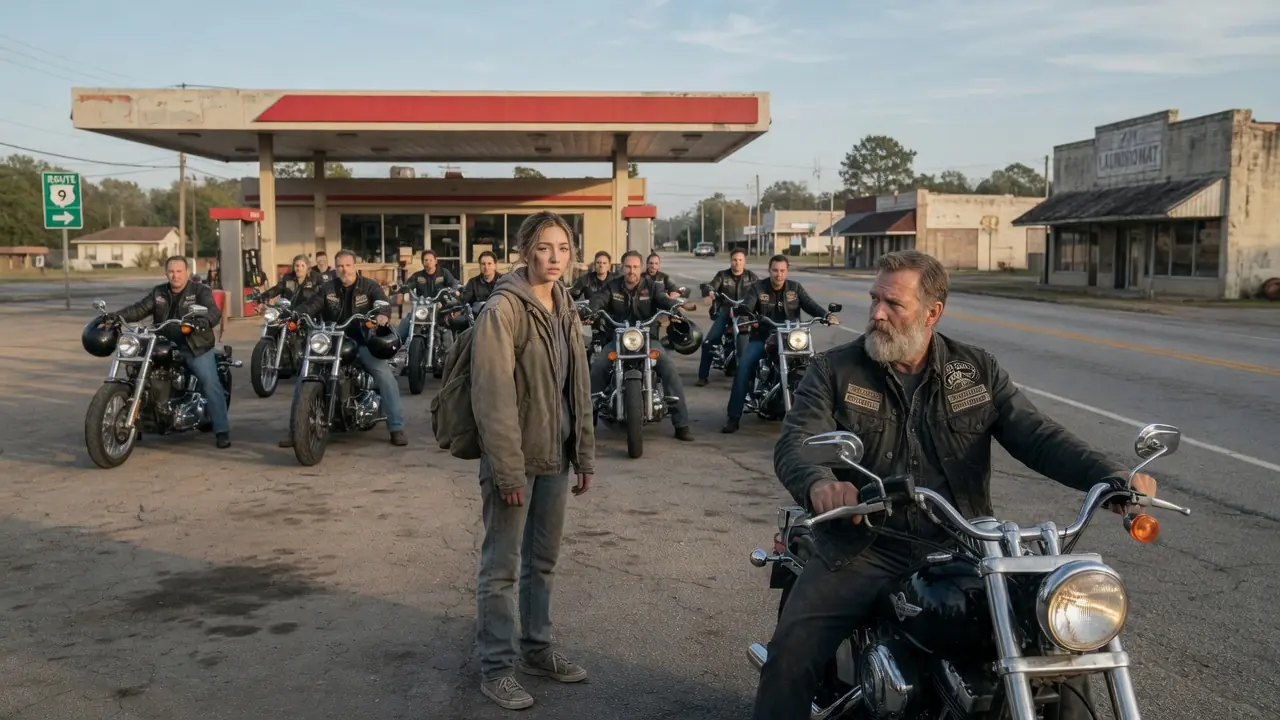
Fifteen motorcycles stood in the parking lot of Connelly’s Gas Station, chrome shining under the pale Georgia morning.
The riders were pulling on gloves, checking straps, and laughing over bad coffee like men with no idea that seven minutes down Route 9, the Millbrook Bridge was waiting to kill them.
Hope stood in the middle of the lot, thin, barefoot, her oversized jacket hanging from one shoulder.
Nobody moved.
Then the biggest rider turned toward her.
He had a thick neck, a heavy mustache, and the impatient face of a man who had been interrupted too many times in his life.
“What did you say?”
Hope swallowed.
“The bridge,” she said. “They cut it last night. You can’t cross it.”
The man stared at her dusty feet, her tangled hair, the torn sleeve on her jacket, and let out a harsh laugh.
“Get lost, kid.”
“I’m not lying.”
“Move.”
“Please.” Hope’s voice cracked. “I watched them do it. Three men with an angle grinder. They cut the support beams underneath. If you ride across that bridge, none of you come back.”
The bikers glanced at one another.
Some looked annoyed.
Some looked uncomfortable.
Most looked like they wanted someone else to deal with her.
The big rider waved her off and turned back to his bike.
“Everybody ready?”
Engines began roaring to life, one after another, filling the lot with thunder.
Hope stepped forward.
“No. Please, listen to me.”
The sound swallowed her voice.
She looked from face to face, searching for one person willing to believe her. But to them, she was only the homeless girl from under the bridge. The dirty one. The strange one. The one people crossed streets to avoid.
Her knees weakened.
She dropped to the asphalt and covered her mouth with both hands.
“I’m telling the truth,” she whispered.
At the back of the pack, one rider had not started his engine.
His name was Hank Sullivan.
He was fifty-two years old, with a silver beard, sharp eyes, and the quiet authority of a man who did not need to raise his voice to be heard. He had spent half his life reading danger in places where a wrong judgment cost more than pride. He knew fear when he saw it.
And the girl kneeling in the parking lot was terrified.
Not dramatic.
Not confused.
Terrified.
Hank lifted one hand.
“Engines off.”
The big rider frowned.
“Hank, come on.”
“I said engines off.”
One by one, the motorcycles fell silent.
Hope looked up.
For the first time that morning, someone was really looking at her.
Hank walked over and stopped a few feet away, giving her space.
“What’s your name?”
“Hope,” she said. “Hope Gardner.”
“Hank Sullivan. Now tell me again. Slow.”
“The Millbrook Bridge. East side. Four middle supports. They cut them from underneath, almost all the way through. They said fifteen bikes at speed would finish it. I heard them say it.”
Hank’s face changed.
Not much.
Just enough.
He looked toward a thin man with wire-rimmed glasses standing near a blue Harley.
“Sam. Toolkit.”
The thin man straightened.
“On it.”
Hank turned to the big rider.
“Craig, you’re coming.”
Craig looked irritated.
“You really buying this?”
“I’m checking it.”
Hope pushed herself to her feet.
“I can show you.”
Hank nodded.
“Then show us.”
Fourteen months earlier, Hope Gardner had lived in a house that smelled like cinnamon and lavender.
It was not much of a house. The roof leaked over the back bedroom, the porch swing squeaked in the wind, and the kitchen window stuck in summer. But it was home because Eleanor Gardner lived there.
Eleanor was Hope’s grandmother and the only person who had ever stayed.
Hope’s mother had walked away when Hope was three. Her father was nothing but a blank space in family stories. Eleanor raised her on little money, strong tea, library books, and one stubborn belief.
“Kindness is the only thing nobody can steal from you,” she used to say.
Hope believed her.
Then came the cough.
At first, Eleanor waved it off. Then she stopped sleeping. Then she stopped eating. By the time Hope convinced her to see a doctor in the next town, the sickness had settled deep.
Eleanor died on a Tuesday morning in November with Hope holding her hand.
The bank took the house sixty days later.
Hope stood on the sidewalk with one backpack, one box of books, and nowhere to go while a man in a gray suit changed the locks without looking at her.
She tried the shelter in Colton.
Full.
She tried the church on Fifth Street.
Pastor Lewis said he would pray for her.
Prayer did not keep rain off her back.
So Hope found the Millbrook Bridge.
The bridge had been built decades earlier, before the highway bypass made it almost unnecessary. Underneath it, the concrete embankment formed a shallow alcove just wide enough for a sleeping bag, a milk crate, and the books she refused to give up.
She dragged a piece of corrugated tin over the opening to block the wind.
It was not a home.
But it was hers.
Grayville had around four thousand people.
Most of them knew Hope existed.
Almost none of them cared.
Mrs. Callaway, who ran the grocery store, once chased Hope out with a broom when she came inside to warm up during a storm.
“You’re scaring customers,” she snapped.
Hope had been standing by the canned soup, dripping rainwater onto the floor.
Chief Braddock told her twice that if she kept loitering near Main Street, he would arrest her.
He said it the way people talked to stray animals.
Only Earl Weston treated Hope like she was human.
Earl was seventy-one, owned a one-man repair shop on Route 4, and had hands permanently stained with grease. Every few days, he left a brown paper bag on the bridge railing.
A sandwich.
An apple.
Sometimes a bottle of water.
Once, he left a flashlight with a note taped to it.
For your books.
Hope kept that flashlight under her pillow.
It became the most valuable thing she owned.
That was why she was awake the night the men came.
She had been reading a library book about bridges, steel load, stress fractures, and support design. The flashlight beam shook slightly because her fingers were cold. Around midnight, she heard tires on gravel above her.
Then voices.
Men.
Three of them.
She crawled deeper into the shadow under the bridge and watched through a gap in the tin.
One man wore a red jacket and carried an angle grinder. Another held a flashlight. The third smoked and kept looking toward the road.
Hope recognized the smoker.
Wade Thornton.
He owned the Iron Mule, a failing bar on Creston Avenue. He was known for drinking with Chief Braddock and threatening people who owed him money. Hope had avoided him for years.
“You sure this works?” one man whispered.
Wade’s voice came low and hard.
“Fifteen bikes. Full speed. They hit the middle, bridge gives. We get down there before anyone else does.”
“What about survivors?”
“There won’t be any.”
Hope stopped breathing.
The grinder screamed to life.
For nearly forty minutes, she lay under that bridge while sparks rained through the cracks and hot metal dust floated in the dark. She watched them cut the beams. One. Two. Three. Four.
When they left, Hope crawled out shaking.
She had no phone.
No one to call.
No one who listened.
At dawn, she started running.
Barefoot.
Hungry.
Terrified.
By the time she reached the gas station, the fifteen bikers were almost ready to leave.
And almost nobody believed her.
Hope led Hank, Sam, and Craig down the gravel path along Miller Creek. The air smelled of wet grass and old mud. Her feet hurt badly now, but she did not slow down.
The Millbrook Bridge appeared around the bend, rust-streaked and ordinary.
Craig crossed his arms.
“Looks fine.”
“Not from the top,” Hope said.
She pointed toward the east embankment.
“Underneath.”
Hank climbed down first. His boots sank into the mud near the creek. He ducked beneath the bridge and looked up.
For three seconds, he did not speak.
Then his voice came out sharp.
“Sam. Now.”
Sam hurried down, opened his tool bag, and pulled out a flashlight. The beam landed on the first support beam.
A clean diagonal cut ran deep through the steel.
Fresh.
Bright.
Intentional.
Sam moved the light to the second beam.
Then the third.
Then the fourth.
His face went still.
Craig climbed down behind him and stopped smiling.
“What am I looking at?”
“Attempted mass casualty,” Sam said quietly.
Craig swallowed.
Sam ran his fingers near the cut without touching it.
“These are not age cracks. These were made by a grinder. Less than twelve hours ago. Four main supports cut most of the way through.”
Hank’s jaw tightened.
“If we crossed?”
Sam looked at him.
“With fifteen loaded motorcycles at speed?” He paused. “The deck fails almost instantly. You go down with it.”
The creek moved softly beneath them.
Above, Hope stood barefoot in the mud, arms wrapped around herself.
Hank climbed back up the embankment. His face was pale with controlled anger.
He stopped in front of her.
“You saved our lives.”
Hope blinked at him.
Nobody had ever said words like that to her.
She looked away, embarrassed by the force of them.
“I just told you what I saw.”
“That’s more than most people do.”
Craig came up next. He removed his riding gloves and held them out to her.
Hope stared.
“I’m sorry,” he said.
She did not answer.
“I mean it,” Craig continued. “I looked at you and thought I knew your worth. I was wrong.”
Hope took the gloves.
They were too large, warm from his hands, and made of worn black leather softened by years of use.
It was the first gift anyone had given her since Earl’s flashlight.
Hank called the police.
That was the proper thing to do.
It was also the first mistake.
Chief Roy Braddock arrived twenty minutes later in his department SUV, coffee in hand, sunglasses on, and irritation written across his face. He walked toward the bridge like he had been called out to inspect a pothole.
“What seems to be the issue?”
Hank pointed beneath the bridge.
“Four support beams cut with a grinder. Deliberate sabotage.”
Braddock crouched near the embankment but did not climb down. He glanced under the bridge for maybe five seconds, then stood and brushed his pants.
“Old bridge,” he said. “Steel wears out.”
Sam stepped forward.
“I’m a structural engineer. Those cuts are machine-made.”
Braddock smiled without warmth.
“I’m sure you know your business. I know my town.”
Hope stepped forward.
“I live under that bridge. Those cuts weren’t there three days ago.”
Braddock looked at her.
Something shifted in his face.
Recognition.
And annoyance.
“Miss Gardner, this does not concern you.”
Hope held his stare.
“I was under it when they cut the beams.”
“Or you had a nightmare.”
Craig’s hands tightened.
Hank lifted a finger slightly, warning him to stay still.
Braddock continued.
“I’ll put up a road closed sign and have county take a look next week.”
“Next week?” Craig snapped. “Someone tried to kill us today.”
Braddock looked at the bikers.
“What I have is a homeless girl with a story and a group of travelers getting worked up over an old bridge. That is not evidence of a crime.”
Sam lifted his phone.
“It is when it’s recorded.”
Braddock’s mouth tightened.
Hank noticed.
The chief had not asked who Hope was.
He already knew.
He had not taken photographs.
He had not taken statements.
He had not gone under the bridge.
He had not acted surprised.
When Braddock drove away, Hank watched the SUV disappear toward town.
Craig stared after it.
“He knows.”
“At minimum,” Hank said, “he does not want to know.”
Hope spoke quietly.
“Chief Braddock drinks with Wade Thornton every Thursday night at the Iron Mule.”
Hank turned to her.
“The man you saw.”
She nodded.
“Wade owns the bar. Braddock parks behind it until late.”
Hank looked at Sam.
“Call the FBI field office.”
Sam nodded.
“Nearest one is Albany.”
“Then call Albany.”
Hope stared at him.
“They’ll believe you?”
Hank looked at her, then at the damaged bridge.
“They’ll believe evidence.”
By noon, fifteen motorcycles stood outside the Iron Mule.
The bar had once been lively. Now the sign hung crooked, the windows were dirty, and the whole building looked like it was waiting to be repossessed. Wade Thornton stood behind the counter polishing a glass when Hank walked in.
Fourteen bikers followed.
They spread through the room without needing instructions. Two near the back exit. Two by the front. The rest forming a loose half circle around the bar.
Wade’s eyes flicked toward the office door.
Blocked.
Hank stopped at the counter.
“Wade Thornton.”
“Who’s asking?”
“The fifteen men you tried to kill this morning.”
The glass slipped in Wade’s hand.
He caught it just before it hit the floor.
That was enough.
A man falsely accused becomes confused or angry.
Wade became afraid.
“I don’t know what you’re talking about.”
“Millbrook Bridge,” Hank said. “East side. Four beams cut between midnight and one in the morning. Red Dodge Ram parked off Route 9. Your voice heard saying fifteen bikes at speed would bring the bridge down.”
Wade’s face lost color.
“You got no proof.”
“Sam,” Hank said.
Sam moved toward the office.
Wade lunged to stop him.
Craig stepped in his way.
Not touching.
Just standing.
Sam pushed open the office door. A metal trash can was smoking beside the desk. Papers curled and darkened at the edges.
“Burning documents,” Sam called. “Equipment rental receipt. Route map. Bridge circled.”
Wade’s breathing turned rough.
“You don’t understand. I owed money. I just needed—”
“You needed our wallets,” Craig said.
Wade looked at the floor.
“Nobody was supposed to die.”
Sam stepped out holding the half-burned map.
“A thirty-foot fall into shallow water over rocks. You did the math. You just didn’t care about the answer.”
The front door opened.
Chief Braddock walked in with his hand near his belt.
Then he saw the room.
Saw Wade cornered.
Saw Hank waiting.
“Roy,” Wade said.
Just the name.
Just enough.
Hank turned.
“Chief. Good timing. The FBI is on the way.”
Braddock’s face hardened.
“You had no right to come in here.”
“No,” Hank said. “But the federal agents will.”
Dark SUVs pulled up outside moments later.
The room changed immediately.
Federal agents entered with calm voices, badges, and eyes that actually looked at evidence. They separated Wade and Braddock into opposite corners. Sam handed over the video, the photographs, and the recovered papers.
Hope stood outside on the sidewalk as half the town gathered.
For the first time since Eleanor died, people looked at her.
Not through her.
At her.
Wade and Braddock were taken away without sirens.
Quietly.
Final.
The bikers could have left after that.
Their route to Memphis was delayed. The memorial ride mattered. They had names to honor, wreaths to lay, and friends waiting at the next stop.
But that afternoon, Hank found Hope sitting behind Connelly’s Gas Station, Craig’s gloves folded neatly in her lap.
She looked exhausted.
Not tired.
Emptied.
He sat beside her on the curb.
For a while, neither spoke.
Then Hank asked, “Where did you grow up?”
“Birch Lane,” Hope said. “Two blocks from the church.”
“Parents?”
“My grandmother raised me. Eleanor. She died fourteen months ago.”
The words were simple, but Hank heard the weight beneath them.
“What happened after?”
“The bank took the house. Shelter was full. Church said they’d pray. So I found the bridge.”
Hank looked toward the road.
“How long?”
“Eleven months.”
Hope looked down at the gloves.
“It’s not so bad in summer. Winter was harder. Earl gave me a sleeping bag. And a flashlight for reading.”
“You still read?”
“Every day.”
“What kind of books?”
“History. Science. Engineering. I like knowing how things hold together.”
Hank was quiet for a long moment.
Then he said, “How far did you get in school?”
“Eleventh grade. After Eleanor died, I had no permanent address. No address, no enrollment. No enrollment, no transcript. No transcript, no future.”
Hank’s jaw tightened.
“I’ve heard that kind of math before.”
Hope glanced at him.
He rubbed one hand over his beard.
“I had a friend. Jamie Torres. Came home from war and got buried under paperwork. No housing. No benefits. No one to answer the phone. The system swallowed him.”
“What happened to him?”
Hank did not answer immediately.
“He didn’t make it.”
Hope understood enough not to ask more.
Hank stood and held out his hand.
Hope took it.
He pulled her to her feet and walked back to the bikers gathered near the pumps.
“We’re not leaving tonight,” Hank said.
Craig looked up.
“Memphis?”
“Can wait.”
Nobody argued.
By sunset, the empty lot behind Connelly’s Gas Station looked like a camp. The bikers set up tents in a tight circle. Tools appeared. Coolers opened. Craig built a fire pit from old cinder blocks. Sam spread bridge diagrams across the hood of a truck.
The next morning, the work began.
Sam inspected the bridge from end to end and drew a repair plan. Hank called everyone he knew: veteran groups, construction companies, old friends, reporters, donors. By noon, steel beams arrived on a flatbed from Atlanta. By afternoon, old Mr. Peterson from the hardware store had donated bolts, cutting wheels, gloves, and safety lights.
Hope showed up at dawn wearing Craig’s gloves.
Nobody told her to work.
Nobody told her to stop.
So she worked.
She hauled water. Held flashlights. Passed tools. Wrote down measurements for Sam. Her feet were bandaged now because Danny, the youngest rider and the group’s medic, had cleaned and wrapped them the night before with the gentle seriousness of a man treating a battlefield wound.
On the third day, Grayville began to change.
Earl Weston arrived first in his battered pickup, tailgate loaded with tools.
“Figured you could use hands,” he said.
Hank smiled.
“We need twenty.”
Earl looked toward town.
“Give it an hour.”
He was right.
By eight, five locals had arrived.
By ten, there were twelve.
By noon, the bridge looked like a barn raising.
Mrs. Callaway came with sandwiches, bottled water, apples, and a face full of shame. She set up a folding table under a tree and fed everyone. For an hour, she avoided Hope.
Then she finally walked over.
Hope was kneeling on the bridge deck, holding a bolt steady while Sam tightened it below.
“Hope.”
Hope looked up.
Mrs. Callaway held out a sandwich and water.
“I chased you out of my store in the rain.”
Hope said nothing.
“I’m sorry,” Mrs. Callaway whispered. “I am so sorry.”
Hope looked at the sandwich.
Then she took it.
“Thank you.”
That was all.
No speech.
No easy forgiveness.
Just food accepted.
That was enough for the moment.
On the fifth evening, the Millbrook Bridge stood reinforced, repaired, and stronger than it had been in twenty years.
Sam inspected every connection twice.
Hank stood in the middle of the bridge with Hope beside him and looked down at Miller Creek.
“This bridge is done,” he said.
Hope nodded.
Then Hank looked toward town.
“But we’re not.”
By then, the story had spread.
A homeless girl saving fifteen bikers. A sabotaged bridge. A corrupt chief. A failing bar owner. A town that had ignored her until she became the reason people were still alive.
Donations began arriving.
Not just from Grayville.
From Atlanta.
Macon.
Savannah.
Other motorcycle groups.
Veterans’ networks.
Churches that finally remembered their doors were supposed to open outward.
A fund was created under Eleanor Gardner’s name.
Hank refused to let it become a show.
“This isn’t charity theater,” he told the town council. “This is repair. You let a girl sleep under a bridge. Now you fix what that says about you.”
Six days after Hope stopped the bikers in the parking lot, Hank walked her down Birch Lane.
Hope stopped when she saw the house.
412 Birch Lane.
Her grandmother’s house.
The porch no longer sagged. The roof had new gray shingles. The windows had been repaired. The front door had been painted sky blue, Eleanor’s favorite color. The porch swing was still there, hanging from new chains.
Hope covered her mouth.
“No.”
Hank opened the gate.
“Yes.”
Inside, the floors had been sanded. The kitchen counters replaced. The walls painted warm cream. A couch sat in the living room, along with a bookshelf filled with books chosen by Mrs. Patterson from the county library.
Hope walked slowly, afraid the house might vanish if she moved too fast.
In the back bedroom, she found a framed photograph on the nightstand.
Eleanor Gardner, sitting on the old porch swing, smiling with a glass of sweet tea in one hand.
Hope picked it up with trembling fingers.
“Earl found it,” Hank said from the doorway. “Someone sold off a box of things after the house was cleared. He bought the whole box and kept it safe.”
Hope sat on the bed.
For fourteen months, she had cried quietly.
Under bridges.
Behind buildings.
Into sleeves.
Into darkness.
This time, she did not cry quietly.
She held her grandmother’s photo to her chest and sobbed until her whole body shook.
Hank stayed in the doorway and said nothing.
He knew the sound of survival finally ending.
When Hope could speak again, she looked up.
“Why?” she whispered. “You didn’t even know me.”
Hank’s eyes softened.
“I know you ran barefoot to save fifteen strangers who laughed at you. I know you kept telling the truth when nobody wanted to hear it. And I know my friend Jamie needed someone to stop for him.”
He paused.
“So I’m stopping for you.”
Outside, Birch Lane was full of people.
Bikers stood along the curb with helmets tucked under their arms. Neighbors filled the sidewalks. Earl leaned against his pickup, smiling. Mrs. Callaway wiped her eyes. Children sat on their fathers’ shoulders to see over the crowd.
A sheet hung between two oak trees, spray-painted in crooked letters.
Welcome Home, Hope Gardner.
The new mayor, Claire Ashworth, stepped forward with an envelope.
“Hope,” she said, “on behalf of Grayville, we are establishing the Eleanor Gardner Community Fund. Emergency housing, meals, and education support for anyone in this town who needs help before things fall apart.”
She handed Hope the envelope.
Inside was a scholarship to Walker County Community College.
Tuition.
Books.
Housing support.
Hope stared at the letter until the words blurred.
Hank spoke to the crowd.
“She saved fifteen lives with nothing but courage. The least this town can do is make sure she never sleeps under a bridge again.”
The applause rose slowly at first.
Then all at once.
Hope stood on the porch of the house she thought she had lost forever, holding her grandmother’s photograph in one hand and her future in the other.
For the first time in fourteen months, she was not under concrete.
Not behind tin.
Not hidden from rain.
She was home.
Six months later, Hope sat in the front row of an engineering class at Walker County Community College, taking notes faster than the professor could speak.
Earl’s flashlight stayed in the front pocket of her canvas bag.
She no longer needed it to read in the dark.
She kept it anyway.
On weekends, she volunteered at the Eleanor Gardner Community Shelter, a converted storefront on Main Street where no one was turned away just for looking poor. Mrs. Callaway ran the kitchen on Sundays. Earl handled repairs. Pastor Lewis, to his credit, showed up every week and washed dishes without making speeches.
The Iron Oath Brotherhood rode through Grayville twice a year.
The first time they returned, nobody locked doors.
Children waved from sidewalks.
Mrs. Callaway served lemonade.
Hank always stopped first at 412 Birch Lane.
He and Hope would sit on Eleanor’s porch swing and talk about school, bridges, books, and the strange burden of being seen after a long time of being invisible.
The Millbrook Bridge had a new sign bolted to the east railing.
HOPE’S BRIDGE
Underneath, in smaller letters, someone had added:
Because one voice was enough.
Years later, people in Grayville would tell the story differently depending on who was speaking.
Some said fifteen bikers saved a homeless girl.
Some said a town finally woke up.
Some said a bridge nearly fell and took everyone’s shame with it.
Hope knew the truth was simpler.
She had seen danger.
She had told the truth.
And one man had finally listened.
That was where everything changed.
Not when the crowd cheered.
Not when the house was restored.
Not when her name went on a bridge.
Everything changed in that gas station parking lot when she was barefoot, hungry, shaking, and dismissed by almost everyone.
When fifteen engines were ready to roar toward death.
When her voice had nearly disappeared beneath the sound.
And when Hank Sullivan looked at her like she mattered.
Sometimes, saving a life does not begin with strength.
Sometimes, it begins with someone everyone ignores standing in the road and saying one more time, even while nobody believes her:
“Please. Listen.”