“Stop. It’s a trap.”
“Get lost.”
“The bridge. Someone cut the supports last night. Three men. I watched them do it.”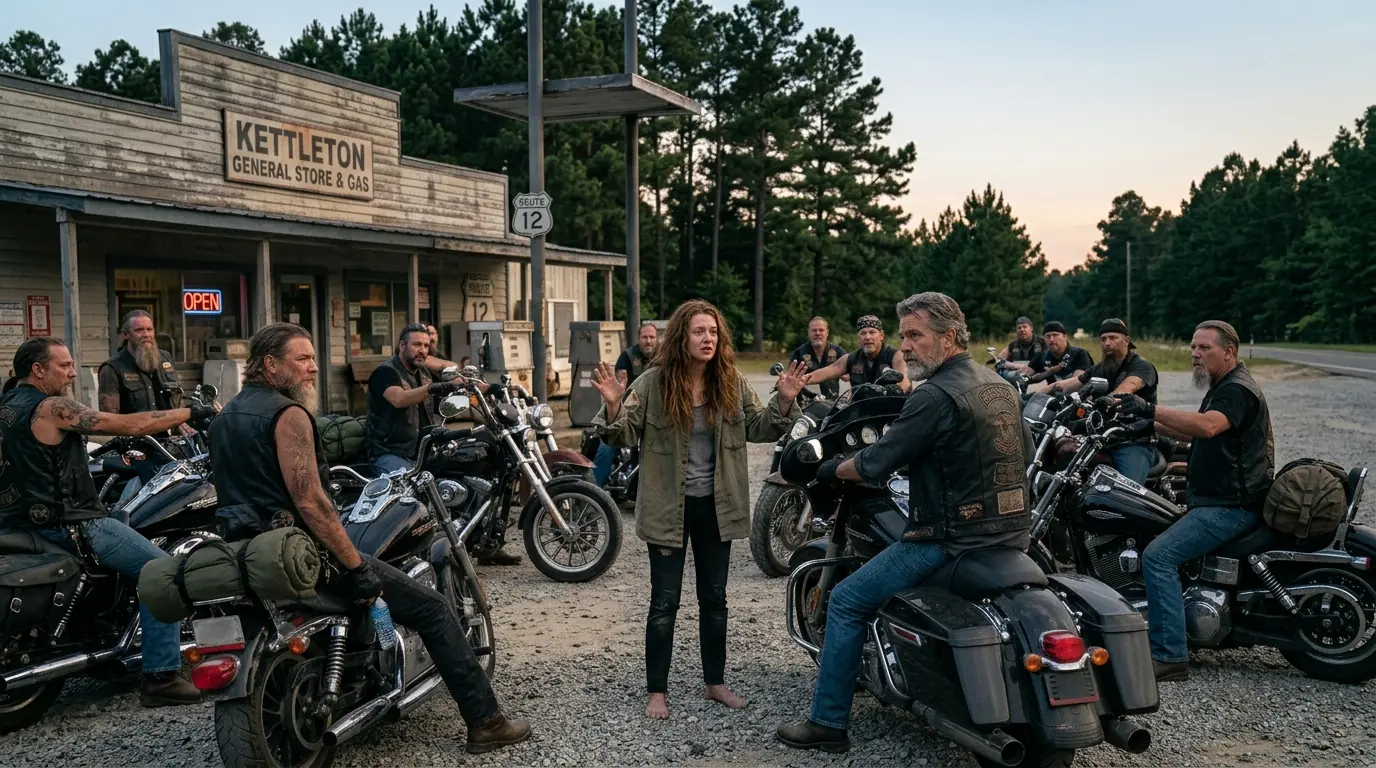
“You’re crazy. Move.”
“Please. You cross that bridge, none of you come back.”
The bikers shoved past her. Eighteen engines roared to life.
Lily Carver dropped to her knees in the middle of the parking lot, barefoot, homeless, 21 years old. She had nothing. No phone, no family, no voice that anyone in Kettleton, Alabama, had ever thought was worth hearing.
She had run two miles on empty asphalt before sunrise to save 18 strangers.
Not one of them believed her.
She pressed her palms flat against the hot concrete and whispered to herself the way her grandmother Ruth had taught her to pray when the world stopped listening.
At the back of the pack, one man’s eyes narrowed.
He looked at her.
Really looked.
Not through her.
At her.
Then he killed his engine.
What happened after that changed the town forever.
“Everybody shut your engines off.”
Jack Mercer had not moved from his bike. He had not raised his voice. But something in the way he said it made 17 men reach for their throttles at the same time.
Eighteen engines died.
The forecourt went silent so fast you could hear the creek running somewhere behind the tree line.
Bobby Crane swung around.
“Jack, come on. We’ve got four hundred miles.”
“Bobby.”
That was all.
One word.
Bobby stopped.
Jack climbed off his bike and walked toward Lily. Not fast. Not slow. The walk of a man who had already made a decision and was now executing it.
He stopped two feet in front of her and looked at her the way nobody in Kettleton had looked at her in 13 months.
Like she was worth listening to.
“Say it again,” he said. “From the beginning. Slower.”
Lily’s throat moved. Her bare feet were bleeding where the asphalt had cut them on the run in.
“Harland Creek Bridge. Route 12. Two miles south. Last night around two in the morning, three men were under the bridge with cutting equipment. They were damaging the support beams on the west span.”
She stopped and drew a breath.
“The man who set it up was Dale Whitmore. He owns the Copper Spike Bar on Cumberland Street. I heard him say…”
Her voice cracked.
“He said the bridge wouldn’t hold the bikes at full speed. He said it wouldn’t hold past the second span.”
Nobody moved.
Bobby’s jaw tightened.
“She’s making it up.”
“Maybe,” Jack said.
He didn’t look at Bobby.
“Reed.”
Reed Holston was already off his bike, already cleaning his glasses. That was his tell, the one the whole group knew. It meant something had his full attention and wasn’t letting go.
He was a former Navy structural engineer, a man who had spent 22 years building and inspecting things most people never thought about until they failed.
“If several primary beams are compromised and you put 18 bikes on that span at highway speed on a downhill approach,” Reed said flatly, “the load could fail the bridge in seconds.”
No drama.
Just numbers.
“Deck drops. Bikes go with it.”
“How far down?” Bobby asked.
Reed paused.
“About thirty feet. Limestone creek bed. Dry season.”
The pump next to Jack’s bike was still running, clicking off gallons into a tank nobody was thinking about anymore.
“Show us,” Jack said to Lily.
Dale Whitmore was still in the doorway of Harland’s Gas and Supply. He had been standing there since Lily first opened her mouth. Coffee cup in one hand, the other hand loose at his side, watching.
Jack looked at him once on the way past.
Dale looked back.
Jack kept walking.
“Vic. Eyes on him.”
Vic Donahue didn’t look up from where he was leaning against his bike. Arms folded. Eyes forward.
Fifty-eight years old. Retired drill sergeant. A man who had not needed to raise his voice in nine years.
Dale did not move from the doorway.
The path along Harland Creek was packed red clay and loose gravel. Lily walked it without slowing. Jack followed. Reed had his canvas kit over one shoulder. Bobby trailed at the back, arms crossed, mouth shut, wearing the posture of a man who wanted to be wrong.
Nobody talked.
A quarter mile around the bend, the bridge came through the trees.
Old two lanes. Steel girder construction. Rust on the railings. A county route marker so sun-bleached the number was gone.
The kind of bridge you cross without thinking about it.
The kind of bridge a whole town had stopped thinking about the day the bypass opened.
“Looks fine to me,” Bobby said.
“It’s not on top.”
Lily pointed to the west embankment, where the bank sloped down toward the creek bed.
“Underneath. The support beams.”
Jack went down first. He slid down the embankment, boots hitting the mud at the bottom, and ducked under the bridge deck.
He looked up.
Three seconds.
Four.
Five.
“Reed.”
Reed came down fast, nearly losing his footing on the wet clay. Flashlight out before he hit the bottom.
He aimed the beam at the first crossbeam.
The cut was clean, diagonal, and deep. The exposed metal was still bright. Fresh.
Reed moved the light.
Second beam.
Same damage.
Third.
Fourth.
Fifth.
Several major support points on the west span had been deliberately compromised.
Reed opened his notebook. His voice went flat, the way it went when numbers stopped being abstract and started being real.
“These cuts are recent. The pattern is deliberate. This is not age. This is not fatigue. This is sabotage.”
He wrote something down.
“At full load, with a group riding across at speed, this span could fail almost immediately.”
He stopped writing.
“Everything on it goes down.”
The creek murmured past them in the silence.
Bobby had come down the bank without anyone noticing. He was standing behind Reed now, staring at the damaged beam. His jaw was open.
“That’s not weathering,” he said quietly.
Bobby turned around and looked at Lily.
She was standing at the top of the bank, barefoot in the mud and rock, arms at her sides, waiting for someone to tell her she had imagined it.
Jack climbed back up.
He stood at the top of the bank and looked at Lily for a long moment.
“You ran two miles to tell us that.”
Not a question.
She nodded.
“Before sunrise.”
She nodded again.
“Barefoot.”
She nodded a third time.
“And we told you to get lost.”
She did not answer that one.
She did not need to.
Jack turned to Reed.
“Get everything on video before we touch anything. Every beam, every cut, every angle. Timestamps.”
Reed was already pulling out his phone.
“Bobby, go back up. Nobody leaves that forecourt. Nobody. Make sure Whitmore is still at the pump.”
Bobby was already moving up the bank.
Jack put the phone to his ear.
“FBI field office in Birmingham.”
He looked at Lily while it rang.
“We’ve got documented evidence of attempted murder of 18 people, and we need someone who actually examines a crime scene.”
He looked back at the bridge, then at Lily.
“You said you sleep under this bridge.”
“Eleven months,” she said.
He reached into his vest and took out his riding gloves. He held them out.
She looked at them, then at him.
“Your feet,” he said. “Ground’s rough going back.”
She took them.
That was the moment Bobby Crane, ex-Army, built like a truck, first man to tell her to get lost, pressed his fist against his mouth and looked away.
Lily Carver was not supposed to be awake at two in the morning.
She was not supposed to hear anything.
She was not supposed to be the one person in Kettleton, Alabama, who stood between 18 men and a bridge that would have taken every last one of them.
But she was there.
She heard it.
And she ran.
To understand why that took everything she had, you have to go back 13 months, to a house on Sycamore Road with a yellow porch light, the smell of cornbread through the screen door, and a woman named Ruth Carver who believed that doing the right thing was the only thing worth doing, even when it cost you everything.
Thirteen months ago, Lily Carver had a home.
It was not much. A narrow wood-frame house at the end of Sycamore Road with a screen door that stuck in summer and a porch light Ruth left on every night without exception.
Even when Lily was grown. Even when there was no reason anymore except habit, and the belief that a light in the dark was never wasted.
The house smelled like cornbread and motor oil. Ruth Carver had cooked every evening of her life and spent every Saturday morning tinkering with the ancient Buick in the carport that had not run since 2009. She kept working on it anyway.
She said the point was not the destination.
The point was knowing how something worked.
Lily had grown up watching those hands.
Ruth was 67 years old and had raised Lily from the age of four, the year Lily’s mother drove to Birmingham for a job interview and did not come back.
Not dead.
Just gone.
The kind of gone that does not leave a forwarding address.
Lily’s father was a first name on a birthday card that stopped arriving when she was six.
So it was just the two of them on Sycamore Road in Kettleton, Alabama. Population 4,312.
Ruth worked the early shift at the county records office for 21 years. She got up at five, drove the Buick when it ran, and walked when it did not. She came home by 3:30 every afternoon with her shoes worn down and her back aching, then made dinner like it was the most important thing she had done all day.
Some nights, it was.
“Come read to me,” she would say, settling into the armchair by the window after dinner.
Lily would bring whatever she had checked out from the Kettleton Public Library that week.
History, mostly. Engineering. Anything that explained how the world held itself together.
“You read that one already,” Ruth would say.
“It’s better the second time.”
Ruth laughed at that every time.
Then came October.
The cough that did not stop.
The doctor in Anniston said pneumonia. Said Ruth needed the hospital. Said it was not optional.
Ruth said she would think about it.
Ruth did not go.
By November, she could not get out of the armchair without help. By the third week of November, she could not get out of bed.
Lily slept on the floor of Ruth’s room for 11 days. She learned to check a pulse by pressing two fingers against the inside of a wrist. She learned that the sound of shallow breathing at three in the morning is the loneliest sound in the world.
She called 911 on a Tuesday when Ruth stopped responding to her name.
Ruth died in the ambulance on the way to Anniston Regional.
Lily was holding her hand when the paramedic said it.
She did not let go until they pulled into the bay and someone gently, firmly moved her arm away.
She was 20 years old.
The bank took the house 63 days later.
Unpaid mortgage.
Ruth had been behind for years, stretching every dollar across rent and groceries and Lily’s community college tuition until there was nothing left to stretch.
Lily found the stack of past-due notices in the kitchen drawer three weeks after the funeral, rubber-banded together, each one more final than the last.
She stood on the Sycamore Road sidewalk on a Thursday morning in February and watched a man in a gray Chevrolet pull up, unlock the front door, and change the deadbolt.
He had a clipboard.
He did not look at her once.
She tried the Kettleton Women’s Shelter on Dexter Avenue.
Full.
Waitlist of eleven.
She tried the First Baptist Food Pantry on Green Street.
Pastor Dennis said he would put her on the prayer list.
The prayer list did not have a bed.
She called the county housing office from a pay phone outside the Dollar General.
Automated system.
Press one for English.
Press two for Spanish.
Press three to be placed on hold for 40 minutes before the line disconnected.
So Lily found the bridge.
Harland Creek Bridge was old and forgotten and almost entirely useless since the Route 47 bypass had opened in 2011. Nobody drove it anymore except locals cutting through to the creekside farms, and not many of those.
The county kept it on the maintenance schedule but had not truly maintained it in years.
Underneath the west embankment, where the concrete abutment met the bank at an angle, there was a shallow alcove. Maybe six feet deep. Four feet wide. High enough to sit upright if you tucked your knees.
Lily lined it with cardboard from behind the Dollar General and a sheet of corrugated tin she dragged from a demolition pile on Route 12.
It kept the rain off.
Mostly.
Kettleton, Alabama.
Population 4,312.
Most of them knew Lily Carver existed.
None of them did anything about it.
Mrs. Hargrove, who ran Hargrove’s General on Main Street, had called the police on Lily twice. Once for sheltering in the doorway during a thunderstorm. Once for using the outdoor water spigot to wash her face.
“You’re bad for business,” she said.
She said it the way you say something you have decided is simply true.
Sheriff Roy Cobb had stopped Lily on the street three times in six months. Vagrancy warnings.
The third time, he put his hand on her shoulder and squeezed.
“If I see you near the businesses on Main Street again, I’ll process you.”
He said it quietly.
Almost kindly.
The way a man talks when he has practiced the words.
The gas station on Route 12, Harland’s Gas and Supply, run by Tommy Garrett, was the only place in town Lily could use a bathroom without being told to leave. Tommy was 24 and working the overnight shift, and he had never once asked her to move along.
He left the side door unlocked after 10:00 p.m. and pretended not to notice when she slipped in to use the restroom and fill her water bottle at the sink.
He never said anything about it.
She never thanked him.
That was the arrangement, and it worked.
The only other person in Kettleton who treated Lily like a person was Walter Pruitt.
Walter was 69 years old and ran a one-man auto repair shop off Route 12 called Pruitt’s Auto, a cinder-block building with a hand-painted sign, three bays, and a coffee maker that ran all day.
He had hands like a man who had used them for 50 years and had not stopped. He drove a 1987 Ford pickup that he had rebuilt twice and planned to rebuild a third time.
Every few days, Walter left a brown paper bag on the railing of Harland Creek Bridge. A biscuit wrapped in foil. An apple. Sometimes a bottle of Gatorade.
He never made anything of it. Never asked how she was doing.
He would nod if he saw her on the road and keep driving.
Once in December, he left a sleeping bag still in the plastic wrap, store-bought and rated for cold weather. Underneath it was a flashlight with a note written on a Pruitt’s Auto receipt.
“For reading.”
Lily kept that flashlight under her blanket every night. She charged it at Tommy Garrett’s outlet when Tommy was not watching.
It was the most valuable thing she owned.
She was 21 years old.
She had been sleeping under a bridge for 11 months.
She had a library card, a flashlight, a sleeping bag, and a paperback history of the Tennessee Valley Authority she had checked out four times. She had read the chapter on bridge engineering six times.
That was why, when she heard the cutting tool start under Harland Creek Bridge in the middle of the night, she knew exactly what she was hearing.
Lily was awake because she was always awake at two in the morning in summer. The heat under the bridge stayed past midnight. She was lying on top of her sleeping bag with the flashlight off, reading by memory, running the TVA chapter in her head the way she had learned to when she wanted to sleep but could not.
Then she heard it.
The sound started low.
Mechanical.
Coming from underneath the bridge, from the west side where the embankment dropped down to the creek bed.
Lily sat up.
She knew that sound.
Every mechanic’s granddaughter knows that sound.
It was not like a saw. Not like a drill. It was the high, grinding noise of metal being eaten through slowly by something that did not stop.
Walter Pruitt had a tool like that in his second bay. She had heard it a hundred times through the cinder-block wall while she waited for him to finish a job before he would pretend not to notice her filling her water bottle at his outdoor spigot.
This was that sound.
In the middle of the night.
Under a bridge.
She did not move for thirty seconds.
Then she did.
She came down the embankment from the east side, the opposite bank, moving slow, staying in the tree shadow, placing each foot before she committed her weight. The creek was low enough in August to cross on the stones without getting above the ankle.
She crossed.
She pressed herself against the concrete abutment on the west side and looked around the corner.
Three men.
One running the tool. One holding a work light. One standing back with his arms folded, watching with the posture of a man supervising rather than working.
They had a truck parked up on Route 12 with the headlights off. She could see the dark silhouette of it through the bridge deck above.
She could not see their faces in the dark, but she could see the man who was watching.
She knew the shape of him.
Wide through the shoulders. Weight on his left foot. The specific stillness of a man who was used to being the one other men checked on.
She had seen Dale Whitmore stand exactly like that a hundred times from a distance.
Outside the Copper Spike at closing time. In the parking lot of the county courthouse the morning of the liquor-license hearing last spring. At the Route 12 intersection on Thursday evenings when he drove past on his way to wherever he went on Thursday evenings.
She pressed her back against the concrete and did not breathe.
The tool stopped.
One of the men said something she could not hear.
Dale said something back.
Then she heard it clearly, because Dale was not a man who lowered his voice when he was certain he was alone.
“Eighteen bikes at full speed. She won’t hold past the second span.”
A pause.
“What about the girl under the bridge?”
Dale did not answer right away.
The work light shifted.
“She’s not here. Hasn’t been here in two nights. She found somewhere else.”
He was wrong.
She had been somewhere else. Two nights sheltering in the doorway of the closed laundromat on Green Street after Sheriff Cobb’s third warning.
She had come back yesterday morning.
The tool started again.
Lily stayed against the abutment for several minutes, counted the seconds, did not move.
Then she crossed the creek stones back to her side, climbed the embankment, and sat on her sleeping bag in the dark with her knees pulled to her chest.
She stayed like that until the truck started up on Route 12 and drove away north.
She checked the time by the angle of the stars.
Ruth had taught her that years before the flashlight, years before the library card.
Then Lily thought about what to do.
Here is the thing about asking for help when nobody in a town has looked at you straight for 11 months.
You stop believing your own voice matters.
It is not dramatic. It does not happen all at once. It happens the way rust happens, slowly, in the places you cannot see, until one day you press on something that used to be solid and it gives way.
Lily sat in the dark under Harland Creek Bridge until four in the morning, running through the list.
Walter Pruitt.
She could go to Walter.
But Walter was 69 years old with a bad hip, a landline phone, and no reason anyone would listen to him about 18 bikers she had heard about from a conversation under a bridge in the middle of the night.
She could not bring Walter into this.
Tommy Garrett at the gas station.
Tommy was kind. Tommy would listen.
Tommy was also 24 years old and on the overnight shift, and he would have to call Sheriff Roy Cobb.
Sheriff Roy Cobb, who had squeezed her shoulder and told her not to come back to Main Street. Sheriff Roy Cobb, whose cruiser sometimes stayed in the lot behind the Copper Spike past midnight.
She had seen that, too.
The county sheriff’s office in Anniston was 22 miles north. No car. No phone. No way to get there before sunrise. No guarantee anyone there would treat a homeless woman’s middle-of-the-night claim any differently than Cobb would.
She thought about Ruth.
Ruth Carver had not been a woman who talked about courage the way people talk about courage in speeches, like it was a thing you summoned, a resource you drew down.
Ruth talked about it the way she talked about everything mechanical.
Like it was a function.
Like it either worked or it did not.
And the only way to know was to try it.
“The hardest part isn’t being brave,” she had told Lily once.
They were sitting on the Sycamore Road porch the summer Lily was 18, the summer everything still felt possible.
“The hardest part is being brave when you already know it probably won’t work.”
Lily had been talking about something small then. A school thing. A situation with a teacher who would not listen.
Ruth had answered like it was the most important question in the world, because Ruth answered everything like that.
“You do it anyway,” Ruth said. “Not because it’ll work. Because you’re the one who knows. And knowing and doing nothing, that’s a weight you carry a long time.”
She had picked up Lily’s hand and looked at it, turned it over, pressed her thumb against the center of Lily’s palm the way she did when she was making a point she wanted to stay.
“You do it anyway, baby.”
Lily made her decision before sunrise.
She would go to the bikers directly.
She did not know who they were. She had heard the engines the previous afternoon when they had passed through on Route 12 heading south. Eighteen Harleys in formation, the sound rolling through the creek valley like thunder.
She had seen the route.
Whoever they were, they were coming back through. And Route 12 South meant Harland Creek Bridge.
She had one chance. One window.
The time between when they stopped for fuel at Harland’s Gas and Supply, the only station south of the county line, and when they rolled out again.
She lay down on her sleeping bag and did not sleep.
At 5:45, she heard them.
Eighteen engines coming from the north.
She was already moving.
Two miles on Route 12 in August, barefoot before sunrise on asphalt that held the previous day’s heat in its surface like a stone.
She ran the first mile and walked the second when her right foot started bleeding where the road edge had cut it.
She reached Harland’s Gas and Supply at 6:41.
Eighteen Harleys were lined up at the pumps. Men in leather vests with road dust on their shoulders checked tire pressure, passed water bottles, and laughed about something at the front of the line.
On the back of every vest, a large embroidered patch showed a mountain ridge in black thread over an iron wheel. The words Iron Ridge Brotherhood arched top and bottom in worn gold lettering.
Road-worn.
Real.
A group at ease.
A group that had no idea.
She stood at the edge of the forecourt for 11 seconds.
Eleven seconds of every voice Kettleton had ever used on her running through her head at once.
Get out.
You’re not wanted here.
She’s not all there.
Move along.
Don’t come back.
Then she heard Ruth’s voice underneath all of them.
You do it anyway, baby.
Lily walked straight into the middle of 18 strangers and said the thing she knew.
She said it twice before anyone paid attention.
The first time, a big man with a handlebar mustache turned around and looked at her the way you look at something that has wandered into the wrong place.
The second time, he laughed.
The third time, she said the name Dale Whitmore, Copper Spike Bar, second span, and the engines started.
One by one, the bikes roared back to life.
The formation reassembled.
In 90 seconds, they would be on Route 12.
Lily did not move.
She stood in the forecourt of Harland’s Gas and Supply with 18 engines shaking the air around her and tears cutting clean tracks through the dust on her face.
Ruth Carver’s voice stayed in her chest like a coal that would not go out.
She had done it anyway.
It had not worked.
Then a voice cut through the noise from the back of the pack.
“Everybody shut your engines off.”
Dale Whitmore had not always been a man who planned to hurt people.
He had been a lot of things before that. A decent high school football player. A passable husband for 11 years before Sandra left and took the kids to Tuscaloosa. A bar owner who, for the first six years, had actually run a decent place.
Cold beer. Good jukebox. A kitchen that did a respectable pulled pork on Fridays.
The Copper Spike on Cumberland Street had been his father’s before it was his. Lester Whitmore had built it in 1987 with money from selling the family farm and 30 years of stubbornness that was either admirable or destructive, depending on who you asked.
Dale inherited it at 41 when Lester’s heart gave out on a Tuesday afternoon. He ran it the only way he knew how, which was the way his father had.
That was not a good way.
It was the way of a man who believed that if you kept the lights on long enough, something would eventually turn around.
Nothing turned around.
The highway bypass had killed the Copper Spike slowly over nine years. When Route 12 was the only road south, the bar filled up every weekend with travelers and truckers and anyone moving between Birmingham and the coast.
After the bypass opened in 2011, that traffic did not stop.
It just stopped stopping.
Kettleton became a town you drove past rather than through.
The Copper Spike became a bar where the same thirty people sat on the same stools drinking the same beer while Dale watched the numbers go the wrong direction month after month after month.
He borrowed money in 2019 to renovate the kitchen. The renovation took six months and cost $40,000 and brought in exactly no new customers because there was no one new to bring in.
He borrowed again in 2021. Twenty thousand for new refrigeration units and a sound system nobody used for live music because he could not afford to book anyone worth listening to.
The man he borrowed from both times was not a bank.
His name was Gerald Foss.
He ran a financing operation out of a commercial property on the outskirts of Anniston that listed itself as a business consulting firm.
Gerald Foss did not consult.
Gerald Foss lent money at rates that were not discussed on paper, on timelines that were not written down, with consequences communicated verbally in the back booth of the Copper Spike over bourbon at closing time.
By March of that year, Dale owed Gerald Foss $63,000.
Gerald Foss came to see him in April, sat in that same back booth, finished his bourbon, slid the empty glass to the center of the table, and said in the same quiet voice he always used that he would need the full amount by the end of August, or he would begin collecting in other ways.
He did not specify what other ways meant.
He did not need to.
Dale drove home that night and sat at his kitchen table until two in the morning, trying to find a number that worked.
There was no number that worked.
And here is where a man makes the choice that defines him.
Not the big dramatic choice.
The quiet one.
The one made alone at a kitchen table at two in the morning with no one watching.
Dale made his.
The plan came to him in May.
He was not proud of it later.
He told himself that, in the moment it came to him, it did not feel like a plan to hurt anyone. It felt like a plan to take something from people who would be gone before anyone knew what had happened.
He told himself that later, and he knew while he was telling it that it was not true.
He told it anyway because that is what people do with the things they cannot look at straight.
The Iron Ridge Brotherhood rode through Kettleton every summer. They had done it for 11 years. Dale knew their route because everyone in Kettleton knew their route.
Eighteen Harleys moving south on Route 12 in formation was not something a town of four thousand missed.
He had served them at the Copper Spike three times over the years.
Good tippers.
Cash.
He knew they carried road money, phones, watches, gear. Saddlebags loaded for a three-week trip. He knew Route 12 south of town dipped down into the Harland Creek Valley and crossed the old bridge.
The one nobody used anymore.
The one the county had stopped thinking about.
The one that crossed a dry creek bed in August.
He told himself the fall would be survivable.
He did not want to check whether that was true.
He recruited two men in June. Travis Meade, who did odd jobs and owed Dale money, and Kenny Sutton, who had done time before and had a long history of following the strongest voice in the room.
They damaged the bridge late on a Saturday night before the Iron Ridge Brotherhood was scheduled to come through.
Dale had confirmed their route from a public event listing. Public information, posted weeks in advance.
The men drove out after dark. Dale parked away from the bridge with the headlights off. They went under the span and worked until the support structure had been weakened enough that it looked intact from above but could fail under heavy movement.
Dale watched.
The other men did the work.
When it was done, the exposed cuts looked bright in the work light.
Dale felt something move through him that he would spend a long time afterward trying to name.
Not satisfaction.
Not guilt.
Something between them.
The feeling of a door being opened that could not be closed again.
“Let’s go,” he said.
They went up the embankment, loaded the equipment into the truck bed, and drove back toward town.
Dale did not look in the rearview mirror.
He did not know that a few yards away, pressed against the east abutment in the dark, a 21-year-old woman was counting seconds and not breathing.
The next morning, Dale was at Harland’s Gas and Supply early.
He told himself he was buying coffee.
He told himself he just wanted to see the group roll through and confirm the route.
He told himself a lot of things that morning.
He was on his second cup when he heard the engines. Eighteen of them coming down Route 12 from the north.
Chrome catching the early light.
They pulled into the forecourt in formation, bikes finding the pumps like they had done it a hundred times.
Dale stayed in the doorway.
He watched them fuel up. Watched them check tires. Watched them pass water bottles and study a map spread across the lead bike’s seat.
Big group. Road-worn. Easy with each other, the way men are easy when they have been through things together.
He looked at their faces.
He looked away.
Then a movement at the far edge of the forecourt.
Someone coming in off Route 12 on foot.
Barefoot running, or what was left of running after two miles of hot asphalt.
A young woman in an oversized jacket with a torn sleeve. Hair matted. Feet bleeding at the edges.
Dale’s stomach dropped.
He knew her.
He knew her because he had said her name hours earlier under a bridge.
She’s not here.
Hasn’t been here in two nights.
He had been wrong.
She walked straight into the middle of 18 strangers and started talking.
Dale set down his coffee cup.
He did not move from the doorway.
He watched her talk. Watched them dismiss her. Watched the engines start again.
He told himself it was over.
It was fine.
She was nobody.
Nobody would listen.
Then the man at the back of the pack said, “Everybody shut your engines off.”
And Dale Whitmore understood, standing in the doorway of a gas station with a cold coffee cup in his hand, that the door he had opened in the middle of the night was not going to close the way he had planned.
He did not run.
He thought about it.
He looked at the side lot, looked at his truck, and thought about it for three full seconds.
Then he stayed.
He told himself later that he stayed because running would have confirmed everything.
That was part of it.
The other part, the part he would not say out loud for a long time, was that somewhere between the doorway and the decision, he looked at the girl walking away down the creek path with those 18 men following her, barefoot and bleeding, leading them to the thing she knew and they did not.
And something in him understood what he was looking at.
He just did not know yet what to do with it.
Jack Mercer made two calls from the creek bank.
The first was to the FBI field office in Birmingham. He gave them a location, a name, and words that moved things fast.
“Documented evidence of sabotage.”
The agent on the other end asked three questions, confirmed the address twice, and gave him a time frame.
The second call was to Reed.
“Get everything. Every beam. Every cut. Timestamps on every frame.”
Reed was already recording.
Jack climbed back up the embankment and looked at the group assembled on the path. Seventeen men waiting. Nobody asking questions. Nobody checking their watch.
“Whitmore’s bar,” Jack said. “Cumberland Street. We go now, before the FBI gets here. Before he has time to think.”
He paused.
“We’re not touching him. We’re not threatening him. We walk in. We surround him. And we wait.”
Bobby Crane cracked his knuckles.
“Bobby,” Jack said.
“I know,” Bobby said. “I know.”
Eighteen motorcycles arrived on Cumberland Street at 9:40 in the morning.
They came in from the north end and cut their engines at the same moment. A wall of silence rolled down the block and hit the Copper Spike’s front window like a pressure wave.
A woman walking her dog on the opposite sidewalk stopped and stared. The mechanic at the garage two doors down put down his wrench.
The Iron Ridge Brotherhood filed off their bikes in formation.
No rushing.
No noise.
The deliberate, unhurried movement of men who had learned in other contexts that speed is not always the point.
Presence is the point.
Jack went in first.
The Copper Spike smelled like stale beer, industrial cleaner, and the particular staleness of a bar that opens too early because the owner has nowhere else to be.
Low light. Four stools at the bar. Two of them occupied by men nursing coffee and not looking up. A flat screen in the corner ran a morning news channel with the sound off.
Dale Whitmore was behind the bar polishing a glass.
He looked up when the door opened.
He saw Jack.
He kept polishing.
Two men took the back exit. Two stayed at the front door. The rest spread through the room. Not rushed. Not aggressive. Just present, filling the space the way water fills a vessel, completely and without gaps.
The two men at the bar stools looked up, looked around, quietly put money on the counter, and left.
Dale set the glass down.
“Can I help you, gentlemen?”
Not a question.
The voice of a man who had decided on a posture and was committed to it.
“Dale Whitmore,” Jack said.
“Who’s asking?”
“The eighteen men you tried to kill last night.”
The glass Dale had just set down shifted half an inch on the bar.
His hand had moved.
Just slightly.
Just enough.
A man who did not know what Jack was talking about would have been confused.
Dale was not confused.
“I don’t know what you’re referring to.”
Jack put both hands flat on the bar. He spoke at the same volume he had used all morning.
Calm.
Precise.
The voice of a man delivering information he had already confirmed.
“Harland Creek Bridge. West span. Several primary support beams deliberately damaged last night. Your truck parked north on Route 12 with the headlights off.”
He paused.
“You told your men, and I’m quoting a witness, that the bridge would not hold past the second span.”
The color left Dale’s face.
Not white.
Gray.
The specific gray of a man watching every calculation he has made collapse simultaneously.
“Whoever told you that—”
“Is currently at the bridge with a retired Navy structural engineer and a phone camera that has been recording since this morning.”
Jack straightened up.
“The FBI field office in Birmingham is on its way.”
He looked at Dale steadily.
“You’ve got time to sit down.”
Dale did not sit.
He stood behind his bar and looked from face to face. Sixteen men arranged through his bar. Two at his exits. One in front of him.
He looked for a crack in the formation.
There was none.
These were men who had held positions in worse places than a bar on Cumberland Street.
“I want a lawyer,” Dale said.
“That’s your right,” Jack said. “Make the call.”
Dale reached under the bar.
Four men moved forward simultaneously.
Not grabbing.
Not touching.
Just closing the distance.
Dale’s hand came back up with a cell phone.
He dialed.
No answer.
He dialed again.
The door to the back office was three feet to Dale’s left. His eyes moved to it once.
Reed Holston was already positioned at the end of the bar between Dale and the office door, arms folded, watching.
Dale put the phone down.
“I need…”
“Dale.”
The voice came from the front door.
Everyone turned.
Sheriff Roy Cobb walked in with his hand on his belt and his chest forward.
The posture of a man arriving to take control of a room.
He was 54 years old, 22 years in the Kettleton Sheriff’s Department, the last nine as chief. He had the specific confidence of a man who had never walked into a room in this town and not been the most important person in it.
He stopped when he saw 18 bikers looking at him.
His hand dropped from his belt.
“Roy,” Dale said quietly.
Just the name.
The way you say a name when you need someone to understand the situation without being told.
Roy Cobb looked at Dale.
Looked at Jack.
Looked at the room.
“What’s going on here?”
“Sheriff,” Jack said, turning to face him, “glad you could join us. We have your friend here on attempted destruction of evidence, and we have you on video from this morning refusing to investigate a documented crime scene after being shown physical evidence by a retired Navy structural engineer.”
He let that sit for a moment.
“You want to tell us how you knew Lily Carver’s name this morning without anyone introducing her?”
The silence in the room changed.
Bobby Crane looked at Jack, then at Cobb, then back at Jack.
Cobb’s jaw tightened.
“I’ve known that girl for—”
“You called her by her last name,” Jack said. “At the bridge. Before she said a word to you. Before anyone in our group said her name in your presence.”
He paused.
“That’s a small detail, Sheriff. The FBI will probably ask you about it.”
Cobb looked at Dale.
Dale looked at the bar.
“Roy,” Dale said again.
Quieter this time.
Cobb’s hand moved back toward his belt.
“Sir.”
Vic Donahue’s voice came from the left side of the room.
Quiet.
Absolute.
He was standing six feet from Cobb with his hands at his sides and his eyes level.
“I wouldn’t.”
Cobb’s hand stopped.
Three seconds of silence.
Then Dale’s eyes went to the office door again.
“Reed,” Jack said without turning around.
Reed was already moving. He went around the end of the bar, pushed open the office door, and stepped inside.
A metal trash can near the desk was smoking, papers curling black at the edges.
Reed pulled the can away from the desk with one hand and stamped out the remaining flame with his boot.
“Burning documents,” he called out. His voice was flat and informational. “Equipment rental receipt. Looks like a tool rental. Thursday cash transaction. Printed map of Route 12. Bridge location circled in red marker.”
He paused.
“And what looks like a handwritten schedule. Dates. Times.”
Another pause.
“Iron Ridge Brotherhood. Route 12 South.”
Dale lunged for the back exit.
He made it two steps.
Three bikers stepped into his path without grabbing him, without touching him, without a word.
A wall.
Denim and leather and absolute stillness.
Dale stopped.
He stood in the middle of his own bar, breathing hard, looking at the floor.
“You don’t understand,” he said.
His voice had changed.
The bar owner voice was gone.
What was left was smaller.
“The bar is going under. I owe $63,000 to a man who doesn’t negotiate. I needed…”
He stopped.
“You needed our wallets,” Bobby Crane said from across the room.
His voice was quiet, controlled with the control of a man keeping something in.
“So you cut a bridge and planned to go through the wreckage.”
“Thirty feet,” Reed said from the office doorway.
He was holding the partially burned map.
“Onto limestone. Dry season. Eighteen riders.”
He looked at Dale steadily.
“You knew enough to plan the damage. You knew enough to understand the risk. You just decided the answer was acceptable.”
Dale’s mouth opened.
Closed.
He looked at the map on the bar. His own handwriting. The circle in red marker. The bridge he had stood under in the dark with another man’s tool in another man’s hands.
He looked at it for a long time.
Outside, tires moved on asphalt.
Two vehicles pulled to the curb.
Reed checked his watch.
“Faster than I expected.”
Two black SUVs. Federal plates. Four agents through the front door. Badges out. Voices low and efficient.
They moved through the room the way people move who have done this before, separating Dale and Cobb immediately. Different corners. Different agents. Different questions starting at the same time.
One agent came to Jack.
Young. Precise. Notepad already open.
“You the one who called?”
“I am.”
“Walk me through it.”
Jack walked him through it start to finish. The gas station, the girl, the path, the bridge, the cuts, the video, the sheriff who knew a name he should not have known.
He spoke for six minutes without stopping, and the agent wrote and did not interrupt.
When Jack was done, the agent looked up.
“The witness,” he said. “The woman who came to you this morning. Where is she?”
Jack looked at the front window.
Lily Carver was standing on the sidewalk outside, looking in through the glass. She had Reed’s canvas tool bag over one shoulder. She had carried it back from the bridge without being asked.
Bobby’s riding gloves were still on her hands.
Around her on Cumberland Street, people had gathered. Thirty. Forty of them.
Word traveled fast in a town of four thousand.
They stood on the sidewalk and in doorways, watching the federal vehicles, watching the bar, watching the girl standing outside it for the first time in 13 months.
Every one of them was looking at Lily Carver.
Not through her.
At her.
She did not look away.
Inside the Copper Spike, the agent who had been questioning Dale Whitmore stood up from the table and said something to his colleague.
Dale sat with his hands flat on the table and his eyes on the floor.
Not calculating anymore.
Not looking for exits.
Just sitting with what he had done and what it had cost and what it was going to keep costing for a long time.
The agent walked to the back corner where Roy Cobb was seated and said something Cobb did not respond to.
Cobb looked out the front window at Lily. At the crowd around her. At the town he had policed for 22 years, standing on a sidewalk looking at a girl he had told three times to stay away from Main Street.
He looked back at his hands.
Two sets of handcuffs.
Two men walked to separate vehicles.
No sirens.
The crowd watched them go in silence.
The specific silence of people witnessing something they would be explaining to each other for years.
Jack walked out of the Copper Spike and stood next to Lily on the sidewalk.
Neither of them said anything for a moment.
“It’s done,” Jack said.
Lily watched the second SUV pull away from the curb and disappear around the corner onto Route 12.
“Yes,” she said.
It was the quietest word she had said all morning, and somehow the most certain.
Dale Whitmore’s first night in federal custody was in a holding room in Birmingham. He sat at a metal table with a paper cup of coffee that went cold and a public defender who arrived late and spent 40 minutes explaining what the evidence against him looked like from the outside.
It looked complete.
Video documentation of the bridge damage. Reed Holston’s written structural analysis signed with his Navy engineering credentials. The partially burned rental receipt recovered from the trash can. Enough of it legible to confirm a cash transaction at Kettleton Hardware. The printed Route 12 map with the bridge circled. The handwritten schedule with the Brotherhood’s date and route pulled from a public event listing.
And a witness who had been close enough to hear him.
When Dale said the words out loud, the defender laid it out methodically.
Dale listened.
When the defender finished, Dale asked one question.
“The girl. Is she all right?”
The defender looked at him.
“That’s your question?”
“Yes.”
“She’s fine,” the defender said. “She’s the reason you’re here.”
Dale nodded. He picked up the cold coffee and put it back down without drinking it.
“I saw her walking,” he said. “At the bridge, when they were going down to look.”
He said it to the table, not to the defender.
“Barefoot. Leading them down that path.”
He stopped.
“I thought I knew that bridge better than anyone in Kettleton. I drove it every week for twenty years. I stood under it in the dark and I looked at those beams and I did the calculation.”
He looked up.
“I didn’t calculate her.”
The defender waited.
“I told Travis she wasn’t there,” Dale said. “I believed it. I’d convinced myself.”
He pressed both hands flat on the table.
“She was right there, and I decided she didn’t exist.”
He was quiet for a long time after that.
“I need to make a statement,” he said. “A full one. Everything. Travis Meade. Kenny Sutton. Gerald Foss. All of it.”
He looked at the defender.
“I want it on record that the girl had nothing to do with any of it. I want it on record that she did everything right.”
The defender wrote something down.
“That won’t reduce the charges,” the defender said.
“I know,” Dale said. “Write it down anyway.”
Roy Cobb’s interview lasted four hours.
He did not confess immediately. He asked for his own lawyer, who advised him to say nothing.
Cobb said nothing for a long time.
Then the agent across the table put a phone on the surface and pressed play.
Cobb’s cruiser parked behind the Copper Spike.
Seven separate Thursday nights over four months, documented by a trail camera on the adjacent property that the hardware store owner had installed after a break-in the previous winter.
Seven nights. Same pattern.
Cobb’s vehicle arriving late and leaving after midnight.
The agent let the footage run without comment.
Cobb watched it.
“He told me it was insurance,” Cobb said finally. “That nobody would get hurt. That the bikes would go down on the far side of the creek where it was sandy.”
He stopped.
“I knew about the bridge. I didn’t know about the girl.”
“You knew her name this morning,” the agent said. “At the scene.”
Cobb was quiet.
“You had warned her three times,” the agent said. “You knew exactly who she was and exactly where she slept. And when she showed up at that bridge with 18 bikers, a structural engineer, and a phone full of video, you called it wear and tear and walked back to your vehicle.”
Cobb’s lawyer put a hand on his arm.
Cobb moved his arm away.
“I know what I did,” Cobb said.
He did not say anything else for the rest of the interview.
He did not need to.
He signed the statement at 3:40 in the morning and sat with his hands folded on the table while the agent gathered his paperwork.
He looked like a man who had been carrying something for a long time and had finally put it down.
Not because he wanted to.
Because he had run out of road.
Travis Meade and Kenny Sutton were picked up by Limestone County deputies before noon.
Travis gave a full statement quickly. He described the rental, the drive, the men involved, and Dale’s instructions. He said he had not known anyone was sleeping under the bridge. He said he had thought about it afterward and had not slept well.
Kenny said less, but confirmed enough.
Gerald Foss was picked up in Anniston two days later. His lawyer was considerably more expensive than Dale’s.
It did not make the evidence go away.
The Iron Ridge Brotherhood did not leave Kettleton that day.
Jack made the call from the sidewalk outside the Copper Spike, standing next to Lily while the federal vehicles were still pulling away from the curb.
“Memphis,” Bobby said.
“Memphis waits,” Jack said. “We’ve got something to do here first.”
Nobody argued.
They set up in the empty lot behind Harland’s Gas and Supply. Tommy Garrett unlocked the side gate without being asked and brought out an extension cord and a water hose. He did not say anything about it, which was exactly right.
Tents went up in 18 minutes. Bedrolls, tool bags, coolers arranged in a tight perimeter.
Bobby Crane built a fire ring from cinder blocks he found stacked behind the station. By sunset, it looked less like a campsite and more like a forward operating base.
Because that was what it was.
Day one, Jack made calls.
He sat on an overturned milk crate with a spiral notebook and his phone and worked through a list for four hours straight. The Veterans Motorcycle Alliance regional office in Atlanta. The Wounded Warriors Foundation. Two former Marine captains he had served with who now ran construction companies in Georgia and Tennessee. A journalist at the Birmingham News who answered on the second ring.
By ten that night, a fundraiser titled Lily’s Bridge had been shared more than a thousand times.
Day two, Reed went to work.
He was at Harland Creek Bridge before sunrise with a full structural assessment drawn up in his notebook. Materials list. Load calculations. Repair sequence. Timeline.
He walked into Kettleton Hardware when it opened, put the list on the counter, and said to the owner, whose name was Doug Patterson and who had operated the store for thirty years, “I need everything on this list. We’re fixing the bridge your town let someone destroy.”
Doug Patterson looked at the list.
He looked at Reed.
“When do you need it?”
“Today.”
Doug Patterson did not charge them a cent.
The bikers split into crews by eight in the morning. Some handled the damaged sections. Some hauled steel. Some cleared the bank. Reed supervised every movement.
Walter Pruitt had driven his pickup to the bridge before anyone asked. He opened his tailgate and unloaded every tool he owned.
“Figured you could use some help,” he said to Jack.
“We could use about thirty people,” Jack said.
Walter nodded.
“Give it a couple hours.”
He was right.
By nine, eight townspeople had shown up at the bridge.
By eleven, twenty-two.
By early afternoon, the creek bank looked like a barn raising. People who had not spoken to each other in months worked side by side, passing steel, holding ladders, sharing coffee from a thermos that got refilled three times.
Lily worked alongside them.
She showed up at the bridge at dawn on the second day wearing Reed’s canvas gloves. Nobody told her to come. Nobody told her not to.
She hauled materials, held flashlights while Reed checked measurements, carried water up and down the bank without stopping.
She worked until dark and came back before sunrise.
On the third morning, Mrs. Hargrove arrived.
She drove her station wagon to the bridge site and parked on the verge. She sat in the driver’s seat for two full minutes before she got out.
Then she opened the tailgate and started unloading.
Sandwiches wrapped in wax paper. Bottles of water. A foil pan of biscuits still warm from the oven.
She set up a folding table under the oak tree at the top of the bank. She arranged everything carefully and straightened the napkins twice.
Then she walked down to where Lily was kneeling on the bridge deck, holding a bolt in place while Reed tightened the nut from below.
“Lily.”
Lily looked up.
Mrs. Hargrove was standing there with a sandwich in one hand and a bottle of water in the other.
Her eyes were red at the rims. She had the look of a woman who had been thinking about what she was going to say for two days and had decided that none of it was adequate.
“I called the police on you,” she said. “Twice. For standing in my doorway out of the rain.”
Lily did not say anything.
“I told you that you were bad for business.”
Mrs. Hargrove’s voice broke on the last word.
“You were cold and wet, and I told you that.”
She stopped.
“I’m sorry,” she said. “I am so sorry.”
Lily reached up and took the sandwich.
“Thank you, Mrs. Hargrove,” she said.
That was all.
No speech.
No performance.
A sandwich accepted quietly the way Ruth Carver would have accepted it, with the understanding that forgiveness is not a ceremony. It is a decision.
And the decision had been made.
Mrs. Hargrove pressed her free hand against her mouth and walked back to the folding table.
She fed people for the rest of the day.
Day four.
Day five.
The bridge grew stronger by the hour. New steel seated and welded. Reinforced connection plates on every joint. Fresh concrete poured where the old structure had cracked with age.
Reed inspected every weld twice and signed off on the repair with the seriousness of a man who knew what failure cost.
On the evening of the fifth day, Jack stood in the center of the completed bridge and looked at the creek below.
Then he made a phone call.
Afterward, he gathered everyone, bikers and townspeople together on the bank, and said five words.
“The bridge is done. We’re not.”
The fundraiser had crossed $114,000 that morning.
Jack had a plan for every dollar.
On the morning of the sixth day, he told Lily they were going for a walk.
She did not ask where. She had learned that Jack Mercer did not explain things until they were ready to be explained.
She pulled on Reed’s gloves and followed him down Main Street.
The town felt different.
A man she had never spoken to nodded from across the street and said good morning by name.
She almost stopped walking.
Jack turned onto Sycamore Road.
Lily’s steps slowed.
She had not walked this street since February. She had avoided it the way you avoid a specific memory. Not because you have forgotten it, but because remembering it with your whole body in the place where it happened is a different thing entirely.
Sometimes you are not ready for that.
At the end of the block, number 47 had new porch boards, pale against the weathered siding. The roof was fresh and clean. The screen door had been rehung straight.
The porch light was on, even in the daytime.
Ruth had always left the porch light on.
The front door was painted yellow.
Not the color it had been before.
A new color.
But Ruth had always said she wanted yellow and had never gotten around to it. Whoever had made this decision had somehow known that, or guessed it exactly right.
Lily stopped on the sidewalk.
“What is this?”
Jack walked up the steps and opened the door.
Inside smelled like fresh paint and sawdust and something underneath that. Something that lived in the walls of a house that had been loved for a long time.
The floors were sanded and sealed, the wood pale and clean.
The kitchen had new laminate countertops. Simple. Nothing expensive.
The living room had a couch, a reading lamp, and a bookshelf.
The bookshelf was full.
Lily walked to it. Her fingers moved across the spines.
Engineering.
History.
The Tennessee Valley Authority.
Three books on structural mechanics she had been on the county library waitlist for since spring.
“Mrs. Patterson at the library picked them,” Jack said from behind her. “She said she knew what you’d want.”
Lily’s hands stopped on the spine of the TVA book.
She walked to the back bedroom.
On the nightstand, a framed photograph.
Ruth Carver sitting on the Sycamore Road porch in the summer, the old swing behind her, a glass of sweet tea in her hand, squinting into the sun and smiling the way she smiled when she did not know someone was taking a picture.
Completely without arrangement.
Lily picked it up with both hands.
“Walter found it,” Jack said from the doorway. “Someone sold a box of things from the house after the bank cleared it. Pawn shop on Dexter Avenue. Walter bought the whole box eight months ago. He’d been keeping it in his shop.”
Lily sat on the edge of the bed.
She held the photograph against her chest and cried.
Not the quiet kind.
Not the kind she had taught herself over 13 months of needing to be invisible and silent and small enough that nobody had a reason to move her along.
The other kind.
The kind that comes from somewhere below control. The kind that shakes your shoulders and makes it impossible to speak and does not ask your permission.
Jack stood in the doorway and said nothing.
He had been in enough hard places to know that some moments did not need anything added to them.
When she finally looked up, face streaked, eyes swollen, she asked the question she had been carrying since the gas station forecourt.
“Why? You don’t know me.”
Jack was quiet for a moment.
“I know you ran two miles barefoot to warn eighteen strangers,” he said. “I know you stood in the middle of us and said the true thing when every voice in your head was telling you it wouldn’t work.”
He paused.
“And I know I had a friend. Marcus Webb. Did two tours with me in Fallujah. Came home. The VA lost his file, lost his housing, lost everything in a system that decided his paperwork mattered more than he did.”
He stopped.
“He didn’t make it. And I think about what would have been different if one person had just stopped.”
He looked at her.
“I’m stopping,” he said. “That’s all.”
Outside, Sycamore Road was full of people.
The 18 bikers lined the curb, helmets off. Walter Pruitt stood at the end of the row with his arms folded. Tommy Garrett was there, still in his gas station shirt. Mrs. Hargrove stood on the sidewalk with her hand over her mouth.
People Lily had passed on the street for 13 months without a word.
All of them here.
All of them looking at the yellow door of 47 Sycamore Road.
Someone had hung a banner between the two oak trees across the street.
A bedsheet, black spray paint, uneven letters.
Kettleton Stands With Lily Carver.
It was not straight.
It was not professional.
It was perfect.
Lily walked to the porch and looked out.
The new mayor of Kettleton, Sandra Oaks, appointed three days after Roy Cobb’s arrest triggered an emergency council session, stepped forward from the crowd.
“Lily,” she said, “on behalf of the Kettleton Town Council, I’m announcing the Ruth Carver Community Fund. Emergency housing, meals, and educational support for any resident of this county who needs it.”
She held out an envelope.
“And this.”
Lily walked down the steps and took it.
A scholarship letter.
Calhoun Community College.
Full tuition.
Books.
Fees.
Housing stipend.
Funded jointly by the Veterans Motorcycle Alliance Southeast Chapter and matched dollar for dollar by the state of Alabama.
Lily looked up at the crowd.
Walter Pruitt, arms folded, smiling the way he smiled. Small. Certain. Real.
Tommy Garrett wiping his eyes with the back of his wrist.
Mrs. Hargrove with both hands pressed together in front of her mouth.
Jack Mercer at the back of the group, not in the center, not making a speech.
Just standing there the way a man stands when he has done what he came to do and does not need anything back for it.
He caught her eye.
Nodded once.
She nodded back.
The applause started everywhere at once.
Six months later, Lily Carver sat in the front row of a structural engineering lecture at Calhoun Community College.
Notebook open. Pen moving. Hand up before the professor finished the question.
She carried her books in a canvas bag Reed Holston had mailed from Virginia, the same one he had used in the Navy for 22 years. Worn at the corners. A small anchor patch stitched on the front flap.
Inside the front pocket, wrapped in a Pruitt’s Auto receipt, was Walter’s flashlight.
She did not need it anymore.
She kept it anyway.
Dale Whitmore pleaded guilty in September.
Attempted murder. Conspiracy. Destruction of critical infrastructure.
The federal sentencing guidelines put him at twelve to fifteen years. His lawyer negotiated nothing. There was nothing to negotiate. The evidence was complete, and Dale had declined to contest any of it.
At the sentencing hearing, Dale was given the opportunity to speak.
He stood up.
He looked at the courtroom, the federal prosecutor, the agents, the court reporter, and then he looked at Lily, who was seated in the second row with a notepad on her knee and a pen in her hand.
The way she sat everywhere now.
He spoke for four minutes.
He said he had done the calculation wrong.
Not the structural one.
That one he had gotten exactly right.
He had done the human one wrong.
He had looked at 18 strangers on motorcycles and seen a problem to be solved. He had looked at a 21-year-old woman sleeping under a bridge and seen no one at all.
He said those two errors were the same error made from the same place.
And the only reason he was standing in a courtroom instead of a cemetery was that the person he had decided did not exist had decided to exist anyway.
He said he was sorry.
He said it once, clearly, without decoration.
Then he sat down.
Lily wrote two words in her notepad.
She did not show them to anyone.
But later, in the car back to Kettleton, when Sandra Oaks asked her how she felt, Lily looked out the window at the Alabama tree line moving past and said, “Like it’s over.”
She paused.
“Like it can be over now.”
Sandra glanced at the notepad on Lily’s knee.
The two words were still visible.
They read, “I heard.”
Sandra did not say anything.
She just drove.
Roy Cobb was convicted on two counts in October. Obstruction of justice and failure to act on a reported felony. He received 18 months and a permanent revocation of his law enforcement credentials.
He did not speak at sentencing. He sat with his hands folded and his eyes down and accepted it the way a man accepts something he has known was coming for a long time.
Gerald Foss was indicted on federal loan-sharking and extortion charges in November. His expensive lawyer got one count reduced. The others held. Foss was looking at years in prison and seemed genuinely surprised by this, which said something about how long he had operated without consequence.
Travis Meade received a suspended sentence and two years’ probation. He had cooperated fully and immediately, and the prosecutor took that into account. He moved to Decatur in December and got a job in a warehouse. As far as anyone in Kettleton knew, he did not look back.
Kenny Sutton took a plea and received time at Limestone Correctional, a place he knew well enough to navigate. He did not seem particularly affected by any of it, which was either resilience or something else, and the distinction probably mattered, but nobody in Kettleton spent much time on it.
The Ruth Carver Community Fund opened its doors on the first of October.
A converted storefront on Main Street, two doors down from Hargrove’s General.
Sandra Oaks cut the ribbon. Walter Pruitt stood in the back with his arms folded and his good shirt on. Tommy Garrett came on his lunch break and stayed for three hours helping set up furniture.
Mrs. Hargrove ran the kitchen.
She closed Hargrove’s General on Sunday mornings to cook pot roast, cornbread, sweet potato pie.
She never talked about the day she had called the police on Lily for standing in her doorway in the rain.
She did not need to.
Everyone in Kettleton knew what she did on Sunday mornings.
That was a different kind of accounting.
The kind that gets settled over time through action rather than apology.
Nobody in Kettleton slept outside anymore.
That was the measure.
That was the number that mattered.
Walter Pruitt still left brown paper bags on the railing of Harland Creek Bridge.
Old habit.
Except now they were addressed to no one in particular, left for whoever might need them.
Sometimes they came back with a note tucked inside.
Sometimes they came back empty and folded neatly, which meant someone had eaten and had been raised to clean up after themselves.
Walter considered both outcomes equally good.
The Iron Ridge Brotherhood passed through Kettleton twice a year after that.
Spring and fall.
Eighteen Harleys down Main Street. Chrome catching the light. Engines low.
Instead of locked doors and sidewalks that cleared ahead of them, they got waves from doorways, handshakes at the gas station, and cold lemonade on Mrs. Hargrove’s porch.
She set it out every time without being asked because she had decided this was something she did now, and she was a woman who kept her decisions.
Jack Mercer always stopped at 47 Sycamore Road first.
He would sit on the porch swing, Ruth’s old swing, new chains, same creek, and Lily would bring two glasses of sweet tea.
They would talk about school. About the TVA book she had finally finished and the three more she had found on the same subject. About Marcus Webb sometimes, and what it meant to be the person who stopped.
About what Kettleton looked like from the porch of a house with a yellow door and a light that stayed on.
Sometimes they did not talk about anything in particular.
Sometimes that was enough.
Harland Creek Bridge had a new sign on the west railing.
Small steel-faced county-standard lettering.
Someone had filed the paperwork through the transportation department, and the county commissioner had approved it without much discussion because by that point the story had been in the Birmingham News and picked up by national outlets, and nobody on the county commission wanted to be the person who said no to a sign.
It read Lily’s Bridge.
Underneath, in smaller letters:
Because one voice was enough.
Tommy Garrett said it best.
A journalist from Birmingham came through Kettleton in November doing a follow-up piece, and Tommy was the one she found willing to talk, leaning against the pump at Harland’s Gas and Supply.
The same pump Lily had stood next to on that August morning.
The same forecourt where 18 engines had gone quiet because one man decided to listen.
“What changed?” the journalist asked.
Tommy thought about it for a moment.
“I think we learned,” he said, “that the person you’ve been walking past might be the only one who can see what you can’t.”
He looked at the Route 12 South sign at the end of the block.
“And that ignoring someone long enough doesn’t make them wrong.”
That was the story.
A homeless woman, 18 bikers, and a bridge that almost killed them all.
A town that had to learn the hard way, the only way some lessons get learned- that the person they decided did not count was the one keeping count of everything.
Lily Carver ran two miles barefoot on hot asphalt to warn 18 strangers who had never done a single thing for her. She did it knowing they probably would not believe her. She did it after a year of being told in every way a town can tell a person that her voice did not matter.
She did it anyway.
Not because she was sure it would work.
Because she was the one who knew.
And she understood, the way her grandmother had taught her, the way Ruth Carver had pressed her thumb into the center of Lily’s palm and said it like a fact, that knowing and doing nothing is a weight you carry a long time.
Think about who in your life might be carrying something you have not stopped to hear yet.
Who has been standing at the edge of the room saying the true thing and getting told to move along.
It does not take 18 bikers to change someone’s life.
Sometimes it takes one person who kills their engine and says, “Say it again. Slower. I’m listening.”