“Stop! It’s a trap. Turn back, or every one of you could die tonight!”
The girl was barefoot, thin as a shadow, and she threw her whole body into the path of twenty-two roaring motorcycles.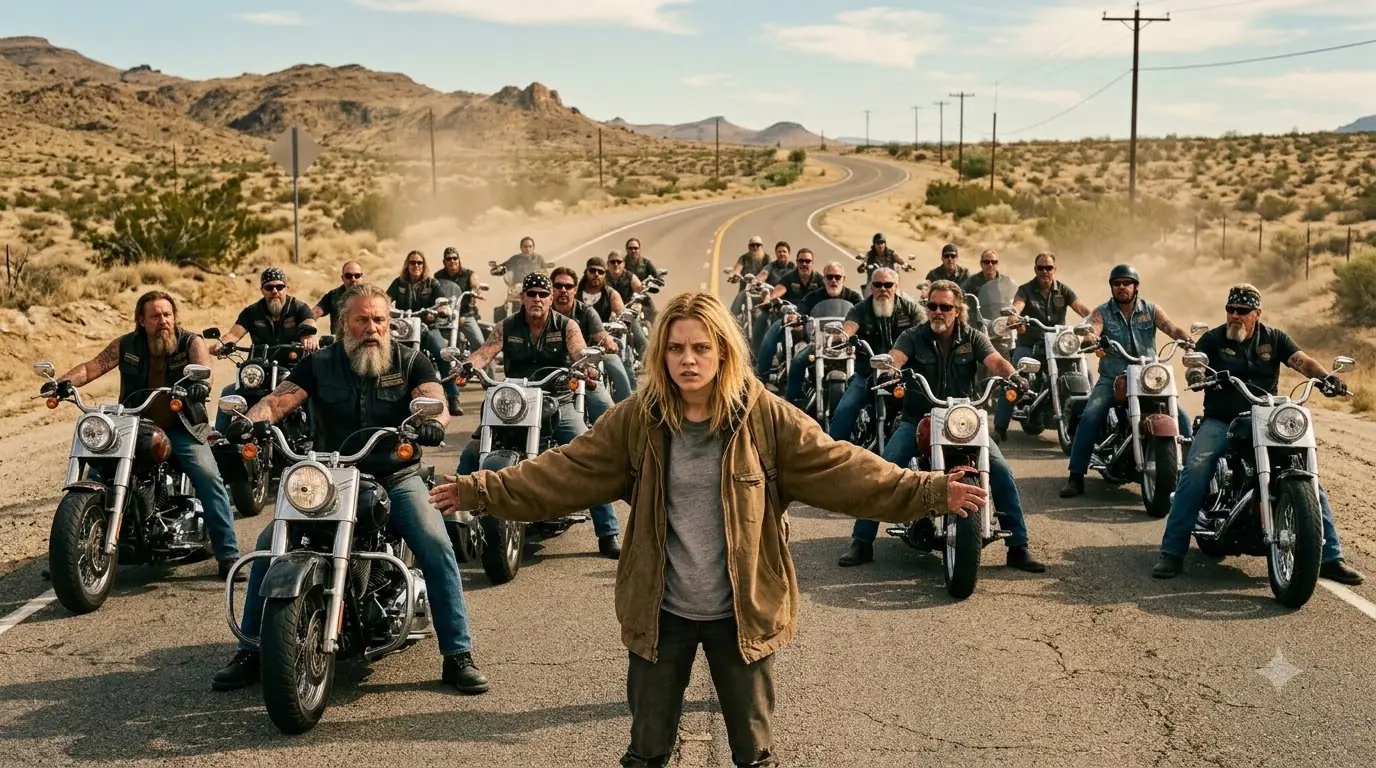
Cole “Bear” Harrison crushed his brakes so hard the tires screamed, stopping only inches from her. One motorcycle after another slowed behind him until the entire line came to a halt.
Nobody warned a hard-edged biker club like the Iron Angels. Nobody dared.
Yet there stood a starving seventeen-year-old girl, trembling so badly she could barely remain upright, willing to risk being hit because she would rather put herself in danger than watch twenty-two strangers ride blindly into something terrible.
The engines died one by one until the only sound left on that lonely highway was the girl’s breathing.
She remained in the middle of the road, shaking, her arms stretched wide as though two skinny hands could somehow hold back thousands of pounds of steel and leather.
Cole Harrison sat astride his motorcycle and stared at her.
He was fifty-two years old, with a gray beard falling over his chest and arms covered in old tattoos whose colors had faded over decades. He had seen plenty of strange things during thirty years on the road.
He had never seen this.
“Get off the road,” he said, low and careful.
The girl didn’t move.
“I said get off the road, kid. You almost got yourself killed.”
“You didn’t hear me.” Her voice cracked. “I said stop. All of you. Right now. Don’t go any farther up that highway.”
Behind Cole, the other riders were already getting off their motorcycles. Twenty-one men stepped onto the pavement, boots striking asphalt, leather jackets creaking in the desert wind.
Somebody muttered under his breath.
Another man laughed, but there was nothing kind in the sound.
A rider called Diesel pushed toward the front. He was a large, bald man with a temper that had caused the club trouble more than once.
“You know who we are, little girl?”
“Yes.”
“Then you know jumping in front of us is one of the dumbest things a person could do.”
“I know.”
That answer stopped Diesel.
It wasn’t defiant.
It wasn’t sarcastic.
It was simply honest.
Cole raised one hand.
The entire group fell silent.
That was the kind of respect he had earned over thirty years. When Bear Harrison raised his hand, men who rarely feared anything stopped talking.
“What’s your name?” Cole asked.
“Emily.”
“Emily what?”
“Carter.”
“Emily Carter.” Cole swung one leg off his motorcycle and stood slowly so he would not frighten her any more than she already was. “All right, Emily Carter. You’ve got about ten seconds to explain why you’d risk your life stopping twenty-two strangers on an empty road.”
Her eyes filled, not exactly with tears but with something heavier.
“Because I couldn’t watch it happen,” she whispered. “Not again. Not when I could stop it.”
“Watch what happen?”
Emily lifted one arm and pointed up the highway toward the hills, toward the long dark stretch of road beyond the second curve.
“They’re waiting for you up there.”
Nobody moved.
“There are men hidden near the rocks,” she continued. “They prepared something across the road to force you to stop, and they’re waiting for you to come through.”
For several seconds, nobody spoke.
Then Diesel snorted.
“This is a setup.”
“No.”
“Sure it is. Girl stops us in the middle of nowhere, tells us some story, keeps us standing out in the open. Bear, she could be part of it.”
“I’m not!”
Emily’s voice rose.
“I swear I’m not. I don’t even know you. I don’t know any of you. I was looking for food. That’s all. I was looking for something to eat, and I saw them.”
“Saw who?” Cole asked.
“The men preparing everything. Five, maybe six. There was a truck hidden near the ridge. One of them kept checking his phone and saying you’d be there soon.”
Cole felt something cold move through his stomach.
He did not let it show on his face.
“How do you know they meant us?”
“Because one of them said twenty-two.”
The laughter stopped.
Every member of the club heard the number.
Twenty-two.
Exactly the number of motorcycles that had rolled away from the last gas station.
Diesel’s expression changed.
“Anybody could’ve counted us.”
“Not her,” Cole said quietly. “She was already standing in the road when we came around the bend. She didn’t have time.”
Nobody answered.
Cole turned back toward Emily.
He studied her carefully.
Her jacket was two sizes too large and torn at the sleeves. Her backpack hung flat against her spine as though there was almost nothing inside it. The canvas around her feet barely qualified as shoes anymore.
Then he saw her eyes.
Cole knew those eyes.
He had seen them in people who had been alone too long.
People who had learned that the world did not always come when somebody cried for help.
“You could’ve run,” he said.
“I know.”
“Nobody would’ve blamed you. Girl like you out here alone, nobody expects you to risk yourself for a bunch of strangers.”
“I know.”
It was the third time she had said it.
Then her voice softened.
“That’s exactly why I couldn’t leave.”
Cole frowned.
“What’s that supposed to mean?”
Emily swallowed.
“It means I know what it feels like when you’re the one in danger and everyone who could help just looks the other way. They keep walking. They pretend they didn’t see.”
Her chin trembled.
“I’ve been that person. The one nobody stops for.”
“I promised myself that if I ever saw somebody about to walk into something bad, I wouldn’t be one of those people. I wouldn’t look away.”
She looked directly at Cole.
“Even if it was you.”
The entire club heard her.
Twenty-one hardened men stood behind Cole, and not one of them had anything to say.
Diesel looked down at his boots.
Cole let out a long breath.
“You scared of us right now, Emily?”
“Yes.”
“But you stopped us anyway.”
“Yes.”
Cole nodded slowly.
He had spent much of his life measuring people. Who ran. Who folded. Who lied to save themselves.
In less than a minute, this half-starved girl had shown more courage than many grown men showed in a lifetime.
But courage was not proof.
Cole had not kept people alive for decades by trusting first and checking later.
“Here’s what we’re going to do,” he said. “Snake, Torres, Little Ray. You three take the back trail. Quiet. Check the second curve from a safe distance and come back. Nobody confronts anybody.”
Three riders disappeared into the brush.
Cole looked at Emily.
“And you stay right here where I can see you until they return.”
“I’m telling the truth.”
“Then you’ve got nothing to worry about.”
But she did worry.
Cole could see it in the way she wrapped both arms around herself.
That worried him more than anger would have.
She did not look like somebody afraid of being caught in a lie.
She looked like somebody terrified the men she had risked herself to save might not believe her quickly enough.
The minutes crawled.
Diesel paced.
A younger rider named Cutter kept glancing behind them as though danger might arrive from the opposite direction.
Dust blew over the highway.
“You got family, Emily?” Cole asked, partly because he wanted to keep her talking.
“No.”
“Nobody?”
“There was somebody once.”
Her eyes fell.
“Not anymore.”
“How long have you been out here alone?”
“A while.”
“How long?”
“I stopped counting.”
“Where do you sleep?”
She hesitated as though ashamed.
“There’s an old bridge a couple miles back. It stays dry underneath most nights.”
Cole’s jaw tightened.
He thought about his own daughter, whom he barely saw anymore, and the idea of any seventeen-year-old sleeping beneath a bridge made something twist in him.
“How old are you?”
“Seventeen.”
Someone behind him cursed quietly.
“Seventeen,” Cole repeated. “And you stepped in front of twenty-two motorcycles for people you’d never met.”
“You needed help.”
Emily said it as if that explained everything.
Maybe it did.
Then footsteps came through the brush.
Fast.
Snake appeared first.
His face had gone pale beneath the sunburn.
“Bear.”
Cole stepped forward.
“Talk.”
“She’s telling the truth.”
Every rider went still.
Snake caught his breath.
“There are several men hidden beyond the curve. They prepared the roadway so anyone coming through too fast would have to stop suddenly. They’re waiting on both sides.”
Snake shook his head.
“If we’d gone through there the way we planned, we would’ve ridden straight into it.”
Silence.
Twenty-two men stood on an empty highway, all realizing the same thing.
They had been minutes away from disaster.
Diesel slowly turned toward Emily.
He no longer looked at her like bait.
He looked at her as though he were seeing her for the first time.
“You saved my life.”
His voice came out rough.
“You saved all of us.”
Emily had prepared herself for suspicion.
For anger.
For them to ride away.
She had not prepared herself for gratitude.
Her knees suddenly gave way.
Cole caught her before she hit the pavement.
“Easy.”
He held her upright.
“Easy, kid. I’ve got you.”
“I’m sorry,” Emily kept saying. “I’m sorry. I got dizzy. I haven’t eaten today.”
Cole froze.
“You haven’t eaten?”
She shook her head.
That broke something inside him.
This girl was hungry, exhausted, and barely standing, yet somehow she had found enough strength to put herself in front of twenty-two motorcycles.
“Cutter,” Cole called. “Water. Food. Whatever anybody has.”
Three riders were already digging through their bags.
A canteen appeared.
A protein bar.
Half a sandwich.
Cole eased Emily onto the pavement and crouched in front of her.
“Slow. Small sips.”
Her hands shook so badly she struggled to hold the canteen.
Cole steadied it.
She drank.
Then she looked at him with tired blue eyes.
“You believe me now?”
Cole swallowed.
“Yeah, kid.”
His voice was thick.
“We believe you.”
Behind them, the mood of the group had changed.
The men who had been ready to accuse Emily minutes earlier now stared toward the hills with cold concentration.
“They said nobody would miss us,” Diesel muttered.
Cutter looked at him.
“What?”
“That’s what she heard. They thought nobody would care what happened to a bunch of bikers out here.”
Cole stood.
He looked toward the curve, then down at Emily with a half-eaten sandwich in her shaking hands.
“Emily, I need you to tell me everything you remember. Slow. Careful. How many men. What they looked like. Anything you heard.”
“Why?”
“Because those people made a serious mistake today.”
Cole looked toward the ridge.
“They assumed nobody would warn us.”
He looked back at her.
“They didn’t count on a girl everybody else had ignored.”
Emily stared at him.
“They’re going to regret ignoring you,” he said.
Around them, motorcycles started again one by one, but nobody rode toward the curve.
Cole held out his hand.
“Can you stand?”
“I think so.”
“Then stand up, Emily Carter.”
She looked at his large tattooed hand.
A man she had feared.
A man strangers probably crossed streets to avoid.
Then she reached up and took it.
His grip closed around her fingers, steady and warm, and he pulled her carefully to her feet.
“You did one of the bravest things I’ve ever seen,” he said. “Now let us handle the rest.”
Emily’s mouth opened.
Nothing came out.
Then Cole added something she clearly had not expected.
“You’re not sleeping under that bridge tonight.”
Her eyes widened.
“You understand me?”
“Cole…”
“Whatever happens next, we’ll figure it out.”
She looked at him as though he had spoken in another language.
Because you cannot easily answer a promise like that when you stopped believing promises were real.
The group moved to a safer position while several members contacted authorities and helped secure the area from a distance. Nobody rushed blindly toward the danger.
Cole made that clear.
They had survived because Emily had seen something they had not.
He was not going to waste that gift by becoming reckless.
As they waited, Emily suddenly grabbed his sleeve.
“There’s something else.”
Cole looked down.
“What?”
“I saw another person lower down near the road. Your men might not have been able to see him from where they checked.”
Snake’s expression changed immediately.
“You sure?”
Emily nodded.
“I watched him move there earlier.”
Cole stared toward the landscape and then back at her.
“You just saved us twice.”
Emily shook her head.
“I just don’t want anybody getting hurt.”
Cole studied her.
“That’s what I’m starting to understand.”
When authorities arrived and the immediate danger was finally brought under control, the scope of what Emily had overheard became clearer.
The people waiting near the road had not chosen the bikers randomly.
They had been hired.
Somebody specifically wanted Cole Harrison and his club frightened, scattered, or worse.
Emily remembered one name.
“Merrick.”
Cole went still.
Diesel noticed.
“You know it.”
Cole looked toward the empty highway.
“Danny Merrick.”
Nobody spoke.
Cole explained that Merrick was a man from his past, someone whose illegal operation Cole had helped expose eleven years earlier after Merrick had tried to use the club’s reputation as cover for his own crimes.
Merrick had blamed Cole for everything that followed.
In court, he had promised revenge.
Cole had assumed those were simply angry words from a man facing consequences.
Apparently, they had not been.
“Eleven years?” Snake asked.
Cole nodded.
“He waited.”
Emily spoke softly.
“Then he probably won’t stop because this failed.”
Every face turned toward her.
“If he waited eleven years and spent money planning this, he’s not going to shrug and walk away.”
Diesel exhaled.
“The kid’s right.”
“The kid keeps being right,” Cole said.
He looked at Emily.
“How do you see things like that?”
Emily stared at her hands.
“When you’ve got nothing and nobody’s coming to help you, you get really good at noticing what might happen next.”
Her voice became quieter.
“Seeing it coming is sometimes the only thing that keeps you safe.”
Cole heard the deeper meaning.
“How long?”
Emily glanced up.
“Two years.”
Two years of watching every stranger.
Every doorway.
Every shadow.
Two years of preparing for the next bad thing because no adult had taken responsibility for making sure that bad thing did not come.
Cole looked away for a second.
Then back.
“Well,” he said, voice rough, “from today on, you’re not watching alone.”
Something moved across Emily’s face.
Hope fighting suspicion.
“You don’t owe me anything.”
“I know.”
“I didn’t warn you because I wanted something.”
“I know that, too.”
“That’s exactly the reason we’re not letting you walk away alone.”
Diesel stepped closer.
“For what it’s worth, kid, I owe you an apology.”
Emily looked at him.
“I called you bait back there.”
“I remember.”
“I was wrong.”
Diesel rubbed the back of his neck awkwardly.
“I don’t say that much, so enjoy it.”
To everyone’s surprise, Emily smiled.
Small.
Tired.
Real.
“You were right to be careful,” she said. “A girl jumps in front of twenty-two motorcycles in the middle of nowhere, you probably should be careful.”
Diesel laughed.
“I like this kid.”
Some of the tension finally broke.
But Cole still had Merrick to think about.
The authorities had taken statements and begun following the evidence. One of the men connected to the roadside plot agreed to cooperate, confirming Merrick’s involvement and explaining that another person had been sent later to check whether the plan succeeded.
That man arrived expecting to find evidence of disaster.
Instead, he found Cole, Emily, and law enforcement waiting.
His name was Reggie.
Unlike the others, Reggie had not participated directly in the confrontation. His role had been to document what happened and report back.
Emily looked at him.
“You knew what you were coming here to photograph, didn’t you?”
Reggie avoided her eyes.
“I didn’t ask questions.”
“That’s not the same as not knowing.”
His jaw tightened.
Emily continued.
“I know what it feels like when people decide something isn’t their business. They see somebody in trouble and keep walking because getting involved is uncomfortable.”
Reggie looked at her.
“Every person who walked past me probably had a reason,” she said. “Maybe they were late. Maybe they were scared. Maybe they told themselves somebody else would help.”
She paused.
“But when you keep doing that, it follows you.”
Reggie’s expression changed.
“You still have a chance not to be that person.”
He stared at her for a long time.
Then he began talking.
He told the authorities about an old garage outside town that Merrick used as a meeting place. He gave them what he knew about the operation and agreed to cooperate fully.
Cole watched Emily while Reggie spoke.
This seventeen-year-old girl had spent years believing people never changed, yet within hours she had somehow pushed a frightened man toward doing the right thing.
“You’re something else,” Cole said afterward.
Emily shrugged.
“I’m just tired of people looking away.”
Authorities moved quickly once Reggie cooperated. Cole and his club were told clearly not to take matters into their own hands.
Cole agreed.
“Clean and legal,” he told Diesel. “That’s how this ends.”
For all his anger, he understood that revenge would only hand Merrick another victory. Cole wanted him stopped permanently, not turned into the excuse for another cycle of violence.
Reggie worked with investigators.
Merrick was found before he could disappear.
During the operation, things became tense, and Reggie was injured while trying to protect Emily from the confusion around the scene. The injury was serious enough to require medical treatment but not life-threatening.
Emily stayed beside him until help arrived.
“You stayed,” she whispered.
Reggie managed a weak smile.
“Told you. Tired of looking away.”
Emily put her hand over his.
For two years she had believed nobody chose anybody when choosing became difficult.
That people only cared when caring was easy.
Now a man who had spent months serving the wrong person had chosen, at the crucial moment, to do something right.
The world she thought she understood had become more complicated.
Maybe people could fail.
Maybe they could also change.
Maybe promises could be broken.
And maybe some could be kept.
When Merrick was taken into custody, Cole stood beside Emily.
“It’s over,” he said softly.
Emily stared ahead.
“I keep waiting for the part where it goes wrong.”
Cole looked at her.
“What part?”
“The part where you all leave.”
Her voice shook.
“Where it turns out you didn’t mean any of this. That’s what always happens. Somebody’s kind, and then they’re gone.”
Cole crouched in front of her.
“That part isn’t coming.”
She searched his face.
“You hear me?”
Emily said nothing.
“There is no version of tonight where we ride away and leave you standing somewhere alone.”
Her eyes filled.
“You keep waiting for us to disappear if you need to. But you’re going to be waiting a long time.”
Diesel stood behind him.
“So long you’ll get bored.”
A few riders laughed softly.
Cole did not.
“You’ve got people now, Emily.”
The tears came.
Not the terrified tears from the highway.
Not the exhausted tears from hunger.
These came from somewhere deeper.
Two years of them.
Cole pulled her into his arms and held her carefully while she cried against his shoulder. Around them stood twenty-one men in worn leather jackets, silent and uncomfortable with emotion, and not one looked away.
When police began taking formal statements, Emily’s fear changed.
She was no longer afraid of Merrick.
She was afraid of what happened next.
“They’re going to ask where my parents are.”
Cole nodded.
“They should.”
“And then they’ll put me somewhere.”
“We’ll figure it out.”
“You can’t just keep me, Cole. I’m seventeen.”
“I know.”
“I’ll go into emergency placement. A group home. Something like that.”
Cole took her face gently between his rough hands.
“Then we do this properly.”
She looked confused.
“Lawyers. Social workers. Home visits. Judges. Whatever it takes.”
“You don’t even know me.”
“I know enough.”
“How?”
“Because somewhere along the way, people who were supposed to protect you stopped doing their job.”
His voice tightened.
“I’m not going to become one more adult who decides that isn’t his problem.”
Emily’s face crumpled.
“You mean that?”
“Yes.”
“Even if it takes months?”
“Yes.”
“Even if they say no?”
“Then we keep doing it the right way until there aren’t any more right ways left to try.”
She searched him again for the lie.
There wasn’t one.
The police kept Emily for hours that night while detectives documented everything she had witnessed.
Cole never left the building.
A detective told him more than once that he was not family and had no official standing.
Cole sat back down in the hallway.
“I’ll be right here.”
Inside the interview room, Emily told the detectives about her life.
Her mother had died when Emily was fourteen.
Her father had remarried.
The house became increasingly unstable.
By fifteen, Emily understood she was no longer welcome there.
After one terrible argument, she left.
She moved between a shelter and a friend’s couch.
Then the friend’s family moved away.
By sixteen, Emily was largely on her own.
By seventeen, she had stopped expecting anyone to come looking.
One detective stared at the computer.
“Nobody reported you missing.”
Emily barely reacted.
“No.”
The detective looked at her.
“Nobody?”
“Nobody.”
For a moment, he seemed unsure what to say.
Then he cleared his throat.
“There’s a man in the hallway who says he’s not leaving until he sees you.”
Emily looked up.
“Cole?”
“Cole Harrison.”
The detective studied her.
“You know him?”
Emily’s throat tightened.
What was he?
A stranger she had met hours earlier?
A biker the whole world might judge without knowing?
A man who had held a canteen while she drank because her hands shook too badly?
A man sitting in a plastic chair outside because he had promised she would not come through that door alone?
“He’s my family,” Emily said.
The detective stared at her for a moment, then opened the door.
Cole stood before it was fully open.
“You stayed,” Emily said.
“I told you I would.”
“It’s been six hours.”
“I’d have stayed six days.”
He crossed the hallway.
“You okay? They treat you all right?”
“They were fine.”
Her eyes filled again.
“They said it’s complicated. There’s no home to send me back to. They’re arranging emergency placement while they figure things out.”
Cole nodded slowly.
“All right.”
Emily braced herself.
It was an old reflex.
This was where the promise met reality.
Reality usually won.
Cole continued.
“So tonight you go where they say you need to go, because we do this right. Tomorrow morning I start making calls.”
She stared at him.
“What calls?”
“I already spoke with an attorney while you were in there.”
“Cole…”
“Temporary guardianship may not be simple. Foster placement has rules. There are background checks, home inspections, court hearings.”
“You already asked?”
“For two hours.”
Emily could not speak.
Cole crouched to her height.
“I’ve got a stable home. Stable income. A clean legal record where it matters. And approximately twenty-one loud character witnesses willing to tell anybody who asks that you saved their lives.”
The detective standing nearby almost smiled.
Cole continued.
“But I have one thing that matters more.”
“What?”
“I want to do it.”
Emily’s lips trembled.
“You spent years around people who could’ve helped and didn’t want to. Now you’ve met somebody who does.”
The detective cleared his throat.
“For what it’s worth, I’ve been doing this eighteen years. I’ve never seen a case quite like tonight’s.”
He looked at Cole.
“You follow every rule. Every form. Every home visit. No shortcuts.”
“Every form,” Cole said.
“No shortcuts.”
“I’ll document what I saw tonight,” the detective continued. “What the girl did. What you did afterward. I can’t promise what a judge decides.”
“I’m not asking you to.”
“But doing things the right way matters.”
Cole nodded.
“That’s the only way I want it.”
It took four months.
Four months of forms, background checks, interviews, home visits, and meetings with social workers who were rightfully cautious about placing a vulnerable teenager with a fifty-two-year-old biker she had met during an extraordinary event.
Cole never complained about the scrutiny.
Every time Emily worried he would become frustrated and walk away, he told her the same thing.
“They’re supposed to ask hard questions. Their job is protecting you.”
A caseworker visited his house unannounced twice.
Both times, she found the same thing.
A clean, warm home.
A refrigerator full of food.
A bedroom prepared for Emily.
Cole had painted it himself.
Badly.
The walls were uneven in places, and he had somehow gotten paint on the ceiling.
When Diesel saw it, he laughed for ten straight minutes.
“Could’ve called me.”
Cole glared at him.
“I wanted to do it.”
“That’s obvious.”
Emily loved the room before she was even allowed to live in it.
Cole also installed a lock on the bedroom door that Emily could control from inside.
The social worker had suggested it.
Cole understood immediately.
A girl who had slept in unsafe places for years deserved to decide when her own door opened.
During those four months, Emily remained in supervised placement.
Cole attended every visiting day.
Every one.
The other teenagers eventually stopped believing Emily when she told them a biker named Bear was trying to become her guardian.
Then one Saturday, twenty-two motorcycles rolled into the parking lot.
Every kid in the building crowded the windows.
Diesel climbed off first carrying three pizzas.
Snake brought sodas.
Cutter carried a ridiculous stuffed bear almost as large as Emily.
Cole walked in last.
Emily looked at him and laughed harder than she had in years.
“You brought everybody?”
“You said the place was boring.”
“It was.”
“Well, now it’s loud.”
Months passed.
Reggie recovered and cooperated fully with investigators. His testimony helped authorities build a broader case against Merrick and several people connected to him.
Reggie began working honestly afterward, repairing motorcycles at a small shop connected to one of the club members.
He was quieter than before.
Different.
One honest day at a time.
“You told me I’d someday tell somebody about the night I stopped being a coward,” he said to Emily during one visit.
“I remember.”
“I’ve told it about forty times.”
Emily smiled.
“Do they believe you?”
“Not the part where a seventeen-year-old girl was the bravest person there.”
“That’s because you exaggerate.”
“Nope.”
He shook his head.
“That’s the only part I never exaggerate.”
Eventually came the court hearing.
The judge was a woman who had spent more than two decades dealing with difficult family cases.
She was skeptical of Cole.
She should have been.
Cole respected that.
She asked him hard questions about his past, his income, his lifestyle, his relationship with his adult daughter, the environment around the club, and what he understood about trauma.
He answered everything plainly.
He did not pretend to be perfect.
When she asked about his mistakes as a father years earlier, he admitted them.
When she asked why he believed he deserved another chance to care for somebody, he said he did not know whether he deserved anything.
“I just know Emily deserves somebody willing to try.”
Then the judge turned toward Emily.
She sat in a borrowed outfit chosen for court, hands folded tightly in her lap.
“You’ve been through a great deal, young lady.”
Emily nodded.
“I have to be careful with you,” the judge continued. “Especially when somebody offers something that feels like rescue. I want you to understand that you can answer honestly, and nobody in this courtroom is allowed to punish you for what you say.”
Emily glanced at Cole.
He nodded.
The judge asked, “Do you want this? Do you want to live with Mr. Harrison?”
Emily swallowed.
“Can I tell you a story first?”
The judge paused.
“All right.”
Emily stood.
“Four months ago, I was standing on a highway while twenty-two motorcycles were coming toward me. I had a choice.”
The courtroom fell silent.
“I could hide and let them ride into danger, or I could step into the road and try to stop them.”
She looked at the judge.
“Everything in my life up to that point taught me to hide. Look after yourself. Nobody’s coming. Don’t trust anyone. When somebody else is in trouble, keep walking because nobody ever stopped for you.”
Her voice remained steady.
“But I stepped into the road.”
The judge nodded slightly.
“And that man…”
Emily pointed toward Cole.
“…stopped.”
Cole lowered his eyes.
“He didn’t know me. He had every reason not to trust me. But he stopped.”
She continued.
“When he found out I was hungry, he fed me. When he found out I slept under a bridge, he didn’t laugh. When I got scared, he didn’t tell me to toughen up. When the police took me inside for six hours, he sat outside for all six.”
Emily’s eyes filled.
“And when everybody told him helping me would be complicated, he started learning the complicated part.”
A few people in the courtroom looked down.
“He painted a bedroom badly.”
The judge’s mouth twitched.
Cole muttered, “It’s not that bad.”
Emily almost laughed.
“It’s terrible.”
Even the judge smiled briefly.
Then Emily’s expression became serious again.
“You asked if I want this.”
She took a breath.
“I trusted these people before I knew their names. I trusted them enough to step into that road.”
Her voice cracked.
“I trust them even more now.”
The judge removed her glasses.
For a long moment, she said nothing.
Then she looked toward Cole.
“In twenty-two years on this bench, I have rarely been as certain that a person understands the weight of a promise as I am right now.”
Cole’s throat tightened.
The judge approved the placement.
Emily barely remembered the next several minutes.
She remembered Cole standing so quickly his chair scraped the floor.
She remembered him crossing the room.
She remembered him lifting her into a hug so tight she laughed and cried at the same time.
Outside the courthouse, the sound began low.
Then the entire street seemed to vibrate.
Twenty-one motorcycles started at once.
Diesel had parked the club outside.
He had told everyone that the second they saw Bear come through those doors with Emily beside him, they were to let the whole city know.
Emily stepped outside.
The engines thundered.
People on the courthouse steps turned.
Cole laughed.
Emily covered her face, overwhelmed.
Diesel walked toward her.
For once, he seemed unsure of himself.
“I called you bait the first day.”
“I remember.”
“I want you to remember something else instead.”
He reached into his vest and pulled out a small leather patch, old and hand-stitched, worn soft with age.
He placed it in her hands.
“That belonged to my daughter.”
Emily looked up.
Diesel swallowed.
“I lost her years ago. Nothing anybody could’ve prevented. Just one of those things life does.”
His voice roughened.
“I never figured I’d have anybody else to give that to.”
Emily looked down at the patch.
“You’re not bait, kid.”
Diesel’s eyes were wet.
“You’re family.”
Emily could not answer.
She simply hugged him.
Diesel froze for half a second, then wrapped both arms around her like a mountain closing around something fragile.
Reggie was there, too.
His arm was still recovering, but he was walking normally.
He waited until the others finished before approaching.
“You going home?”
Emily smiled.
“Yeah.”
“For real?”
“For real.”
He nodded.
“Good.”
That evening Emily went home.
Not beneath a bridge.
Not to an emergency shelter.
Not to a group home where she counted the days until the next hearing.
Home.
Cole’s house.
Her room had a real bed with clean sheets.
A window overlooking the yard.
A desk.
A lamp.
A lock she controlled.
On the mirror, Cole had taped a photograph.
It showed the highway from that first afternoon.
Twenty-two motorcycles.
Dust.
Men standing around in confusion.
And one skinny seventeen-year-old girl near the center of everything.
Reggie had taken the photograph before anybody understood how the day would end.
Underneath it, Cole had written four words.
The day everything changed.
Emily stood in the doorway for a long time.
Then she slowly removed the old backpack from her shoulders.
The same flat backpack she had carried everywhere.
The same bag that contained everything she owned.
For two years, she had never left it far from reach.
Sleeping meant keeping it close.
Entering a building meant knowing where the exit was.
Trusting somebody meant remembering how quickly trust could disappear.
Emily set the backpack on the floor.
Not beside the door.
Not within reach.
She pushed it beneath the desk.
Then she sat on the bed.
And she cried.
These were not the old tears.
The old tears had been about surviving.
These were about finally understanding that survival might not have to be the only thing left.
Cole knocked softly against the open door.
“You okay?”
Emily wiped her face.
“Yeah.”
He stepped inside.
“I keep thinking about the highway.”
Cole sat beside her.
The mattress creaked.
“What about it?”
“How close I came to hiding.”
Cole looked at the photograph.
“You want to know what I keep thinking about?”
“What?”
“All the people who drove past you during those two years.”
Emily became still.
“All the people who saw some skinny kid with nowhere to go and decided not to see.”
He shook his head.
“And not one of them knew the person they were ignoring would become the bravest person I’ve ever met.”
Emily stared at the floor.
“I used to think they were right.”
“About what?”
“Me.”
Cole turned.
“I used to think if enough people looked at you and decided you didn’t matter, maybe eventually that became true.”
His jaw tightened.
“And now?”
Emily looked around the room.
The badly painted walls.
The clean bed.
The leather patch Diesel had given her sitting on the nightstand.
The photograph.
The door she could lock herself.
Then she looked at Cole.
“Now I think they were just looking away.”
Cole waited.
“It was never about whether I mattered.”
Her eyes filled again.
“It was about whether they bothered to see me.”
She leaned against him.
“Some people do.”
Cole put an arm around her shoulders.
“Some people stop twenty-two motorcycles.”
Emily laughed.
“No. I stopped them.”
“Technicality.”
They sat together without speaking for a while.
Years passed.
Good years.
Full years.
Emily eventually went to college.
She became the first person in her family to do it.
One of her recommendation letters came from the judge who had approved her placement.
Another came from the detective who had interviewed her the night everything changed.
A third came from Cole Harrison.
His letter was three pages long and full of spelling errors.
Emily kept the original forever.
She studied social work.
Of course she did.
She became the person who moved toward the teenager everyone else ignored.
The one who noticed the child sitting alone in a hallway.
The one who understood why a frightened seventeen-year-old might lie about where she slept.
The one who knew that asking “Why didn’t you ask for help?” was often the wrong question.
Sometimes the real question was, “How many times did you ask before you stopped believing anybody would answer?”
Emily told her story in college classrooms.
She told it in training sessions for social workers.
She told it to teenagers who believed their lives were already finished.
Years later, she told part of it at her own wedding.
Twenty-one aging bikers filled several rows of seats.
Reggie sat among them.
Diesel cried before the ceremony even started and denied it to everyone who mentioned it.
Cole Harrison walked Emily down the aisle.
His gray beard had turned almost entirely white.
Halfway down, Emily felt his hand shaking.
“You nervous?” she whispered.
“No.”
“You’re crying.”
“No, I’m not.”
“You absolutely are.”
“Dust.”
“We’re indoors.”
“Indoor dust.”
Emily laughed.
At the front, before letting go of her hand, Cole leaned close.
“You still waiting for us to leave?”
Emily looked at the rows behind him.
At Diesel.
Snake.
Torres.
Cutter.
Reggie.
The men who had once been strangers.
The people who had become family.
Then she looked back at Cole.
“No.”
He smiled.
“Took you long enough.”
Whenever Emily told the story publicly, people always asked the same question.
Why?
Why step into the highway?
Why risk anything for strangers?
Why not hide?
Why not decide it was somebody else’s problem?
Emily always gave roughly the same answer.
“Because somebody has to be the person who doesn’t look away.”
She would pause.
“The whole world had looked away from me for two years. I knew exactly what it felt like to be the person who needed help while everybody else decided it wasn’t their business.”
Then she would smile.
“When I saw twenty-two people heading toward something they couldn’t see, I had a choice. I could become one more person who looked away, or I could be the one who didn’t.”
The room usually became quiet there.
“I chose not to look away.”
She would glance toward Cole whenever he was present.
“It helped save twenty-two lives.”
Then her voice would soften.
“And afterward, those twenty-two people turned around and helped save mine.”
That was the whole thing.
Everything Emily Carter eventually understood about the world fit somewhere inside that truth.
People could fail each other.
They could ignore suffering.
They could make selfish choices.
They could be frightened, careless, suspicious, or cruel.
But people could also stop.
They could turn around.
They could apologize when they were wrong.
They could keep promises even when those promises became inconvenient.
They could spend six hours in a hallway.
They could paint a bedroom badly.
They could learn an entire legal process because a child deserved stability.
They could choose to become better than the person they had been yesterday.
A seventeen-year-old girl with almost nothing stepped into the path of twenty-two motorcycles because she refused to look away.
She believed she was saving strangers.
She had no idea she was meeting her family.
The world had never made Emily invisible.
People simply had not been looking closely enough.
Twenty-two people finally did.
And that made all the difference.