The Store Manager decided the Elderly Woman did not belong in his boutique before she had spoken ten words.
He watched her wheelchair roll through the polished brass-and-glass entrance of the Fifth Avenue location and immediately looked past her toward the door, as though someone more appropriate might be following. The Elderly Woman wore a flowing cream dress beneath a loose beige linen coat, an old camel-brown leather handbag rested against the side of her chair, and a long wooden-bead necklace hung over her chest. Nothing she wore displayed a recognizable luxury logo.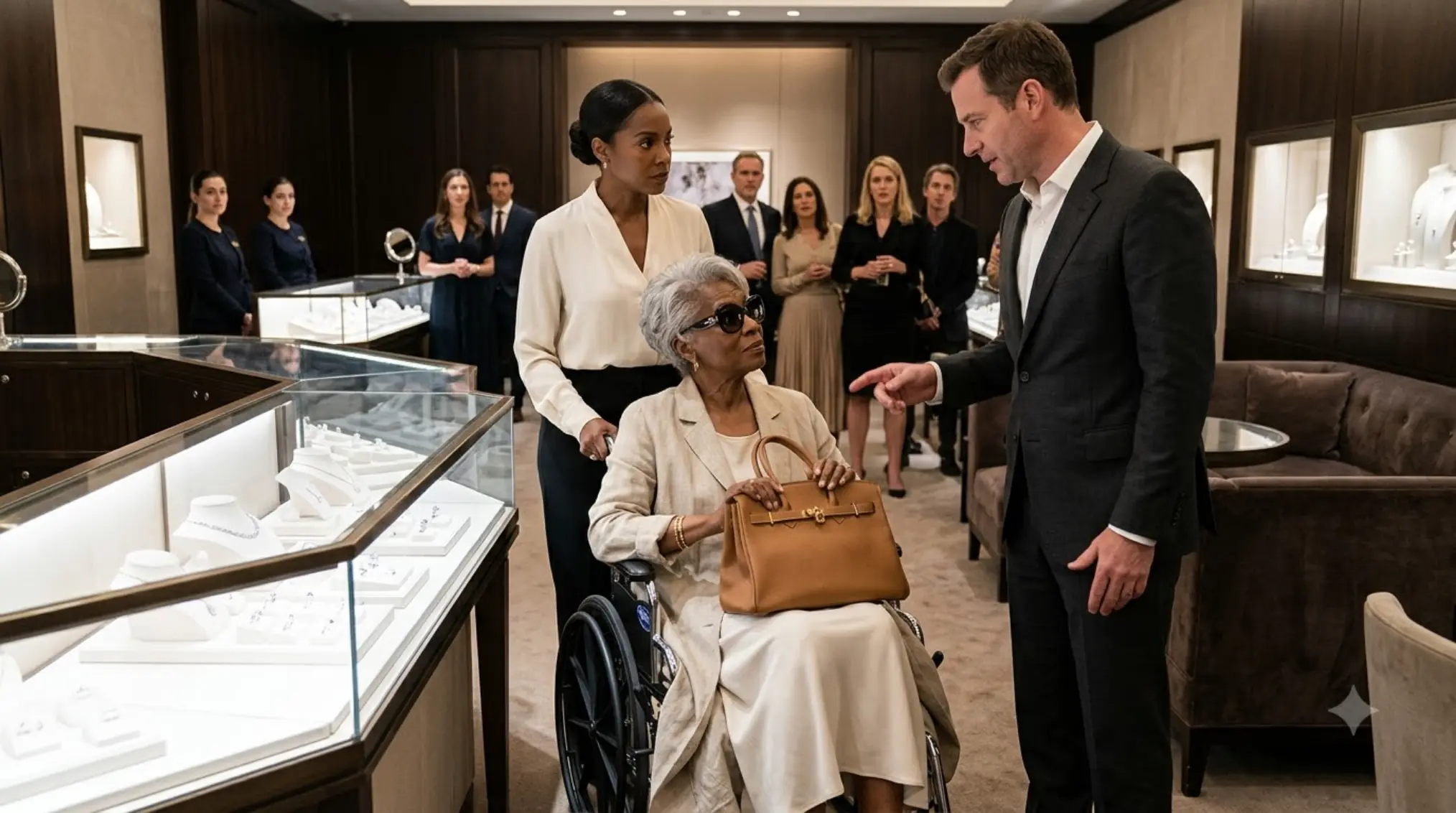
That was deliberate.
Behind the wheelchair walked her forty-year-old Daughter, wearing a cream blouse, fitted black trousers, and simple black heels. Her hair was pulled into a precise low bun, and she carried nothing except a phone and a small black notebook hidden inside the pocket of her trousers. She had been instructed before entering the boutique to say almost nothing.
The Elderly Woman wanted to see what happened naturally.
For seven months, customers had been telling her what happened naturally.
The complaints had started slowly.
One customer said she had been ignored for twenty-three minutes while employees served people who arrived after her.
Another said an associate followed him continuously through the store without offering assistance.
A young Black physician claimed a saleswoman asked whether she understood that the engagement ring she requested to see cost more than twenty thousand dollars.
A retired school principal described being told that the private collection was “appointment only,” even though a white couple without an appointment had been shown the same pieces fifteen minutes later.
Each complaint alone could be explained.
Poor training.
Bad timing.
Miscommunication.
An inexperienced employee.
But patterns mattered.
And the Elderly Woman had spent forty-six years building her company by learning never to ignore patterns.
Her jewelry group now operated nineteen boutiques in six cities, produced its own private diamond collection, and supplied custom pieces to clients whose names appeared in financial magazines and society pages. The Fifth Avenue location was supposed to represent everything the brand had become: careful craftsmanship, discretion, exceptional service, and dignity.
Instead, complaint volume from that store had tripled in eleven months.
The Store Manager blamed demanding customers.
The regional director blamed staffing.
Human resources said most accusations could not be substantiated because the witnesses contradicted one another.
The Elderly Woman stopped reading explanations after complaint number seventeen.
She wanted evidence.
So she came herself.
Not in the tailored suits photographed at charity galas.
Not in the chauffeured sedan usually waiting beneath her office.
Not surrounded by executives.
She entered through the front door in clothes that looked comfortable rather than expensive and used the wheelchair she had required since hip surgery eight weeks earlier.
Only four people inside the company knew she was coming.
Her Daughter.
The chief legal officer.
The head of internal compliance.
And a retired security investigator sitting two blocks away with access to the store’s existing camera system.
Nobody at the boutique had been warned.
The Elderly Woman rolled toward the central diamond case.
A young sales associate saw her first.
For half a second, the woman began moving toward her.
The Store Manager stopped her with two fingers against her elbow.
“I’ll handle it.”
The associate stepped back.
The Store Manager approached.
He was forty-six, polished, carefully groomed, and dressed in a charcoal suit tailored closely enough to announce its price. He had managed luxury retail for nearly twenty years and knew how to read customers quickly.
He believed this was one of his greatest skills.
“Good afternoon,” he said.
The Elderly Woman smiled.
“Good afternoon.”
“Can I help you find something?”
“I’d like to see the necklace in the center case.”
His eyes moved toward the piece.
Platinum.
Emerald-cut diamonds.
Thirty-seven stones.
Retail price: $184,000.
His expression barely changed.
“That collection isn’t available for general viewing.”
The Daughter’s hand tightened slightly on the wheelchair handle.
The Elderly Woman noticed.
She did not turn.
“Oh?”
“The pieces in that case are part of our private collection.”
“I understand.”
“Private appointments only.”
The Elderly Woman looked around the boutique.
“There seems to be plenty of staff available.”
“That isn’t the issue.”
“What is?”
The Store Manager gave a patient smile usually reserved for people he considered difficult.
“May I suggest something from our standard collection?”
“No, thank you.”
“There are lovely pieces starting under three thousand.”
The Elderly Woman looked directly at him.
“I asked about that necklace.”
“Yes.”
“Could I see it?”
“No.”
A wealthy-looking couple standing several feet away became interested.
The Store Manager noticed.
His shoulders became slightly straighter.
Public interactions had always brought out the performer in him.
The Elderly Woman pointed toward the diamond case.
“Why?”
“I already explained.”
“You said private appointment.”
“Yes.”
“So make me one.”
The Store Manager paused.
The Daughter looked down to hide the beginning of a smile.
The Elderly Woman continued.
“Preferably now.”
“I’m afraid we don’t have availability.”
“How unfortunate.”
The Store Manager started turning away.
The Elderly Woman spoke again.
“What about tomorrow?”
He stopped.
“I don’t think that would be appropriate.”
The Daughter finally looked at him directly.
The Elderly Woman asked, “Why?”
The Store Manager exhaled.
“Madam, that necklace costs nearly two hundred thousand dollars.”
“Yes.”
His expression changed.
He had expected surprise.
There was none.
“Clients interested in pieces at that level generally contact us through private banking relationships, established purchase history, or concierge referral.”
“That sounds different from needing an appointment.”
“It is part of the process.”
“Where is that written?”
The Store Manager stared at her.
“What?”
“The policy.”
“I don’t need to show you internal policy.”
“I’m asking whether such a policy exists.”
A second customer had started listening.
The Daughter remained silent.
The Store Manager’s patience disappeared.
“I’m trying to save everyone time.”
The Elderly Woman nodded.
“Whose time?”
“Everyone’s.”
“Mine?”
His mouth tightened.
“Particularly yours.”
The Elderly Woman removed her sunglasses.
Her eyes were calm.
“I have plenty.”
The Store Manager looked away first.
That bothered him.
He turned toward the Daughter.
“Perhaps you can explain.”
The Daughter spoke for the first time.
“Explain what?”
“That we have merchandise better suited to her needs.”
The Daughter looked toward the diamond necklace.
“She told you what she needs.”
The Store Manager smiled without warmth.
“You know exactly what I mean.”
“No.”
“Please.”
He lowered his voice.
“This does not need to become embarrassing.”
The Elderly Woman heard every word.
“So far,” she said, “I’m not embarrassed.”
The Store Manager turned back.
“Madam—”
“Are you?”
Silence.
The elderly customer near the watch counter smiled slightly.
The Store Manager saw it.
His face hardened.
“I have been extremely polite.”
“Politeness and respect are not the same thing.”
That landed.
The Store Manager stepped closer.
“What exactly are you accusing me of?”
“Nothing.”
The Elderly Woman leaned back in her wheelchair.
“I’m asking to see a necklace.”
He stared at her.
She stared back.
Then he said the sentence that would later appear word for word in the investigation report.
“That collection costs more than your entire life. Stop wasting my staff’s time.”
The Daughter’s eyes changed immediately.
The Elderly Woman remained still.
Several customers stopped pretending not to listen.
The Store Manager must have realized he had gone too far because he quickly added, “I’m speaking practically.”
The Elderly Woman’s voice became softer.
“Are you?”
“Yes.”
“Is that how you speak to every customer you think is poor?”
His jaw tightened.
“I did not say you were poor.”
“You didn’t need to.”