Inside the bright Hermès boutique on Rodeo Drive, Ava Sterling stood beneath clean white lights with one hand resting gently on the handle of an orange Birkin. The forty-two-year-old Black American CEO wore a perfectly tailored cream suit, a silk blouse, diamond earrings, and nude heels, while her long black hair fell smoothly past her shoulders. She had entered alone, without an assistant, driver, or security detail, because she wanted the purchase to feel personal. Twenty feet away, Store Manager Celeste Ward leaned toward a uniformed guard and spoke loudly enough for Ava to hear.
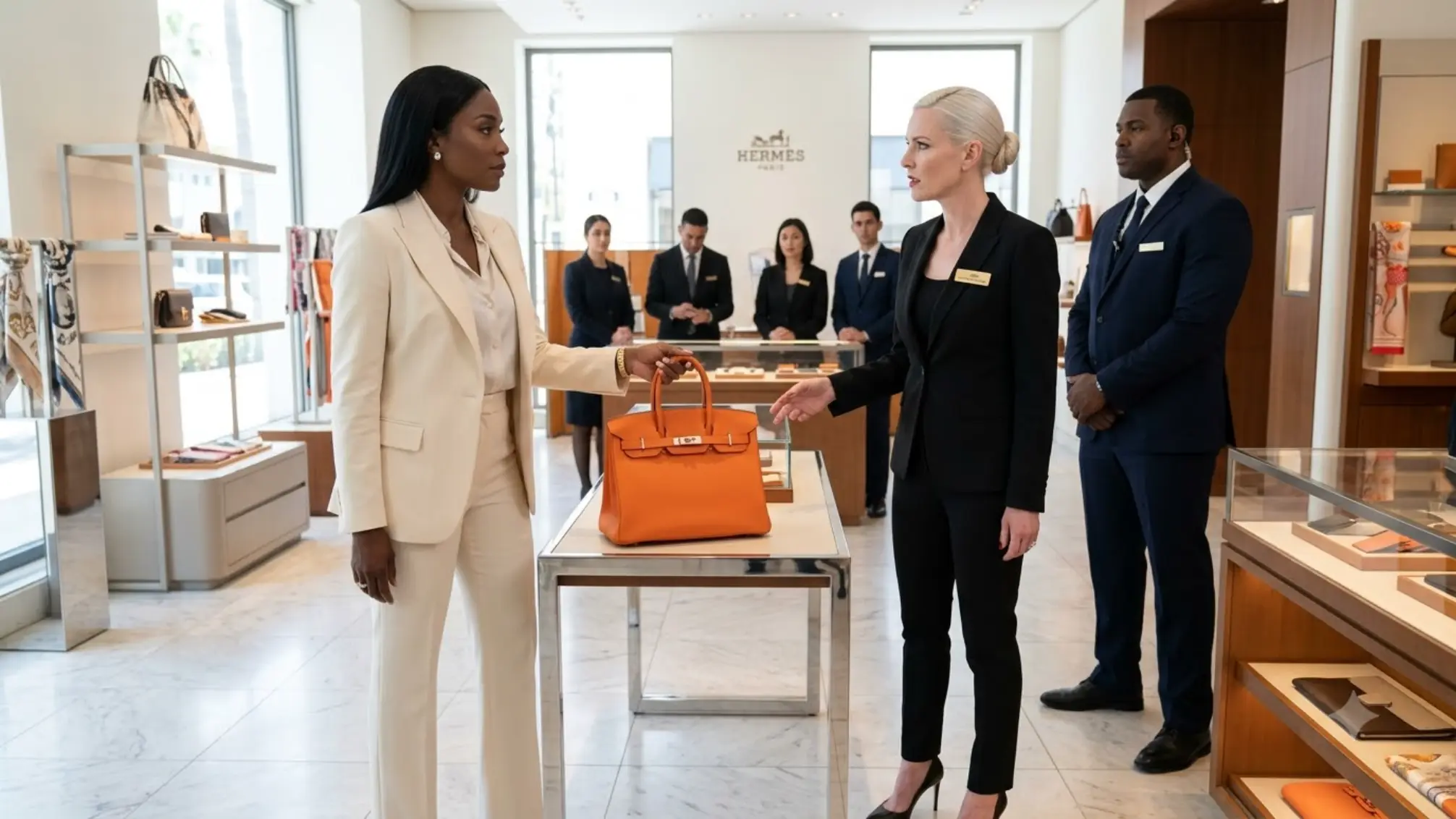
The boutique became unnaturally quiet. Two sales associates stopped arranging scarves, a customer near the jewelry display lowered her phone, and the security guard shifted uncomfortably beside the entrance. Celeste stared at Ava for a second before laughing as if the warning were too absurd to deserve concern. She looked Ava’s cream suit up and down, searching for something that would restore the confidence she had possessed moments earlier.
“This store does not survive or fail because a walk-in customer makes a threat,” Celeste said. “The Birkin is not available for general sale, and touching it without permission is already inappropriate.”
Ava removed her hand from the handle. “A sales associate invited me to examine it.”
Celeste glanced toward a young Black saleswoman standing near the scarf wall. “Did you?”
The associate, Nia Brooks, straightened. “Yes, Ms. Ward. Ms. Sterling asked about the bag, and I brought it from the consultation room.”
Celeste’s eyes narrowed. “You brought a reserved Birkin onto the floor for someone without purchase history?”
“She gave me her name.”
“And you verified nothing.”
Ava watched the exchange carefully. Celeste was no longer speaking to her directly because humiliating a junior employee offered an easier target. Nia appeared to be in her late twenties, professionally dressed in a dark boutique suit with a gold name badge, and she carried herself with restraint rather than fear. Still, her fingers tightened around the tablet in her hands.
Ava stepped closer to the counter. “She followed your client-service procedure. I gave her my name, requested a private consultation, and explained exactly what I wanted.”
Celeste smiled thinly. “People explain many things when they want access to products they cannot obtain.”
“You seem very interested in what I cannot obtain.”
“I am interested in protecting merchandise worth more than most people earn in a year.”
Ava looked at the orange leather bag. It was beautifully made, structured and bright without being loud, with polished gold hardware reflecting the boutique lights. She had selected the color because it matched the first notebook carried by Evelyn Shaw, the retired schoolteacher who had lent Ava six thousand dollars when no bank would finance her original software company. Evelyn had refused shares, titles, or public credit, saying she only wanted Ava to build something honest.
The company Ava built became Sterling Meridian Group, a global retail-technology and investment corporation valued at more than twenty billion dollars. Its divisions developed inventory systems, acquired struggling luxury properties, and restored companies whose value had been damaged by poor leadership rather than weak products. Three months earlier, Sterling Meridian had entered confidential negotiations to purchase a controlling interest in Maison Ardent Holdings, the American franchise operator that managed this boutique and eleven other luxury locations.
The acquisition vote was scheduled for six that evening.
Celeste did not know that.
Only Maison Ardent’s board, regional director, outside counsel, and six Sterling Meridian executives had been informed that Ava might visit one of the stores anonymously. She had not come to set a trap. She wanted to observe ordinary service before approving a deal worth nearly nine hundred million dollars.
Her visit had lasted eleven minutes before Celeste ordered security to watch her.
Ava reached into her handbag and removed a simple black cardholder. Celeste watched the movement and spoke sharply to the guard.
“Stay close.”
The guard’s expression tightened. His name badge read Marcus Bell, and he looked more embarrassed than threatening. Ava opened the cardholder slowly and placed her identification on the counter.
“Run my name,” she said.
Celeste did not look at it. “A luxury card does not create purchase history.”
“It is not a credit card.”
“Then it is irrelevant.”
Nia stepped forward and read the identification. Her eyes widened when she saw the name and company seal, but she controlled her reaction. Celeste noticed the change and snatched the card from the counter.
Ava Sterling. Founder and Chief Executive Officer. Sterling Meridian Group.
For one instant, Celeste’s face became empty.
Then she recovered.
“These can be printed,” she said.
Nia stared at her. “Ms. Ward, I checked the client database before bringing out the bag.”
Celeste turned slowly. “What did you find?”
“Sterling Meridian has a corporate account through the New York flagship. Ms. Sterling’s purchases are handled through executive services.”
“You accessed executive services without permission?”
“The system connected automatically after I entered her information.”
Celeste lowered her voice. “Go to the stockroom.”
Nia did not move. “Why?”
“Because I am your manager.”
Ava held out her hand for the identification. Celeste returned it reluctantly.
“Ms. Brooks stays,” Ava said.
Celeste’s smile disappeared. “You do not give instructions to my employees.”
“Not yet.”
The words landed with enough force to silence the nearest customers again. Ava did not raise her voice or move closer. She merely returned the identification to her cardholder and looked toward the security camera mounted above the consultation room.
“Your cameras record audio?” she asked.
Celeste folded her arms. “That is confidential.”
Marcus answered from the entrance. “The floor cameras do.”
Celeste glared at him. “Security policy is not discussed with customers.”
Marcus kept his eyes on Ava. “You asked me to watch her before she touched the bag. That should be on the recording.”
The manager’s face hardened. “You are not part of this conversation.”
Ava looked at him. “You are now.”
Celeste stepped between them. “This performance is finished. Ms. Sterling, even assuming your identification is legitimate, the bag is reserved. You were told that clearly.”
“Reserved for whom?”
“Client information is private.”
“Was it reserved before I entered?”
“Yes.”
Nia’s expression changed.
Ava noticed.
“Nia?”
The associate hesitated. “The inventory screen listed it as available for executive allocation.”
Celeste turned toward her. “I told you to go to the stockroom.”
“And I am telling her to answer,” Ava said.
“You cannot interrogate my staff.”
“I asked one question.”
Nia lifted the tablet. “The bag arrived yesterday. It was not assigned to a client when I checked twenty minutes ago.”
Celeste reached for the device, but Nia held it closer to her body. The manager stopped herself before creating another visible confrontation.
“There are verbal reservations not yet entered,” Celeste said.
Ava tilted her head. “For whom?”
Celeste refused to answer.
A woman standing beside the jewelry display quietly began recording with her phone. Another customer moved closer, pretending to examine a silk scarf while listening. Celeste finally appeared to understand that the situation had escaped the private control she usually maintained inside the boutique.
She forced a smile. “Let us continue this discussion in my office.”
“No,” Ava said.
“You are disrupting other clients.”
“You began the disruption in front of them.”
Celeste leaned toward her. “You want an apology? Fine. I apologize if you misunderstood our loss-prevention process.”
“That is not an apology.”
“It is what you are receiving.”
Ava looked toward Marcus. “Did I trigger any security alarm?”
“No, ma’am.”
“Did I conceal merchandise?”
“No.”
“Did I refuse instructions from an employee?”
“No.”
“Did anyone report me behaving suspiciously?”
Marcus glanced at Celeste. “Only the manager.”
Ava turned back to her. “Then your loss-prevention process was your opinion.”
Celeste’s voice became colder. “Luxury retail depends on judgment.”
“So does leadership.”
The front doors opened, and a tall white man in a navy suit entered with two assistants. His silver hair and hurried expression made several employees straighten immediately. Regional Director Jonathan Mercer had managed Maison Ardent’s western stores for nine years, and Celeste greeted him with visible relief.
“Mr. Mercer, thank goodness. This customer has threatened the store and interfered with staff.”
Jonathan looked past her.
He recognized Ava instantly.
His face drained of color.
“Ms. Sterling.”
Celeste stopped talking.
Jonathan crossed the boutique quickly. “I was told you might visit one of our locations, but no one informed me which one.”
“That was intentional.”
“Of course.”
Celeste looked between them. “You know her?”
Jonathan’s stare was almost painful. “She is the chief executive of Sterling Meridian.”
Celeste’s lips parted.
Ava added, “The company deciding whether to acquire Maison Ardent before tonight’s vote.”
Nia lowered her tablet.
Marcus exhaled slowly.
The customers who had been recording shifted closer, sensing that the confrontation had become more serious than an argument over a handbag.
Celeste recovered with remarkable speed. “Then this was a secret evaluation.”
“No,” Ava replied. “It became one because of your behavior.”
“You entered without identifying yourself as an investor.”
“I identified myself as a customer.”
“You allowed us to believe—”
“I allowed you to see a Black woman in a cream suit.”
Celeste’s expression tightened. “This is being turned into something it was not.”
Ava pointed toward the orange Birkin. “You called me someone playing dress-up before checking my name, account, or appointment.”
“I was protecting restricted merchandise.”
“You did not ask Marcus to watch the white customer handling jewelry without an associate.”
“That customer has a relationship with the store.”
“You never asked whether I did.”
Jonathan stepped closer. “Celeste, stop.”
She turned toward him. “I am trying to explain.”
“You are making it worse.”
The regional director looked at Ava. “I sincerely apologize. This conduct does not represent Maison Ardent’s standards.”
Ava glanced around the boutique. “Do you know whether that is true?”
Jonathan hesitated.
The answer was visible in his silence.
Ava picked up her phone and called Sterling Meridian’s general counsel, Dana Whitfield. She requested an immediate preservation order covering security footage, audio, employee messages, client-allocation records, commission reports, inventory movements, and complaints from every Maison Ardent location during the previous five years.
Celeste stepped forward. “You cannot seize private company records.”
“I am not seizing anything.”
“You are ordering an investigation.”
“I am preserving evidence before the board decides whether to place your company under my control.”
Jonathan looked toward his assistants. “Issue the preservation notice.”
Celeste stared at him. “You are agreeing to this?”
“I am preventing destruction of records.”
“Nothing has been destroyed.”
Ava looked directly at her. “Then preservation should not frighten you.”
Nia stood very still beside the counter. Ava noticed that the associate looked less surprised by the order than relieved.
“What else should be preserved?” Ava asked her.
Celeste answered first. “She has no authority to make accusations.”
Ava continued looking at Nia.
The young woman swallowed. “The private client lists.”
Jonathan frowned. “What about them?”
“There are two versions.”
Celeste moved toward her. “Be careful.”
Marcus stepped away from the entrance and placed himself where he could observe both women. He did not touch Celeste, but his position stopped her from coming closer.
Nia continued. “The official list is in the customer system. The second list is maintained by management.”
“What does it contain?” Ava asked.
“Clients allowed to purchase high-demand bags.”
Jonathan shook his head. “All allocations are supposed to be recorded centrally.”
“They are not.”
Celeste laughed sharply. “She is a junior associate who does not understand relationship management.”
Nia looked at her for the first time without fear. “I understand that bags marked unavailable are sold privately through people connected to you.”
The boutique fell silent again.
Jonathan’s expression changed. “Explain.”
Nia opened a folder on her tablet. It contained photographs of inventory labels, dates, client names, and screenshots of messages. She had kept the records because several customers complained that requested bags had vanished after appearing as available.
Orange, black, rose, and emerald Birkins were repeatedly removed from inventory without corresponding retail sales.
Days later, identical bags appeared through private resellers at prices two or three times higher.
Several buyers were connected to Celeste’s sister, who operated an invitation-only luxury-consignment company in Nevada.
Celeste’s face became pale.
“This is stolen internal data.”
“It is evidence,” Nia replied.
“You photographed restricted screens.”
“Because you deleted allocation histories.”
Jonathan took the tablet. He reviewed several entries and called Maison Ardent’s chief compliance officer.
Ava remained beside the counter, coffee-brown eyes fixed on Celeste. The manager had begun the morning believing appearance gave her the right to define who belonged inside the boutique. Now every hidden transaction beneath her authority was being examined because she could not resist humiliating one customer publicly.
Celeste folded her arms. “Even if there were allocation errors, they have nothing to do with Ms. Sterling.”
“They explain why you claimed an available bag was reserved,” Ava said.
“That proves nothing.”
“Who was supposed to receive it?”
Celeste said nothing.
Nia pointed toward one record on the tablet. “The orange Birkin was scheduled for transfer to Silver Crest Consignment tonight.”
Jonathan read the receiving account. “The owner is your sister.”
Celeste’s controlled expression finally cracked. “The boutique receives marketing support from that company.”
“There is no approved vendor agreement,” he said.
“It is an informal partnership.”
“You diverted protected inventory.”
“I maintained relationships with influential buyers.”
“You sold bags through an outside reseller for private gain.”
Celeste raised her voice. “I saved this store.”
Several customers turned fully toward her.
She continued anyway. “Maison Ardent cut staffing, reduced local marketing, and demanded impossible revenue. I created buyers willing to pay. I kept commissions high and prevented layoffs.”
Nia stared at her. “You reduced our commissions while routing bonuses to yourself.”
Celeste ignored her.
Jonathan looked as though he had aged several years in minutes. “How long?”
Celeste’s mouth tightened.
“Three years?” Ava asked.
No answer.
“Five?”
Still nothing.
Marcus spoke quietly. “I have worked here four years. The back-door pickups started before I arrived.”
Everyone turned toward him.
He explained that luxury vehicles sometimes entered the service alley after closing. Celeste personally carried sealed merchandise to them, bypassing the standard shipping log. Security was instructed to mark the exits as executive deliveries.
“Why did you not report it?” Jonathan asked.
Marcus looked ashamed. “I did. Twice.”
“To whom?”
“Your office.”
Jonathan’s face hardened. “I never received a report.”
Marcus removed his phone and displayed two email confirmations. Both messages had been sent to Jonathan’s executive assistant and forwarded to an operations account controlled by Celeste.
A third complaint had been closed as employee misunderstanding.
Jonathan turned toward one of his assistants. “Contact corporate technology. Preserve every email route.”
Celeste laughed again, but panic now lived beneath the sound. “You are all behaving as though handbags are government evidence.”
Ava’s voice remained even. “Fraud does not become harmless because the stolen object is fashionable.”
“I did not steal anything.”
“Did the boutique receive the full resale profit?”
Celeste said nothing.
“Did the clients know the bag was being diverted?”
Silence.
“Did the sales associates receive the commission?”
No answer.
Ava looked toward Jonathan. “Suspend her access now.”
Celeste stepped forward. “You cannot fire me.”
“I did not fire you,” Ava said. “I told the current regional director to suspend your access while he still controls the company.”
Jonathan nodded to his assistant.
Within seconds, Celeste’s employee credentials, inventory access, company email, and building privileges were frozen. Marcus requested her store keys and security badge.
She refused.
“You are making a catastrophic mistake.”
Marcus held out his hand. “The keys, ma’am.”
“I built the client network that keeps this place alive.”
Nia answered quietly. “You built a network that kept everyone afraid.”
Celeste looked around the store for support.
No employee defended her.
The customers who once seemed like an audience to Ava’s humiliation now watched Celeste’s power disappear in the exact public space where she had used it against others. She removed the badge from her jacket and threw it onto the counter.
The gold plate struck the wood beside the orange Birkin.
“You think this company will survive under people who care more about feelings than revenue?” she asked.
Ava picked up the badge and placed it gently away from the bag.
“No. It will survive under people who understand that trust is revenue.”
Celeste was escorted to the office to collect personal belongings while compliance investigators arrived. Ava asked that the customers be informed honestly that a management matter was being reviewed and that no client data had been compromised as far as they knew.
Jonathan offered to close the boutique for the day.
Ava refused.
“Do not punish the employees for the manager’s conduct.”
Nia looked at her in surprise.
The store remained open, but the orange Birkin was secured in a transparent evidence cabinet until inventory ownership could be confirmed. Ava did not attempt to purchase it. The bag had become part of the investigation, and taking it would have blurred the difference between authority and entitlement.
Instead, she sat in the private consultation room with Jonathan, Nia, Marcus, and the arriving compliance team.
The first review uncovered twenty-seven diverted handbags.
By evening, the number reached sixty-three.
Celeste and her sister had used coded messages to identify bags expected to command high resale prices. Bags were marked as damaged, returned, transferred, or reserved for nonexistent clients. They were then delivered to Silver Crest Consignment and sold privately.
The boutique received the normal retail price through falsified transactions.
The resale profit disappeared into shell companies.
More than six million dollars had moved through the operation.
The discrimination complaints were worse in a different way.
Employees had documented repeated incidents in which Black, Latino, Middle Eastern, and casually dressed customers were followed, denied service, or told inventory was unavailable. Several were wealthy clients with established purchase histories at other luxury stores.
Celeste frequently labeled them “brand risk.”
Her private client notes contained phrases such as “does not look premium,” “possible influencer without funds,” and “wrong energy for allocation.” White customers wearing equally casual clothing were often invited into private consultations.
Jonathan read the notes in silence.
“I should have known,” he said.
Ava closed the folder. “You should have looked.”
He did not defend himself.
Maison Ardent’s executive team had rewarded Celeste for high revenue, low reported theft, and strong relationships with resellers. They had not asked why employee turnover was twice the company average or why formal complaints rarely survived beyond the local level.
The system had not failed to notice.
It had learned not to notice.
At five thirty, Maison Ardent’s board convened by video. The acquisition vote remained scheduled for six, but several directors requested postponement.
Ava joined from the boutique conference room.
She was still wearing the cream suit Celeste had called dress-up. Nia sat outside the glass wall, assisting investigators with inventory records. Marcus continued normal security operations at the entrance.
Board Chairman Louis Ardent appeared on the main screen. “Ms. Sterling, we deeply regret today’s incident.”
“Do you regret the incident or the discovery?”
He paused.
“Both.”
“Only one surprised you.”
Several directors shifted uneasily.
Ava presented the initial findings. She explained that the diversion scheme exposed poor controls, retaliation against employees, manipulated allocation records, and reputational risk across the franchise network.
One director asked whether Sterling Meridian intended to reduce its purchase offer.
Another wanted to know whether Ava planned to cancel the deal completely.
Ava listened without answering immediately.
Sterling Meridian could withdraw. The agreement allowed termination if material fraud or undisclosed liability appeared before closing. Walking away would protect Ava’s company and satisfy shareholders who disliked uncertain acquisitions.
But withdrawal would leave hundreds of honest employees inside a failing organization still controlled by leaders who had ignored warning signs.
Ava looked through the conference-room glass at Nia.
The associate had risked her career to preserve evidence.
Marcus had reported the operation and been silenced.
Neither deserved abandonment simply because executives found reform expensive.
Ava returned her attention to the screen.
“I will approve the acquisition under revised conditions.”
Jonathan looked surprised.
Louis Ardent leaned forward. “What conditions?”
“Immediate independent audits at every store. Protection and compensation for whistleblowers. Removal of executives who suppressed complaints. Restitution for stolen commissions. Transparent bag-allocation procedures. External civil-rights review of customer-treatment policies.”
One director objected. “That will cost millions.”
“The fraud already cost millions.”
“It may damage exclusivity.”
“Exclusivity is not permission to discriminate.”
Another director asked whether Ava intended to control hiring.
“I intend to require leadership capable of reading reports that make them uncomfortable.”
The board requested a private recess.
Twenty minutes later, it accepted every condition.
Ava signed the acquisition authorization at 6:47.
Sterling Meridian would take operational control after regulatory review. The purchase price was reduced to account for liabilities, but the boutiques would remain open. Employees uninvolved in misconduct would keep their jobs.
Jonathan submitted his resignation.
Ava did not accept it immediately.
“You failed to see the problem,” she told him. “Leaving might protect your reputation more than staying to repair the damage.”
“What do you want me to do?”
“Spend six months helping investigators recover every complaint your office lost. After that, the new board will decide whether you remain.”
He agreed.
Celeste was arrested three weeks later after financial investigators traced proceeds through companies in Nevada and Delaware. Her sister was charged with conspiracy, fraud, money laundering, and possession of diverted luxury inventory.
More than forty handbags were recovered.
Some had already been sold to buyers who believed the purchases were legitimate. Those clients received refunds or opportunities to return the bags without penalty. Others cooperated when they learned the allocation process had been manipulated.
Celeste’s attorney argued that the transactions were unofficial marketing partnerships.
Emails showed otherwise.
In one message, she wrote that “the right clients never ask where a bag came from.”
In another, she called ordinary boutique customers “window decoration” while reserving the most valuable inventory for private resale.
Her treatment of Ava became part of the evidence, though it was not the central crime.
The recording showed her ordering security to watch a customer before asking a single question. It showed her refusing valid identification, threatening Nia, and falsely claiming the orange Birkin had been reserved.
The video demonstrated the culture that allowed the financial scheme to survive.
Celeste believed judgment did not need verification.
She believed confidence could replace records.
She believed people she considered unimportant could be insulted, removed, or silenced without consequence.
At trial, her attorney asked Ava whether personal anger had influenced the acquisition investigation.
Ava sat calmly in the witness box.
Defense Attorney (skeptically, pacing before the jury): “You were offended because Ms. Ward did not recognize you as a billionaire CEO, correct?”
Black CEO Woman (firmly, folding her hands): “I was concerned because she believed respect required recognizing one.”
Defense Attorney (pressing, gesturing toward her): “You used corporate power after a personal insult.”
Black CEO Woman (coldly, meeting his eyes): “I preserved records after she tried to hide an available bag and silence the employee who told the truth.”
Defense Attorney (sharply, raising his voice): “Would this investigation exist if she had treated you politely?”
Black CEO Woman (calmly, looking toward the jury): “The fraud would still exist. It simply might have remained profitable longer.”
Celeste was convicted of fraud, conspiracy, money laundering, falsifying inventory records, and retaliating against employees who reported misconduct. She received a prison sentence and was ordered to repay stolen commissions and company losses.
Nia received the largest portion of recovered commissions because many diverted sales had originated from clients she cultivated. Sterling Meridian also awarded her a protected whistleblower payment, but Ava did not promote her immediately.
Nia asked why.
“Because telling the truth should not trap you in a job you may not want,” Ava said. “Choose your direction first.”
Nia chose operations compliance.
She spent the next year helping redesign inventory systems so no manager could remove high-value merchandise without dual authorization and automatic audit records. Every allocation generated a timestamp visible to regional compliance.
Marcus became western director of retail security.
His new policy prohibited staff from being monitored solely because of clothing, race, age, accent, or perceived wealth. Security interventions required observable conduct documented in writing.
Employees received authority to challenge discriminatory instructions.
The system changed slowly.
Some wealthy clients complained that transparent allocation weakened mystery and exclusivity. Ava answered that luxury could remain selective without becoming dishonest.
Sales did not collapse.
They increased.
Customers trusted the process because the rules no longer changed according to who a manager believed belonged in the room. Employee turnover dropped, complaints were reviewed independently, and recovered inventory helped stabilize Maison Ardent’s finances.
Six months after the acquisition, Ava returned to the Beverly Hills boutique.
No one had been warned.
A young associate greeted her near the entrance and asked whether she had an appointment. The question was polite, neutral, and followed by an offer to arrange immediate assistance.
Ava gave her name.
The associate checked the system, smiled, and led her toward a private room without panic or exaggerated attention.
Nia met her there.
She now wore a compliance badge rather than a sales badge. On the table rested the orange Birkin that had started the investigation.
“It was cleared from evidence last week,” Nia said.
Ava touched the handle.
“Was it ever assigned?”
“No. Celeste created a false transfer six minutes after you entered.”
“To prevent me from buying it?”
“To move it to her sister before the acquisition vote.”
Ava examined the bag.
It was still beautiful, but its meaning had changed. She no longer saw only Evelyn Shaw’s orange notebook. She saw Nia refusing to disappear into the stockroom, Marcus acknowledging what the cameras would show, and every employee whose warnings had been treated as inconvenience.
“Would you like to purchase it?” Nia asked.
Ava smiled.
“Yes.”
The transaction was processed at the listed retail price.
No private markup.
No special discount.
No hidden transfer.
Ava carried the bag personally to Evelyn’s small home outside Baltimore. The retired teacher was eighty-one and still lived in the modest brick house where she had written Ava’s first business check.
Evelyn opened the box and stared at the orange leather.
“This is too expensive.”
“You said the same thing about the computer you bought me.”
“That computer cost eight hundred dollars.”
“It changed my life.”
Evelyn touched the handle. “Why orange?”
Ava pulled the old notebook from her own handbag.
The cover was faded, the corners bent from years of use, but the color matched closely.
“You wrote my first budget in this.”
Evelyn laughed softly. “Most of that budget was wrong.”
“It was hopeful.”
“That is a polite word.”
Ava sat beside her.
The bag was not repayment. Six thousand dollars could never be measured against the life Evelyn’s faith helped create. The gift was simply evidence that kindness shown before success had not been forgotten after it.
Evelyn looked at Ava carefully.
“Tell me the story behind it.”
Ava did.
She described the whisper to security, the insult at the counter, Nia’s evidence, the diverted inventory, and the acquisition vote. Evelyn listened without interrupting.
When Ava finished, the older woman closed the box.
“You know what people will say.”
“What?”
“That manager made the mistake of insulting the wrong Black woman.”
Ava nodded.
“They are already saying it.”
“And what will you tell them?”
Ava looked at the orange notebook.
“She was wrong before she knew who I was.”
Evelyn smiled.
“Then the company may be worth saving after all.”
Years later, the Beverly Hills incident became a case study inside Sterling Meridian’s leadership program. New managers watched the security footage until the moment Celeste whispered to Marcus.
The video stopped there.
Instructors asked one question: What decision had already been made?
Some trainees answered that Celeste had profiled a customer.
Others said she had created unnecessary security risk.
The strongest answer came from a young assistant manager who said Celeste had decided evidence would matter less than her assumption.
That was the failure Ava wanted remembered.
Celeste did not lose her career because she failed to recognize a billionaire. She lost it because she used authority without verification, treated dignity as a reward for visible wealth, and built a corrupt operation around the belief that certain people could be ignored.
Ava entered the boutique wanting one orange bag.
She left with evidence of stolen inventory, silenced employees, manipulated commissions, and leadership that had confused polished surfaces with honest business.
The manager believed her worst decision was insulting the woman who could approve the acquisition.
It was not.
Her worst decision came seconds earlier, when she looked at a Black customer she did not recognize and decided that no one important would care what happened next.