Amid a blizzard swallowing the silent highway, inside a run-down diner buried in overdue bills, Darius Cole, fifty-two and widowed, was about to turn off the lights and give up for good.
Suddenly, the door swung open.
A group of lost truckers, frozen, exhausted, and desperate, stumbled in, begging for shelter.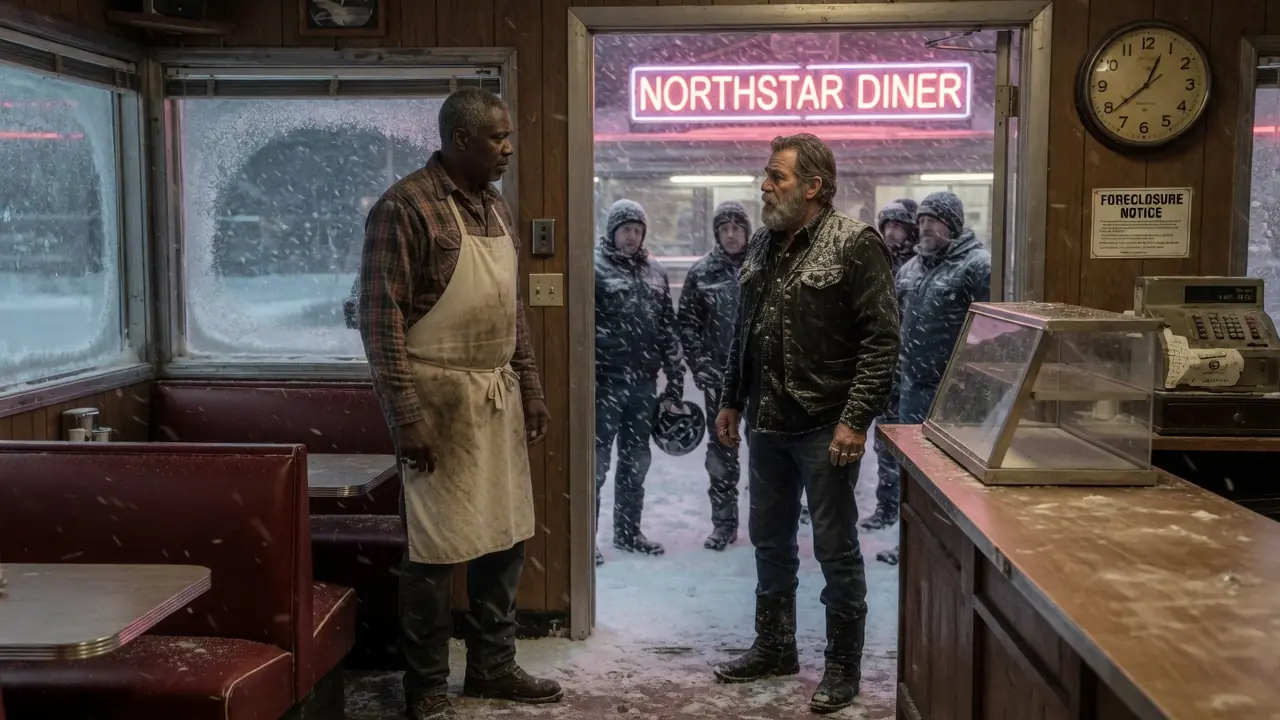
Darius had almost no food left, but he still decided to cook them the last hot meal he had. He had no idea that this choice would uncover a long-hidden secret from his past. And by the next morning, more than two hundred trucks would be parked outside his diner.
Route 17 stretched through the Montana wilderness like a forgotten promise, its cracked asphalt disappearing beneath layers of fresh snow that fell harder with each passing hour. The yellow center lines had faded years ago into barely visible ghosts. Tonight, with the wind howling and visibility dropping to near zero, it felt less like a highway and more like the edge of the world.
The Northstar Diner sat alone against that vast white emptiness, a small square building that looked like it had been fighting the elements for too long and was finally losing. The wooden siding had weathered to a dull gray, paint peeling in long strips that curled away from the boards like dry skin. The roof sagged slightly in the middle, and the gutters hung crooked, clogged with ice.
But the neon sign still glowed, barely. Pink letters spelling Northstar Diner flickered uncertainly, buzzing with electrical static, casting pale rose-colored light across the empty parking lot. The lot itself could have held twenty rigs easily once upon a time. Tonight, it held only a single battered pickup truck with rust eating through the wheel wells.
Inside, the diner wore its age like an old man who had stopped caring about appearances. The booths lined the walls in faded red vinyl, cracked and split in places where gray foam padding pushed through like exposed bone. Someone had tried patching them with duct tape years ago, but even that had worn through.
The wooden counter ran the length of the room, its surface dark with decades of coffee rings and elbow grease, scarred by cigarette burns from back when people still smoked indoors. The pie case stood empty, its glass smudged with fingerprints and reflecting the dim overhead lights that buzzed with the same tired frequency as the sign outside.
A smell hung in the air, old coffee, lemon cleaner, and something else harder to name. The ghost of better days, maybe. The echo of a place that had once been full of life.
Behind the counter stood Darius Cole, both hands planted flat on the worn wood, staring at nothing in particular. He was a big man, fifty-two years old, built like someone who had spent his youth hauling freight and loading docks. Tall, broad across the shoulders, with dark skin weathered by wind and sun, and close-cropped hair going silver at the temples.
His hands were large and callused, the hands of someone who knew how to fix things, to work with tools and engines and the physical world. But tonight, those hands just rested on the counter, unmoving, while his dark brown eyes stared past the empty booths toward the windows where snow piled higher against the glass.
He had been a trucker once. Long-haul, cross-country, the kind of work that meant three weeks on the road and three days home, sleeping in the cab more often than in a bed, eating at diners just like this one scattered across the interstate system like beads on a string.
He had loved it. The solitude, the rhythm of the miles, the brotherhood of other drivers connected by CB radio chatter and truck stop coffee.
That was before Maya.
Maya Cole had been waiting tables at a diner in Billings when Darius first walked through the door, road-weary and looking for nothing more than a hot meal and strong coffee. She had been small and fierce, with quick hands, a quicker smile, and a way of making every customer feel like they were the only person in the room.
Within six months, they were married.
Within two years, they had saved enough to buy this place, the Northstar Diner. Their dream made real. Their chance to build something permanent in a life that had always been about motion.
For fifteen years, it had thrived. Drivers knew the Northstar the way they knew the road itself. A reliable stop, good food, fair prices, and Maya Cole remembering your name even if you had not been through in half a year. The parking lot stayed full. The lights burned late. The CB radio behind the counter crackled constantly with road chatter and friendly voices.
Then Maya got sick.
Cancer, the kind that moved fast and did not negotiate. She fought it hard, harder than anyone Darius had ever known. But cancer did not care about fight. It did not care about dreams or plans or the life you had built together.
Three winters ago, she died.
And something in the Northstar had died with her.
Darius had kept going because he did not know what else to do. He opened the doors every morning, poured coffee, worked the grill, closed up at night, and climbed the narrow stairs to his apartment above the diner, where the silence waited for him like a physical presence.
But without Maya’s warmth, without her gift for making strangers feel like family, the light had dimmed. Fewer drivers stopped. Highway traffic shifted to newer routes with bigger truck stops offering Wi-Fi, showers, and twenty-four-hour convenience stores.
Now the Northstar was dying, too.
Darius reached beneath the counter and pulled out the envelope he had been avoiding for a week. The paper was thick and official, the kind of weight that made bad news feel permanent. He unfolded it slowly, even though he already knew what it said.
Final notice of foreclosure, in bold black letters across the top.
Thirty days to come up with three months of back mortgage payments, plus penalties, plus interest.
He did not have the money.
He did not have a quarter of the money.
He refolded the notice carefully, slid it back beneath the counter next to the broken cash register, and looked up at the old clock on the wall.
Six forty-five.
Minutes until he could flip the sign to closed, lock the door, turn off the lights, and climb those stairs to sit alone in the dark like he did every single night.
Maybe tonight should be the last night.
Maybe it was time to accept that some things could not be saved, no matter how hard you had worked to build them or how much they had mattered once. Maybe keeping the lights on was just prolonging the inevitable.
His hand moved toward the light switch, fingers hovering over the toggle.
Then he heard Maya’s voice.
Not real, just memory, but so clear it might as well have been. Soft and certain, the way she used to sound when she was trying to talk sense into him.
“One more night, Darius. Keep the light on. One more night. You never know who might need it.”
His hand stopped.
Then it dropped.
He turned away from the switch, walked back to the counter, picked up a rag, and started wiping down wood that was already clean.
Outside, the wind shrieked and threw snow against the windows hard enough to rattle the frames. The pink neon sign flickered, steadied, flickered again. The parking lot disappeared beneath white.
Then, sudden enough to make Darius’s heart jump, the door rattled hard, the bell above it giving a startled jingle.
He looked up sharply, expecting nothing, expecting wind.
But there in the doorway stood a young man.
Snow clung to his shoulders like he had been rolled in powdered sugar. His canvas jacket was dark with moisture, and his face, what Darius could see of it beneath a trucker’s cap pulled low, was raw and red from the cold.
The man stamped his boots on the worn rubber mat, sending cascades of snow scattering across the linoleum, and looked up with eyes that held equal parts hope and exhaustion.
“Evening, sir.” His voice came out rough, scraped raw by cold or too many hours breathing frigid air. “Any chance you’re still serving?”
Darius felt the automatic response form on his tongue.
Sorry, about to close.
The words he should say. The sensible words that would let him lock up and escape to his quiet apartment, where he would not have to pretend anymore that he was fine, that he was not drowning.
But something stopped him.
Maybe it was the way the young man stood there, shoulders hunched against cold that had followed him inside, hands shoved deep in his pockets like he was trying to hold on to whatever warmth he had left.
Maybe it was the exhaustion written so clearly across his face, the kind of bone-deep tiredness that came from too many hours behind the wheel with nowhere safe to stop.
Or maybe it was just Maya’s voice still echoing in his head.
“Yeah,” Darius heard himself say, surprised by the steadiness in his own voice. “Coffee’s still hot. Take a seat anywhere.”
The relief that washed across the young man’s face was almost painful to witness, like he had been bracing for rejection and had not quite known what he would do if it came.
He pulled off his cap, revealing dark hair plastered to his forehead with sweat despite the cold, and moved to the counter with steps that suggested his legs were not entirely steady.
“Thank you.” The words came out thick with gratitude. “I mean it. Thank you.”
He slid onto a stool, the red vinyl cracked but still serviceable, and wrapped his hands around the coffee mug Darius set in front of him like it was a lifeline. Steam rose between them, carrying that familiar burnt coffee smell that every diner in America seemed to share.
“Name’s Evan,” the young man said after taking a long swallow. “Evan Ward. Been driving since Ohio.”
Darius poured himself a cup and leaned against the counter, studying the kid properly now. Early twenties, maybe twenty-five at most. Lean in the way of people who forgot to eat regularly. Dark eyes trying hard to stay alert even as exhaustion pulled at them.
Evan nodded, cradling the mug.
“Got a delivery in Spokane. Supposed to be there by tomorrow morning, but...” He gestured vaguely toward the windows, where the storm was intensifying and the world outside was disappearing into white. “I don’t think that’s happening.”
“No,” Darius said quietly, following his gaze. “I don’t think it is.”
They sat in companionable silence for a moment. The only sounds were the wind battering the building and the labored hum of the old heater trying its best to keep the cold at bay.
Darius found himself noticing details he had stopped seeing years ago. The way the lights reflected off the chrome napkin dispensers. The gentle tick of the clock on the wall. The warmth that came not from the heater, but from having another human presence in a space that had been too empty for too long.
“You want something to eat?” Darius asked, surprising himself again.
Evan’s expression brightened.
“If it’s not too much trouble.”
“No trouble.”
Darius moved to the grill, firing it up with practiced ease. His hands remembered the motions, even if his heart had forgotten why they mattered. Cracking eggs onto the hot surface, laying down strips of bacon, dropping bread into the toaster.
The smells that rose up were familiar and comforting, anchoring him to something that felt almost like purpose.
“How long you been driving?” Darius asked as he worked.
“About two years. Started right out of high school.” Evan took another sip of coffee. “Always wanted to see the country, you know? Figured this was a way to get paid for it.”
“It is that,” Darius agreed. “You see everything there is to see, good and bad.”
“You drive?”
“Used to. Long time ago.” Darius flipped the eggs with a quick flick of his wrist. “Gave it up when my wife and I bought this place. She wanted something permanent, something we could build together.”
He was not sure why he was offering this information to a stranger, but something about the late hour, the storm, and the fact that they were the only two people in the world right now made it feel natural.
“That must have been nice,” Evan said quietly. “Building something together.”
“It was.”
Darius plated the food and slid it across the counter.
“Eat up. You look like you need it.”
Evan did not argue. He ate with the focused intensity of someone who had been running on fumes and convenience store snacks for too long.
Darius refilled his coffee and found himself settling back against the counter, watching the young man eat and feeling something he had not felt in months.
Not happiness exactly.
But not quite so alone either.
Outside, the clock in his mind ticked past seven, past closing time, but Darius made no move toward the light switch. Instead, he poured himself another cup of coffee, topped off Evan’s mug, and let the warmth of the diner wrap around them both while the storm raged outside.
Just one more hour, he told himself.
Then he would close up.
Just one more hour would not hurt anything.
The door shook hard at 7:03, the bell jangling with an urgency that made both Darius and Evan look up from their conversation. The wind pushed through in a blast of freezing air, and with it came two more figures, stumbling inside like survivors reaching shore.
They were older than Evan but younger than Darius, somewhere in their thirties, both wearing heavy jackets with company logos across the back. Snow had crusted on their shoulders and beards, and their faces held that particular drawn look of people who had been fighting bad roads for too long.
“You open?” one of them asked, his voice tight with cold.
Darius straightened, feeling something shift in his chest, a decision point.
He could say no. He could explain that he had only stayed open for Evan and was about to close. It would be reasonable, expected even.
“Yeah,” he said instead. “Come on in.”
They moved to the counter with the careful steps of people whose legs had gone stiff from hours in a cramped cab. They settled onto stools, and Darius was already reaching for the coffee pot, already moving back to the grill.
“Bless you, man,” the second driver said as warmth from the coffee mug seeped into his hands. “We’ve been looking for a place to stop for the last hour. Everything’s either closed or full.”
“Where you coming from?” Darius asked, firing up the grill again.
“Denver. Hauling auto parts up to Calgary.” The first driver, his name tag reading Carl, pulled off his gloves with stiff fingers. “Highway patrol’s talking about closing Route 17 completely. Said conditions are only getting worse.”
Darius glanced toward the windows where the snow was falling so thick now that you could not see more than a few feet beyond the glass. The parking lot lights created small halos of illumination that disappeared into white nothing.
“You call ahead to any motel?” Darius asked.
Carl shook his head grimly.
“All booked. Storm caught everyone off guard. There are probably fifty trucks backed up along this stretch looking for someplace to wait it out.”
Evan set down his fork, his expression troubled.
“I tried calling earlier. Even the truck stops are turning people away. Parking lots are full.”
The door rattled again.
Then again.
By 7:30, the Northstar Diner had transformed from a dying relic into something that almost resembled its former self. Eight drivers occupied the booths and counter stools, their wet jackets draped over chair backs, steam rising from their coffee cups.
The air filled with the smell of frying eggs and bacon, toast browning, coffee brewing. The sounds of forks on plates and low conversation created a backdrop that Darius had not heard in so long it felt almost foreign.
He moved between the grill and the counter with an efficiency he had thought was lost. His body falling back into rhythms it remembered even if his mind had tried to forget. Crack eggs, flip them, toast bread, pour coffee. The simple choreography of service, repeated a thousand times until it became as natural as breathing.
A younger driver, who could not have been more than twenty-two, approached the counter hesitantly. His jacket had a rookie company’s logo, the kind that hired fresh-faced kids straight out of school and paid them barely enough to survive.
“Excuse me, sir.” His voice cracked slightly with nervousness.
Darius looked up from the grill.
“What do you need?”
“I just...” The kid swallowed hard. “How much is all this going to cost? I’ve only got about thirty dollars till payday.”
“Coffee is two,” Darius said, keeping his voice level. “Refills are free. Eggs and toast another five. Don’t worry about it right now. Just eat.”
The kid’s face flooded with relief so profound it was almost painful to witness.
“Thank you, sir. Thank you so much.”
He returned to his booth, and Darius caught Evan watching him with an expression that was hard to read. Respect maybe, or recognition of something familiar.
The bell rang again. Two more drivers pushed through the storm.
Then another.
By eight, every booth was full, and drivers were starting to double up, sharing tables without needing to be asked. The diner held maybe thirty people at capacity. They were rapidly approaching that limit.
Darius paused at the grill, spatula in hand, and did a quick mental inventory.
The freezer held enough eggs for maybe another round of cooking. Bread was running low. Bacon was nearly gone. Coffee would last a while longer, but everything else was close to empty.
The door opened again, and a woman stepped through. She was in her sixties, small and wiry, with steel-gray hair pulled back in a tight bun. Her coat was dusted with snow, and her sharp eyes took in the crowded diner with a single sweeping glance.
Laya Hart had worked at the Northstar for twelve years. She had been Maya’s closest friend and had stayed on after her death out of loyalty to both the memory and the man left behind.
Darius had told her not to come in tonight, that there would not be any business worth the dangerous drive.
Clearly, Laya Hart had never been particularly good at following directions.
“Looks like you could use a hand,” she said, already pulling off her coat and reaching for an apron.
“Laya,” Darius started.
She cut him off with a look.
“Don’t even start. I’ve been pouring coffee in this place since before that boy over there was born.” She jerked her chin toward the young, nervous driver. “I’m not about to stop now just because there’s a little weather.”
Despite everything, the stress, the exhaustion, the weight of too many worries, Darius felt his mouth twitch into something almost like a smile.
“Glad you’re here.”
“Of course you are.”
She tied the apron with practiced efficiency and surveyed the room.
“Now, what do we have for supplies?”
They moved into the narrow kitchen together, and Darius watched as Laya opened the freezer and began taking inventory with the sharp focus of a general surveying limited ammunition before a long battle.
“We’ve got maybe two dozen eggs left,” she said, her voice low enough that the drivers would not hear. “Half a loaf of bread, some frozen sausage, pancake mix, maybe enough for one batch, and a couple cans of beans.”
She straightened up, meeting his eyes.
“Darius, this isn’t enough to feed this many people through the night, much less breakfast.”
“I know.”
“And if more come—”
“I know,” he said again, more firmly.
Laya studied him for a long moment, her expression unreadable. Then she nodded once, sharp and decisive.
“All right, then. We stretch what we have. Make the portions smaller. Focus on coffee and toast. Keep people warm and fed enough that they don’t go back out into that mess.”
She gestured toward the windows where the storm had reached a fevered pitch. The wind screamed, rattling the frames, and snow struck the glass like thrown sand.
“Nobody’s sleeping in their truck tonight,” Darius said quietly. “Not in this.”
“Your apartment?” Laya asked.
“If it comes to that, the couch pulls out. There’s floor space. We’ll make it work.”
From the dining room, the CB radio crackled to life.
Darius had forgotten it was even on.
A voice cut through the static, urgent and strained.
“Breaker one-nine. Anybody got ears on Route 17? Highway’s shut down hard. We’ve got drivers stuck out here with nowhere to go.”
Every conversation in the diner stopped.
Drivers turned toward the counter where the old radio sat, its lights glowing green in the dimness.
Darius moved to it automatically, muscle memory guiding his hand to the microphone. He pressed the talk button, and his voice came out steady and calm despite the hammering of his heart.
“This is Northstar Diner, mile marker thirty-two. We copy. What’s your twenty?”
A pause filled with static and wind noise.
Then, “Northstar? Damn. Didn’t think anyone would still be open. We’re at the junction, maybe ten miles out. Got fifteen, maybe twenty rigs backed up here. No shelter. It’s bad.”
Darius looked around the diner.
Every face was turned toward him now. Drivers who understood exactly what it meant to be stuck in a truck during a storm like this. The cold that crept in no matter how long you ran the engine. The danger of fuel running out. The very real risk of freezing if the engine died.
He thought about the supplies in the freezer.
He thought about the foreclosure notice under the counter.
He thought about how smart money said to tell those drivers he could not help, that he was already at capacity, that they should find somewhere else.
And then he thought about Maya, about the promise he had made her, about the reason this place existed in the first place.
“How far out did you say you were?” Darius asked into the radio.
“Ten miles, but the roads are drifted deep. Not sure we can make it through.”
“You try,” Darius said, his voice carrying across the diner. “You get as close as you can. We’ll keep the lights on.”
He set down the microphone and turned to find every driver in the place watching him with expressions that ranged from respect to worry to something that might have been awe.
Carl stood up from his booth.
“Twenty more people, and we don’t have supplies for them.”
“I know.”
“And there’s no room unless we start sleeping in shifts.”
“I know that, too.” Darius met his eyes steadily. “But I’m not sending anyone back out into that storm to die in their cab. We’ll figure it out.”
For a long moment, nobody spoke.
Then Carl nodded slowly, and something shifted in the room. A collective decision, unspoken but understood.
“We can double up,” Carl said. “Share booths. Some of us can sleep sitting up if we have to.”
A woman driver with short dark hair and grease-stained hands stood up.
“I’ve got extra granola bars in my rig and a case of bottled water. I’ll go get them.”
“I’ve got blankets,” another driver offered. “And a Coleman stove if the power goes out.”
One by one, they stood, offering what they had. Extra food, blankets, thermoses of coffee, the willingness to make do with less so that others might have enough.
Evan moved to Darius’s side, his young face serious.
“Tell me what you need me to do.”
Darius looked at him, this kid he had only met an hour ago, and saw in his expression the same determination he saw in his own mirror every morning when he forced himself out of bed to face another day of slow failure.
“Help Laya in the kitchen,” Darius said. “We’re going to need every hand we can get.”
“You got it.”
The wind howled, the snow fell, and inside the Northstar Diner, a group of strangers who had sought shelter from the storm began transforming into something else entirely.
Something that looked almost like family.
They came in waves over the next two hours. Not fifteen trucks, closer to twenty-five. The parking lot filled until there was no more room, and trucks began lining the highway shoulder for a quarter mile in each direction, their hazard lights blinking through the white like distant stars.
Each time the door opened, a blast of arctic air swept through, and with it came another driver, or two, or three, stumbling inside with snow-crusted clothes and faces raw from wind. They stood in the doorway, blinking against the warmth and light like people emerging from a cave.
And each time, Darius waved them toward whatever space remained.
“Find a spot. Coffee’s hot.”
The diner had never been designed to hold this many people. Bodies packed into booths meant for four now held six. Drivers sat on the floor with their backs against walls. Some stood in the narrow spaces between tables, too tired to care about comfort, just grateful to be warm.
Laya moved through the chaos with the efficiency of someone conducting an orchestra, somehow keeping track of who had eaten and who was still waiting, who needed more coffee and who looked ready to collapse.
Evan worked the grill alongside Darius now, his inexperience showing, but his willingness making up for it.
“How do you want these eggs?” Evan asked, spatula hovering uncertainly over the sizzling surface.
“Doesn’t matter,” Darius said. “Just keep them coming.”
The food stretched impossibly thin. Eggs became scrambled because they went further that way. Toast was cut into halves, then quarters. The pancake batter was watered down until it was barely thick enough to hold together on the griddle, but it was hot, and it was filling, and nobody complained.
A driver named Hank, older, maybe sixty, with a weathered face and hands that trembled slightly as he held his coffee, approached the counter.
“Mr. Cole?”
Darius looked up from the grill.
“Yeah?”
“Just wanted to say thank you. My rig was running on fumes when I pulled in. Another hour out there and...” He did not finish the sentence.
He did not need to.
“Don’t mention it.”
“No, I mean it.” Hank’s voice roughened. “I’ve been driving thirty years. I’ve seen a lot of places close their doors when things got hard. You didn’t. That means something.”
He returned to his booth before Darius could respond, leaving behind words that settled somewhere deep in Darius’s chest, in a place that had been empty for too long.
By ten, the last of the food was gone. The freezer stood empty except for a few forgotten ice cubes. The pantry held nothing but empty containers.
Darius stood in the kitchen doorway, surveying the situation and doing math that did not add up no matter how he worked it.
Forty-some people.
No food.
A storm that showed no signs of stopping.
And morning still hours away.
Laya appeared at his elbow, her face drawn with exhaustion.
“That’s it,” she said quietly. “We’re tapped out.”
Darius nodded. He had known it was coming. They had stretched their supplies past any reasonable limit and then kept stretching, but there was nothing left to give.
“The coffee will last a while longer,” Laya continued. “But after that...”
“After that, we keep people warm and hope the storm breaks by morning.”
From the dining room came the sound of voices, not complaining, but talking, sharing stories, the low rumble of conversation that spoke of people settling in for a long night.
Darius moved back to the counter and looked out over the crowded space. The Northstar Diner had never looked like this, not even in its busiest days.
Every surface held someone. The air was thick with body heat and the smell of damp clothes drying.
And despite the cramped conditions, despite the lack of food, despite everything that should have made this situation miserable, there was something else present.
Community.
Connection.
The unspoken understanding that they were all in this together.
Evan was refilling coffee cups, moving between tables with easy conversation. Carl had organized a group near the back to rearrange seating, making more floor space. The woman driver with short hair, Roxy, had produced a deck of cards and was teaching the nervous young driver some game that involved a lot of laughing.
Darius felt something crack inside his chest, some wall he had built brick by brick over three years of grief and isolation.
He had thought the Northstar was dying.
He had thought the dream he and Maya had built was over.
But looking at this, at strangers helping strangers, at community forming in the midst of crisis, at the simple human warmth of people taking care of each other, he realized he had been wrong.
The Northstar was not dying.
It had just been waiting.
Waiting for this moment.
This night.
This reminder of what it was meant to be.
A light in the darkness. A haven for travelers. A place where people mattered more than profit.
The CB radio crackled again.
“Northstar, you still awake?”
Darius reached for the microphone.
“We’re here.”
“Just wanted to say thanks for keeping the light on. You saved lives tonight, whether you know it or not.”
The transmission ended.
Darius stood there holding the microphone, staring at it, and felt his eyes burn with something he would not name.
Around him, the diner settled into the quiet rhythms of a long night. Drivers dozed in booths or on the floor. Quiet conversations continued in corners. The heater hummed and groaned, working overtime.
And through it all, the pink neon sign outside continued to glow, casting its light across the snow-buried parking lot.
A beacon.
A promise.
A light that refused to go out.
Morning came slowly, the darkness outside fading to gray so gradually it was hard to say when night ended and day began. The storm had eased sometime around four, the wind dying to a low moan, and the snow falling lighter, slower.
But the world beyond the windows remained buried under white drifts piled high against the building, the parking lot invisible beneath smooth, unbroken snow.
Inside the Northstar, drivers began to stir around six, groaning and stretching, wincing at muscles cramped from sleeping on hard surfaces. Nobody had slept well. How could they, packed together like this?
But they had slept warm and safe, and that was worth more than comfort.
Darius stood behind the counter, red-eyed and running on nothing but coffee and adrenaline. He had not slept at all. Someone had needed to keep watch, to monitor the heater, to make sure nobody slipped outside into the cold.
So he had stayed awake, moving between the kitchen and the dining room, checking on people, adding wood to the small emergency stove they had fired up when the main heater started struggling.
His body ached in ways he had forgotten were possible. His feet throbbed from standing all night. His back had that deep grinding pain that came from too many hours bent over a grill.
But when he looked out over the room at the drivers waking slowly, helping each other fold blankets, sharing the last dregs of coffee, he felt something he had not felt in three years.
Purpose.
Laya emerged from the back room where she had dozed for a few hours on a pile of aprons. Her hair had escaped its bun, falling around her shoulders in a way that made her look younger despite the exhaustion etched into her face.
She caught Darius’s eye and moved to join him behind the counter.
“We need to tell them,” she said quietly. “About the food.”
“I know.”
“They’re going to ask about breakfast, and we’ve got nothing. Not even bread for toast.”
Darius nodded, feeling the weight of it settle across his shoulders. He had kept these people safe through the night, but now morning had come, and he had nothing left to give them.
The failure of it sat bitter on his tongue.
But before he could speak, Carl stood up from his booth and cleared his throat.
The room quieted immediately, all attention turning toward the big man whose presence somehow commanded respect without demanding it.
“Listen up, folks.” Carl’s voice carried easily across the diner, rough from too little sleep but steady. “Before we start talking about heading back out, I think we need to talk about what happened here last night.”
Murmurs of agreement rippled through the room.
“This man,” Carl said, gesturing toward Darius, and forty pairs of eyes followed the gesture, “kept his doors open when he had every reason to close them. He fed us with the last food he had. He gave us shelter when we had nowhere else to go. He didn’t ask for anything in return. Didn’t even hesitate.”
Carl paused, letting the words settle like snow on quiet ground.
“Now, I’ve been driving for twenty years,” he continued. “I’ve seen a lot of places in that time, and I’ve seen a lot of places shut their doors on people who needed help. Seen diners turn away drivers because it was past closing time, or because they didn’t want to deal with the hassle, or just because they didn’t care. The Northstar didn’t do that. And I think we all know what would have happened if these doors had been locked when we came knocking.”
The silence that followed was heavy with understanding.
They all knew.
They had all heard the stories. Drivers found frozen in their cabs after a bad storm. People who had thought they could wait it out and been wrong. It was the nightmare that lived in the back of every trucker’s mind during winter runs.
“So here’s what I’m proposing,” Carl said, his voice gaining strength. “We don’t just say thank you and drive away. We do something about it. We make sure this place survives. Because places like the Northstar are disappearing. The family diners, the independent stops, the places that treat you like a human being instead of a transaction. They’re all going under. And if we don’t do something, we’re going to lose them all.”
More voices joined in now, a chorus of agreement, building like a wave.
Evan stood up from where he had been sitting on the floor near the back, his young face serious in a way that made him look older. He pulled out his phone, checking the screen even though the battery was nearly dead.
“I made some calls last night,” he said. “Early this morning, actually, when the cell service came back for a few minutes. Called some people I know, dispatchers, other drivers, fleet managers I’ve worked with. Told them what happened here. Told them about the Northstar and what it stands for.”
He looked around the room, making eye contact with driver after driver.
“They’re coming,” Evan said simply. “Word is spreading through the network. People want to help. They want to make sure this place stays open.”
Darius felt his throat close up.
He opened his mouth to protest, to say it was not necessary, that he did not deserve this kind of support.
But before he could speak, Roxy, the woman driver with short dark hair and permanently grease-stained hands, stood up.
“How many of us have been helped by places like this?” she asked, her voice carrying a challenge. “How many times has a small diner or a family truck stop saved you when you needed it? When you were broke or lost or just so tired you couldn’t see straight? How many times has someone kept the light on for you?”
Hands went up around the room.
Almost everyone.
Some people raised both hands, indicating multiple times.
“Exactly,” Roxy said. “We’ve all been there. We’ve all needed help, and someone gave it to us. No questions asked. So now it’s our turn. Now we’re the ones who can help.”
What happened next would stay with Darius for the rest of his life, replaying in his memory during quiet moments, during the times when doubt crept back in and tried to tell him he did not matter.
One by one, the drivers approached the counter.
They pulled out their wallets, worn leather things that carried licenses and fuel cards and photographs of people they loved but rarely got to see. They pulled out bills, crumpled twenties and smooth fifties and sometimes just fives, whatever they could spare from paychecks that had to stretch too far already.
And each one came with a story.
Frank, the older driver with trembling hands, set down three twenties and spoke in a voice roughened by emotion.
“I drove this route thirty years ago,” he said. “Me and my wife, we used to stop here every run. Your wife, Maya, she remembered our names every single time, even if it had been six months between visits.”
His eyes grew distant with memory.
“My wife died two years ago. Cancer, like yours. And I kept driving because I didn’t know what else to do with myself. But places like this, they remind me that there’s still good in the world, that people still care about each other. I need that reminder, Mr. Cole. We all do.”
Sarah, a younger woman who could not have been driving more than a few years, placed her contribution on the growing pile and wiped at her eyes.
“I stopped here three years ago,” she said. “I was on my first solo run, and I was terrified. I had just left a bad marriage. I was trying to start over, and I didn’t know if I could handle the road.”
She took a shaky breath.
“Your wife, Maya, saw me crying in a booth. She sat with me for an hour. Just listened while I talked about everything that was falling apart in my life. She didn’t judge. Didn’t offer advice I didn’t ask for. Just listened. And when I left, she said...” Sarah’s voice broke slightly. “She said, ‘The road will teach you that you’re stronger than you think.’ She was right. I wouldn’t be here without that conversation.”
Hector, a stocky driver with a thick accent and kind eyes, added his bills to the pile.
“You don’t remember me,” he said to Darius. “But I remember you. Five years ago, I broke down on Route 17 in the middle of the night. Frozen fuel line. I was panicking because I had a time-sensitive delivery, and I was going to miss it. You pulled over in your rig. You were still driving then, and you helped me get it fixed. Took two hours in freezing cold. And when I tried to pay you, you said no. You said, ‘Just pass it along to someone else who needs it.’ So I did. And I’ve been doing it ever since.”
The stories kept coming, layering one upon another like sediment forming rock.
Each one was a moment Darius had forgotten or never realized mattered. Small acts of basic human decency that had rippled outward in ways he had never imagined.
A driver named Marcus talked about the time Maya had spotted that he was running a fever and had insisted he rest in the apartment upstairs rather than push through and risk an accident.
“She probably saved my life that day,” he said simply.
A woman named Teresa remembered how Darius had once fronted her a meal when her company’s payment card was declined, trusting her to come back and pay when she could.
“I was broke and hungry and too proud to ask for charity,” she said. “You gave me dignity along with that meal. I’ve never forgotten it.”
Jaime, the young nervous driver who had been so worried about being a burden, stepped forward with bills clutched in his shaking hand.
“I don’t have a story like everyone else,” he said quietly. “This is my first time meeting you. But last night, when I asked about the cost, and you told me not to worry about it...”
He swallowed hard.
“My dad was a driver. He died three years ago. Fell asleep at the wheel after pushing too hard to make a delivery. And I kept thinking last night, if there had been a place like this on his route, somewhere he could have stopped and rested without worrying about the cost or the time, maybe he’d still be alive.”
He set down his money.
“This is for my dad. And for every driver who needs a place like this to exist.”
By the time the last driver had contributed, the pile of money on the counter had grown substantial. Darius stared at it through blurred vision, unable to process what he was seeing.
It was more than enough to catch up on the mortgage, more than enough to restock the kitchen, maybe even enough to make some of the repairs the building desperately needed.
But it was not really about the money.
It was about what the money represented.
It was about community, about the unspoken code of the road that said when someone needs help, you help them.
It was about the brotherhood that bound these strangers together more tightly than blood.
“I don’t...” Darius started, then had to stop and clear his throat roughly. “I don’t know what to say.”
“Say you’ll keep the light on,” Carl said firmly. “That’s all we need to hear.”
Before Darius could respond, the sound of engines rumbled from outside. Deep, powerful diesel engines, multiple of them, approaching from both directions.
Several drivers moved to the windows, brushing away the condensation to peer out into the gray morning.
“What the hell?” someone muttered.
Darius moved to the door and pushed it open, stepping out into air so cold it burned his lungs. Laya and Evan followed, and behind them came a stream of drivers, all of them crowding into the doorway or pressing against the windows to see the parking lot.
What was visible of it beneath the snow had begun to fill with trucks, but not the trucks that had been there all night.
These were new arrivals, pulling in from the highway one after another, their chrome grills gleaming dully in the weak morning light.
First came three semis with matching logos from a company Darius did not recognize. Then two more from a different company. Then a convoy of five owner-operator rigs, each one custom painted and clearly loved by its driver.
They pulled into formation with the precision of a military operation, parking in neat rows, their air brakes hissing in sequence like a mechanical symphony.
And they kept coming.
Trucks from carriers big and small, flatbeds and refrigerated trailers and tankers, new rigs with gleaming paint jobs and old workhorses that had clearly been around the block a few thousand times.
They lined the parking lot and spilled onto the highway shoulder, forming a solid wall of steel and chrome that stretched as far as Darius could see in both directions.
Drivers climbed down from their cabs, and Darius felt his heart stutter in his chest. He recognized some of them, faces from years past, people he had served coffee to or helped with directions or simply shared a moment of human connection with on some forgotten night.
But others were complete strangers, people who had never set foot in the Northstar before, but who had heard the story and decided it mattered enough to make the journey.
They gathered in the parking lot, forming a loose semicircle around the diner’s entrance.
A man in his fifties approached first, wearing a heavy jacket with Porter Logistics embroidered across the back in professional lettering. He walked with the confident stride of someone used to making decisions and having them respected, but his face held a warmth that immediately put Darius at ease.
“Will Porter,” he said, extending a gloved hand.
His grip was firm, the kind of handshake that spoke of old-school values and keeping your word.
“I run a regional fleet, about sixty trucks covering five states. Heard what you did last night. Actually, heard what you’ve been doing for years. My drivers have been talking.”
Darius shook his hand, still too overwhelmed to form coherent words.
“I’d like to make the Northstar an official stop for my company,” Will continued. “Regular route station. We’ll commit to a minimum number of visits per week. Probably fifteen, twenty trucks minimum. Help with supply costs. Maybe work out a fuel partnership if you’re interested. It’s good business for both of us, but more than that...”
He paused, his expression growing serious.
“It’s the right thing to do. Places like this built this industry. They deserve to survive.”
Before Darius could find his voice to respond, a woman stepped forward. She was probably in her sixties, with steel-gray hair cut in a professional bob and sharp, intelligent eyes that assessed everything with practiced efficiency.
“Linda Morrison,” she introduced herself. “I coordinate supply chains for a regional food distributor. We service restaurants and truck stops across Montana and Wyoming.”
She pulled a business card from her pocket and pressed it into Darius’s hand.
“I’d like to set up a standing contract with you. Regular deliveries at cost, no markup. You’d get reliable supplies. We’d get a reliable customer, and we’d be helping preserve something worth preserving.”
Then another person stepped forward.
And another.
Fleet managers offering contracts and partnerships.
Independent operators pledging to make the Northstar a regular stop on their routes.
Representatives from trucking associations talking about recognition programs and historical preservation grants.
A mechanic who owned a shop thirty miles away offered free maintenance on the diner’s heating and electrical systems.
A fuel company proposed a small but viable fuel island installation that could serve the trucks that stopped there.
They came forward one by one, each offering something tangible. Not charity, but partnership. Not handouts, but mutually beneficial arrangements that would help ensure the Northstar’s survival while serving their own needs, too.
And through it all, Darius stood there, taking it in, trying to process the reality that his small act of keeping the doors open had somehow sparked this massive response.
Carl appeared through the crowd, carrying a thick envelope bulging with contents. He pressed it into Darius’s hands with both of his own, holding it there for a moment.
“From the drivers,” Carl said, his gruff voice softened by emotion. “The ones who were here last night and a bunch of others who heard about what happened and wanted to contribute. We made some calls. Passed the word around. This came together in about four hours.”
He paused.
“Should be enough to catch up on that mortgage we heard about. Maybe get the roof fixed, too. And whatever’s left over, you use it to keep this place running the way it’s meant to run.”
Darius looked down at the envelope, then back up at Carl, then out at the sea of faces watching him expectantly.
His vision blurred.
His throat closed completely.
He tried to speak but could not force words past the emotion lodged there like a physical object.
It was Laya who saved him, stepping forward and speaking when he could not.
“On behalf of the Northstar,” she said, her voice carrying clearly across the parking lot, “and on behalf of Darius, who seems to have temporarily lost the ability to form sentences...”
A ripple of warm laughter ran through the crowd.
“Thank you. All of you. You’ve given us more than money and contracts. You’ve given us hope.”
The crowd responded with nods and murmurs of approval.
Then Frank, the older driver with trembling hands, stepped forward, carrying something wrapped carefully in a faded rag that might once have been a shop towel.
“Got something else,” Frank said, his voice carrying despite its roughness.
He approached Darius and began unwrapping the item with slow, reverent movements.
It was a CB radio handset, battered and scarred with age, but clearly well maintained. The coiled cord was worn but intact, and the metal clip showed the distinctive pattern of having been carried on a belt for thousands of miles.
“You gave me your backup handset outside Cheyenne,” Frank said, meeting Darius’s eyes. “Back in ’97. Must be twenty-eight years ago now. I’d been on the radio calling for help. My primary had died, and I was trying to navigate through a snowstorm without it. You pulled over, spent an hour helping me figure out my route, and then you just handed me your backup. Said you’d always keep the line open, that any driver could reach out and you’d answer if you could.”
Frank held out the handset like an offering.
“Kept it all these years. Used it on every run. It became kind of a good-luck charm for me. Reminded me that there were still good people out there. But I figure it’s time this came back home. Time it returned to where it belongs.”
Darius took the handset with hands that shook.
The weight of it was familiar, comforting. He remembered buying a pair of these back in the nineties. Kept one in his truck and one as backup. He had forgotten about giving it away, forgotten about Frank and that storm and that moment of connection.
But Frank had remembered.
Frank had carried this piece of Darius’s past for nearly three decades, and now was returning it like a sacred trust.
The crowd had gone completely silent, watching the exchange, and Darius felt something inside him crack open completely. Not break. Open, like a seed splitting to let new growth through.
“Thank you,” he managed, his voice barely above a whisper.
Then louder, stronger, speaking to Frank but meaning it for all of them.
“Thank you. All of you.”
He turned and walked back into the diner, moving on instinct more than conscious thought. Behind the counter, the old CB radio base unit sat in its customary spot, dusty and silent. He had kept it there out of habit more than anything else, a relic of the past that he could not quite bring himself to throw away.
Now he took Frank’s handset and clicked it into place.
It fit perfectly, like it had been made for this exact spot.
The connection was solid, and when he keyed the mic, the transmit light glowed green and steady.
The crowd had followed him inside, packing the diner beyond capacity, and they watched as Darius adjusted the squelch and brought the radio fully online.
Immediately, it crackled to life.
Voices emerged from the static. Drivers on the road, calling out reports and warnings and jokes. The constant chatter that was the heartbeat of the highway.
“Southbound at mile marker forty-five, got a four-wheeler with a flat in the left lane.”
“Copy that. I see him moving over.”
“Anybody know if that truck stop at Junction City is still open? The one with the good pie?”
“Yeah, but it’s under new management. Pie is not what it used to be.”
“Ten-four. Thanks for the heads up.”
The familiar sound of it, the rhythm and cadence of road communication that had been the soundtrack to years of Darius’s life, wrapped around him like a blanket.
He stood there with one hand on the counter and the other still holding the microphone. And he let himself feel it all.
The grief and the loss.
The years of loneliness.
The slow death of hope.
But also this.
This moment.
This community.
This reminder that even in the darkest times, even when you thought you were completely alone, you were not.
You were part of something larger.
Something that endured.
Evan appeared at his side, and when Darius looked at the young man, he saw understanding in his eyes. Evan had been a stranger twenty-four hours ago. Now he felt like family.
“They mean it,” Evan said quietly. “All those offers, all those commitments. This isn’t just talk. These people are going to follow through.”
“I know,” Darius said.
And he did.
He could feel it in the air, in the weight of the handset in his palm, in the way the gathered drivers looked at him. Not with pity, but with respect and affection.
Outside, the morning sun was finally breaking through the clouds, sending shafts of pale light across the snow-covered landscape. The parking lot full of trucks gleamed in that light, chrome and steel and glass reflecting brilliance.
The Northstar had survived the night.
And now, impossibly, miraculously, it was going to survive much longer than that.
The light was going to stay on.
The transformation took six weeks, but it felt like watching time-lapse photography of something growing.
The parking lot was expanded and properly paved with pull-through spaces designed for the longest rigs. The cracked asphalt was replaced with smooth blacktop marked with clean white lines. Lighting towers stood at intervals, bright enough to illuminate the entire area but angled to avoid blinding drivers.
A small fuel island occupied one corner. Nothing fancy, just two pumps, but it was enough to serve the trucks that stopped there regularly.
The building itself was repaired from the ground up. The sagging roof was replaced and properly insulated this time. The siding was restored and painted in the same colors it had worn in its prime, cream with forest green trim. New windows replaced the old drafty ones, but they were the same size and style, keeping the character intact.
But it was the sign that drew the eye.
The pink neon Northstar Diner glowed steady and strong now, rebuilt from scratch but faithful to the original design. Beneath it, in smaller letters of warm gold, were the words: A Haven for All Travelers.
Inside, the transformation continued, that careful balance between restoration and improvement. The booths wore fresh red vinyl that matched the original color exactly, but this time the padding was thick and comfortable. The counter had been refinished, keeping every scar and burn mark that held memories while sealing the wood properly.
The floor was replaced but styled to match the vintage linoleum pattern. New equipment filled the kitchen, a commercial refrigerator that actually maintained temperature, a grill with even heat distribution, and a dishwasher that would save hours of manual labor.
But the layout remained the same. The workflow remained unchanged. They had kept the soul intact.
They added a small trucker’s lounge to one side. Nothing fancy, just a room with comfortable couches, a couple of showers, a washer and dryer, and a quiet space where drivers could rest between shifts. It had been Will Porter’s idea, and he had helped fund the construction.
The most important addition sat behind the counter on a polished wooden plaque, the CB radio, restored to full functionality, with Frank’s handset mounted permanently in place.
The brass plate beneath it read: Maya Cole. She Kept the Light On.
Beside it hung a photograph of Maya behind that very counter, coffee pot in hand, laughing at something just out of frame. Her joy was captured there forever, a reminder of what the Northstar had always been meant to be.
Laya became the official manager, her salary finally reflecting years of devotion. They hired two more staff members, a cook and another server, to handle the increased traffic that came as word spread through the trucking network like wildfire.
Drivers went out of their way to stop at the Northstar now. Not just for fuel, food, or clean restrooms, though those were all excellent, but for something harder to quantify.
They came because the Northstar felt like home.
On reopening day, Darius stood outside, looking up at the new sign.
Beneath Northstar Diner was the new subtitle.
A Haven for All Travelers.
“Looks good,” Laya said, joining him in the cold morning air.
“Yeah,” Darius said. “It does.”
He swallowed hard.
“Maya would have loved this.”
“She would have loved that you didn’t give up,” Laya said. “That you kept her dream alive even when it was killing you to do it.”
The CB radio crackled inside, now restored to its place of honor.
Always on.
Always listening.
“Breaker one-nine, Northstar Diner. You got your ears on?”
Darius smiled and headed inside, reaching for the handset with practiced ease.
“Northstar here. Go ahead.”
“This is Red River Express coming in from Billings. Heard tell you folks make the best coffee on Route 17.”
“We do our best. How far out are you?”
“About twenty minutes. Got four rigs with me.”
“We’ll have the coffee hot and the grill ready. Come on in.”
“Copy that, Northstar. See you soon.”
Darius hung up the handset and found Laya already firing up the grill, moving with the practiced efficiency of someone who belonged exactly where she was.
The morning rush was coming.
They were ready for it.
They were always ready now.
The grand reopening had been scheduled for a Saturday in late spring, when the snow had finally melted and the world was green and new again. Darius had wanted something quiet, maybe a few extra customers, a small acknowledgement, nothing special.
But the trucking community had other ideas.
By ten in the morning, the parking lot was full. Trucks lined up along the highway shoulder for half a mile in both directions, their hazard lights blinking, drivers waiting patiently for space to open so they could pull in.
A local news crew had shown up, drawn by the human-interest angle, the story of a dying diner saved by the community it had served for decades.
Evan had coordinated most of it, working with drivers and companies to create a celebration worthy of the occasion.
There was food, not just from the Northstar’s kitchen, but potluck contributions from drivers who had brought regional specialties from their home states. Texas barbecue sat next to Wisconsin cheese curds. Carolina pulled pork beside Maine lobster rolls. It was a feast assembled from across the country, a culinary map of the highways these people traveled.
Someone had brought a portable speaker system, and music filled the air, country and classic rock, and the occasional trucker anthem that everyone seemed to know the words to. A driver who played guitar had convinced a few others to join him, forming an impromptu band that set up near the fuel island and played with more enthusiasm than polish.
But it was the people that made it special.
Hundreds of them filled the parking lot and the diner and spilled out onto the grass. Drivers Darius had met on that stormy night six weeks ago. Drivers he had known for years. Drivers who had never been to the Northstar before but had heard the stories and wanted to be part of it.
They came in work clothes and company jackets, bringing families when they could, wives and husbands and children who had heard about Dad’s job or Mom’s life on the road and wanted to see this place that meant so much.
They came with cameras and phones, documenting the day, taking pictures beside the sign and inside the diner with Darius, Laya, and the staff.
Frank was there, holding court near one of the booths, telling stories to a group of younger drivers about the old days when Route 17 was a major artery and places like the Northstar dotted the highway like jewels on a chain. His hands still trembled, but his voice was strong. The young drivers listened with the respect due to someone who had earned his wisdom through hard miles.
Carl arrived with his daughter, a college student studying engineering, who looked at her father with new eyes when she saw how he was treated there, the respect and affection shown to him by his peers.
She pulled Darius aside at one point and said quietly, “Thank you for this. My dad talks about this place like it’s sacred. I never really understood until now.”
Roxy brought her wife and their two kids, introducing them proudly to everyone they met.
“This is the place I told you about,” she kept saying to her family. “This is what I mean when I say the road takes care of its own.”
Sarah, the young woman who had once talked with Maya about starting over, arrived with a confident stride that spoke of someone who had found her way. She sought out Darius specifically to tell him she had bought her own rig.
She was an owner-operator now, building her own business.
“Your wife was right,” Sarah said. “The road taught me I was stronger than I thought.”
Even some of the company representatives showed up. Will Porter and Linda Morrison and a dozen others who had made commitments and were following through. They mingled with the drivers, talking shop and sharing stories, the lines between management and labor blurring in the face of shared purpose.
The local news crew interviewed driver after driver, collecting stories for their segment. What they heard clearly surprised them.
This was not just about a diner being saved.
It was about community. About people taking care of each other in an industry that could be brutal and isolating. About preserving something that mattered in a world that too often valued efficiency over humanity.
They interviewed Darius, of course, and he did his best to answer their questions, even though talking to cameras made him profoundly uncomfortable.
“Why do you think people responded the way they did?” the reporter asked, microphone extended.
Darius thought about it, choosing his words carefully.
“I think people are hungry for connection,” he said finally. “We live in a world where everything’s automated and anonymous. You can go days without having a real conversation with another human being. But places like this, they remind us that we need each other, that we’re better together than we are alone.”
“And what does the Northstar mean to you personally?”
Darius glanced back at the diner, at the people streaming in and out, at the laughter and conversation and life that filled it now.
“It’s my wife’s dream,” he said simply. “Maya believed that everyone deserves a place where they’re treated like family, where they matter. I almost let that dream die, but these people...”
He gestured to the crowd.
“They wouldn’t let me. They reminded me why it matters. Why she was right all along.”
Around noon, someone called for speeches.
Darius tried to decline, but the crowd would not hear it. They gathered around the diner’s entrance, drivers and families and staff, and they waited expectantly.
He stood on the small step by the door, feeling awkward and exposed, and looked out over the sea of faces. Some he knew well. Others he had never met. But they were all there for the same reason.
They believed in what the Northstar represented.
“I’m not much for speeches,” he started, and several people laughed warmly. “But I need to say thank you.”
He took a breath.
“Six weeks ago, I was ready to give up. I thought I was out of options, out of time, out of hope. And then the storm came.”
He paused, gathering his thoughts.
“When that first driver walked through my door that night...” He caught Evan’s eye in the crowd and nodded to him. “I almost turned him away. Almost said I was closed and sent him back out into the cold. But I didn’t, because I heard my wife’s voice in my head telling me to keep the light on one more night. And that one small choice, that one moment of keeping the door open instead of closing it, changed everything.”
His voice roughened slightly, and he had to pause to clear his throat.
“What happened that night and what has happened since has taught me something I had forgotten. It taught me that we are not alone. That when things get hard, there are people who will help. Not because they have to, but because they choose to. Because that’s what community means. That’s what family means.”
He looked around at the crowd, meeting eyes, acknowledging faces.
“This place, the Northstar, it was never really about the building or the business. It was always about people. About creating a space where travelers could find rest and warmth and connection. Maya understood that from the beginning. She knew that what we were really offering wasn’t food or coffee. It was humanity. It was someone caring whether you made it through the night safely.”
Darius’s voice grew stronger, more certain.
“So, thank you. Thank you for caring. Thank you for helping. Thank you for proving that places like this still matter, that people still matter. The Northstar is going to stay open, and it’s going to stay open the right way. Doors unlocked, coffee hot, and the light always burning. That’s a promise.”
The applause started before he finished speaking, building into something that felt less like praise and more like affirmation.
People were not just clapping for him.
They were clapping for themselves, for the community they had built, for the choice they had all made to preserve something worth preserving.
Laya appeared at his elbow, pressing a glass of water into his hand.
“Good speech,” she said quietly. “Maya would have been proud.”
“Think so?”
“I know so.”
She squeezed his arm.
“Now come on. We’ve got a restaurant to run and about three hundred people who want to eat in it.”
The celebration continued into the evening. Drivers came and went, stopping by to pay their respects before heading back out onto the road. The band played until their fingers hurt. Children ran between trucks under the watchful eyes of parents who had learned to let them play but never stopped counting heads.
As the sun began to set, painting the Montana sky in shades of orange, gold, and deep purple, Darius stood in the doorway of the Northstar and watched it all unfold.
The parking lot full of trucks.
The people gathered in small groups, talking and laughing.
The warm light spilling from the diner’s windows.
Evan approached, holding two cups of coffee. He handed one to Darius and stood beside him in comfortable silence for a moment.
“You did it,” Evan said finally.
“We did it,” Darius corrected. “All of us.”
“Fair enough.” Evan took a sip of coffee. “You know this is going to change things, right? The news coverage, the documentary they’re talking about, all the attention. The Northstar is going to be famous.”
Darius grimaced slightly.
“I don’t want famous. I just want to keep the doors open.”
“I know. But sometimes you don’t get to choose. Sometimes the story chooses you.” Evan paused. “Just remember, no matter how big this gets, the heart of it stays the same. It’s still about people helping people. It’s still about keeping the light on.”
“Yeah,” Darius agreed. “It is.”
They stood there as the last light faded from the sky and the parking lot lights came on, illuminating the scene in artificial daylight.
More trucks were arriving even now, drivers who had heard about the reopening and wanted to be part of it, even if they were late.
The CB radio crackled inside, voices calling out across the darkening landscape, drivers checking in and looking out for each other the way they always had. The sound of it had become constant background music again, the rhythm Darius had missed more than he had realized.
“I should get back inside,” Evan said. “Laya’s making me work for my dinner.”
“Go ahead. I’ll be there in a minute.”
Evan clapped him on the shoulder and disappeared into the warmth of the diner.
Darius remained in the doorway, coffee cooling in his hands, and let himself feel the full weight of the moment.
He thought about Maya, about the dreams they had shared and the life they had built. He thought about the three years of grief and loneliness that had followed her death. And he thought about that storm night six weeks ago when keeping the door open for one more traveler had somehow sparked this miraculous chain of events.
The wind picked up slightly, carrying the smell of spring grass and distant rain. A weather front was moving in. Nothing serious, just the kind of evening shower that would settle the dust and cool things down.
Drivers would be watching for it, adjusting their routes, looking for safe places to pull over if needed.
And they would know the Northstar was here.
That the light was on.
That the doors were open.
Always open.
Darius drained the last of his coffee and turned to go inside.
Behind him, the pink neon sign glowed steady and strong against the darkening sky, and the gold letters beneath it promised what they had always promised.
A haven for all travelers.
A place where people mattered.
A light that would never go out.
Six months after the storm, the Northstar had become more than a successful business. It had become an institution, a landmark that drivers planned their routes around, that companies added to official stop lists, that travelers sought out because they had heard the stories.
The walls filled with photographs. Truckers posing beside their rigs. Group shots of impromptu convoy reunions. Handwritten notes of thanks.
Someone started a tradition of leaving company patches or small mementos, and a bulletin board near the entrance became crowded with memories from drivers spanning the continent.
But the heart remained unchanged.
Darius still worked the counter.
Laya still moved through the room with sharp eyes and a soft heart.
The CB radio still crackled constantly, and every single driver who walked through the door was treated like family.
Evan stopped by regularly, his route somehow always managing to bring him past mile marker thirty-two. He had become an unofficial ambassador for the Northstar, and Darius had stopped being surprised when the young man showed up with new ideas.
One October afternoon, Evan came in carrying his phone with barely contained excitement.
“You need to see this.”
He pulled up an article from a trucking industry magazine. The headline read: Northstar Diner: The Little Truck Stop That Refused to Die.
Darius read through it slowly, seeing his own story reflected back through someone else’s words.
The article talked about community, about the code that bound truckers together, about human connection in an isolating industry. It talked about him, Darius Cole, the former driver who had kept his doors open during a blizzard and sparked a movement.
“They want to do a follow-up,” Evan said. “Maybe even a documentary. People are responding to this, Darius. It’s bigger than just us.”
“It’s just a diner,” Darius said, handing the phone back.
“No. It’s a reminder that people still care about each other. That we’re not just cargo manifests or delivery schedules. We’re human beings, and sometimes we need a place where that actually matters.”
That night, after the last customer left and the kitchen was cleaned, Darius climbed the stairs to his apartment. It was larger now, expanded during the renovations, but he had kept Maya’s things exactly where she had left them.
Her books on the shelf.
Her favorite mug in the cabinet.
The quilt she had made draped over the couch.
He sat in his worn armchair and looked out the window at the diner below. The lights glowed warm against the darkness. The pink neon sign cast its reflection on fresh snow. The parking lot held a dozen trucks, their chrome gleaming.
“We did it,” he said softly to the empty room, to the memory of the woman who had believed when belief seemed foolish. “We kept the light on.”
The wind outside carried the distant sound of a truck engine on the highway.
But it did not sound lonely anymore.
It sounded like coming home.
Winter returned as it always did, bringing snow and ice and the kind of cold that made breath freeze in your lungs.
But the Northstar stood ready.
The heater worked perfectly.
The kitchen was fully stocked.
The parking lot was plowed regularly.
And the lights burned steady and bright, visible for miles.
On a December night, when the snow was just beginning to fall, Darius stood behind the counter, doing what he had done a thousand times, wiping down wood that was already clean, preparing for whatever the night might bring.
The diner held a comfortable number of customers. Not empty, not crowded, just right. Laya was training Rosa, their newest server, showing her the rhythm of the work. Evan sat at the counter, working on his logbook between bites of pie.
The CB radio crackled.
“Northstar Diner. You still open?”
The voice was young, uncertain, holding that particular quality of someone on their first solo run, hoping desperately not to mess up.
Darius smiled, a real smile that reached his eyes.
He had heard that tone before.
He had used it himself years ago.
“Northstar here,” he said, his voice warm and steady. “We’re open. Where are you?”
“About five miles out. It’s starting to snow pretty hard and I’m... I’m not sure I should keep going.”
“You shouldn’t. Highway gets bad fast. Come on in. We’ve got hot coffee and a warm place to rest.”
Relief flooded through the radio.
“Thank you, sir. I’ll be there in ten.”
“We’ll be waiting. Drive safe now.”
Darius hung up and caught Evan’s eye. The young man was grinning.
“Here we go again,” Evan said.
“Here we go again,” Darius agreed.
He moved to start a fresh pot of coffee, his hands steady and sure. Through the window, snow began to fall more heavily, white flakes swirling in the light from the parking lot.
But he was not worried.
The Northstar had weathered storms before.
It would weather this one, too.
The door opened with its familiar jingle. A young driver stepped inside, stamping snow from his boots, looking around with wide eyes that gradually relaxed as he took in the warmth and light.
“Come on in,” Darius called. “Take any seat you like.”
The young man moved to the counter, and Darius poured him coffee, watching his cold hands wrap gratefully around warm ceramic.
“First time out alone?” Darius asked.
“That obvious?” the young man said with a sheepish smile.
“Yeah.”
“Second week. Still figuring it all out.”
“You’ll get there. We all do. The road teaches you if you let it.”
“You drive?”
“Used to. These days I just keep the coffee hot and the lights on.”
“Well...” The young man raised his mug slightly. “I appreciate it. Was starting to think I’d have to sleep in my cab.”
“Not while the Northstar’s standing,” Darius said firmly. “You need a place to rest, you’ve got one.”
The CB crackled again.
Another voice calling out through the snow.
Then another.
Drivers looking for shelter, following the beacon of pink light through the gathering storm.
Darius answered each call with steady reassurance.
One by one, they came.
The parking lot filled with trucks. The diner filled with people. And somewhere in the midst of it all, Darius paused and looked around and felt it.
That deep sense of rightness that had been missing for so long.
This was what Maya had envisioned.
Not just a business, but a home. A haven. A light in the darkness.
Laya caught his eye across the room and smiled.
He smiled back.
Outside, the storm intensified.
But inside the Northstar Diner, the lights burned warm and steady. The coffee flowed freely, and the doors stayed open.
They would always stay open.
Because that was the promise Darius Cole had made to his wife, to himself, and to every traveler who found their way to this bright place on the edge of the wilderness.
The light would never go out.
Not tonight.
Not tomorrow.
Not ever.
The Northstar would keep burning, a beacon for the lost and weary, a reminder that even on the coldest nights and darkest roads, there was always somewhere warm to land, always someone willing to keep the light on, always home.