Look at that. Brandon Crest stopped in the middle of the hallway, crossed his arms, and tilted his head like he was studying something mildly amusing at a zoo.
Dorothy Harmon was on her knees wringing out a mop head over a bucket the way she had done five evenings a week for the past 18 months.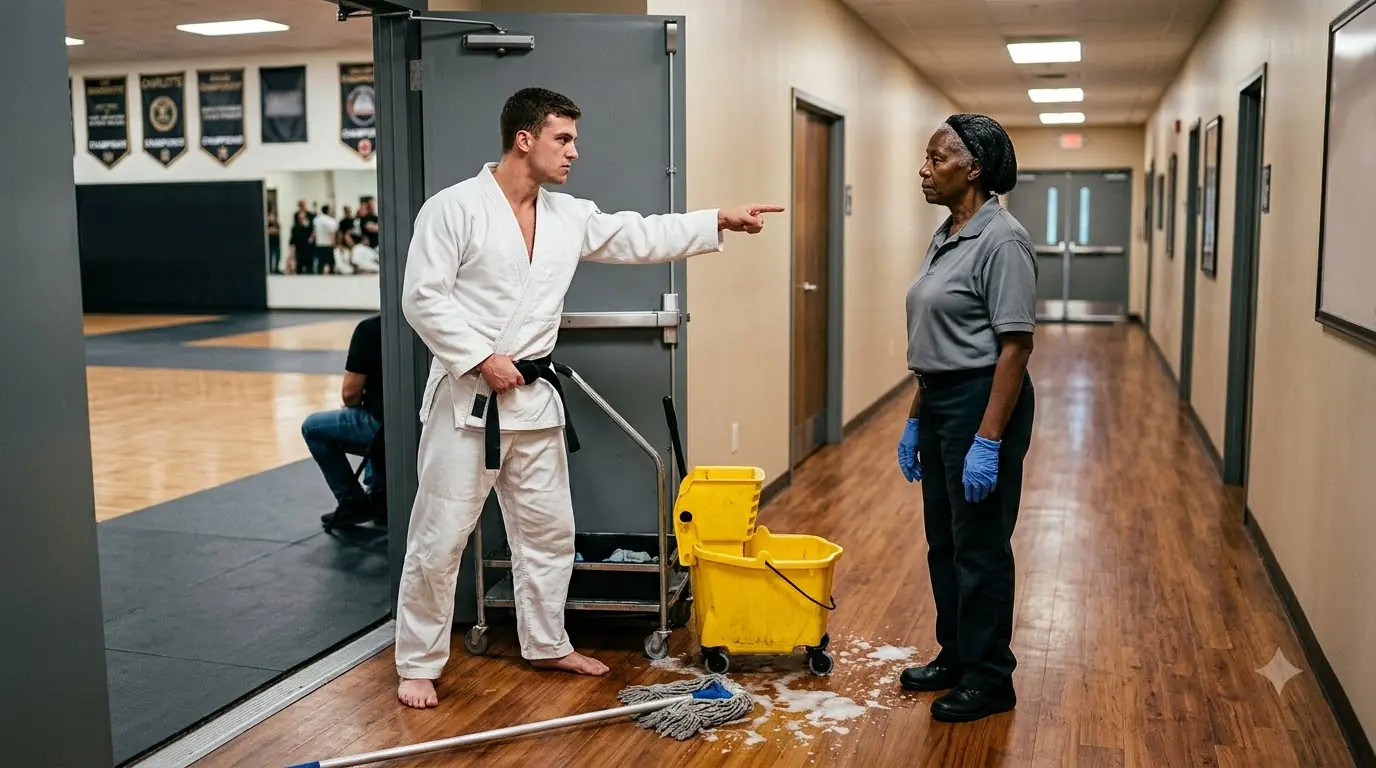
Brandon reached over to the bulletin board beside him, unpinned the entire stack of tournament flyers, 40 maybe 50 pages, and let them fall. Straight down onto the wet floor she had just finished cleaning.
There you go. Give the old black woman something to do. He grinned at the students behind him. Lord knows that mop isn't going to push itself. Laughter broke out.
He wasn't done. He stepped closer, close enough that his shadow fell over her, and crouched down to her eye level.
You know what I love about you? You never complain. You just kneel. He let the word hang in the air.
It's like God made you for this exact position. More laughter. Louder this time. Someone in the back whistled.
Dorothy kept her eyes on the floor. Her hands did not stop moving. Brandon straightened up, smoothed his gi, and delivered the last line like a punch line he'd been saving all day.
40 years from now they're going to put a plaque on that mop bucket. In memory of the best janitor Voss Academy ever had. The hallway erupted. And not one person said stop.
What none of them knew was that Brandon Crest would spend the rest of his life trying to forget that the man flying in from Tokyo that Saturday had been waiting 46 years to bow to her.
Voss Martial Arts Academy sat at the end of a strip mall on Providence Road in Southeast Charlotte, North Carolina. The kind of strip mall where every storefront looked deliberate, curated, expensive. Polished glass doors, a window display of gleaming trophies stacked three rows high. A hand-painted sign above the entrance that read, "Champions begin here."
Inside it smelled like cedarwood polish and ambition. The main training hall stretched 60 feet from wall to wall, hardwood floors lacquered to a mirror shine, championship banners hanging from the rafters like flags at a consulate.
Monthly tuition started at $450. Parents arrived in Range Rovers and Cadillac Escalades, waiting on cushioned benches along the perimeter wall while their children learned to fight.
Every evening after the last student bowed out and the last parent drove away, one woman stayed behind. Dorothy Harmon.
She was 68 years old, 5 feet 3 inches tall. Her frame was small, the kind of small that made strangers assume fragility, but her shoulders carried themselves straight in a way that had nothing to do with posture and everything to do with history.
She wore her silver-streaked locks pinned back beneath a hairnet on working nights. Her hands were rough, the knuckles slightly enlarged, the kind of hands that had spent decades in motion.
She arrived every weekday evening at 5:00, pushing a cart that squeaked on its left rear wheel, no matter how many times maintenance was promised. She mopped, she wiped, she emptied, she restocked. She locked the front doors at midnight and walked to her car alone.
Her pay was $13.20 an hour. No health insurance, no sick days, no retirement contribution. Half of every paycheck went to Renee. Her daughter was 44 years old and had been living with multiple sclerosis for six years.
The disease had taken her mobility in stages. First the left leg, then the right, then her ability to work full-time at the dental office where she had spent 12 good years. Renee raised two children, Marcus Jr., 15, and Imani, 11, mostly from a wheelchair now, with Dorothy filling every gap that insurance and government assistance left open. Grocery runs, school pickups, electric bills in February when the heating costs doubled, and the choice between warmth and medication became concrete.
Dorothy never talked about it at work. Nobody at Voss Academy had ever thought to ask. Her apartment was 12 minutes away by bus, a one-bedroom on Albemarle Road with a kitchen that faced a brick wall and a living room that received exactly 40 minutes of direct sunlight on clear afternoons.
She kept it clean in the way that people keep things clean when cleanliness is the one form of order they can still control. A small table, two chairs, a second-hand couch covered in a quilt her mother had made in 1963.
On the wall above the television hung a single photograph in a plain black frame. A young woman in a white gi standing at the center of a tournament podium, a gold trophy held above her head with both hands.
She was grinning wide, unreserved, the kind of smile that happens before the world has had a chance to teach restraint. Beneath the photograph, in small print on a label someone had taped there years ago: Charlotte Open Regional Championship, October 1971. Dorothy had been 19 years old in that photograph.
She had grown up in Albany, Georgia, during the last years of legal segregation, a world of separate water fountains and side entrances and teachers who told Black children to aim lower than their God-given ability. She discovered martial arts at nine years old through a church youth program run by a Korean War veteran named Earl Bassett, a man who believed that discipline could do for a child what circumstances could not.
She trained in Earl's church basement three evenings a week until she was 17, absorbing every technique he offered, and then kept absorbing long after she had surpassed him. She enlisted in the Army at 18, served as a field nurse during the final years of the Vietnam War, and was stationed in Okinawa for the last two years of her service.
It was there, in a small training hall behind a fish market in Naha, that she met Grandmaster Ryuji Nakamura, a man who trained students without regard for their gender, their skin color, or their nationality, only their willingness to show up.
Dorothy showed up every single day she was not on duty, and many days that she was. She earned her sixth dan in Goju-Ryu karate in 1978. She was 26 years old. She was the first Black woman in the United States to hold that rank.
Between 1971 and 1979, she won seven regional titles under the name the local sports press gave her after her third consecutive victory, the Iron Orchid. A photograph of her mid-kick at the 1975 Southeast Regional ran on the front page of the Charlotte Observer sports section. Her mother cut it out and kept it in her Bible until the day she died.
Then came 1979, the National Championships in Indianapolis. Dorothy entered ranked first in her division. She won every match. The judges deliberated for 40 minutes, an unusually long time, and returned a decision citing a minor procedural irregularity in her registration documents. The title went to the second-place finisher.
Nobody in the building believed the ruling. Several competitors walked out in protest. A young Japanese competitor named Kenji Mori, 19 years old in his first national tournament, stood in the corridor outside and watched Dorothy receive the decision in complete silence. He never forgot her face in that moment.
Every morning before 5:00, in the living room of whatever apartment she called home, Dorothy Harmon moved through kata in the dark. Alone. Precise. Devastating. She simply never told anyone.
And so when she arrived at Voss Academy each evening, cart squeaking, polo shirt tucked, nobody wondered. To the students of Charlotte's most prestigious martial arts academy, Dorothy Harmon was the woman who mopped their floors. Until the night Brandon Crest decided she was something less even than that.
Brandon Crest was 24 years old, 6 feet 1 inch tall, and 205 pounds of carefully maintained muscle. He held a second-degree black belt, earned over five years of consistent training, competed in regional tournaments often enough to have won three of them, and arrived at every session 15 minutes early and left 30 minutes late. His gi was always freshly pressed. His belt was always tied correctly on the first attempt.
From the outside, he looked like exactly what Voss Academy advertised in its brochure. His father, Richard Crest, owned Crest Property Group, a real estate development company with active projects across seven states. Richard had donated $60,000 to Voss Academy over four years: new flooring in the main training hall, a complete overhaul of the locker rooms, a renovated lobby with his name on a brass plate beside the front entrance.
He attended every parent showcase and sat in the front row. He applauded his son loudly and said very little on the drive home. What Richard said at the dinner table was different.
"You're not the best, Brandon. You have every advantage, and you're still not the best." He had delivered some version of that sentence since Brandon was 11 years old. It had done its work. Brandon carried it the way some people carry a splinter, not always aware of it, but feeling it every time he moved in a specific direction.
He trained to quiet it. He competed to silence it. And when neither approach delivered lasting relief, he looked for a target smaller than himself, someone he could stand above without having to earn the elevation. He found Dorothy Harmon on a Tuesday in October.
She had been working at Voss Academy for 18 months before Brandon truly noticed her. She was part of the building like the trophy case or the fire extinguisher mounted beside the back door. Present and entirely unconsidered. But on that particular Tuesday, Brandon was carrying the kind of mood that needed an audience, and Dorothy was in the hallway outside the equipment room with her cart partially blocking the corridor.
He stopped, looked at the cart, looked at her. "Hey, you mind?" Dorothy glanced up, then quietly moved the cart two feet to the right without a word. Brandon walked through, then stopped, then turned back.
He reached out and pushed the cart, not violently but with great deliberateness, so that the front wheel caught the edge of a floor mat and the bucket tipped. Dirty gray water spread across 12 square feet of hallway. Dorothy had finished mopping 20 minutes earlier. She looked at the water, then at him.
He spread his hands wide in a gesture of theatrical helplessness. "Oops." He walked away without looking back.
Three students standing near the drinking fountain had witnessed the exchange. One of them laughed, a short, uncomfortable sound. The other two found their phones suddenly interesting. Nobody said a word.
Dorothy turned, retrieved a dry mop from her cart, and began cleaning the floor again. Her expression did not change. Her hands did not shake. She simply started over the way she had been starting over for most of her adult life, methodically and without complaint.
What Brandon could not have known, what he never would have thought to wonder, was that someone else had seen every detail of what had just happened. Nate Harmon was 17 years old and had been a student at Voss Academy for two years. He trained seriously, showed genuine aptitude, and carried himself with the quiet discipline of someone who had absorbed the idea of respect, not from a poster on a wall, but from watching a specific person live it. He was Dorothy's grandson.
He had enrolled partly at her encouragement. "Structure is good for you, baby. This is a good place." And partly because the training itself had claimed him in the way that real things claim young people who are ready to be claimed by something real.
He was standing in the doorway of the changing room, gi half-tied, when his grandmother's bucket went over. He watched Brandon walk away, shoulders loose, completely unbothered. He watched his grandmother get on her knees and start cleaning the mess up again. His hands curled into fists at his sides.
He was 17 and understood enough to know that stepping forward would make things harder for her, not for him. He understood that Brandon Crest's father had paid for the floor she was now re-mopping. He understood that the academy needed that money and that the adults in this building had arranged themselves around that fact in ways that left no room for his grandmother's dignity.
And he had heard her say more than once, in a voice that closed the door on argument, "Don't make a fuss on my account, Nate. I handle myself." So he stood in the doorway. He said nothing. He would carry the weight of that silence for a very long time.
Patricia Ware was at the reception desk at the far end of the lobby when the incident occurred. Forty-one years old, nine years at Voss Academy, she knew Brandon Crest's particular brand of casual cruelty, the way you recognize a recurring weather pattern by its specific feel and the season it arrives in.
She had filed two internal memos over the past year describing incidents involving Brandon and junior students. Neither memo had produced a meeting, a conversation, or any consequence whatsoever. She watched Dorothy mop the hallway a second time.
She opened her desk drawer and removed a small green notebook she had purchased herself from a drugstore two blocks east with her own money. She uncapped her pen, wrote the date and time in the top margin, and beneath it wrote two factual sentences describing exactly what she had witnessed. Then she closed the notebook, returned it beneath a stack of enrollment forms, and went back to her computer screen.
Patricia had learned through direct experience that documentation was the only leverage available to people who could not afford to lose their jobs. At the end of the hallway, Brandon reappeared. He was holding his phone up. The camera application was already open, the lens aimed directly at Dorothy.
He had not even tried to be discreet about it. He walked slowly, phone raised at chest height, voice low and easy, the tone of a nature documentary narrator observing something mildly exotic in its natural habitat.
"Ladies and gentlemen, welcome to another evening at Voss Academy. World-class training, state championship banners, and of course our signature amenity." He panned the camera deliberately from Dorothy's cart to Dorothy herself, then back to the lens with a practiced half-smile. "Eighteen months of service, undefeated record in the mop division. We've been trying to teach her a roundhouse kick for weeks." He paused for effect.
"No progress. Some people just find their calling."
He posted it that night with the caption, "Our academy's secret weapon. Someone give this woman a black belt in mopping." By the time Dorothy finished her shift and walked to her car in the empty parking lot, the video had 412 likes. By the time she reached her apartment on Albemarle Road, it had passed 700.
She discovered it the following morning when Renee sent her a screenshot with no message, just a single question mark. Dorothy looked at the clip for eight seconds. Herself on her knees working. Brandon's voice loose and amused. Students visible in the background, some of them laughing. The camera catching her from an angle she would never have chosen.
She turned the phone face down on the kitchen table, finished her oatmeal, washed the bowl, and set it in the rack to dry. That was all she allowed herself.
The following Wednesday, she arrived at the academy and went directly to her supply closet near the back entrance. The narrow space she kept organized with the kind of precision that had once been military habit and was now simply her nature. Every item in its designated position. Mop heads stacked left, disinfectant lined right, trash bags folded flat in the third shelf corner.
She opened the door. The shelves were bare. She checked the utility bathroom, the hallway storage cabinet, the equipment room. Nothing.
She found her supplies 25 minutes later crammed into the dumpster in the alley behind the building. The mop heads were soaked through with something thick and dark. A sticky note had been pressed to the outside of the largest trash bag, the handwriting wide and unhurried, done by someone who felt entirely comfortable taking their time.
"Help wanted. Someone younger and actually useful."
Dorothy peeled the note off carefully, read it once, folded it in precise thirds, and placed it in the front pocket of her polo shirt. Then she pulled her supplies out of the dumpster one by one, carried them to the utility sink, rinsed what could be salvaged, and replaced the rest.
The new supplies cost her $22 from the petty cash envelope she was permitted to access for legitimate emergencies. She did not submit a receipt. She did not report the incident. There was no one to report it to who would have done anything about it.
The break room incident happened on a Friday. Dorothy ate her dinner during the 15-minute window between the 6:00 and 7:00 classes, a turkey sandwich she assembled at home every morning, a small bag of crackers, a bottle of water she refilled from the tap. She sat at the corner table, the small round one near the window that nobody else used because it faced the parking lot rather than the wall-mounted television.
Brandon came in with two senior students behind him. He looked around the room, then at Dorothy, then back at his companions with an expression of refined distaste, as though he had walked into a restaurant and found a hair in his water glass.
"Smells like Pine-Sol in here." He moved to the counter, pulled open the refrigerator. "Can't even taste my food." One student picked up his plate and moved to the hallway without a word. The other hesitated. Dorothy counted four full seconds, then followed.
Brandon leaned against the counter and looked at her. "See, this is the thing about not having a designated staff area. It creates situations. Comfort issues. You understand?"
Dorothy folded her wax paper into a neat rectangle. She did not look up. "Didn't think so." He left.
Dorothy sat alone in the break room. She put the crackers back in her bag. She was no longer hungry.
That night she sat on the edge of her bed for a while before reaching beneath the frame. She pulled the shoebox out and set it on her lap without opening it immediately. Just held it. The cardboard was soft at the corners from years of careful handling.
Then she lifted the lid. The tournament certificates had yellowed, but the print was still legible. The newspaper clippings were folded into precise rectangles, preserved with the instinct of someone who understood that certain things, once lost, cannot be recovered. She lifted the sixth-dan certificate from beneath the clippings and held it with both hands.
The paper was heavy. The ink was still dark. Her name was still there. She held it for a long time. Then she replaced it exactly as she had found it, closed the box, and returned it to the darkness under the bed.
She was still sitting on the edge of the mattress, hands in her lap, when her phone buzzed on the nightstand. A text from Renee. "You doing okay, Mama?"
Dorothy typed back, "Fine, baby. Get some rest." She put the phone down, sat quietly for another moment, then set her alarm for 4:45 in the morning, turned off the light, and lay back in the dark. She did not cry.
It was not stubbornness that kept the tears away. It was something older than that, the particular composure of a person who has been forced to learn that falling apart is a luxury the world does not extend equally.
What Dorothy did not know was that she was no longer invisible. Maya Torres was 22 years old and had joined Voss Academy six weeks earlier following a platform incident on the Charlotte light rail that had left her shaking for three days and convinced that the ability to protect herself was no longer optional but necessary.
She was quiet and observant in the manner that graphic designers often are, perpetually reading the composition of any room, the relationship between its elements, the detail that does not belong. She had been watching Brandon and she had been watching Dorothy.
On the Thursday after the break room incident, Brandon tossed a roll of athletic tape across the hallway toward Dorothy. Not at her exactly, but in her direction, close enough to require a response. Dorothy's right hand came up and caught it. Clean, immediate, without looking.
Maya stood completely still. The catch had lasted less than a second, but she had seen it, the hand moving the way hands move when they have been trained to move. Not instinct, not luck. Reflex. The specific cultivated kind that takes years to build and never fully leaves the body.
Maya took out her phone, not to film Dorothy, to search. She typed a name into the search bar, then deleted it because she was not sure of the spelling, then typed something else. Black female martial arts champions, 1970s, Charlotte, North Carolina.
She waited. The first result was a scanned newspaper archive from the Charlotte Observer dated September 1975. The headline read, "The Iron Orchid Strikes Gold Again." Maya looked at the photograph beneath the headline for a long moment. Then she looked up toward the hallway where Dorothy was quietly pushing her cart around the corner.
She did not move for a full minute.
And then across the academy, Brandon Crest opened an email from Master Voss on his phone and read the words that made him straighten in his chair and smile slowly for the first time all week.
Grandmaster Kenji Mori. One session only. Charlotte. Next Saturday.
Brandon read it twice, then set his phone down. This was his moment, the greatest living martial artist in the world coming here to this academy where Brandon Crest trained. Every senior student would be watching. His father had already confirmed he would attend. Everything that weekend needed to be exactly right.
Which meant Dorothy Harmon needed to be somewhere else entirely.
The prospective family showcase ran every quarter, a Thursday evening event designed to convert observers into paying customers. Parents brought their children, sat in folding chairs along the wall, and watched the senior students demonstrate what $450 per month could produce. It was carefully staged, precise, choreographed without appearing choreographed.
Brandon ran the sparring demonstration at the center of the hall. He was good at it. He moved with the practiced ease of someone who understood that an audience elevates the value of what you are doing simply by watching it. He called corrections to junior students, adjusted stances, reset guard positions. All of it smooth, all of it visible, all of it designed to be seen.
Parents leaned forward in their folding chairs. Several had their phones raised. Dorothy was in the hallway behind the observation glass, working her way along the corridor with her mop. She had done this particular section of floor every Thursday evening for 18 months and did not need to think about it.
Brandon spotted her through the glass. He paused the drill, called a water break, and then walked to the hallway door and pushed it open with the particular unhurried ease of someone who has never once considered that anything in any room might push back at him.
"Hey." He raised his voice slightly, pitched for the parents visible behind him through the doorway. "Come here a minute. Let's show these families our full team."
Dorothy looked up from the floor. "Come on." He smiled back at the watching parents, performing the invitation as though it were generous. "Let's see that famous floor technique of yours."
A few parents laughed, the uncertain kind of laugh people produce when they genuinely cannot determine whether something is charming or wrong. The students on the mat glanced at each other and stayed where they were. Nobody said stop.
Dorothy set the mop against the wall, and then a voice came across the room like a match being struck.
"Stop it."
Every head turned. Nate Harmon stood at the edge of the mat in his training gi, hands held flat at his sides, 17 years old and visibly terrified by the action he was taking and taking it anyway. His jaw was set. His eyes were clear and very direct.
"That's my grandmother." His voice fractured on the last word but held its shape. "Stop."
The room went completely silent. Brandon looked at him with the expression of a man encountering an unexpected variable in a situation he thought he had fully mapped.
"Your grandmother is the janitor." He glanced at the parents along the wall, at the students on the mat, working the room with the instinct of someone who has never learned that an audience can stop being yours. "That's... wow, man. What?"
A few people laughed. Most did not. Dorothy crossed the floor in six quiet steps and placed her hand on Nate's shoulder. One hand resting there with the specific weight of a complete sentence delivered through a single sustained point of contact.
"Go back to class, baby."
"Grandma?"
"I'm fine." She held his eyes steadily and waited until she felt his breathing slow. "Go."
He went. Slowly, with his shoulders back and his head level, which was more composure than most of the adults in that room were currently managing. Dorothy returned to the hallway, picked up her mop, and continued working.
The showcase resumed behind the glass. Nobody mentioned what had happened, but something had rearranged itself permanently in Nate Harmon's chest, and it would not rearrange back.
That night Dorothy sat at her kitchen table and typed a resignation letter on her phone. Two sentences. Polite, clean, and entirely without bitterness or performance. She read it twice and changed one word.
Then she opened her contacts and scrolled to a name she had not called in three years. Gladys Mori answered on the second ring. They talked around the edges of the real subject for several minutes, the way old friends navigate toward difficult things carefully in widening circles.
Then Dorothy told her plainly and without embellishment what had been happening over the past weeks. The video. The supplies in the dumpster behind the building. The break room. The showcase that evening. And Nate's voice and her hand on his shoulder and the silence that followed.
Gladys listened without interrupting. When Dorothy finished, the pause before Gladys spoke was long enough to have its own particular weight.
"Dorothy." Her voice was careful. "Kenji is going to be in Charlotte next Saturday. He asks about you every single time we travel to the States. Without fail. For years now."
Dorothy did not respond immediately.
"He carries a photograph," Gladys continued. Another brief pause. "From the 1971 Charlotte Open. It has been in his travel bag for 50 years, Dorothy. Fifty years."
Dorothy closed her eyes. Her hand holding the phone was completely steady. "I already know about the seminar," she said finally. "I saw the flyer on the board at work."
"Then you know he'll be there."
Dorothy did not answer that. She thanked Gladys for her time, said good night, and set the phone face down on the table. She deleted the resignation letter. She did not write another one.
On Thursday morning, Dorothy arrived at the academy at 4:45 for early-access cleaning, a responsibility attached to a key she had held for over a year without anyone thanking her for the additional hours. The building was dark and completely still.
She let herself in through the back entrance, walked past her supply cart without pausing, through the equipment room, and into the main training hall. She removed her shoes and placed them beside the door. In the dark, she began to move.
The first kata was the one she had learned at nine years old in Earl Bassett's church basement in Albany. The sequence that had been her original point of entry into a discipline that would quietly define the next six decades of her life. Her bare feet made almost no sound on the lacquered wood. Each strike landed clean and without hesitation.
In the dark, alone, with no audience and nothing at stake, Dorothy Harmon moved the way water moves through a channel it has carved over a long time, without effort and without uncertainty.
Master Elias Voss arrived at 4:52 for his own early session, as he did on Thursdays without exception, and pushed open the training hall door. He stopped.
The hall was dark, but he could hear it. The controlled exhale, the specific displacement of air, the particular quality of silence produced by someone who has trained long enough that their body no longer makes incidental noise while doing the things it was built to do.
He did not reach for the light switch. He stood in the doorway for 11 full minutes and watched the silhouette of Dorothy Harmon move through kata she had first learned 59 years ago, before this academy existed, before Kenji Mori had ever held a white belt, before any of the people in this building had been born.
When she finished, the room settled into complete stillness. She collected her shoes, walked to the door, and passed him without stopping. He stood alone in the dark hall for a long time after her footsteps faded.
Saturday arrived the way important days always arrive, quietly, without announcement, indistinguishable from any other morning until it was not. By noon, the Voss Academy parking lot was full. Cars extended down Providence Road in both directions for two full blocks.
Students arrived in pressed gis with their belts tied with particular care, the kind of care reserved for occasions when the person you are trying to impress is not your usual instructor. Parents who had never attended a regular weekday session materialized with cameras and good posture.
Master Voss had arranged folding chairs along both walls of the main training hall, positioned a low platform at the north end, and mounted a banner across the entrance that read, "A Living Legend: Grandmaster Kenji Mori, Eighth Dan. One Session Only."
The air inside carried the specific charge of something genuinely significant, not manufactured excitement, but the real thing, the kind that moves through a room without requiring anyone to announce it.
Brandon Crest arrived at 11:30, 90 minutes early. His gi was immaculate, pressed flat along every seam. His belt had been ironed along its length and tied with the precision of someone who understood that the distance between first and second impression is often a single visible detail.
He positioned himself near the front of the training mat, visible from the platform, visible from the entrance door, and warmed up with the deliberate unhurriedness of a man who knows that being seen preparing is its own category of performance. He greeted Master Voss with pronounced warmth. He held extended conversations with two senior instructors.
He made certain to be in motion each time the front entrance opened, so that the first thing anyone saw when they walked in was Brandon Crest working. Richard Crest arrived at 12:15 and settled into the VIP row, three chairs positioned slightly forward of the general seating along the east wall.
Nobody had requested this arrangement. It had appeared as certain arrangements appear when sufficient financial history creates its own gravity. Richard sat, crossed one leg over the other, and studied his son on the mat with the expression of a man who is perpetually in the process of deciding whether he is satisfied.
Patricia Ware was behind the reception desk at 5:05 when the back door opened and Dorothy Harmon pushed through it, cart squeaking on its left rear wheel, polo shirt tucked exactly as she had arrived on every working evening for the past 18 months.
Patricia rose from her chair immediately. "Mrs. Harmon." She paused, choosing words carefully. "We have a special event today, a major event. Master Voss asked that non-essential personnel..."
"I'm just here to do my shift, Patricia."
Dorothy moved through the lobby toward the supply corridor. Patricia stood behind her desk and watched her go, then slowly sat back down and pressed her fingers flat against the desktop.
Brandon was crossing the lobby toward the water station when he saw her. He stopped, looked at her cart, looked at the corridor beyond it, looked through the training hall glass at the students warming up, at his father in the VIP chairs, at the banner above the entrance.
He stood there for three full seconds doing the arithmetic. Then he walked toward Dorothy with the composed, purposeful stride of someone who has made a decision and is not anticipating complications.
"Hey." He moved into her path, positioned between her and the hallway. His voice was measured, almost reasonable. "Not tonight. You need to go home."
Dorothy continued forward, angling to move around him. He stepped with her. "I'm serious." His voice dropped slightly.
"Grandmaster Mori arrives in 90 minutes. We have press here. We have families. We have..."
He stopped himself and recalibrated toward something closer to patience. "This isn't the right night. Go home. Come back Monday. Your schedule can shift."
"My schedule hasn't changed." Dorothy's voice was even and entirely without heat. "I'm here to work."
"Your schedule changed as of right now."
The lobby had gone quiet in the way spaces go quiet when people stop pretending they are not listening. Twelve people in the lobby and adjacent hallway had ceased all movement. The conversation was contained, but the stillness radiating outward from it was not.
Dorothy looked at him for a moment, then turned her cart toward the supply corridor entrance. Brandon followed.
The corridor was narrower than the lobby, a working passage, not a public space, but eight students were visible at the far end near the equipment room, and the lobby glass made Patricia Ware a visible witness from her desk.
He came around Dorothy and positioned himself in front of her again. This time he reached forward and took hold of the cart's handlebar with both hands. Not violently, deliberately.
He began walking the cart toward the emergency exit at the corridor's far end. "I said go home, old woman. Clear enough now?"
Deliberate enough for the corridor to carry every word to every person in it. "You do not belong here today. Today is for serious martial artists, for people who've earned the right to be on that mat. Not for..."
He let the pause complete the sentence. The corridor was absolutely still. Eight students frozen at the far end. Patricia Ware, visible through the lobby glass, both hands pressed flat on the desk surface, standing. Master Voss, somewhere beyond the training hall door, out of sight but close.
Dorothy stood at the corridor's center without her cart. She turned to face Brandon, and the hallway saw something that none of them could fully articulate afterward. Not because nothing visible had occurred, but because what occurred was the precise opposite of what the situation had been constructed to produce.
There was no flinching. No visible distress. No anger. No performance of any kind. No tears. Nothing that would have confirmed for Brandon that the architecture of this moment had worked the way he intended it to.
There was only Dorothy Harmon, 68 years old, gray polo, work pants, silver locks pinned back, standing in a corridor looking at Brandon Crest with eyes so completely still and so thoroughly without fear that several people watching from the far end felt something shift in their chests in a way they could not immediately name or explain.
She did not speak. Brandon opened his mouth.
The training hall door opened behind him.
Grandmaster Kenji Mori was 72 years old and carried his age the way certain people carry theirs, not diminished by it, but concentrated. He was 5 feet 6 inches tall, slight-framed, with white hair cropped close and hands disproportionately large for the rest of him, the hands of a man who had spent 60 years asking them to perform difficult work without complaint.
He wore a plain gray training jacket over dark pants. No insignia, no ornamentation of any kind. The clothing of someone who had long ago arrived at the place where credentials no longer required display.
He had been inside the training hall for 40 minutes when he heard the particular quality of silence that settles after a confrontation. Not peaceful silence, not the silence of a room at rest, but the compressed, held-breath silence of people who have witnessed something and are waiting to find out what it means.
He came through the training hall door. He stepped into the corridor. He stopped.
Later, every person present would struggle to describe precisely what happened to his face in that first moment. Surprise was the word most of them reached for, and most of them immediately felt it was wrong. Recognition was closer, but recognition understood as a physical event, the way a tuning fork responds to the specific frequency it was made to receive.
Something in him simply aligned, snapped into correspondence with something it had been oriented toward for a very long time. His eyes moved across the scene, the cart shoved against the emergency exit, the students motionless along the wall, Brandon Crest standing at the corridor's center with his mouth still open, and then settled and stilled and stayed on Dorothy Harmon.
She stood six feet away in her gray polo shirt and work pants, 68 years old, silver locks pinned back, looking up at Kenji Mori across 20 feet of hallway with an expression that was not surprise and was not relief and was not the performance of either.
He walked. He did not look at Brandon, did not acknowledge the students or Patricia Ware visible through the lobby glass, or Master Voss, who had appeared in the training hall doorway behind him.
He walked in a straight line through the corridor, the way a compass needle moves, not choosing a direction, but responding to one, pulled by something he had been oriented toward for 50 years. He stopped in front of Dorothy Harmon.
Then Grandmaster Kenji Mori, eight-time national champion, eight-time world representative, the most decorated martial artist in Japanese history, a man before whom heads of state had bowed, bent at the waist and bowed.
Not a nod, not the brief forward tilt that passes for respect in gyms and studios across the country. This was a full, deliberate, unhurried bow, spine parallel to the floor, hands flat at his thighs, held for a count that no one in the hallway dared interrupt with sound or movement.
The precise bow of the martial arts tradition. The specific one. The kind reserved for a master whose rank surpasses your own. He held it for five full seconds.
Then he straightened and looked at her and spoke.
"Sensei Harmon. It has been too long."
Two words, quiet and exact, each syllable placed with the care of someone who had been waiting a long time to say them correctly in the right room. The hallway did not breathe.
Brandon Crest's face went the particular white that belongs to people whose understanding of a room has just been dismantled so completely that the brain requires additional time to construct a replacement framework. His mouth was fractionally open. Without apparent awareness of doing it, he had taken one small step backward, his shoulder blade finding the wall behind him.
At the far end of the corridor, students stood where they had stopped. Not one of them reached for a phone. Not yet. That would come in a moment. Right now, they simply could not move.
Master Voss stepped fully into the corridor. When he spoke, his voice was careful and slightly unsteady, the voice of a man trying to maintain professional composure over something that was actively outpacing his capacity to process it.
"Grandmaster Mori, you know her?"
Mori did not look away from Dorothy. "Know her?" He held the phrase for a moment, the way you hold a word when you recognize that it is inadequate to what it is being asked to carry.
"Dorothy Harmon taught me my first real kata in 1971 in a training hall in this city. She held a sixth dan when I was still working toward my second. She is the reason I did not walk away from this art in the winter of 1973, when I was 22 years old and had decided with complete certainty that I had no future in it."
He paused. The corridor held the silence carefully, like a room holding water.
"I have trained under four grandmasters in two countries. I have practiced alongside some of the finest martial artists this discipline has ever produced.
In 50 years of this work..." His voice did not rise or accelerate. It simply carried. "Dorothy Harmon is the finest practitioner I have ever had the privilege of sharing a floor with. Bar none. Without qualification."
Another pause. "I have been trying to find her for 11 years."
Something passed through the watching students. Not a sound, not a visible movement, but a collective shift of comprehension. The sensation of a group of people understanding simultaneously something they could not quite believe they had only just understood.
The woman who mopped their floors. The woman Brandon Crest had shoved a cart away from. The woman he had told to go home.
Dorothy's eyes had filled. She had not blinked them clear and was not attempting to. But her face was still the particular stillness of someone who had learned through long practice to carry enormous things without setting them down in public spaces.
She bowed. Slowly. Back straight. Completely unhurried. The bow of an equal, not deference, not relief, not gratitude. The clean and mutual acknowledgement of two people who knew precisely who they were and who the other person had always been.
When she straightened, Mori was still looking at her. "I have something for you," he said quietly. "When you are ready to receive it."
Dorothy nodded once. Richard Crest was on his feet in the lobby, visible through the glass, hands at his sides, the confident architecture of his expression entirely gone.
Behind him, through the lobby windows, a student who had been filming on his phone for the last 90 seconds was already pressing upload. The video was 43 seconds long. It would have three million views before midnight.
And in every comment on every platform, in every language spoken by anyone who had ever been told they did not belong in a room they had already earned the right to stand in, people typed the same two words over and over until the servers strained.
The Iron Orchid.
The 43-second video reached one million views before midnight. By the time the seminar concluded and the last car left the Voss Academy parking lot, the clip had been shared across every major platform in 14 languages.
Reaction videos appeared within the hour. Martial arts forums dormant for years flooded with thousands of comments. Sports journalists who had never previously covered a story involving a Charlotte dojo were filing copy before 10:00 Saturday night.
The title that spread fastest, the one that appeared in comment sections and text messages and group chats across the country, was not the uploader's original caption. It was something a commenter had written in response, four words that the internet immediately recognized as the only correct description of what it had witnessed.
She was his teacher.
By morning, the story had been picked up by three national sports networks, two civil rights journalism outlets, and a podcast that documented overlooked chapters of American athletic history. The original clip had been viewed eight million times. A second video, longer, captured from a different angle, showing the full sequence from Brandon's confrontation in the corridor to Mori's bow, added four million more.
The comments did not divide the way viral stories usually divide. They converged.
This woman has been mopping floors in silence, and she trained the greatest martial artist alive.
The dignity she showed in that hallway. The absolute, unshakable dignity.
Fifty years. She carried this for 50 years and never said a word.
Brandon Crest drove home from the academy at 9:15 without speaking to his father, who had left 20 minutes earlier in a separate car without looking at his son. Brandon sat in his apartment still in his gi, phone on the table in front of him. For a long time, he did not reach for it.
Then he typed two words into the search bar. Dorothy Harmon.
The archived results loaded slowly, scanned documents from newspaper libraries, digitized sports pages from the 1970s that had never been fully indexed by any search engine. He found the Charlotte Observer photograph first. Dorothy mid-kick, the image that had run on the front page of the sports section in the summer of 1975. "The Iron Orchid Strikes Gold Again."
He found the regional championship records, tournament programs, a short feature from a Black community newspaper in 1977 describing her as the most dominant competitor in women's martial arts in the entire Southeast and among the most technically gifted practitioners in the country, regardless of gender or division.
He found the 1979 article last. "Championship Controversy: Title Stripped from Dorothy Harmon in Disputed Decision."
He read it once, read it again, set the phone face down on the table, and looked at the ceiling of his apartment for a very long time.
The emergency board meeting was called for Monday morning at 9:00. Master Voss sent the notification at 11:15 Saturday night. The Voss Academy board had five members: Master Voss, three senior instructors, and Richard Crest, who held a non-voting advisory seat attached to his family's financial relationship with the institution.
Richard arrived Monday in a suit that communicated precisely how seriously he intended to be taken. His personal attorney, a man named Douglas Fitch, sat beside him with a leather portfolio open on the table. Master Voss stood at the head of the table and did not sit down for the duration of the meeting.
"What happened in this building on Saturday," he said before Richard could find his opening, "was not a surprise to this academy's management. It should have been. That it was not is a failure of leadership, and I include myself in that failure without reservation."
Richard leaned forward. "Elias, with respect, what we have here is a significant liability situation. The woman was employed as a janitor. The viral nature of this event creates exposure for the academy that needs to be managed carefully and quickly. I've had my attorney draft..."
"Your son told a 68-year-old woman she did not belong in a building where she has worked for 18 months." Master Voss's voice did not rise. It did not need to. "He said it in front of the most respected martial artist in the world, who then informed 30 witnesses that she was his superior in this discipline. I am not interested in managing that, Richard. I am interested in correcting it."
The room held its silence. Dorothy was asked to arrive at 10:00.
She came in her work clothes, gray polo, dark slacks, the same shoes she wore every working evening. She did not bring anything with her. She sat at the conference table with her hands folded and looked at each person present without apparent discomfort or performance of any kind.
Master Voss apologized on behalf of the academy. He was specific. He did not use the word unfortunately. He did not use the phrase to the extent that.
He said, "We failed you. It was wrong, and it happened here while I was responsible for what happens here."
Dorothy listened. She nodded once when he finished.
Richard Crest cleared his throat. Douglas Fitch removed a document from the portfolio and positioned it on the table. Richard's voice was measured, carefully calibrated toward the register of reasonableness.
"Mrs. Harmon, my family wants to make this right. We've prepared a settlement, a generous figure in exchange for a mutual non-disclosure agreement. You would be free to leave this situation behind entirely and move forward without further disruption. I believe that's the cleanest possible outcome for everyone at this table."
Dorothy looked at the document. She did not pick it up.
"No."
The word was quiet and entirely without anger. It landed in the center of the room with the specific weight of something decided long before this meeting had been convened.
Richard's expression adjusted with visible effort. "Mrs. Harmon, I'd strongly encourage you to consider..."
"I've considered." She looked at him directly, without heat and without wavering. "I don't want your settlement, Mr. Crest. I want something else entirely."
She placed both hands flat on the table. She looked around the room at each face in turn, ending with Richard Crest's, which had gone very still.
"Would you like to hear what it is?"
Nobody spoke. Nobody moved. The room was completely, absolutely hers.
Dorothy did not consult notes. She did not raise her voice or pause to gather herself. She spoke in the same even register she used for everything, the voice of someone who stopped performing composure decades ago. Composure had simply become the architecture of how she moved through the world.
She had four conditions.
"First," she said, "a full public statement from this academy acknowledging what occurred. Not a general expression of regret. Not a values statement about inclusion. Specific: what was done, who did it, and that it was wrong. In writing, on every platform where this academy maintains a presence, within 72 hours."
Richard's attorney made a note in his portfolio.
"Second, Brandon is permanently removed from this academy."
Richard's jaw tightened. "That is my son."
"Your son filmed me without consent and posted it publicly to mock me." Her voice did not change pitch or pace. "He destroyed my supplies and left a note on the bag. He pushed my work cart into a wall and told me I did not belong here. He did every one of these things because he believed there would be no consequence."
She paused. "I want there to be a consequence."
No one in the room offered an objection. Douglas Fitch continued writing.
"Third, the Crest family establishes a scholarship for young Black women pursuing martial arts training. Fifty thousand dollars annually for five consecutive years, administered by an independent organization. Not this academy. Not your family's foundation. Independent."
Richard was watching her with the expression of a man who had arrived at this meeting intending to conclude it efficiently and was now understanding with increasing clarity that he did not control how or when it ended.
"And fourth," her voice remained level. The weight it carried was not in its volume. "The 1979 National Championship record is formally corrected. My name is entered as the rightful winner of the division I competed in and won. The ruling that removed my title is publicly acknowledged as erroneous by the governing body that issued it."
The conference room absorbed this for a full, uninterrupted moment. Richard leaned back slowly.
"Mrs. Harmon, that championship was 46 years ago. The organization that governed it has restructured multiple times since. The individuals who rendered that decision are..."
"I am aware of exactly how long ago it was." She looked at him without expression. "I have been aware of it every day since."
"What she is asking for is not impossible."
The voice came from the far corner of the room. Grandmaster Kenji Mori had been seated quietly since the meeting began, present at Master Voss's specific request, introduced briefly, and thereafter largely silent. He held no formal role in what was being decided.
He stood from his chair anyway and crossed the room to the conference table. He set his travel bag on the surface and opened it. From inside, he removed a manila envelope worn at the corners, the original clasp replaced at some point with a small binder clip.
He set it at the center of the table. "I was 20 years old at the 1979 National Championships in Indianapolis," he said. "I was competing in my first national tournament. I was present during the deliberation. I witnessed the ruling. I watched Dorothy Harmon receive a decision that every competitor in that arena understood to be incorrect, understood it, and said nothing because the people saying something would have been the same people who could not afford to."
He opened the envelope and removed a folded document. "In 2003, while preparing testimony for an International Martial Arts Equity Commission, I wrote a formal witness statement documenting what I observed in Indianapolis that evening. It is notarized. I have carried it in this bag for 22 years."
He placed it at the center of the table. "I have been waiting for the appropriate moment to submit it formally. I am satisfied that this is that moment."
The conference room went completely still. Douglas Fitch looked at the document, then at Richard Crest. Richard was not looking at the document. He was looking at his son.
Brandon had been sitting in the far corner of the conference room since the meeting began. He had said nothing. He had barely moved. He sat with his hands resting on his knees and his eyes on the table surface in front of him, wearing the expression of a person who was in the process of understanding something about himself, something that, once the understanding was complete, could not be approached from the other side of it again.
He raised his eyes to his father. "Dad."
Richard turned.
"Stop." Brandon's voice was quiet. It was not performing anything.
It had no audience in mind. "She's right. She's right about all of it. Just stop."
The room held what he had said for a long moment. Richard Crest looked at his son. He looked at Dorothy. He looked at the notarized document lying in the center of the table. He looked at Douglas Fitch, who had set down his pen and was examining the middle distance with the specific expression of an attorney who was privately and rapidly recalculating several things at once.
Richard Crest was a man who had spent his entire professional life in rooms like this one, moving outcomes in the directions he needed them to move through the application of money and patience and the willingness to outlast the other side. He was very good at it. He had been doing it for 30 years.
He looked at Dorothy Harmon, 68 years old, hands folded on the table, waiting without impatience, without performance, with the complete and settled composure of someone who had already decided that she would still be sitting there when everyone else in the room had exhausted every other option.
He nodded once. "All four," he said. "You'll have all four."
Dorothy held his gaze. "In writing, before I leave this building."
"You'll have it."
Master Voss exhaled. It was a small sound, barely audible. In the silence of that room, it carried.
Mori returned to his seat. He sat and clasped his hands in his lap and looked at Dorothy across the table with the expression of a man who had carried something heavy for 22 years and had at last been allowed to set it down in the right place at the right time.
The paperwork required 40 minutes to prepare properly. Dorothy read every word of every page before she added her signature. She did not rush. She asked two questions and received written clarifications on both before signing.
When she finished, she capped the pen, placed it on the table, and pushed back her chair. She stood, straightened her polo shirt, and picked up her bag.
"Thank you," Dorothy said to Master Voss.
She said nothing to Richard Crest. She walked out of the conference room, through the lobby, and out the front entrance into the afternoon, where the air was cool and the light was going low and golden across the parking lot.
She sat in her car for a few quiet minutes with the engine off and her hands resting on the wheel. Then she drove to Magnolia Ridge Care Center to see her daughter.
The National Martial Arts Governing Council issued its formal correction six weeks later, following a review that moved with unusual speed given the quality of the documentation Grandmaster Mori had provided and the scale of public attention the case had drawn.
The statement was four paragraphs. It acknowledged the 1979 ruling. It acknowledged the evidence that the ruling had been applied incorrectly and inconsistently with the standards governing that championship division. And it acknowledged, in language that was careful but left no room for alternative interpretation, that the outcome had caused lasting and significant harm to a competitor who had won her matches and earned her title by every legitimate measure.
Dorothy Harmon was formally recognized as the 1979 National Women's Martial Arts Champion, 46 years, two months, and 11 days after the decision was rendered.
The ceremony was held at Voss Academy on a Saturday morning in November. It was not large by the standards of the attention the story had received. No arena, no production company, no red-carpet arrangement of any kind. Master Voss had insisted on that, and Dorothy had insisted on it more firmly.
The training hall was arranged simply: chairs for invited guests along the perimeter, the mat cleared and cleaned to its mirror shine. Thin morning light came through the high windows at a low November angle that made everything in the room look slightly warmer than the temperature outside warranted.
Forty people were present. Former competitors from the 1970s tournament circuit, several of whom had driven or flown in from other states when word reached them. Members of the local martial arts community. Patricia Ware in the front row wearing a dress she had pressed twice that morning.
Renee Harmon arrived in her wheelchair, pushed by Marcus Jr., with Imani walking close beside her, wearing the expression of an 11-year-old who understood that something important was happening and was taking in every detail to keep. Nate stood at the edge of the mat in his full training gi, hands clasped behind his back.
Master Voss spoke briefly and without notes. Then a representative from the National Council presented the corrected documentation, a formal certificate signed and dated, Dorothy's name printed clearly across its center in letters that left no ambiguity about who it belonged to.
Then Grandmaster Kenji Mori reached into his travel bag and removed a small velvet box. The medal inside was a faithful replica of the 1979 championship medal, commissioned specifically for this occasion because the original had never been placed in its rightful recipient's hands.
He lifted it by its ribbon, turned to Dorothy, and looked at her for a moment before speaking.
"Fifty-four years," he said quietly. "I have wanted to do this for 54 years."
He placed it around her neck.
The room applauded. It was not a polite sound. It was the kind of applause a room produces when something that has been wrong for a very long time finally stops being wrong at a specific, witnessed moment, and everyone present understands they are standing inside that moment as it occurs.
Renee pressed one hand to her mouth. Her other hand found Imani's and held it. Nate did not try to stop the tears. He stood at the mat's edge and let them come without apology, and he felt nothing about it except that it was correct, and that he would not have done anything differently.
Dorothy addressed the room when the applause had settled and the hall had returned to quiet. She did not speak about 1979. She did not speak about the hallway, the dumpster, the break room, the showcase, or any of the specific things that had been said and done over the preceding months.
She spoke about the students she had watched for 18 months from the edges of rooms, the ones who trained through pain they never reported, the ones who arrived uncertain and left a fraction less so, week after week, in ways they probably could not articulate yet.
She said she had learned more about what this discipline genuinely offers a person by watching from the hallway than she had learned in some years of active competition.
"The mat doesn't care what you did before you got on it," she said. "It only cares what you do while you're there. That's all any of us has. What we do while we're there."
The Crest family scholarship for Black women in martial arts was announced publicly the following week. The first cohort of seven recipients was selected by an independent panel Dorothy had helped assemble and notified by individual letter. The youngest recipient was 17 years old and had never previously set foot inside a training facility of any kind.
Brandon Crest did not attend the ceremony. In the weeks following the board meeting, he had withdrawn entirely from public life. No social media presence, no tournament appearances, no statement of any kind.
He had enrolled in a counseling program in Concord and continued attending it past the point at which attendance was suggested. In January, quietly and without announcement, he began volunteering three afternoons per week at a youth martial arts program operating out of a community center gymnasium in Charlotte's Eastside neighborhood, working with children between eight and 14 who could not have afforded Voss Academy's tuition at any price point.
He showed up for every session. He did not speak publicly about why. He simply continued showing up.
Master Voss offered Dorothy a full teaching position: co-instructor, her name on the published schedule, her own office, full benefits. She accepted without hesitation, with one condition.
"I keep my Tuesday cleaning shift."
Voss looked at her. "Dorothy, that's not..."
"I am not ashamed of where I've been," she said. "And I don't want the people who are still in that position to think, even for a moment, that I am."
He agreed without further discussion.
Production on a documentary titled The Iron Orchid began three months after the ceremony. A director who had spent her career filming stories about overlooked American athletes flew in from Los Angeles and spent two weeks following Dorothy through her ordinary days: the Tuesday cleaning shift, the Thursday pre-dawn training session, the Saturday morning classes that had begun drawing 40 students from across Charlotte and its surrounding counties.
Hospital workers, bus drivers, hotel housekeepers, a man who worked overnight at a distribution warehouse and drove 38 miles each way to attend. People who had spent their lives being looked through in rooms that were not designed with them in mind, learning to stand differently in all the rooms that came after.
Dorothy taught them the way Earl Bassett had taught her in a church basement in Albany, Georgia, in 1965, without conditions, without auditions, with the foundational belief that the ability to stand in a room and feel that you belong there is not a luxury to be earned. It is a right. And it is a right that can be learned.
The Saturday morning class ended the same way every week, without exception. Dorothy stood at the front of the mat in her white gi. She bowed to her students, and every one of them bowed back with the gravity of people who had begun to understand, some of them for the very first time, what the gesture actually means, what it costs, and what it gives back.
In the front row, Nate Harmon bowed the deepest of anyone present, and Dorothy Harmon, the Iron Orchid, 68 years old, medal on the office wall, mop in the supply closet down the hall, smiled the same smile she wore in the photograph above her television at home.
Wide. Unreserved. The smile from before the world had considered it its business to teach her restraint. She had simply decided, at long last, that she was finished being taught that particular lesson.