Rain hammered the enormous glass windows of Hayes Market No. 184 as Malcolm Hayes placed a package of prime ribeye beside the self-checkout scanner.
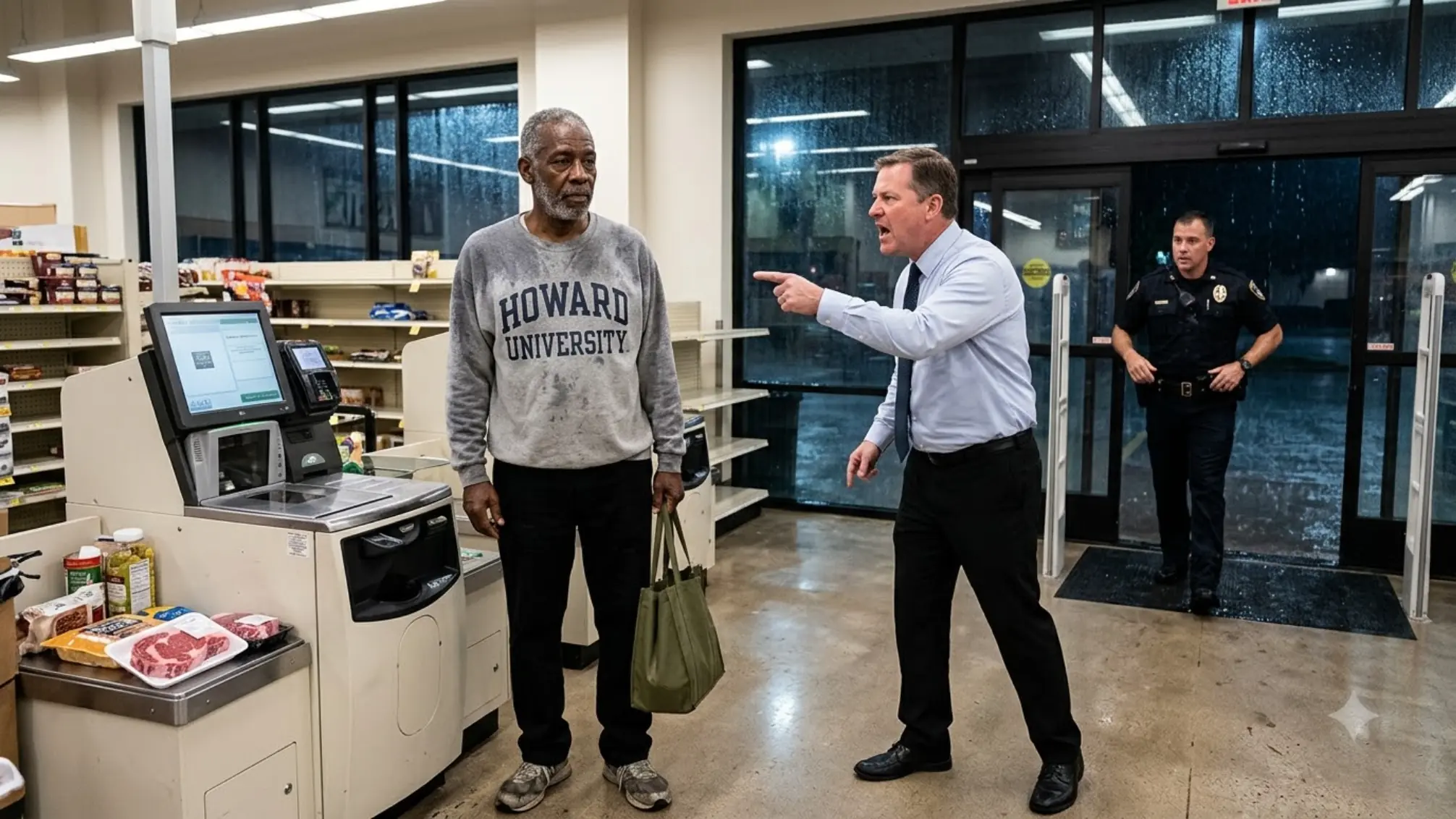
The store was nearly empty.
Outside, a violent Texas storm turned the Dallas parking lot into a black mirror reflecting streetlights and headlights. Water streamed down Malcolm’s faded gray Howard University sweatshirt, and his olive-green reusable grocery bag hung from one hand.
He looked tired.
Ordinary.
Forgettable.
That was exactly what he wanted.
Malcolm was sixty-two years old, with deep brown skin, short graying black hair, a salt-and-pepper beard, and intelligent eyes sharpened by four decades of building businesses people once told him he would never own.
Tonight, there was no tailored Italian suit.
No driver.
No security detail.
No assistant carrying two phones behind him.
No chairman’s badge.
Just a wet older Black man buying groceries shortly before closing.
Malcolm slid the steak across the scanner.
Nothing happened.
He tried again.
The machine beeped.
ITEM NOT RECOGNIZED.
Malcolm frowned.
He placed the steak beside the scanner, removed a package of mushrooms from his reusable bag, and tried scanning that instead.
Behind him, someone had already decided what was happening.
“Sir.”
Malcolm turned.
Forty-five-year-old store manager Brent Wallace stood approximately fifteen feet away, pointing directly at his grocery bag.
Brent wore a pale-blue dress shirt, dark tie, black slacks, and the red Hayes Market management badge Malcolm himself had approved six years earlier when the chain underwent a branding redesign.
Beside Brent stood Officer Nolan Pierce of the Dallas Police Department.
His hand rested near his belt.
Brent’s face tightened.
“Why are you stuffing steaks in that bag before paying? Put it down, thief.”
Malcolm stared at him.
Not angrily.
Not yet.
“You called the cops before checking the register?”
Brent gave a contemptuous laugh.
“People like you always have an excuse.”
He gestured toward Officer Pierce.
“Cuff him.”
The officer hesitated.
Malcolm slowly reached inside his sweatshirt.
Pierce immediately stiffened.
“Hands where I can see them.”
Malcolm stopped.
“Officer, I’m reaching for identification.”
“Slowly.”
Malcolm obeyed.
He pulled out a black leather wallet and removed a dark corporate credential.
Brent rolled his eyes.
Malcolm held it toward him.
“Go ahead,” he said quietly. “Then explain why you arrested the man who owns this entire chain.”
For two seconds, Brent said nothing.
Then he laughed.
It was not nervous laughter.
It was genuine disbelief.
“You own Hayes Market?”
Malcolm held his gaze.
“Yes.”
Brent looked at Pierce.
Then back at Malcolm.
“Oh, this is good.”
He stepped closer.
“You expect me to believe Malcolm Hayes is standing in my store soaking wet in a college sweatshirt stealing meat?”
Malcolm’s expression changed slightly.
“Your store?”
Brent pointed toward the doors.
“Take the fake ID and get him out.”
Officer Pierce accepted the credential.
He examined it.
The amusement disappeared from his face.
The card bore Malcolm’s photograph.
His full name.
MALCOLM A. HAYES
FOUNDER & EXECUTIVE CHAIRMAN
A holographic corporate seal shimmered beneath the fluorescent lighting.
Pierce turned it over.
There was an authentication number.
Brent saw his expression.
“What?”
Pierce said nothing.
“What?”
“This looks legitimate.”
Brent snatched the card from his hand.
“It’s fake.”
Malcolm’s eyes narrowed.
“You might want to stop touching my identification.”
“You might want to stop pretending to be somebody important.”
Brent threw the credential onto the self-checkout counter.
It landed beside the steak.
Malcolm looked at it.
Something inside him changed.
Until that moment, there had been a small possibility that the situation was merely incompetence.
A poorly trained manager.
A misunderstanding.
A badly configured self-checkout.
The credential hitting the counter removed that possibility.
Malcolm reached for his phone.
Brent stepped forward.
“No.”
Malcolm looked up.
“No?”
“You don’t get to start calling your friends now.”
“My friends?”
“Whoever you’re working with.”
Malcolm stared at him.
Brent pointed toward the canvas bag.
“We’ve had theft crews working these stores all month. One comes in, distracts staff, another loads merchandise, somebody outside takes it.”
Malcolm glanced around the nearly deserted supermarket.
“Who exactly is helping me?”
Brent hesitated.
Malcolm continued.
“You watched an older man walk through a storm carrying one shopping bag. You saw him use the self-checkout. You never checked the machine. You never checked the cameras. You never checked his receipt because he hadn’t finished paying.”
Brent folded his arms.
“I know what theft looks like.”
Malcolm’s voice lowered.
“No.”
He looked directly into Brent’s eyes.
“You know what you decided theft looks like.”
Officer Pierce shifted uncomfortably.
Brent’s face flushed.
“Don’t turn this into something it isn’t.”
“What is it?”
“You concealed merchandise.”
“I placed groceries in a reusable shopping bag while shopping.”
“That’s concealment.”
“Your company encourages customers to bring reusable bags.”
“My company—”
Brent stopped.
Malcolm noticed.
“My company?”
Brent clenched his jaw.
“This store.”
Malcolm nodded slowly.
“Interesting correction.”
Pierce walked toward the self-checkout screen.
“What happened when you scanned the steak?”
“Machine rejected it.”
Pierce touched the screen.
A transaction window appeared.
Four items had already been scanned.
Pasta.
Cream.
Mushrooms.
Parmesan.
The steak was listed as pending manual verification.
Pierce looked toward Brent.
“He was checking out.”
Brent’s expression tightened.
“That doesn’t prove he intended to pay for everything.”
Malcolm almost smiled.
“How exactly would you like me to prove an intention you never allowed me to complete?”
Brent turned toward Pierce.
“You’re the officer. Handle it.”
Pierce did not move.
“I don’t have probable cause to arrest him.”
“Are you kidding me?”
“No.”
“I watched him put merchandise in a bag.”
“He’s standing at the checkout.”
“He was going to walk out.”
“Did he?”
Brent’s face reddened.
Malcolm quietly picked up his executive credential.
Then his phone vibrated.
A message appeared.
ELENA: You inside 184?
Malcolm typed one word.
Yes.
Thirty-eight miles away, Hayes Market chief operating officer Elena Brooks was sitting at her kitchen table reviewing reports Malcolm had asked her to retrieve.
Those reports were the reason he was in Store 184.
Three weeks earlier, an anonymous complaint had reached Malcolm’s private corporate inbox.
Normally, complaints were routed through regional management.
This one had been addressed directly to him.
Mr. Hayes, you probably won’t read this. But your managers are stopping Black customers at Store 184 even when they have receipts. My father was held for forty minutes over coffee he had already paid for.
The sender attached a receipt.
Then another person wrote.
A nurse.
She claimed employees followed her through the beauty aisle and demanded she open her purse before leaving.
Another complaint arrived from a twenty-year-old college student.
He had been accused of stealing baby formula.
Security video later showed him paying.
Then came a photograph.
An elderly Black woman seated on a bench inside Store 184 while two employees emptied her shopping bags.
Her receipt was sitting on her lap.
Malcolm forwarded everything to Elena.
“Find out whether these are isolated.”
They were not.
Fourteen customer complaints had been filed against Store 184 in eight months.
Only three appeared in the official regional incident database.
The other eleven had disappeared.
That bothered Malcolm more than the accusations themselves.
Complaints happened in a company with nearly four hundred stores.
Complaints disappearing was different.
He asked Elena not to contact regional management.
Then Malcolm decided to visit Store 184 personally.
Not as Malcolm Hayes.
Not with corporate executives.
Just as a customer.
He had expected poor service.
He had not expected police.
Brent pointed toward Malcolm’s phone.
“Who are you texting?”
Malcolm slipped it back into his pocket.
“Someone who actually works for Hayes Market.”
Brent laughed again.
“Here we go.”
The automatic entrance doors opened.
Wind pushed rain across the tile.
A woman hurried inside beneath a black umbrella.
Behind her came two men carrying corporate laptop cases.
Brent turned.
His face changed instantly.
He knew the woman.
Every Hayes Market manager in North Texas knew Elena Brooks.
She was fifty-one, Black, composed, and famous inside the company for walking into stores unannounced and finding problems regional directors somehow never noticed.
Brent straightened.
“Ms. Brooks?”
Elena closed the umbrella.
Her eyes moved from Brent to Officer Pierce.
Then to Malcolm.
Then to the steak sitting beside the scanner.
“Mr. Hayes.”
Silence.
Brent stopped breathing for what seemed like several seconds.
Officer Pierce looked at Malcolm.
Then at Elena.
Brent whispered, “Mr... Hayes?”
Malcolm said nothing.
Elena walked directly toward him.
“Are you okay?”
“I’m fine.”
She looked at Pierce.
“Officer?”
Pierce raised one hand.
“I was called regarding suspected shoplifting. The transaction screen indicates Mr. Hayes was actively checking out. I haven’t detained him.”
Elena nodded.
“Thank you.”
Then she looked at Brent.
The manager had gone pale.
“Ms. Brooks, I can explain.”
Malcolm finally spoke.
“I’d like to hear it.”
Brent swallowed.
“Sir, I didn’t recognize you.”
Malcolm stared at him.
“That’s your explanation?”
“I mean—”
“Would recognizing me have changed whether I was stealing?”
Brent opened his mouth.
Nothing came out.
Malcolm stepped closer.
“The answer should be no.”
“Yes, sir.”
“Then why does recognizing me matter?”
Brent looked toward Elena as though she might rescue him.
She did not.
“I was protecting company inventory.”
Malcolm nodded toward the steak.
“How much?”
Brent blinked.
“Excuse me?”
“The steak.”
Malcolm picked up the package.
“How much does it cost?”
Brent glanced at the label.
“Thirty-eight dollars.”
“You called armed police over thirty-eight dollars without checking the register?”
“We’ve been told to reduce shrinkage.”
“By whom?”
“Our regional director.”
“Name.”
“Dennis Crowley.”
Elena and Malcolm exchanged a glance.
That name was already inside the complaint files.
Malcolm set the steak down.
“What exactly did Dennis tell you?”
Brent hesitated.
“Managers need to identify high-risk customers before they reach exits.”
Malcolm’s eyes hardened.
“What’s a high-risk customer?”
Brent shifted his weight.
“You know. Suspicious behavior.”
“Define it.”
“Concealing products.”
“What else?”
“Repeatedly handling expensive merchandise.”
“What else?”
No answer.
Malcolm took another step.
“What else, Brent?”
The manager looked at the officer.
Pierce’s expression had become cold.
Elena opened one of the laptop cases.
She removed a tablet.
“We found something today,” she said.
Brent looked at her.
“What?”
Elena turned the screen around.
A spreadsheet appeared.
Rows of entries.
Dates.
Incident numbers.
Loss estimates.
Customer descriptions.
Malcolm had reviewed the document in the car before entering.
One column disturbed him more than anything else.
CUSTOMER PROFILE.
Codes appeared beneath it.
H1.
H2.
H3.
A1.
A2.
Malcolm pointed.
“Tell Officer Pierce what H2 means.”
Brent’s face drained completely.
“I don’t know.”
“You’re the store manager.”
“It’s a regional code.”
“Then tell us.”
Brent shook his head.
Elena spoke quietly.
“H means high-loss demographic.”
Pierce frowned.
“What does the number mean?”
Elena tapped another document.
“We recovered a deleted training guide from a regional shared drive.”
She rotated the tablet.
H1 referred to young men in oversized clothing.
H2 referred overwhelmingly to Black male customers.
A different code covered Hispanic teenagers.
Another identified homeless-looking customers.
There was no explicit racial slur.
Whoever designed the system had been smarter than that.
But internal examples made the meaning unmistakable.
Malcolm felt something colder than anger settle inside him.
“How long?”
Brent shook his head.
“I didn’t create this.”
“That wasn’t my question.”
“Dennis gave us the guide six months ago.”
“And you followed it.”
“We were losing inventory.”
Elena’s voice sharpened.
“So you classified customers by appearance.”
“No.”
“You just admitted you did.”
“I classified behavior.”
Malcolm pointed toward himself.
“What behavior?”
Brent said nothing.
“I walked in wet.”
Silence.
“I selected food.”
Silence.
“I used a reusable bag sold beside your front entrance.”
Brent swallowed.
“I went to self-checkout.”
Malcolm’s voice remained calm.
“And before I could finish, you called police.”
Brent’s hands trembled slightly.
“Sir, I made a mistake.”
Malcolm looked toward the store entrance.
“You made a decision.”
That distinction mattered.
Mistakes were accidental.
Decisions revealed systems.
Officer Pierce’s radio crackled.
He stepped aside to respond.
Elena opened another folder.
“We also found altered incident reports.”
Brent’s head snapped toward her.
“What?”
“Fourteen customer complaints.”
“I don’t manage the complaint database.”
“You approve store-level responses.”
“Dennis handles escalations.”
“Your digital signature appears on nine closures.”
Brent stared at the screen.
“I sign dozens of things every day.”
Malcolm’s expression hardened.
“That sentence has destroyed a lot of careers.”
Brent looked frightened now.
Not embarrassed.
Frightened.
“What happens to me?”
Malcolm ignored the question.
“Elena, lock management access for Store 184.”
She typed something.
“Done.”
“Preserve every camera file for the last twelve months.”
“Already initiated.”
“Cash office?”
“Locked remotely.”
“Employee communications?”
“Legal preservation notice is being issued.”
Brent stepped forward.
“Mr. Hayes, please.”
Malcolm turned.
“You called police on me before checking whether I committed a crime.”
Brent’s voice cracked.
“I’m asking for five minutes.”
Malcolm stared at him.
“You wouldn’t give me thirty seconds.”
Brent lowered his eyes.
Two additional corporate investigators arrived twenty minutes later.
By then, the rain had intensified.
Employees who had been hiding near registers slowly gathered at the edges of the store.
No one spoke loudly.
One cashier named Teresa Nguyen approached Elena.
“Ms. Brooks?”
Elena looked up.
“Yes?”
Teresa glanced nervously toward Brent.
“I have something.”
Brent’s eyes widened.
“Teresa, don’t.”
Malcolm turned immediately.
“Don’t what?”
Brent said nothing.
Teresa pulled out her phone.
Her hand shook.
“Mr. Wallace made us use a group chat.”
She opened it.
“Loss Prevention Alerts.”
Photographs appeared.
Customers.
Dozens of them.
Some taken from security cameras.
Some apparently captured by employee phones.
Captions included instructions.
WATCH THIS ONE.
BAG CHECK IF POSSIBLE.
KNOWN TYPE.
DON’T LET HIM LEAVE WITHOUT RECEIPT REVIEW.
Malcolm scrolled.
Nearly every face was Black or Hispanic.
One image showed an older Black man wearing hospital scrubs.
Another showed a teenage girl carrying a backpack.
Another showed a woman holding a toddler.
Malcolm stopped.
The woman was the customer from one of the complaints.
“Who posts these?”
Teresa looked at Brent.
“Managers.”
Brent’s face twisted.
“You participated too.”
Teresa flinched.
Malcolm noticed.
Brent continued.
“Every employee participated. Don’t pretend you’re innocent.”
Teresa’s eyes filled.
“You told us we’d lose hours if shrinkage stayed high.”
“I told you to do your jobs.”
“You told us to follow Black customers.”
The store went completely silent.
Brent pointed at her.
“That is not what I said.”
Teresa raised her phone.
“I recorded the meeting.”
Brent froze.
Malcolm slowly looked at her.
“You recorded it?”
She nodded.
“My brother told me to after the first complaint.”
“Play it.”
Teresa pressed the screen.
Brent’s own voice filled the aisle.
“I don’t care about being politically correct. You know who walks in here loading bags. Watch them before they get comfortable. If corporate asks, call it behavior-based loss prevention.”
No one moved.
The recording continued.
“Dennis wants incident numbers down. If somebody paid after being stopped, there was no incident. Don’t file it.”
Elena looked directly at Brent.
There it was.
Not misunderstanding.
Not interpretation.
Instruction.
Malcolm’s jaw tightened.
“Send that recording to corporate counsel.”
Teresa nodded.
Brent looked around desperately.
“This came from above me.”
Malcolm’s eyes narrowed.
“Then we go above you.”
By 2:00 a.m., Store 184 was closed.
A handwritten notice on the glass doors said the location would reopen after an internal operational review.
That review did not remain internal for long.
At 7:15 the next morning, Malcolm convened an emergency meeting at Hayes Market headquarters.
Regional Director Dennis Crowley appeared by video from Fort Worth.
He was fifty-eight and had worked for Hayes Market for nineteen years.
Dennis began with confidence.
“Malcolm, Store 184 has one of the highest shrinkage rates in the district.”
Malcolm sat at the head of a conference table.
Elena sat to his right.
Corporate counsel sat to his left.
Teresa’s recording was already queued on the screen.
Malcolm asked one question.
“Did you create the H-profile system?”
Dennis leaned back.
“I created a behavioral-risk matrix.”
“That wasn’t my question.”
“We were responding to theft trends.”
“Did you create H1, H2, and H3?”
Dennis paused.
“Yes.”
“What does H2 mean?”
“It isn’t racial.”
“What does it mean?”
“Higher-risk male demographic.”
Malcolm leaned forward.
“Which demographic?”
Dennis’s expression tightened.
“It was based on store observations.”
“Which demographic?”
Dennis stopped answering.
Elena displayed the deleted training guide.
Then the group-chat records.
Then customer complaints.
Then Teresa’s recording.
Dennis tried another defense.
“These managers were under pressure to reduce losses.”
Malcolm stared at him.
“From you.”
“From corporate targets.”
“Targets I approved?”
“Profitability expectations come from leadership.”
Malcolm’s voice hardened.
“Do not hide discrimination inside a spreadsheet and hand me the blame because I expected you to run profitable stores.”
Dennis’s face reddened.
“You don’t understand what happens on the floor.”
Malcolm sat back.
“I spent last night on the floor.”
Silence.
“Your manager called police on me.”
Dennis stared.
Malcolm continued.
“He saw a wet Black man wearing an old sweatshirt and decided the ending before the transaction even began.”
Dennis exhaled.
“That’s unfortunate.”
Malcolm’s eyes hardened.
“No.”
He placed both hands on the table.
“A thunderstorm is unfortunate.”
He pointed toward the screen.
“This was policy.”
Corporate counsel interrupted.
“We’ve also identified evidence that loss numbers may have been manipulated.”
Dennis looked up.
“What?”
Elena opened another spreadsheet.
Store 184 had reported unusually high “prevented theft.”
That statistic earned Brent’s location regional recognition.
Prevented theft was calculated using the value of merchandise recovered during customer interventions.
But many so-called recoveries involved customers who ultimately proved they had paid—or intended to pay.
A woman stopped with sixty dollars in groceries became sixty dollars of prevented loss.
A teenager forced to show a receipt became twenty-three dollars.
A customer who abandoned a cart after being publicly questioned became the entire cart’s value.
Those numbers flowed upward.
Brent benefited.
Dennis benefited.
Regional loss-prevention bonuses increased.
Malcolm stared at the data.
“So they weren’t just profiling customers.”
Elena nodded.
“They were turning accusations into performance metrics.”
Dennis said nothing.
Malcolm continued.
“The more innocent people your managers stopped, the better your district looked.”
Corporate counsel slid another document across the table.
“And bonuses increased accordingly.”
Dennis’s video feed remained silent.
Malcolm leaned toward the camera.
“Your access is suspended effective immediately.”
“Malcolm—”
“You’ll hear from counsel.”
“You cannot judge nineteen years of service on one night.”
Malcolm’s expression did not move.
“I’m judging six months of records.”
The call ended.
But Malcolm did not consider the matter finished.
Over the next eight weeks, Hayes Market reviewed every customer detention and loss-prevention incident across its Texas stores for three years.
The findings were worse than anyone expected.
Store 184 was the most aggressive.
It was not unique.
Twenty-three locations had used informal customer codes.
Nine had suppressed complaints.
Five had reward structures encouraging questionable stops.
A regional vice president had received monthly summaries and never asked why certain stores were reporting extraordinary levels of “prevented theft” with almost no resulting police charges.
Malcolm removed him.
Three regional managers resigned.
Two store managers were terminated for falsifying records.
Several employees who had objected internally were reinstated or compensated for lost hours.
Customers who had been wrongly detained received direct notices from the company.
Not generic statements.
Individual letters.
Some accepted apologies.
Some sued.
Malcolm did not complain about the lawsuits.
“Our mistakes cost people something,” he told the board. “Repair should cost us something too.”
The board initially resisted his reforms.
One director worried that publishing the investigation would invite negative coverage.
Malcolm answered quietly.
“They already experienced what happened. Hiding it protects us from embarrassment, not them from harm.”
The investigation was published.
Not every confidential detail.
But enough.
Hayes Market eliminated the demographic risk system.
Bag checks required documented objective reasons.
Employees could no longer use “prevented theft” as a bonus metric unless an incident had been independently reviewed.
Customer complaints bypassed local management if they alleged discriminatory conduct.
Body-worn cameras were piloted for dedicated loss-prevention personnel.
Every disputed stop generated an automatic preservation of surveillance footage.
And every store manager was required to spend one full shift per quarter working anonymously outside their normal location.
That final rule was Malcolm’s idea.
Several executives thought it was theatrical.
He disagreed.
“You cannot run a customer-facing company entirely from conference rooms.”
Brent Wallace was terminated after the investigation.
He was not arrested because Malcolm refused to fabricate criminal consequences for dramatic satisfaction.
What Brent had done was serious enough without inventing crimes.
Dennis Crowley lost his position and later became a defendant in civil litigation connected to altered records and discriminatory practices.
Teresa Nguyen received formal whistleblower protection and eventually became a regional customer-integrity manager.
Officer Nolan Pierce submitted his body-camera recording as part of the investigation.
Malcolm later wrote him a short letter.
Thank you for checking the evidence before making the arrest someone demanded.
Pierce kept it.
Months passed.
The scandal faded from headlines.
The reforms did not.
One rainy evening almost a year later, Malcolm returned to Store 184.
This time, nobody knew he was coming.
The pale-blue manager shirts were still there.
The fluorescent lights were still too bright.
The self-checkout machines still occasionally failed.
Some things were eternal.
Malcolm wore another old sweatshirt.
Not Howard this time.
Prairie View A&M.
He carried the same olive-green reusable bag.
He selected pasta.
Mushrooms.
Cream.
Parmesan.
Then he walked toward the meat case.
He stopped when he saw prime ribeye.
For a moment, he simply stared.
A young employee standing nearby smiled.
“Good sale tonight.”
Malcolm looked at him.
“How much?”
“Twenty-nine ninety-nine.”
Malcolm raised an eyebrow.
“That is not a good sale.”
The employee laughed.
“Okay, fair.”
Malcolm picked up the steak.
At self-checkout, the scanner rejected it.
He stared at the machine.
“You have got to be kidding me.”
A supervisor approached.
She was a Latina woman in her early thirties.
“Machine giving you trouble?”
“Yes.”
She scanned her employee badge.
The item appeared.
“Sorry about that.”
“No problem.”
She began stepping away.
Malcolm deliberately placed the steak inside his reusable bag before completing payment.
The supervisor noticed.
She did not tense.
She did not call security.
She simply pointed politely toward the screen.
“It hasn’t charged you for that one yet.”
Malcolm looked at her.
“Thanks.”
He removed the steak and scanned it properly.
The transaction finished.
Outside, rain tapped against the glass.
Malcolm paid.
He collected his receipt.
Before leaving, he looked toward the manager’s office.
A framed document hung beside the door.
Not Malcolm’s photograph.
Not a corporate slogan.
A short statement.
VERIFY BEFORE YOU ACCUSE.
Underneath it were three smaller words.
DIGNITY COMES FIRST.
Malcolm had not written them.
Teresa had.
He stood there for several seconds.
A cashier noticed him.
“Sir, everything okay?”
Malcolm smiled.
“Yeah.”
He picked up the bag.
“Everything’s finally okay.”
The automatic doors opened.
Cool rain blew inside.
Malcolm stepped beneath the awning and looked back through the glass.
Families moved between aisles.
Employees stocked shelves.
An older Black man waited at a register.
A young white cashier smiled while helping him find a coupon on his phone.
Nothing remarkable happened.
That was exactly the point.
Malcolm had spent forty years building the largest grocery chain in Texas.
He had thought ownership meant knowing revenue, margins, properties, suppliers, payroll, expansion plans, and inventory.
Store 184 taught him something more uncomfortable.
You could own every brick in a building and still have no idea what happened to someone walking through its doors.
The company’s sign was his name.
That meant the failure was his too.
His phone rang.
Elena.
Malcolm answered.
“You testing stores again?”
He smiled.
“How did you know?”
“Because your driver just called asking whether I knew why the chairman disappeared into another grocery store during a thunderstorm.”
Malcolm looked at the rain.
“Old habit.”
“How was it?”
Malcolm glanced back through the windows.
“No cops.”
Elena laughed.
“That is a painfully low standard.”
“It’s progress.”
He started toward his car.
“Did they recognize you?”
“No.”
“Good.”
Malcolm stopped.
Across the parking lot, a young man struggled beneath an umbrella while carrying grocery bags toward an old sedan.
One bag split.
Cans rolled across the wet pavement.
Malcolm walked over.
He crouched and picked up two cans.
The young man looked embarrassed.
“Thanks, sir.”
“No problem.”
Together they gathered the groceries.
The young man noticed Malcolm’s sweatshirt.
“Prairie View?”
“My nephew went there.”
“Good school.”
“So is Howard.”
The young man laughed.
Malcolm handed him the final can.
Neither knew the other’s name.
Neither needed to.
Malcolm walked away through the rain.
He had entered Store 184 a year earlier believing he was conducting an undercover inspection.
Instead, the store had inspected him.
Not as a billionaire.
Not as a chairman.
As the man whose name appeared over every entrance.
And when the company failed someone under that name, the title on Malcolm’s identification card mattered far less than what he chose to do after discovering it.