Pamela Cross picked up her pen, tapped it twice on the judges’ desk, and leaned into the microphone with the kind of smile that had survived twenty years of live television.
“Oh, sweetheart.”
She tilted her head.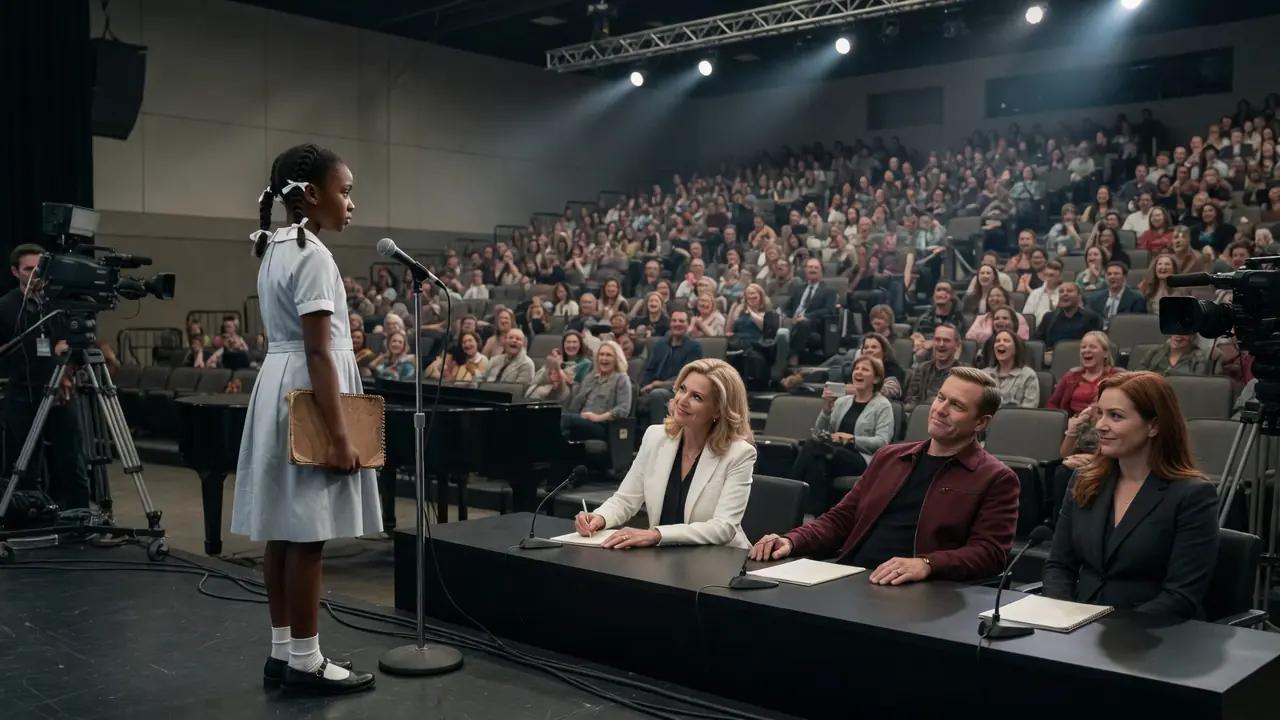
“Is this the part where the little girl from Baltimore tells us she’s the next Whitney Houston?”
Four hundred people laughed.
Pamela set the pen down slowly, folded her hands, and watched Zara Daniels standing alone at the microphone in a hand-pressed dress.
Eleven years old.
Not one note sung yet.
Then Pamela added, almost gently, “Because, baby, Whitney could speak in full sentences.”
The laughter got louder.
Derek Vance leaned back in his chair, smirked at the ceiling, and said into his mic without even looking at her, “Somebody check the back door. I think one of the school groups left somebody behind.”
The booth laughed.
The floor laughed.
Someone in the third row already had their phone out.
Then Brooke Ellison, almost as an afterthought, cupped her hand over her mic and stage-whispered to Pamela, loud enough for the first six rows to hear every word.
“Who let her think she was ready for this?”
Four hundred people were laughing at one eleven-year-old child who had not sung a single note.
Zara Daniels did not step back.
She did not look down.
She did not make a sound.
What happened in the next four minutes would be replayed in classrooms, church halls, and congressional briefings across America.
Nobody in that room knew that yet.
The city of Baltimore holds its stories the way old buildings hold water, quietly in the walls until the weight gets to be too much.
Zara Daniels lived on the second floor of a narrow row house on Brentwood Avenue in East Baltimore, in an apartment that smelled like cedarwood, frying onions, and the particular kind of clean that comes not from money but from discipline.
The carpets were worn to the thread in two places.
The path from the front door to the kitchen.
And the path from the kitchen to Loretta’s bedroom.
Those were the only two routes that mattered in that apartment.
Everything else was decoration.
Everything else was extra.
Loretta Daniels was sixty-eight years old and had been raising Zara since the child was six.
That was the year Keziah Daniels, Loretta’s only daughter, was killed by an uninsured driver on a Tuesday afternoon on East Fayette Street.
Keziah had been walking home from the pharmacy.
She had been carrying a bag of groceries in one hand and a birthday card for Zara in the other.
The card was still sealed when the paramedics found it.
Loretta had kept it in the top drawer of her dresser ever since, still sealed, because opening it felt like finishing something that was not supposed to be finished.
There was no settlement.
The driver had no insurance, no assets, and disappeared from the court docket eighteen months after the accident.
Loretta hired a paralegal with eight hundred dollars she borrowed from her church.
The paralegal did what she could.
It was not enough.
Loretta went back to cleaning houses five days a week and raised Zara on $1,140 a month in Social Security and whatever was left after the electric bill.
She had been the choir director at Greater Calvary Baptist Church for eleven years before her knees gave out.
She still hummed while she cooked.
She still knew every hymn in the book from memory.
And she believed with the quiet certainty of a woman who had survived more than she was ever supposed to that God put a voice in a person for a reason.
The worst thing you could do in this life was let somebody else talk you out of using it.
Zara’s stutter came on at age seven.
It did not come from birth.
It came from grief.
The year after her mother died, Zara stopped speaking in full sentences at school.
Not because she could not form the words.
She could.
In her head, the words came fast and clear and complete.
But something between the thought and the sound kept seizing up like a key turning in a lock that had swollen in the rain.
The school counselor called it a grief response.
The pediatric speech clinic on North Charles Street quoted $3,600 for a twelve-week intervention program.
Loretta folded that paper twice and put it in the drawer with the electric bills.
The stutter stayed.
So did the cruelty.
In second grade, a substitute teacher asked the class to read aloud from a social studies textbook, one paragraph each going down the rows.
When it was Zara’s turn, she got through the first sentence and the second sentence, then stopped at the third on the word between.
The B would not release.
She held it for four full seconds while twenty-two other children watched.
The substitute finally said, not unkindly, which almost made it worse, “That’s okay, sweetheart. We’ll just skip ahead.”
The class did not laugh.
But three of them looked at her with the kind of careful, deliberate pity that a seven-year-old remembers longer than laughter.
In fourth grade, a boy named Tyler Briggs started calling her the broken radio on the playground.
It caught on the way mean things catch on, fast and without anyone deciding to let it.
By the end of the month, half the class used it.
By the end of the year, even some of the kids who liked her used it without thinking, the way you use a word so many times it stops feeling like a choice.
What nobody at school knew, what nobody anywhere knew except Loretta, was that when Zara sang, the stutter disappeared completely.
Not improved.
Not reduced.
Gone.
It had started in the bathroom of the Brentwood Avenue apartment when Zara was eight years old.
She had been standing at the sink, running the tap so Loretta could not hear her cry, and she had started humming one of the hymns from her grandmother’s old church book without meaning to.
Then the humming became words.
And the words came out clean and whole and unbroken.
Every consonant sat exactly where it was supposed to sit.
Every syllable landed without seizure or pause.
She stood there for a long moment, water running, listening to her own voice like it belonged to someone else.
She did not tell anyone.
Not even Loretta.
Not for a long time.
Instead, she started singing every night after Loretta went to sleep.
Quietly in the bathroom with the tap running.
Then in her bedroom with a pillow held over her mouth.
Under her bed, in a spiral notebook with a cracked cover, she kept her songs.
Seventeen of them, written in pencil and erased and rewritten so many times that some pages had worn thin in the middle.
She had never performed any of them for anyone.
She had never intended to.
Then Mrs. Patricia Webb happened.
Zara’s fifth-grade music teacher had stayed late one Thursday afternoon in October, grading sight-reading worksheets at her desk, when she heard something from the hallway outside her classroom.
She set down her pen, walked to the door, and opened it two inches.
Zara Daniels was standing alone in the empty corridor, backpack on, waiting for the late bus, singing softly to herself.
A melody Mrs. Webb did not recognize.
Something original.
Something low and aching and far older than any eleven-year-old had any business knowing how to carry.
Mrs. Webb stood very still in the doorway for the full two minutes it lasted.
Then she closed the door, walked back to her desk, and picked up her phone.
She did not tell Zara.
She did not tell Loretta.
She submitted the application for the Spotlight Stage Junior National Audition that same night and checked the confirmation email three times before she went to bed.
The phone rang on a Wednesday morning three weeks later.
Loretta was standing at the kitchen counter opening a bill.
She sat down at the table and did not speak for ninety seconds.
The morning of the audition, Loretta was up before five.
Zara heard her moving through the apartment in the dark.
The soft drag of slippers on linoleum.
The creak of the closet door.
The particular sound the ironing board made when it unfolded, a metallic groan like something waking up reluctantly.
Loretta had borrowed a travel iron from the woman two doors down, Mrs. Patrice Coleman, who had lent it without asking why because that was the kind of building it was.
The kind where people knew enough not to need an explanation.
The dress was pale blue with a white collar.
Loretta had bought it eight months earlier at a Goodwill on Harford Road for four dollars, hung it in the back of the closet in a dry-cleaning bag, and waited for the right occasion.
She pressed every seam twice.
She pressed the collar three times.
She stood back and looked at it hanging on the door, then nodded once, the way she nodded at things that were as right as they were going to get.
Zara sat on the edge of her bed and watched her grandmother work.
She did not say anything because there was nothing to say that would have been bigger than what was already in the room.
They took the 6:40 bus to the Baltimore Convention Center.
Loretta brought a folding stool she had borrowed from the church, a small aluminum one with a canvas seat that fit inside a canvas sleeve.
Her knees had been bad since March.
The doctors had mentioned a cortisone injection, then mentioned the cost, and the conversation had ended there.
She carried the stool under one arm and her purse under the other and walked with the careful, deliberate pace of a woman who had learned that the only way to keep moving was to be precise about where she put her feet.
The line outside the Convention Center wrapped around the block and halfway down the next one.
Zara had not expected the other children.
She had not expected the matching outfits, the rolling equipment cases, the vocal coaches in professional clothes standing at their students’ shoulders with water bottles and printed sheet music.
One mother was running scales with her daughter against the side of the building, both of them counting in Italian.
A boy of about thirteen was doing breathing exercises with his eyes closed while a man in a blazer watched a stopwatch.
Zara held her spiral notebook against her chest and looked at all of it without moving.
Loretta put a hand on her shoulder.
She did not say anything reassuring.
She did not say, “Don’t worry.”
She did not say, “You’re just as good as any of them.”
Loretta Daniels had never in her life offered comfort by lying.
She just kept her hand there, warm and steady, until Zara’s breathing slowed.
Inside the holding area, a young woman named Keisha Monroe came over with a clipboard and a small lavalier microphone kit.
She was twenty-six, with a natural puff and small gold hoops.
There were stickers on her clipboard.
A yellow sun.
A small cartoon cassette tape.
A sticker that said Still Here in green letters.
She crouched down when she reached Zara.
Not bent at the waist.
All the way down on her heels until her eyes were level.
“What are you performing today?” she asked.
Zara told her.
The stutter hit on the title.
The first syllable caught and held for two full beats before the word came out.
Keisha did not fill the silence.
She did not finish the sentence.
She waited with the particular patience of someone who had learned that waiting was its own form of respect.
“Good choice,” Keisha said when Zara finished.
She clipped the mic to the dress collar with steady hands.
“I’ve got you on the main board and a backup channel. You won’t lose your sound today. I’ve got you.”
She winked.
Then she stood up and moved on to the next contestant.
Zara watched her go and felt something small but real shift in her chest.
Fifteen minutes before the round began, segment producer Frank Solano gathered the three judges in a green room behind the stage.
He pulled up a tablet.
He scrolled to slot seven.
He said the words sympathy slot.
He pulled up Zara’s intake form.
A photograph.
The box marked speech impediment.
The box marked no professional training.
The box marked guardian grandmother, retired.
He laughed first to give them permission.
Derek Vance laughed second, then looked at his phone.
Brooke Ellison looked at the contract renewal document sitting on the corner of the table, three months out and not yet signed, then smiled and nodded.
Pamela Cross did not laugh.
She just looked at the photograph for a long moment.
Then she set the tablet face down on the table with the quiet efficiency of someone filing something away.
“Don’t play neutral,” Frank said. “The audience reads neutral as boring. Just react.”
Nobody objected.
Nobody said a word.
In the corridor between the green room and the stage entrance, there was a thin partition wall made of painted drywall that the production team used to separate the judges’ access route from the contestant holding area.
The partition was not soundproof.
Zara was standing on the other side of it, back against the wall, hands flat against the cool surface, waiting for her number to be called.
She heard her name.
She heard the words sympathy slot.
She heard the word impediment said the way people say a word when it is a verdict, not a description.
She heard three people laugh at the idea of her before she had made a single sound.
She stood very still.
Her hands went cold against the wall.
She took two steps toward the exit.
Two full steps back toward the holding area, toward the door that led to the street and the bus stop and the apartment on Brentwood Avenue.
Then she stopped.
At the far end of the corridor, through a gap in the crowd of production assistants and waiting children and parents with water bottles, she could see her grandmother sitting on the small aluminum stool with the canvas seat.
Loretta’s eyes were closed.
Her hands were folded in her lap.
Her lips were moving.
She was praying.
Quietly.
Without performance.
The way she had prayed every morning of her life since she was nine years old.
Zara watched her for a long moment.
Then she turned around and walked back toward the stage door.
The stage lights hit differently when you are eleven years old and alone.
Zara Daniels walked out from the wings and into the full brightness of the Spotlight Stage audition floor.
The first thing she felt was not fear.
It was the heat.
The lights at the Baltimore Convention Center were industrial rigs borrowed from a touring production company, and they threw a warmth that pressed down on the top of your head like a hand.
She blinked once, adjusted, and kept walking.
The white tape mark was fifteen feet from the judges’ table.
She walked to it and stopped.
The microphone stand had been set at adult height.
A stagehand jogged out from the left wing to lower it, which took approximately twelve seconds.
The audience laughed during those twelve seconds, the way audiences laugh at small things when they have already decided they are in the presence of something small.
It was the first laugh of the afternoon directed at Zara Daniels.
It would not be the last.
She waited while the mic was lowered.
She did not fidget.
She did not look at her feet.
She looked at the soundboard on the left side of the floor, found Keisha Monroe’s face in the dim light behind the board, and held it there like a fixed point on a horizon.
Pamela Cross did not wait for the stagehand to clear the floor.
She picked up her pen, tapped it twice on the desk the way she had in the beginning, a habit, a signal, a way of calling the room to attention that she had been doing for twenty years without noticing she did it.
Then she leaned into the microphone.
“Oh, sweetheart.”
The tilt of the head.
The smile.
“Is this the part where the little girl from Baltimore tells us she’s the next Whitney Houston?”
The laugh came fast, the way it always comes fast when someone powerful gives the room permission to be cruel.
It swept from the judges’ table outward through the first three rows, then back through the rest of the audience like wind moving through dry grass.
Four hundred people laughing.
Pamela set the pen down slowly and folded her hands.
“Because, baby,” she said, “Whitney could speak in full sentences.”
The laugh got louder.
Someone in the fifth row actually applauded.
Derek Vance leaned back in his chair and looked at the ceiling with the particular posture of a man performing boredom for an audience.
Then he brought his mic close without looking at Zara at all.
“Somebody check the back door,” he said. “I think one of the school groups left somebody behind.”
The booth laughed.
The floor crew laughed.
A man in the third row had his phone out, pointed at the stage, already recording.
The live stream counter in the top corner of the production monitor in the booth read 4,200 viewers and climbing.
Brooke Ellison cupped her hand over her microphone, a gesture that looked like discretion and was the opposite of it, and stage-whispered to Pamela in a voice that carried cleanly to the first six rows.
“Who let her think she was ready for this?”
Pamela smiled without turning her head.
Zara stood at the white tape mark and absorbed all of it.
She did not step back.
She did not look at the floor.
She did not do the thing every instinct in her body was telling her to do, which was to make herself smaller, to fold inward, to give the room the retreat it was pushing her toward.
She had spent four years being made smaller in classrooms and hallways and playgrounds.
She understood with the bone-deep knowledge of a child who had had no other choice that making yourself smaller never once made the laughter stop.
Backstage, on her aluminum stool with the canvas seat, Loretta Daniels had her hands clasped so tightly that the knuckles had gone the color of old paper.
She could hear everything.
The Convention Center acoustics were not kind.
Every word from the judges’ table came through the wing curtain clear and whole.
She sat very still and breathed very carefully and did not allow her face to do what it wanted to do.
Because Zara might look back.
And if Zara looked back, she needed to see something steady.
In the front row, an eight-year-old boy named Isaiah sat between his mother and his older sister.
He had laughed at the microphone stand moment, a small genuine laugh because it was a little funny in the uncomplicated way things are funny when you are eight and nothing has weight yet.
But he had laughed at the other things too.
The things Pamela and Derek and Brooke had said.
Not because they were funny, but because everyone around him was laughing.
At eight years old, you do not always know the difference between something that is funny and something that is just loud.
Now he was looking at the girl on the stage.
She was looking at the soundboard.
Not at the judges.
Not at the audience.
At the soundboard, where the woman with the natural puff and gold hoops was sitting very still behind her equipment.
The soundboard woman gave the girl one small nod.
The girl closed her eyes.
She placed one hand flat against her sternum.
A small private gesture.
Fingers spread, pressing gently against something under the fabric of her dress.
Later, people who had been in the front rows would describe it differently.
Some said it looked like she was calming herself.
Some said it looked like she was remembering something.
One woman in the second row, a choir director from a church in Dundalk, said it looked like a person placing their hand on a door before opening it.
Isaiah stopped laughing.
He was not sure why.
He just stopped.
The girl at the microphone opened her eyes.
She looked out at four hundred people who had already decided what she was.
She opened her mouth.
And she began to sing.
The first note came out barely above a whisper.
That was what stopped the room first.
Not the quality of it.
Not yet.
But the sheer unexpected quietness of it.
After all the noise of the last three minutes, after the laughter and the microphone and the judges and the phones, the sound that came out of Zara was so small and deliberate that the people in the first four rows had to lean forward slightly just to make sure they were hearing it correctly.
She had chosen I Can’t Make You Love Me.
The Bonnie Raitt version.
The one recorded in a single take in 1991 in a studio in Los Angeles.
The one Bonnie herself had said she could never perform live because it cost too much every time.
Zara had heard it for the first time at age nine on a secondhand MP3 player she had found in a box at a church rummage sale.
She had listened to it eleven times in a row, sitting on the floor of her bedroom with her back against the bed, not moving.
Then she had taken out her spiral notebook and written at the top of a blank page:
This is what telling the truth sounds like.
She had been working on her own arrangement for fourteen months.
She sang the opening line without accompaniment, just her voice alone in the room.
“Turn down these voices inside my head.”
The stutter was gone.
Not reduced.
Not managed.
Not pushed through with effort and visible strain, the way the school counselor had once suggested.
“Just power through it, sweetheart.”
As if a stutter were a hill you could sprint up if you wanted it badly enough.
It was simply, completely, entirely absent.
Every consonant sat in its place.
Every vowel opened clean.
The words came out of her the way water comes out of a tap when the pressure is right.
Continuous.
Unbroken.
Utterly natural.
The accompanist at his piano, a tired-looking man named Gerald, had been playing audition tracks since seven that morning.
He had been given Zara’s arrangement sheet the night before by Keisha.
He had looked at it once, raised an eyebrow, and said nothing.
Now he brought the piano in under her voice at the second line, soft and low, following her phrasing instead of leading it, the way a good accompanist does when he understands that his job is to carry, not to drive.
In the front row, Isaiah’s mouth was open.
He was eight years old.
He did not have the vocabulary for what he was hearing.
He could not have told you about phrasing or breath control or the particular kind of emotional restraint that makes a voice feel larger than the room it is in.
What he could tell you, what he understood in the wordless way children sometimes understand things before adults do, was that the girl on the stage was telling the truth.
Whatever she was singing about, she meant every single syllable of it.
And he had been laughing at her thirty seconds ago, and he did not know what to do with that now.
His smile was gone.
His mouth was still open.
He did not move.
By the end of the first verse, the wave had started.
It moved the way real silence moves through a crowd.
Not all at once.
In a rolling progression from the front to the back, row by row, as each person registered what was happening and went quiet in response to it.
The small conversations running in the back rows stopped.
The woman who had been texting in the seventh row put her phone face down on her knee.
The man who had applauded Pamela’s joke sat with his hands flat on his thighs and did not move them.
At the judges’ table, Derek Vance set down his pen.
He had spent eleven years as a session singer before television found him.
Eleven years in studios in Atlanta and New York and Los Angeles, playing behind artists whose names people knew, learning to hear music the way a carpenter learns to hear wood for its grain and its weight and the places where it is likely to split under pressure.
He had not used that ear in a long time.
Television did not require it.
Television required reactions, not listening.
He was listening now.
He heard the internal architecture of what she was doing.
The way she was breathing with the phrase instead of against it.
The way she was leaving space inside the melody, the way you leave space inside a room to make it feel larger.
The way her voice dropped at the end of each line, not out of uncertainty, but out of control.
The kind of control that is invisible because it looks exactly like the absence of effort.
He opened his mouth.
He looked at Pamela.
He started to say something.
He could not find the word.
His mouth closed.
Then it opened again.
Then it stayed open.
Brooke Ellison had been in the music industry for sixteen years and had coached forty-three artists to professional recording contracts.
She knew, with the technical precision of long experience, exactly what she was hearing.
The phrasing was not learned.
You could not teach an eleven-year-old to phrase like that.
You could not teach the specific quality of earned sadness that was sitting inside every line of this performance.
It was not a child performing grief.
It was a child who had met grief personally and was reporting back.
Brooke’s smile, the one she had put on for the room three minutes ago, the one she had not taken off since, dissolved.
Her hand came up and covered her mouth.
Her eyes went wet.
She did not blink.
At the back of the room, Pamela Cross had a line ready.
She had been composing it in her head since the first note, the way she always composed her lines, shaping the words in advance so they would land clean and final when the moment came.
Sweetie, this isn’t a sympathy contest.
She opened her mouth.
No sound came out.
She raised her hand toward the production booth, the signal to cut, to go to break, to do something.
Keisha Monroe at the soundboard had quietly disconnected the talkback channel forty seconds earlier.
Pamela lowered her hand.
The girl on the stage kept singing.
At the bridge, Zara’s voice climbed, not with force, not with the kind of theatrical crescendo that audition performances usually reach for, but with the slow, inevitable rise of something that had been building pressure for a long time and had finally found the opening it needed.
Then the final note.
She held it for four full counts.
Not five.
Not six.
Four, exactly.
The precise length that Gerald had marked on the arrangement sheet.
The length that Zara had chosen.
Because it was long enough to say everything and short enough not to ask for applause.
She let it go.
The piano faded underneath her.
And the room fell into a silence so complete that the air conditioning, which had been running the entire time, was suddenly audible for the first time.
Four seconds.
Nobody breathed.
In the front row, Isaiah was standing on his chair.
The woman in row six stood first.
She was a woman in her mid-forties in a gray blazer, and she rose slowly, without theatrics, the way people stand in church when something has moved them past the point of staying seated.
She began to clap.
Not fast.
Not performance applause.
Slow and deliberate, each clap its own complete sound.
The man beside her stood.
Then the row.
Then the row behind it.
By the seventh second, all four hundred people in the Baltimore Convention Center audition hall were on their feet.
The same four hundred who had laughed three minutes and forty seconds ago.
Isaiah was standing on his chair with both hands above his head, clapping like the effort of it was the only thing keeping him upright.
At the judges’ table, nobody spoke.
Tyler Nash, the host, walked out from the wings with his cue card and looked at the judges, then the audience, then back at the judges.
For the first time in six seasons of hosting this show, he appeared to have no idea what the correct thing to say was.
He stood at the edge of the stage and waited.
Derek Vance pressed yes.
He did not speak.
Brooke Ellison pressed yes.
She did not speak either.
Pamela Cross looked at her button for eight full seconds.
Then she pressed yes.
Not one of them said a single word.
Backstage, Loretta Daniels had let go of her folding stool and was standing with one hand pressed flat against the curtain and one hand pressed flat against her own chest.
Her eyes were closed.
Her lips were moving again in the same silent motion they had been moving in all morning.
Zara came off the stage and walked directly into her, and Loretta held her with both arms and did not say anything for a long time because there was nothing language was built for in that moment.
That night, the clip went up.
Not the broadcast version that would not air until the following evening.
A grainy, wide-angle audience recording from someone’s phone in the eighth row, posted at 11:47 p.m. to a personal account with no caption except a single period.
By midnight, it had four thousand views.
By three in the morning, it had ninety thousand.
By the time Zara woke up the next morning at 6:15 and walked to the kitchen in her socks, it had crossed one million.
By seven, it had eleven million.
Derek Vance was the first judge to post publicly.
He did it from his own account at 6:40 in the morning.
No publicist.
No prepared statement.
No careful PR framing.
He wrote four sentences and posted them before he had time to think better of it.
Last night I was told to perform a reaction to a child before she sang a note.
I performed it.
I was wrong.
That girl has more in her voice than I have carried in my entire career. I’m sorry, Zara.
He put his phone face down on his kitchen table and sat there for twenty minutes without picking it up.
Brooke Ellison’s post was longer.
She wrote about the phrase she had said, Who let her think she was ready for this, and how she had first heard a version of those words spoken about herself in 2007 by a music executive who had looked at her across a conference table and decided in under a minute what she was and was not capable of.
She wrote about the four years she had spent after that conversation trying to make herself acceptable to rooms that had already made up their minds.
She wrote:
When Zara walked out on that stage, I had a choice.
I made the wrong one.
That phrase I said, I gave it to a child. I have been carrying it for sixteen years, and I handed it to an eleven-year-old girl, and I will not forgive myself for that quickly.
I’m sorry.
By nine in the morning, the hashtag #SilentRoom was the top trending topic in the United States.
A freeze-frame from the audience recording, the four seconds of complete stillness after Zara’s final note, four hundred people in absolute motionless silence, had been screenshotted and shared two hundred thousand times.
People were using it as their profile picture.
A design account had turned it into a poster with no text.
Pamela Cross did not post.
She had not slept.
She had been on the phone with her publicist from midnight until four in the morning.
With her entertainment lawyer from four until six.
With the network’s head of communications from six until eight.
By nine, she had a plan.
The official broadcast version of the audition aired that evening at eight p.m. Eastern on a two-hour primetime special.
It had been re-edited under Pamela’s direct supervision over the course of a twelve-hour session that had begun the previous night and ended forty minutes before airtime.
In the broadcast version, the four seconds of silence after Zara’s final note were cut entirely.
The standing ovation was reduced to eleven seconds.
Derek and Brooke’s reaction shots during the performance, the open mouths, the wet eyes, the stillness, were replaced with reaction shots from earlier in the audition before the singing started, expressions of polite attention that read as neutral.
Zara’s final held note was shortened by one full count.
And over the opening thirty seconds of the performance, while Zara’s voice was just beginning to fill the room, a light murmur of crowd noise had been laid in.
Not laughter.
Just the ambient sound of an audience that was not yet moved, still waiting to be convinced.
The story the broadcast version told was quiet and simple and completely false.
A child with a disability.
A generous panel.
A touching moment of sympathy.
That same afternoon, Pamela went on a podcast hosted by a colleague and former network executive and said in a calm, measured voice, “The reaction online has been beautiful, and I understand it. But I want to be honest. I have a responsibility to the integrity of this competition. That child has a real and significant speech condition. Putting her on a national stage at this level is not kindness. It is exposure.”
She paused.
“I voted yes because my heart said yes. My professional judgment is another matter.”
At Cooper University Hospital, where Loretta had been taken after her glucose spiked during the audition and had been kept overnight for monitoring, Zara sat in a chair beside her grandmother’s bed and watched the podcast on Keisha’s phone with the volume low.
When it ended, Loretta looked at the ceiling for a long moment.
Then she looked at her granddaughter.
“Baby,” she said, “when somebody twists your story, you don’t fight to untwist their lie. You answer it with the truth one time, in the right room.”
Keisha unzipped the small bag at her feet.
She pulled out a USB drive and set it on the hospital tray between them.
The USB drive contained four things.
The raw soundboard audio, uncompressed from Keisha’s primary recording channel.
Zara’s voice exactly as it had entered the microphone.
No crowd noise layered over it.
No edited silence.
None of the seventeen adjustments that had been made in the twelve-hour re-edit session the previous night.
It also contained the wide-angle stage camera footage sourced from a second independent feed that Keisha had been quietly routing to a backup drive since the audition began.
The complete four seconds of silence intact.
The full standing ovation, all three minutes and forty seconds of it uncut, including Isaiah standing on his chair in the front row with his hands above his head.
Keisha had told no one she was saving the backup.
She had told Zara on the audition day that she had a backup channel, and she had winked, and Zara had nodded.
Neither of them had said anything more about it because sometimes understanding does not require more than that.
“This is what really happened,” Zara said.
It was not a question.
“That’s what it is,” Keisha said.
Zara looked at the drive for a long moment.
Then she looked at her grandmother in the hospital bed.
Then she looked back at Keisha.
“Upload it,” she said.
Keisha uploaded it to her personal YouTube account at 9:47 that evening with a caption she had typed and deleted and retyped three times before settling on the version Zara dictated quietly from the chair beside the hospital bed.
This is what really happened. Z.
Six million views in twenty-four hours.
By the second day, the hashtag #ApologizePamela had appeared in thirty-one countries.
The freeze-frame of the silent room had been joined by a second image: a side-by-side comparison of the broadcast edit and the raw footage showing exactly where the silence had been removed, exactly where the ovation had been cut, exactly where the crowd noise had been inserted.
A data journalist at a media analysis publication had done the frame-by-frame comparison herself and published it at two in the morning.
It had been shared six hundred thousand times before sunrise.
Three days after the audition, Spotlight Stage posted a press release on its official social media accounts.
The release announced what it called a format realignment for the upcoming quarterfinal round.
Going forward, the release explained, all quarterfinal contestants would be required to perform a selection from a network-approved songbook of classical and Broadway repertoire.
No original compositions.
No contemporary material.
The release described this as a measure of fairness, a level playing field that allowed the audience to evaluate each contestant on pure vocal technique, free from the advantages of self-written material.
Buried in paragraph five was a single sentence about judging criteria.
Vocal clarity and diction will be weighted as primary factors in the quarterfinal evaluation.
Frank Solano laughed out loud when the release went live.
He was standing in the production hallway with a coffee cup in his hand, and he laughed the way people laugh when a plan has come together exactly as designed.
“Classical repertoire,” he said to the assistant producer beside him, “and a stutter? We just ended this story.”
The assistant producer smiled and said nothing.
Then he went back to his desk and stared at his screen for a long time without working.
The message in the press release was not subtle to anyone who was paying attention.
Strip the child of her own material.
She was a writer first, and a writer without her words was working at a disadvantage.
Force her onto a formal classical standard where her stutter, absent during her own songs, might behave differently under unfamiliar text.
Make diction a stated criterion and hand Pamela Cross a sentence she could hide behind when she voted no.
That same night, Loretta was discharged from the hospital on the condition of complete bed rest at home for a minimum of one week.
Keisha drove them back to Brentwood Avenue.
She helped Loretta up the stairs and into bed, brought a glass of water and the evening medication, and sat in the kitchen for a while before she left, quietly washing the dishes that had been in the sink since the morning of the audition.
After Loretta was asleep, Zara sat on the edge of the bed and looked at her grandmother’s face in the dark.
She thought about saying the thing she had been thinking since she read the press release.
She thought about it for a long time.
“Grandma,” she said softly.
Loretta opened one eye.
“What if I just stopped? What if we just went home?”
Loretta was quiet for a moment.
She found Zara’s hand without looking.
“You don’t quit in front of people who expect you to quit,” she said.
Her voice was low and even and very tired and completely certain.
“That’s just giving them what they ordered.”
She closed her eye.
Zara sat there until her grandmother’s breathing slowed into sleep.
Then she walked to the kitchen and found Keisha still at the sink.
Keisha dried her hands.
She reached into her bag, pulled out a manila folder, and set it on the kitchen table without saying anything.
Zara sat down and opened it.
Inside were printed screenshots of internal Slack messages between Frank Solano and a senior producer.
Comedy angle on Daniels. Keep it running through semis if she survives the first cut.
Internal emails with subject lines like Format Options Limiting Original Material.
And a single printed transcript, timestamped from an audio recording made in a production meeting three days before the audition.
Frank’s voice.
Sympathy slot. Play it for laughs first.
Zara read every page.
She closed the folder.
“Not yet,” she said.
Keisha nodded.
“Not yet.”
They both understood.
A folder full of evidence is not a weapon until you are standing in the right room with the right people watching and no exit available to the people it belongs to.
At that exact moment, four hundred miles north in a recording studio in Midtown Manhattan, a fifty-four-year-old man named Raymond Cole was watching Keisha’s YouTube upload for the fourth time on a monitor in his control room.
He had five Grammy Awards on the shelf behind him.
He had a granddaughter at home who was nine years old.
He had been sitting in seat B12 of the Baltimore Convention Center audition hall two days earlier because a friend on the production team had quietly sent him the contestant list, and one name on it had stopped him mid-sentence.
He turned off the monitor.
He sat in the dark for a while.
Then he picked up his phone and booked a train from Penn Station to Baltimore departing the following morning.
He packed a single overnight bag, a notebook, and a small silver fountain pen he had carried since his first Grammy.
The one he used to sign every contract he had ever believed in.
He did not call ahead.
He did not send a message.
He just booked the ticket and went to bed.
Raymond Cole knocked on the door of the second-floor apartment on Brentwood Avenue at 10:15 on a Tuesday morning.
Zara answered it.
She was in her school sweatshirt with a bowl of cereal in her hand, and she looked at the man in the hallway and did not recognize him for a full three seconds.
Then she did.
The bowl tilted slightly, and a small amount of milk went over the edge onto the floor.
Neither of them mentioned it.
From the bedroom, Loretta called out, “Baby, who is it?”
Zara turned her head toward the hallway.
Her voice came out steady and entirely calm, which was either genuine composure or the particular shock that arrives too large for any single reaction to contain.
“Grandma,” she said, “it’s Raymond Cole.”
There was silence from the bedroom.
Then the sound of the bed shifting.
Then Loretta appeared in the hallway doorway in her housecoat, moving with the slow precision of a woman under doctor’s orders to take it easy.
She looked at the man standing at her front door for a long moment.
Then she put her hand to her chest and laughed, soft and surprised and completely unguarded, the way people laugh when something happens that they had not permitted themselves to hope for.
“Lord,” she said, “come in out of that hallway.”
Raymond sat on the sofa that had been in that apartment since 1999.
Loretta poured coffee from a pot that had been sitting since seven that morning, and he drank all of it without mentioning the temperature because he was a man who understood that accepting hospitality exactly as it is offered is its own form of respect.
He looked around the apartment.
The worn carpet paths.
The magnet on the refrigerator that said He Is Able.
The stack of medical billing statements on the counter held down by a ceramic dish.
He did not say anything about any of it.
Then he turned to Zara.
“I’ve been making records for thirty-one years,” he said. “In that time, I have sat across from maybe eight voices that made me stop what I was doing and pay attention. Yours is the eighth. I came here because I want to make sure the people trying to bury what you have do not succeed.”
Zara looked at him.
“How did you know where we live?”
Raymond smiled.
“Keisha.”
He stayed for two days.
The first morning, he sat at the kitchen table with Zara and the approved songbook from the Spotlight Stage format announcement and went through every selection page by page.
When they reached Somewhere from West Side Story, Raymond stopped.
He read the lyric twice.
He set the book down flat on the table and looked at the ceiling for a moment.
“This one,” he said.
Zara looked at the page.
“Why this one?”
“Because it’s a song about a place that doesn’t exist yet,” Raymond said. “Written for people who have been told they don’t belong where they are. You understand that song from the inside. That is not something you can fake, and it is not something you can teach.”
He spent the first day rearranging the piece entirely, stripping it back to a single piano line, rebuilding the harmonic structure around Zara’s natural low register, leaving deliberate space inside the phrasing where her stutter might appear.
Not to avoid those moments.
To frame them.
“The pause before the note is not a flaw,” he told her during the third hour of work. “It is anticipation. It makes the room lean forward. We are going to build the arrangement around it so that when the note arrives, it arrives like something the audience has been waiting for without knowing they were waiting.”
Zara listened.
She tried it.
She tried it again.
On the fourth attempt, she felt the difference.
The way the pause held with intention instead of fought against with effort changed the weight of the note that followed it.
She sat with that feeling for a moment.
Then she nodded.
Raymond nodded back.
They kept working.
On the second day, Dr. Angela Marsh arrived.
She had flown from Howard University to Baltimore on her own time and her own money.
She was fifty-one years old, with reading glasses pushed up on her forehead and a tote bag full of research papers.
Her manner was no-nonsense in a way Zara understood immediately as the professional equivalent of Loretta’s warmth delivered without softness.
Care expressed through precision.
Dr. Marsh did not offer to fix anything.
“Your stutter is not a problem I am here to solve,” she said, sitting across from Zara at the kitchen table. “I am here to give you more tools, more colors. What you do with them is yours.”
She spent four hours with Zara on breath support and resonance placement exercises designed not to eliminate the stutter, but to give Zara access to the space around it, the breath below it, the note waiting on the other side of it.
She showed her how a held consonant released through a supported exhale could become a texture inside a musical phrase rather than an interruption of one.
She showed her how to land a word after a pause so that the landing had weight and intention.
Zara absorbed it the way she absorbed music.
Not by analyzing it.
By feeling it until it became part of her body’s knowledge.
In two hours, she did work that Dr. Marsh later told a colleague typically took adult patients four months.
On the second afternoon, Brooke Ellison took the Amtrak from New York to Baltimore and a car from the station to a diner on Harford Road.
She sat across from Zara in a corner booth with both hands wrapped around a mug of tea she never drank.
She looked at the child directly and did not flinch from what she had to say.
“I laughed at you,” Brooke said. “A tweet doesn’t fix that. But I can stand next to you when it matters. And there is something I know about Pamela and 2007 that I have been carrying by myself for a long time. I’m saving it for the night when the cameras are running and there is nowhere for her to go. Will you trust me until then?”
Zara looked at her for a moment.
“Yes,” she said.
That evening, a forty-second video arrived through Keisha’s phone from a thirteen-year-old girl in Memphis named Destiny.
She had a stutter.
She had watched Zara’s audition clip twenty-two times.
She spoke slowly into her phone camera, choosing each word with care.
“I sang out loud in front of my mama for the first time because of you. Thank you.”
Zara watched it twice without speaking.
Then she said quietly to Keisha, “When this is over, I want to meet her.”
The night before the quarterfinal, Zara sat on the edge of Loretta’s bed in the dark.
Loretta’s breathing was slow and even, almost sleep.
Zara took her grandmother’s hand.
“Grandma, what if I stutter on stage?”
Loretta was quiet for a moment.
When she spoke, her voice was low and unhurried and completely certain.
“Then you stutter, baby, and the whole world hears what a real voice sounds like anyway.”
The quarterfinal stage of Spotlight Stage was dressed in gold and white.
Sixteen million people had tuned in live, the highest single-night viewership in the show’s seven seasons.
The production team had brought in additional camera rigs and a second lighting grid.
The judges’ table had been repositioned six feet closer to the stage, which someone in the production notes had described as creating intimacy, and which everyone in the building understood meant something else entirely.
Zara Daniels walked out in a dress Loretta had made.
Not bought.
Made.
From fabric purchased at $3.49 per yard from a bolt of deep blue cotton at a fabric store on Greenmount Avenue in Baltimore.
Cut and sewn on Loretta’s old machine over three evenings while Zara was at rehearsal.
Finished with a white hem that Loretta had redone twice because the first attempt was not level, and Loretta Daniels did not send her granddaughter onto a national stage in an uneven hem.
Zara walked to the white tape mark.
The mic stand had been preset at her height this time.
Nobody had told the stage crew to do that.
Keisha had done it herself during the afternoon sound check and had not mentioned it to anyone.
Five hundred miles south, in the apartment on Brentwood Avenue, Loretta Daniels was propped against three pillows in her bed with a laptop open on the blanket in front of her.
Keisha’s younger sister Nadia was sitting in the chair beside the bed.
Loretta had her hands folded in her lap.
Her eyes were open and very still.
The arrangement opened with a single piano note.
Gerald played it soft, one note held, fading slowly into the room.
Then Zara’s voice entered underneath it, barely above a whisper, the same way she had opened at the audition.
With the deliberate quietness of someone who understands that the way to fill a large room is not to be loud, but to make the room come to you.
“There’s a place for us.”
The pause before place lasted one full beat.
The audience felt it.
A small collective intake.
An unconscious leaning forward.
The body’s instinctive response to anticipated sound.
Then the note arrived, and the room exhaled.
She sang the first verse with the stripped clarity Raymond had built into the arrangement.
Every word precise.
Every breath placed.
The piano holding the space underneath her without crowding it.
Her voice in the low register had a quality the producers in the booth watching on monitors would later struggle to describe accurately in their notes.
One of them wrote, Sounds older than she is.
Another crossed that out and wrote, Sounds exactly as old as everything she has been through.
At the bridge, the stutter came.
It arrived on the word somewhere.
The held S.
One beat.
One and a half beats.
The consonant suspended in the room while four hundred people in the studio and sixteen million people at home waited without breathing.
Zara did not stop.
She did not look down.
She breathed through the base of her ribs the way Dr. Marsh had shown her.
The exhale carried the word forward.
And the note that came out on the other side of it was the cleanest, most fully supported note she had sung all evening.
In the front row, a woman began to cry.
She did not cover her face.
Derek Vance stood at the second verse.
He did not make a production of it.
He simply stood the way you stand when sitting no longer seems like the right relationship to what you are hearing.
Brooke Ellison stood at the bridge.
The same moment the stutter appeared and resolved.
The same moment the audience leaned in and then released.
She stood, and her eyes were wet, and she kept them open.
The final note held.
Four counts.
Released.
The room rose.
Pamela Cross did not stand.
She waited for the applause to crest and then leaned forward into her microphone with the expression of a woman performing reluctant honesty.
“That was genuinely touching,” she said. “Zara, you have real heart. But I have to be transparent with this audience. A stutter in a classical piece is a technical error. I’m not certain this format is serving you. I want what’s best for you, and I have to ask whether advancing you is actually—”
“Pamela.”
The voice came from the upper section of the auditorium.
Seat B12.
Raymond Cole stood up.
He was not in a hurry.
He came down the carpeted aisle steps slowly in a dark blazer, the silver pen on his lapel catching the stage light.
By the time he reached the floor, the room had gone quiet in the particular way rooms go quiet when someone enters a space and the entire room understands instinctively that the space now belongs to them.
He walked to center stage.
He put his hand on Zara’s shoulder.
He looked at Tyler Nash.
“Tyler, before this vote, there is something fourteen million people watching tonight deserve to see.”
Tyler Nash, who had been briefed that afternoon by Raymond and Brooke in a coffee shop two blocks from the studio, nodded and stepped back.
The screen behind the judges’ table came alive.
Slack messages.
Comedy angle on Daniels.
Internal emails.
Format options limiting original material.
Frank Solano’s voice from the timestamped transcript.
Sympathy slot. Play it for laughs first.
Then the side-by-side comparison appeared.
The broadcast edit against the raw footage, frame by frame.
Showing exactly where the silence had been cut.
Exactly where the crowd noise had been inserted.
Exactly what had been taken from Zara’s audition and replaced with something that served a different story.
The studio audience went completely still.
Then Brooke Ellison pulled her microphone close.
“In 2007, Pamela Cross told my manager that my voice was a regional sound that would never scale,” Brooke said. “The exact phrase she used was, ‘Bless her heart, but she’ll never sell.’ I spent four years not recording because of those words. I became a coach instead of an artist because of those words. And when Zara walked out on this stage three weeks ago, I said something to Pamela that I have spent every day since wishing I could take back.”
Her voice stayed steady, though her eyes did not.
“Because I had been carrying her words for sixteen years, and I handed them to an eleven-year-old child. I am done carrying them. And I am done being quiet.”
Derek turned to the camera.
“I was given a role to play on this show,” he said. “I played it. I chose my contract over my conscience. I will not make that choice again.”
Pamela Cross opened her mouth.
Nothing came out.
She sat very still for three full seconds.
Then she reached up, removed her in-ear monitor, and set it on the table in front of her with the careful, deliberate motion of someone putting down something they had been holding for a very long time.
She stood.
She did not look at Derek.
She did not look at Brooke.
She did not look at Zara.
She walked off the stage.
She did not look back.
Derek pressed yes.
Brooke pressed yes.
Pamela’s button sat unpressed on an empty table.
Tyler Nash stood at center stage for four full seconds without speaking.
Then quietly, he said, “I think that’s a yes.”
Zara reached up and took Raymond’s hand.
“Mr. Cole,” she said, “my grandma’s watching.”
Raymond bent down and wrapped both arms around her.
Five hundred miles south, on Brentwood Avenue, Loretta Daniels pressed both hands over her mouth and made a sound that Nadia, sitting beside her, would later describe as the sound of a person who had been holding her breath for eleven years.
And in an apartment in Memphis, a thirteen-year-old girl named Destiny turned to her mother and said without stuttering three words she had never said out loud before in her life.
“I want to audition.”
Pamela Cross stepped down from Spotlight Stage forty-eight hours after the quarterfinal broadcast.
The network’s official statement cited personal reasons and thanked her for twenty years of service.
Her name did not appear in any subsequent press release.
Her photograph was removed from the show’s official website on a Saturday morning, quietly, without announcement, the way you remove something from a wall when you have decided the wall looks better without it.
Frank Solano was terminated the following Monday.
The network announced a third-party editorial audit of the show’s production practices to be completed within ninety days and released in full to the public.
Derek Vance and Brooke Ellison remained on the panel.
Both enrolled in implicit bias training programs of their own choosing and said so publicly, not in managed statements, but in direct posts from their own accounts, in their own words, without publicist framing.
Derek’s post was four sentences.
Brooke’s was two paragraphs and ended with, This is not penance. This is paying attention.
Two weeks later, the semifinal aired.
Zara performed an original song she had written on a paper grocery bag at Loretta’s kitchen table at eleven at night after the quarterfinal, when the apartment was quiet and the medical bills were still on the counter and the refrigerator was humming and everything felt simultaneously enormous and completely ordinary.
She had written it in pencil in forty minutes.
Keisha had smoothed the bag flat and photographed it so it would not be lost.
Raymond had spent one afternoon building an arrangement around it that changed almost nothing because almost nothing needed to change.
The song was called Still Here.
She won the semifinal audience vote with sixty-one percent, the widest margin of any contestant in any round in the show’s history.
The finale aired on a Saturday night in March.
Loretta Daniels was in the front row.
It was her first time leaving the apartment in three weeks.
She had borrowed her neighbor Mrs. Coleman’s good church dress, a deep burgundy with a round collar, because her own good dress had a loose hem she had not had the strength to fix.
Keisha drove them from Brentwood Avenue to the production facility in a rented car and walked beside Loretta from the parking structure to the entrance with one hand ready at her elbow.
Not holding it unless needed.
Loretta Daniels did not require assistance she had not asked for.
She took her seat in the front row.
She placed her purse on her lap.
She folded her hands on top of it.
She did not let go of it once during the entire show.
Zara won.
The prize was $200,000.
Raymond Cole set up a trust the following morning.
Every dollar locked until Zara’s eighteenth birthday.
His label, Threshold Records, separately covered all outstanding medical expenses for Loretta Daniels: $14,200 in diabetes management, specialist consultations, and prescription costs accumulated over the previous fourteen months.
The label’s director of artist development called Loretta directly to tell her.
Loretta listened to the full explanation without interrupting.
When it was finished, she said, “Thank you.”
Then she said, “God is able.”
Then she was quiet for a moment.
Then she said, “Thank you again.”
Because sometimes the only thing large enough for a moment is the same word twice.
Zara declined the speech and language intervention program the label’s medical coordinator offered to fund.
She thought about it for two days.
Then she sat down with Raymond at the kitchen table and told him her answer.
“I want to keep my voice the way it is,” she said. “It’s the voice my mama left me. She made it. I’m keeping it.”
Raymond looked at her for a moment.
Then he nodded.
“Understood,” he said.
Loretta’s next round of scans came back two months later.
Remission.
Still Here went gold in four months.
Zara returned to school in Baltimore and missed a total of four days.
Twice for television appearances.
Once for the gold record ceremony.
And once because she had a cold, and Loretta made her stay home and drink ginger tea and rest because gold records were fine, but they did not outrank the immune system.
In May, Destiny flew up from Memphis.
She and Zara sat on the front stoop of the Brentwood Avenue building on a warm afternoon and recorded a duet version of Still Here.
Zara’s voice and Destiny’s voice, both of them sitting on the concrete steps with a portable speaker between them and Keisha filming on her phone.
They did not use a studio.
They did not use headphones.
No click track.
No soundboard.
They just sang together on the stoop while two neighborhood kids on bikes circled the sidewalk and pretended not to listen.
Keisha posted it a week later with no caption.
Three point two million views.
Destiny’s mother sent Keisha a text message two days after the video went up.
It said:
She asked to start speech therapy. First time she’s ever asked. I cried for twenty minutes.
Dr. Angela Marsh founded a nonprofit that summer with seed funding from Threshold Records.
Its mission was supporting children whose voices had been labeled defective, insufficient, or unready by schools, casting systems, and well-meaning adults who had confused their own discomfort with a child’s limitation.
The mission statement was written by Dr. Marsh and Zara together over a single afternoon at the kitchen table on Brentwood Avenue, going through drafts until Zara said, “That one.”
And Dr. Marsh stopped and wrote it down.
Your voice is not broken. It is yours.
Keisha Monroe signed a producer development deal with Threshold Records.
She kept her phone number.
She kept her clipboard with the stickers on it.
Isaiah, the eight-year-old from the front row, who had laughed first and cried first and stood on his chair first, came to a signing event in Baltimore three months after the finale with his mother and a small spiral notebook.
He worked his way to the front of the line.
Zara recognized him immediately.
They took a photograph together.
She signed his notebook and wrote four words underneath her name.
For the kid who listened.
Mrs. Patricia Webb, the music teacher who had submitted Zara’s name without telling anyone, retired at the end of the school year.
At her retirement assembly in the school gymnasium, Zara performed Still Here live for the first time in the city where it had been written.
Every teacher in the room stood.
The boy in the back row who sat alone at lunch and had a slight stutter, the boy who had been watching everything from the beginning, looked up from his book and did not look back down.
In the spiral notebook under Zara’s bed, there was a line she had written at age nine, before she knew what to do with it, before she knew it would ever mean anything to anyone outside the walls of the apartment on Brentwood Avenue.
My voice gets stuck sometimes, but it never stops.
She had never erased it.
One year after the audition, Zara Daniels walked to the center of the stage at the Kennedy Center in Washington, D.C., for the first performance of her first national tour.
Twenty-four hundred seats sold out.
The lights were warm and white and very bright.
The room had the particular quality of silence that only an audience in genuine anticipation can produce.
Not the silence of waiting.
The silence of readiness.
Loretta was in the front row in Mrs. Coleman’s burgundy church dress, her purse on her lap, her hands folded on top of it.
Before she walked out, Zara stood in the wings and opened the locket at her throat.
Inside was a photograph of Keziah Daniels, twenty-nine years old, laughing at something outside the frame of the picture.
Her head tilted back.
Her eyes closed fully in the moment the photograph had caught.
Zara looked at her mother’s face for a long time.
Then she closed the locket.
She walked toward the lights.
Somewhere along the way, someone told you the thing about yourself that needed to be fixed.
Your accent.
Your stutter.
The way you laugh too loud or take too long to find the word.
Maybe you believed them.
Maybe you spent years making that thing smaller, quieter, less visible, trying to become acceptable to rooms that had already decided what you were.
Zara Daniels walked into a room of four hundred people who had already decided.
She did not fix anything.
She did not hide anything.
She just sang the truth in the only voice she had ever had.
And the room had no choice but to listen.
The thing they keep telling you to fix might not be broken.
It might be exactly the reason someone, somewhere, has been waiting to hear from you.
Because somewhere right now, there is a kid standing at a microphone who just needs to know the room can change.
And sometimes, all it takes is one real voice refusing to disappear.