The July heat lay over Custer County, Nebraska, like a heavy iron sheet when seventeen-year-old Travis Kepler slammed a grease-blackened wrench onto the workbench. The blow echoed through the corrugated-steel equipment shed and startled a pair of sparrows from the rafters. Behind him stood the family’s 1975 New Holland TR70 combine, its faded yellow panels hanging open and hydraulic oil dripping slowly onto the concrete. Beyond the wide doors, nearly five hundred acres of wheat waited beneath a white-hot sky, but the machine that had harvested those fields for eighteen years could no longer move under its own power.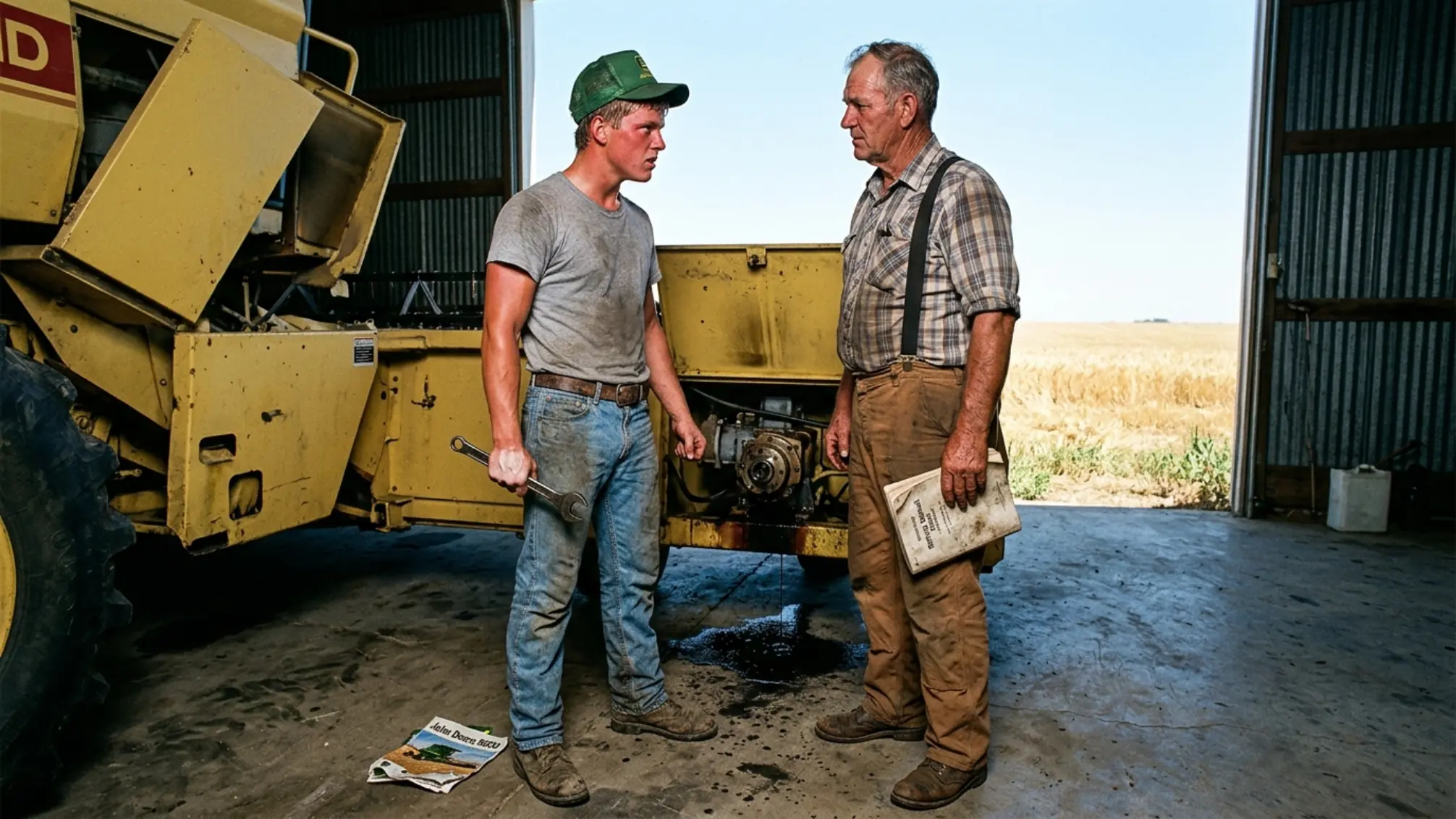
Martin Kepler’s voice was not loud, but it carried the finality of a gate being locked. At sixty-three, he had survived drought, hail, collapsing grain prices, and the farm crisis that had driven half the county from land their families had worked for generations. Deep lines crossed his sun-darkened face, and the fingers holding the service manual were thick with old scars from engines, fences, and machinery that had refused to cooperate. He did not threaten often, which was why Travis knew he meant every word.
Travis stared at his father in disbelief.
“You’d keep me from the farm over one worn-out machine?”
“No,” Martin said. “I’d keep the farm from a man who thinks buying his way around trouble is the same as solving it.”
“We can afford something better.”
“Barely.”
“The dealer has a used John Deere 9600. Five years old, low hours, air conditioning, electronic monitors, twice the capacity of this thing.”
“And a payment due every month whether rain falls or not.”
Travis kicked the crushed dealership brochure near his boot. He had studied it until he could recite every feature. The green machine in the photograph looked powerful, modern, and dependable—the opposite of the TR70 that had broken down in nearly every field during the previous harvest.
He had spent three summers operating the old combine. He knew which vibration meant a loose belt and which metallic scream meant shutting down immediately. He had watched the unloading auger seize with fifty bushels trapped in the grain tank, the feeder chain stretch until it jumped its sprocket, and the engine temperature climb toward disaster on hundred-degree afternoons.
Every failure embarrassed him.
Neighbors crossed nearby fields in newer machines with sealed cabs and cold air blowing across their faces. Travis sat inside a dusty glass box, breathing chaff and listening for the next part to fail. He imagined them watching the Keplers stop again and thinking the family farm was as worn out as its equipment.
Martin walked toward the combine and placed one hand against its faded side panel.
“This machine paid for your mother’s hospital bills,” he said. “It carried us through the drought of eighty-three and the price collapse in eighty-six. It finished harvest the year your uncle died because there was no one else to drive it.”
“That doesn’t mean it can run forever.”
“No machine runs forever.”
“Then why are we pretending this one can?”
Martin turned. “Because you have confused old with worthless.”
Travis opened his mouth, but his father raised the service manual.
“Hydrostatic pump is failing. That’s why you heard the grinding. Remove it, rebuild it, then inspect every system from the header to the grain tank.”
“Every system?”
“Every bearing, chain, belt, hose, sprocket, cylinder, and electrical connection.”
“Harvest starts in six weeks.”
“Then you should stop arguing.”
Martin placed the manual on the workbench and walked toward the house.
Travis remained in the shed, staring at the machine that had just become his judge.
The Kepler farm had begun with one hundred sixty acres purchased by Martin’s grandfather in 1921. The family survived the Dust Bowl by repairing equipment other farmers abandoned, bartering labor for seed, and refusing to sell land even when the bank offered less than it was worth. Martin inherited four hundred eighty acres in 1968 with no ceremony beyond a handshake from his father and one instruction: leave the soil stronger than you found it.
The TR70 arrived seven years later, bright yellow and revolutionary. It was the first self-propelled combine the family had owned, purchased with a loan that took Martin years to repay. Photographs in the farmhouse showed a younger Martin standing beside it with one boot on the tire, smiling as though he had brought home a piece of the future.
Now the paint had faded nearly cream. Rust crept along the lower panels, the seat had been repaired with duct tape, and more than ten thousand hours showed on the meter. To Travis, it represented everything holding the farm back.
The following morning, he entered the shed before sunrise.
The service manual waited where Martin had left it. It was three inches thick, its pages stained by grease and filled with exploded diagrams, torque specifications, and warnings printed in red. Travis opened it to the hydrostatic drive section and immediately felt overwhelmed.
The pump sat beneath guards, brackets, belts, hoses, and wiring. Removing it required draining fluid, labeling connections, supporting the housing, and loosening bolts that had not moved in years. The first bolt stripped before seven o’clock.
Travis threw the wrench across the floor.
Martin appeared in the doorway carrying two cups of coffee.
“Finished already?”
“The bolt head is ruined.”
“So remove it another way.”
“How?”
Martin sipped his coffee. “That is why you have a brain.”
“You could just tell me.”
“I could also rebuild the combine myself.”
Travis glared at him.
Martin set down one cup. “Heat the housing around the bolt. Tap it with a hammer. Use the extractor set in the second drawer.”
“Why didn’t you say that before I destroyed it?”
“Because next time you’ll stop before you destroy it.”
He walked away.
By noon, the pump finally rested on the workbench. It was heavier and more complicated than Travis expected, filled with precisely machined pistons, bearings, seals, and a swash plate that controlled the combine’s speed. Dirt entering the housing could ruin the entire assembly, so every part had to be removed, cleaned, measured, and arranged in order.
Travis worked until evening.
When he entered the kitchen, his mother, Ellen, placed roast beef and potatoes before him. Martin sat at the opposite end of the table studying crop reports without mentioning the repair.
“You could help him more,” Ellen said.
“I am helping.”
“You’re watching him suffer.”
Martin folded the newspaper. “Struggle is not suffering.”
“It feels like it when you’re seventeen,” Travis muttered.
His father looked at him. “What did you find?”
“The input bearing is rough. The swash plate may be scored.”
“May be?”
“I haven’t measured it.”
“Then you don’t know.”
Travis pushed his plate away. “Nothing I say is good enough.”
“Guessing is not good enough when a ten-ton machine depends on your answer.”
“I know that.”
“No. You are beginning to know it.”
Travis left the table before anger made him say something he could not take back.
For three days, he disassembled the pump. He washed every component with solvent, blew oil passages clean with compressed air, and used a micrometer to compare worn surfaces against specifications. The input bearing had failed. Two pistons showed deep wear, and the swash plate carried grooves that would worsen under pressure.
He made a list and handed it to Martin.
His father studied the measurements.
“You checked them twice?”
“Yes.”
“Order the parts.”
Travis stared at him. “That’s it?”
“What do you want, a parade?”
“I expected you to tell me I did something wrong.”
Martin returned the paper. “You did it correctly.”
The simple approval warmed Travis more than he wanted to admit.
While they waited for replacement parts, Martin ordered him to inspect the engine. The combine used a six-cylinder turbocharged diesel that had run through eighteen harvests. Travis changed the oil, removed injectors for testing, checked valve clearances, pressure-tested the cooling system, and examined the turbocharger shaft for movement.
The engine was worn but healthy.
Next came the drive system.
Chains that appeared usable stretched several inches beyond specification. Sprocket teeth had worn into sharp hooks, and bearings that seemed smooth while installed produced a faint grinding sound when spun by hand. Martin taught Travis to listen through the handle of a screwdriver pressed against a housing, using vibration to identify damage hidden inside.
“Machines talk,” Martin said. “Most people only listen after they start screaming.”
Travis replaced bearings and chains, but some original parts were no longer available. When the dealer said a mounting bracket had been discontinued, Travis expected the repair to stop.
Martin placed a sheet of steel on the bench.
“Make one.”
“I’m not a machinist.”
“You will be by supper.”
They traced the old bracket, cut the steel, drilled mounting holes, and bent it in a hydraulic press. Travis welded the seams and ground them smooth. The finished piece looked rougher than the factory version but fit perfectly.
He held it beneath the work light.
“We made that.”
“You made it,” Martin corrected.
The project expanded from repair into resurrection.
They removed the rotor assembly and found threshing bars worn smooth along their leading edges. Travis wanted new bars, but the cost was nearly twelve hundred dollars.
Martin unbolted one and flipped it over.
“The trailing edge is still sharp.”
“You can use them backward?”
“You can use them correctly in the opposite position.”
They reversed every bar, adjusted the concave, replaced damaged wires, and cleaned years of packed dust from areas Travis had never known existed. He crawled beneath the cleaning shoe, breathing dirt and wheat chaff while repairing rusted sieves and balancing the fan.
Each completed system revealed another weakness.
A hydraulic hose cracked when Travis bent it. Electrical connections were green with corrosion. The feeder chain had stretched three inches, and its tensioner was nearly worn through. One cylinder leaked so slowly that no one noticed until it lay disassembled on the bench.
Then Travis found the fracture.
It appeared as a thin dark line along the main frame rail beneath the grain tank. He scraped away paint, followed the crack with a flashlight, and felt his stomach tighten. If it had continued spreading, the frame could have separated under a full load during harvest.
“Dad,” he called.
Martin crawled beneath the machine and studied it without speaking.
“Could this have killed someone?”
“It could have ruined the combine. Maybe worse.”
“We never saw it.”
“We never looked closely enough.”
Travis sat back on the concrete. “If we bought the 9600, this wouldn’t matter.”
“If we bought the 9600 without finding this, the dealer would give us scrap value and sell us a loan.”
“So?”
“So now you know why inspection matters before replacement.”
They ground the crack clean, drilled holes at both ends to prevent further spreading, welded it, and added reinforcement plates. Martin made Travis repeat the weld after discovering weak penetration on the first attempt.
By the fourth week, Travis stopped counting the days until harvest.
The rebuild no longer felt like punishment. Every mechanism became a problem with an answer waiting to be discovered. He began arriving before Martin and working after supper, not because he feared losing the farm but because he wanted to see the machine whole again.
His friends invited him to the county lake one Saturday.
Travis declined.
“You’re spending summer with that dinosaur?” his friend Cody asked.
“I’m rebuilding it.”
“Why?”
Travis looked at the exposed rotor and newly painted frame. “Because nobody else thinks it can be saved.”
Cody laughed, but the insult no longer bothered him.
The hydrostatic parts arrived in early August. Travis rebuilt the pump on a spotless cloth, lubricating each piston and checking every clearance. Martin watched from a stool but never touched the components.
When Travis reached for the housing, his father stopped him.
“What did you forget?”
Travis scanned the bench.
The new shaft seal remained inside its package.
He exhaled sharply. “I almost closed it without the seal.”
“And what would happen?”
“It would leak as soon as pressure built.”
“How much work to fix it?”
“Remove the pump again.”
Martin nodded. “Slow is faster than doing it twice.”
Travis installed the seal.
They mounted the completed pump, connected the lines, filled the system, and bled the trapped air. Travis climbed into the cab while Martin stood beside the open panel watching for leaks.
The engine turned twice before roaring to life.
Travis eased the hydrostatic lever forward.
The combine moved.
There was no grinding, no hesitation, and no violent shudder beneath the cab. The machine rolled across the yard with a smoothness he had never felt from it before.
He looked down through the windshield at his father.
Martin gave one small nod.
That evening, they washed the sheet metal, sanded the worst rust, and sprayed fresh yellow paint across the repaired areas. The combine did not look new, but it no longer looked defeated.
Harvest began six days later.
The first field lay north of the house, one hundred acres of winter wheat rolling gold beneath a clear morning sky. Neighbors had already started cutting, and distant combines moved across the horizon like ships.
Travis climbed into the TR70 before sunrise.
Martin stood on the ladder outside the cab.
“You nervous?”
“No.”
“You should be.”
“Why?”
“Confidence checks the oil. Arrogance assumes someone else did.”
Travis rolled his eyes but checked every fluid level again.
He lowered the header, engaged the rotor, and entered the wheat. Stalks vanished beneath the cutter bar, grain flowed through the feeder house, and clean kernels began filling the tank.
The combine ran without complaint.
For eight straight days, it cut four hundred acres. The engine temperature held steady. The rebuilt pump remained smooth, the feeder chain stayed tight, and the unloading auger emptied faster after Travis adjusted its drive.
He no longer feared every sound.
He understood them.
One afternoon, neighboring farmer Carl Brennan stopped beside the field while they unloaded grain. He walked around the combine, staring at the repaired panels and fresh welds.
“I thought this machine was finished,” Carl said.
“So did I,” Travis admitted.
Martin climbed down from the grain truck.
“Travis rebuilt it.”
“The pump?”
“The entire machine.”
Carl removed his cap. “You did all this?”
“With some help.”
Martin shook his head. “He did the work.”
Carl looked at Travis with a respect the boy had never received from an older farmer.
“Most young men only know how to turn a key,” Carl said. “You know what happens after the key fails.”
The words stayed with Travis through the rest of harvest.
In November, the John Deere dealer called Martin with a better offer on the used 9600. The price had dropped, and the farm’s wheat yield was strong enough to manage the payments.
Martin invited Travis to review the figures.
“What do you think?” he asked.
Months earlier, Travis would have signed immediately.
Now he studied the payment schedule, interest rate, insurance costs, and expected maintenance. He compared them with the money already invested in the TR70.
“We should keep what we have.”
Martin leaned back. “Why?”
“The TR70 is paid for. I know every system, and we can repair almost anything ourselves. If wheat prices fall, that payment won’t care.”
“You still want the newer machine?”
“Yes.”
“So why refuse it?”
“Wanting something doesn’t make it wise.”
Martin smiled.
It was not triumphant. It was proud.
The TR70 remained on the Kepler farm for another ten years. Travis improved it every winter, adding better seals, a cab radio, reinforced guards, and modifications that increased reliability. Other farmers began bringing broken equipment to him, and he became known throughout the county as the young man who could revive machinery dealerships had declared worthless.
In 1998, Martin suffered a heart attack.
He survived, but the doctor ordered him to reduce his workload. At twenty-two, Travis assumed responsibility for planting, harvest schedules, equipment maintenance, and grain sales.
The transition frightened him.
Then a drought struck, corn prices fell, and the farm’s primary tractor lost its hydraulic system during planting. Travis rebuilt the control valve from salvaged parts and finished before the next rain.
Martin watched from the porch.
“You were right,” Travis said later.
“About what?”
“The combine.”
Martin shook his head. “I was right that you could learn. The machine was only the classroom.”
In 2003, the TR70’s engine block cracked beyond repair. By then, the farm was profitable, and Travis had earned the right to choose without anger guiding him.
He and Martin purchased a used John Deere 9610.
It had air conditioning, electronic monitors, a wider header, and nearly every feature Travis had begged for in 1993. He appreciated all of them, but he also kept the service manual beside the seat and inspected every system before harvest.
The TR70 was moved to the rear of the equipment shed.
Travis drained its fluids, covered the exhaust, and placed a tarp over the faded yellow body. He could not bring himself to sell it for scrap.
Martin died peacefully in 2012 at the age of eighty-two.
Half the county attended his funeral. Farmers told stories of engines he had repaired, storms he had predicted, loans he had warned them against, and help he had offered without expecting payment.
After the burial, Travis entered the equipment shed alone.
He removed the tarp from the TR70 and rested one hand on its cold metal.
“I should have thanked you sooner,” he whispered.
Six years later, Travis’s ten-year-old son, Luke, asked when he would be allowed to operate the modern combine.
Travis heard his own seventeen-year-old voice inside the boy’s excitement.
He led Luke to the back of the shed and pulled away the tarp.
The TR70 stood beneath dust and shadows, silent for fifteen years.
“What is that?” Luke asked.
“The machine your grandfather made me rebuild.”
“Does it run?”
“No.”
Luke smiled. “Can we scrap it?”
Travis handed him the same grease-stained service manual Martin had thrown across the shed in 1993.
“You’re going to make it run again.”
The boy’s smile vanished.
“How long will that take?”
“As long as it takes.”
“That’s not fair.”
Travis placed a hand on his son’s shoulder.
“No,” he said softly. “It’s more valuable than fair.”
They began with the engine.
Luke complained, rushed, stripped bolts, and asked why they could not simply purchase another machine. Travis resisted the temptation to complete the difficult work for him.
He offered guidance but left the tools in Luke’s hands.
By autumn, the old yellow combine ran again.
Father and son drove it into a soybean field at sunset and harvested one slow, perfect round. When they stopped, Luke remained seated behind the wheel, staring across the cut rows.
“I understand now,” he said.
“Tell me.”
“It isn’t really about the combine.”
Travis felt his throat tighten.
“What is it about?”
“Knowing I can figure something out when it breaks. Not needing everything to be easy or new.”
Travis looked toward the fading sky and imagined Martin standing beside the field with his arms folded.
“Your grandfather would have been proud.”
“Were you mad when he made you do it?”
“Furious.”
“Did you ever tell him he was right?”
“Eventually.”
Luke smiled. “I’m still a little mad.”
“That means the lesson is working.”
The TR70 returned to the shed, but it was no longer abandoned machinery. It had become a family inheritance more valuable than any deed, bank account, or modern machine.
It taught three generations that farming was not merely operating equipment when conditions were perfect. It was learning how systems worked, remaining patient when solutions refused to appear, and keeping something alive when the world declared it finished.
In 1993, Travis believed his father was trapping him in the past.
Years later, he understood that Martin had been preparing him for the future.
The old combine never made the Keplers wealthy. It did not harvest faster than newer machines or impress neighbors from across the highway.
What it produced could not be measured in bushels.
It built a farmer who knew how to survive.