Seventeen-year-old Lucas Carter first noticed the biker because the man kept staring at the menu like it was written in a language he could almost understand, but not quite afford.
It was late evening in Detroit, Michigan.
Rain pressed against the glass windows of a small roadside diner, sliding down in uneven streaks like tired tears.
Neon lights from outside reflected on the wet pavement, flickering red and blue from passing cars and motorcycles. Inside, the diner was warm but not comforting in the way people imagine.
It was warm in a practical way—coffee machines humming, fryers sizzling, and the smell of grilled meat mixing with cheap soap and rain-soaked jackets.
Lucas sat in a corner booth wearing a plain gray hoodie and jeans slightly worn at the knees. His backpack rested beside him, half-open, revealing a school notebook, a pen, and a folded paper with part-time job applications he had been meaning to finish.
He was sixteen, but life had made him feel older in small ways. Not in a dramatic sense. Not in some cinematic hardship.
But in quiet routines—checking prices before ordering, counting coins before buying anything, and always choosing the cheapest thing on the menu without looking like he was thinking too hard about it.
His mother, Diane Carter, worked double shifts at a nursing home. She always told him the same thing before leaving:
“Eat something warm, Lucas. And don’t wait for me to come home to eat.”
He always nodded.
But sometimes he waited anyway.
Tonight was one of those nights.
The diner was half full. Truck drivers in reflective jackets. A couple arguing quietly over coffee. A waitress wiping the same counter for the third time because standing still made her look like she wasn’t busy enough.
And then there were the bikers.
Three of them.
Leather jackets. Heavy boots. Helmets placed on the bench beside them like they were part of their bodies even when removed. They looked like they had been on the road for hours—dust, rain, exhaustion, and that specific silence people carry after long distance riding.
But one of them stood out.
Not because of his jacket.
Not because of his bike parked outside.
But because he wasn’t eating.
He was just sitting there.
Staring at the bill in his hand.
Lucas noticed it without meaning to.
The biker was older than the others—maybe mid-forties. His beard was thick but uneven, like he had been too busy to maintain it properly. His hands were rough, stained faintly with oil. His jacket had patches sewn onto the sleeves, some faded, some new.
But his eyes…
His eyes didn’t match the rest of him.
They weren’t tired from riding.
They were tired from thinking.
The waitress approached him gently.
“Sir, everything okay?”
The biker hesitated.
Then nodded too quickly.
“Yeah. Just… give me a minute.”
She smiled politely and walked away, but Lucas saw her glance at the bill.
It stayed on the table.
Untouched.
Lucas returned to his notebook, pretending to write something. But his attention kept drifting back.
The biker’s friends were already eating. Burgers. Fries. Coffee. Laughing occasionally, talking about roads, weather, engines.
But the older biker wasn’t touching anything.
He was just calculating something silently in his head.
Lucas had seen that look before.
His mother used to have it near the end of the month.
The “do I have enough or not” look.
The biker finally reached into his wallet.
He opened it slowly.
Lucas didn’t mean to look.
But he did.
And he saw it.
Almost empty.
A few folded bills. Some coins. A worn-out card. That was it.
The biker closed it again like it physically hurt to look inside.
He leaned back in the booth.
Rubbed his forehead.
Then looked at the plate in front of him—already served, already waiting.
But he still hadn’t started eating.
Lucas felt something shift in his chest.
Not pity.
Not judgment.
Something closer to recognition.
The waitress returned.
“Everything alright with the order, sir?”
The biker forced a smile.
“Yeah… just not hungry yet.”
Lucas knew that was a lie.
Because hungry people in diners always looked at food the same way—like it was either a relief or a problem.
This man was looking at it like a responsibility.
The waitress nodded and walked away again.
The biker exhaled slowly.
Then quietly pushed the plate a little further away.
Lucas closed his notebook.
He looked down at his own food.
Simple meal.
Burger. Fries. Water.
Nothing special.
He counted what he had left in his pocket without taking it out.
Enough for himself.
Barely.
Not enough for someone else.
Or maybe just enough.
He didn’t know yet.
But his father’s voice came back to him suddenly.
Not a memory of words exactly.
More like a feeling.
“You don’t ignore someone just because it costs you something small.”
Lucas swallowed.
He looked at the biker again.
The man was now staring out the window at the rain, like he was trying to decide whether hunger or pride was stronger.
Lucas stood up.
Slowly.
His chair scraped the floor quietly.
The biker didn’t notice at first.
Lucas walked to the counter.
The cashier looked up.
“Need something?”
Lucas hesitated for half a second.
Then spoke.
“That table… the guy with the leather jacket.”
The cashier glanced over.
“Yeah?”
“I want to cover his meal.”
The cashier blinked.
“You sure?”
Lucas nodded once.
“Yes.”
There was a pause.
Then the cashier looked at him differently.
Not surprised exactly.
More like trying to understand if Lucas fully understood what he was doing.
“Alright,” she said. “I’ll add it to your bill.”
Lucas felt his stomach tighten slightly.
But he nodded again.
Then he walked back to his booth.
He sat down.
Pretended nothing had changed.
But his hands were slightly colder now.
The biker still hadn’t noticed.
Not yet.
But something was about to.
The waitress approached the biker again a few minutes later.
She leaned in slightly.
“Sir… your meal’s been taken care of.”
The biker frowned.
“What?”
She smiled gently.
“A customer covered it.”
Silence.
The biker looked around the diner slowly.
Confused.
Suspicious.
Almost defensive.
“Who?”
The waitress shook her head.
“Didn’t want to say.”
The biker’s eyes scanned the room.
And then—
They stopped.
On Lucas.
Lucas wasn’t even looking at him at first.
He was staring at his own glass of water like it had suddenly become very interesting.
The biker stared longer.
Lucas finally looked up.
Their eyes met.
For a moment, neither of them moved.
Then the biker stood up.
Slowly.
Not aggressively.
Just… carefully.
He walked toward Lucas’ booth.
Lucas suddenly became very aware of his own heartbeat.
The biker stopped beside the table.
“You did that?” he asked.
Lucas nodded.
“Yes sir.”
Another pause.
The biker looked at the chair across from Lucas.
“Mind if I sit?”
Lucas shook his head quickly.
“No sir.”
The biker sat down.
He looked at Lucas for a long time.
Not angry.
Not happy.
Just trying to understand something.
Finally, he spoke.
“Kid… you know I can’t pay that back right away.”
Lucas shook his head again.
“I didn’t do it so you could pay me back.”
The biker frowned slightly.
“That’s usually how things work.”
Lucas hesitated.
“Not always.”
Silence again.
Rain hit the window harder.
Somewhere in the diner, someone laughed.
But at their table, everything felt quieter.
The biker leaned forward slightly.
“What’s your name?”
“Lucas.”
“Lucas what?”
“Carter.”
The biker nodded slowly.
“Lucas Carter…”
He repeated it like he was trying to remember it.
Then he leaned back.
“I’m Ray.”
Lucas nodded.
“Nice to meet you, Ray.”
Ray exhaled through his nose, almost like a laugh he didn’t fully release.
“You always buy food for strangers, Lucas Carter?”
Lucas shrugged slightly.
“No.”
“Then why me?”
Lucas looked down for a moment.
Then answered honestly.
“Because you looked like you were trying not to choose between eating and worrying.”
Ray went still.
That hit something.
Lucas continued softly.
“My mom does that sometimes.”
Ray didn’t respond immediately.
Instead, he looked at the plate in front of him again.
Then finally picked up a fry.
A single one.
He ate it.
Slowly.
Then nodded once.
“Alright,” he said quietly. “Alright…”
And for the first time that night, he actually started eating.
Rain kept sliding down the diner windows long after the food arrived at Ray’s table.
But now it was different.
The plate was no longer untouched.
The fries were half gone.
The burger had been opened.
And Ray, the biker who had walked in carrying more silence than appetite, was finally eating like someone who didn’t need to justify it anymore.
Lucas stayed seated across from him, pretending to sip his water slowly, though he wasn’t sure why he hadn’t left yet.
Most people would’ve said what they needed to say and returned to their own life.
But something about Ray’s reaction kept him there.
Not gratitude.
Something heavier.
Like disbelief trying to turn into meaning.
Ray finished chewing a bite, then leaned back slightly.
“You’re still here,” he said.
Lucas shrugged.
“It’s raining.”
Ray smirked faintly.
“That’s not usually a reason teenagers stick around old bikers.”
Lucas looked down at his cup.
“I didn’t think I should just leave.”
Ray studied him for a moment.
“You always like this?”
“Like what?”
“Doing things without thinking about what you get back.”
Lucas hesitated.
Then shook his head.
“No. Not really.”
Ray nodded slowly, like he already suspected that.
He glanced toward the window where his bike was parked outside. Rainwater slid down the fuel tank in thin streams.
“That bike outside,” Ray said, “took me through three states this week.”
Lucas nodded, not sure what that meant yet.
Ray continued.
“And I was supposed to get paid for a delivery job when I got here.”
Lucas looked up slightly.
“Supposed to?”
Ray let out a short breath.
“Company folded before I arrived. Didn’t tell us until we showed up.”
Silence settled between them.
Lucas didn’t interrupt.
Ray tapped the table once.
“So that meal you just bought…” he said quietly, “that’s basically my only hot food today.”
Lucas felt something tighten in his chest.
“I didn’t know that.”
“I know,” Ray said. “That’s why it matters.”
Lucas looked down again, uncomfortable now.
“I just saw you weren’t eating.”
Ray gave a small nod.
“Most people see that and look away.”
Lucas didn’t respond to that.
Because he knew it was true.
Ray leaned forward slightly.
“You got parents?”
Lucas hesitated.
Then nodded.
“My mom.”
Ray waited.
Lucas continued.
“She works a lot.”
Ray understood without needing details.
“Mine used to,” Ray said. “Before she passed.”
Lucas looked up again.
Ray’s tone wasn’t dramatic. Not emotional in a loud way. Just… factual.
Like someone stating weather.
“Motorcycles were my father’s thing,” Ray added. “I just kept riding after he died. Didn’t really know what else to do with my hands.”
He looked down at his palms.
“They still feel like they’re waiting for something to fix.”
Lucas glanced at them.
They were rough. Oil-stained. Old scars on knuckles.
Hands that had lived a lot of miles.
Ray exhaled.
“I don’t usually accept things I can’t repay.”
Lucas said quietly.
“I didn’t ask for repayment.”
Ray smiled faintly again.
“I noticed.”
Another pause.
Then Ray leaned back.
“So what do you do, Lucas Carter? Besides buying meals for strangers with broken wallets?”
Lucas almost smiled.
“I go to school.”
“That’s it?”
“I help my mom sometimes.”
Ray nodded.
“That’s something.”
Lucas hesitated.
Then added:
“I fix things too.”
Ray raised an eyebrow slightly.
“Fix what?”
“Bikes. Small engines sometimes. My neighbor lets me try.”
Ray looked more interested now.
“Self-taught?”
Lucas shrugged.
“My dad used to show me some stuff.”
Ray nodded slowly.
That detail landed differently.
Like a shared language.
“What happened to him?” Ray asked gently.
Lucas stared at the table for a moment.
Then answered.
“Car accident. Three years ago.”
Ray didn’t rush the silence that followed.
He just nodded once.
“Yeah,” he said quietly. “Life doesn’t really ask permission for that kind of thing.”
Lucas nodded.
Neither of them spoke for a moment.
The diner noise filled the space again—plates clinking, coffee machines hissing, rain tapping glass.
Then Ray looked at Lucas more seriously.
“You know,” he said, “most people don’t buy meals for strangers in places like this.”
Lucas frowned slightly.
“What do you mean?”
“I mean,” Ray said, “this kind of place is full of people pretending not to see each other.”
Lucas looked around briefly.
He noticed it then.
People eating. Looking at phones. Staring at plates. Avoiding eye contact.
Even the laughter felt distant.
Ray continued.
“You broke that rule.”
Lucas shifted in his seat.
“I didn’t know there was a rule.”
Ray smiled slightly.
“There always is. Most people just learn it early and forget they learned it.”
Lucas didn’t like that idea.
“So what happens now?” Lucas asked.
Ray tilted his head.
“To you?”
Lucas nodded.
Ray looked toward the counter.
Then back at him.
“I don’t know yet,” he said honestly.
That answer surprised Lucas.
It didn’t feel like avoidance.
It felt like possibility.
Ray reached into his jacket pocket and pulled out something small.
A folded receipt.
He placed it on the table.
Then wrote something on the back with a pen.
Lucas watched carefully.
Ray slid it across.
It wasn’t money.
It was an address.
And a name:
Ray Mercer — Meridian Garage
Lucas looked up.
“What’s this?”
Ray leaned forward slightly.
“If you ever want to learn real motorcycle work,” he said, “come by.”
Lucas frowned.
“I don’t even have a motorcycle.”
Ray smirked.
“Doesn’t matter. Nobody starts with the thing they want to fix.”
Lucas stared at the paper.
“You’re serious?”
Ray nodded.
“I don’t make offers I don’t mean.”
Lucas hesitated.
“This is because I bought you food?”
Ray shook his head immediately.
“No.”
A pause.
Then he added:
“That was just the reason I noticed you.”
Lucas felt that line hit deeper than expected.
Ray stood up slowly.
He reached for his helmet.
Then paused.
Looked back at Lucas.
“One more thing,” Ray said.
Lucas looked up.
Ray pointed slightly toward him.
“Don’t stop noticing people just because it costs you something small. That’s how most people end up alone in rooms full of others.”
Lucas didn’t know how to respond to that.
So he just nodded.
Ray gave a short nod back.
Then walked toward the door.
The bell above it rang softly as he left.
And just like that, the diner felt slightly different.
Not louder.
Not quieter.
Just… changed.
Lucas stayed seated for a long time after Ray left.
He looked at the address again.
Meridian Garage.
Then he folded it carefully and put it inside his wallet.
The waitress came by later.
“He left pretty fast,” she said.
Lucas nodded.
“Yeah.”
She looked at the empty plate.
“He seemed like he really needed that meal.”
Lucas stared at the table.
“I think he needed more than that.”
The waitress didn’t ask what he meant.
She just nodded like she understood something she had seen before.
Lucas paid his bill.
The diner door opened again as he stepped out.
Cold air hit him instantly.
Rain had slowed but not stopped.
Across the street, Ray was already on his motorcycle.
Helmet on.
Engine running.
Waiting.
Lucas stood under the diner awning for a moment.
Then Ray lifted two fingers in a small wave.
Not goodbye.
Not thank you.
Something in between.
Lucas lifted his hand slightly in return.
Then Ray drove off into the wet street, taillight fading into the gray distance.
And Lucas stayed there a moment longer than necessary.
Because something about tonight didn’t feel finished.
Not even close.
Lucas Carter didn’t go to Meridian Garage the next day.
Or the day after that.
He told himself it was because of school.
Then homework.
Then his mom’s schedule.
Then the simple fact that he didn’t know what he would even say if he showed up.
But the truth sat somewhere quieter.
He was afraid that what happened in the diner would feel smaller in the daylight.
Like most meaningful things do when you revisit them too soon.
Still, he kept the folded paper in his wallet.
Meridian Garage. Ray Mercer.
And every time he saw it, he remembered the way Ray had looked at him before leaving—not grateful, not impressed.
Recognizing something.
As if Lucas had done something Ray understood on a level deeper than the moment.
Three days later, everything changed at home.
Lucas came back from school to find his mother sitting at the kitchen table earlier than usual.
Not tired.
Not rushed.
Still.
That was the first warning sign.
“Mom?” Lucas asked, slowly dropping his backpack.
She didn’t answer right away.
Instead, she placed a folded envelope on the table.
Medical center logo.
Lucas felt his stomach tighten immediately.
“What is it?” he asked.
His mother exhaled slowly.
“I got my hours cut again,” she said.
Lucas didn’t speak.
Because there was nothing to fix in that sentence.
Only absorb.
“They’re reducing staff,” she continued. “I can still work… but fewer shifts.”
She tried to smile.
It didn’t work.
“That’s it?” Lucas asked quietly.
She shook her head.
“That’s the beginning of it.”
Silence filled the room.
Lucas looked at the table.
At the envelope.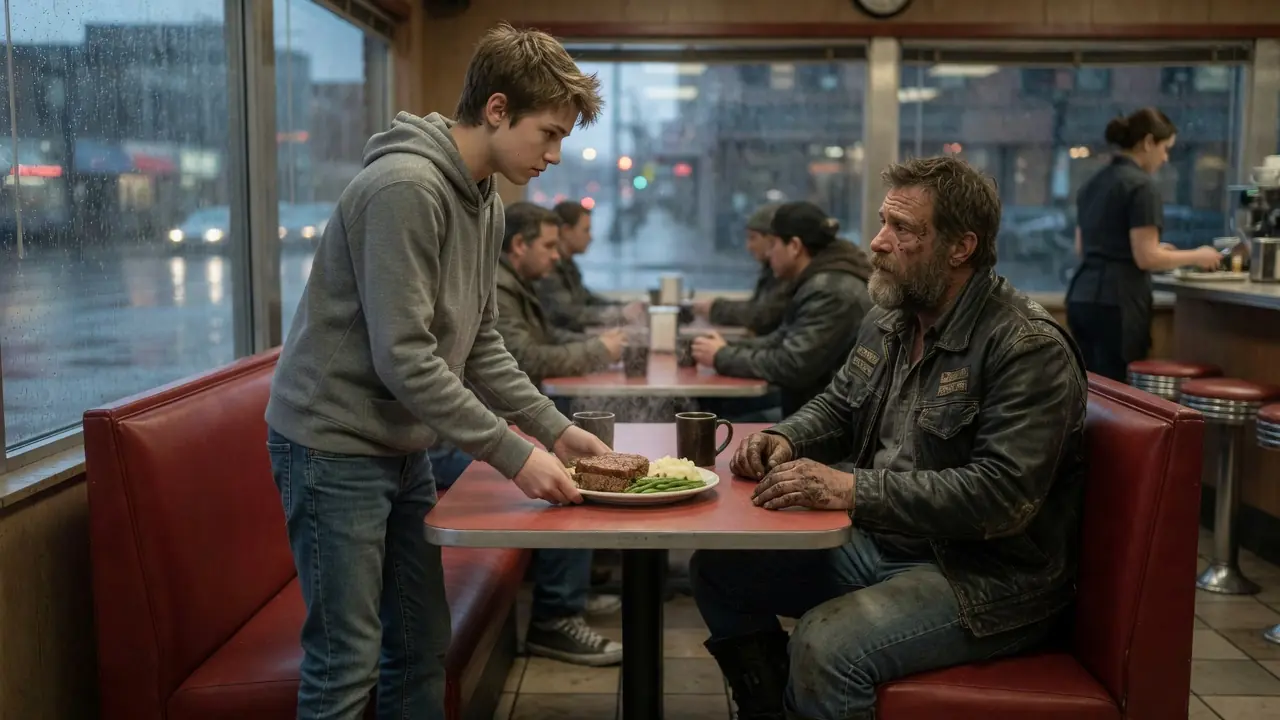
At the cracks in the wood that suddenly felt louder than anything else.
His mind immediately started calculating.
Rent.
Bills.
Groceries.
Transport.
Everything stacked too fast.
His mother noticed his face.
“Hey,” she said softly, standing up. “We’ll figure it out.”
Lucas nodded.
But his father’s voice came back to him again.
Not in words this time.
In pressure.
In responsibility.
In that invisible expectation that someone had to step up when things started slipping.
That night, Lucas didn’t sleep much.
At 2:14 AM, he got up.
At 2:16 AM, he opened his wallet.
At 2:17 AM, he stared at the folded paper again.
At 2:18 AM, he made a decision.
Meridian Garage was on the edge of an industrial strip just outside the city.
Not hidden.
Not advertised.
Just present.
Like something that existed because it refused to disappear.
When Lucas arrived, the morning air smelled like oil, metal, and damp concrete.
The garage doors were open.
Inside, motorcycles lined both sides like sleeping machines.
Tools hung in organized rows.
A radio played low classic rock.
And at the center, Ray Mercer was crouched over an engine, sleeves rolled up, completely focused.
He noticed Lucas only when Lucas stepped inside.
Ray looked up slowly.
For a moment, he didn’t react.
Then he straightened slightly.
“Well,” he said. “You actually came.”
Lucas shifted his weight.
“I wasn’t sure I should.”
Ray nodded.
“Most people aren’t.”
Lucas looked around.
“It’s bigger than I thought.”
“It’s smaller than it used to be,” Ray corrected. “Before I started losing contracts.”
Lucas didn’t ask what that meant yet.
Ray wiped his hands on a cloth.
“You hungry?” he asked casually.
Lucas almost smiled.
“No. I already ate this morning.”
Ray smirked.
“Good. I hate teaching hungry people. They forget things.”
Lucas stepped further in.
“I wanted to ask something.”
Ray nodded.
“Go ahead.”
Lucas hesitated.
Then said it.
“Why me?”
Ray leaned back against a workbench.
“That question again.”
“It’s important.”
Ray studied him for a moment.
Then spoke honestly.
“Because most people give kindness that ends when they walk away,” he said. “You gave something that followed me out of that diner.”
Lucas frowned slightly.
“I don’t understand.”
Ray picked up a wrench, turning it slowly in his hand.
“That meal wasn’t just food,” he said. “It was someone seeing me when I was calculating whether I could afford to be seen.”
Lucas didn’t respond.
Ray continued.
“And people like you… they don’t show up often.”
Lucas looked down.
“I didn’t have much money. It wasn’t a big deal.”
Ray shook his head.
“That’s where you’re wrong.”
He placed the wrench down.
“It’s always a big deal to the person receiving it.”
Silence stretched between them.
Then Ray motioned toward the bikes.
“You said you fix things,” he said.
Lucas nodded.
“Some things.”
Ray walked to a nearby motorcycle and tapped the seat.
“Start here.”
Lucas blinked.
“What?”
Ray repeated.
“Start here.”
Lucas hesitated.
“I don’t know motorcycles.”
Ray nodded.
“Good.”
“That’s good?”
“It means I don’t have to un-teach bad habits.”
Lucas slowly walked closer.
Ray handed him a rag.
“Clean it first.”
Lucas stared at the bike.
Then at Ray.
“You’re actually letting me work on this?”
Ray shrugged.
“You bought me dinner like you already belonged here. I’m just catching up.”
Lucas exhaled slowly.
Then started cleaning.
Over the next hour, Lucas learned the rhythm of the garage.
Not speed.
Not complexity.
Attention.
Ray didn’t teach like a teacher.
He taught like someone who expected you to notice what he didn’t say.
“Feel that?” Ray asked, guiding Lucas’ hand.
“The vibration?”
“That’s looseness. Not damage yet. But it will become damage if ignored.”
Lucas nodded.
Ray stepped back.
“Most people wait until something breaks before they care,” he said.
Lucas looked up.
“You don’t.”
Ray shook his head.
“Mechanics don’t have that luxury.”
Lucas wiped his hands.
“Neither do people,” he said quietly.
Ray looked at him sharply.
Then nodded once.
“Yeah,” he said. “Neither do people.”
By noon, Lucas was covered in grease.
But he didn’t notice.
For the first time in days, his mind wasn’t stuck on bills or fear.
It was focused on something immediate.
Real.
Fixable.
Ray noticed.
“You pick things up fast,” he said.
Lucas shrugged.
“I just pay attention.”
Ray smirked slightly.
“That’s rarer than skill.”
Lucas hesitated.
“Can I ask something now?”
Ray nodded.
“Sure.”
Lucas looked around the garage.
“This place… is it doing okay?”
Ray didn’t answer immediately.
That told Lucas everything before words did.
Finally, Ray spoke.
“Barely.”
Lucas frowned.
“Why?”
Ray leaned on a table.
“Less work. Fewer clients. Bigger shops nearby undercut pricing. Insurance costs went up. Parts got expensive.”
He paused.
“Same story everywhere.”
Lucas absorbed that.
Then asked something he didn’t expect himself to ask.
“Do you want to close it?”
Ray looked at him like the answer was obvious.
“No.”
Lucas nodded slowly.
“Then why don’t you fix it?”
Ray laughed once—not humorless, but tired.
“That’s what I’m trying to do.”
Lucas looked at the garage again.
At the bikes.
At the tools.
At the quiet space that felt like it had more history than money.
Then he said something without thinking too long.
“What if people knew about it more?”
Ray raised an eyebrow.
“What do you mean?”
Lucas hesitated.
Then explained.
“Like… not just bikers. People like me. People who don’t even own bikes but want to learn. Or help.”
Ray studied him.
“That’s not how garages usually survive.”
Lucas shrugged.
“Maybe that’s why they don’t.”
That landed.
Ray didn’t respond right away.
Instead, he looked around the garage again.
Like he was seeing it slightly differently.
By late afternoon, Lucas had to leave.
His mom would be home soon.
Ray walked him to the entrance.
“Same time tomorrow?” Ray asked.
Lucas paused.
“You want me back?”
Ray smirked faintly.
“You didn’t think this was a one-time thing, did you?”
Lucas almost smiled.
“I didn’t know what this was.”
Ray nodded.
“Neither do I yet.”
Lucas stepped out into the sunlight.
Then stopped.
Turned back.
“Ray?”
Ray looked up.
“Yeah?”
Lucas hesitated.
“About that meal…”
Ray cut him off immediately.
“Don’t.”
Lucas frowned.
“What?”
Ray’s voice softened slightly.
“Don’t turn it into debt. Or guilt. Or something you have to repay.”
Lucas stood still.
Ray continued.
“Just leave it as what it was.”
Lucas nodded slowly.
Then said quietly:
“Okay.”
Ray gave a short nod back.
Lucas walked away.
But as he left, he realized something strange.
For the first time in a long time, he didn’t feel like he was walking away from something.
He felt like he was walking toward something he hadn’t named yet.
Lucas Carter started going to Meridian Garage every day after school.
At first, it was just “helping.”
Cleaning tools.
Holding parts.
Learning names of things he had never cared about before—carburetors, brake lines, spark plugs, torque settings.
But slowly, it became something else.
A routine.
Then a place.
Then a second home that didn’t ask him to explain himself every time he walked in.
Ray noticed the change before Lucas did.
“You’re here more than you’re at home,” Ray said one afternoon while tightening a bolt.
Lucas shrugged.
“My mom works late.”
Ray nodded.
“And you don’t like sitting in empty rooms.”
Lucas didn’t answer.
Because that was too accurate.
Weeks passed.
Then something happened that shifted everything.
A notice came.
Printed paper.
Official envelope.
Lucas found Ray staring at it alone in the garage, long after closing time.
The garage was quieter than usual.
Even the radio wasn’t on.
Ray didn’t speak when Lucas walked in.
He just handed him the paper.
Lucas read it.
Then read it again.
Lease review. Final notice. Increase beyond current agreement. Payment required within 30 days or termination.
Lucas looked up.
“What is this?”
Ray exhaled slowly.
“The landlord sold the building.”
Lucas frowned.
“So… you just move?”
Ray shook his head.
“I don’t have anywhere to move it to.”
Silence.
Lucas looked around the garage.
At the bikes.
The tools.
The workbench.
The space that had slowly become part of his life without permission.
“This can’t close,” Lucas said.
Ray gave a small, tired laugh.
“Everything closes eventually.”
Lucas shook his head immediately.
“No.”
Ray looked at him.
“Kid—”
Lucas cut in.
“No. You don’t just accept it.”
Ray studied him.
“Life doesn’t care what we accept.”
Lucas clenched the paper.
“I do.”
That surprised Ray.
He didn’t respond.That night, Lucas couldn’t sleep.
Not because of fear.
Because of something worse.
Clarity.
He realized something simple.
If the garage closed, something inside him would feel like it closed too.
Not dramatic.
Not symbolic.
Real.
A place where he first felt useful instead of small.
A place where fixing things made sense when everything else didn’t.
At 2:03 AM, he got up.
At 2:10 AM, he opened his notebook.
At 2:22 AM, he started planning.
The next day, Lucas showed Ray something on his phone.
Ray frowned.
“What is this?”
“A fundraiser page.”
Ray blinked.
“For what?”
“For the garage.”
Ray immediately shook his head.
“No.”
Lucas didn’t stop.
“I already started it.”
Ray stared at him.
“You what?”
Lucas swallowed.
“I didn’t use your name. Just the shop. People can donate. Local groups. Motorcycle forums. Even school pages.”
Ray looked stunned.
“Lucas…”
Lucas rushed to explain.
“I didn’t lie. I just… told the story. The real one. About the diner. About what you do here. About teaching kids. About fixing bikes for people who can’t afford shops.”
Ray rubbed his forehead.
“This is not how businesses survive.”
Lucas looked at him.
“I know.”
Ray exhaled.
“This is not how anything works.”
Lucas nodded.
“I know that too.”
A pause.
Then Lucas added quietly:
“But maybe it should.”
Ray didn’t respond.
Not immediately.
He just looked at Lucas for a long time.
Then finally said:
“You remind me too much of myself when I thought I could fix everything.”
Lucas answered:
“I don’t think I can fix everything.”
He hesitated.
“I just think this shouldn’t break.”
That hit harder.
Ray looked away.
Over the next days, something unexpected happened.
The fundraiser spread.
Slow at first.
Then faster.
A few local bikers donated.
Then mechanics.
Then people Lucas didn’t even know—people who had once been helped by small repair shops, or who remembered what it meant to be seen when you had nothing.
The diner story came back.
Someone posted it.
Then another.
Then it moved.
Not viral.
But alive.
Ray didn’t like attention.
Lucas could tell.
But he also didn’t stop him.
That was Ray’s way.
He didn’t approve.
But he didn’t destroy hope either.
One evening, Lucas arrived to find a small group of bikers outside the garage.
Not Ray’s friends.
New ones.
Different jackets. Different ages.
One of them stepped forward.
“You Ray Mercer?”
Ray nodded cautiously.
The man handed him an envelope.
“From the fundraiser.”
Ray opened it.
His expression changed slowly.
Lucas watched closely.
Ray didn’t speak for a long time.
Then he said:
“This is… not possible.”
The biker shrugged.
“Apparently it is.”
Inside the envelope was enough to cover the rent increase.
Not forever.
But enough.
Time.
Ray looked at Lucas.
Lucas looked down immediately.
“I didn’t think it would actually work,” Lucas admitted.
Ray gave a short laugh.
“That’s the difference between you and most people.”
Lucas frowned.
“What?”
“You don’t stop at ‘impossible.’”
The landlord still wasn’t convinced.
There were negotiations.
Warnings.
Pressure.
But something else happened too.
A local community organization stepped in after hearing the story.
Then a small business support group.
Then a retired mechanic who once worked with Ray’s father.
Each one adding weight.
Not just money.
But legitimacy.
By the end of the month, the garage didn’t just survive.
It was reclassified.
Not as a struggling shop.
But as a community repair space.
A learning workshop.
A local training hub.
Ray stood in the garage one afternoon holding the new paperwork.
He didn’t look happy.
But he didn’t look defeated either.
He looked… uncertain.
Lucas watched him carefully.
“You’re angry,” Lucas said.
Ray shook his head.
“No.”
“Then what?”
Ray folded the paper slowly.
“I built this place to fix machines,” he said. “Not become a story.”
Lucas stepped closer.
“But it is a story.”
Ray looked at him.
“And that bothers me.”
Lucas hesitated.
“Why?”
Ray answered honestly.
“Because stories change things I can control.”
Silence.
Then Lucas said quietly:
“Maybe that’s the point.”
Ray didn’t respond.
But he didn’t argue either.
A week later, Ray called Lucas early in the morning.
“Come to the garage,” he said.
Lucas arrived before sunrise.
The air was cold.
The garage lights were already on.
And Ray was standing in front of the building with a wooden board.
Freshly painted.
Lucas frowned.
“What is that?”
Ray didn’t answer.
He just pointed.
Lucas walked closer.
And stopped.
The sign read:
MERCER & CARTER MOTORWORKS
Lucas froze.
“What… is this?”
Ray finally spoke.
“I didn’t choose it alone.”
Lucas looked at him.
Ray continued:
“You started something I didn’t know how to stop.”
Lucas shook his head.
“I didn’t do anything like this.”
Ray stepped closer.
“You bought a meal for a stranger in a diner and treated it like it didn’t matter.”
Lucas stayed silent.
Ray pointed at the sign again.
“That’s where it started.”
Lucas looked at the name.
His own name.
On a building.
On a shop.
On something real.
“No,” Lucas said quietly. “I can’t take that.”
Ray shook his head.
“It’s not about taking.”
“Then what is it about?”
Ray answered simply:
“Belonging.”
Silence.
The wind moved through the open garage door.
Lucas felt something inside him tighten.
Not fear.
Not pride.
Something heavier.
Understanding.
Years later, people would say the shop became something special.
Not just repairs.
Not just motorcycles.
But a place where people learned how to fix things—and sometimes themselves.
Ray taught the mechanics.
Lucas taught the thinking behind it.
Ray showed the hands.
Lucas showed the noticing.
And together, they built something neither of them expected.
A place where broken things didn’t get ignored.
They got understood first.
And whenever someone asked Lucas how it started…
He always paused for a moment.
Then said the same thing:
“I bought a biker a meal in a diner because he looked like he was choosing between pride and hunger.”
He would smile slightly.
“And somehow, that turned into my name on a workshop.”
Then he would add softly:
“But really… it started because someone taught me that noticing people is the first kind of repair.”