Exhausted from a grueling night shift, Matthew Vance was rushing down the street to make it to his early morning shift when he suddenly heard sobbing nearby.
The rain was coming down hard, hammering the sidewalk, turning the city lights into blurred streaks across the pavement.
Matthew was a sixteen-year-old teenager, though on nights like this he felt much older than any boy should.
His work uniform was stained with concrete dust from the warehouse loading dock where he worked after school.
His shoulders ached from hauling boxes for hours, and his boots were soaked through from walking in the storm.
He should have kept going.
He had another shift waiting before school.
Another supervisor ready to dock his pay if he was late.
Another handful of dollars he desperately needed.
But then he saw her.
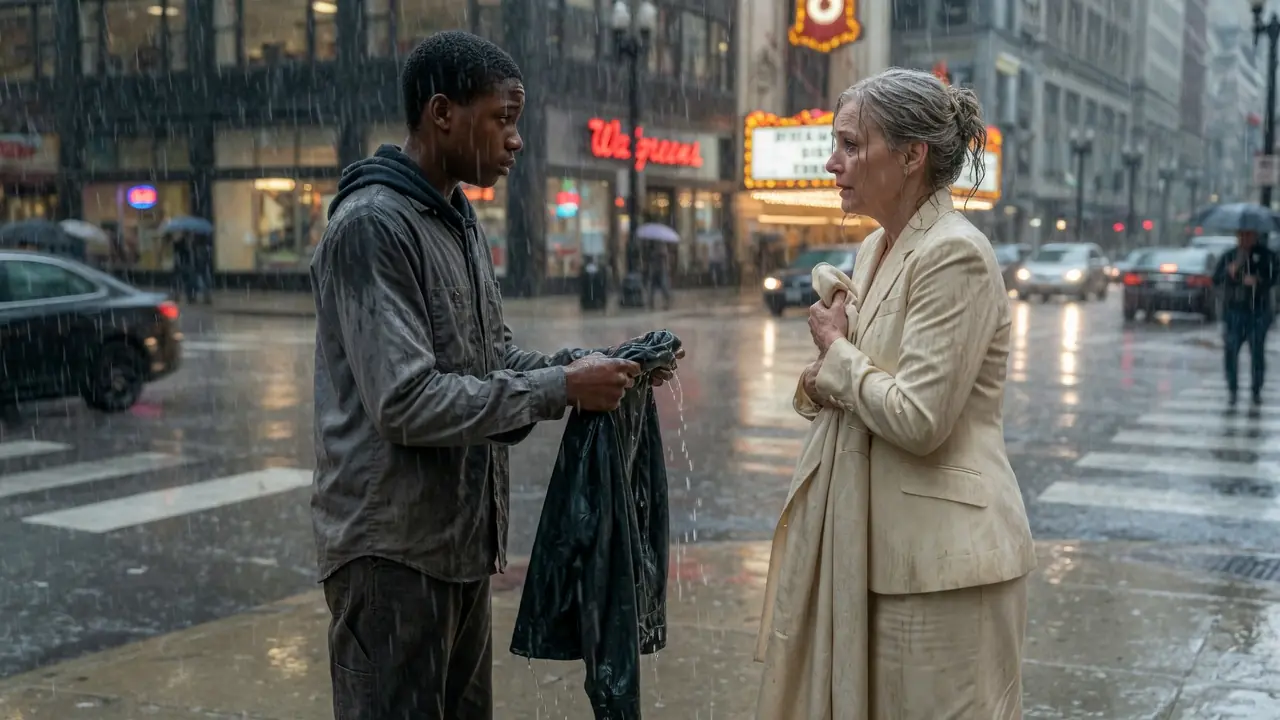
An elegant elderly woman stood alone on the corner of Fifth and Madison, soaked from head to toe, clutching her coat like it was the only thing keeping her upright.
Her gray hair, once carefully styled, had come loose in the rain.
Her cream-colored suit clung to her thin frame.
A luxury sedan sat at the curb nearby, hazard lights blinking, while a uniformed driver held an umbrella and looked helpless.
“Mrs. Whitmore, please,” the driver called over the rain. “You’ll catch pneumonia.”
The woman did not move.
“Leave me alone, David.”
“Ma’am, I really must insist.”
“I said leave me alone.”
Her voice cracked like a whip, but underneath the sharpness, Matthew heard something broken.
He knew that sound.
It was the sound of a person who was trying not to collapse.
Matthew stepped closer.
“Ma’am,” he said gently. “You okay?”
The woman did not look at him.
“I’m fine.”
“You’re standing in the rain.”
“Observant.”
Matthew almost smiled despite himself.
“Your driver’s worried about you.”
“David worries too much. I pay him to drive, not to worry.”
The driver looked toward Matthew as if begging him to help.
Matthew should have walked away.
He did not know this woman.
He was already late.
His own life was one missed paycheck away from falling apart.
But something about the way she stood there, proud and stubborn and alone, reminded him of his mother.
Clara Vance would rather suffer quietly than let anyone see she needed help.
She would rather sit in pain than admit she was afraid.
Matthew looked at the elderly woman again and softened his voice.
“My mom is about your age,” he said. “She’s stubborn too. Won’t let anybody help her with anything.”
The woman finally turned.
Her eyes were red-rimmed, either from crying, the rain, or both.
But they were sharp.
They took him in quickly, the dirty uniform, the soaked jacket, the tired eyes, the rough hands of a boy who had been forced to grow up too soon.
“Your mother sounds wise,” she said quietly.
“She is,” Matthew replied. “And she’d kill me if she knew I walked past somebody standing in a storm without offering help.”
A ghost of a smile touched the woman’s lips.
“Would she now?”
“Yes, ma’am.”
They stood in the rain for a moment.
Matthew’s phone buzzed in his pocket, probably his shift manager asking where he was.
He ignored it.
The woman’s shivering got worse.
Her lips had started to turn pale.
Matthew made a decision.
He shrugged off his only jacket.
It was old, wet, and stained from work, but it was still warmer than nothing.
“Here,” he said, holding it out.
She stared at the jacket.
“I can’t accept that.”
“You’re freezing.”
“It’s filthy.”
Matthew glanced down at it and nodded.
“Yes, ma’am. I know. I’m sorry. It’s been a long day. But it’s warm.”
“I have a car right there with heat.”
“Then why aren’t you in it?”
The question hung between them.
The woman’s face crumpled for only a second before she forced herself back under control.
“Because I’m angry,” she said finally. “And I needed to be angry outside, where I could breathe. Where I didn’t have to pretend everything was fine.”
Matthew understood that more deeply than he wanted to.
“That’s fair,” he said. “But you can be angry inside my jacket until you’re ready to be angry in that heated car.”
She looked at him.
Then at the jacket.
Then back at him.
“It really is quite dirty.”
“Yes, ma’am. Won’t argue with that.”
“And it smells like…”
“Like a kid who’s been working since school let out.”
Despite herself, she laughed.
It was short and surprised, as though the sound had escaped without permission.
“You’re very persistent.”
“I got that from my mama too.”
The woman finally took the jacket.
Matthew helped drape it over her shoulders.
It was too large for her, hanging nearly to her knees, but she stopped shivering so hard.
“Thank you,” she said softly.
“You’re welcome, ma’am.”
“Beatrice,” she said, extending her hand. “Beatrice Whitmore.”
Matthew shook it carefully.
Her hand was ice cold and small inside his rough, calloused one.
“Matthew Vance.”
“Well, Mr. Vance,” Beatrice said, “it seems I am in your debt.”
“No debt, ma’am. I just couldn’t walk away.”
“You were headed somewhere before you stopped.”
“Work.”
“Another job?”
“Yes, ma’am. Early shift down on 17th before school.”
“In this weather?”
“Bills don’t care about weather.”
She nodded slowly, as though that made perfect sense.
Then she said, “Let me give you a ride.”
Matthew immediately shook his head.
“No, ma’am. I couldn’t.”
“You gave me your jacket. The least I can do is make sure you do not catch pneumonia getting to your shift.”
“Are you refusing an old woman’s request?”
Matthew opened his mouth.
Then closed it.
He knew that tone.
His mother used the same voice when she had already made up her mind.
“No, ma’am.”
“Good. David, we are taking Mr. Vance to 17th Street.”
But before they could move toward the car, Beatrice stopped.
She looked at the sedan, then at the glowing windows of the houses beyond the street.
Her shoulders sank.
“I am not ready to go home,” she whispered.
The driver looked pained.
“Mrs. Whitmore…”
“I am not ready.”
Matthew heard the grief in her voice now.
Not anger.
Not pride.
Grief.
He glanced at the driver, then back at Beatrice.
“Where is home?”
“Twelve blocks from here.”
“Twelve blocks is a long walk in heels.”
“I am aware.”
On her very next step, her heel caught in a crack in the sidewalk.
Matthew reached out and steadied her by the elbow.
“Ma’am,” he said gently. “There’s no shame in accepting help here.”
He offered his arm formally, like a gentleman from an old movie.
“Hold on.”
After a brief hesitation, Beatrice slipped her hand through the crook of his elbow.
And they walked.
For the first block, neither of them spoke.
Rain pelted them from every direction.
Matthew’s shirt clung to his back, and water squelched in his boots.
Beatrice kept his jacket wrapped around her shoulders.
“Why are you really doing this?” she asked as they turned onto Sixth Avenue. “You don’t know me. You’re missing work. You’re getting drenched.”
Matthew thought for a moment.
“You ever feel like the universe puts someone in your path for a reason?”
“I do not believe the universe has plans.”
“Then maybe it’s just luck. Bad luck that you’re in a storm. Good luck that someone walked by who couldn’t leave you there.”
“Because I remind you of your mother?”
“Yes, ma’am.”
“Stop calling me ma’am. It makes me feel ancient.”
“What should I call you?”
“Beatrice.”
“Okay, Beatrice.”
She was quiet for a long while.
They passed a bodega where the owner was pulling down the metal shutters.
A couple ran past them laughing, soaked but carefree, as if the storm were an adventure.
Finally, Beatrice spoke.
“Today is my son’s birthday. Or it would have been.”
Matthew’s chest tightened.
“I’m sorry.”
“His name was Michael. He would have been 43.”
Her voice trembled, but she kept walking.
“David took me to the cemetery. I put white roses on his grave. They were his favorite. I stood there for an hour trying to feel something. Anything.”
She swallowed hard.
“But there was nothing.”
Matthew slowed with her.
“Two years,” Beatrice continued. “Two years, and I still cannot accept that he is gone. I will never hear his voice again. Never receive another phone call with him excitedly explaining his latest design. Never see him walk into a room late because he lost track of time sketching something impossible.”
She stopped walking and pressed a trembling hand to her mouth.
Matthew stopped too.
He did not rush her.
He simply stood beside her in the rain.
“My house is full of rooms he will never enter again,” she said. “Today I baked a cake. I lit candles. I sang happy birthday to an empty chair.”
Her voice broke.
“Does that sound strong to you?”
“Yes,” Matthew said simply. “That sounds like a mother who loves her son.”
Beatrice closed her eyes.
“There is nothing stronger than that.”
They continued walking.
The neighborhood changed slowly.
The cracked sidewalks gave way to cleaner streets.
The dim storefronts became elegant houses.
Trees lined the road, and streetlights reflected softly in the rain.
“You’re very young to be working so late,” Beatrice said.
Matthew gave a small shrug.
“I don’t really get to be young full-time.”
“And your mother?”
“Clara. Clara Vance.”
“She is ill?”
Matthew hesitated, then nodded.
“Heart problems. Cataracts too. She needs surgery. Without it, she’ll go completely blind.”
“That is treatable.”
“If you can afford it.”
Beatrice looked at him.
“How much?”
Matthew gave a humorless laugh.
“Four hundred dollars by Monday. After that, they push her eye surgery back three months.”
“Four hundred dollars.”
“To some people, that’s dinner. To us, it’s everything.”
Beatrice said nothing.
Matthew continued before he could stop himself.
“She raised me alone after my father died. Worked three jobs so I could stay in school. Never complained. Never asked for anything. Now she can barely read her own medicine bottles, and I can’t fix it fast enough.”
“What do you want to study?”
Matthew blinked at the question.
“Architecture.”
Beatrice stopped again.
“My son was an architect.”
Matthew looked at her.
“Really?”
“He was brilliant. He designed buildings that made people stop and stare. He believed architecture was not just about buildings. It was about creating spaces where people could dream.”
Matthew felt those words settle deep in his chest.
“I think that too.”
“Then why are you working two jobs instead of drawing buildings?”
The question hit harder than she probably intended.
Matthew looked down at the sidewalk.
“Because dreams don’t pay rent.”
Beatrice’s expression softened.
“No. But sometimes they keep people alive.”
Matthew did not answer.
He thought about the sketchbook hidden under his mattress.
The one full of buildings he drew after Clara fell asleep.
Libraries with big windows.
Community centers with ramps wide enough for wheelchairs.
Apartment buildings with courtyards where kids could play without broken glass.
He never showed anyone those drawings.
They felt too fragile.
Too foolish.
Too much like wanting something he had not earned yet.
“You should not have to give up your future at sixteen,” Beatrice said quietly.
Matthew looked at her.
“I’m not giving it up. I’m just… putting it somewhere safe until we survive.”
Beatrice touched his arm gently.
“My son would have liked you.”
They reached the final block.
At the end of the street stood a mansion with white columns, tall windows, iron gates, and perfectly trimmed hedges.
Even through the rain, it looked unreal.
“That’s your house?” Matthew asked.
“Unfortunately.”
“Why unfortunately? It’s beautiful.”
“It’s empty.”
Her voice was flat.
“Twelve thousand square feet of empty rooms and memories. I rattle around inside like a ghost haunting my own life.”
They climbed the marble steps.
Beatrice turned to face him.
Her makeup was ruined.
Her hair was wet.
His oversized work jacket hung around her shoulders.
But her eyes looked clearer than before.
“Thank you,” she said. “For walking with me. For listening. For not treating me as though I were insane.”
“You’re not insane. You’re hurting. That’s different.”
She looked down at his jacket.
Then she started to remove it.
“Keep it until you get warm inside,” Matthew said.
“You will freeze.”
“I’ll manage.”
She reached into her purse.
Matthew stepped back immediately.
“No.”
“Please let me give you something.”
“No, ma’am.”
“Beatrice.”
“No, Beatrice.”
His voice stayed gentle, but firm.
“I didn’t help you for money.”
“I know that.”
“If I take money now, it feels like I sold you my kindness. And kindness isn’t for sale.”
Beatrice’s eyes widened.
“Even when you desperately need it?”
“Especially then.”
He thought of his mother.
“My mama raised me better than that. I helped because it was right. Because you needed help, and I was there.”
Most people would have taken the money.
Matthew knew that.
Maybe he should have.
But something inside him would not allow it.
Beatrice studied him for a long moment.
Then instead of arguing, she hugged him.
It was brief and awkward.
An elderly white woman in ruined designer clothes hugging a sixteen-year-old boy in a filthy work uniform on the steps of a mansion.
But Matthew hugged her back carefully.
Like he would hug his mother.
When she pulled away, she took a business card from her purse and pressed it into his hand.
“Then take this. Not as payment. As friendship.”
Matthew looked down.
Beatrice Whitmore.
CEO, Whitmore Enterprises.
He blinked.
“You’re a CEO?”
“Unfortunately.”
“What does the company do?”
“Real estate development. Commercial buildings. Mixed-use spaces. Some residential. My husband started the company. After he died, I took over. When Michael died, I became majority shareholder, sole board member, and a very tired old woman who does not know when to retire.”
Matthew tried to hand the card back.
“I can’t take this.”
“Why not?”
“I don’t want you to think I helped you so I could network or get something later.”
“You are possibly the most stubborn boy I have ever met.”
“I learned from the best.”
“Your mother?”
Matthew smiled.
“Yes, ma’am.”
Beatrice laughed again.
A real laugh this time.
Rusty, but genuine.
“Keep the card, Matthew. As friendship. Is that acceptable?”
He hesitated, then nodded.
“That’s acceptable.”
Beatrice turned toward her door, then looked back one last time.
“Your mother is very lucky to have you.”
“I’m lucky to have her.”
“And Matthew?”
“Yes?”
“Do not give up on architecture completely. The world needs more people who design spaces where others can dream.”
Before he could respond, she stepped inside and closed the door softly behind her.
Matthew stood in the rain, holding a business card worth more than anything in his wallet.
Then his phone buzzed.
A text from his shift manager.
Don’t bother coming in. You’re done.
Matthew sighed.
There went tonight’s cash.
He tucked Beatrice’s card carefully into his wallet and started the long walk home.
The rain eased to a drizzle.
His body ached.
His jacket was gone.
He was poorer than he had been an hour ago.
But somehow, strangely, he felt less alone.
The next morning, Friday, 8:47 a.m., Matthew stood in front of his apartment building with one hand gripping the strap of his backpack and the other checking his phone for the third time.
He was already late for school.
The warehouse job had fired him, and the diner had not answered his message asking for extra weekend hours.
His uniform still hung loose on his tired frame.
Sixteen years old, and he felt like a man carrying the weight of a whole house on his back.
He was about to walk toward the bus stop when he heard engines.
Expensive engines.
Three sleek SUVs rolled down the narrow street like a funeral procession.
Their tinted windows reflected the cracked sidewalk and peeling paint of the buildings.
Matthew’s neighborhood did not see cars like this.
Not unless someone had died.
Or someone was about to be arrested.
His stomach dropped.
The SUVs stopped directly in front of his building.
Doors opened in unison.
Men in dark suits stepped out, wearing earpieces, hands clasped in front of them like Secret Service agents.
They scanned the block with cold, practiced eyes.
Matthew’s grip tightened on his backpack.
His heart began hammering.
Neighbors appeared instantly.
Mrs. Patterson from 2B cracked her door open, eyes wide.
Old Mr. Jenkins stopped sweeping his stoop.
The guys who usually stood near the corner store went silent and backed away.
“That’s undercover,” someone whispered.
“They finally coming for that Vance boy?”
“I told y’all he was mixed up in something.”
“Lord have mercy. What about his poor mama?”
Matthew heard every word.
He had lived in this neighborhood his whole life, and he knew how fast rumors spread.
How quickly a hardworking teenager could become a criminal in people’s minds.
How standing still could look guilty to the wrong eyes.
One of the security men, tall with polished shoes and a jaw like stone, stepped forward.
His eyes locked on Matthew.
“Are you Matthew Vance?”
Matthew’s throat went dry.
His mind raced.
Old debts?
Hospital bills?
Something with school?
None of that explained the private security.
His pulse thudded in his ears.
He wanted to run.
But his mother was inside.
Sick.
Helpless.
He slowly raised his hands, palms out.
It was instinct.
The kind of instinct drilled into boys from childhood.
Show your hands.
Do not make sudden moves.
Do not give them a reason.
“Yeah,” Matthew said, his voice steadier than he felt. “That’s me.”
The security team exchanged glances.
The tall man stepped closer.
“We need to come inside.”
“Inside?”
Matthew’s voice cracked slightly.
He cleared his throat.
“Look, man, I don’t know what this is about, but my mother is in there. She’s sick. Real sick. She has a heart condition. If y’all come storming in there with all this…”
Another person stepped forward.
A woman in a charcoal pantsuit carrying a leather portfolio.
Her expression was softer, but still unreadable.
“Matthew, we are not here to cause alarm. We just need a few minutes of your time.”
“For what?”
Matthew’s jaw clenched.
He squared his shoulders, even though he knew it was pointless.
These people could do whatever they wanted.
But he was not going to roll over while his mother was ten feet away, probably already scared by the commotion.
Then he heard it from inside.
A wet, rattling cough.
Deep and painful.
His mother.
“Please,” Matthew said.
He hated how the word sounded like begging, but he did not care.
“Please, just let me check on her first. Five minutes. She’s 57. She’s on oxygen half the day, and she gets scared easy.”
The woman glanced at the tall security man.
Some silent communication passed between them.
Finally, she nodded.
“You have five minutes. But we’re coming in with you.”
“Like hell you are.”
The words came out before Matthew could stop them.
The security men stiffened.
But Matthew stood his ground.
“You want to talk to me, fine. But you’re not walking into my mama’s home looking like the FBI. You’ll scare her half to death.”
The neighborhood had gone completely silent.
The woman studied him.
Then she said,
“Matthew, you are not in trouble.”
Matthew blinked.
“What?”
“You are not being arrested. We are not law enforcement.”
She opened the portfolio and pulled out a thick cream-colored envelope.
“We are here on behalf of Beatrice Whitmore. She sent us to find you.”
The name hit Matthew like a sudden gust of wind.
Beatrice.
The woman from the storm.
“She knows you,” the woman said. “And she asked us to deliver this personally.”
Matthew stared at the envelope.
Nothing about this made sense.
From inside the apartment, Clara coughed again.
Weaker this time.
“I have to go,” Matthew said, already turning. “I need to check on my mother.”
“We understand,” the woman replied. “May we wait in the hallway?”
Matthew hesitated with his hand on the door.
Every instinct told him to slam it in their faces.
But something in her voice sounded genuine.
“Hallway only,” he said. “And tell your guys to stop looking like they’re about to raid the place. You’re scaring people.”
The woman nodded.
The security team relaxed slightly.
Matthew pushed open the door and led them inside.
The hallway was dim and smelled like old cooking oil and cleaning products.
A single fluorescent bulb flickered overhead.
Matthew unlocked apartment 3 with shaking hands.
“Mama,” he called as he stepped inside. “Mama, it’s me. Everything’s okay.”
The apartment was small.
Two bedrooms, a cramped kitchen, and a living room barely big enough for a couch and a television.
But it was clean.
Matthew made sure of that.
Every surface was wiped down.
Every dish was put away.
Every piece of mail was stacked neatly on the counter.
Clara Vance sat in her wheelchair by the window, an oxygen tube running beneath her nose.
She looked so small now.
Nothing like the strong woman who had raised him alone after his father died.
Her hands trembled as she turned toward his voice.
Her cataracts made her squint.
“Baby,” she said hoarsely. “What’s all that noise outside? Sounded like the police.”
“It’s nothing, Mama.”
Matthew knelt beside her and took her cold hands in his.
“Just some people here to talk to me.”
“You in trouble?”
Fear crept into her voice, and it broke his heart.
“No, Mama. I promise. I didn’t do anything wrong.”
He squeezed her hands gently.
“How are you feeling? You take your medicine?”
“Took it an hour ago.”
She coughed again, her whole body shaking with effort.
“Don’t feel like it’s working much today.”
Matthew grabbed the small towel from the armrest and held it near her mouth until the coughing settled.
When he pulled it away, he pretended not to see the fleck of red.
“You need to go back to bed,” he said softly.
“You’re supposed to be at school,” Clara said. “And work after.”
“I’ll be late. It’s fine.”
“You missing too much school already.”
“Mama…”
“And you still need four hundred dollars for my surgery.”
Her voice cracked.
“Dr. Morrison said if we don’t get it by Monday, they have to push it back another three months. I can’t see anything anymore, Matthew. I just want to see your face clearly before my eyes get worse.”
Matthew’s voice became firm.
“Don’t talk like that. We’re going to get the money.”
He was lying.
He had already asked for an advance twice that year.
They had said no the last time.
But he could not tell her that.
Clara reached up with a trembling hand and touched his cheek.
“You’re such a good boy. Your daddy would be so proud.”
Matthew closed his eyes for one second.
Then he stood.
“I need to talk to these people real quick. Then I’ll make you some tea before I go.”
“What people want with you?”
“I don’t know yet,” he admitted. “But I’ll find out.”
He kissed her forehead and went back to the hallway.
The woman in the pantsuit waited there with the envelope.
“I’m Sarah Chen,” she said. “Executive assistant to Mrs. Whitmore.”
Matthew crossed his arms.
“Okay, Sarah. Talk.”
She handed him the envelope.
His name was written on the front in elegant cursive.
Matthew Vance.
He tore it open.
Inside was a check.
For $10,000.
Made out to Clara Vance.
Matthew stared.
The world seemed to tilt under his feet.
His hand started shaking.
There was also a handwritten note on thick stationery.
For the eyes of a mother who raised a true gentleman.
With deep gratitude and respect.
B.W.
Matthew could not speak.
Ten thousand dollars.
Not four hundred.
Not barely enough.
Ten thousand.
His mother could get her surgery.
They could catch up on rent.
Buy her medicine on time.
Fix the heater.
Buy groceries without counting every dollar.
Maybe Matthew could stop working late enough to actually finish homework before dawn.
“Matthew,” Sarah said carefully. “Are you all right?”
Matthew turned and walked back into the apartment.
His mother was trying to wheel herself toward the door.
“Mama, no.”
He hurried to her.
“It’s okay. Everything’s okay.”
“Why are there so many people? Are you in trouble?”
“No, Mama.”
Matthew knelt in front of her again.
“Do you remember I told you I helped an old lady last night? Walked her home in the rain?”
“The rich lady with the sad story?”
“Yeah. That one.”
His voice cracked.
“Mama, she sent someone here to thank me.”
“Thank you how, baby?”
Matthew held up the check even though he knew she could not read the numbers.
“She sent money. For your surgery. For your eyes.”
Clara went very still.
“How much money?”
“Ten thousand dollars.”
His mother gasped.
Her hands flew to her mouth.
“Ten thousand dollars? Matthew, that’s not possible. People don’t just give away that kind of money.”
“She did.”
Matthew was crying now.
“She wrote a note. Said it’s for the mother who raised a gentleman. Mama, she’s paying for your surgery. All of it.”
Clara began sobbing.
Deep, painful sobs that shook her whole body.
Matthew sat on the edge of the bed and pulled her gently into his arms.
She felt small and fragile, but her grip on his shirt was fierce.
“Thank you, Jesus,” she whispered. “Thank you. Thank you.”
Sarah appeared in the doorway.
“Mrs. Vance, may I come in?”
Clara wiped at her tears.
“Yes, of course. I’m sorry. I’m just…”
“Please don’t apologize.”
Sarah entered the room.
“Mrs. Whitmore wanted me to tell you something personally.”
She looked at a message on her phone.
“Please tell Clara Vance that her son restored my faith in humanity at a moment when I had none left. Tell her she did a remarkable job raising him. Tell her the world needs more Matthews, and we are all grateful she gave us one.”
Clara cried harder.
“I don’t know what to say.”
Sarah’s expression softened.
“She knows.”
Then Sarah turned slightly toward the hallway.
“But there is more.”
Matthew looked up sharply.
“More?”
A professional-looking woman in scrubs entered, carrying a medical bag.
“This is Elena Rodriguez,” Sarah said. “She is a registered nurse. Starting today, she will visit daily to help care for Mrs. Vance. Medical monitoring, basic care, medication support, all covered by Mrs. Whitmore.”
Matthew stood quickly.
“No. No, that’s too much.”
“Mrs. Whitmore was very clear.”
“The money for surgery is already too much.”
“She doesn’t want you to worry about your mother’s care. She wants you free to focus on other things.”
“What other things?”
Sarah smiled.
“We’ll get to that.”
Elena moved kindly toward Clara.
“Hello, Mrs. Vance. Why don’t we start by checking your vitals and making sure you’re comfortable?”
Matthew watched in disbelief.
This was too much.
He had walked an old woman home in the rain.
That was all.
Now his life was being rearranged by strangers in suits.
“Matthew,” Sarah said. “Can we speak in the living room?”
Matthew followed her numbly.
The tall security guard waited near the door, quiet and respectful.
“I need to give this back,” Matthew said immediately, holding out the check. “I can’t accept it.”
“Mrs. Whitmore anticipated you would say that.”
“Then she knows I can’t take this much money.”
“Why not?”
“Because I didn’t earn it. I walked her twelve blocks. That’s not worth ten thousand dollars.”
Sarah studied him.
“Mrs. Whitmore disagrees. She said you gave her something she had not felt in two years.”
“What?”
“Hope.”
Matthew looked away.
“That’s not something you can price.”
“No,” Sarah said gently. “But it is something you can honor.”
He shook his head.
“I helped her because it was right. If I take the money, it makes everything transactional.”
“Or it makes you a young man who accepted help when he needed it.”
“There’s shame in taking advantage of someone’s grief.”
“You are not taking advantage of anything. Mrs. Whitmore is an intelligent businesswoman. She does not part with money unless she chooses to.”
Matthew said nothing.
Sarah lowered her voice.
“If the money bothers you that much, think of it as helping your mother. Clara deserves this surgery, doesn’t she?”
That hit him hard.
His resistance wavered.
“Of course she does.”
“Then let someone help her. Let Mrs. Whitmore honor your kindness by taking care of the woman who taught you to be kind.”
Matthew stared at the check again.
His mother’s name.
Ten thousand dollars.
A miracle he did not know how to accept.
“I need time,” he said quietly.
“That is fair.”
Sarah opened her portfolio again.
“While you think about that, Mrs. Whitmore asked me to discuss something else with you.”
“What else could there possibly be?”
Sarah pulled out several architectural drawings.
Detailed.
Professional.
Beautiful.
Matthew leaned closer before he could stop himself.
The building had clean lines, wide glass panels, open gathering spaces, natural light, and flowing movement from one section to another.
It was gorgeous.
“What is this?” he asked.
“The Michael Whitmore Arts and Community Center. Mrs. Whitmore’s son was designing it when he died. The project has been stalled for two years because no one could capture his vision well enough to complete it.”
Matthew traced his fingers over the lines.
“It’s beautiful.”
Sarah watched him closely.
“Mrs. Whitmore wants to sponsor your education.”
Matthew’s head snapped up.
“What?”
“She looked into your school record last night. You are sixteen, working long hours, caring for your mother, and still maintaining strong grades in math, drafting, and design. Your art teacher described your sketches as exceptional.”
Matthew backed away.
“No. No, this is insane.”
“She wants to create a scholarship fund for you. Full tuition through college, tutoring support, transportation, materials, and a paid internship with the lead architecture team once you are legally eligible.”
“Stop.”
Matthew held up his hand.
“Just stop.”
Sarah went quiet.
“I’m sixteen. I haven’t even finished high school. I work in warehouses and diners. I draw buildings in cheap notebooks under my bed. That doesn’t mean I deserve all this.”
Sarah’s voice became firm.
“You earned it by being decent when most people would have walked past. You earned it by having talent. You earned it by sacrificing more than a child should ever have to sacrifice.”
Matthew’s chest tightened.
“You have been earning this for years. You just didn’t know it.”
It was too much.
The money.
The nurse.
The scholarship.
The possibility that his life could become something other than survival.
“I need air,” Matthew said.
Sarah nodded.
“The offer stands. Take the time you need.”
Matthew left the apartment and walked three blocks before stopping against a brick wall.
He leaned there, trying to breathe.
His phone buzzed.
A message from his former shift manager.
You still coming in this weekend or not? Need an answer by three.
Twelve hours ago, losing that job had felt devastating.
Now someone was offering his mother surgery, medical care, and a future that included college.
It felt like a dream.
Or a trap.
Or both.
Then another message came through from an unknown number.
Matthew, this is Beatrice Whitmore. I apologize for the overwhelming morning. I tend to be efficient to a fault. I am having lunch at Marello’s at 1:00 p.m. Would you join me? I would like to explain properly. No pressure. Just conversation. B.W.
Matthew stared at the screen.
He should say no.
He should give back the money, decline the scholarship, and return to a life that made sense.
But that life meant working himself into exhaustion before he was even grown.
It meant watching his mother slowly go blind.
It meant never showing anyone his old sketchbooks.
Maybe it was time to stop choosing normal.
He typed back.
I’ll be there.
At 1:00 p.m., Matthew walked into Marello’s restaurant wearing the cleanest shirt he owned.
The hostess looked him up and down with barely concealed judgment.
But when he mentioned Beatrice Whitmore’s name, her face changed instantly.
“Of course, Mr. Vance. Right this way.”
The restaurant was all white tablecloths, crystal glasses, and soft music.
Everyone looked expensive.
Matthew felt like he had wandered onto a movie set where he did not belong.
Beatrice sat at a corner table in a navy suit, reading something on a tablet.
When she saw him, she smiled.
“Matthew. Thank you for coming.”
“I almost didn’t.”
“I would not have blamed you.”
He sat carefully.
The chair probably cost more than their monthly rent.
“How is your mother?” Beatrice asked.
“Still crying. Happy crying, but still.”
Beatrice nodded.
“I am glad.”
Matthew looked at her.
“Why are you doing all this?”
She folded her hands.
“Because what I am offering is not charity. It is not even repayment. It is recognition.”
“Recognition of what?”
“Potential being buried. Goodness going unprotected. A gifted young man being forced to carry adult burdens alone.”
Matthew looked away.
“I’m not special.”
“My son Michael was like you,” Beatrice said quietly. “Brilliant. Kind. Always putting others first. He volunteered at community centers. Designed low-income housing pro bono. Used his privilege to lift others.”
She looked toward the window.
“When he died, I was devastated. But I was also angry. Angry that the world lost someone so rare while crueler men kept thriving.”
“I’m sorry.”
“Do not be sorry. Listen.”
She turned back to him.
“Last night, standing in that rain, I was ready to give up on the arts center. On Michael’s final dream. On everything. Then you appeared.”
Matthew started to protest, but she raised a hand.
“You had no reason to help me. You were exhausted. Poor. Late to work. Freezing. And still, you stopped. You gave me your only jacket and walked with me through my grief.”
Her voice softened.
“You reminded me that Michael’s kind of goodness still exists.”
Matthew swallowed.
“That doesn’t make me worthy of all this.”
“I looked into your school record.”
His brows lifted.
“You investigated me?”
“I have resources.”
“That’s a nice way of saying yes.”
Beatrice almost smiled.
“Yes.”
She turned the tablet toward him.
“Your art teacher, Ms. Green, keeps one of your building sketches pinned beside her desk. She said you draw spaces like someone who has already lived inside them.”
Matthew froze.
“She said that?”
“She did. She also said you fall asleep in class because you work nights, not because you do not care.”
Matthew’s throat tightened.
He had not known anyone noticed.
“You have a future,” Beatrice said.
“I have bills.”
“Yes. And you chose your family. That is strength. But it is also a tragedy if the story ends there.”
Their food arrived, but neither of them touched it.
Beatrice slid the tablet closer.
“These are Michael’s original sketches for the community wing. What do you see?”
Matthew studied the plans.
“Open spaces. Natural light. Flexible rooms. He wasn’t just thinking about art. He was thinking about families. Kids who need safe places after school. Adults who need classes. Seniors who need somewhere to belong.”
Beatrice’s eyes filled.
“Exactly.”
Matthew pointed to one section.
“This area here should stay open. If someone turns it into offices or luxury retail, they’ll destroy the purpose of the building.”
“The last architect I showed it to said the community wing was wasted square footage.”
Matthew felt anger flare.
“That misses the whole point.”
“Yes,” Beatrice said. “It does.”
She pulled out a formal document.
“This is the education offer. A full scholarship through high school support, college tuition, housing if needed, books, transportation, tutoring, and a paid summer internship with Whitmore Enterprises’ design division when you turn seventeen.”
Matthew stared at her.
“This is too much.”
“It is the correct amount.”
“You don’t even know if I’ll be good enough.”
“I know enough.”
“What if I fail?”
“Then you learn.”
“What if I’m not smart enough?”
“Then we provide mentors, training, support, whatever you need.”
She leaned closer.
“But I do not believe you will fail. I believe you will exceed expectations.”
The certainty in her voice frightened him.
And thrilled him.
“Can I think about it?”
“Of course.”
“The check for my mother…”
“Not contingent on anything. Whether you accept my offer or not, that money is hers.”
“That makes it harder.”
“Good. Charity should make you uncomfortable. It means you still have dignity. I am not trying to take that from you. I am trying to honor it.”
Matthew sat in silence.
Then he said,
“My mama always told me when someone shows you kindness, the best way to pay it back is to pass it on.”
“She sounds wise.”
“She is.”
He looked again at Michael’s drawings.
“If I accept this, and I’m not saying I am, I want something in writing.”
“What?”
“The community wing stays. It stays affordable. Free where possible. This center helps people, not just your company’s image.”
Beatrice smiled.
“Done.”
“You don’t even know if I’m saying yes yet.”
“I have a suspicion.”
Matthew looked at the plans.
At the light, the space, the promise of something beautiful.
“I need to talk to my mother first.”
“Of course.”
“And I need to know you’re not doing this because of guilt.”
“I am doing this because I am a pragmatist,” Beatrice said. “And pragmatically speaking, you are the right young man to help protect this dream. The gratitude simply helped me see what was already true.”
Matthew nodded slowly.
“Okay.”
Beatrice raised her glass of water.
“To new possibilities.”
Matthew lifted his glass and touched it to hers.
“To new possibilities.”
Two years later, the Michael Whitmore Arts and Community Center stood on the corner of Fifth and Madison, gleaming in the autumn sunlight.
Matthew stood across the street staring at it like he had every morning since construction finished.
He was eighteen now.
Still young.
Still carrying more memories than most boys his age.
But no longer trapped under them.
Glass and steel rose three stories high.
Sunlight poured through wide windows.
The front entrance opened into a bright atrium full of plants, benches, art, and movement.
He still could not believe it was real.
“Stop gawking and get inside,” Beatrice said beside him. “Your speech starts in an hour.”
Matthew smiled.
“I know. I just…”
“You helped build that.”
“We helped build that,” he corrected.
Beatrice looked at the building, then at him.
“Yes. We did.”
The center was beautiful.
The ground floor held the community wing, exactly as Michael had designed.
Free classrooms.
A library.
A café run by local vendors.
A quiet sensory room for children who needed calm.
A small health resource office where families could meet social workers without shame.
The second floor held art studios, music rooms, and performance spaces.
The third floor housed administrative offices.
The rooftop garden had already become the pride of the neighborhood.
But what made Matthew proudest were the details.
The wheelchair ramps that looked like part of the design, not an afterthought.
The windows placed low enough for children to see out.
The sliding payment scale that meant no family would be turned away because of income.
The benches outside where seniors could sit safely in the afternoon.
This was not just a building.
It was a promise kept.
“Matthew!”
He turned.
Elena Rodriguez, the nurse who had cared for Clara, waved from the curb.
Beside her, Clara Vance walked carefully with a cane.
Walked.
Not wheeled.
Her surgery had been successful.
Her vision had been restored.
Physical therapy helped her regain enough strength that she only used the wheelchair on bad days.
When Matthew saw her looking at the building with clear eyes, his throat tightened.
She could see it.
She could see his face.
She could see what he had helped build.
“Baby,” Clara called. “We’re not late, are we?”
“You’re early, Mama.”
Matthew crossed the street and hugged her carefully.
“How do you feel?”
“Proud,” she said, her eyes shining. “So proud I could burst.”
She adjusted his tie.
“Look at you in that suit. Your father would be so proud.”
“I hope so.”
“He is.”
Inside the center, the main atrium was full.
City council members.
Local residents.
Reporters.
Donors.
Students.
Elderly neighbors.
Families with children.
A stage had been set up near the staircase, and behind the podium stood a large photo of Michael Whitmore smiling in a hard hat at a construction site.
Matthew felt the familiar ache.
He had never met Michael.
But after two years of studying his drawings, reading his notes, and fighting for his vision, he felt like they had worked together.
Sarah Chen, now vice president of community development, appeared beside him.
“You ready?”
“As ready as I’ll ever be.”
“You earned this.”
Matthew looked out at the crowd.
Some days, he still felt like an impostor.
Like someone might realize he was just a poor kid pretending he belonged among architects, executives, and city leaders.
Then he looked at the building.
At the kids using the art room.
At seniors signing up for painting classes.
At families walking through doors they never had to pay to enter.
And he remembered why it mattered.
The ceremony began.
The mayor spoke.
Then Beatrice.
Her voice trembled when she spoke of Michael, but it never broke.
Several community members shared how the center had already changed their lives.
Then Matthew stepped to the podium.
For a moment, he could only look at his mother in the front row.
Clara smiled at him, tears already in her eyes.
Matthew smiled back.
Then he began.
“Two years ago, I was sixteen, working late shifts, missing sleep, and trying to keep my family from falling apart.”
The room quieted.
“I thought that was just how life worked. Some people got to dream, and some people worked to survive. I thought I was in the second category permanently.”
He paused.
“Then I met a woman standing in a rainstorm, and everything changed.”
Beatrice looked down, smiling faintly.
“Not because of money or opportunity, though those came later. It changed because someone saw potential in me that I had stopped seeing in myself.”
Matthew looked around the atrium.
“Mrs. Whitmore did not just help my mother. She gave me back a future. Then she trusted me with her son’s dream. That is a responsibility I do not take lightly.”
He gestured around him.
“Michael Whitmore believed architecture was not just about buildings. It was about creating spaces where people could thrive. Where a kid from a tough neighborhood could take a free art class and discover they have talent. Where a senior citizen could learn to paint and find purpose. Where families could gather without worrying about cost.”
His voice grew stronger.
“This building is not mine. It is not even Mrs. Whitmore’s. It belongs to this community. It is a promise that good things are possible when people care enough to build them.”
He looked at Clara.
“My mama taught me that we are never too poor to be kind. That dignity matters more than dollars. That strength is not about never falling down. It is about getting back up and keeping going.”
His voice cracked slightly.
“This building stands because of those lessons. Because kindness matters. Because investing in people pays dividends no spreadsheet can measure.”
He took a breath.
“So thank you. Thank you to Mrs. Whitmore for trusting me. Thank you to everyone who worked on this project. Thank you to the community for welcoming us. And thank you to Michael Whitmore, who I never met, but whose vision guides every inch of this place.”
When Matthew stepped back, applause filled the atrium.
Not polite applause.
Real applause.
His mother was crying.
Beatrice stood with one hand pressed to her heart, smiling through tears.
After the ceremony, people flooded forward to explore the building.
Matthew gave tour after tour.
He showed the classrooms, the rooftop garden, the performance space, the quiet room, and the art studios.
A young girl approached him nervously near the second-floor balcony.
“Mr. Vance?”
“Yes?”
“My name is Angela Rodriguez. I’m studying design at City College. I couldn’t afford portfolio classes, but I saw the center offers them free, so I enrolled.”
She swallowed.
“It has already changed everything for me.”
Matthew felt his chest swell.
“Angela, keep working hard. When you finish school, if you need a reference, an internship, anything, you can find me.”
Her eyes widened.
“Really?”
“Really.”
She walked away grinning.
Beatrice appeared beside him.
“Still gawking?”
“Always.”
He looked at her.
“Thank you for all of this. For believing in me when I didn’t believe in myself.”
“You did the work, Matthew. I opened a door. You walked through it.”
They stood together in the bright atrium.
“You know what the best part is?” Matthew said.
“What?”
“In five years, ten years, kids who use this place won’t know my name or yours. They’ll just know this is a place that welcomes them. That’s legacy.”
Beatrice’s eyes softened.
“Michael would have liked you very much.”
“I wish I could have met him.”
“In a way,” she said, “you did. Every day you worked on this building, you were collaborating with him.”
Later, as the sun set and the center’s lights came on, Matthew found himself outside on the same street where he had first met Beatrice.
It had been raining that night.
He had been exhausted, broke, and hopeless.
Now he stood in a suit, watching the building he helped create glow against the evening sky.
His phone buzzed.
A text from his mother.
So proud of you, baby. Come home for dinner when you’re done. I made your favorite.
Matthew smiled and typed back.
On my way, Mama.
As he started walking, he saw an elderly man ahead struggling with grocery bags in the light rain.
Matthew did not hesitate.
“Sir, need some help with those?”
The man looked up, surprised.
“Oh, I couldn’t.”
“Please. It’s on my way.”
Matthew took the bags, and they walked together for three blocks while the man talked about his grandchildren.
It was a small thing.
But small things mattered.
Kindness always mattered.
When Matthew finally arrived at his new apartment, the one with working heat and windows that did not leak, Clara was waiting.
The table was set.
She had cooked his favorite meal.
Fried chicken, greens, cornbread, and sweet tea.
She asked him to bow his head before dinner.
“Lord,” she said softly, “thank you for second chances. Thank you for kind strangers. Thank you for dreams that don’t die. And thank you for my son, who never stopped being good, even when being good was hard.”
“Amen,” Matthew whispered.
Later that night, after Clara had gone to bed, Matthew sat in his room and pulled out his old sketchbook.
The one he had hidden for years.
The one filled with dreams he thought were too big for him.
He opened to a blank page and began to draw.
Not a building this time.
A memory.
An elderly woman standing in the rain.
A tired boy offering his jacket.
Two strangers becoming friends.
A single act of kindness changing everything.
Under the sketch, he wrote:
We build buildings, but kindness builds lives. And sometimes, if we are lucky, we get to do both.
Five years later, the security guard at the Michael Whitmore Arts and Community Center was new.
He was young, maybe twenty-five, conscientious, and clearly nervous.
Matthew Vance, now a junior architect at Whitmore Enterprises while finishing his degree, showed his ID during a late evening visit to check on renovation plans.
“Mr. Vance,” the guard said quickly. “Sorry, sir. I didn’t recognize you.”
“Don’t worry about it. You’re doing good. I like seeing someone actually check IDs instead of waving everyone through.”
The guard relaxed a little.
“What’s your name?”
“Marcus, sir. Marcus Johnson. First week. Third day, actually.”
“How are you liking it?”
Marcus hesitated, then shrugged.
“It’s good work. Good people. Better than my last three jobs combined.”
“What were you doing before?”
“Warehouse mostly. Some construction when I could get it. Whatever paid. Got a kid on the way, so I needed something steadier. Mrs. Chen in HR took a chance on me, even though I don’t have much experience.”
Matthew felt something familiar stir in his chest.
He knew this story.
He had lived part of it.
“Congratulations on the baby. Boy or girl?”
“Girl. Due in March.”
“Daughters are something special,” Matthew said, thinking of the community center kids who filled the art rooms every afternoon. “They keep you humble.”
Marcus laughed.
“That’s what everybody keeps telling me.”
Matthew headed toward the elevator, then paused.
“Hey, Marcus. You said you did warehouse and construction?”
“Yes, sir.”
“You know anything about building systems? HVAC, electrical, that kind of thing?”
“Some. I mean, I’m not certified, but I picked up a lot working sites.”
Matthew made a mental note.
“Stop by my office tomorrow during your break. Third floor, corner office. I might have something that could use your expertise.”
Marcus’s eyes widened.
“Really?”
“Really. We’re always looking for people who understand how buildings work from the inside.”
“I… thank you, sir. I’ll be there.”
Matthew rode the elevator up smiling.
Beatrice had taught him well.
Look for potential.
Invest in people.
Create opportunities.
Pass it on.
His office was organized chaos, filled with blueprints, models, sketches, and coffee cups.
On the wall hung a framed photo of him and Beatrice at the ribbon cutting for the center.
Both of them were grinning despite the rain that had started just as the ceremony ended.
Beatrice was older now and officially retired, though she still meddled in company decisions whenever she felt like it.
She had moved into a smaller home, donated most of Michael’s trust to scholarships, and somehow seemed happier than she had in years.
Matthew’s phone buzzed.
A text from Beatrice.
Did you find Marcus yet?
Matthew laughed and typed back.
You already knew about him.
Sarah told me. Good kid. Remind you of anyone?
Very funny.
Give him a real chance, Matthew. Not everyone gets one.
I know. I won’t forget.
And he never would.
Every person he helped.
Every opportunity he created.
Every time he stopped for someone struggling.
It all went back to one stormy night, one grieving woman, and one jacket he could not afford to lose.
Matthew pulled up the plans for the new project.
Affordable housing with community spaces designed to serve families like his own had once been.
Families where parents worked multiple jobs.
Families where kids needed safe places to dream.
His mother’s voice echoed in his mind.
We are never too poor to be kind.
Then Beatrice’s voice followed.
And we are never too successful to remember where we came from.
Matthew picked up his pencil and got to work.
Outside, the rain began again.
Soft.
Steady.
But inside the Michael Whitmore Arts and Community Center, the lights stayed bright, welcoming anyone who needed shelter.
Buildings stood.
Kindness endured.
And sometimes, if you were very lucky, you got to build both.