Sheriff Wade Mercer had one hand resting near his duty belt when he ordered the woman onto her knees.
“Down. Now.”
Three phones were already recording.
Danielle Brooks looked at the cracked pavement beside the Redstone County gas station, then back at the sheriff standing six feet away.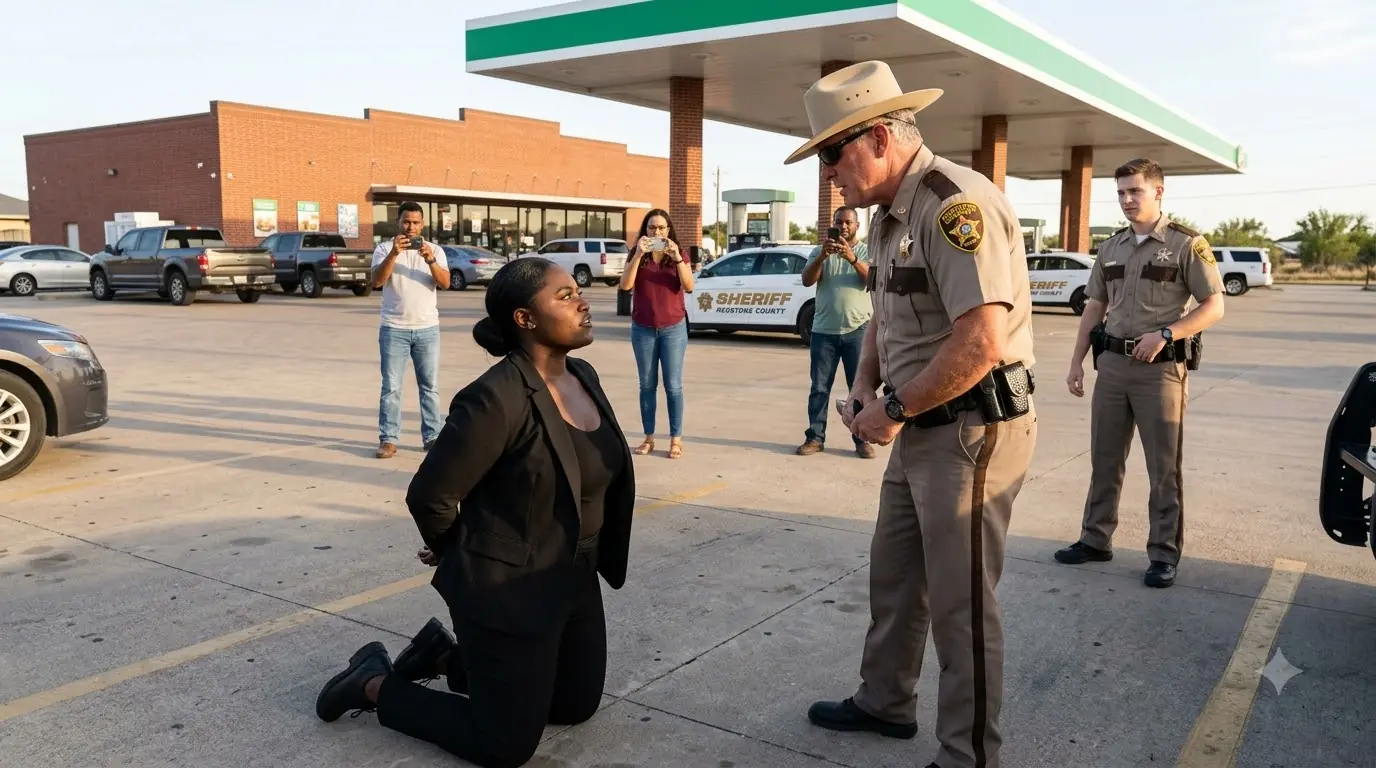
She did not argue.
She did not reach into her jacket.
She definitely did not tell him who she was.
Instead, the thirty-eight-year-old Black woman slowly raised both hands where Mercer could see them.
“Sheriff,” she said evenly, “you might want to reconsider what you’re doing.”
Mercer gave a short laugh.
Behind him, Deputy Ethan Cole shifted uncomfortably.
Twenty minutes earlier, Danielle had been sitting alone in a dark rental SUV across from Maria Alvarez’s roadside diner, drinking lukewarm coffee and watching traffic move through the center of Redstone County.
To everyone else, she looked like a traveler killing time.
She was not.
Danielle had driven from Dallas before sunrise for a reason known to fewer than half a dozen people.
Mercer was not supposed to know she was there.
Not yet.
The assignment had begun four months earlier with a spreadsheet.
That was how a surprising number of investigations began.
Not with sirens.
Not with dramatic arrests.
Not with secret meetings in underground parking garages.
With numbers.
Danielle had been sitting at a conference table inside the Dallas field office when analyst Nora Kim pushed a laptop toward her.
“You see it?”
Danielle studied the screen.
Traffic stops.
Vehicle seizures.
Administrative fees.
Cash-property reports.
Towing invoices.
Dismissed cases.
Complaints.
All from Redstone County.
At first, nothing looked extraordinary.
A rural Texas county with a major highway running through it naturally generated more roadside stops than a quiet suburban jurisdiction.
But Nora had sorted the records differently.
Instead of looking only at arrests, she had matched stops against what happened afterward.
Danielle leaned closer.
“You’re telling me almost thirty percent of these drivers were never charged?”
“Thirty-one point four.”
“And property was still held?”
“In some cases.”
“For how long?”
“Days. Weeks. Sometimes longer.”
Danielle scrolled.
Cash held pending verification.
Vehicles towed for administrative reasons.
Personal property inventoried.
Storage fees.
Release fees.
Processing charges.
Then she noticed another pattern.
“Same towing company.”
Nora nodded.
“Redstone Recovery and Storage.”
Danielle clicked company ownership.
A local businessman named Calvin Mercer.
She looked up.
“Related?”
“Sheriff’s cousin.”
Danielle leaned back.
That alone proved nothing.
Small counties were full of overlapping family connections.
The sheriff’s cousin owning a towing company was not automatically illegal.
But it was enough to keep reading.
Nora pulled up another tab.
Complaints.
“They come from everywhere,” Nora said.
“Dallas.”
“Houston.”
“San Antonio.”
“Louisiana.”
“Oklahoma.”
“Mostly travelers?”
“Mostly.”
Danielle read summaries.
Drivers claiming they had been stopped without clear reason.
Questions about cash.
Questions about destinations.
Pressure to consent to searches.
Threats of towing.
Property temporarily seized.
One man claimed $4,300 had been inventoried but only $3,700 returned.
Another woman reported her car had been held for six days despite no charges.
A college student wrote that Mercer personally told him, “People passing through here don’t tell me how my county works.”
Danielle stopped.
“Mercer personally?”
“Several complaints mention him.”
“Any sustained?”
“None.”
“Who reviewed them?”
Nora turned laptop.
Every complaint had been internally screened through the Redstone County Sheriff’s Office.
Most carried nearly identical resolution language.
Insufficient evidence.
Deputy acted within discretion.
Complainant credibility could not be established.
No policy violation identified.
Danielle stared.
“Same wording.”
“Almost.”
“Who signs them?”
Nora enlarged footer.
Sheriff Wade Mercer.
Danielle looked through the glass wall of conference room toward supervisory offices.
“So he investigates complaints against his own people.”
“And sometimes complaints against himself.”
“Convenient.”
Nora nodded.
“But none of this is enough yet.”
Danielle knew.
Bad optics were not federal crimes.
Rude stops were not automatically corruption.
Nepotism was not necessarily criminal.
Questionable procedure was not proof of conspiracy.
Investigations required evidence.
Specific acts.
Intent.
Records.
Witnesses.
Money trails.
That was why Danielle went to Redstone County.
Quietly.
No marked vehicle.
No advance coordination with Mercer.
No courtesy call.
No local task force.
The sheriff’s office itself might be part of the problem.
The Bureau had one cooperating witness already.
A former dispatcher named Lena Price.
She claimed Mercer maintained a second handwritten log of certain highway stops.
Stops that never entered the regular call system until after vehicle contact.
Lena said those stops were called “gray tags.”
Danielle had asked what that meant.
“I never knew officially,” Lena said during their first interview in Dallas.
“Unofficially?”
Lena hesitated.
“Cars worth searching.”
“How were they selected?”
“I don’t know.”
“Who used the term?”
“Mercer.”
“Anyone else?”
“Senior deputies.”
“What happened after a gray tag?”
“Sometimes nothing.”
“Sometimes tow.”
“Sometimes cash inventory.”
“Sometimes driver sat roadside for an hour while somebody decided what to do.”
“Did you ever alter records?”
Lena’s eyes filled with shame.
“Yes.”
Danielle waited.
“Sheriff told me to correct stop times.”
“Correct?”
“Change them.”
“Earlier or later?”
“Both.”
“Why?”
“He said CAD had glitches.”
“Did you believe that?”
“At first.”
“And later?”
Lena looked down.
“No.”
That was enough for preliminary inquiry.
Not enough for warrants.
Danielle needed more.
Someone inside Redstone County still working under Mercer.
That person became Ethan Cole.
Ethan was thirty-two.
Six years with department.
No serious complaints.
Good evaluations.
Quiet reputation.
His name appeared on several questionable stops, but usually as secondary deputy rather than initiator.
More interestingly, his body camera often stayed active longer than others.
On two cases where Mercer’s report summarized a clean interaction, Ethan’s footage showed arguments about property inventory that never appeared in official paperwork.
He had not reported Mercer.
But he had not turned his camera off either.
Danielle wondered whether that meant courage.
Or caution.
Sometimes they looked identical until someone had to choose.
Now, at the gas station, she was about to find out.
Mercer had first noticed Danielle’s rental SUV because she had been parked across from Maria’s diner for nearly twenty minutes.
At least that was what he claimed.
He pulled behind her without emergency lights.
Danielle saw marked cruiser in mirror.
She placed coffee in cup holder.
Waited.
Mercer approached driver window.
Tan uniform.
Campaign hat.
Dark sunglasses.
Broad shoulders.
Fifty-five.
Weathered face.
A man who carried himself like every square mile of Redstone County had been deeded personally to him.
Danielle lowered window.
“Morning.”
Mercer looked inside vehicle.
Laptop bag on rear seat.
Paper cup.
Rental agreement tucked near console.
Nothing unusual.
“License.”
Danielle looked up.
“Am I being stopped?”
Mercer’s jaw shifted.
“I asked for license.”
“And I asked if I’m being detained.”
That was first crack.
A small one.
Mercer leaned toward window.
“What are you doing parked here?”
“Drinking coffee.”
“For twenty minutes?”
“Approximately.”
“Watching the diner?”
“Looking in that direction.”
“Why?”
Danielle smiled faintly.
“It’s across street.”
Mercer did not.
“What brings you to Redstone?”
“Work.”
“What kind?”
“Consulting.”
“Where?”
Danielle paused.
She had cover story prepared.
But she wanted to understand his threshold.
“What law requires me to explain my client?”
Mercer straightened.
“You one of those?”
“One of what?”
“People who think every conversation with law enforcement is courtroom.”
Danielle kept voice calm.
“I asked whether I’m detained.”
Mercer looked toward her hands.
“Step out.”
“For what?”