The wooden gate creaked beneath Elias Mercer’s hand, but neither of them moved through it. Asha stood on the opposite side of the fence with the evening wind lifting strands of wet black hair across her face. Her confession still hung between them, more dangerous than any weapon either had carried. Elias had spent years believing silence could protect what remained of his life, but four simple words had opened every place inside him he had tried to close.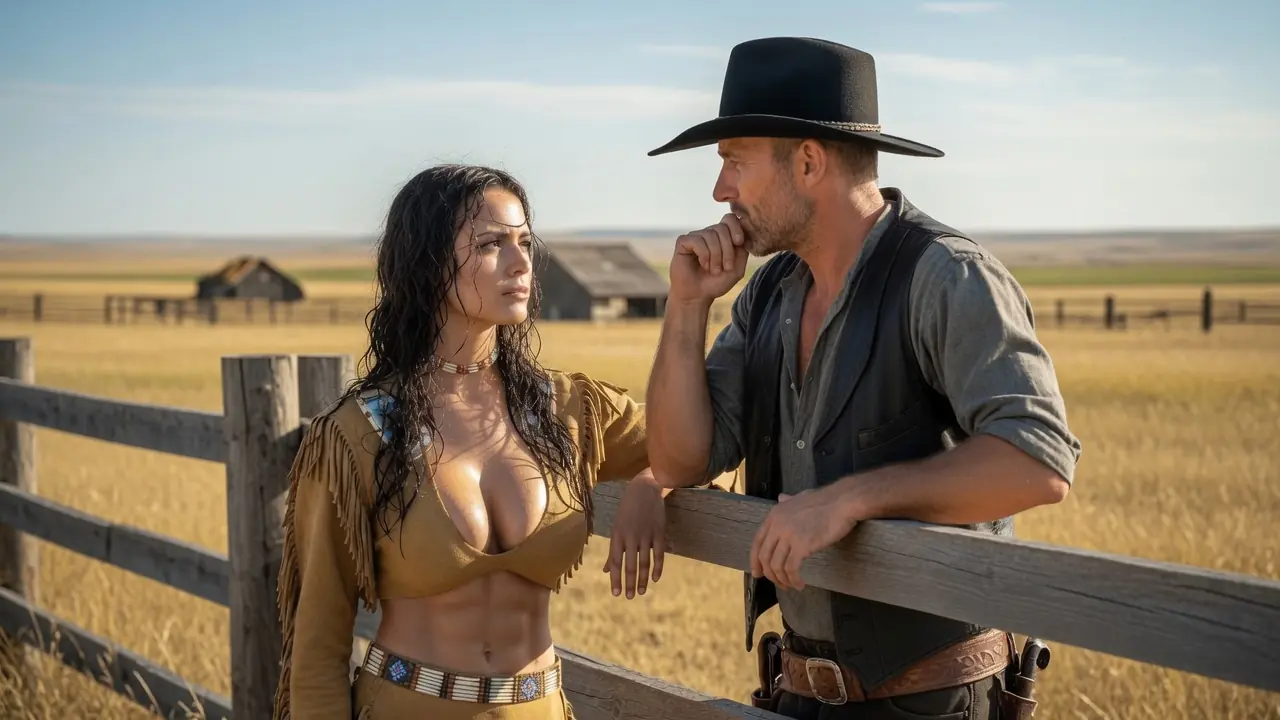
Asha was eighteen, old enough to choose her own path and young enough that the world still underestimated the weight she had already carried. Loss had entered her life early, taking her parents during a winter raid and scattering the surviving members of her extended family across the territory. She had spent more than a year alone near the foothills, moving between an abandoned shepherd’s cabin and hidden camps beside the creek. Isolation had kept her alive, but it had also taught her to distrust every approaching hoofbeat.
Elias was forty-two and looked older when exhaustion settled into his face. Years beneath the New Mexico sun had weathered his fair skin, and the dark stubble along his jaw never quite disappeared. He owned a small cattle ranch beyond Red Willow Creek, though “owned” sometimes felt generous for a place held together by patched fences, stubborn horses, and unpaid bills. His wife and infant son had died twelve years earlier, leaving behind two graves beneath a cottonwood tree and a man who stopped imagining another family.
Neither of them had been searching for love.
They met because Elias’s horse threw a shoe near the creek.
The animal stumbled on a rocky slope and fell hard enough to trap Elias’s leg beneath the saddle. He managed to free himself, but the impact twisted his knee and opened a deep cut along his forearm. His revolver landed several feet away in the mud. When Asha appeared between the trees, he was sitting against a boulder with blood darkening his sleeve and no weapon within reach.
She held a hunting bow but did not raise it.
Elias saw her and kept both hands visible. “Horse needs help before I do.”
Asha’s gaze moved toward the trembling mare. The horseshoe had twisted sideways, one nail driven painfully into the hoof. She approached the animal slowly, speaking in a low voice until the mare stopped fighting.
Elias expected her to take the horse and leave him.
Instead, she removed the damaged shoe.
She tore a strip from the hem of an old blanket, wrapped his arm, and fashioned a sling from a length of leather. She did not give him her name. When he asked where she lived, she disappeared into the trees without answering.
Elias reached his ranch after sunset.
The following morning, he returned to the creek carrying flour, coffee, dried meat, and a new knife. He placed them on a flat stone where Asha had treated his wound, then rode home without waiting.
The gifts were gone by the next day.
In their place sat a small bundle of medicinal leaves tied with blue thread.
That exchange continued for weeks.
Elias left salt, needles, lamp oil, and clean cloth. Asha responded with wild onions, herbs, fish, and once a beautifully repaired saddle strap he had assumed was beyond saving. Neither admitted they were creating a reason to return to the creek.
Their first real conversation happened during a thunderstorm.
Asha had taken shelter beneath a shallow rock overhang when Elias arrived searching for a missing calf. Rain flooded the trail behind him, trapping both of them near the creek until morning. He remained at the far end of the shelter, keeping his revolver inside its holster and his back against the stone.
“You do not have to watch me all night,” he said.
“I do not know that.”
“That’s fair.”
He placed his blanket halfway between them and moved back. Asha stared at it for several minutes before taking it. Elias sat in the cold without complaining.
Before dawn, she asked his name.
“Elias Mercer.”
“Asha.”
He repeated it carefully, making sure he had heard correctly.
She watched his face for mockery or surprise, but found neither.
The storm became the beginning of something neither could name. Asha occasionally appeared near the ranch when Elias repaired fences. She never entered the house at first. He never demanded that she come closer.
He placed food on the porch rail and continued working.
One afternoon, Elias returned from town to find the roof of his chicken coop repaired. Asha sat beneath the cottonwood tree sharpening the knife he had given her.
“You fix everything you see?” he asked.
“Only things worth fixing.”
He looked toward the worn farmhouse. “That may keep you busy.”
The corner of her mouth lifted.
It was the first time he saw her smile.
Trust grew through ordinary acts rather than promises. Elias showed her how to operate the ranch’s hand pump without damaging the seal. Asha taught him to identify tracks near the northern pasture and warned him when a mountain lion began following the calves.
She helped him locate a hidden spring after the lower well turned muddy. He repaired the collapsed chimney of her cabin without asking her to move into his home.
Each understood the other’s boundaries.
That respect mattered more than affection at first.
Elias never reached for Asha unexpectedly. He announced himself when entering the woods near her cabin. He did not ask questions when distant riders made her disappear for several days.
Asha noticed that he never spoke of Apache people as though they were one faceless enemy. He judged individuals by what they did, though he carried the ignorance of a man raised among settlers who rarely questioned their own version of history.
She corrected him when necessary.
He listened.
One evening, Elias called the surrounding land empty.
Asha turned toward him sharply. “Empty because you do not know the names?”
The question embarrassed him.
He looked across the grassland he had considered wild and unclaimed. “No,” he admitted. “Not empty.”
After that, he asked before speaking with certainty.
Their fragile peace might have remained hidden if not for Silas Crowe.
Silas owned the largest ranch near the town of Dry Creek and controlled most of the local cattle contracts. He wanted Elias’s land because Red Willow Creek crossed its eastern edge, providing water during dry seasons. Elias had rejected every offer.
When Silas learned an Apache woman had been seen near the Mercer ranch, he discovered another weapon.
He arrived with two ranch hands while Asha was helping Elias repair the corral. The men stopped outside the gate and stared at her as if she were an animal they had found inside a house.
Silas removed his hat but offered no greeting.
“You collecting strays now, Mercer?”
Elias placed himself between Asha and the visitors. “State your business.”
“My business is protecting neighboring ranches.”
“From a woman holding a fence hammer?”
Silas smiled. “Today it’s a hammer.”
Asha’s grip tightened around the wooden handle, but she did not step back.
Silas claimed cattle had disappeared from the northern range and suggested Asha knew something about it. Elias asked for evidence. Silas answered that people like her did not need to be caught before becoming dangerous.
Elias walked to the gate.
“You will not speak about her that way on my land.”
“You willing to lose the ranch over a girl you barely know?”
“I know enough.”
Silas studied him, then looked toward Asha. “Town won’t forget this.”
Elias opened the gate only far enough to point toward the road. “Town can discuss it while you’re leaving.”
Silas rode away, but the threat remained.
Within days, merchants in Dry Creek stopped extending Elias credit. The blacksmith doubled his price. A buyer refused three of Elias’s cattle after Silas claimed the herd might contain stolen stock.
The pressure was meant to force him to choose.
Asha understood before Elias admitted it.
She stopped coming to the ranch.
For nearly a week, Elias found no tracks near the creek and no bundles on the flat stone. The farmhouse became quieter than it had been before he met her because now he understood exactly what was missing.
He finally rode to her cabin.
Asha stood in the doorway with her bow lowered but ready.
“You should not be here,” she said.
“Neither should loneliness, but it keeps finding me.”
“You are losing business.”
“I have lost business before.”
“They may take your land.”
“They wanted it before you came.”
“My presence gives them a reason.”
“No. Their greed gives them a reason. Their hatred gives them permission.”
She looked away. “You cannot fight the whole territory.”
“I am not asking the whole territory to live with me.”
Asha faced him again.
It was the first time Elias had spoken as though there might be a future containing both of them. The possibility frightened her more than the threats. She could survive abandonment because she expected it.
Hope required trust.
“You do not know what life with me will cost,” she said.
“I know what life without you already costs.”
He left without asking for an answer.
Two days later, Asha returned to the ranch carrying the blue-thread bundle from their first exchange. She placed it beside the farmhouse door and began helping him repair the northern fence.
Nothing was settled.
Yet she had chosen to return.
Silas escalated the conflict during the cattle auction. Elias drove sixteen steers into town, hoping the sale would cover winter feed and the final payment on his land. Silas spoke privately with the auction manager before bidding began.
The manager rejected the herd, claiming ownership marks appeared altered.
Elias demanded an inspection.
Deputy Warren Pike arrived with three armed men. He examined the brands for less than a minute and announced that several belonged to Silas Crowe. The accusation carried a prison sentence and immediate confiscation of the cattle.
Elias knew the brands were false.
Someone had entered the pasture during the night and burned Crowe’s mark over his own.
Silas expected Elias to become violent.
Instead, Elias asked that the cattle be held until a territorial livestock inspector arrived. Warren laughed and ordered him to leave town before they found another charge.
Asha watched from behind the livery stable.
She had followed Elias because she did not trust Silas’s sudden silence. Before dawn, she had seen two of Silas’s men leave the Mercer pasture carrying branding irons. She tracked them to an abandoned shed and found the tools hidden beneath a grain sack.
Asha carried one of those irons into the auction yard.
“This made the new marks,” she said.
Every man turned toward her.
Silas’s face changed.
The iron still carried fragments of burned hair and leather from the night before. More importantly, its handle bore the carved initials of Silas’s foreman.
Silas accused her of stealing it.
Asha looked toward the territorial inspector, who had entered town unexpectedly after receiving a message from Elias’s former employer. “If I stole it yesterday, how did it mark cattle last night?”
The inspector ordered the brands examined properly.
Beneath the fresh burns, Elias’s legitimate mark remained visible.
Silas’s scheme collapsed publicly, but not completely. Powerful men rarely lost influence after a single failure. He was fined for interfering with livestock ownership, while his foreman accepted responsibility and claimed Silas knew nothing.
Everyone understood the lie.
No one could yet prove it.
The incident changed how some townspeople viewed Asha. A few respected her courage. Others resented that she had embarrassed a white rancher before the entire auction.
Elias sold the cattle.
He paid the land note and purchased enough feed for winter.
That evening, he found Asha beside the graves beneath the cottonwood tree. She had seen them before but never asked.
“My wife,” Elias said. “And our son.”
Asha lowered her head.
“Fever took them both,” he continued. “I was gone buying medicine when she died.”
“You blame yourself.”
“I had twelve years to practice.”
Asha touched the weathered wooden marker above the smaller grave. “Grief tells us we should have been stronger than death.”
Elias looked at her. “Who taught you that?”
“No one. I learned it badly.”
They sat together until the stars appeared.
Asha spoke about her family for the first time. Her father had been patient and quiet. Her mother sang while preparing food. Her younger brother followed her everywhere, complaining when she walked too fast.
After they died, Asha survived by becoming invisible.
She hid from soldiers, thieves, and men who considered a lone young woman something to claim. She learned to sleep lightly and trust nothing offered without a price.
Elias did not promise that she would always be safe with him.
Such a promise would have been dishonest.
He only said, “You will always be free to leave.”
Asha looked toward the dark farmhouse. “And free to stay?”
“Yes.”
Winter arrived early.
The first snow trapped Asha at the ranch for nine days. She slept in the small guest room near the kitchen, while Elias remained in his room at the opposite end of the house.
He never crossed her doorway without permission.
Together, they fed cattle, repaired frozen water lines, and cooked over the stove when wind blocked the chimney. The house slowly changed around them.
Asha hung dried herbs near the pantry.
Elias built shelves for her belongings without calling the room hers.
She placed the blue-thread bundle beside the window.
By spring, people no longer asked whether Asha lived at the ranch. They only watched to see whether Elias would admit what everyone understood.
Neither rushed.
Affection grew inside shared labor and familiar silence. Elias began leaving an extra cup beside the coffee pot every morning. Asha repaired his shirts and scolded him when he reopened old injuries by lifting too much.
He taught her to read portions of the territorial newspaper. She taught him words from her language, correcting his pronunciation until both of them laughed.
The age between them remained real.
Elias feared that loving her might become another form of taking. He had a home, legal ownership, and the protection of a society that treated him differently. Asha possessed fewer choices, and he refused to confuse her need for shelter with consent.
One evening, she confronted him beside the fence.
“You think I do not know my own heart.”
“I think you deserve more choices than this ranch.”
“I have walked beyond your land.”
“You are eighteen.”
“I was old enough for the world to leave me alone.”
“That does not mean you should have had to become older so quickly.”
Asha stepped closer. “Do not turn respect into another wall.”
The words stayed with him.
Weeks later, after rain darkened the prairie and the distant barn shone beneath the setting sun, Asha found Elias leaning against the fence. His hat hid part of his face, but she knew his silences now.
She placed one hand on the top rail.
“I love you.”
Elias’s breath caught.
He warned her about the territory, the town, and the danger of choosing him. Asha answered that she had survived loss and would not surrender love simply because frightened people might punish it.
Elias opened the gate.
“Ride with me at dawn,” he said. “We’ll build a life no one can take.”
Asha looked through the opening but did not move immediately.
“Where?”
“To Santa Fe. There is a minister there who owes me a kindness.”
“You want marriage?”
“I want whatever promise you choose freely.”
She touched the gate, considering not only Elias but the world waiting beyond the ranch. Marriage would not erase hatred or guarantee protection. It might create new dangers.
Yet refusing love would not make those dangers disappear.
“I will ride with you,” she said. “But we return here.”
“This is your home if you still choose it.”
“Our home,” she corrected.
They left before sunrise.
Silas heard about their journey and sent two men after them. The riders caught up near a narrow canyon, blocking the trail while another appeared behind.
Elias reached toward his revolver.
Asha stopped him.
She recognized one of the men as the foreman who had taken blame for the false brands. He had lost his position after Silas refused to pay him.
“Crowe sent you?” she asked.
The foreman looked ashamed. “He wants Mercer gone before the marriage.”
“What did he promise?”
“Money.”
“He promised you protection before the auction too.”
The man’s expression hardened.
Asha continued. “You took his blame. He kept his ranch and left you with nothing.”
The foreman looked toward his companion. Silas had used them again, expecting violence to remove the people standing between him and Red Willow Creek.
Elias lowered his hand from the revolver.
“You can ride back and remain his weapon,” he said, “or tell the territorial marshal why he ordered this.”
The men moved aside.
Their testimony later exposed Silas’s involvement in the brand forgery, intimidation, and attempted ambush. Silas lost his cattle contracts and much of his political influence.
He did not disappear.
Men like him rarely vanished completely.
But he could no longer threaten the Mercer ranch without drawing attention from officials who had finally begun watching.
Asha and Elias married quietly in Santa Fe.
There were no wealthy guests, orchestra, or grand celebration. A shopkeeper and his wife served as witnesses, while the minister spoke beneath the shade of a courtyard tree.
Elias gave Asha a simple silver ring.
She gave him a narrow beaded band she had made during the winter.
When they returned to Red Willow Creek, Elias placed both names on a new wooden sign near the gate:
MERCER—ASHA RANCH
Asha studied it.
“My name is not Mercer.”
Elias frowned. “I thought—”
She smiled slightly. “I will share your life. I do not need to lose my name.”
The next morning, the sign changed.
ELIAS AND ASHA — RED WILLOW RANCH
That version remained.
Their life was not easy. Some merchants refused them. Strangers stared in town, and threats occasionally appeared on the fence.
Asha never became merely the cowboy’s wife.
She managed the horses, traded herbs and leatherwork, and developed a reputation for recognizing illness in cattle before experienced ranchers noticed symptoms. Elias asked her judgment before making decisions, not as a gesture, but because the ranch became stronger when both of them led it.
Years later, travelers passing Red Willow Creek sometimes saw a mature cowboy repairing fence while a dark-haired Apache woman worked beside him. Some repeated romantic stories about how Elias rescued her from loneliness.
Those stories missed the truth.
Elias had not rescued Asha.
She saved his horse, treated his wounds, defended his ranch, and forced him to reconsider everything he believed about land, trust, and love. He gave her shelter without demanding ownership.
She gave him hope without promising to erase his grief.
Together, they built something neither could have created alone.
On the tenth anniversary of their first meeting, Asha returned to the creek and placed a small bundle on the flat stone. It contained coffee, blue thread, and a new horseshoe.
Elias approached from behind but stopped at a respectful distance, just as he had in the beginning.
“What is that for?” he asked.
“To remember.”
“The horse was the one with the bad shoe.”
“You were more difficult to repair.”
He laughed and joined her beside the water.
Asha rested her head against his shoulder. The territory beyond the creek remained imperfect, dangerous, and slow to change. Yet the ranch behind them held a life built from deliberate choices.
Their love had not arrived as a grand rescue.
It began with a wounded man who kept his hands visible, a guarded woman who chose kindness without surrendering caution, and two people patient enough to let trust grow before asking it to carry hope.
When Asha said, “I love you,” Elias did not answer by claiming her.
He opened the gate.
She walked through because the choice remained hers.